US durable goods orders dropped -17.2%, ex-transport orders dropped -7.4%

    US durable goods orders dropped -17.2% to USD 170.0B in April, better than expectation of -18.1%. That’s still the second month of sharp decline, following -16.6% in March. Ex-transport orders dropped -7.4%. Ex-defense orders dropped -16.2%.

    Full release here.

    JPY and CHF lower as stocks rebound in premarket, EUR/CHF and GBP/CHF surge

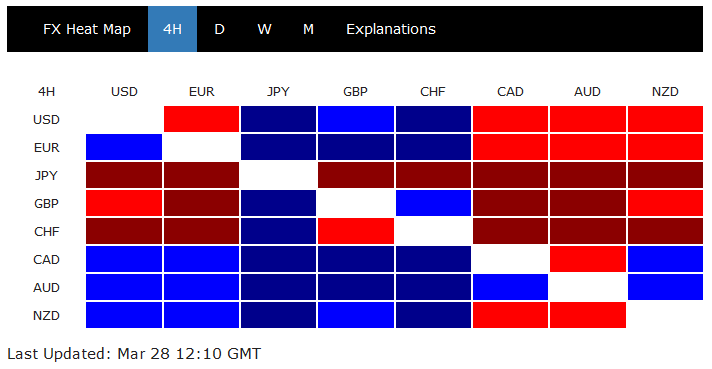
      US stocks futures reverse earlier loss and point to a higher open. The move was triggered by news that Facebook is going to streamline privacy settings. Facebook shares trade more than 1% higher in premarket. The development triggers intensified selling in JPY and CHF. Both are in deep red in 4H heatmap.

      But for now, EUR/JPY is held well below 132.40 resistance, GBP/JPY below 150.92, and USD/JPY below 106.63. There is confirmation of bullish trend reversal in these pairs yet.

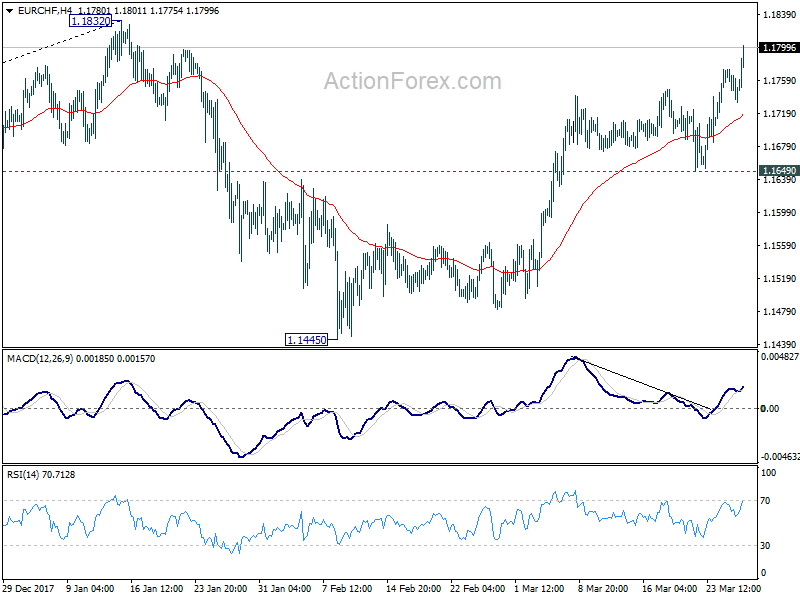
      On the other hand, developments in CHF crosses look more promising. EUR/CHF is on track for a test on 1.1832 resistance.

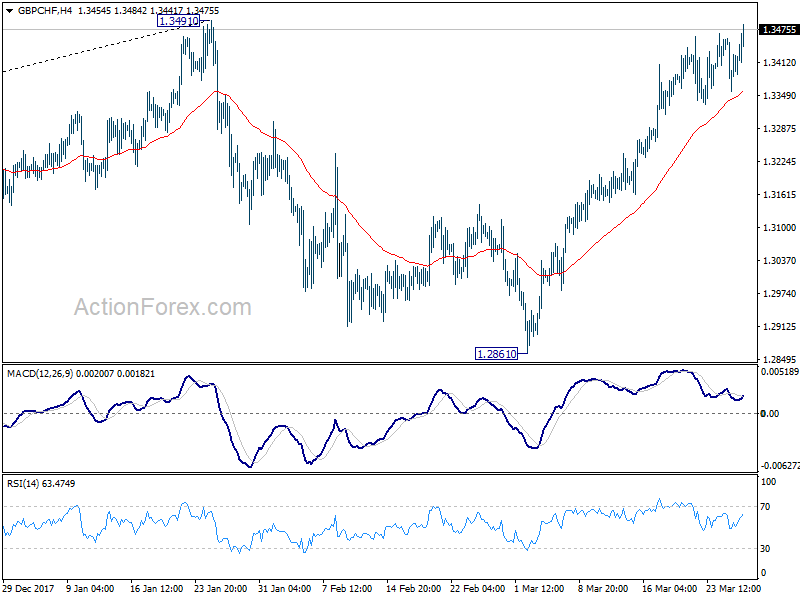
      GBP/CHF is even close to equivalent resistance at 1.3491.

      Based on current momentum, 1.1832 in EUR/CHF and 1.3491 in GBP/CHF could be taken out without much problem.

      Fed’s Kugler: Anchoring inflation expectations must remain top priority

        Fed Governor Adriana Kugler emphasized the importance of keeping inflation expectations well anchored in comments delivered to a Harvard economics class.

        She reaffirmed the Fed’s commitment to the 2% inflation target and stressed “It should be a priority to make sure that inflation doesn’t move up”.

        Kugler also noted that economic activity in the first quarter may have been stronger than previously anticipated, driven by consumer front-loading ahead of expected tariff hikes.

        While the full extent of tariff-related cost pass-through is yet to be seen, she acknowledged the financial strain such developments could place on households. That, she argued, is “exactly why we think we need to keep focus on that.”


        EU Dombrovskis: All member economies are set to growth this year and next

          European Commission is scheduled to announce new economic forecasts tomorrow. Ahead of that Vice-President Valdis Dombrovskis said “all EU economies are set to grow this year and next,” citing the forecast results.

          However, he also warned that “we see risks, especially external risks, on the rise”. And resilience of EU economies could be tested if the risks materialized.

          He also emphasized “it’s high time to do reform while keeping public finances sound.”

          ECB’s Kazimir anticipates single additional rate cut in 2024

            ECB Governing Council member Peter Kazimir suggested today that “we could expect one more interest-rate cut this year.” He underscored his continued concern over the “significant risk of rising inflation,” driven primarily by wage growth.

            Kazimir reiterated his opposition to an interest-rate adjustment at upcoming July meeting. Instead, he advocated for policymakers to wait until the next round of quarterly economic projections before making any decisions.

            “It’s appropriate to wait for the September forecast,” Kazimir stated. “Those are the right moments to make the correct decisions.”

            Johnson and Hunt in Conservative leadership final, EUR/GBP steady

              Former Foreign Minister Boris Johnson and current Foreign Minister Jeremy Hunt entered the final race for UK Conservative leadership after Thursday votes. Johnson (with 160 votes) and Hunt (with 77 votes) knocked out Environment Minister Michael Gove (75 votes). The pair will now battle for supports from 160k Conservative members around UK. Results of postal votes are expected to be announced in the week of July 22.

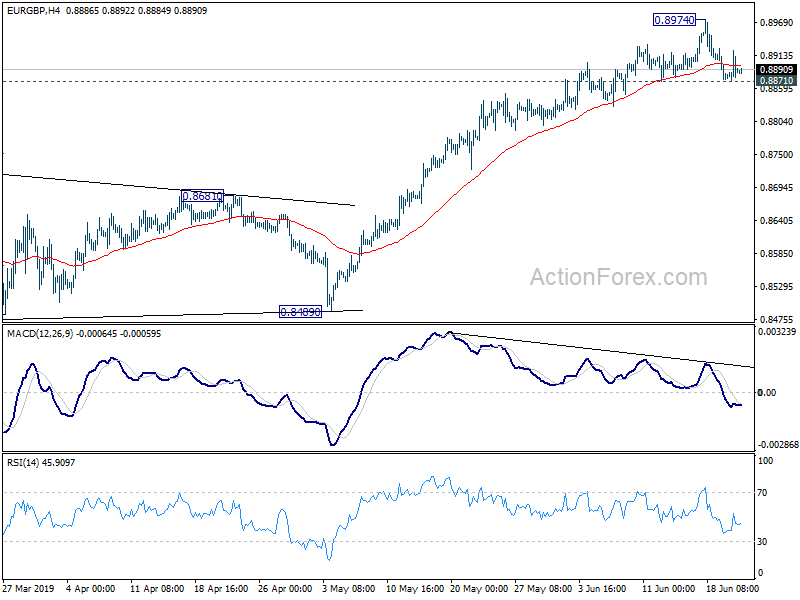
              EUR/GBP pulled back sharply after ECB President Mario Draghi hinted on more monetary policy easing ahead. But there was no follow through selling since then Sterling’s upside is apparent capped by uncertain over who’s the next UK Prime Minister would be, and Brexit risks. 0.8871 minor support is a level to watch for the near term. Further rise is expected as long as 0.8871 holds, for 0.9101 key resistance. But break of 0.8871 will confirm short term topping and bring deeper pull back.

              ECB sets faster APP purchase wind-down schedule

                ECB left interest rate unchanged as widely expected. Main refinancing, marginal lending facility and deposit rate are held at 0.00%, 0.25%, and -0.50% respectively. ECB added that “Any adjustments to the key ECB interest rates will take place some time after the end of the Governing Council’s net purchases under the APP and will be gradual.”

                The pandemic emergency purchase program (PEPP) will stop net purchases as planned at the end of March. The purchase schedule for the regular asset purchase program (APP) is revised, with monthly net purchase at EUR 40B in April, EUR 30B in May and EUR 20B in June.

                ECB added that the calibration for APP net purchases in Q3 will be ” data-dependent and reflect its evolving assessment of the outlook”. If medium term inflation outlook “will not weaken after the end of the net purchases, ECB will conclude net APP purchases in Q3. Also, ECB leaves it open to revise the schedule, size and duration of the purchases.

                Full statement here.

                NIESR expects UK economy to return to growth, but unsure for how long

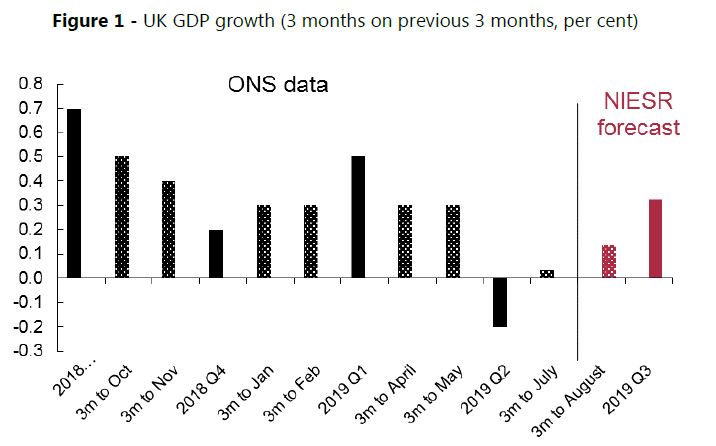
                  The NIESR said in a report that UK economy is on course to grow 0.3% in Q3, rebounding from Q2’s -0.2% contraction. NIESR said it’s a “welcome resumption of economic growth”. However, it also warned that “it is not clear how long growth will continue.”.

                  NIESR added, “Only the services sector is expanding, primarily to meet higher demand from consumers driven by increased household incomes fuelled by rising real wages. But there is a limit to how much further real wages can grow without a pick-up in investment and productivity, and this seems unlikely in the near term.”

                  Full report here.

                  NFP: Where’s the balance between job growth and wage inflation?

                    The imminent NFP report poses a potential quandary for both Fed and market participants. On one hand, steady job growth aligns with Fed’s intention to engineer a soft landing for the US economy. On the other, elevated wages growth due to tight labor market could compel Fed to maintain its tightening course, potentially complicating the soft landing strategy.

                    Expectations are set for a 200k job increase in July, while unemployment rate is predicted to hold steady at 3.6%. Average hourly earnings are projected to climb 0.3% month-on-month.

                    Based on recent developments, economists are gradually warming to the idea that Fed might achieve its “soft-landing” scenario for the economy. Consistent job growth around the 200,000 region per month would provide further support for this possibility.

                    However, uncertainties loom regarding wage growth. With an expected 0.3% mom growth, the annual rate could comfortably remain above 4% yoy – a figure significantly higher than the levels consistent with Fed’s 2% inflation target. A strong report will certainly spark debates in the market about whether Fed will need to tighten its monetary policy further toward a peak of 6%, up from the current 5.25-5.50%.

                    Relevant employment data presents a mixed bag. ISM Services Employment index was at 50.7 in July, down -2.4 points from 53.1 in June. Meanwhile, ISM Manufacturing Employment was lower at 44.4, marking a decline of -3.7 points from 48.1 in June. In contrast, ADP reported private payrolls at 324k against forecast of 195k and prior month’s stronger 455k.


                    Fed left federal funds rate unchanged at 1.75-2.00%, full statement.

                      No surprise from Fed. Below is the full statement.

                      Federal Reserve issues FOMC statement

                      Information received since the Federal Open Market Committee met in June indicates that the labor market has continued to strengthen and that economic activity has been rising at a strong rate. Job gains have been strong, on average, in recent months, and the unemployment rate has stayed low. Household spending and business fixed investment have grown strongly. On a 12-month basis, both overall inflation and inflation for items other than food and energy remain near 2 percent. Indicators of longer-term inflation expectations are little changed, on balance.

                      Consistent with its statutory mandate, the Committee seeks to foster maximum employment and price stability. The Committee expects that further gradual increases in the target range for the federal funds rate will be consistent with sustained expansion of economic activity, strong labor market conditions, and inflation near the Committee’s symmetric 2 percent objective over the medium term. Risks to the economic outlook appear roughly balanced.

                      In view of realized and expected labor market conditions and inflation, the Committee decided to maintain the target range for the federal funds rate at 1-3/4 to 2 percent. The stance of monetary policy remains accommodative, thereby supporting strong labor market conditions and a sustained return to 2 percent inflation.

                      In determining the timing and size of future adjustments to the target range for the federal funds rate, the Committee will assess realized and expected economic conditions relative to its maximum employment objective and its symmetric 2 percent inflation objective. This assessment will take into account a wide range of information, including measures of labor market conditions, indicators of inflation pressures and inflation expectations, and readings on financial and international developments.

                      Voting for the FOMC monetary policy action were: Jerome H. Powell, Chairman; John C. Williams, Vice Chairman; Thomas I. Barkin; Raphael W. Bostic; Lael Brainard; Esther L. George; Loretta J. Mester; and Randal K. Quarles.


                      ECB’s Nagel: June cut plausible, not on autopilot afterwards

                        In a newspaper interview, ECB Governing Council member Joachim Nagel expressed optimism about the current economic outlook, noting that “wage growth is expected to moderate as inflation continues to recede.” He highlighted that recent developments are “heading in the right direction.”

                        Nagel suggested that a first rate reduction in three weeks is “plausible,” provided that incoming data and new projections align with policymakers’ expectations. However, he cautioned against rushing into additional monetary easing, emphasizing, “We should not cut rates hastily and jeopardize what we have achieved.”

                        He also underscored the high level of uncertainty, stating, “Even if rates are lowered for the first time in June, that does not mean we will cut rates further” in subsequent meetings. Nagel stressed that ECB’s approach is not automatic, saying, “We are not on auto-pilot.”

                        Dollar reverses gains as Trump blames manufacturing weakness on Fed

                          Dollar reverses earlier gains after poor ISM manufacturing data. Additionally, it’s weighed down by US President Donald Trump’s attack on Fed. He criticized again that Fed and its chair Jerome Powell “have allowed the Dollar to get so strong, especially relative to ALL other currencies”. And, “our manufacturers are being negatively affected.” Also, “they are their own worst enemies, they don’t have a clue. Pathetic!”

                          Twitter

                          By loading the tweet, you agree to Twitter’s privacy policy.
                          Learn more

                          Load tweet

                          Australia sees second consecutive quarter of falling retail sales volume amidst rising living costs

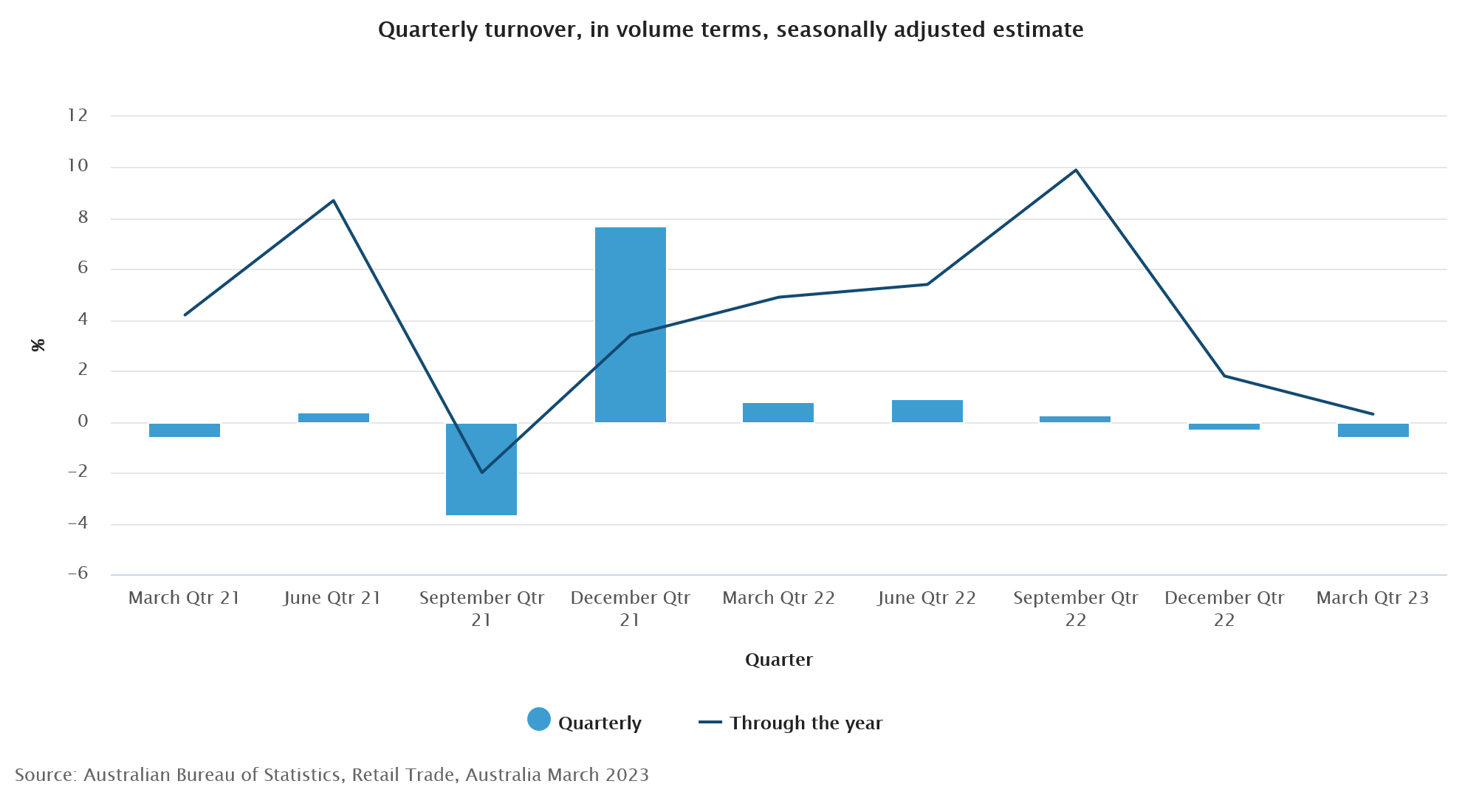
                            Australia’s retail sales volume declined by -0.6% qoq to AUD 96.17 billion in Q1 2023. Through the year, sales volume only managed to register a modest 0.3% yoy growth in the quarter.

                            ABS’s head of retail statistics, Ben Dorber, noted that this marked the second consecutive quarter of falling retail sales volumes, primarily influenced by mounting cost of living pressures that continue to burden household spending.

                            “Outside of the COVID-19 pandemic period, this is the largest fall in retail sales volumes since the September quarter of 2009,” Dorber stated, underlining the gravity of the situation.

                            Meanwhile, retail prices growth has slowed to 0.6% qoq in Q1. “Retail prices rose for the sixth straight quarter, but price growth this quarter is the smallest since September 2021,” Dorber added.

                            He attributed the slowdown in price growth mainly to discounts on clothing and larger household items such as furniture and electronic goods. However, he noted that food retailing prices continued their upward trajectory.

                            Full Australia retail sales release here.

                            BoE Bailey: We’re beginning to see this recovery

                              BoE Governor Andrew Bailey said the policymakers are seeing “activity return” and “we are beginning to see this recovery”. In particular, housing markets and new car sales are returning “quite strongly” but not in hospitality and entertainment. The return to normal is still a “very big question”. Also, he doesn’t yet know the “full story” of the long term economic damage of the coronavirus pandemic.

                              “Financial markets indicate interest rates will stay very low,” he added. “People can see that we are committed to keeping markets stable via quantitative easing… There is a legitimate question about what we do with QE when things get back to normal.”

                              BoJ’s Ueda meets PM Ishiba, stresses stable FX and policy vigilance

                                BoJ Governor Kazuo Ueda said he discussed economic and market conditions, including foreign exchange moves, in a meeting with Prime Minister Shigeru Ishiba today. Ueda told reporters afterward that “it’s desirable for currency rates to move stably, reflecting fundamentals,” but declined to elaborate further on the details of the exchange.

                                On policy, Ueda reaffirmed that the BOJ remains prepared to raise interest rates further if the economy and prices evolve in line with projections. He emphasized that the central bank will “scrutinize without any pre-conception” whether those projections materialize.

                                France PMI manufacturing finalized at 55.9 in Nov, tentative signs of stabilization

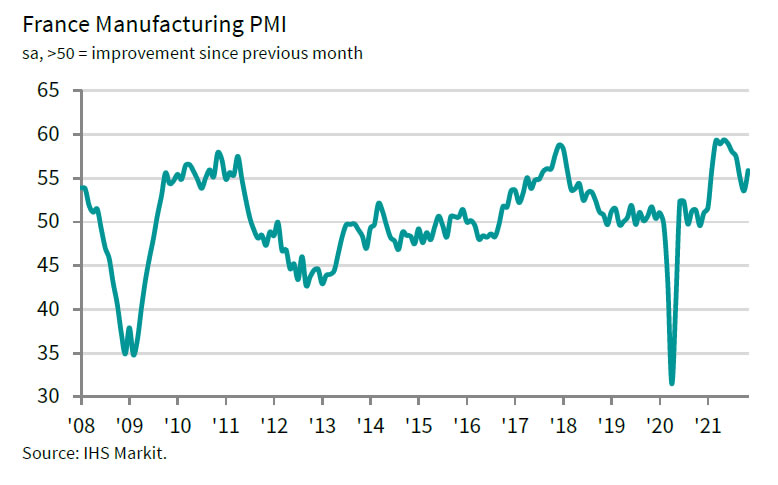
                                  France PMI Manufacturing was finalized at 55.9 in November, up from October’s 53.6. That’s the first increase since May. Markit noted that output volumes were broadly unchanged during the month. Demand improved, but remained subdued amid supply-related constraints. Output price inflation reached new high.

                                  Joe Hayes, Senior Economist at IHS Markit, said: “Tentative signs of stabilisation were seen in the French Manufacturing PMI during November, with the growth slowdown seen since post-pandemic growth peaked back in May finally coming to a halt. The headline PMI posted its first increase for six months as trends improved in output, new orders and employment.

                                  “That said, beyond this positive direction change, the latest data continued to show intense supply-related constraints impeding manufacturing production, denting order book volumes and adding further pressure on margins. As a result, output prices were raised to the greatest extent since this data were first published back in 2002. While demand conditions have slowed, anecdotal evidence has thus far suggested this to be a symptom on component shortages, causing firms to postpone and cancel orders until supplies improve. We’re not seeing much evidence that higher prices are a factor in causing demand to soften, which means elevated rates of inflation may not prove so transitory as many anticipate.”

                                  Full release here.

                                  Germany PMI composite hits 2 month high, clear divergence between manufacturing and services

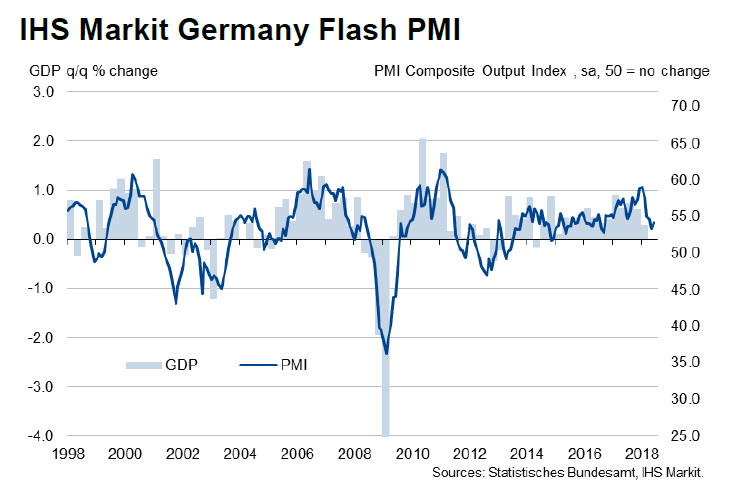
                                    Germany PMI manufacturing dropped to 55.9 in June, down from 56.9 and missed expectation of 56.3. PMI services rose to 53.9, up from 52.1 and beat expectation of 52.2. PMI composite rose to 54.2, up from 53.4, and hit a 2-month high.

                                    Commenting on the flash PMI data, Phil Smith, Principal Economist at IHS Markit said:

                                    “The headline PMI numbers for Germany make for slightly better reading in June thanks to a pick-up in the pace of expansion in the service sector, though the performance over the second quarter as a whole still looks to be one of only modest growth.

                                    “The big disappoint was manufacturing, where the PMI fell further from last December’s record high to the lowest in one-and-a-half years. A worrying slide in export order growth seen since the start of the year continued into June, with the latest survey’s anecdotal evidence highlighting quieter client interest from the US and China.

                                    “A clear divergence between manufacturing and services was also seen in the survey’s gauge of business confidence. Services firms are in buoyant mood towards the outlook over the next 12 months, but manufacturers see growth continuing to cool and are their least optimistic for over three years.”

                                    Full release here.

                                    Japan downgrades fiscal 2024 growth forecast amid consumption struggles

                                      Japan’s government has downgraded its growth forecast for the current fiscal year 2024 from 1.3% to 0.9%.

                                      This adjustment comes as inflation continues to impact private consumption, which accounts for over half of the economy. Private consumption growth is now expected to be just 0.5%, a significant drop from the January forecast of 1.2%.

                                      Various one-off factors, including safety test scandals in the auto industry, have also contributed to this downgrade.

                                      However, the economy is expected to rebound in fiscal 2025 with a growth rate of 1.2%.

                                      Consumer prices are now forecast to rise by 2.8% in fiscal 2024, an increase from the earlier expectation of 2.5%.

                                      The government has also adjusted its assumption for Yen, now expecting it to remain around 158.8 per Dollar for the current fiscal year, weaker than the previous estimate of 149.8 Yen.

                                      Germany economy ministry cut 2022 GDP growth forecast sharply to 2.2%

                                        Germany’s economy ministry cuts 2022 GDP growth forecast to 2.2%, down from January’s projection of 3.6%. Nevertheless, 2023 GDP growth forecast is upgraded slightly from 2.3% to 2.5%. It expects Russia’s invasion of Ukraine, resulted sanctions and higher energy prices will weigh on output.

                                        Inflation is forecast to be at 6.1% in 2022 and 2.8% in 2023, on rising energy prices and consumer prices.

                                        Eurozone unemployment rate dropped to record low, CPI slowed to 1.2%

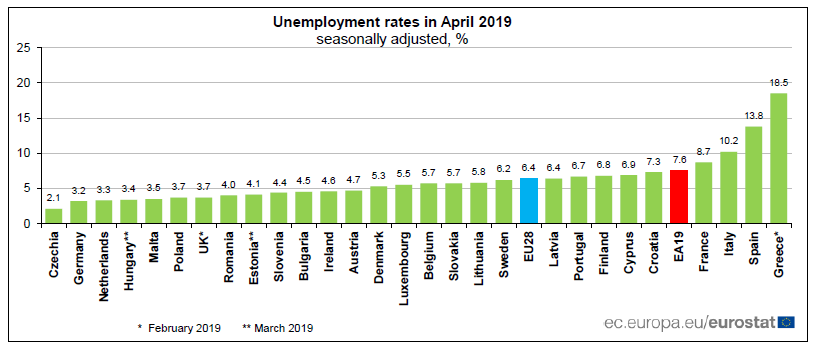
                                          Eurozone Unemployment rate dropped to 7.6% in April, down from 7.7% and beat expectation of 7.7%. That’s also the lowest rate recorded since August 2008. EU 28 unemployment rate was unchanged at 6.4% in April.

                                          Among the Member States, the lowest unemployment rates in April 2019 were recorded in Czechia (2.1%), Germany (3.2%) and the Netherlands (3.3%). The highest unemployment rates were observed in Greece (18.5% in February 2019), Spain (13.8%) and Italy (10.2%).

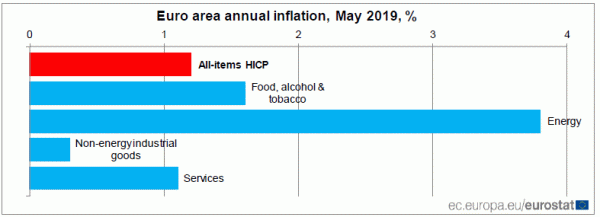
                                          Eurozone CPI slowed to 1.2% yoy in May, down from 1.7% yoy and missed expectation of 0.9% yoy. Core CPI dropped to 0.8% yoy, down from 1.3% yoy and missed expectation of 0.9% yoy. Looking at the components, energy is expected to have the highest annual rate in May (3.8%, compared with 5.3% in April), followed by food, alcohol & tobacco (1.6%, compared with 1.5% in April), services (1.1%, compared with 1.9% in April) and non-energy industrial goods (0.3%, compared with 0.2% in April).