

Sample Category Title
AUD/USD Daily Report
Daily Pivots: (S1) 0.6521; (P) 0.6539; (R1) 0.6575; More...
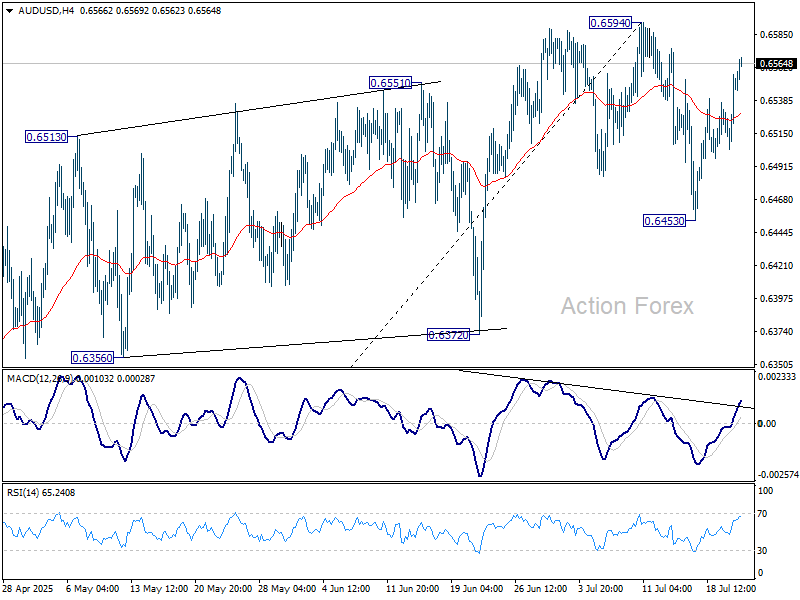
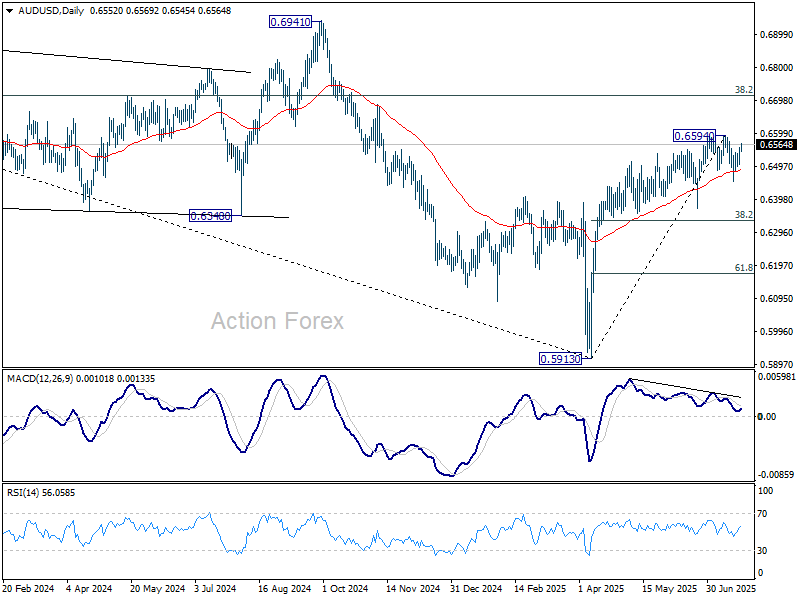
AUD/USD's rebound continues today but stays below 0.6594 resistance. Intraday bias remains neutral at this point. On the downside, break of 0.6453 will extend the correction from 0.6594 to 38.2% retracement of 0.5913 to 0.6594 at 0.6334. Nevertheless, firm break of 0.6593 will resume the rally from 0.5913 and target 0.6713 fibonacci level.
In the bigger picture, there is no clear sign that down trend from 0.8006 (2021 high) has completed. Rebound from 0.5913 is seen as a corrective move. While stronger rally cannot be ruled out, outlook will remain bearish as long as 38.2% retracement of 0.8006 to 0.5913 at 0.6713 holds. Nevertheless, considering bullish convergence condition in W MACD, even in case of another fall through 0.5913, downside should be contained above 0.5506 (2020 low).
Elliott Wave View: Nasdaq Futures (NQ_F) Poised To Extend Higher
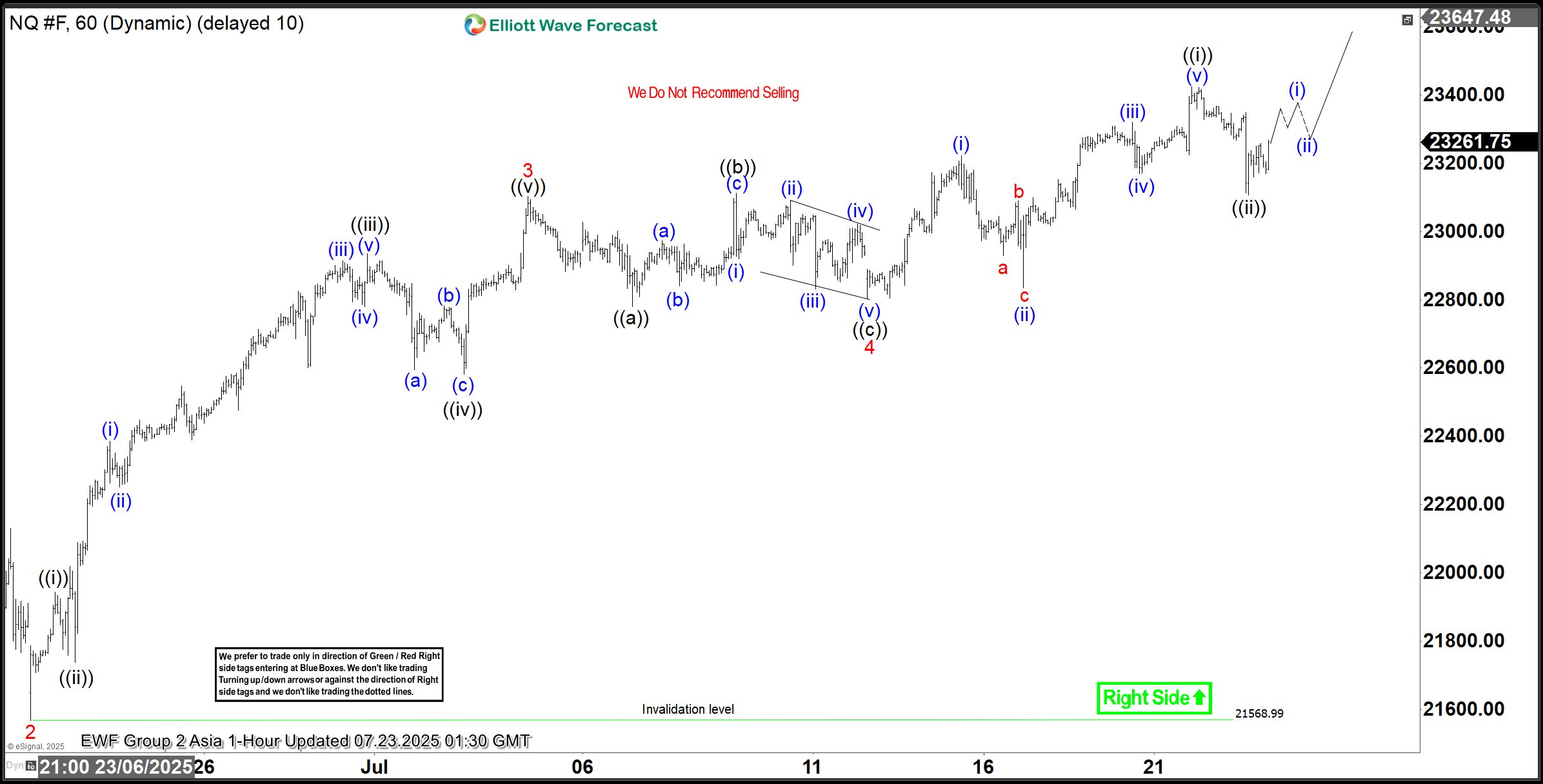
The Nasdaq Futures (NQ_F) favors higher in bullish impulse sequence from April-2025 low. It already broke above December-2024 high & expect short term pullback in 3, 7 or 11 swings to remain supported. Impulse sequence unfolds in 5, 9, 13, 17, 21….. swings count. It ended daily corrective pullback in double correction at 16460 low of 4.07.2025 low. On daily, it should rally extend in to 28864 – 26152 area to finish April cycle before next pullback start. Above there, it favors rally in (3) of ((1)). It placed (1) of ((1)) at 21858.75 high, (2) at 21071.50 low as shallow connector & favoring upside in 5 of (3) against 7.13.2025 low. Every pullback after 4.21.2025 low was shallow & unfolded in 3, 7 or 11 swings calling for more upside as long as it stays above 5.30.2025 low. Within (3), it ended 1 at 22222 high, 2 at 21566.75 low, 3 at 23102.50 high, 4 at 22803 low & favors upside in 5 of (3). Wave 4 as flat correction ended in 7.13.2025 low of 22803 low.
Below 3 of (3) high, it placed ((a)) at 22779.75 low, ((b)) at 23112 high & ((c)) at 22803 low as flat connector against 6.22.2025 low. Above there, it ended ((i)) at 23424.75 high as diagonal & ((ii)) at 23108 low in 3 swing pullback. Above there, it should continue rally in ((iii)) of 5, which will confirm above 23424.75 high to avoid double correction. Within ((i)), it placed (i) at 23222.75 high, (ii) at 22835.5 low, (iii) at 23320.75 high, (iv) at 23169.50 low & (v) at 23424.75 high. Currently, it favors two more highs in 5 of (3) in to 23493.5 – 23934.5 area, above 7.13.2025 low. Based on swing sequence, it already have enough number of swings in (3) to call the cycle completed. But as long as it stays above price trendline, passing through 2 & 4, it should continue upside in to extreme area. We like to buy the next pullback in 3, 7 or 11 swings at extreme area for intraday rally. It favors upside in April-2025 cycle & expected to remain supported in (4) & later in ((2)) pullback as next buying opportunity.
Nasdaq Futures (NQ_F) – 60-Minute Elliott Wave Technical Chart:
Nasdaq Futures (NQ_F) Elliott Wave Technical Video:
https://www.youtube.com/watch?v=Yf6Fe_9tLNc
USD/CAD Daily Outlook
Daily Pivots: (S1) 1.3574; (P) 1.3635; (R1) 1.3667; More...
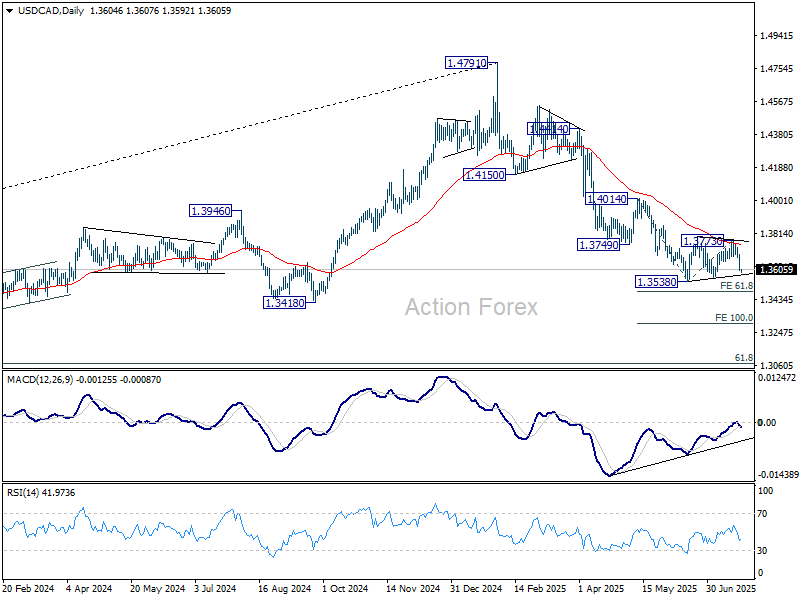
USD/CAD's break of 1.3650 minor support argues that corrective pattern from 1.3538 has completed with three waves to 1.3773. Intraday bias is back on the downside for retesting 1.3538/55 support zone. Decisive break there will resume larger decline from 1.4791. On the upside, however, break of 1.3650 will delay the bearish case and bring more sideway trading.
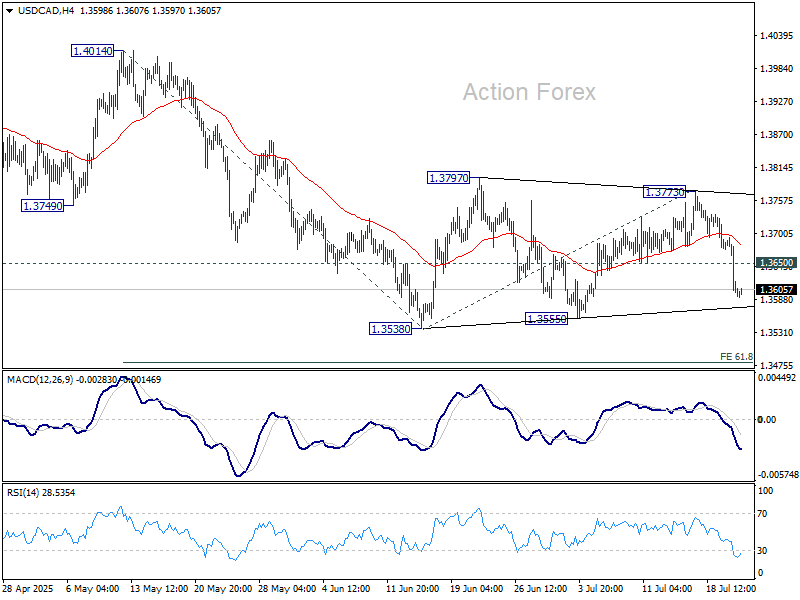
In the bigger picture, price actions from 1.4791 medium term top could either be a correction to rise from 1.2005 (2021 low), or trend reversal. In either case, further decline is expected as long as 1.4014 resistance holds. Next target is 61.8% retracement of 1.2005 (2021 low) to 1.4791 at 1.3069.
Markets Cheer US–Japan Tariff Relief, Ignore Japanese Political Turmoil
Yen slumped across the board in Asia as risk appetite surged following the announcement of a long-anticipated trade agreement between Japan and the US. The deal, which sets a 15% tariff on Japanese goods, down from the previously threatened 25%, sparked a sharp rally in Japanese equities, particularly auto stocks, which major names jumped at least 10%.
While many see the terms as more a reprieve than a win for Japan, the removal of worst-case scenarios provided a relief boost for investor sentiment. The rally extended beyond Tokyo, with South Korean automakers Hyundai and Kia also gaining on optimism that broader regional de-escalation may follow.
Meanwhile, markets appear unfazed by the deepening political crisis in Japan. Prime Minister Shigeru Ishiba’s ruling LDP lost its majority in both houses after the elections over the weekend. Speculation is swirling over his possible resignation by August. Still, the trade breakthrough is clearly dominating market focus.
In currency markets, risk-sensitive currencies lead gains, with Kiwi, Aussie, and Loonie outperforming. Yen sits firmly at the bottom, followed by Swiss Franc and Euro. Dollar and Sterling were more mixed.
In parallel, US Treasury Secretary Scott Bessent signaled progress toward extending the current tariff truce with China, set to expire August 12. He confirmed upcoming meetings with Chinese counterparts in Stockholm next week and hinted a formal extension could be arranged as early as Monday or Tuesday.
The current 90-day tariff pause has kept broader tensions in check, and any confirmation of an extension could support sentiment further. However, gaps remain on structural issues, particularly on state subsidies and tech regulation. Still, investors welcomed signs that both sides are looking to preserve momentum.
Also the US and Indonesia formally announced a framework deal under which Jakarta will remove most tariffs on US imports. In return, the US will impose a 19% tariff on Indonesian goods—lower than the 32% previously threatened under Trump’s sweeping “liberation day” plan. Both countries are expected to finalize the agreement in coming weeks.
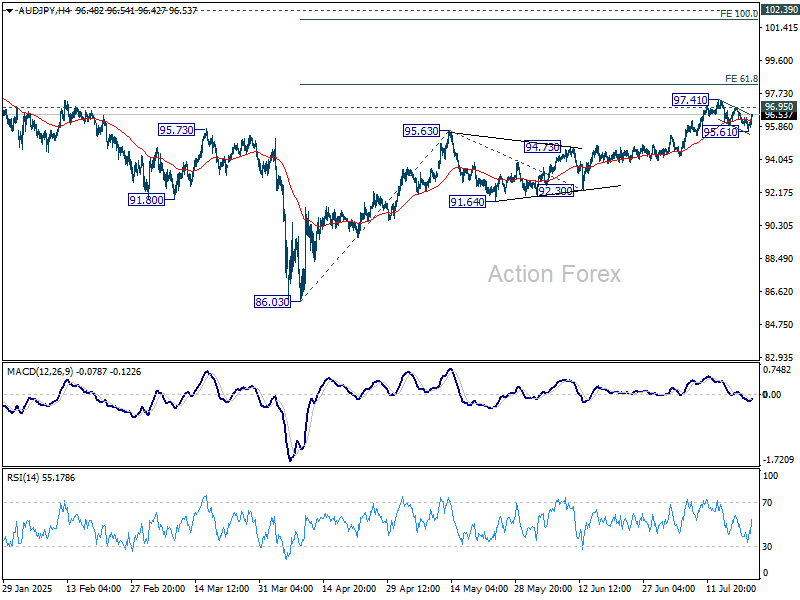
Technically, with today's extended rebound, focus is on 96.95 resistance in AUD/JPY. Firm break there will suggest that correction from 97.41 has completed at 95.61. Larger rally from 86.03 should then be ready to resume to 61.8% projection of 86.03 to 95.63 from 92.30 at 98.23. Sustained break there will pave the way to 100% projection at 101.90.
In Asia, at the time of writing, Nikkei is up 3.64%. Hong Kong HSI is up 1.40%. China Shanghai SSE is up 0.79%. Singapore Strait Times is up 0.46%. Japan 10-year JGB yield is up 0.075 at 1.582. Overnight, DOW rose 0.40%. S&P 500 rose 0.06%. NASDAQ fell -0.39%. 10-year yield fell -0.036 to 4.336.
Nikkei soars Past 41k on landmark US-Japan trade deal
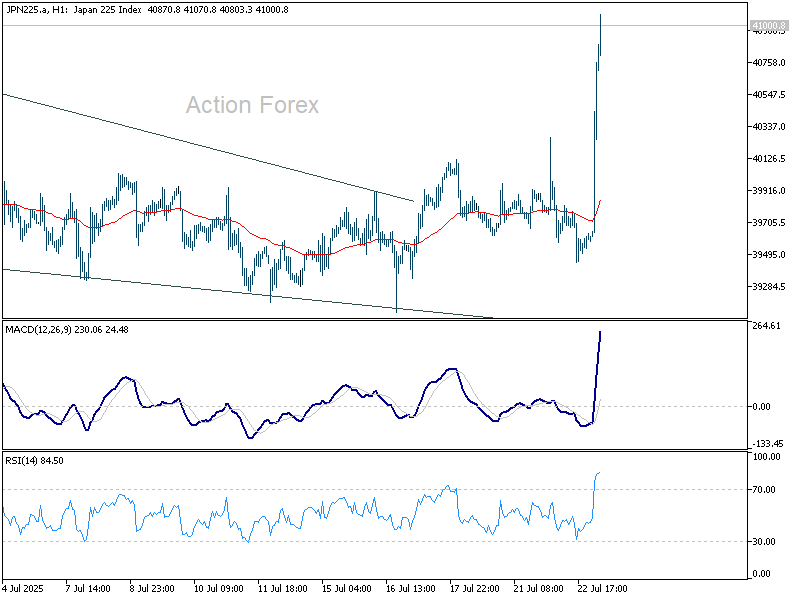
Nikkei jumped today, breaking above the 41k level for the first time in a year after the US and Japan confirmed a long-anticipated trade deal. Investor sentiment was buoyed by the breakthrough, which reduces the threat of harsher tariffs that were set to take effect on August 1.
The agreement, publicly confirmed by both US President Donald Trump and Japanese Prime Minister Shigeru Ishiba, includes a 15% blanket tariff on Japanese imports—down from the initially threatened 25%. Japan’s chief negotiator Ryosei Akazawa called the outcome “#Mission Accomplished” in a social media post.
Trump hailed the deal as “perhaps the largest Deal ever made,” claiming Japan will invest USD 550B into the US and that Americans would receive “90% of the Profits.” Under the terms of the agreement, Japan will further open its markets to US goods, including cars, trucks, rice, and agricultural products. On the other hand, Ishiba indicated that the auto tariff rate will drop to 15% from the current 25% imposed globally.
BoJ's Uchida see moderate growth and temporarily sluggish inflation
BoJ Deputy Governor Shinichi Uchida said in a speech today that Japan's economy is likely to "moderate" amid slowing global growth, with underlying inflation remaining "sluggish temporarily". He added that downside risks dominate the outlook, particularly due to high uncertainty surrounding global trade policy and its spillover effects on both domestic and external demand.
Still, Uchida maintained that if the Bank's baseline outlook holds, gradual rate hikes will continue. With real interest rates deeply negative, the BoJ is positioned to adjust its accommodative stance, but only as long as the economic and inflation path improves as expected.
He also highlighted the crosscurrents in Japan’s inflation profile—cost-push pressures from food remain elevated, while demand-side forces are weak. How businesses adjust wages and prices in response to these forces will be central to determining the sustainability of price growth.
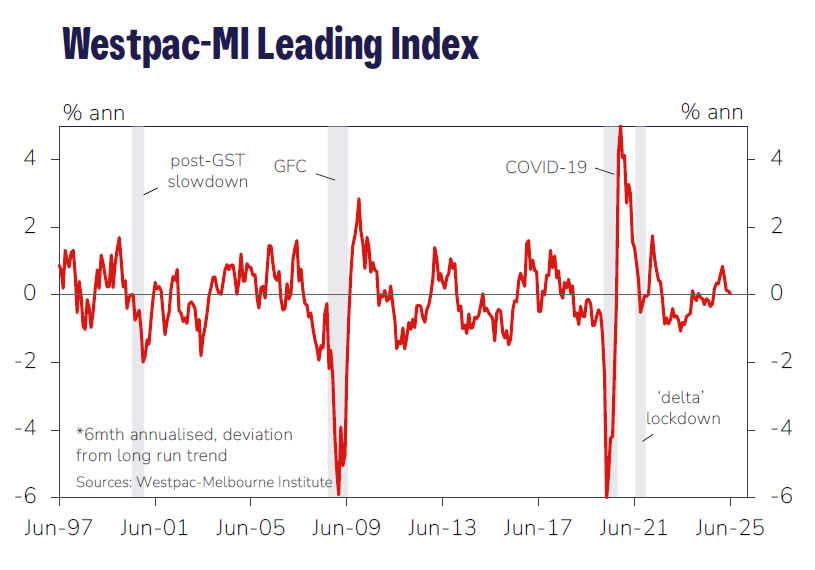
Australia Westpac leading index falls to 0.03%, signals weak H2
Australia’s Westpac Leading Index slipped from 0.11% to just 0.03% in May, continuing a six-month slide that points to weakening momentum heading into the second half of 2025. The index, which provides a guide to economic activity three to nine months ahead, has lost altitude from 0.33% in December, with five of eight components dragging—particularly commodity prices, consumer sentiment, and hours worked.
Westpac noted that the shift from modestly above-trend growth to an “around trend” signal marks a clear step-down in economic momentum. The bank now expects the economy to expand by only 1.7% in 2025, a slight pickup from 1.3% in 2024, but still well below historical averages.
With the RBA set to meet on August 11–12, the Leading Index adds to the case for renewed policy easing. Westpac sees the June quarter CPI, due next week, as the key swing factor. A benign reading would likely clear the way for a 25bp cut in August, followed by another in November and two further cuts in H1 2026 as the central bank gradually loosens policy amid persistent growth headwinds.
USD/CAD Daily Outlook
Daily Pivots: (S1) 1.3574; (P) 1.3635; (R1) 1.3667; More...
USD/CAD's break of 1.3650 minor support argues that corrective pattern from 1.3538 has completed with three waves to 1.3773. Intraday bias is back on the downside for retesting 1.3538/55 support zone. Decisive break there will resume larger decline from 1.4791. On the upside, however, break of 1.3650 will delay the bearish case and bring more sideway trading.
In the bigger picture, price actions from 1.4791 medium term top could either be a correction to rise from 1.2005 (2021 low), or trend reversal. In either case, further decline is expected as long as 1.4014 resistance holds. Next target is 61.8% retracement of 1.2005 (2021 low) to 1.4791 at 1.3069.
GBP/USD Faces Resistance—Upside May Be Exhausted
Key Highlights
- GBP/USD declined below 1.3550 and tested the 1.3365 zone.
- It now faces hurdles near the 1.3520 and 1.3550 levels on the 4-hour chart.
- EUR/USD attempted a fresh increase and might gain pace if it clears 1.1750.
- USD/JPY started a fresh decline below the 148.00 level.
GBP/USD Technical Analysis
The British Pound gained bearish pace below the 1.3620 support against the US Dollar. GBP/USD tested the 1.3365 zone before it started a recovery wave.
Looking at the 4-hour chart, the pair settled below the 1.3550 zone, the 100 simple moving average (red, 4-hour), and the 200 simple moving average (green, 4-hour). The pair recently corrected some losses and traded above the 1.3420 level.
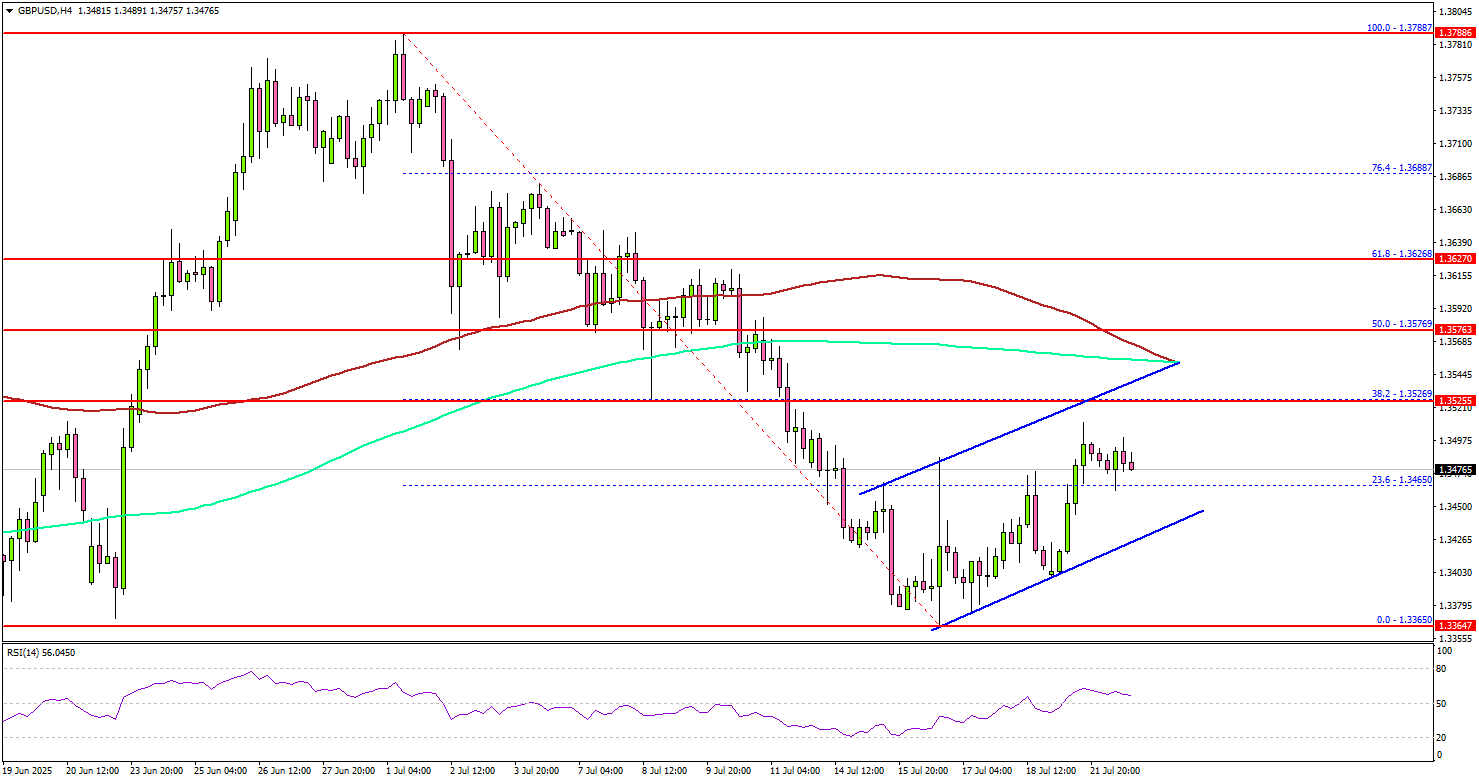
On the upside, the pair could face resistance near the 1.3520 level. It is close to the 38.2% Fib retracement level of the downward move from the 1.3788 swing high to the 1.3365 low.
The next key resistance sits near the 1.3550 level and the 100 simple moving average (red, 4-hour). A close above the 1.3550 level could set the pace for another increase.
In the stated case, the pair could rise toward the 1.3620 resistance. The next major stop for the bulls could be near the 1.3750 resistance.
On the downside, immediate support is near the 1.3450 level. There is also a rising channel forming with support at 1.3450 on the same chart. The next key support sits near 1.3420. Any more losses could send the pair toward the 1.3365 support zone.
Looking at EUR/USD, the pair is attempting a fresh increase, and the bulls might soon aim for a move above the 1.1750 resistance.
Upcoming Economic Events:
- US Existing Home Sales for June 2025 (MoM) - Forecast +0.1%, versus +0.8% previous.
Nikkei soars past 41k on landmark US-Japan trade deal
Nikkei jumped over 2% on today, breaking above the 41k level for the first time in a year after the US and Japan confirmed a long-anticipated trade deal. Investor sentiment was buoyed by the breakthrough, which reduces the threat of harsher tariffs that were set to take effect on August 1.
The agreement, publicly confirmed by both US President Donald Trump and Japanese Prime Minister Shigeru Ishiba, includes a 15% blanket tariff on Japanese imports—down from the initially threatened 25%. Japan’s chief negotiator Ryosei Akazawa called the outcome “#Mission Accomplished” in a social media post.
Trump hailed the deal as “perhaps the largest Deal ever made,” claiming Japan will invest USD 550B into the US and that Americans would receive “90% of the Profits.” Under the terms of the agreement, Japan will further open its markets to US goods, including cars, trucks, rice, and agricultural products. On the other hand, Ishiba indicated that the auto tariff rate will drop to 15% from the current 25% imposed globally.
BoJ’s Uchida see moderate growth and temporarily sluggish inflation
BoJ Deputy Governor Shinichi Uchida said in a speech today that Japan's economy is likely to "moderate" amid slowing global growth, with underlying inflation remaining "sluggish temporarily". He added that downside risks dominate the outlook, particularly due to high uncertainty surrounding global trade policy and its spillover effects on both domestic and external demand.
Still, Uchida maintained that if the Bank's baseline outlook holds, gradual rate hikes will continue. With real interest rates deeply negative, the BoJ is positioned to adjust its accommodative stance, but only as long as the economic and inflation path improves as expected.
He also highlighted the crosscurrents in Japan’s inflation profile—cost-push pressures from food remain elevated, while demand-side forces are weak. How businesses adjust wages and prices in response to these forces will be central to determining the sustainability of price growth.
Australia Westpac leading index falls to 0.03%, signals weak H2
Australia’s Westpac Leading Index slipped from 0.11% to just 0.03% in May, continuing a six-month slide that points to weakening momentum heading into the second half of 2025. The index, which provides a guide to economic activity three to nine months ahead, has lost altitude from 0.33% in December, with five of eight components dragging—particularly commodity prices, consumer sentiment, and hours worked.
Westpac noted that the shift from modestly above-trend growth to an “around trend” signal marks a clear step-down in economic momentum. The bank now expects the economy to expand by only 1.7% in 2025, a slight pickup from 1.3% in 2024, but still well below historical averages.
With the RBA set to meet on August 11–12, the Leading Index adds to the case for renewed policy easing. Westpac sees the June quarter CPI, due next week, as the key swing factor. A benign reading would likely clear the way for a 25bp cut in August, followed by another in November and two further cuts in H1 2026 as the central bank gradually loosens policy amid persistent growth headwinds.
RBA Minutes July 2025: The Narrow Path of Narrative
Two divergent views on the appropriate path for the cash rate got a good airing in the July Monetary Policy Board minutes.
- RBA Monetary Policy Board (MPB) minutes acknowledge that inflation is within target and likely to stay there, while monetary policy is ‘modestly restrictive’. The labour market was viewed as still tight, though subsequent data might imply this judgement needs to evolve.
- A majority of MPB members viewed holding rates steady as necessary to be consistent with strategy of being ‘cautious and predictable’. By contrast, the minority of members in favour of a cut highlighted downside risks to growth and inflation, as well as the lags in the effects of monetary policy. A 50bp cut was not discussed at all.
The minutes cleared up a few misconceptions that have been circulating, including about how the RBA sees the ‘neutral’ cash rate.
The July MPB minutes started by highlighting the surprisingly benign conditions in global financial markets. While the trade environment was still very uncertain, the more extreme scenarios now seemed less likely. There had been ‘little discernible effect’ on the Australian economy so far from the trade disputes. While it was judged that it was too soon to see any effect in the data, the minutes expressed some surprise that there was little effect in the sentiment survey data as well. The MPB put more weight than before on its base case that US tariffs would land at lower rates than originally announced, but still much higher than what prevailed before the current US administration was inaugurated. Understandably, though, there were concerns about whether markets were too complacent now, rather than simply overly pessimistic in April.
The discussion on inflation reflects the institution’s caution and understandable reluctance to declare victory on getting inflation back to target. While the monthly CPI indicator was deemed to be too volatile to rely on, the minutes highlighted alternative monthly calculations that ‘had not eased as much as the monthly trimmed-mean indicator recently’. All of this will be moot by the end of this year, when the full monthly CPI becomes available. As we have previously flagged, there is a risk that June quarter trimmed mean inflation comes in a little above what the RBA had forecast in May, and the RBA was happy to use the monthly data to highlight this risk.
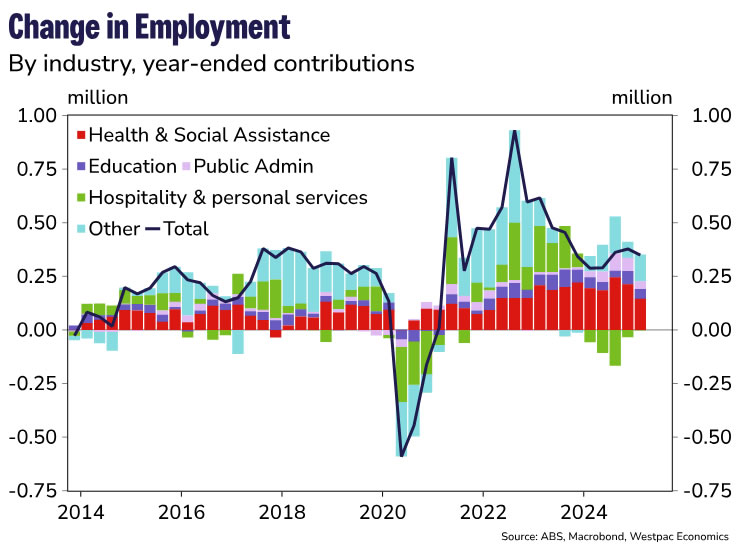
The RBA staff are alive to the need for a handover from non-market to market-sector employment growth, something we have been highlighting for some time. We take some comfort from the resilience of employment growth in most market-sector industries; an earlier downturn in hospitality-related employment now seems to have passed as well (see graph). Interestingly, the minutes suggested it was possible that a ‘shaky’ handover with slower employment growth could be compatible with an unchanged unemployment rate as long as the participation rate did not continue to trend up. Given the demographic trends underlying the participation trend, though, we are less confident that the net result will be benign for unemployment.
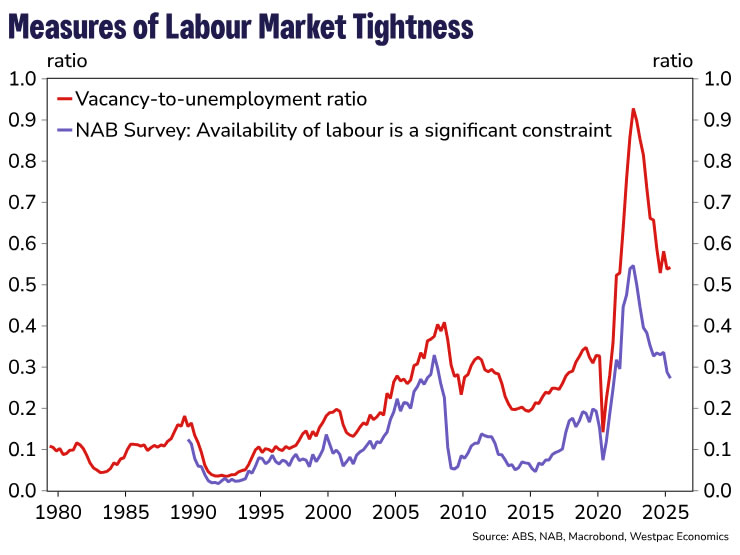
More broadly, the minutes elaborated on the RBA’s ongoing view that the labour market is still tight, pointing to the unemployment rate and underemployment rate. It can be reasonably inferred that the staff showed the MPB a graph of the vacancy-to-unemployment ratio along with the NAB survey’s measure of significant difficulty finding suitable labour, two series that are unreasonably tightly correlated given their different sources. Since the meeting, though, another reading of the NAB quarterly survey has come in, showing another fall. Together with the June labour force survey, this lends further weight to the idea that the labour market is again becoming less tight, after a pause in that unwind late last year.
The minutes again tackled the productivity debate, acknowledging that the expansion of the non-market sector and declining mining sector output had contributed to developments recently. These shorter-term factors are unlikely to continue at the current pace. While it is true, as the minutes highlight, that productivity growth has been lower in recent decades than over a long run of history, the IT/internet boom of the 1990s explains a large part of the gap. What the minutes do not make clear is whether the assumed pick-up in productivity growth in the forecasts is simply the unwind of the shorter-term factors – a reasonable assumption – or relies on AI boosting productivity similarly to the effect computers had in the 1990s.
The MPB also used this meeting’s minutes to clear up some misunderstandings about its view of the economy. In particular, the minutes included an extended discussion about the ‘neutral’ interest rate. A whole-economy view implied that monetary policy was ‘modestly restrictive’. Inflation was in the target and expected to remain around its midpoint even if the cash rate were reduced in line with market pricing at the time of the May forecast round. Various models from the academic and central bank literature point to a similar conclusion. Given the uncertainties around these models, though, ‘public discussion of the stance of monetary policy had possibly overemphasised the inferences that could be drawn from these alternative models, especially for the near term’. This admonition is in line with our earlier warning not to give that shift much credence. The average of estimates of neutral had fallen, but given that revision history, so would have the weight that policymakers put on that central estimate.
With a split decision, both the arguments to hold and to cut got a decent airing. The case to hold largely relied on some recent data coming in marginally stronger than the staff forecasts, along with receding risks of the more severe trade scenarios. The need for further confirmation that inflation was indeed on track aligns with a desire to remain ‘cautious and predictable’.
The minority of members who voted for a cut highlighted the risks that the growth and inflation forecasts might prove too optimistic. More immediately, and as we highlighted ahead of the meeting, they viewed the available information as already providing enough evidence that inflation was in target and on track.
A policy risk implicit in the minutes is that policymakers might cleave to a narrative about how they should conduct policy beyond its use-by date. A good-sounding phrase – ‘the narrow path’, say, or ‘not ruling anything in or out’ – starts off being useful, but it can shape thinking even when circumstances change. The ‘cautious and predictable’ language could be subject to this risk, especially if MPB members take it as an end in itself.
In any case, the argument for caution might not imply a slow return to neutral. The original basis for moving cautiously comes from William Brainard’s work in the 1960s. This showed that if you are uncertain about how much policy will affect the economy, you should do less in the face of a shock than you would if you were certain. But this means not going as far away from neutral as you would in a more certain environment. That is not the same as being away from neutral and returning more slowly than otherwise. But it does suggest that uncertainty about where neutral is will become a bigger issue for the MPB with time.
Bitcoin (BTC/USD) Price Outlook: Triangle Breakout Could Lead Bitcoin to 126200
Bitcoin (BTC/USD) is still consolidating below the key 120k level but a triangle breakout may lead to fresh all-time highs.
The world's largest cryptocurrency has broken above the triangle pattern on the H4 chart which could be the start of the next leg to the upside.
Bitcoin did break below the 50 neutral level on the RSI period 14 yesterday before breaking back above immediately which could be a sign that momentum remains with the bulls.
Looking for potential targets following a triangle breakout, traders typically use a simple method to set a price target:
- Measure the Base: Find the widest part of the triangle. This is the vertical distance between the highest and lowest points at the beginning of the triangle formation.
- Project from Breakout:
-
- For an upside breakout (price breaks above the top trendline): Take the measured height of the triangle's base and add it to the price level where the breakout occurred.
- For a downside breakout (price breaks below the bottom trendline): Take the measured height of the triangle's base and subtract it from the price level where the breakout occurred.
This projected price is your potential target. It's important to also look for increased trading volume to confirm the breakout and consider placing a stop-loss order to manage risk in case of a false breakout.
With this in mind, a potential target rests around the 126200 handle.
Bitcoin (BTC/USD) Daily Chart, July 22, 2025
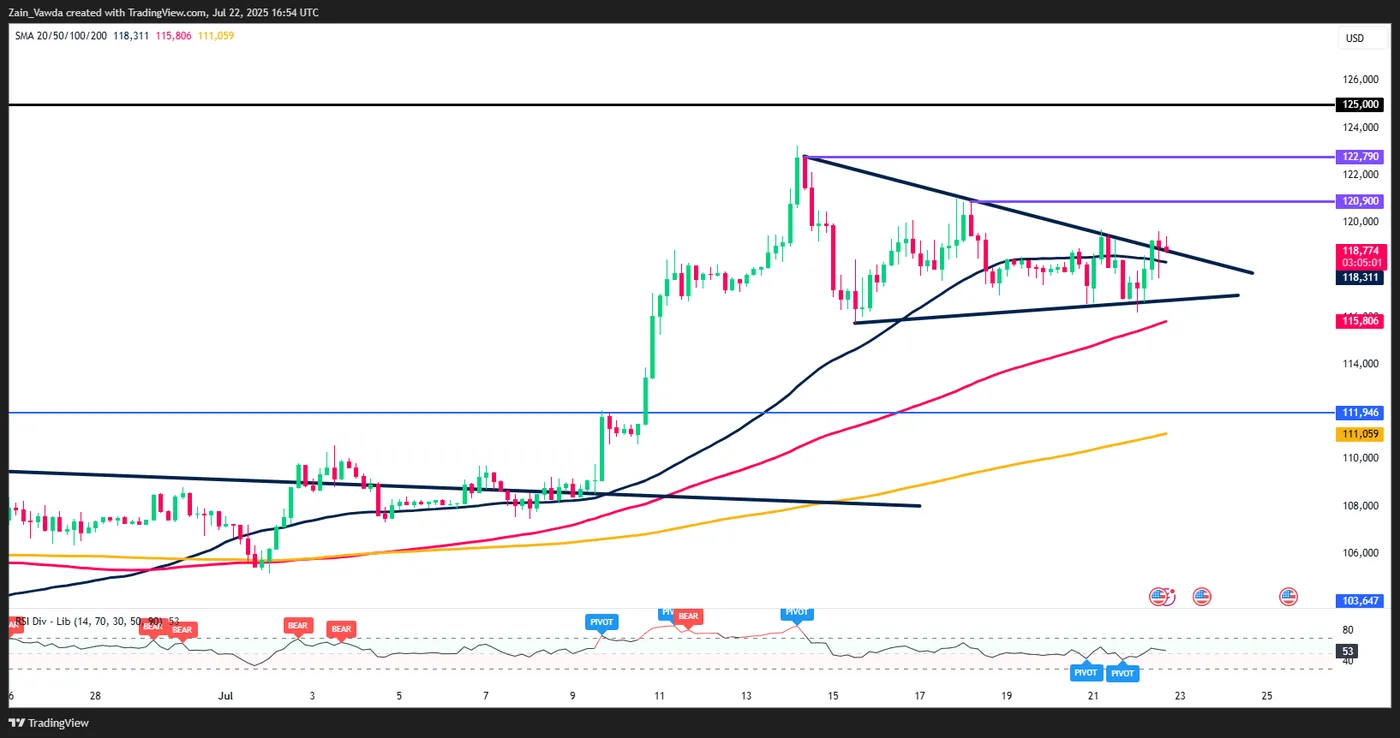
Source: TradingView.com (click to enlarge)
Bitcoin ETF Breaks 12-Day Inflow Streak
The only concern at present may come from spot Bitcoin ETFS, which saw 131.35 million in outflows on Monday. This brought a 12-day inflow streak to an end which brought in as much as $6.6 billion.
The biggest outflow came from ARK Invest’s ARKB, which lost $77.46 million in one day. Grayscale’s GBTC followed with $36.75 million in outflows, and Fidelity’s FBTC saw $12.75 million withdrawn, according to SoSoValue.
Bitwise’s BITB and VanEck’s HODL had smaller outflows of $1.91 million and $2.48 million. BlackRock’s IBIT, the largest fund with $86.16 billion in assets, had no changes in inflows or outflows.
Despite these outflows, total net inflows remain strong at $54.62 billion, and all spot Bitcoin ETFs combined hold $151.60 billion in assets, making up 6.52% of Bitcoin’s total market value.
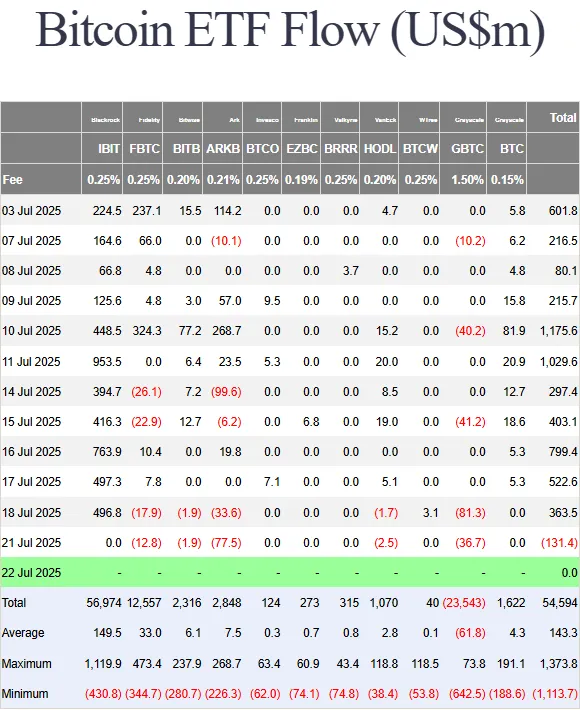
Source: Farside Investors
If outflows do continue then this could hinder a potential rally toward the 126200 area. Another factor to consider could be potential profit taking and rebalancing by institutions following the recent all-time highs.
Client Sentiment Data - Bitcoin (BTC/USD)
Looking at OANDA client sentiment data, the majority of traders are long on Bitcoin with 97% of traders net-long. I prefer to take a contrarian view toward crowd sentiment, thus the fact that 97% of traders are net-long suggests a deeper pullback may be in play in the near-term.