

Sample Category Title
EUR/USD Mid-Day Outlook
Daily Pivots: (S1) 1.1655; (P) 1.1700; (R1) 1.1747; More...
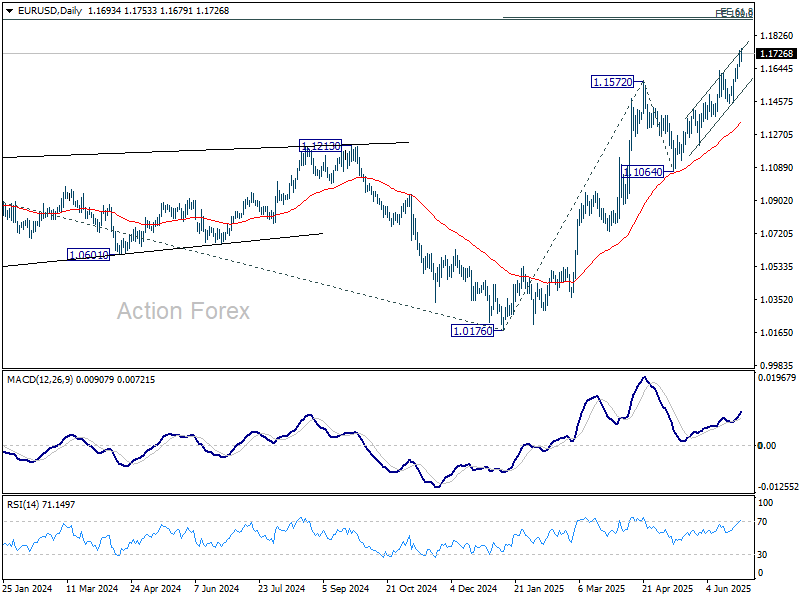
Intraday bias in EUR/USD remains on the upside for 61.8% projection of 1.0176 to 1.1572 from 1.1064 at 1.1927. On the downside, below 1.1679 minor support will turn intraday bias neutral and bring consolidations. But downside should be contained above 1.1452 support to bring another rally.
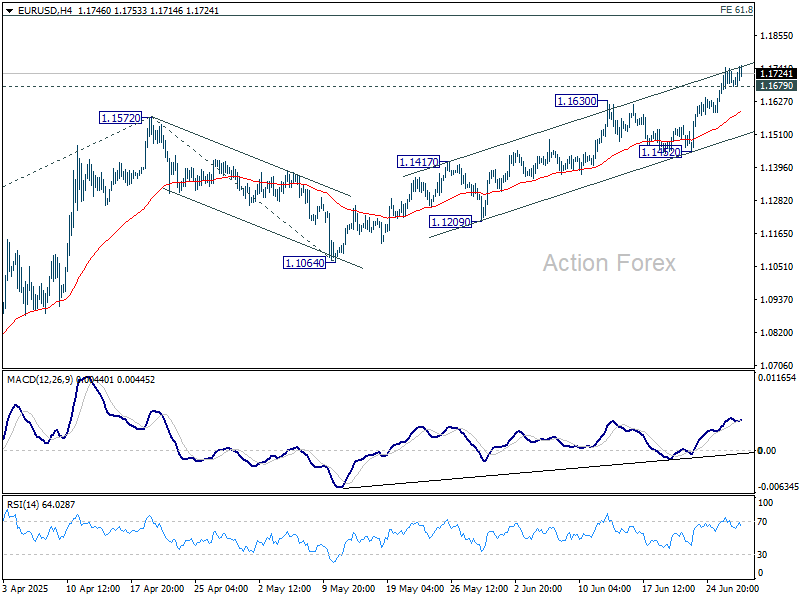
In the bigger picture, rise from 0.9534 long term bottom could be correcting the multi-decade downtrend or the start of a long term up trend. In either case, further rise should be seen to 100% projection of 0.9534 to 1.1274 from 1.0176 at 1.1916. This will now remain the favored case as long as 1.1604 support holds.
GBP/USD Mid-Day Outlook
Daily Pivots: (S1) 1.3662; (P) 1.3716; (R1) 1.3783; More...
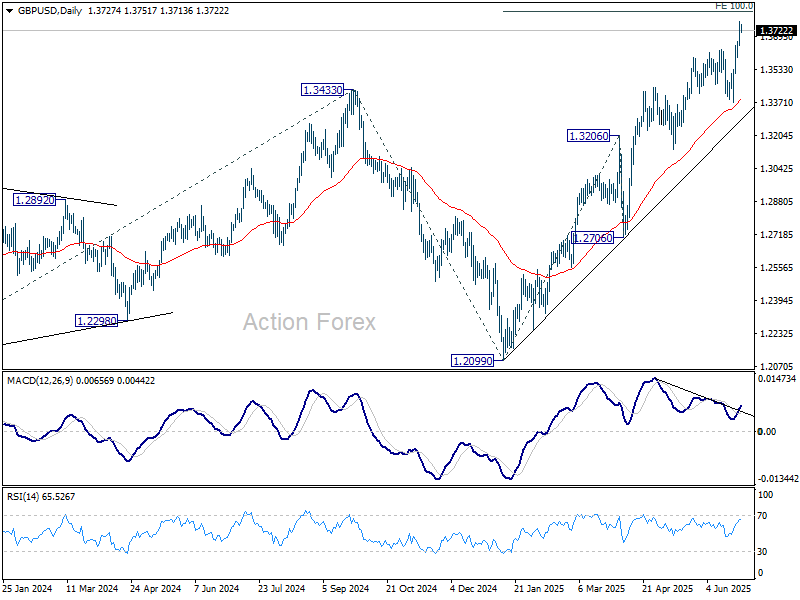
Intraday bias in GBP/USD remains on the upside for 100% projection of 1.2099 to 1.3206 from 1.3138 at 1.3813 next. On the downside, below 1.3647 minor support will turn intraday bias neutral and bring consolidations. But downside should be contained above 1.3369 support to bring another rally.
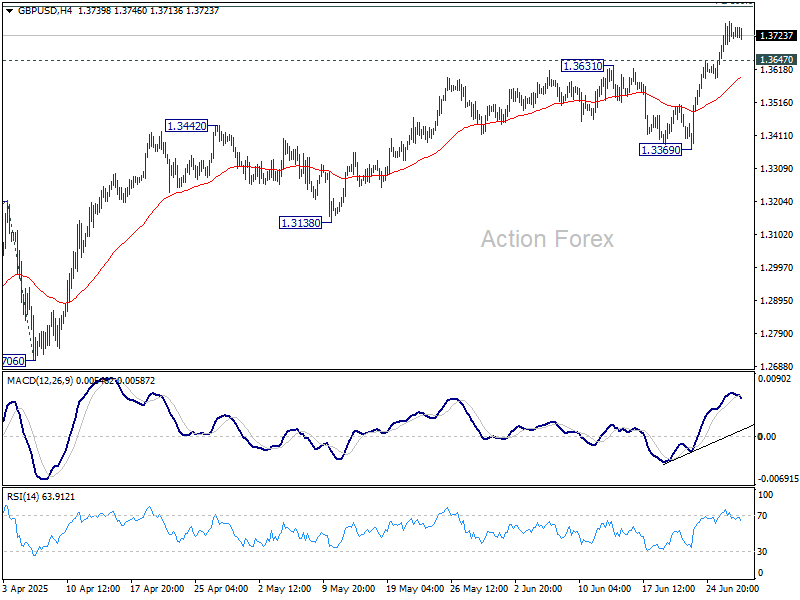
In the bigger picture, up trend from 1.3051 (2022 low) is in progress. Next medium term target is 61.8% projection of 1.0351 to 1.3433 from 1.2099 at 1.4004. Outlook will now stay bullish as long as 55 W EMA (now at 1.2948) holds, even in case of deep pullback.
USD/JPY Mid-Day Outlook
Daily Pivots: (S1) 143.66; (P) 144.48; (R1) 145.21; More...
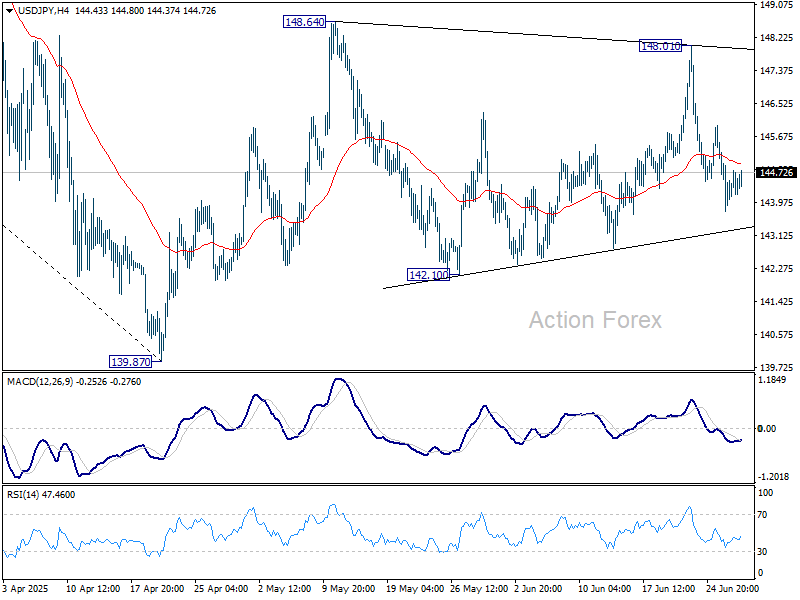
Intraday bias in USD/JPY remains neutral as sideway trading continues. On the upside, firm break of 148.64 will resume the rise from 139.87 to 61.8% retracement of 158.86 to 139.87 at 151.22. However, break of 142.10 will bring deeper fall back to retest 139.87 low.
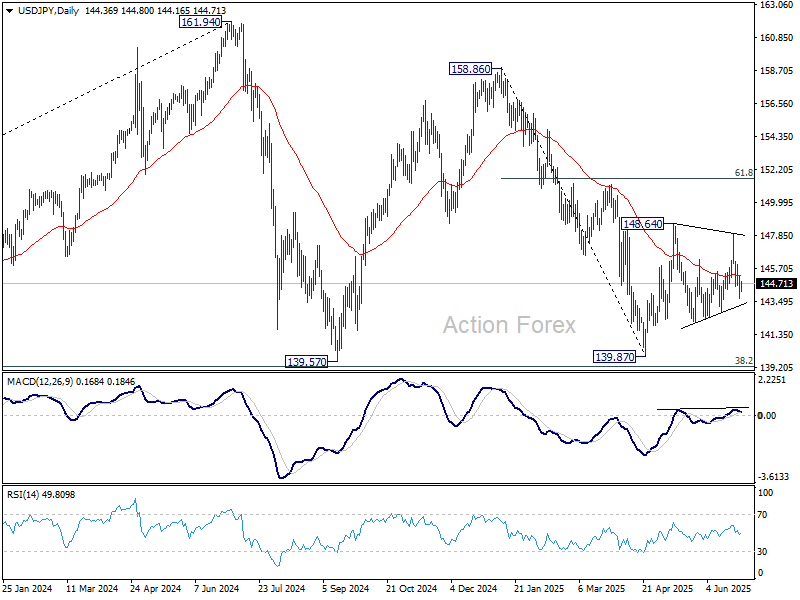
In the bigger picture, price actions from 161.94 are seen as a corrective pattern to rise from 102.58 (2021 low), with fall from 158.86 as the third leg. Strong support should be seen from 38.2% retracement of 102.58 to 161.94 at 139.26 to bring rebound. However, sustained break of 139.26 would open up deeper medium term decline to 61.8% retracement at 125.25.
Canada’s Economy Underdelivers in April, Continued Weakness Expected in May
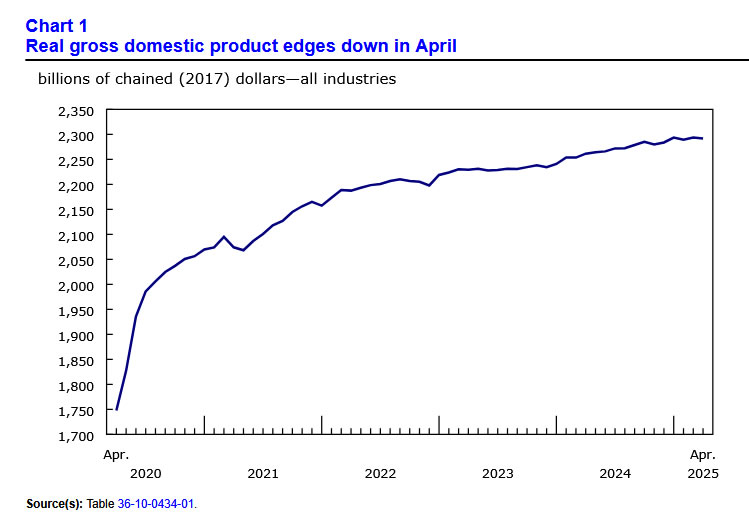
Canadian GDP fell by 0.1% month-on-month (m/m) in April, underperforming Statistics Canada's advanced guidance for an uptick in growth. GDP growth in May is expected to pull back by another 0.1% m/m per the updated flash estimate.
Compositionally, 10 of 20 industries registered a decrease on the month. Goods industries fell by their largest margin since Jan-2024 (-0.6% m/m), while the services sector edged higher by 0.1% m/m.
The manufacturing sector (-2.5% m/m) dragged the entire goods side of the economy lower, led by a 3.7% m/m drop in transportation equipment manufacturing. The construction sector edged forward by a tenth of a percent, while the remaining goods sectors effectively flatlined in April.
On the services side, a 1.9% m/m contraction in wholesale trade, led by motor vehicles and parts, was the biggest detractor to growth. The finance and insurance (+0.7% m/m) and public admin (+0.8% m/m) sectors provided positive offsets.
The advanced guidance for a 0.1% m/m decline in May GDP is driven by decreases in the mining, quarrying and oil and gas sector, public administration, and retail trade.
Key Implications
The downside risks to Canada's economic growth are beginning to manifest, especially in tariff-exposed sectors. April's underperformance combined with downbeat expectations for May leave second quarter growth tracking a mild contraction, setting up a sharp pullback from Q1 readings. Past this, the outlook through the belly of the year faces clear downside risk as the direct impact from tariffs add to the headwinds from plunging business and consumer sentiment.
The Bank of Canada will take this reading in stride, weighing softer economic growth against ongoing underlying inflation pressures. At their June meeting, the Bank decided to hold the policy rate steady at 2.75%, as they "proceed carefully" around risks and uncertainties. We think that the outlooks for growth and inflation have since moved the BoC a bit closer to delivering a 25 bps interest cut in July, but a bit more evidence will be needed for a decisive move. With Canada's labour market showing cracks, consumers reigning in spending, and the housing market visibly strained, we think the BoC has headroom to cut the policy rate two more times this year.
US: Consumer Spending and Income Decline in May
Both consumer spending and income growth came in weaker than expected in May. Personal income decreased 0.4% month-over-month (m/m), well below the Bloomberg consensus of +0.3% m/m. Wages and salaries continued to grow at a solid pace, but transfer payments showed a sharp pullback, driven by a decrease in government Social Security payments due to the Social Security Fairness Act. Consumer spending was also soft, declining by 0.1% m/m. With income declining more than spending, personal savings rate fell to 4.5% (from 4.9% in April).
On an inflation-adjusted basis, spending declined by 0.3%. A sizeable drop in goods spending (-0.8% m/m) primarily drove this trend, as vehicle sales continued to cool in May following tariff-related frontloading in months prior. Services spending also softened, posting no growth in May.
Inflationary pressures picked up a bit, with core PCE – the Fed's preferred inflation gauge – rising by 0.2% m/m, up from the 0.1% pace seen over the previous two months. In annual terms, core PCE ticked up to 2.7% pace – from 2.6% the prior month.
Key Implications
Consumer spending was weak in May, as tariff front-loading eased, and services spending continued to cool. This broad-based slowdown has pushed our tracking of Q2 consumer spending growth to 1.3% (annualized), down from our earlier 1.7% projection.
Looking ahead, we expect consumer spending to remain weak in the third quarter as consumers tighten their purse strings amid some expected cooling in the labor market and lingering economic uncertainty. Prices on consumer goods are also expected to move higher through the summer as companies draw down on existing inventory stockpiles and higher input costs begin to squeeze profit margins.
USD/CHF Mid-Day Outlook
Daily Pivots: (S1) 0.7970; (P) 0.8012; (R1) 0.8044; More….
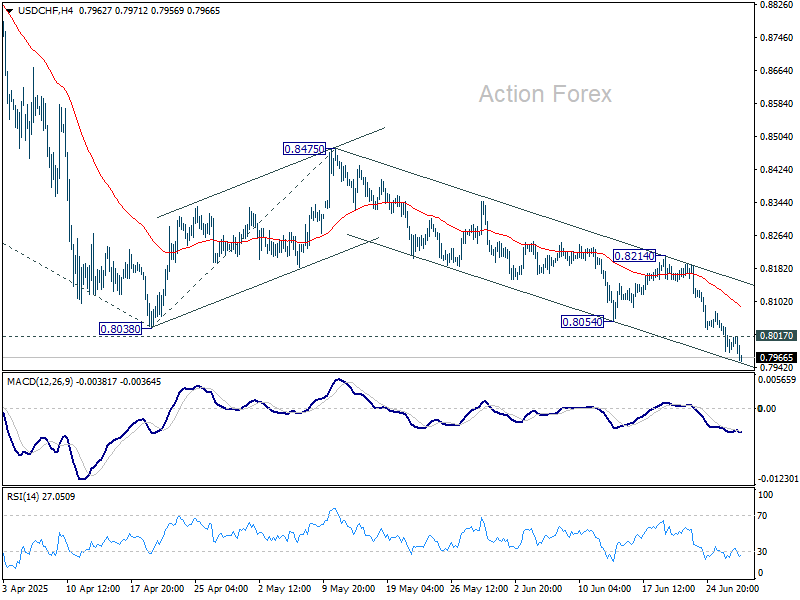
USD/CHF's decline is in progress and intraday bias stays on the downside. Current down trend should target 61.8% projection of 0.9200 to 0.8038 from 0.8475 at 0.7757 next. On the upside, above 0.8017 minor resistance will turn intraday bias neutral and bring consolidations. But recovery should be limited below 0.8214 resistance to bring another fall.
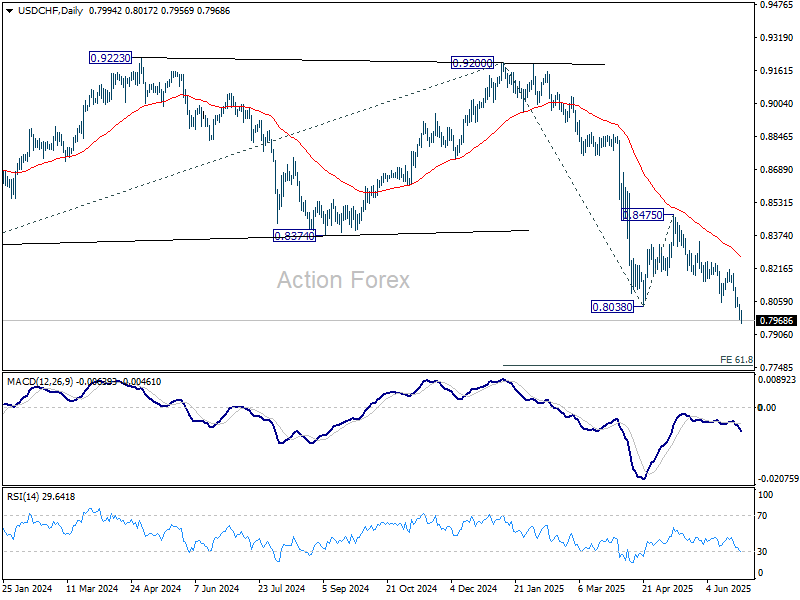
In the bigger picture, long term down trend from 1.0342 (2017 high) is still in progress. Next target is 100% projection of 1.0146 (2022 high) to 0.8332 from 0.9200 at 0.7382. In any case, outlook will stay bearish as long as 0.8475 resistance holds.
Dollar Stays Weak as Traders Weigh Hawkish PCE and Dovish Spending Signals
Dollar enters the US session mixed, as markets digest a batch of data offering signals to both sides of the policy debate. The greenback is seeing additional selling against Euro and Swiss Franc, but recovering modestly against commodity-linked currencies.
Core PCE inflation rose faster than expected in May, providing Fed hawks with further justification for holding off on rate cuts in the near term. But disappointing personal income and spending data, both of which declined on the month, bolster the case for rate reductions later in the year, particularly after tariff uncertainty resolves. With US futures holding firm, markets appear more inclined to focus on the soft demand data as a rationale for easier policy ahead.
On the trade front, China’s Ministry of Commerce confirmed a new framework agreement with the US aimed at easing tensions over tech restrictions and rare earth exports. The framework outlines mutual concessions: China will expedite export approvals under its control regime, while the US is set to roll back a swath of existing curbs. The announcement aligns with comments from US President Donald Trump on Thursday referencing a recently signed deal with Beijing, later clarified by White House officials as an implementation mechanism for the Geneva agreement.
Looking across currencies, Dollar still ranks at the bottom for the week, just ahead of the Canadian Dollar, which failed to gain traction after April and May GDP prints both surprised on the downside. Yen also underperforms, weighed by a sharper-than-expected drop in Tokyo’s inflation. Meanwhile, Swiss Franc tops the leaderboard, with Euro and Sterling also buoyant. Aussie and Kiwi are sitting in the middle of the pack, underperforming relative to the risk-on rally in equities this week.
In Europe, at the time of writing FTSE is up 0.48%. DAX is up 0.72%. CAC is up 1.30%. UK 10-year yield is up 4.483 at 0.006. Germany 10-year yield is up 0.01 at 2.580. Earlier in Asia, Nikkei rose 1.43%. Hong Kong HSI fell -0.17%. China Shanghai SSE fell -0.70%. Singapore Strait Times rose 0.70%. Japan 10-year JGB yield rose 0.012 to 1.436.
US Core PCE surprises to upside at 2.7% in May, but income and spending disappoint
US core PCE inflation accelerated to 2.7% yoy in May, above expectations of 2.6% yoy and up from an upwardly revised 2.6% yoy in April. The Headline PCE index also edged higher from 2.2% yoy to 2.3% yoy as expected. While the inflation print highlights persistent price pressures—particularly in core categories—consumption data painted a weaker picture.
Personal income unexpectedly dropped -0.4% mom, a steep miss versus forecasts for a 0.2% gain. Personal spending fell -0.1% mom against an expected 0.2% mom increase. The fall in spending was driven by a notable USD 49.2B pullback in goods purchases, only partially offset by a USD 19.9B rise in services spending.
Canada’s GDP contracts -0.1% mom in April, early data points to May decline
Canada’s GDP shrank by -0.1% mom in April, missing expectations of a flat print. Weakness was concentrated in goods-producing sectors, which fell -0.6% mom. Services sector offered a mild offset with a 0.1% mom gain. Just 10 of 20 industrial sectors posted growth, suggesting a broad-based soft patch.
Looking ahead, preliminary data indicates another -0.1% mom decline in real GDP for May. Mining, oil and gas extraction, public administration, and retail trade all weighed on activity, with only real estate and rental leasing providing a meaningful offset.
Eurozone economic sentiment falls to 94 in June as industry weakens
June’s economic data from the European Commission showed further erosion in business sentiment, with Economic Sentiment Indicator falling to 94.0 in both the EU and the Eurozone.
France (-3.4) posted the sharpest decline in sentiment among major EU members, followed by Spain (-1.4) and Germany (-0.8), while Poland (+1.0) saw a slight rebound.
The decline was led by deteriorating industry confidence, with retail also contributing. Confidence in services and among consumers held firm, while construction recovered.
Employment expectations, however, remained stable, with the EEI unchanged in the EU (97.5) and marginally higher in the Eurozone (97.1).
Tokyo core inflation slows to 3.1% in June, but food costs still surging
Tokyo’s core CPI (ex-fresh food) slowed more than expected in June, coming in at 3.1% yoy versus 3.6% yoy in May and below forecasts of 3.4% yoy. The decline was largely driven by the resumption of fuel subsidies and temporary reductions in utility charges. Core-core CPI, which strips out both fresh food and energy, also eased to 3.1% yoy from 3.3% yoy.
However, the figure masks ongoing strain on household budgets. Food prices (excluding volatile items) rose a sharp 7.2% yoy, accelerating from May's 6.9% yoy. Tokyo consumers paid nearly 90% more for rice and faced eye-watering increases in chocolate and coffee costs. Service prices edged down slightly but remained elevated at 2.1%.
On the labor side, Japan's May jobless rate held steady at 2.5%, while the job-to-applicant ratio slipped slightly to 1.24.
USD/CHF Mid-Day Outlook
Daily Pivots: (S1) 0.7970; (P) 0.8012; (R1) 0.8044; More….
USD/CHF's decline is in progress and intraday bias stays on the downside. Current down trend should target 61.8% projection of 0.9200 to 0.8038 from 0.8475 at 0.7757 next. On the upside, above 0.8017 minor resistance will turn intraday bias neutral and bring consolidations. But recovery should be limited below 0.8214 resistance to bring another fall.
In the bigger picture, long term down trend from 1.0342 (2017 high) is still in progress. Next target is 100% projection of 1.0146 (2022 high) to 0.8332 from 0.9200 at 0.7382. In any case, outlook will stay bearish as long as 0.8475 resistance holds.
Canada’s GDP contracts -0.1% mom in April, early data points to May decline
Canada’s GDP shrank by -0.1% mom in April, missing expectations of a flat print. Weakness was concentrated in goods-producing sectors, which fell -0.6% mom. Services sector offered a mild offset with a 0.1% mom gain. Just 10 of 20 industrial sectors posted growth, suggesting a broad-based soft patch.
Looking ahead, preliminary data indicates another -0.1% mom decline in real GDP for May. Mining, oil and gas extraction, public administration, and retail trade all weighed on activity, with only real estate and rental leasing providing a meaningful offset.
US Core PCE surprises to upside at 2.7% in May, but income and spending disappoint
US core PCE inflation accelerated to 2.7% yoy in May, above expectations of 2.6% yoy and up from an upwardly revised 2.6% yoy in April. The Headline PCE index also edged higher from 2.2% yoy to 2.3% yoy as expected. While the inflation print highlights persistent price pressures—particularly in core categories—consumption data painted a weaker picture.
Personal income unexpectedly dropped -0.4% mom, a steep miss versus forecasts for a 0.2% gain. Personal spending fell -0.1% mom against an expected 0.2% mom increase. The fall in spending was driven by a notable USD 49.2B pullback in goods purchases, only partially offset by a USD 19.9B rise in services spending.

Gold Once Again Approaches a Cliff Edge
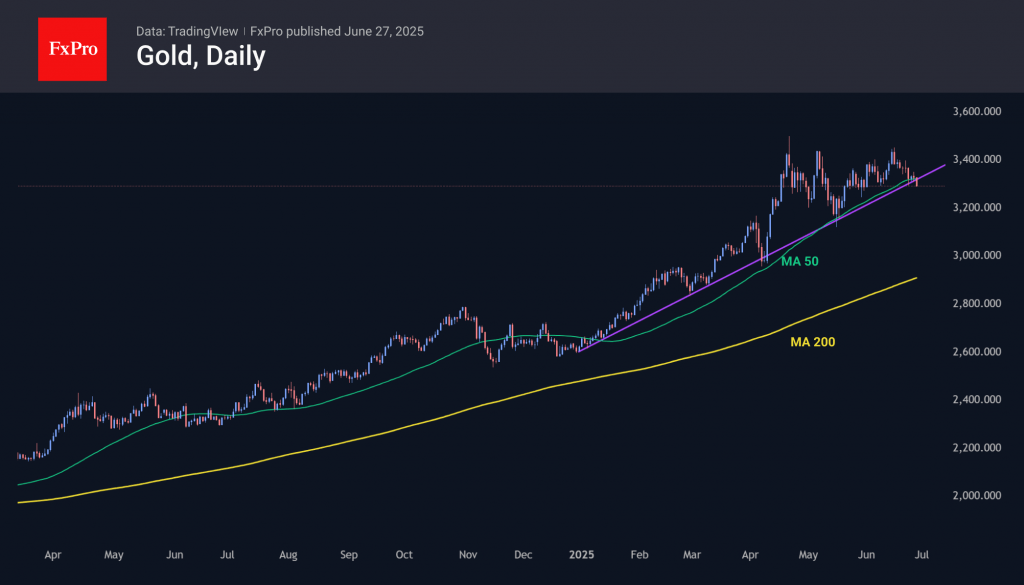
The Israel and Iran ceasefire has reduced demand for gold as a safe-haven asset. The precious metal failed to break out of the medium-term consolidation range of $3,100 to $3,400 per troy ounce and resume its upward trend. This signals weakness among bulls and allows Citigroup to predict a fall in prices below $3,000 in 2026. According to the bank, thanks to Donald Trump’s ‘big and beautiful’ tax bill, the acceleration of the US economy will push gold prices down. The decrease in geopolitical risks will also contribute to gold’s decline.
Goldman Sachs, on the other hand, maintains its forecast for the precious metal to rise to $4,000. It cites the insatiable appetite of central banks, the weakening dollar, and the fall in US Treasury bond yields. Indeed, the White House is keen on lower debt market rates and a weaker currency. A recent survey by the World Gold Council shows that 43% of central banks plan to increase their bullion purchases over the next 12 months, up from just 29% a year ago.
The recent de-escalation has once again tested gold’s support at its uptrend, marked by the 50-day moving average. On Friday, sellers pushed the price below this level, which passes through $3324, and are even attempting to stabilise below $3300. In May, a sharp movement managed to push the price back above this line. However, this metric is now turning downward, reflecting over two months of consolidation after reaching recent highs.
All signs indicate a potential repeat of the consolidation seen in November-December last year, which laid the groundwork for the subsequent rally. However, there is also a high probability that the failure to break through the $3500 level over the past two months signals a global trend reversal. We await whether this will mirror 2020, with a 20% correction in the next six months and a two-year sideways movement or resemble the nearly halving in gold prices from 2011 to 2015.