

Sample Category Title
EUR/GBP Daily Outlook
Daily Pivots: (S1) 0.8515; (P) 0.8527; (R1) 0.8538; More...
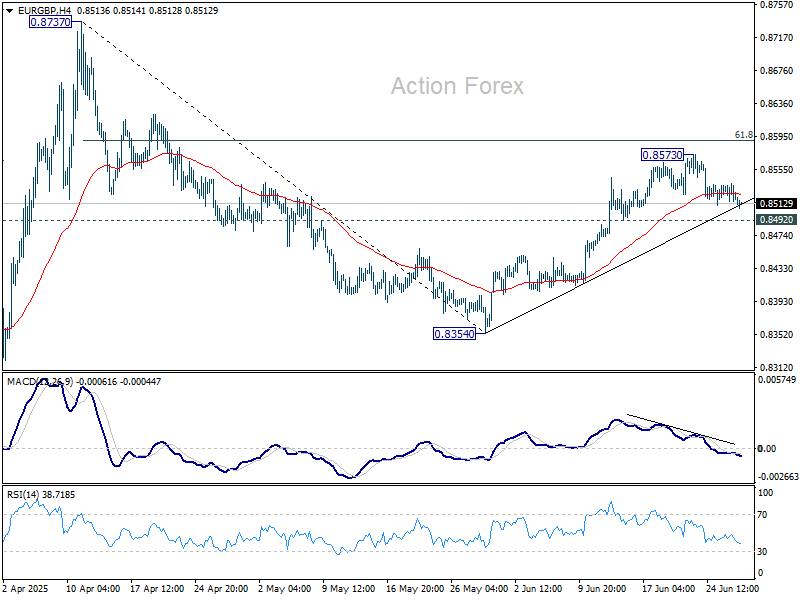
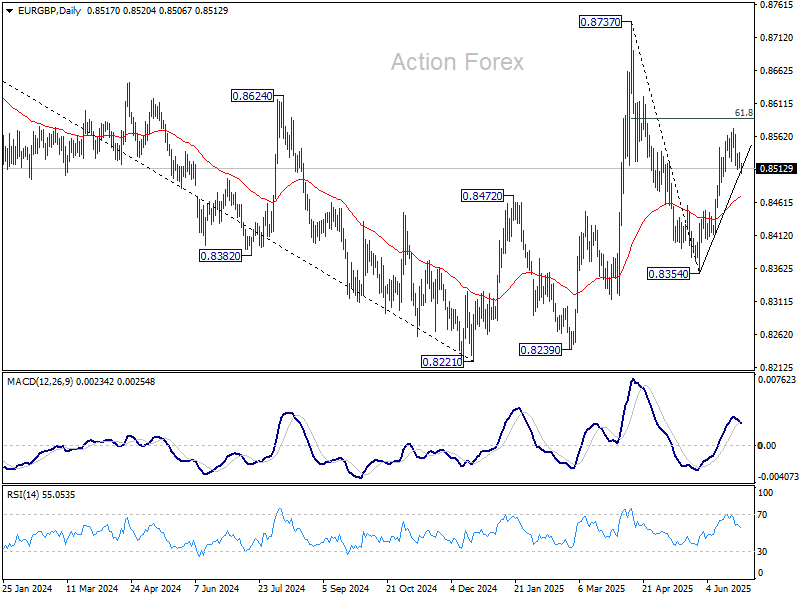
EUR/GBP is staying in consolidations below 0.8573 and intraday bias remains neutral. Further rise remains mildly in favor with 0.8492 support intact. Above 0.8573 will target 61.8% retracement of 0.8737 to 0.8354 at 0.8591. Firm break there will pave the way to 0.8373 resistance. However, firm break of 0.8492 will argue that rebound from 0.8354 has completed, and turn bias back to the downside.
In the bigger picture, price actions from 0.8221 medium term bottom are merely forming a corrective pattern to the down trend from 0.9267 (2022 high). Nevertheless, there is no clear momentum to break through 0.8201 key support (2022 low) yet. Hence, range trading is expected between 0.8221/8737 for now.
EUR/AUD Daily Outlook
Daily Pivots: (S1) 1.7842; (P) 1.7892; (R1) 1.7925; More...
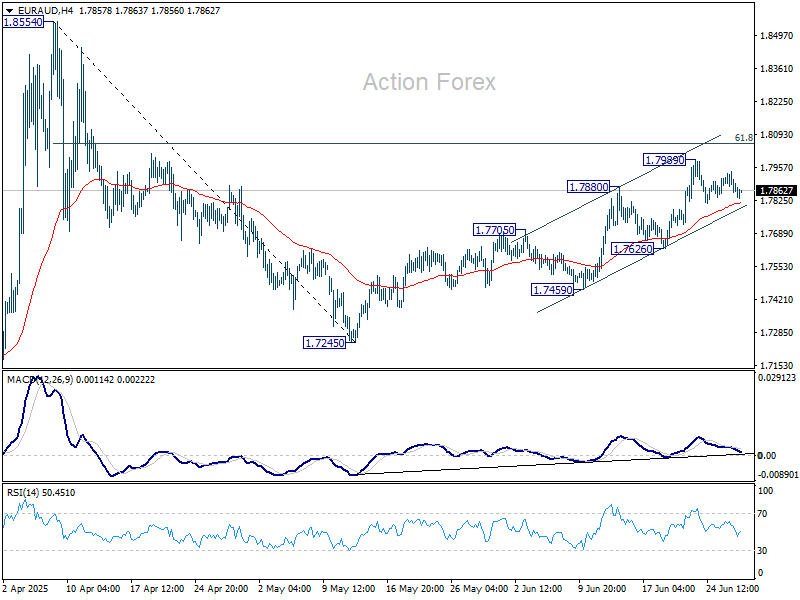
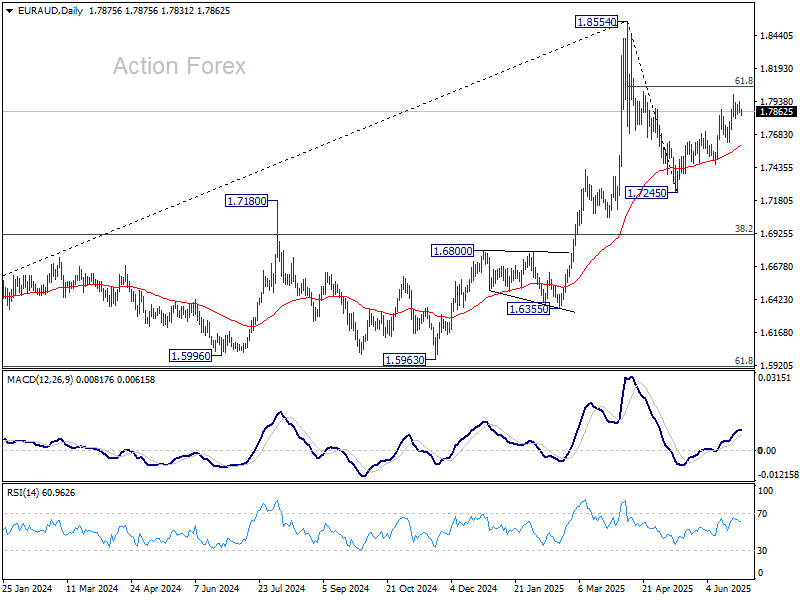
EUR/AUD is extending consolidations below 1.7989 and intraday bias remains neutral. Further rise is expected as long as 1.7626 support holds. Above 1.7989 will target 61.8% retracement of 1.8554 to 1.7245 at 1.8054. Firm break there will pave the way to 1.8554.
In the bigger picture, price actions from 1.8554 medium term are currently seen as a corrective pattern. While deeper pullback might be seen, downside should be contained by 38.2% retracement of 1.4281 (2022 low) to 1.8554 at 1.6922 to bring rebound. Up trend from 1.4281 is expected to resume at a later stage.
EUR/CHF Daily Outlook
Daily Pivots: (S1) 0.9347; (P) 0.9374; (R1) 0.9393; More....
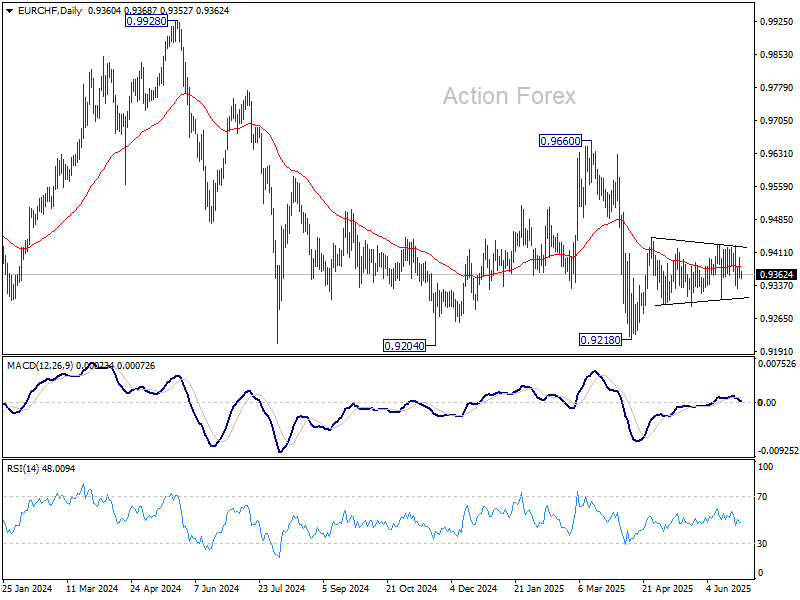
Intraday bias in EUR/CHF remains neutral as range trading continues. On the upside, break of 0.9428/45 resistance zone will resume the rebound from 0.9218. However, break of 0.9306 will turn bias back to the downside for retesting 0.9218 low instead.
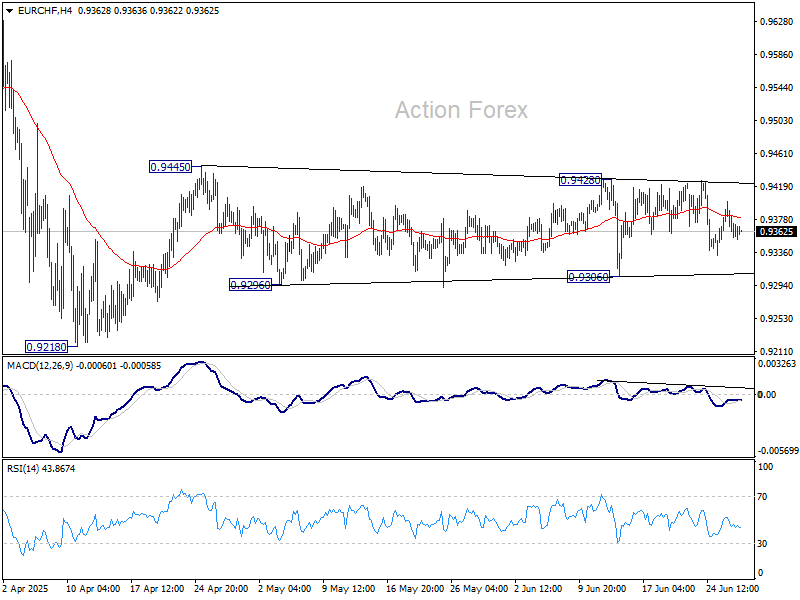
In the bigger picture, prior rejection by long-term falling channel resistance (now at 0.9511) retains medium term bearishness. That is, down trend from 1.2004 (2018 high) is still in progress. Firm break of 0.9204 (2024 low) will confirm resumption. This will remain the favored case as long as 0.9660 resistance holds.
EUR/USD Daily Outlook
Daily Pivots: (S1) 1.1655; (P) 1.1700; (R1) 1.1747; More...
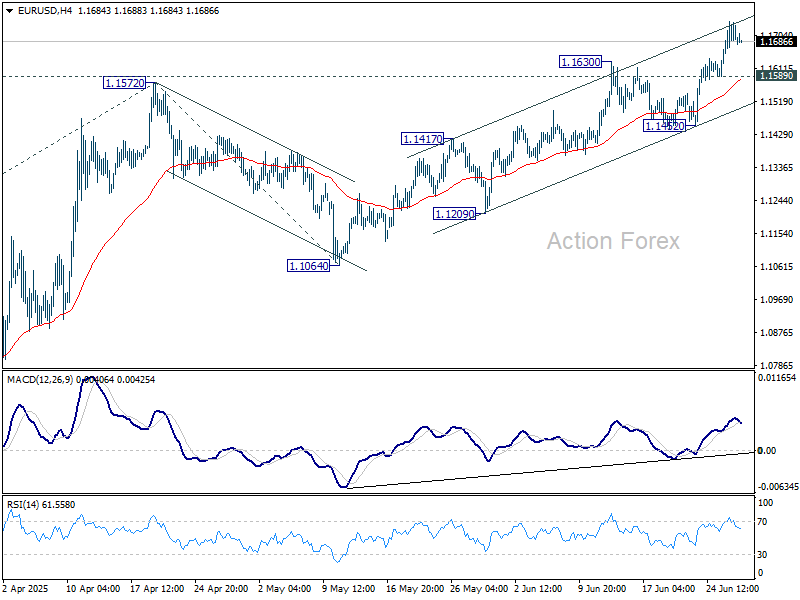
Intraday bias in EUR/USD stays on the upside and current rise should target 61.8% projection of 1.0176 to 1.1572 from 1.1064 at 1.1927. On the downside, below 1.1589 minor support will turn intraday bias neutral and bring consolidations. But downside should be contained above 1.1452 support to bring another rally.
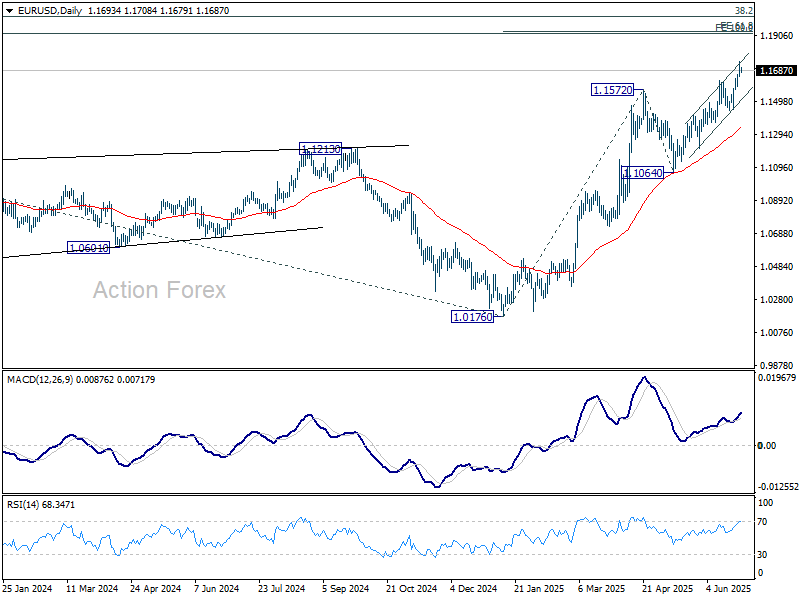
In the bigger picture, rise from 0.9534 long term bottom could be correcting the multi-decade downtrend or the start of a long term up trend. In either case, further rise should be seen to 100% projection of 0.9534 to 1.1274 from 1.0176 at 1.1916. This will now remain the favored case as long as 1.1604 support holds.
USD/JPY Daily Outlook
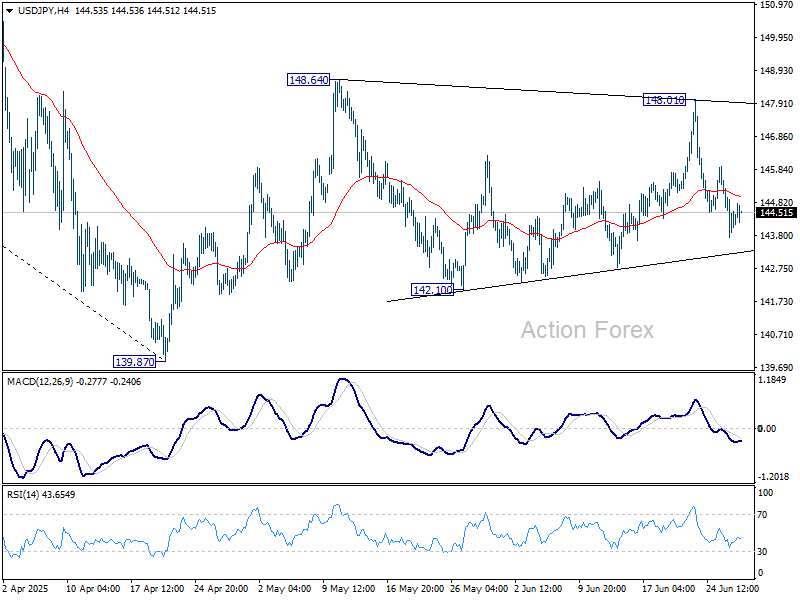
Daily Pivots: (S1) 143.66; (P) 144.48; (R1) 145.21; More...
Range trading continues in USD/JPY and intraday bias stays neutral for the moment. On the upside. firm break of 148.64 will resume the rise from 139.87 to 61.8% retracement of 158.86 to 139.87 at 151.22. However, break of 142.10 will bring deeper fall back to retest 139.87 low.
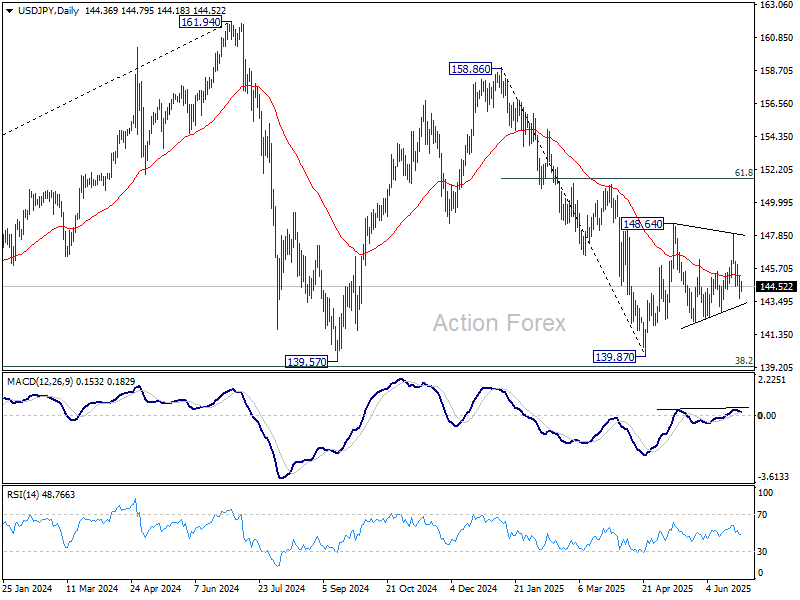
In the bigger picture, price actions from 161.94 are seen as a corrective pattern to rise from 102.58 (2021 low), with fall from 158.86 as the third leg. Strong support should be seen from 38.2% retracement of 102.58 to 161.94 at 139.26 to bring rebound. However, sustained break of 139.26 would open up deeper medium term decline to 61.8% retracement at 125.25.
GBP/USD Daily Outlook
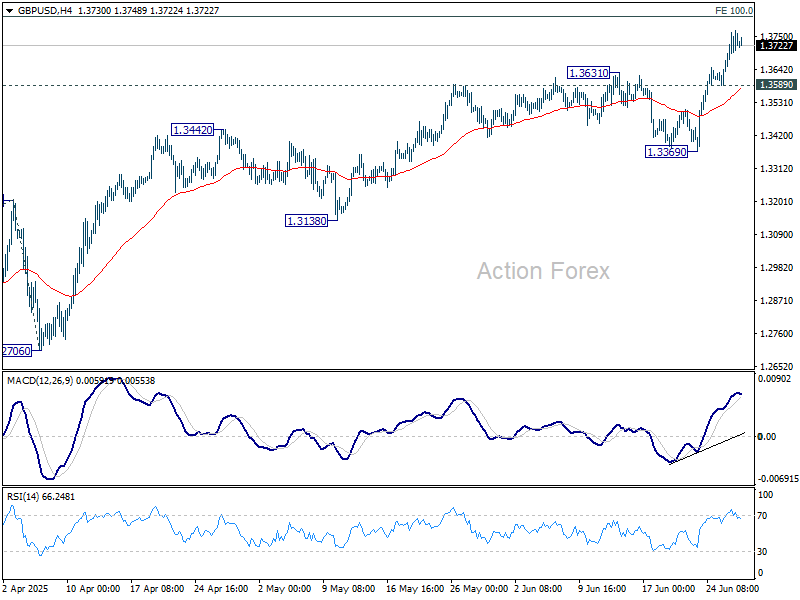
Daily Pivots: (S1) 1.3662; (P) 1.3716; (R1) 1.3783; More...
Intraday bias in GBP/USD stays on the upside and current rally should target 100% projection of 1.2099 to 1.3206 from 1.3138 at 1.3813 next. On the downside, below 1.3589 minor support will turn intraday bias neutral and bring consolidations. But downside should be contained above 1.3369 support to bring another rally.
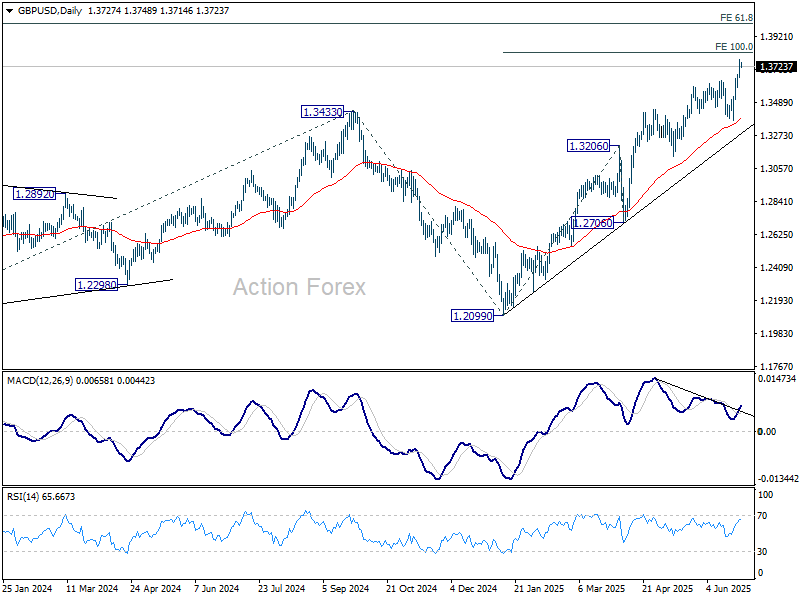
In the bigger picture, up trend from 1.3051 (2022 low) is in progress. Next medium term target is 61.8% projection of 1.0351 to 1.3433 from 1.2099 at 1.4004. Outlook will now stay bullish as long as 55 W EMA (now at 1.2948) holds, even in case of deep pullback.
USD/CHF Daily Outlook
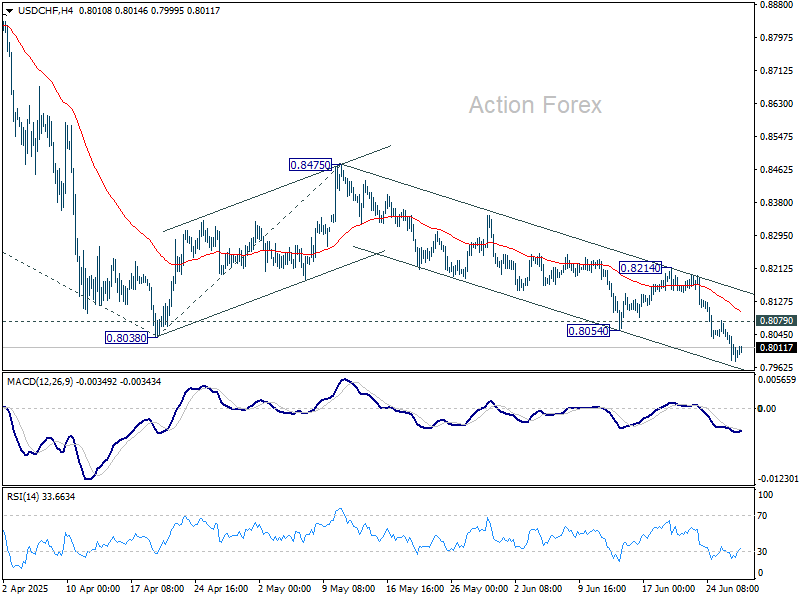
Daily Pivots: (S1) 0.7970; (P) 0.8012; (R1) 0.8044; More….
Intraday bias in USD/CHF remains on the downside at this point. Current down trend should target 61.8% projection of 0.9200 to 0.8038 from 0.8475 at 0.7757 next. On the upside, above 0.8079 minor resistance will turn intraday bias neutral and bring consolidations. But recovery should be limited below 0.8214 resistance to bring another fall.
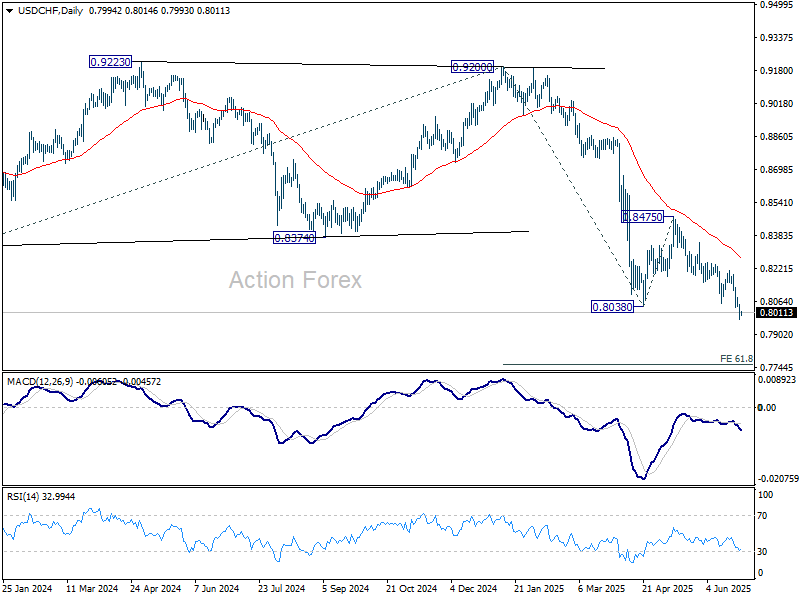
In the bigger picture, long term down trend from 1.0342 (2017 high) is still in progress. Next target is 100% projection of 1.0146 (2022 high) to 0.8332 from 0.9200 at 0.7382. In any case, outlook will stay bearish as long as 0.8475 resistance holds.
USD/CAD Daily Outlook
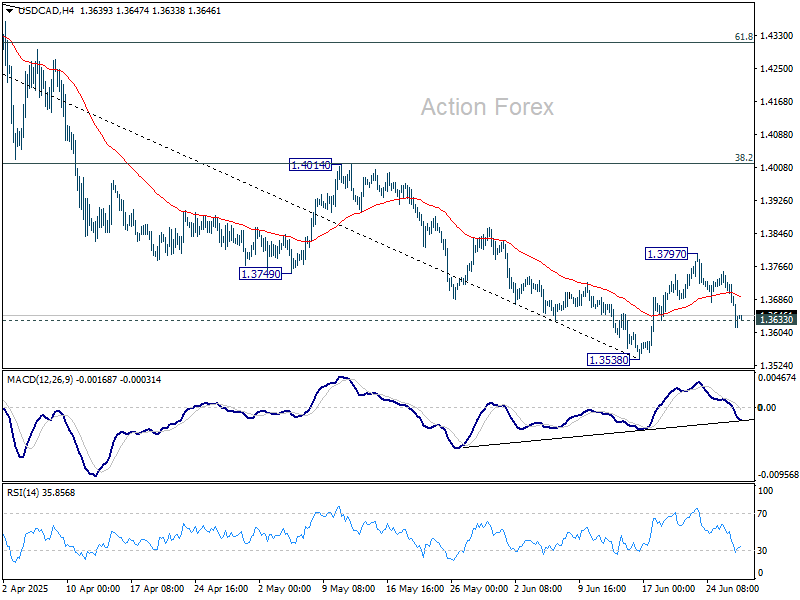
Daily Pivots: (S1) 1.3596; (P) 1.3663; (R1) 1.3709; More...
USD/CAD's break of 1.3633 minor support suggests that corrective recovery from 1.3538 has completed at 1.3797. Intraday bias is back on the downside. Firm break of 1.3538 will resume larger fall from 1.4791. On the upside, break of 1.3797 will extend the corrective bounce towards 1.4014 cluster resistance (38.2% retracement of 1.4791 to 1.3538 at 1.4017).
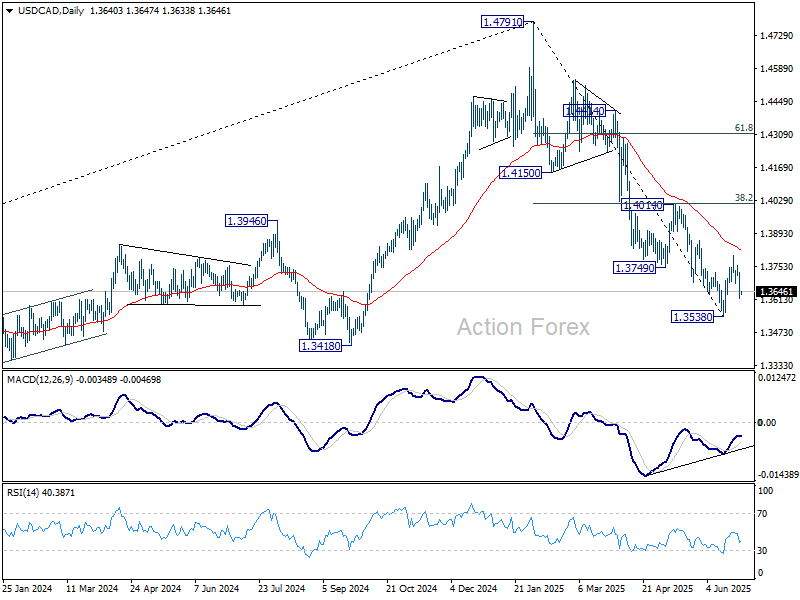
In the bigger picture, price actions from 1.4791 medium term top could either be a correction to rise from 1.2005 (2021 low), or trend reversal. In either case, further decline is expected as long as 1.4014 resistance holds. Next target is 61.8% retracement of 1.2005 (2021 low) to 1.4791 at 1.3069.
AUD/USD Daily Report
Daily Pivots: (S1) 0.6511; (P) 0.6538; (R1) 0.6572; More...
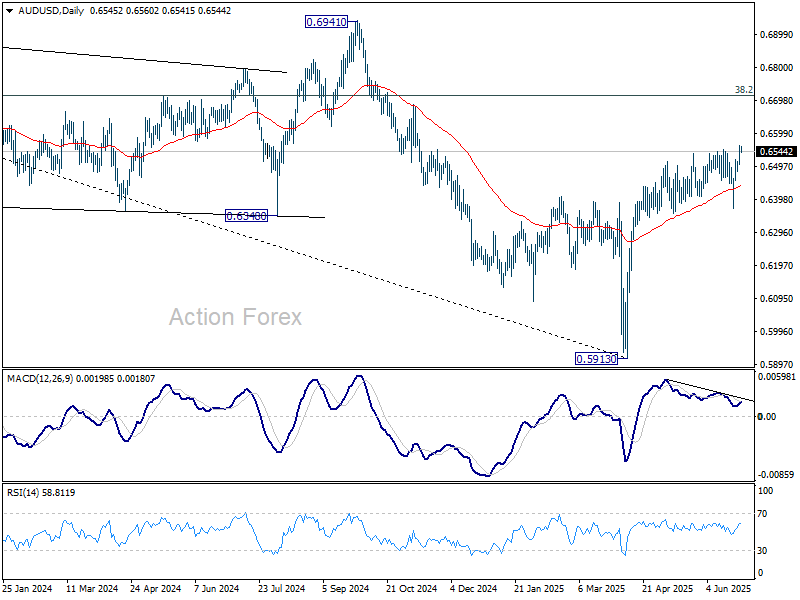
AUD/USD's rise from 0.5913 finally resumed by breaking 0.6551 resistance. Intraday bias is back on the upside for 0.6713 fibonacci level. On the downside, below 0.6483 minor support will turn intraday bias neutral first. But near term outlook will now stay bullish as long as 0.6372 support holds, in case of retreat.
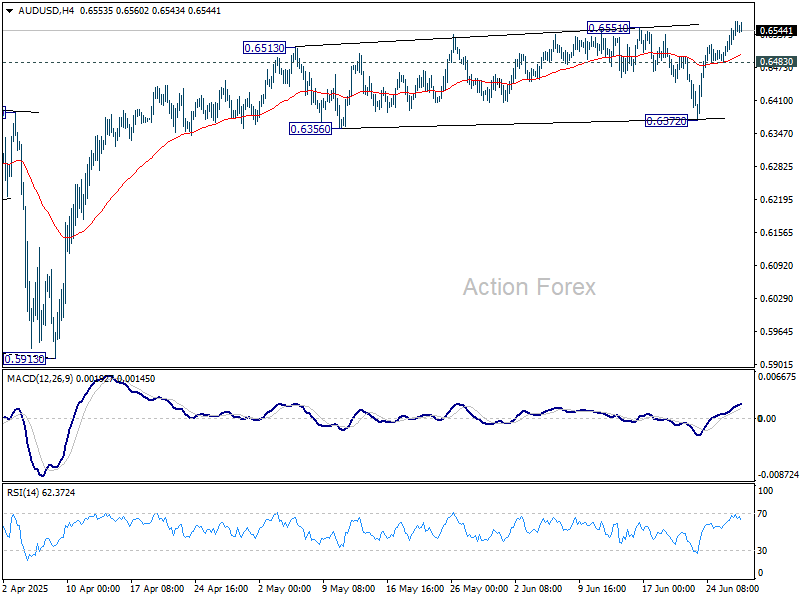
In the bigger picture, there is no clear sign that down trend from 0.8006 (2021 high) has completed. Rebound from 0.5913 is seen as a corrective move. While stronger rally cannot be ruled out, outlook will remain bearish as long as 38.2% retracement of 0.8006 to 0.5913 at 0.6713 holds. Nevertheless, considering bullish convergence condition in W MACD, even in case of another fall through 0.5913, downside should be contained above 0.5506 (2020 low).
Risk Appetite Holds, Dollar Extends Losses Markets Eye PCE into Friday’s Finish
Global risk sentiment remains firm heading into the weekend, with both S&P 500 and NASDAQ pushing near record highs overnight. Asian markets followed suit, with Japan’s Nikkei breaking above the symbolic 40k mark, extending its robust rally driven by AI optimism and strong corporate earnings.
The bullish tone persists despite persistent warnings from Fed officials that a July rate cut is unlikely. Instead, Fed’s consistent message of "not now, but likely later" is reinforcing market hopes that easing will resume by fall. Most policymakers continue to emphasize patience due to tariff-related inflation risks, yet concede that inflation appears to be trending back toward target. This dovish tilt later in the year is offering enough support for equity bulls to stay in control.
Traders are now squarely focused on May’s US PCE inflation release. A modest rise is expected, with headline PCE set to climb to 2.3% and core PCE to 2.6%. A soft reading would further cement the case for September easing, while any significant surprise to the upside could temporarily dampen sentiment. For now, though, investors appear optimistic that inflation remains manageable.
In contrast, China delivered fresh disappointment. Industrial profits plunged -9.1% yoy in May, the steepest drop since last October, reflecting continued weakness in domestic demand and pricing power. Cumulative profits are down 1.1% year-to-date, despite Beijing’s targeted stimulus. The data highlight the limits of China's support measures and add to growth concerns.
In currency markets, Dollar remains under pressure and looks set to finish the week as the worst performer, followed by Loonie and Yen. Swiss Franc leads on the upside, with Sterling and Kiwi close behind. Euro and Aussie are positioning in the middle.
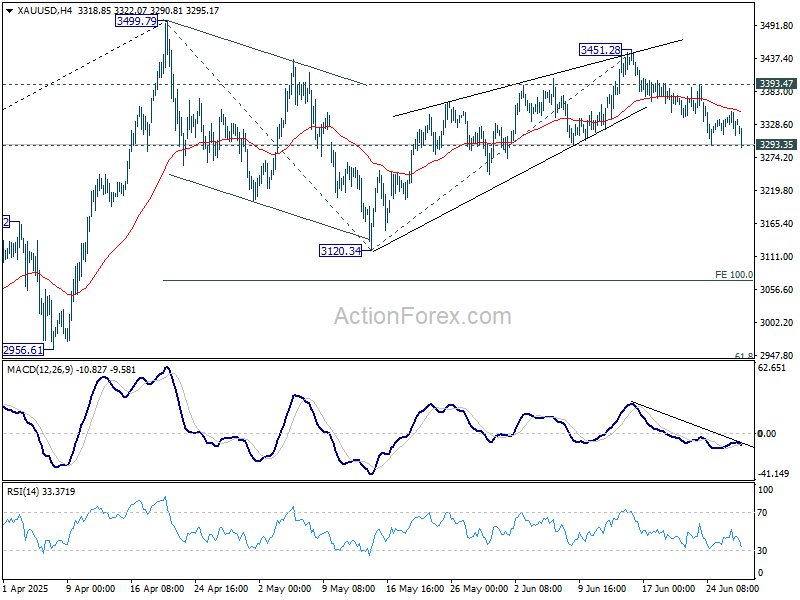
Technically, Gold's weakness returns today and focus is back on 3293.35 support. Firm break there will resume the fall from 3451.28. That would also solidify the case that whole corrective pattern from 3499.79 is already in the third leg. Deeper decline should then be seen back to 3120.34 support.
In Asia, at the time of writing, Nikkei is up 1.56%. Hong Kong HSI is down -0.06%. China Shanghai SSE is down -0.21%. Singapore Strait Times is up 0.64%. Japan 10-year JGB yield is up 0.01 at 1.434. Overnight, DOW rose 0.94%. S&P 500 rose 0.80%. NASDAQ rose 0.97%. 10-year yield fell -0.040 to 4.253.
Tokyo core inflation slows to 3.1% in June, but food costs still surging
Tokyo’s core CPI (ex-fresh food) slowed more than expected in June, coming in at 3.1% yoy versus 3.6% yoy in May and below forecasts of 3.4% yoy. The decline was largely driven by the resumption of fuel subsidies and temporary reductions in utility charges. Core-core CPI, which strips out both fresh food and energy, also eased to 3.1% yoy from 3.3% yoy.
However, the figure masks ongoing strain on household budgets. Food prices (excluding volatile items) rose a sharp 7.2% yoy, accelerating from May's 6.9% yoy. Tokyo consumers paid nearly 90% more for rice and faced eye-watering increases in chocolate and coffee costs. Service prices edged down slightly but remained elevated at 2.1%.
On the labor side, Japan's May jobless rate held steady at 2.5%, while the job-to-applicant ratio slipped slightly to 1.24.
Fed's Barr: Tariffs pose dual risk to inflation and jobs, justifying wait and see
Fed Governor Michael Barr said overnight that tariffs may pose a dual threat to the economy—lifting inflation expectations while simultaneously slowing growth. He pointed to survey data showing households anticipate sharp near-term price increases, which, coupled with supply chain reconfiguration and second round effects effects, could result in "some inflation persistence."
At the same time, Barr acknowledged tariffs could cause the economy to slow and unemployment to rise," disproportionately impacting low-income workers.
Given these uncertainties, Barr advocated for a patient policy approach. “Monetary policy is well positioned to allow us to wait and see how economic conditions unfold,” he said.
Fed’s Collins: July cut too soon, needs more data before moving
Boston Fed President Susan Collins said in a Bloomberg interview that July is too soon for a rate cut, pointing to the limited data available between now and the next FOMC meeting. “We’re only going to have really one more month of data before the July meeting,” she noted, adding, “I expect to want to see more information than that.”
Collins emphasized there’s no urgency to ease policy and reaffirmed her baseline view that cuts are likely later this year. Whether that translates to “one rate cut” or potentially more, she said, will depend entirely on how the data evolves.
Fed's Kashkari needs clarity before cutting rates
Minneapolis Fed President Neel Kashkari reiterated the cautious stance on monetary policy, citing continued uncertainty over the inflationary impact of new tariffs. Speaking at an event overnight, Kashkari said the Fed needs to "go slow" until it gains more clarity, adding, “We still need to get a better assessment of what impact tariffs are going to have on the economy. We just don't know yet.”
He noted that many businesses are hesitating to raise prices, fearing a backlash if tariffs are later reversed. Kashkari also highlighted the ability of supply chains to adapt and “find their way around and through barriers,” suggesting the inflation impact might be more muted than expected.
AUD/USD Daily Report
Daily Pivots: (S1) 0.6511; (P) 0.6538; (R1) 0.6572; More...
AUD/USD's rise from 0.5913 finally resumed by breaking 0.6551 resistance. Intraday bias is back on the upside for 0.6713 fibonacci level. On the downside, below 0.6483 minor support will turn intraday bias neutral first. But near term outlook will now stay bullish as long as 0.6372 support holds, in case of retreat.
In the bigger picture, there is no clear sign that down trend from 0.8006 (2021 high) has completed. Rebound from 0.5913 is seen as a corrective move. While stronger rally cannot be ruled out, outlook will remain bearish as long as 38.2% retracement of 0.8006 to 0.5913 at 0.6713 holds. Nevertheless, considering bullish convergence condition in W MACD, even in case of another fall through 0.5913, downside should be contained above 0.5506 (2020 low).