Sample Category Title
Fed’s Daly sticks to fall cut view, says policy in good place
San Francisco Fed President Mary Daly reiterated her long-standing view that the central bank could begin easing policy in the fall, telling Bloomberg TV, “My modal outlook has been for some time that we would begin to be able to adjust the rates in the fall, and I haven’t really changed that view.”
She added that current policy is in a “good place,” signaling comfort with Fed’s patient stance. Daly also noted that while the labor market is showing signs of cooling, it has not deteriorated enough to warrant immediate action.
Fed’s Barkin: Inflation pressure likely to rise, no urgency to cut
Richmond Fed President Thomas Barkin warned that tariff-driven inflation pressure is likely to intensify, even if its effects have been modest so far. “I do believe we will see pressure on prices,” Barkin said in a speech today, adding that while past tariff increases had only limited impact on measured inflation, “more pressure is coming.”
Barkin also signaled no urgency to adjust policy, saying the economy’s strength gives the Fed room to remain patient. “We have time to track developments patiently and allow the visibility to improve,” he said. “When it does, we are well positioned to address whatever the economy will require.”
Sunset Market Commentary
Markets
Bull steepening is name of the game this week in the US. From Friday’s close, yield changes currently range between -6.5 bps (30-yr) and -17 bps (2-yr). The outperformance at the front end of the curve is driven by a slew of disappointing US eco data, a subtle change of tone in Fed Chair Powell’s House testimony after some monetary doves already ruffled their feathers and the latest rant of US President Trump against that same Fed chair. To be clear: official Fed rhetoric still strictly focuses on fighting (upside) inflation (risks) by means of an unaltered policy rate (4.25%-4.5%) in restrictive territory. Fed Chair Powell at the press conference indicated that we’ll know a lot more over summer. For the first time he emphasized cutting policy rates sooner rather than later in case of a weakening of the US labour market or if inflation risks don’t materialize. By doing so, he starts creating room for maneuvering by the September Fed meeting. SF Fed Daly today also suggested that fall looks promising for a rate cut. Given the policy space left above neutral (3%) and with the Fed’s daring 50 bps opening rate cut last September in mind, we believe the US central bank might use a stealth normalization strategy once it is confident that the ultimate tariff level won’t significantly and structurally raise inflation (expectations). The set-up implies asymmetric risks going into next week’s ISM surveys, ADP employment change and payrolls with markets especially attentive to downside risks. Looking at the technical chart of the 2-yr yield, we see more downward potential in coming months in first instance towards 3.5% (low 2023/2024/2025) but likely even towards the 3%-zone. The relative loss of interest rate support adds to the long list of USD-negative factors. The US currency today touched multiyear lows against some majors after president Trump openly played with the idea of rapidly nominating Powell’s successor turning the current Fed chair into yesterday’s man: EUR/USD 1.1744, GBP/USD 1.3765, DXY 97. The greenback remains in a sell-on-uptickspattern. Apart from the data and Fed positioning, near term risks include the passage of Trump’s big beautiful, deficit-enlarging bill.
News & Views
The Swedish National Institute of Economic Research published its June Economic Tendency indicator. It declined from 94.5 to 92.8, which the NIER labels as weaker than usual. On the business activity side, sentiment softened across all sectors. Manufacturing confidence declined only marginally and stays close to the historical average, but pricing plans fell notably. While declining, construction sentiment signals a ‘normally strong mood’. The decline in the trade sector was one of the largest ever recorded, signaling a weak mood. Confidence in the services sector also declined, reaching the lowest level since February 2024. Consumer confidence rose slightly but remains at a low level. This weak Tendency Survey comes as the Minutes of the June Riksbank meeting yesterday showed ample support for the 25 bps cut to 2% on June 19. There was also broad support to at least keep the option open for further easing later this year as several MPC members acknowledged downside risks to growth that might warrant some policy support while (underlying) inflationary pressures are seen easing. Money markets almost fully discount an additional cut in H2. The krone declined after the last week’s decision with EUR/SEK holding above 11 (11.07).
The June retail sales measure of the Confederation of British industry was very poor. June sales declined sharply this month with the reported balance at -46% from -27% in May. This marked the ninth month in a row of declining volumes and retailers expect sales to fall further in July (-49%). Sales volumes for the time of year were judged to be “poor” to a greater extent than in May (-37% from -19%).Retail orders placed upon suppliers (-51 from -41) in the year to June declined at the fastest pace since December 2023 and retailers expect orders to fall at a similar pace next month. At the same time, retail stock volumes rose in relation to expected demand (+26% from +12%; long-run average of +17%) and are set to remain elevated in July (+27%). Wholesale sales declined at a slower pace in the year to June (-34) but are expected to fall again next month (-39%). The UK curve steepens further today. Sterling declines only marginally against the euro (EUR/GBP 0.8534). Cable even tests the strongest level against a weak dollar since October 2021 (GBP 1.372).
EUR/USD Mid-Day Outlook
Daily Pivots: (S1) 1.1612; (P) 1.1638; (R1) 1.1687; More...
Intraday bias in EUR/USD remains on the upside, and current rally should target 61.8% projection of 1.0176 to 1.1572 from 1.1064 at 1.1927. Below 1.1589 minor support will turn intraday bias neutral and bring consolidations. But downside should be contained above 1.1452 support to bring another rally.
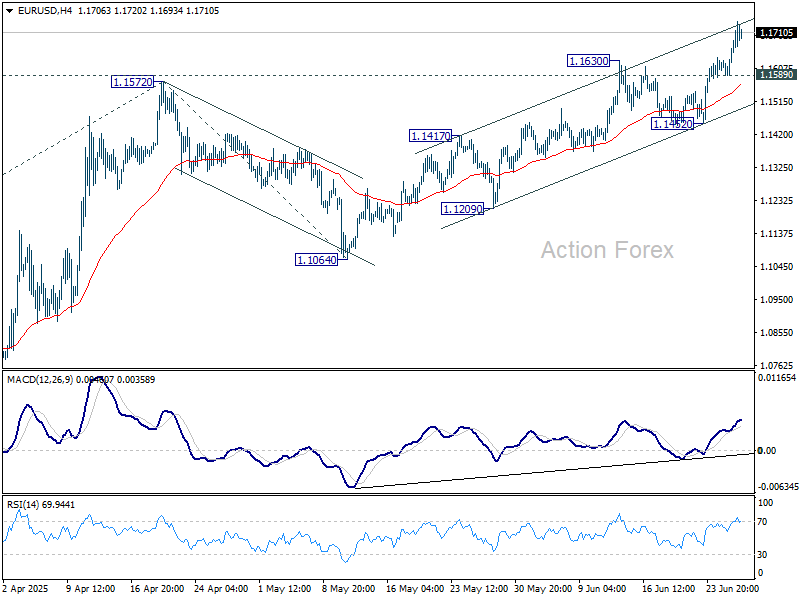
In the bigger picture, rise from 0.9534 long term bottom could be correcting the multi-decade downtrend or the start of a long term up trend. In either case, further rise should be seen to 100% projection of 0.9534 to 1.1274 from 1.0176 at 1.1916. This will now remain the favored case as long as 1.1604 support holds.
GBP/USD Mid-Day Outlook
Daily Pivots: (S1) 1.3613; (P) 1.3642; (R1) 1.3694; More...
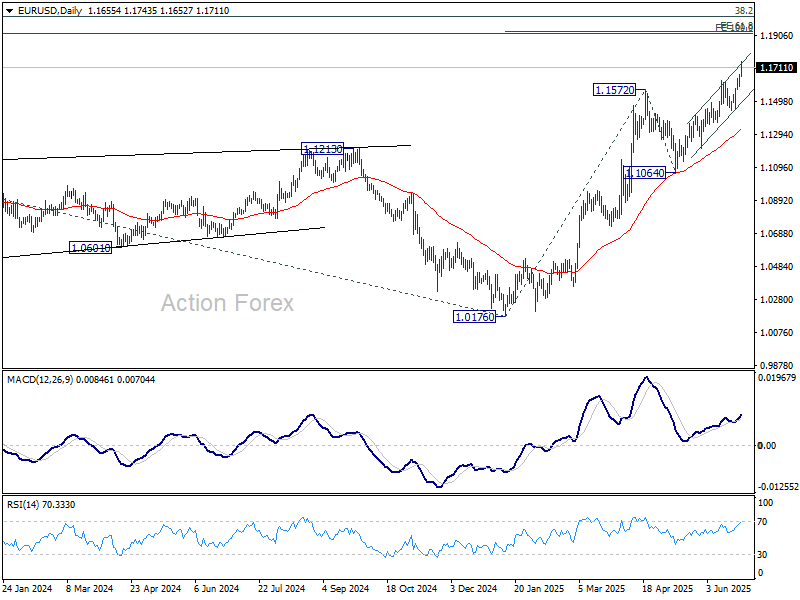
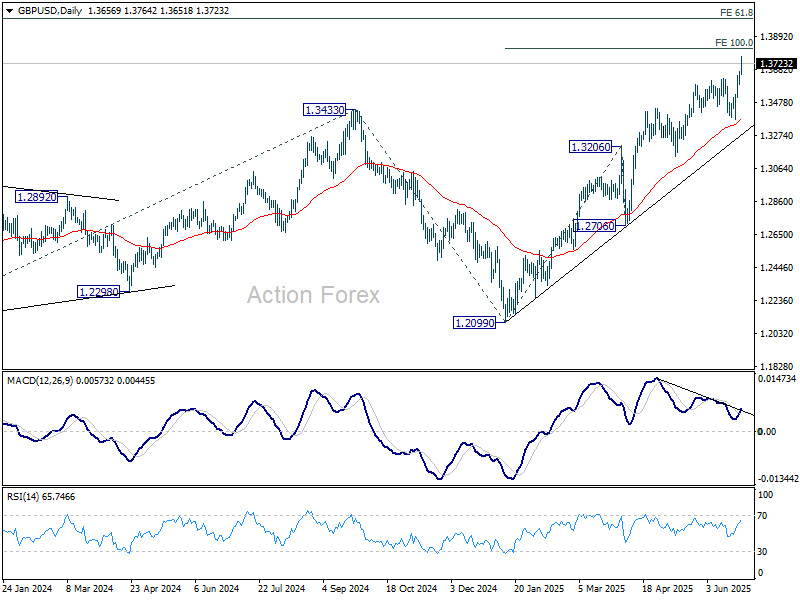
Intraday bias in GBP/USD remains on the upside, and current rally should target 100% projection of 1.2099 to 1.3206 from 1.3138 at 1.3813 next. On the downside, below 1.3589 minor support will turn intraday bias neutral and bring consolidations. But downside should be contained above 1.3369 support to bring another rally.
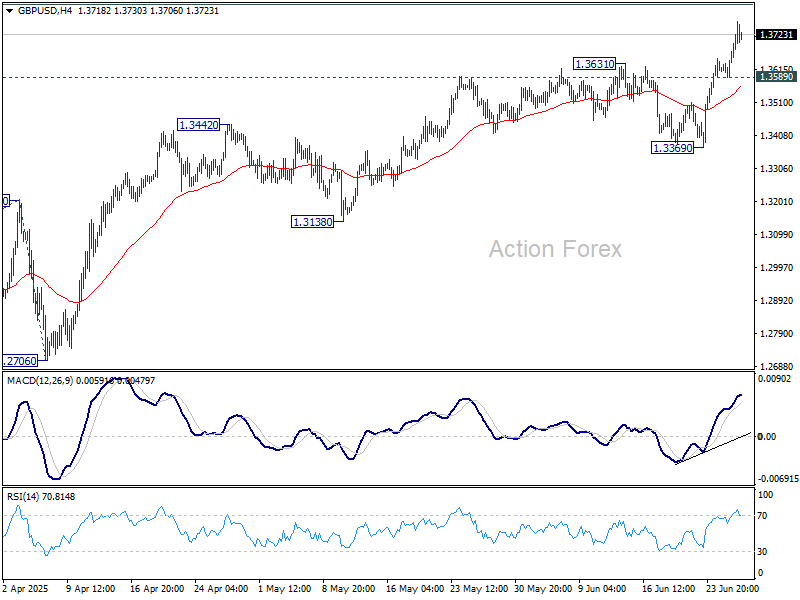
In the bigger picture, up trend from 1.3051 (2022 low) is in progress. Next medium term target is 61.8% projection of 1.0351 to 1.3433 from 1.2099 at 1.4004. Outlook will now stay bullish as long as 55 W EMA (now at 1.2948) holds, even in case of deep pullback.
USD/CHF Mid-Day Outlook
Daily Pivots: (S1) 0.8032; (P) 0.8056; (R1) 0.8073; More….
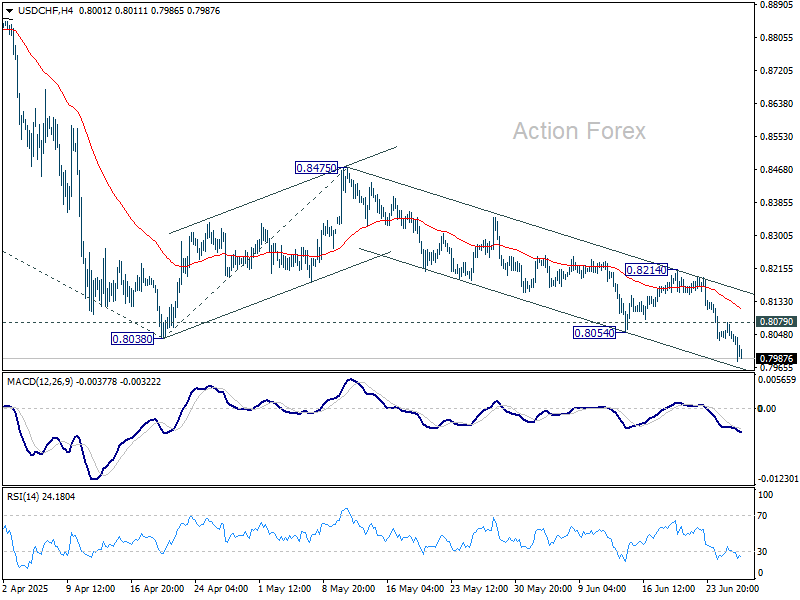
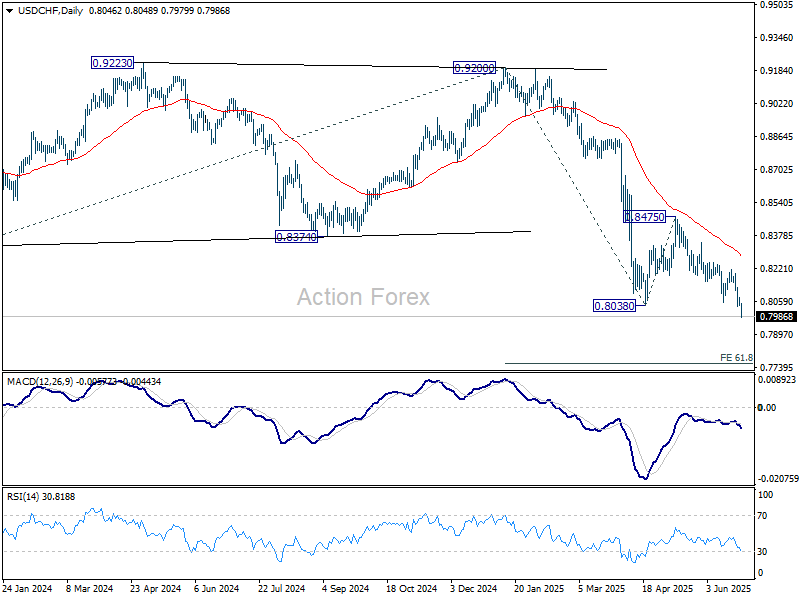
USD/CHF's down trend continues today and intraday bias stays on the downside for 61.8% projection of 0.9200 to 0.8038 from 0.8475 at 0.7757 next. On the upside, above 0.8079 minor resistance will turn intraday bias neutral and bring consolidations. But recovery should be limited below 0.8214 resistance to bring another fall.
In the bigger picture, long term down trend from 1.0342 (2017 high) is still in progress. Next target is 100% projection of 1.0146 (2022 high) to 0.8332 from 0.9200 at 0.7382. In any case, outlook will stay bearish as long as 0.8475 resistance holds.
USD/JPY Mid-Day Outlook
Daily Pivots: (S1) 144.59; (P) 145.27; (R1) 145.93; More...
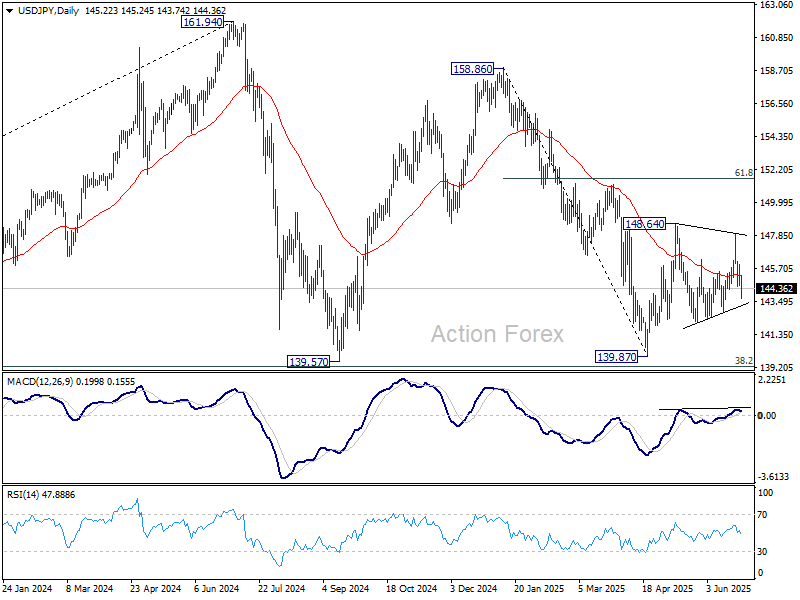
USD/JPY's fall from 148.01 extends lower today, but stays above 142.10 support. Intraday bias remains neutral and further rise is still in favor. On the upside. firm break of 148.64 will resume the rise from 139.87 to 61.8% retracement of 158.86 to 139.87 at 151.22. However, break of 142.10 will bring deeper fall back to retest 139.87 low.
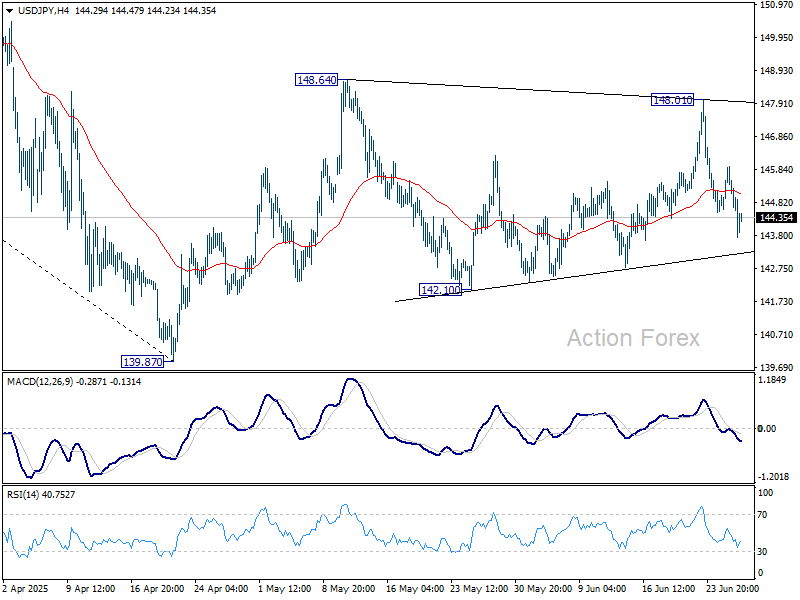
In the bigger picture, price actions from 161.94 are seen as a corrective pattern to rise from 102.58 (2021 low), with fall from 158.86 as the third leg. Strong support should be seen from 38.2% retracement of 102.58 to 161.94 at 139.26 to bring rebound. However, sustained break of 139.26 would open up deeper medium term decline to 61.8% retracement at 125.25.
Dollar Struggles After Mixed Data; Yen Rallies With Nikkei Surge
Dollar weakness continues to dominate FX markets, with the greenback staying under pressure across the board. he spotlight is on which currencies are capitalizing the most. Yen is stealing the show, along with sharp rally in the Nikkei as AI-fueled optimism sends semiconductor shares surging. Swiss Franc and Aussie are also firming, while the Kiwi and Loonie lag. Euro and Sterling are steady in the middle of the pack, with their earlier bullish momentum taking a breather.
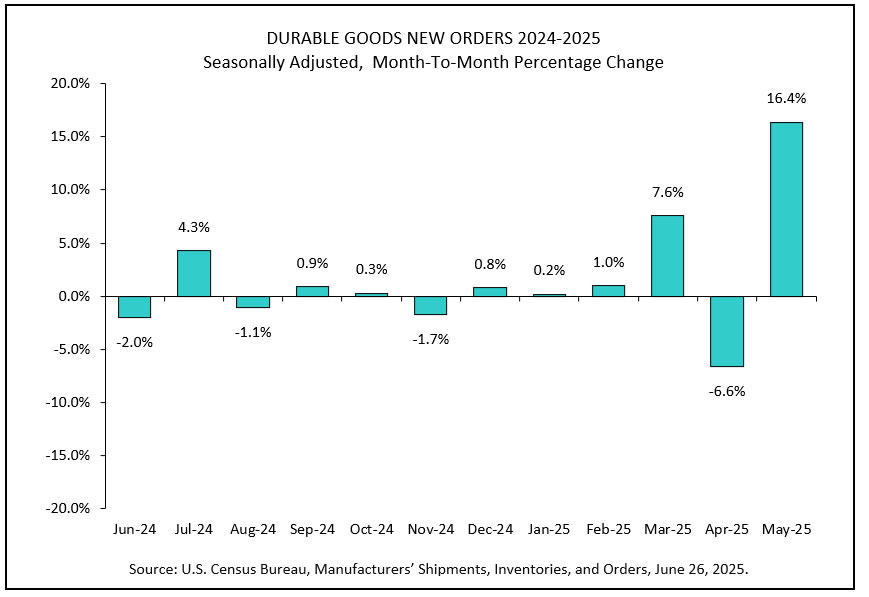
Economic data from the US did little to reverse the greenback’s decline. Finalized Q1 GDP was revised down to -0.5%, reinforcing concerns about underlying growth momentum. Durable goods orders surprised to the upside at 16.4%, but that strength was concentrated in a 48% surge in transportation equipment—most likely driven by tariff frontloading. Jobless claims fell more than expected, but signs of labor market resilience were not enough to shift the rate cut narrative.
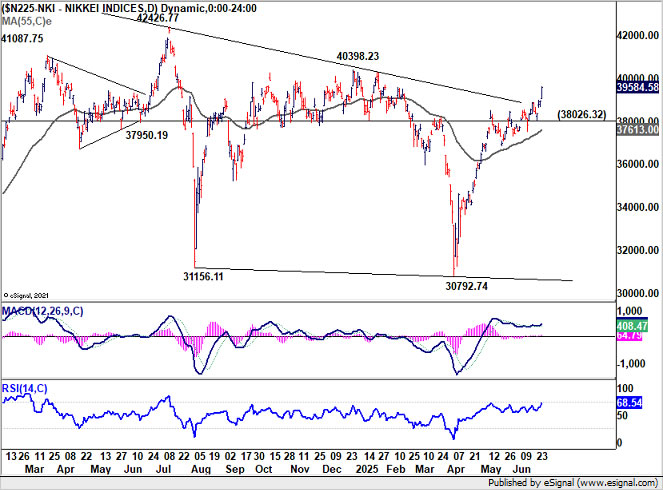
Earlier today, Japan’s Nikkei surged to a five-month high, with tech and chip-related stocks outperforming amid robust investor appetite linked to artificial intelligence demand. Despite pressure on automakers tied to slowing progress in US-Japan trade negotiations, the broader index rallied.
Technically, the break of trend line resistance solidifies that case medium term correction from 4246.77 has completed with three waves down to 30792.74. Further rally is expected in Nikkei as long as 38026.32 support holds. Break of 40398.23 will bring retest of 42426.77.
In Europe, at the time of writing, FTSE is up 0.24%. DAX is up 0.36%. CAC is down -0.01%. UK 10-year yield is down -0.02 at 4.464. Germany 10-year yield is down -0.023 at 2.549. Earlier in Asia, Nikkei rose 1.65%. Hong Kong HSI fell -0.61%. China Shanghai SSE fell -0.22%. Singapore Strait Times rose 0.32%. Japan 10-year JGB yield rose 0.02 to 1.425.
US durables rise 16.4% mom in May, transportation surges 48.3% mom
US durablg goods orders rose 16.4% mom to USD 343.6B in May, well above expectation of 6.8% mom. Ex-transport orders rose 0.5% mom, above expectation of 0.1% mom. Excluding defense, new orders increased 15.5% mom. Transportation equipment, up five of the last six months, led the increase, by 48.3% mom to USD 145.3B.
US initial jobless claims fall to 236k vs exp 247k
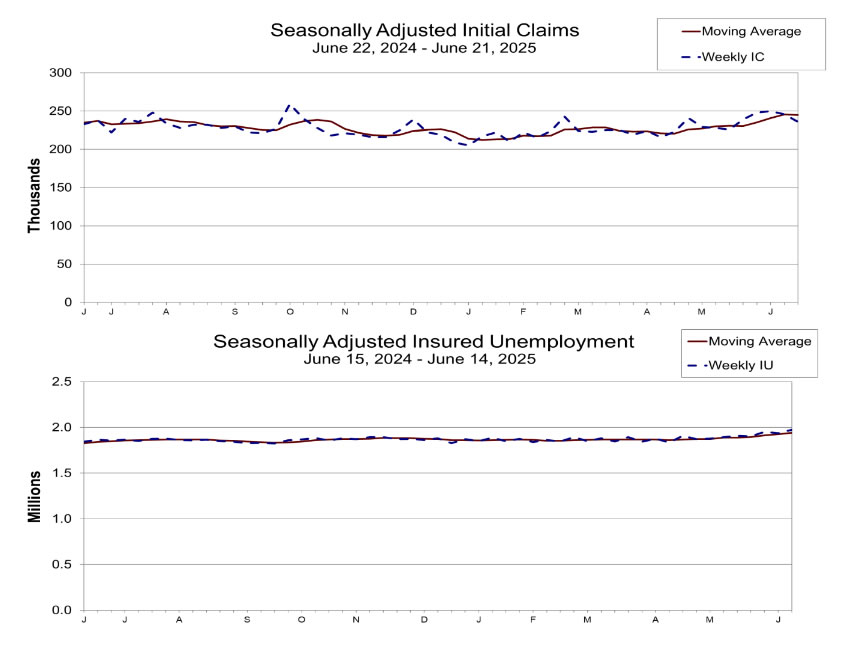
US initial jobless claims fell -10k to 236k in the ween ending June 21, below expectation of 247k. Four-week moving average of initial claims fell -750 to 245k.
Continuing claims rose 37k to 1974k in the week ending June 14, the highest level since November 6, 2021. Four-week moving average of continuing claims rose 17k to 1941k, highest since November 20, 2021.
BoE's Bailey: Policy still restrictive to squeeze out sticky inflation
BoE Governor Andrew Bailey said in a speech today that while the UK has made notable progress on disinflation, monetary policy remains restrictive to "squeeze out remaining persistence in inflationary pressures".
Speaking weeks ahead of the August policy meeting, Bailey stressed the presence of “two-sided risks” to inflation. He emphasized that a "gradual and careful approach" remains appropriate and monetary policy is "not on a pre-set path".
Germany’s Gfk consumer sentiment falls to -20.3, mood sours slightly as precautionary saving picks up
German consumer sentiment slipped slightly in July, with the Gfk index easing from -20.0 to -20.3, missing expectations of a recovery to -19.0.
The drop came despite a strong rebound in the economic expectations component, which surged seven points to 20.1—its highest since the early stages of the Ukraine war. Income expectations also improved for the fourth consecutive month, rising to 12.8.
Yet the consumer climate remains weighed down by caution. The willingness-to-buy index was subdued at -6.2. The notable jump in the savings indicator to 13.9, the highest since April 2024, suggests that households are still holding back on discretionary spending.
GfK’s Rolf Bürkl pointed to rising savings as a key drag, reflecting continued uncertainty and a lack of confidence in making large purchases.
USD/JPY Mid-Day Outlook
Daily Pivots: (S1) 144.59; (P) 145.27; (R1) 145.93; More...
USD/JPY's fall from 148.01 extends lower today, but stays above 142.10 support. Intraday bias remains neutral and further rise is still in favor. On the upside. firm break of 148.64 will resume the rise from 139.87 to 61.8% retracement of 158.86 to 139.87 at 151.22. However, break of 142.10 will bring deeper fall back to retest 139.87 low.
In the bigger picture, price actions from 161.94 are seen as a corrective pattern to rise from 102.58 (2021 low), with fall from 158.86 as the third leg. Strong support should be seen from 38.2% retracement of 102.58 to 161.94 at 139.26 to bring rebound. However, sustained break of 139.26 would open up deeper medium term decline to 61.8% retracement at 125.25.
US durables rise 16.4% mom in May, transportation surges 48.3% mom
US durable goods orders rose 16.4% mom to USD 343.6B in May, well above expectation of 6.8% mom. Ex-transport orders rose 0.5% mom, above expectation of 0.1% mom. Excluding defense, new orders increased 15.5% mom. Transportation equipment, up five of the last six months, led the increase, by 48.3% mom to USD 145.3B.
US initial jobless claims fall to 236k vs exp 247k
US initial jobless claims fell -10k to 236k in the ween ending June 21, below expectation of 247k. Four-week moving average of initial claims fell -750 to 245k.
Continuing claims rose 37k to 1974k in the week ending June 14, the highest level since November 6, 2021. Four-week moving average of continuing claims rose 17k to 1941k, highest since November 20, 2021.