Sample Category Title
EUR/AUD Daily Outlook
Daily Pivots: (S1) 1.7138; (P) 1.7217; (R1) 1.7320; More...
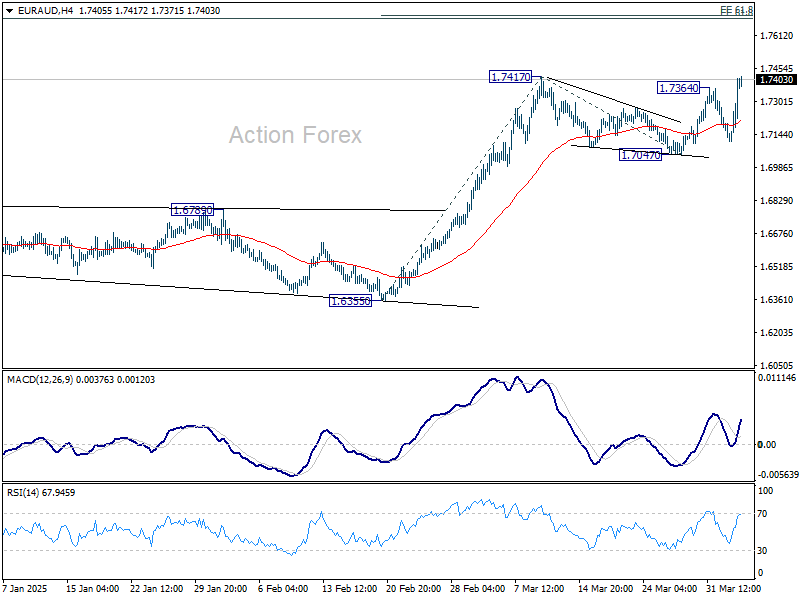
EUR/AUD's strong rebound and break of 0.7364 revives the case that consolidation from 1.7417 has already completed at 1.7047. Intraday bias is back on the upside. Firm break of 1.7417 will resume larger up trend, and target 61.8% projection of 1.6355 to 1.7417 from 1.7047 at 1.7703. In any case, outlook will now stay bullish as long as 1.7047 support holds.
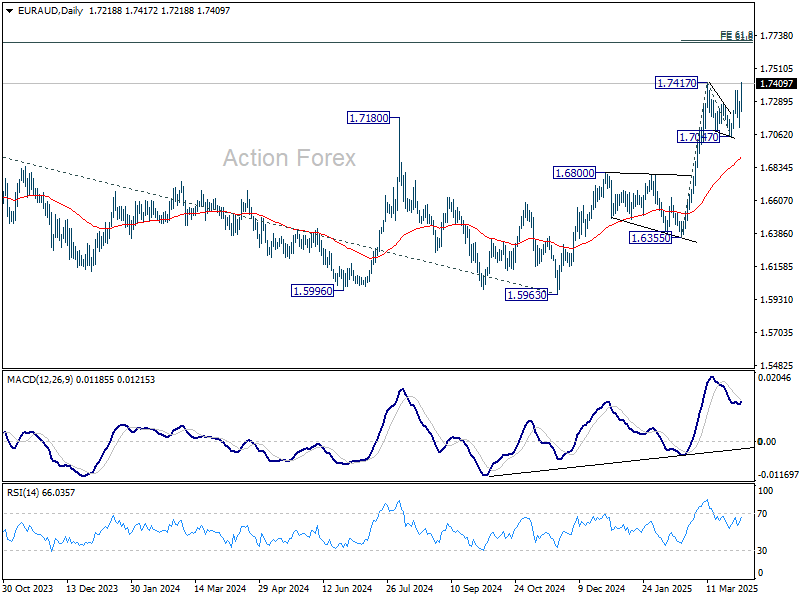
In the bigger picture, up trend from 1.4281 (2022 low) is resuming and should target 61.8% projection of 1.4281 to 1.7062 from 1.5963 at 1.7682, which is also close to 61.8% retracement of 1.9799 (2020 high) to 1.4281 at 1.7691. For now, this will remain the favored case as long as 1.6800 resistance turned support holds, even in case of deep pullback.
EUR/CHF Daily Outlook
Daily Pivots: (S1) 0.9519; (P) 0.9576; (R1) 0.9633; More....
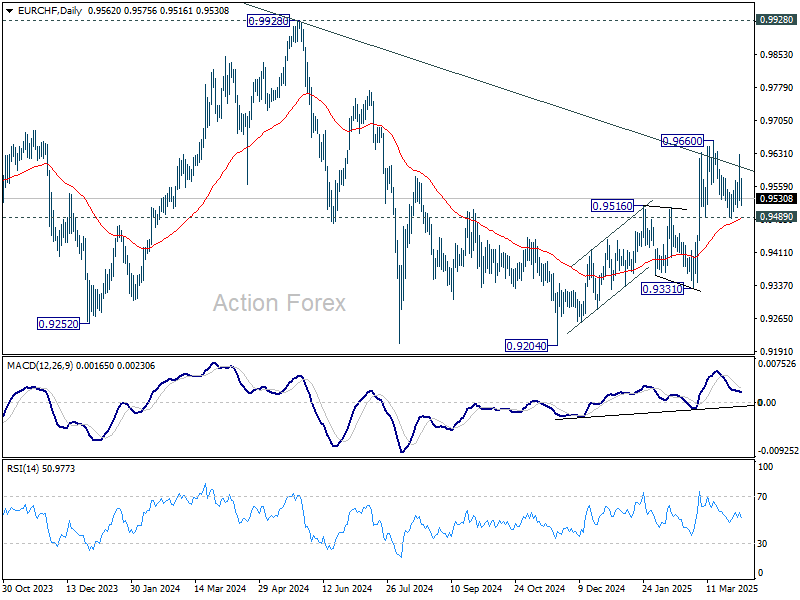
EUR/CHF spiked higher to 0.9626 but quickly reversed. Overall, range trading is still in progress and intraday bias remains neutral. On the upside, break of 0.9660 will resume larger rise from 0.9204. However, sustained break of 0.9489 will bring deeper fall back to 0.9331 support next.
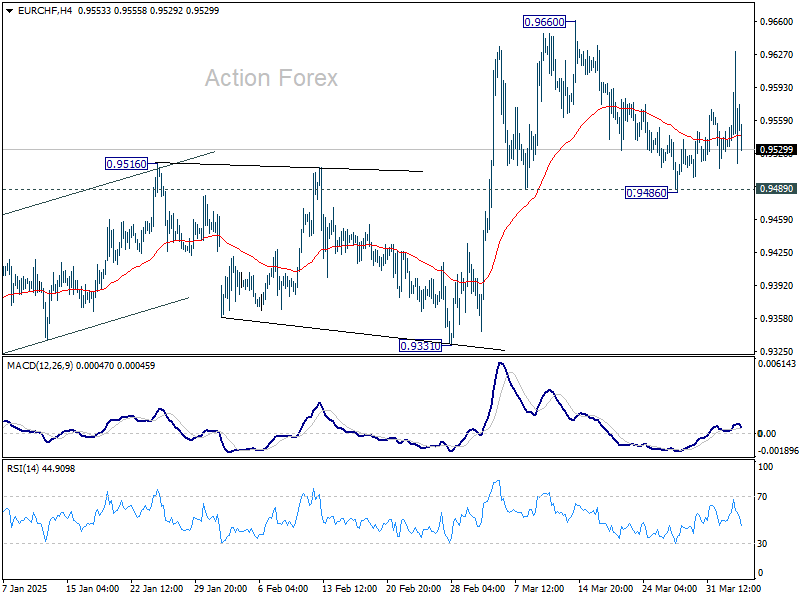
In the bigger picture, prior strong break of 55 W EMA (now at 0.9491) is a medium term bullish sign. Sustained break trading above long-term falling channel resistance (at around 0.9610) would suggest that the downtrend from 1.2004 (2018 high) has bottomed at 0.9204. Stronger rally should then be seen to 0.9928 key resistance at least.
Interest in the Dollar Declines Amid Trump’s Escalating Trade Wars
The tariffs introduced by Trump yesterday on imports from various countries—20% on the EU, 34% on China, and 46% on Vietnam—have heightened uncertainty in the currency markets. As expected, these measures have contributed to increased volatility in major currency pairs. The actions of the White House administration have led to losses for the dollar, causing concern among investors. The tariffs also affect countries such as Taiwan (32%), Japan (24%), and South Korea (25%), which could significantly impact exchange rates. Amid global economic instability, market participants are focused on how these changes will affect the world economy.
USD/JPY
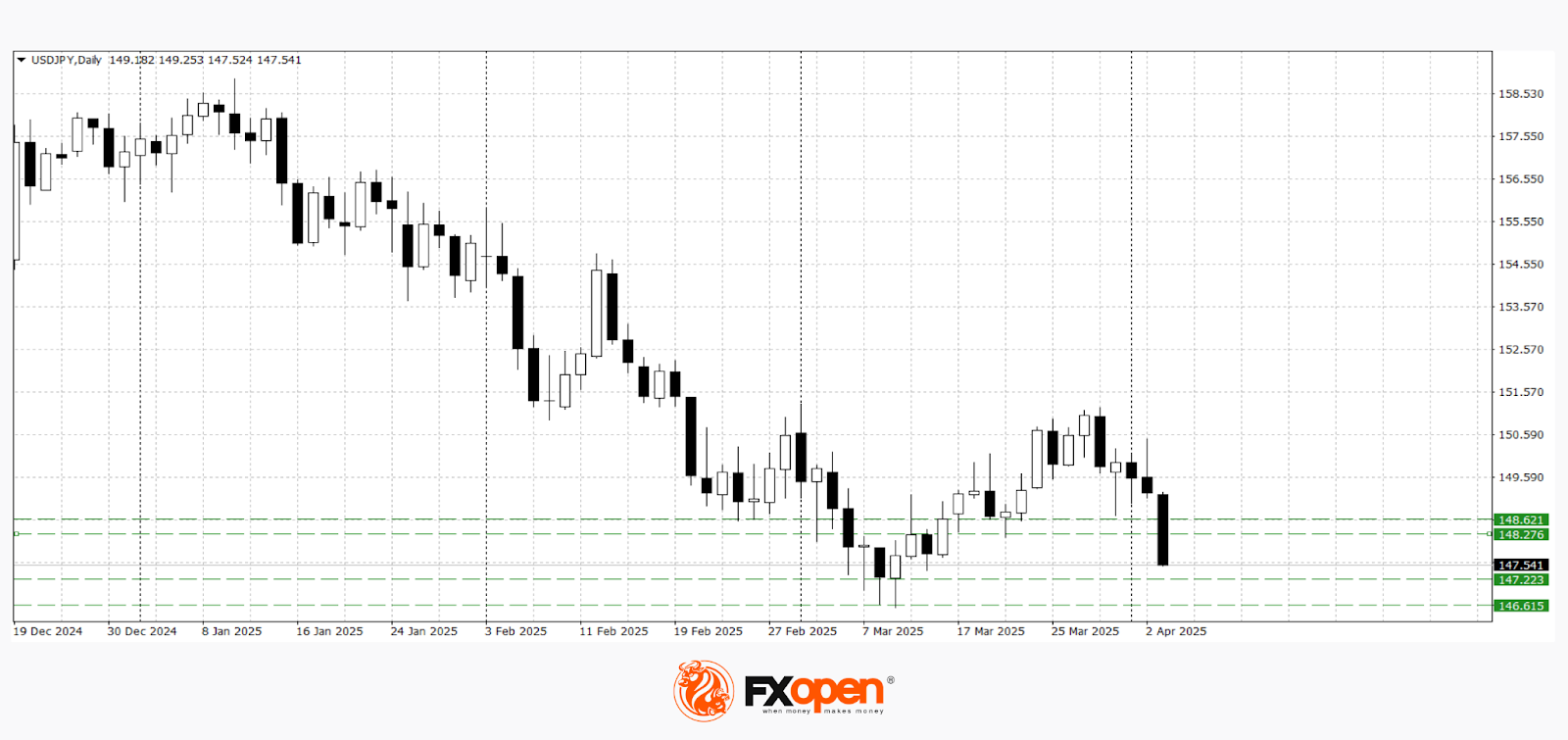
Yesterday, before Donald Trump's speech, the USD/JPY currency pair was trading near 150.00. Better-than-expected preliminary labour market data and a rise in US industrial orders for February (0.6% versus the forecast of 0.5%) contributed to a slight strengthening of USD/JPY. However, the US President’s announcement of trade tariffs led to sharp market fluctuations and a loss of more than 150 pips for USD/JPY within just a few hours. At present, the pair is trading below 148.00. A technical analysis of USD/JPY suggests a possible test of this year's March lows in the 147.20–146.70 range.
Key events that could influence USD/JPY today:
- 13:00 (GMT+2): OPEC meeting (USA)
- 14:30 (GMT+2): Challenger job cuts report (March) (USA)
- 15:30 (GMT+2): Total number of unemployment benefit recipients (USA)
- 15:30 (GMT+2): Export and import volume (February) (USA)
USD/CAD
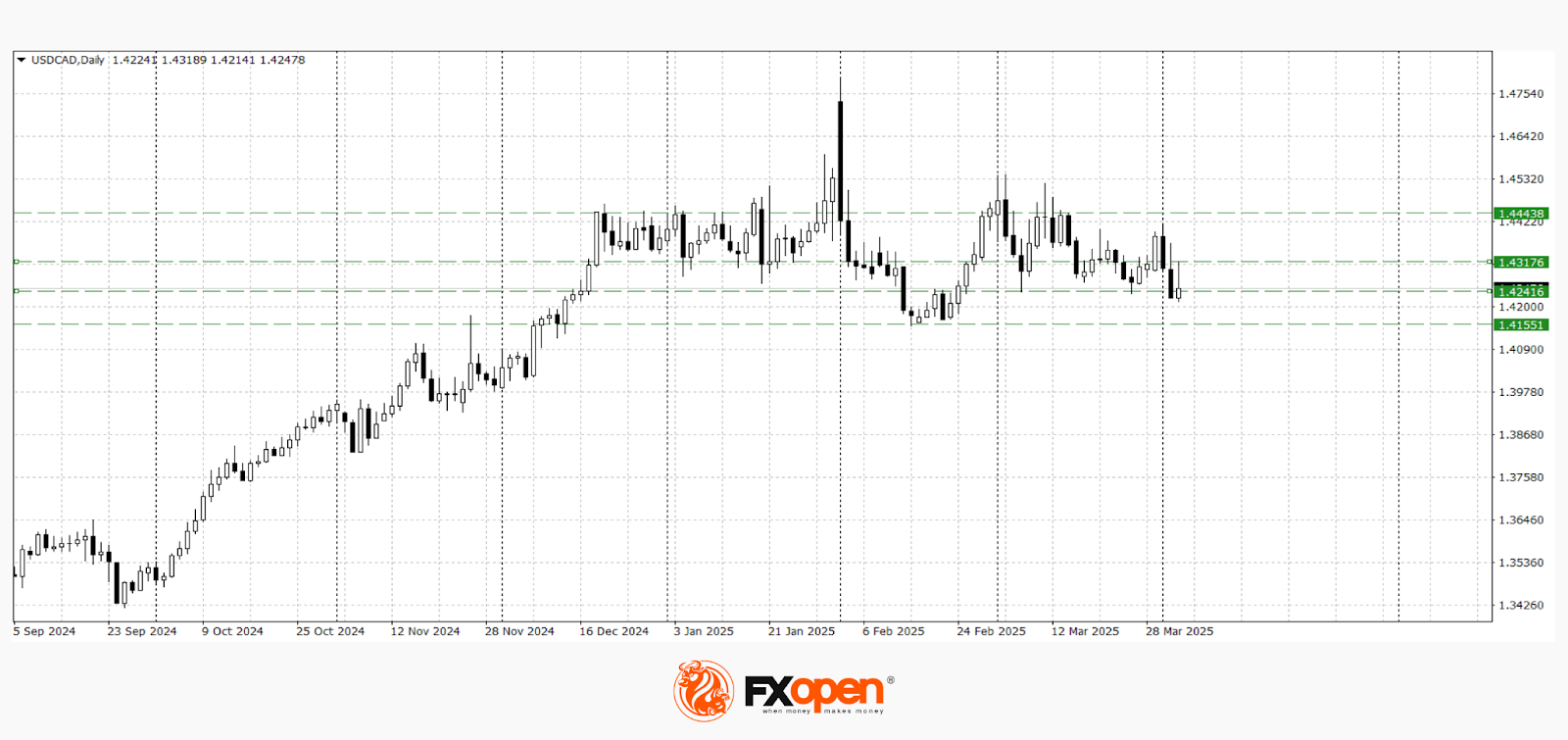
The news of tariffs enabled USD/CAD sellers to break below the lower boundary of the medium-term flat corridor 1.4470–1.4260. If the 1.4260 level turns into a support level, a test of this year's February lows around 1.4150 could be expected. A reversal of the downward scenario would be possible if the price strengthens confidently above 1.4470.
Key news that could impact USD/CAD pricing:
- 15:30 (GMT+2): Export volume (February) (Canada)
- 15:30 (GMT+2): Trade balance (Canada)
- 16:45 (GMT+2): Composite PMI by S&P Global (March) (USA)
- 16:45 (GMT+2): Services PMI (March) (USA)
Trade over 50 forex markets 24 hours a day with FXOpen. Take advantage of low commissions, deep liquidity, and spreads from 0.0 pips. Open your FXOpen account now or learn more about trading forex with FXOpen.
This article represents the opinion of the Companies operating under the FXOpen brand only. It is not to be construed as an offer, solicitation, or recommendation with respect to products and services provided by the Companies operating under the FXOpen brand, nor is it to be considered financial advice.
Stronger and Broader US Tariffs Than Expected
In focus today
In the US, the ISM March Services Index is due for release in the afternoon. Its PMI-counterpart released earlier pointed towards a more positive outlook despite the tariff uncertainty. We will also keep an eye out for the March Challenger Report on layoff announcements. While usually not a market mover it could provide further clarity on the scale of DOGE's federal layoffs.
In the euro area, we receive the final March PMIs. In the past months, the final PMIs have shown unusual revisions of the flash release, which makes them more important to follow. Also in the euro area, we will scrutinize the minutes from the March ECB meeting for any hints of what to expect at the April meeting.
In Sweden, services and composite PMIs are due for release today. The consensus view is for a roughly unchanged figure compared to last month's numbers, like Monday's manufacturing PMI. Furthermore, Riksbank Governor Thedéen participates in a panel discussion regarding EU capital markets. As such, Swedish monetary policy is unlikely to be discussed at length, but there might still be the odd titbit worth keeping an eye out for.
Economic and market news
What happened overnight
In the US, Donald Trump presented a range of new, country-specific tariffs on "Liberation Day". In a move that has resulted in confusion as to the exact country-specific rates, Trump announced tariff rates ranging from 10-60%, depending on the country, with a 10% universal tariff alongside the country-specific duties. The new tariffs were generally stronger and broader than we and markets expected, and sent shockwaves through global markets amid worries that the aggressive duties will slow growth, hit corporate earnings, and increase inflation.
In China, the Caixin PMI services, which is the private survey, surprised to the upside as it rose to 51.9 in March from 51.4 in February. This was mainly driven by increases in domestic demand, as both business activity and new orders picked up and contributed to the strongest growth in the services sector since December.
What happened yesterday
In Denmark, Nationalbanken's (NB) currency interventions in March were released. In line with expectations, NB did not intervene in the foreign exchange market, thereby marking the 26th consecutive month without intervention.
In Poland, the Polish central bank (NBP) kept the leading interest rate unchanged at 5.75%, in line with consensus. We will have to await Governor Glapinski's press conference, scheduled at 15.00 CET today, for more information regarding the NBP's view on rates going forward.
Equities: Asian stock markets are lower this morning, with Japanese markets hit hardest as the currency strengthens as Japan is set to face a 24% tariff. European futures are down as well, while US markets are experiencing the most significant decline due to this massive implicit tax hike for US consumers. The cross assets playbook this morning aligns closely with what we have observed in the trade war escalation over the last one and a half months.
FI&FX: The rumours of soft tariffs ahead of the press conference that gave a lift to equities and US yields going into the press conference proved to be wrong. The outcome was worse than expected and it raises the risk for a US recession. Equity futures plunged with S&P 500 and Nasdaq indicating a deep-red opening. Nikkei is down 3.5%. US treasuries rallied across the curve while the 2s and the 10s are off some 15bp from yesterday's highs. The USD is generally weaker. USD/JPY loses 2% overnight and trades close to 147. EUR/USD adds to initial gains and breaches 1.09. Scandi FX is caught by opposing forces following the Trump announcements: a higher probability of a US recession (negative) vs higher appeal of non-US assets (positive). EUR/SEK at 11.75 and EUR/NOK 11.33.
USD/CAD Daily Outlook
Daily Pivots: (S1) 1.4264; (P) 1.4339; (R1) 1.4380; More...
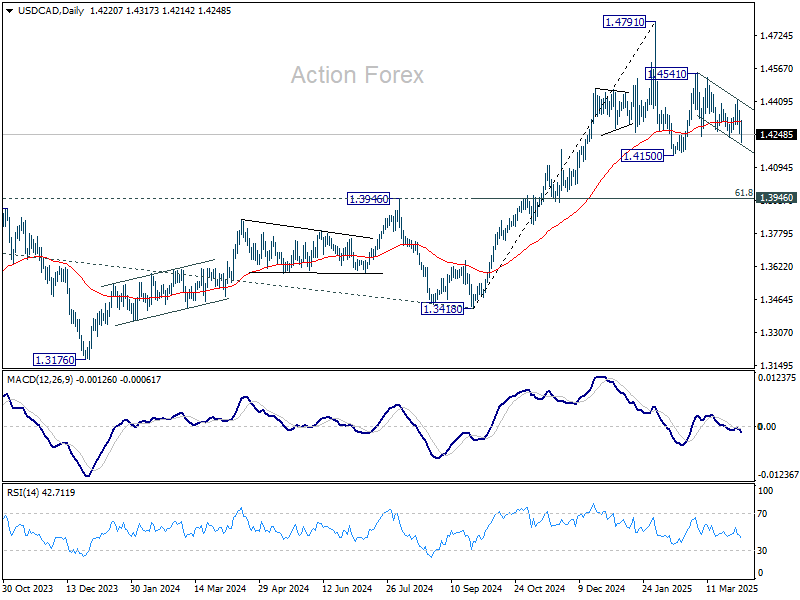
Intraday bias in USD/CAD is back on the downside with breach of 1.4234 support. Deeper fall would be seen to 1.4150 low. Overall, corrective pattern from 1.4791 is still extending. Firm break of 1.4150 will confirm the start of the third leg towards 1.3946 cluster support. On the upside, break of 1.4414 will argue that the pattern is still in the second leg. Intraday bias will be turned back to the upside for 1.4541 resistance first.
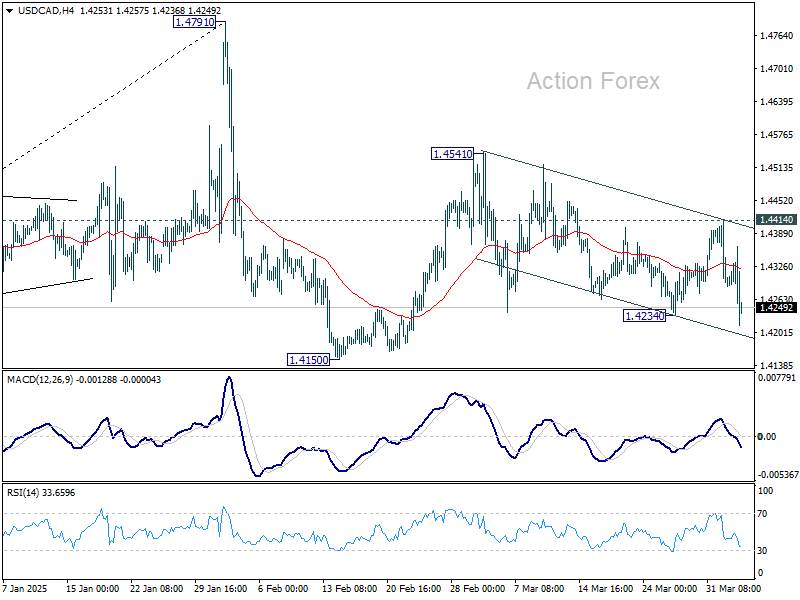
In the bigger picture, long term up trend is tentatively seen as resuming with prior breach of 1.4667/89 key resistance zone (2020/2015 highs). Next target is 100% projection of 1.2401 to 1.3976 from 1.3418 at 1.4993. This will remain the favored case as long as 1.3976 resistance turned support holds (2022 high), even in case of deep pullback.
AUD/USD Daily Report
Daily Pivots: (S1) 0.6258; (P) 0.6299; (R1) 0.6341; More...
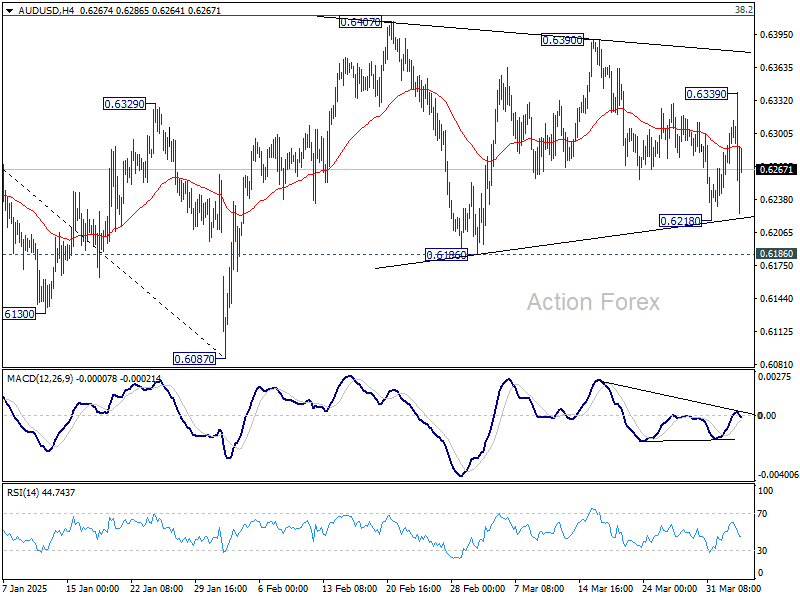
AUD/USD spiked higher to 0.6339 but quickly reversed. Intraday bias stays neutral for the moment. On the downside, break of 0.6218 will target 0.6186 support first. Firm break there will indicate that corrective pattern from 0.6087 has completed and larger fall from 0.6941 is ready to resume. However, break of 0.6339 will bring stronger rise back to 0.6390/6407 resistance zone instead.
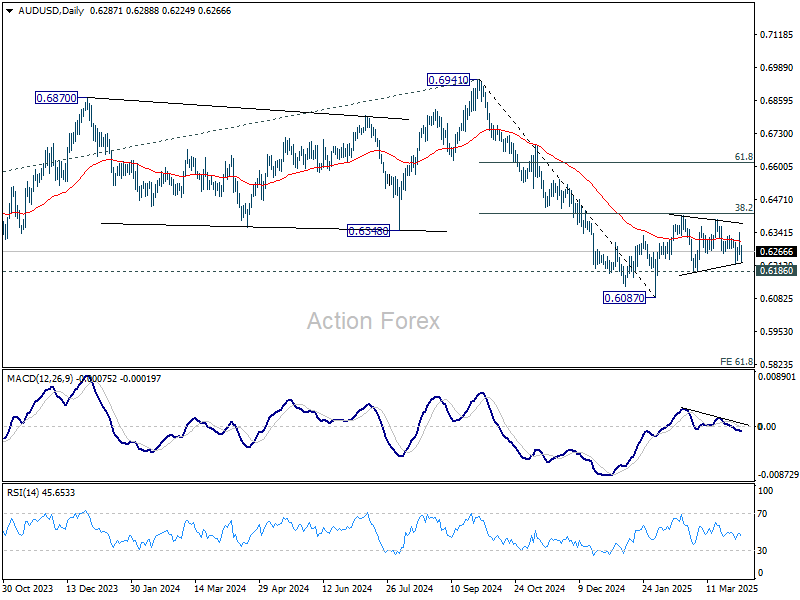
In the bigger picture, fall from 0.6941 (2024 high) is seen as part of the down trend from 0.8006 (2021 high). Next medium term target is 61.8% projection of 0.8006 to 0.6169 from 0.6941 at 0.5806. In any case, outlook will stay bearish as long as 55 W EMA (now at 0.6461) holds.
EUR/USD Daily Outlook
Daily Pivots: (S1) 1.0785; (P) 1.0855; (R1) 1.0929; More...
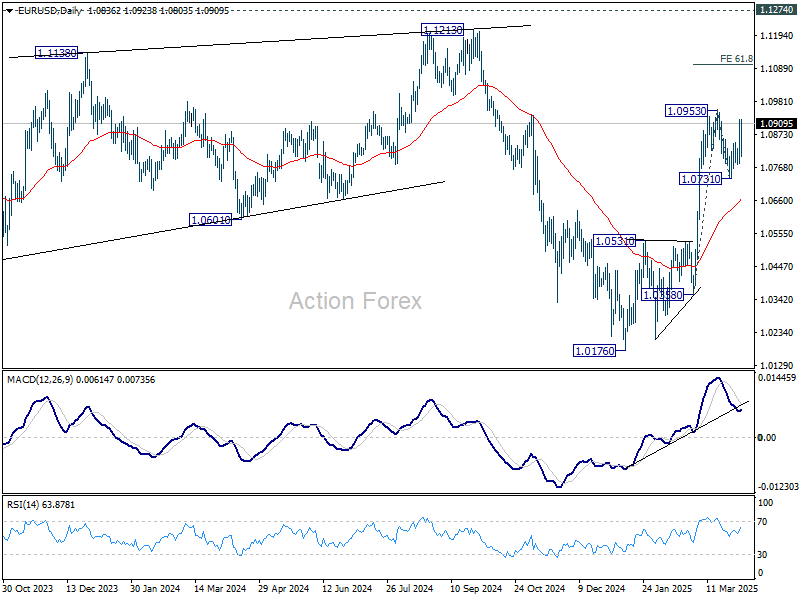
EUR/USD's break of 1.0857 resistance suggests that correction from 1.0953 has already completed at 1.0731. Intraday bias is back on the upside. Decisive break of 1.0953 will confirm resumption of whole rally from 1.0176. Next target is 61.8% projection of 1.0358 to 1.0953 from 1.0731 at 1.1099. This will now be the favored case as long as 1.0731 support holds, in case of retreat.
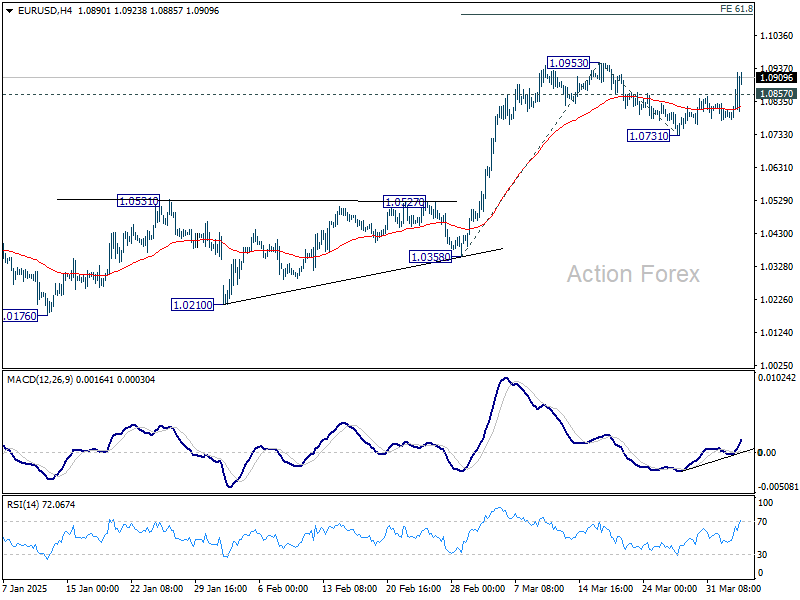
In the bigger picture, prior strong break of 55 W EMA (now at 1.0692) suggests that fall from 1.1274 (2024 high) has completed as a three wave correction to 1.0176. Rise from 0.9534 is still intact, and might be ready to resume. Decisive break of 1.1274 will target 100% projection of 0.9534 to 1.1274 from 1.0176 at 1.1916. Also, that will send EUR/USD through a multi-decade channel resistance will carries larger bullish implication. This will now be the favored case as long as 1.0531 resistance turned support holds.
GBP/USD Daily Outlook
Daily Pivots: (S1) 1.2932; (P) 1.2979; (R1) 1.3056; More...
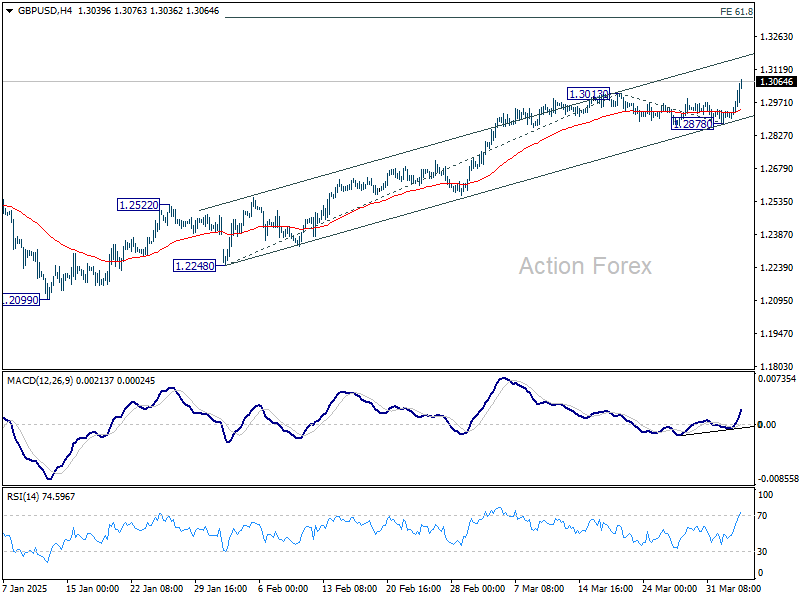
GBP/USD's rally from 1.2099 resumed by breaking through 1.3013 resistance. Intraday bias is back on the upside. Next target is 61.8% projection of 1.2248 to 1.3013 from 1.2878 at 1.3351. For now, outlook will remain bullish as long as 1.2878 support holds, in case of retreat.
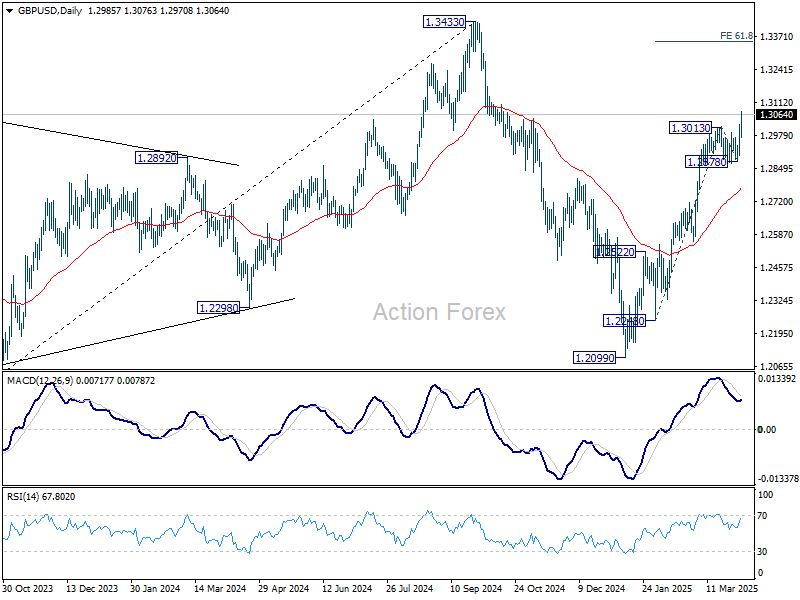
In the bigger picture, up trend from 1.3051 (2022 low) is not completed. Resumption is expected after corrective pattern from 1.3433 completes. Next target will be 1.4248 key resistance (2021 high). This will now remain the favored case as long as 1.2099 support holds.
USD/CHF Daily Outlook
Daily Pivots: (S1) 0.8805; (P) 0.8827; (R1) 0.8841; More…
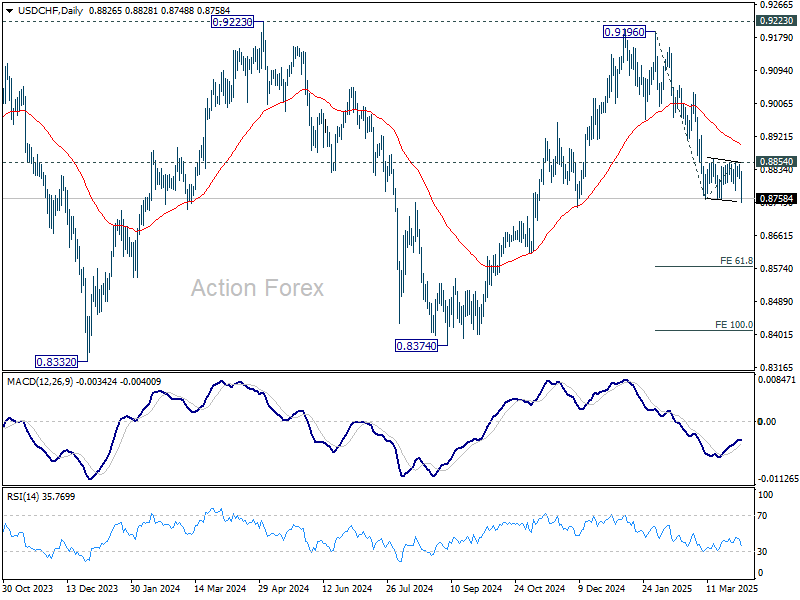
USD/CHF's breach of 0.8757 suggests that fall from 0.9196 is resuming. Intraday bias is back on the downside. Next target is 61.8% projection of 0.9196 to 0.8757 from 0.8854 at 0.8583. For now, outlook will stay bearish as long as 0.8854 resistance holds, in case of recovery.
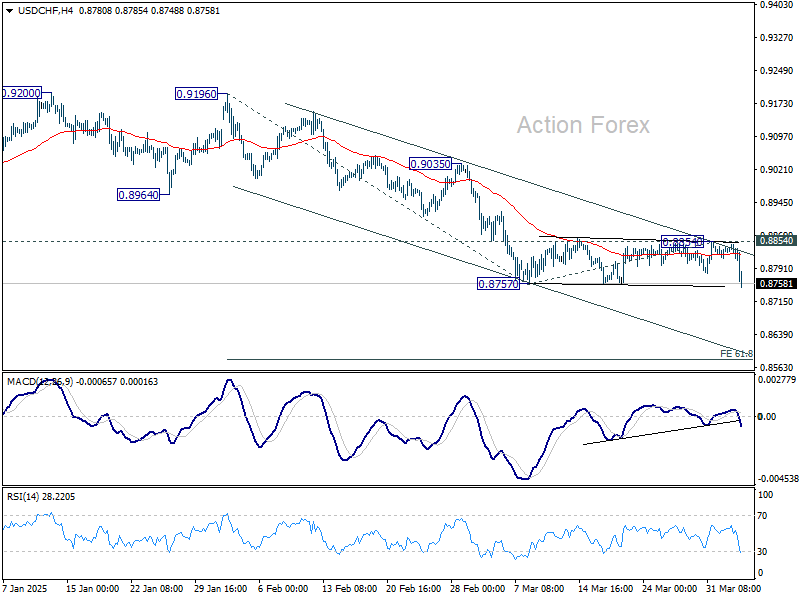
In the bigger picture, rejection by 0.9223 key resistance keep medium term outlook bearish. That is, larger fall from 1.0342 (2017 high) is not completed yet. Firm break of 0.8332 (2023 low) will confirm down trend resumption.
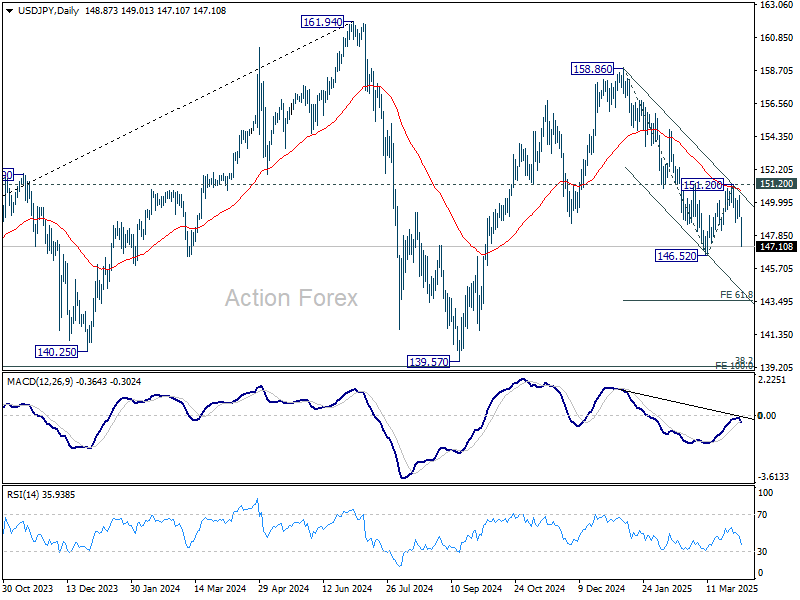
USD/JPY Daily Outlook
Daily Pivots: (S1) 148.80; (P) 149.64; (R1) 150.19; More...
Intraday bias in USD/JPY is back on the downside with break of 148.69 and retest of 146.52 low should be seen next. Firm break there will resume whole fall from 158.86. Next target is 61.8% projection of 158.86 to 146.52 from 151.20 at 143.57. On the upside, above 148.69 support turned resistance will turn intraday bias neutral first. But recovery should be limited below 151.20 resistance to bring another fall.
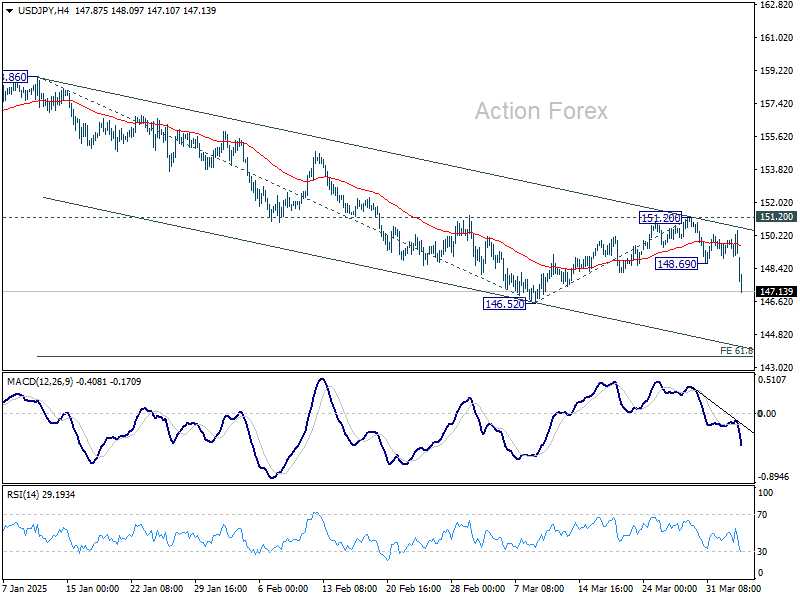
In the bigger picture, price actions from 161.94 are seen as a corrective pattern to rise from 102.58 (2021 low), with fall from 158.86 as the third leg. Strong support should be seen from 38.2% retracement of 102.58 to 161.94 at 139.26 to bring rebound. However, sustained break of 139.26 would open up deeper medium term decline to 61.8% retracement at 125.25.