

Sample Category Title
Anticipation Builds for US CPI
In focus today
Today's most important data release will be the US February CPI. We think headline CPI grew by +0.2% m/m SA and 2.8% y/y (Jan. +0.5% m/m SA and 3.0% y/y) and core CPI by +0.3% m/m SA and 3.2% y/y (Jan +0.4% m/m SA and 3.3% y/y). The previous January release surprised sharply to the topside and markets will closely follow if this was driven by one-off annual price increases at the beginning of the year, or if it was a sign of more persistent inflation pressures.
In Canada, the BoC is set to announce its policy rate decision, with markets and consensus favouring a 25bp rate cut. We also expect a 25bp rate rut, bringing the policy rate to 2.75%, as we anticipate the BoC will ensure the Canadian economy is well-protected against the impact of US tariffs.
Economic and market news
What happened overnight
In Japan, many of the big Japanese corporates, such as Toyota, the largest carmaker in the world, have decided to fully meet their labour unions' wage demands, which on average amounted to 6.1% this year. This follows what is expected to be very strong financial results for 2024. The big question is now whether the smaller companies, which employs most of the Japanese, also find room to meet wage demands. Strong wage growth is key for supporting domestic demand in Japan and a prerequisite for further rate hikes from the BoJ.
In geopolitics, delegations from Ukraine and the United States concluded discussions, with Ukraine agreeing to a 30-day US-brokered ceasefire. This led the US to agree to reinstate military assistance and intelligence sharing with Ukraine. The proposed ceasefire still requires Russia's acceptance. Both countries stated they had agreed to finalise a comprehensive agreement to develop Ukraine's critical mineral resources as soon as possible, following uncertainty after Zelenskyy's meeting at the White House.
In the US, 25% tariffs on steel and aluminium imports came into effect as exemptions concluded, despite increasing worries about the risk of a domestic recession. Yesterday, Trump initially threatened to increase tariffs to 50% on all steel and aluminium imports from Canada but later retracted after Ontario agreed to suspend the 25% surcharge. This caused fluctuations in financial markets, which were already unsettled by Trump's extensive tariff measures.
What happened yesterday
In the US, the JOLTs report showed that job openings remained relatively stable at 7.74m in January (cons: 7.63m, prior: 7.508m). Involuntary layoffs decreased, potentially boosting consumer sentiment despite prevailing uncertainties. Meanwhile, the NFIB index, measuring small business sentiment, weakened for a third straight month, marking its lowest reading since before the November election. This drop reflects owners' concerns over tariff and spending cut plans, showcasing increased uncertainty among business owners.
Equities: The sell-off did not make Trump cave in, frankly the opposite as Trump doubled up on steel import tariffs at the US opening bell only to retreat at closing. As a result, the rebound in futures was absent and replaced by another day of declines. S&P 500 fell -0.8% - which means we are flirting with correction levels - Dow -1.1% while Nasdaq shaved off only -0.2% and Russell 2000 even rose 0.2%. Sector performance was a more buoyant reading than the headline though. Cyclicals outperformed defensives, although both were lower, with MAG 7 the notable outperformers, while equal-weighted S&P 500 was down more. European equities sold off heavily, Stoxx 500 -1.7%, but interestingly this was also a reflection of defensives selling off. Health care and consumer staples were actually the worst performing sectors, although cyclicals were weak as well. Futures are significantly higher in Europe this morning, as a potential ceasefire could be imminent in Ukraine. This could de-risk European equities and warrant more foreign equity inflows. US futures also a notch higher this morning.
FI & FX: Yesterday's FX session was generally characterized by an outperformance of European FX with the EUR, CEEs, SEK and NOK all being the outperformers while the JPY at the other end of the spectrum saw a slight setback. In FI-space the sell-off continued in the US and European markets as government bond yields rose and the curves steepened from the long end. 10Y German government bond yields rose some 6bp, while the 2Y segment declined 2bp. Furthermore, the Bund ASW-spread widened towards -13bp. In the US 10Y yields also rose 6bp like the move in the 2Y segment. Furthermore, there has been a rise in interest rate volatility, but we are not seeing much flight-to-quality as the 10Y BTPS-Bund spread remains fairly stable.
EUR/USD Daily Outlook
Daily Pivots: (S1) 1.0849; (P) 1.0898; (R1) 1.0968; More...
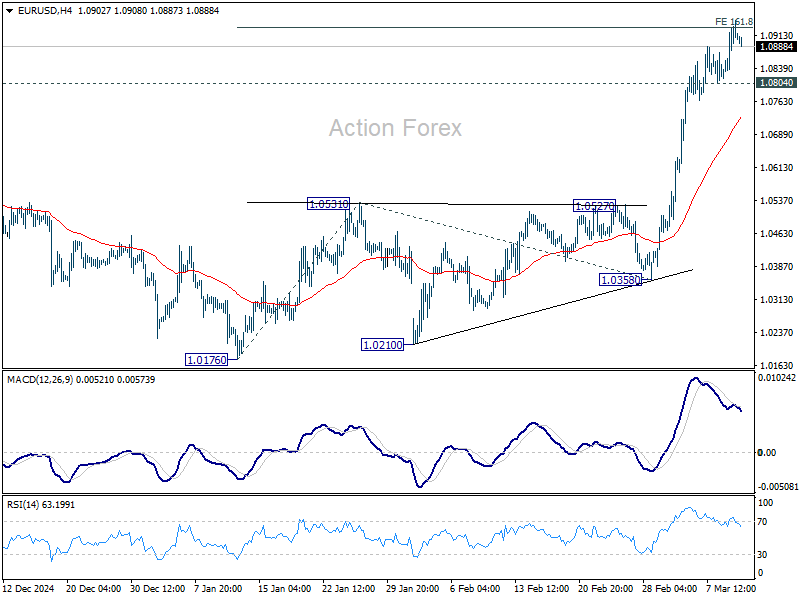
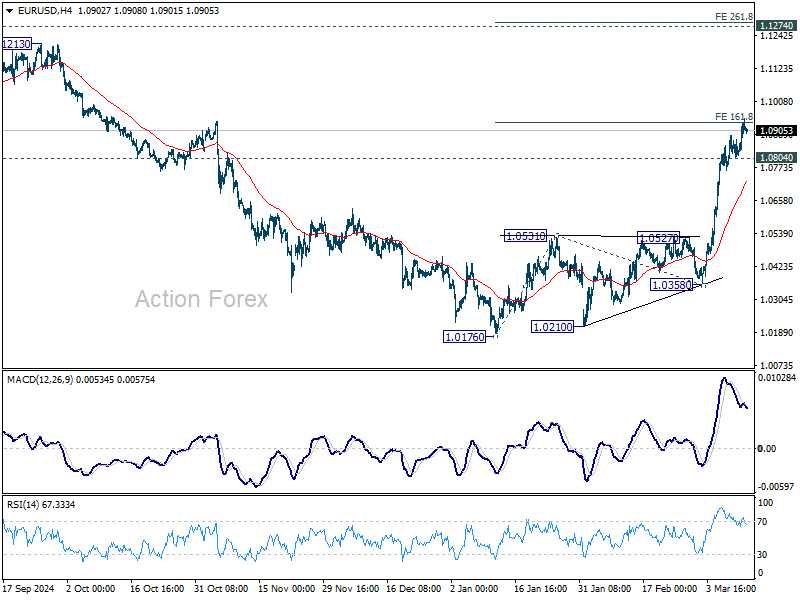
EUR/USD's rally continued and met 161.8% projection of 1.0176 to 1.0531 from 1.0358 at 1.0932 already. There is no clear sign of topping yet and intraday bias stays on the upside. Sustained trading above 1.0932 will target 261.8% projection at 1.1287, which is slightly above 1.1274 key resistance. On the downside, below 1.0804 support will turn intraday bias neutral again and bring consolidations.
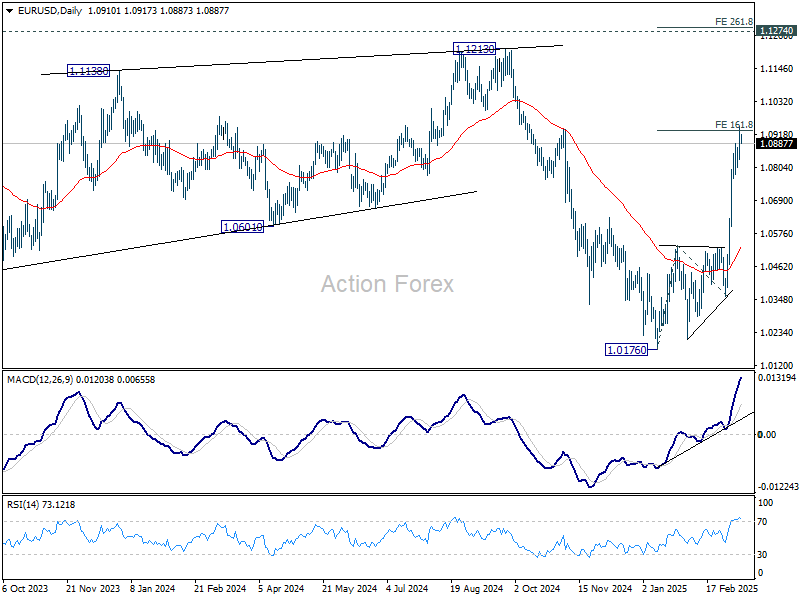
In the bigger picture, the strong break of 55 W EMA (now at 1.0675) suggests that fall from 1.1274 (2024 high) has completed as a three wave correction to 1.0176. Rise from 0.9534 is still intact, and might be ready to resume. Decisive break of 1.1274 will target 100% projection of 0.9534 to 1.1274 from 1.0176 at 1.1916. Also, that will send EUR/USD through a multi-decade channel resistance will carries larger bullish implication. This will now be the favored case as long as 1.0531 resistance turned support holds.
GBP/USD Daily Outlook
Daily Pivots: (S1) 1.2889; (P) 1.2927; (R1) 1.2989; More...
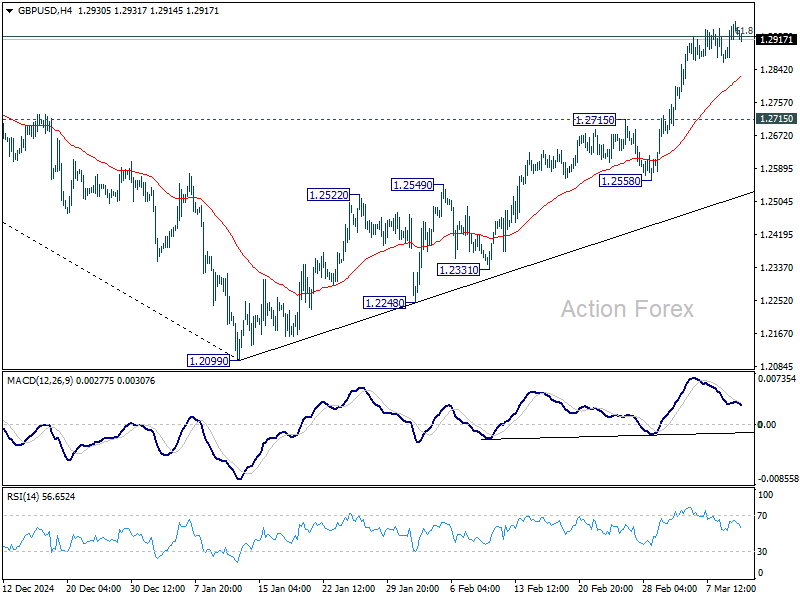
GBP/USD edged higher but failed to sustain above 61.8% retracement of 1.3433 to 1.2099 at 1.2923 so far. Intraday bias stays neutral first. IN case of another retreat, downside should be contained by 1.2715 resistance turned support to bring rebound. Sustained trading above 1.2923 will resume the rise from 1.2099, and pave the way back to 1.3433 high.
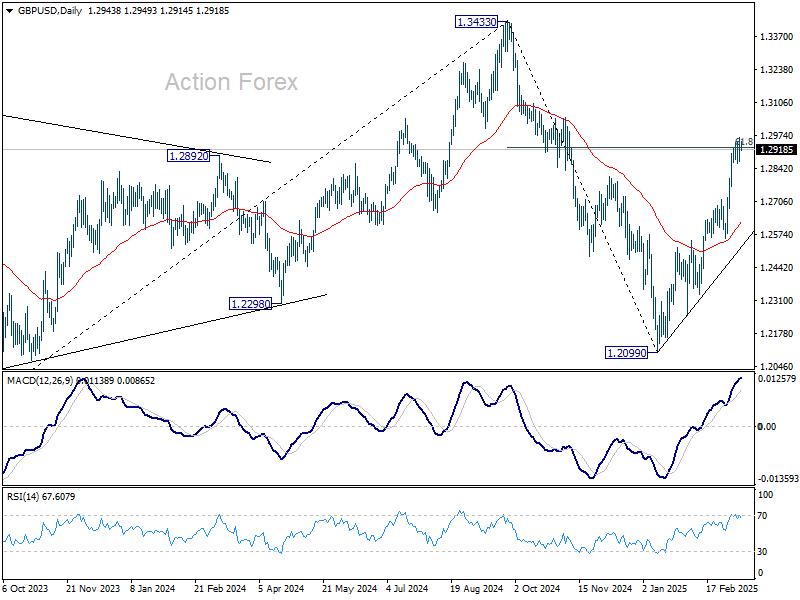
In the bigger picture, fall from 1.3433 (2024 high) should have completed at 1.2099 as a corrective move. Up trend from 1.3051 (2022 low) is still in progress but it's too early to say that it's resuming. Corrective pattern from 1.3433 could extend with one more down leg. But after all, eventual upside breakout is expected at a later stage.
USD/JPY Daily Outlook
Daily Pivots: (S1) 146.83; (P) 147.48; (R1) 148.41; More...
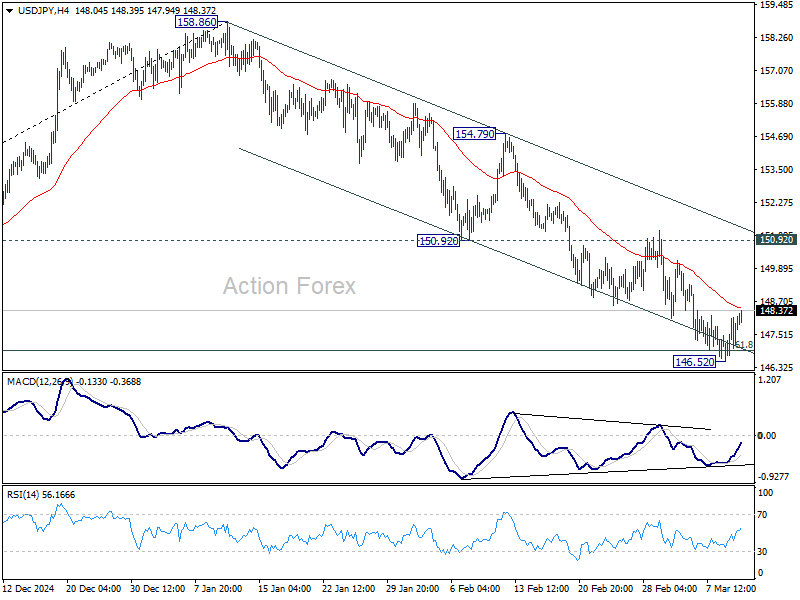
USD/JPY is extending consolidations above 146.52 and intraday bias remains neutral. Upside of recovery should be limited by 150.92 support turned resistance. On the downside, sustained trading below 61.8% retracement of 139.57 to 158.86 at 146.32 will pave the way to 139.57 support.
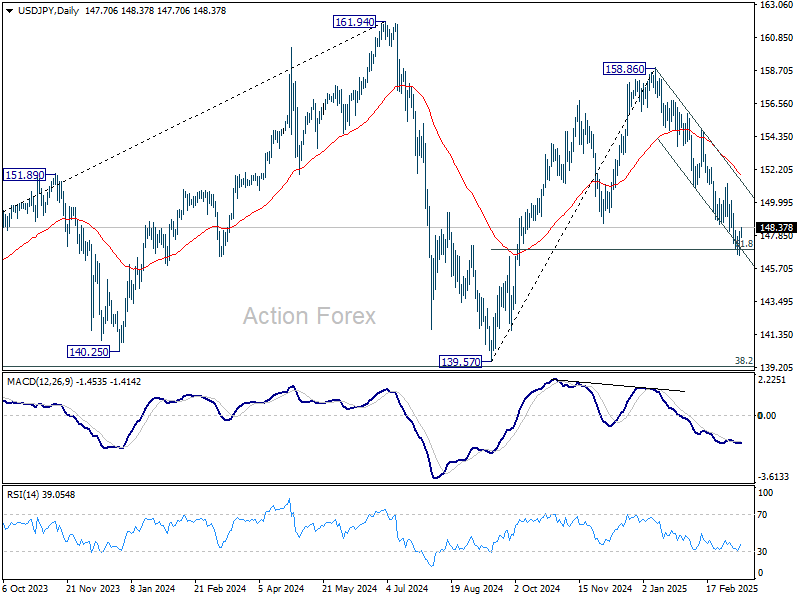
In the bigger picture, price actions from 161.94 are seen as a corrective pattern to rise from 102.58 (2021 low), with fall from 158.86 as the third leg. Strong support should be seen from 38.2% retracement of 102.58 to 161.94 at 139.26 to bring rebound. However, sustained break of 139.26 would open up deeper medium term decline to 61.8% retracement at 125.25.
USD/CHF Daily Outlook
Daily Pivots: (S1) 0.8787; (P) 0.8812; (R1) 0.8850; More…
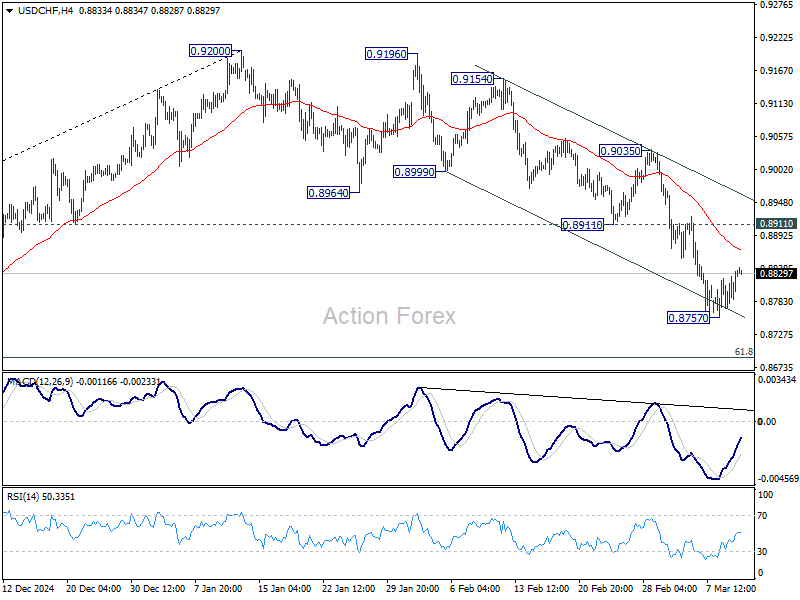
USD/CHF is extending consolidations above 0.8757 and intraday bias remains neutral. Upside of recovery should be limited by 0.8911 support turned resistance to bring another fall. On the downside, below 0.8757 will resume the fall from 0.9200 and target 61.8% retracement of 0.8374 to 0.9200 at 0.8690. Sustained break there will pave the way back to 0.8374 support.
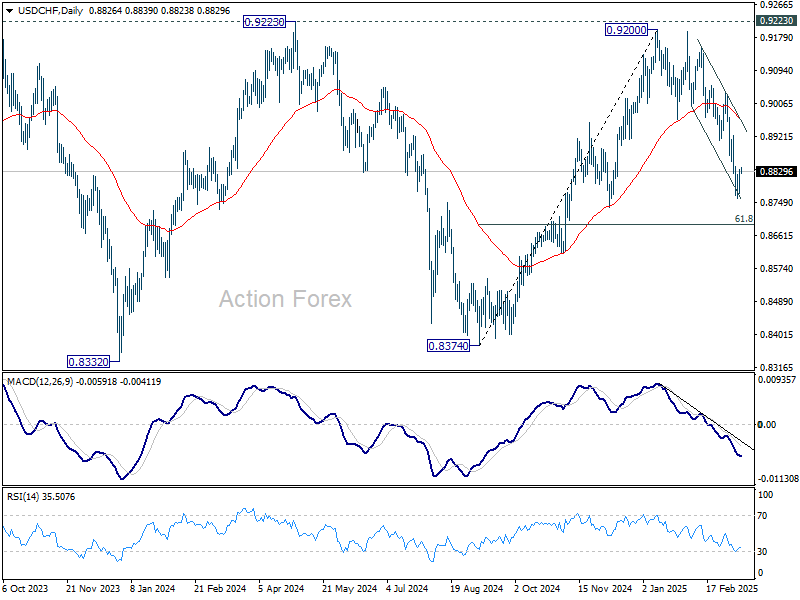
In the bigger picture, rejection by 0.9223 key resistance keep medium term outlook bearish. That is, larger fall from 1.0342 (2017 high) is not completed yet. Firm break of 0.8332 (2023 low) will confirm down trend resumption.
AUD/USD Daily Report
Daily Pivots: (S1) 0.6267; (P) 0.6290; (R1) 0.6320; More...
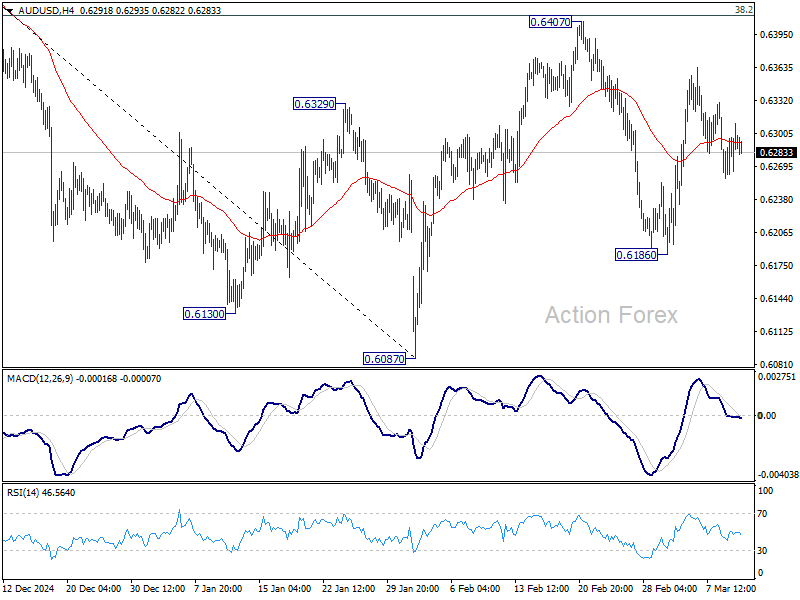
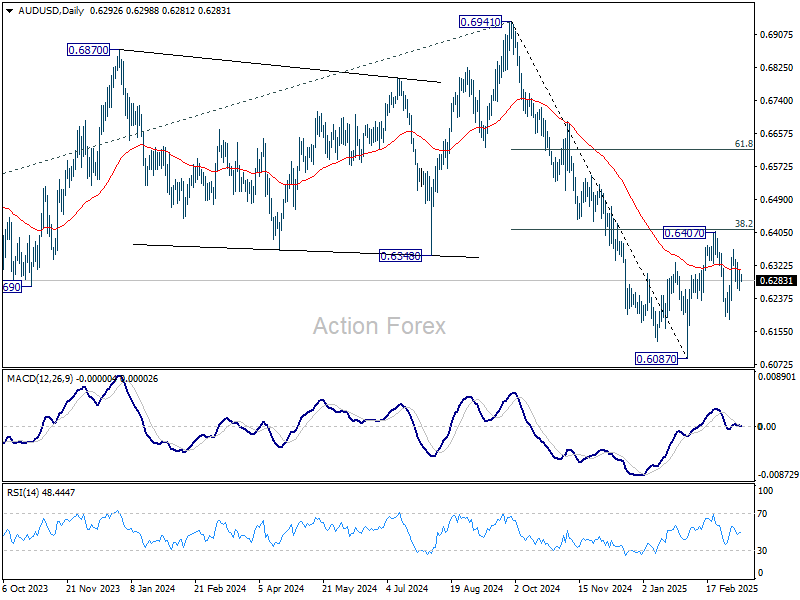
No change in AUD/USD's outlook as range trading continues. Intraday bias remains neutral at this point. On the downside, break of 0.6186 will target 0.6087 support first. Firm break there will resume whole decline from 0.6941. However, sustained trading above 38.2% retracement of 0.6941 to 0.6087 at 0.6413 will raise the chance of near term bullish reversal, and target 61.8% retracement at 0.6615 next.
In the bigger picture, fall from 0.6941 (2024 high) is seen as part of the down trend from 0.8006 (2021 high). Next medium term target is 61.8% projection of 0.8006 to 0.6169 from 0.6941 at 0.5806. In any case, outlook will stay bearish as long as 55 W EMA (now at 0.6487) holds.
USD/CAD Daily Outlook
Daily Pivots: (S1) 1.4370; (P) 1.4445; (R1) 1.4511; More...
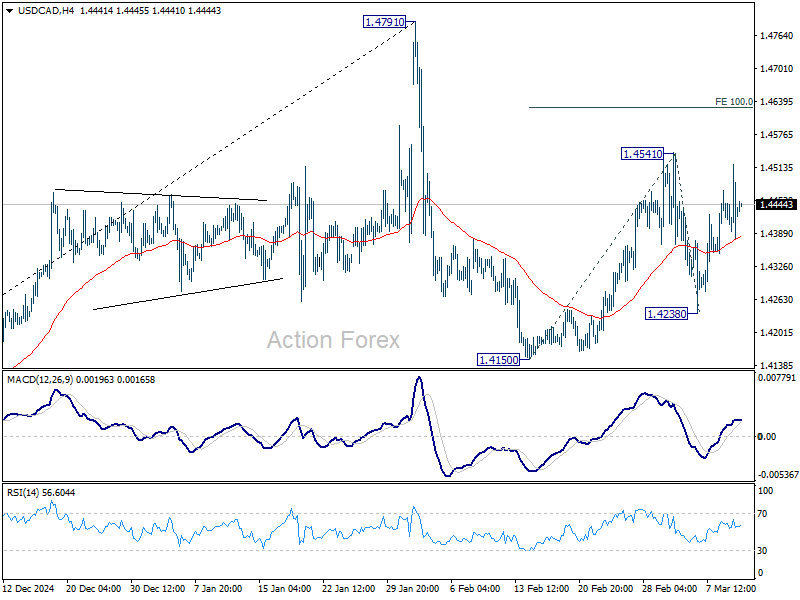
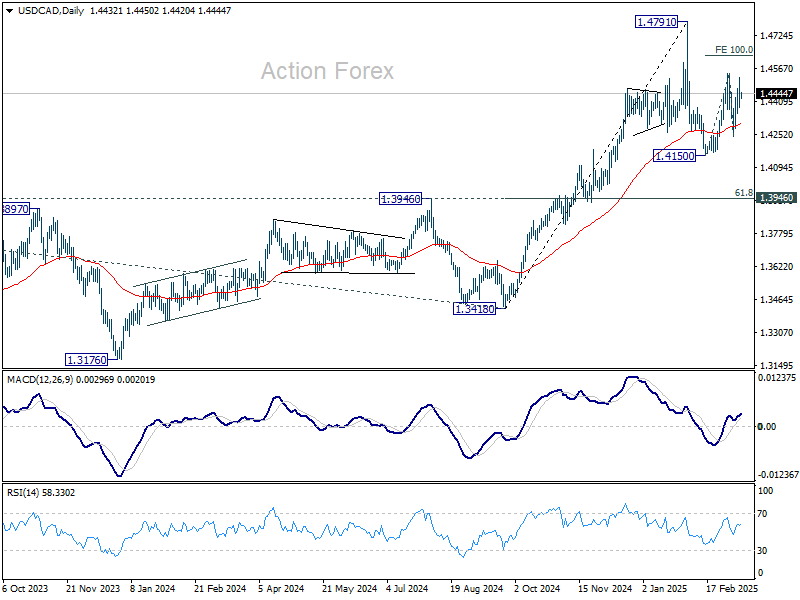
USD/CAD retreated ahead of 1.4541 and resistance and intraday bias is turned neutral first. Overall, price actions from 1.4791 high are seen as a corrective pattern, with rebound from 1.4150 as the second leg. On the upside, break of 1.4541 will target 100% projection of 1.4150 to 1.4541 from 1.4238 at 1.4629 and above. But for now, strong resistance is expected from 1.4791 to limit upside to bring the third leg. On the downside, break of 1.4238 will confirm that the third leg has started through 1.4150 support.
In the bigger picture, long term up trend is tentatively seen as resuming with prior breach of 1.4667/89 key resistance zone (2020/2015 highs). Next target is 100% projection of 1.2401 to 1.3976 from 1.3418 at 1.4993. This will remain the favored case as long as 1.3976 resistance turned support holds (2022 high), even in case of deep pullback.
Canadian Dollar Volatile on Trade Chaos, Focus Shifts to BoC Cut and US CPI
Canadian Dollar endured a roller-coaster session overnight, initially hitting turbulence after US President Donald Trump threatened to double tariffs on Canadian steel and aluminum imports to 50%. Markets were rattled by the surprise escalation, which was set to take effect within hours. However, the situation shifted after Ontario Premier Doug Ford agreed to suspend a surcharge on electricity exports to the US and scheduled a meeting with US Commerce Secretary Howard Lutnick. Following Trump’s indication that tariffs could be lowered after the talks, the Loonie managed to pare some of its earlier losses.
Despite this temporary relief, uncertainty surrounding tariffs is likely to weigh on business and consumer confidence on both sides of the border. Markets are now increasingly betting that BoC will need to extend its easing cycle to cushion against economic fallout. With a 25bps rate cut widely expected at today’s BoC meeting, traders are now pricing in at least two additional rate cuts by the end of the year. The central bank’s guidance will be critical in shaping expectations for further policy moves, particularly as growth concerns deepen amid trade war disruptions.
Another key event on traders’ radar today is US Consumer Price Index release. Though volatility could spike on the initial headline print, many market participants expect to “look through” the immediate reaction and return to the broader risk-off narrative. Recession worries, fueled by inconsistent trade policies and softer macro data, continue to overshadow the Dollars performance. This environment has generally weighed on the greenback in recent sessions, even though it managed a modest recovery from the steep selloff triggered by intensifying tariff drama.
Technically, EUR/USD appears to be taking a breather after hitting 161.8% projection of 1.0176 to 1.0531 from 1.0358 at 1.0932. But further rally is expected aslong as 1.0804 support holds. Firm break of 1.0932 could prompt upside reacceleration to 200% projection at 1.1287, which is slightly above 1.1274 key resistance. Nevertheless, break of 1.0804 will bring consolidations first.
In terms of weekly performance so far, Euro remains the best-performing currency. The British Pound follows closely behind, while Dollar has managed to stabilize, recovering some of its recent losses. On the other end of the spectrum, Canadian Dollar is currently the weakest performer, reflecting ongoing trade concerns and expectations of deeper BoC rate cuts. Swiss Franc and Australian Dollar are also lagging, while New Zealand dollar and Japanese Yen are positioned in the middle of the pack.
In Asia, at the time of writing, Nikkei is up 0.35%. Hong Kong HSI is down -0.35%. China Shanghai SSE is up 0.10%. Singapore Strait TImes is up 0.46%. Japan 10-year JGB yield is up 0.025 at 1.531. Overnight, DOW fell -1.14%. S&P 500 fell -0.76%. NASDAQ fell -0.18%. 10-year yield rose 0.075 to 4.288.
US CPI in focus as DOW vulnerable with double top breakdown
Market sentiment in the US remains fragile ahead of today’s CPI data for February, which is expected to be a major market-moving event. The challenge, however, lies in interpreting the impact of inflation data given the complex interplay between inflation trends, economic conditions, and Fed expectations. More importantly, the interaction is further complicated by the unpredictable shifts in US tariff policies. In the end, while traders may react initially to the numbers, they're more likely to revert to pre-existing trends once the CPI risk is cleared.
Consensus forecast sees headline CPI dipping slightly from 3.0% to 2.9%, signaling that the uptrend from September’s low of 2.4% has finally ended. Meanwhile, core CPI is expected to ease marginally from 3.3% to 3.2%, but remains stuck in a narrow 3.2%-3.3% range since last June.
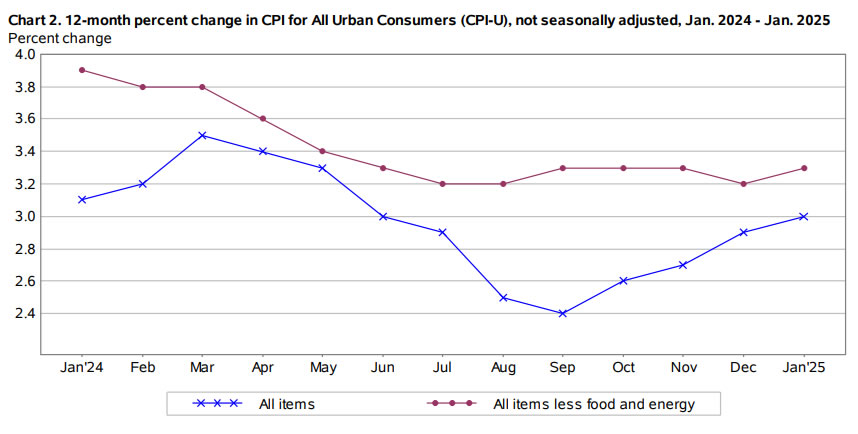
If the data confirms these expectations, it would reinforce the view that disinflation progress continued to stall. This, in turn, supports Fed’s cautious stance. Fed Chair Jerome Powell has repeatedly stressed that the central bank is in no rush to lower interest rates, and today’s inflation data is unlikely to change that narrative.
Fed fund futures are currently pricing in a 97% probability that Fed will hold rates at 4.25%-4.50% in its upcoming March 19 meeting, making it almost a certainty. However, the outlook for Q2 is much murkier. Traders are factoring in a 38% probability of a cut in May and an 85% chance of a reduction in June.
Beyond the near term, the real test will come in April when reciprocal tariffs are formalized. Given recent stock market volatility, where recession concerns have already led to deep selloffs, any additional economic stress from tariffs could further push Fed toward an aggressive easing cycle.
Some economists have already noted that the May or June rate cut could indeed start a series of swift reductions in the second half of the year, if confidence deteriorates further—especially if the labor market weakens significantly.
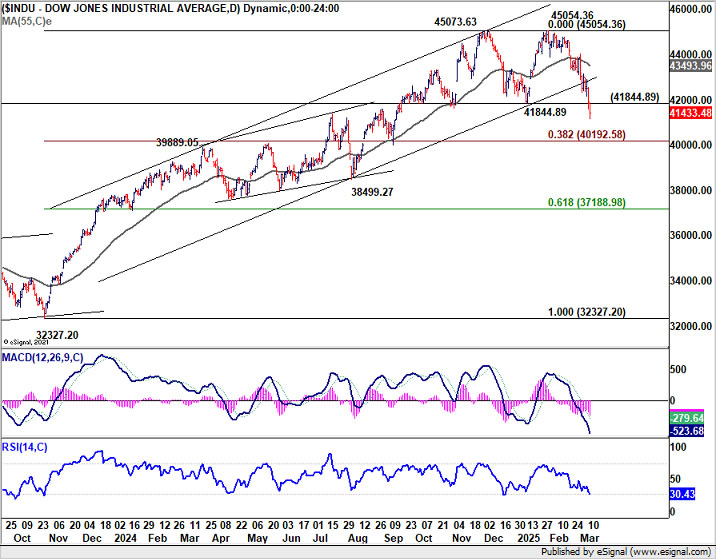
Technically, DOW should have completed a double top pattern (45073.63, 45054.36) after breaking through 41844.89 support. While deeper pull back is now in favor, strong support could be seen around 40k zone to contain downside, at least on first attempt.
The 40k zone represents 39889.05 resistance turned support, as well as 38.2% retracement of 32327.20 to 45054.36 at 40192.58. This development would keep price actions from 45054.36 as a correction to rise from 32327.20 only, likely a sideway pattern.
However, decisive break of 40k will argue that DOW is already in an even larger scale correction, or enter a bear market as some would describe.
BoJ’s Ueda acknowledges rising yields as market bets on policy shift
BoJ Governor Kazuo Ueda addressed the recent rise in bond yields, and noted, "I don't see a big divergence between our view and that of markets".
Speaking to parliament, Ueda emphasized the "biggest determinant" of long-term interest rates is market expectations regarding the central bank’s short-term policy rate.
He added, it is "natural for long-term rates to move in a way that reflects such market forecasts". His comments come as Japan’s benchmark 10-year bond yield surged to a 16-year high of 1.575% on Monday.
Separately, Japan’s latest inflation data showed that annual wholesale inflation slowed slightly in February. Corporate goods price index , which tracks the prices businesses charge each other for goods and services, rose 4.0% yoy, in line with market expectations, down from January’s 4.2% yoy increase.
USD/CAD Daily Outlook
Daily Pivots: (S1) 1.4370; (P) 1.4445; (R1) 1.4511; More...
USD/CAD retreated ahead of 1.4541 and resistance and intraday bias is turned neutral first. Overall, price actions from 1.4791 high are seen as a corrective pattern, with rebound from 1.4150 as the second leg. On the upside, break of 1.4541 will target 100% projection of 1.4150 to 1.4541 from 1.4238 at 1.4629 and above. But for now, strong resistance is expected from 1.4791 to limit upside to bring the third leg. On the downside, break of 1.4238 will confirm that the third leg has started through 1.4150 support.
In the bigger picture, long term up trend is tentatively seen as resuming with prior breach of 1.4667/89 key resistance zone (2020/2015 highs). Next target is 100% projection of 1.2401 to 1.3976 from 1.3418 at 1.4993. This will remain the favored case as long as 1.3976 resistance turned support holds (2022 high), even in case of deep pullback.
US CPI in focus as DOW vulnerable with double top breakdown
Market sentiment in the US remains fragile ahead of today’s CPI data for February, which is expected to be a major market-moving event. The challenge, however, lies in interpreting the impact of inflation data given the complex interplay between inflation trends, economic conditions, and Fed expectations. More importantly, the interaction is further complicated by the unpredictable shifts in US tariff policies. In the end, while traders may react initially to the numbers, they're more likely to revert to pre-existing trends once the CPI risk is cleared.
Consensus forecast sees headline CPI dipping slightly from 3.0% to 2.9%, signaling that the uptrend from September’s low of 2.4% has finally ended. Meanwhile, core CPI is expected to ease marginally from 3.3% to 3.2%, but remains stuck in a narrow 3.2%-3.3% range since last June.
If the data confirms these expectations, it would reinforce the view that disinflation progress continued to stall. This, in turn, supports Fed’s cautious stance. Fed Chair Jerome Powell has repeatedly stressed that the central bank is in no rush to lower interest rates, and today’s inflation data is unlikely to change that narrative.
Fed fund futures are currently pricing in a 97% probability that Fed will hold rates at 4.25%-4.50% in its upcoming March 19 meeting, making it almost a certainty. However, the outlook for Q2 is much murkier. Traders are factoring in a 38% probability of a cut in May and an 85% chance of a reduction in June.
Beyond the near term, the real test will come in April when reciprocal tariffs are formalized. Given recent stock market volatility, where recession concerns have already led to deep selloffs, any additional economic stress from tariffs could further push Fed toward an aggressive easing cycle.
Some economists have already noted that the May or June rate cut could indeed start a series of swift reductions in the second half of the year, if confidence deteriorates further—especially if the labor market weakens significantly.
Technically, DOW should have completed a double top pattern (45073.63, 45054.36) after breaking through 41844.89 support. While deeper pull back is now in favor, strong support could be seen around 40k zone to contain downside, at least on first attempt.
The 40k zone represents 39889.05 resistance turned support, as well as 38.2% retracement of 32327.20 to 45054.36 at 40192.58. This development would keep price actions from 45054.36 as a correction to rise from 32327.20 only, likely a sideway pattern.
However, decisive break of 40k will argue that DOW is already in an even larger scale correction, or enter a bear market as some would describe.
Crypto Struggles: Bitcoin Dips Further, Recovery Faces Major Hurdles
Key Highlights
- Bitcoin price declined heavily and even traded below the $80,000 support.
- BTC is now well below a key bearish trend line with resistance at $86,650 on the 4-hour chart.
- Ethereum price also declined and traded below the $2,000 support.
- The US CPI could rise 2.9% in Feb 2025 (YoY).
Bitcoin Price Technical Analysis
Bitcoin price made a couple of attempts to settle above $90,000 against the US Dollar. However, BTC failed and started a fresh decline.
Looking at the 4-hour chart, the price gained bearish momentum after it broke the $85,000 support zone. There was a close below the $85,000 level, the 100 simple moving average (red, 4-hour) and the 200 simple moving average (green, 4-hour).
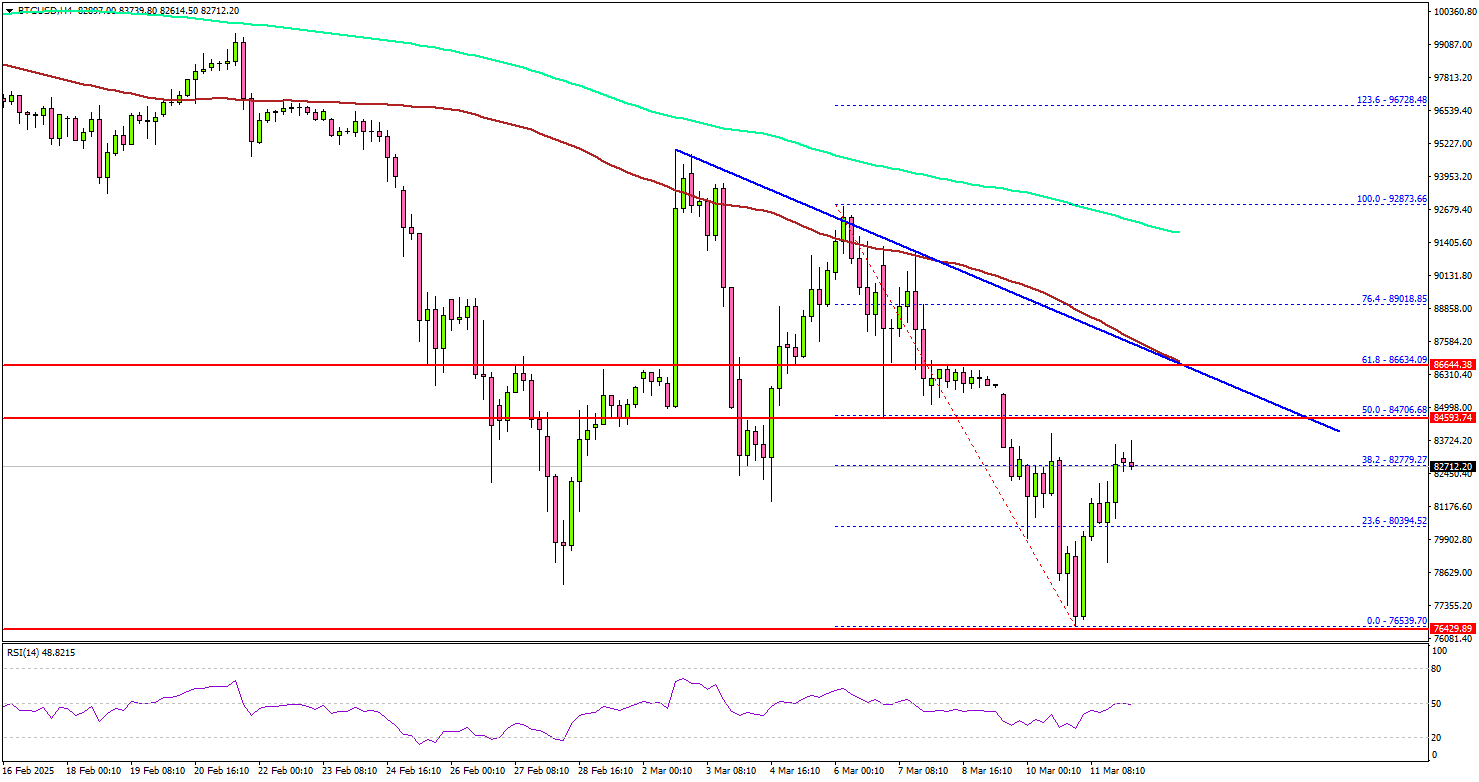
The bears even pushed the price below the $80,000 mark. A low was formed at $76,539 and the price is now consolidating losses. On the upside, the price could face resistance near the $84,700 level or the 50% Fib retracement level of the downward move from the $92,873 swing high to the $76,539 low.
The next key resistance is $86,500. There is also a key bearish trend line forming with resistance at $86,650 on the same chart. It is close to the 61.8% Fib retracement level of the downward move from the $92,873 swing high to the $76,539 low.
A successful close above $86,650 might start another steady increase. In the stated case, the price may perhaps rise toward the $90,000 level. Any more gains might call for a test of $92,000.
Immediate support is near the $78,500 level. The next key support sits at $76,650. A downside break below $76,650 might send Bitcoin toward the $75,000 support. Any more losses might send the price toward the $72,500 support zone.
Looking at Ethereum, there was a fresh bearish reaction and the bears pushed the price below the $2,000 support zone.
Today’s Economic Releases
- US Consumer Price Index for Feb 2025 (MoM) – Forecast +0.3%, versus +0.5% previous.
- US Consumer Price Index for Feb 2025 (YoY) – Forecast +2.9%, versus +3.0% previous.
- US Consumer Price Index Ex Food & Energy for Feb 2025 (YoY) – Forecast +3.2%, versus +3.3% previous.