

Sample Category Title
EUR/CHF Daily Outlook
Daily Pivots: (S1) 0.9367; (P) 0.9384; (R1) 0.9397; More....
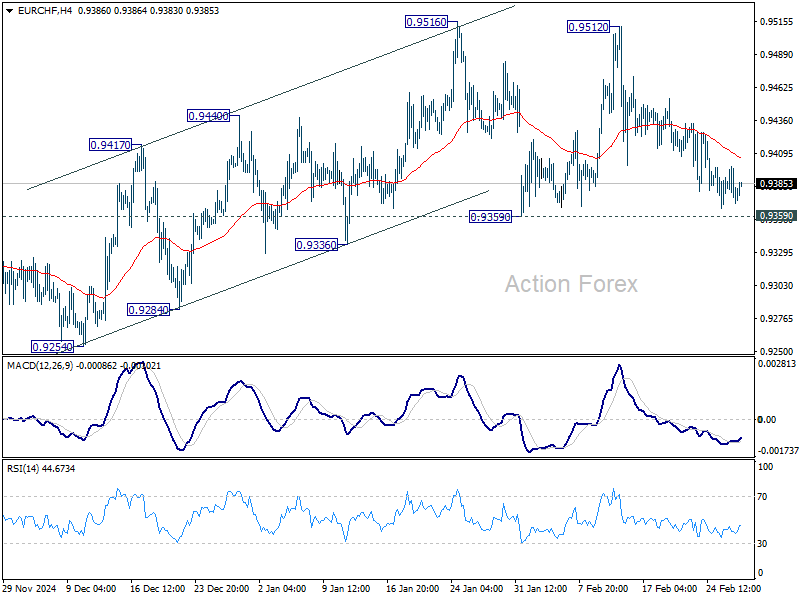
No change in EUR/CHF's outlook as range trading continues inside 0.9359/9516. Intraday bias remains neutral. On the downside, firm break of 0.9359 will revive the case that choppy rise from 0.9204 is merely a correction and has completed. Deeper fall should then be seen back to retest 0.9204 low. However, firm break of 0.9516 and sustained trading above 0.9481 fibonacci level will carry larger bullish implication and extend the rise from 0.9204.
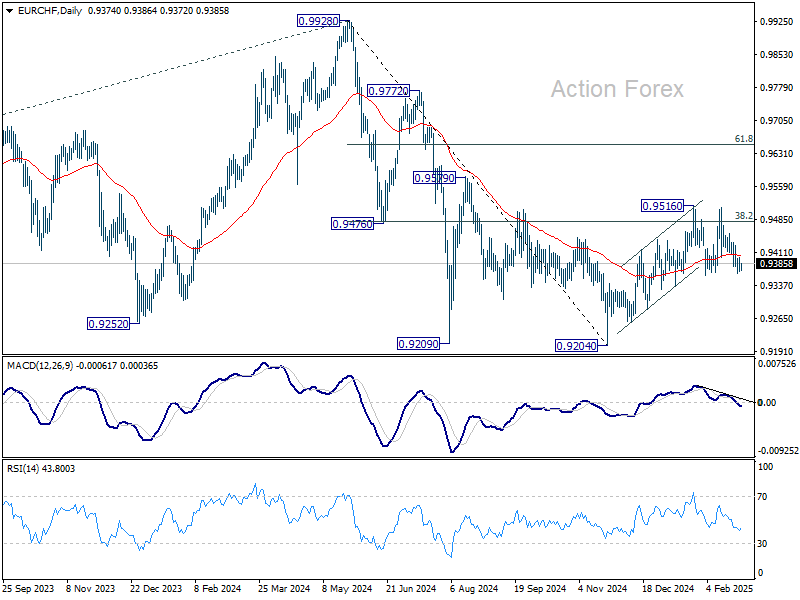
In the bigger picture, sustained trading above 38.2% retracement of 0.9928 to 0.9204 at 0.9481 should confirm that whole fall from 0.9928 has completed at 0.9204. Further rally should then be seen back to 61.8% retracement at 0.9651 and above. However, another rejection by 0.9481 will keep outlook bearish for extending larger down trend through 0.9204 at a later stage.
USD/CAD Daily Outlook
Daily Pivots: (S1) 1.4297; (P) 1.4333; (R1) 1.4372; More...
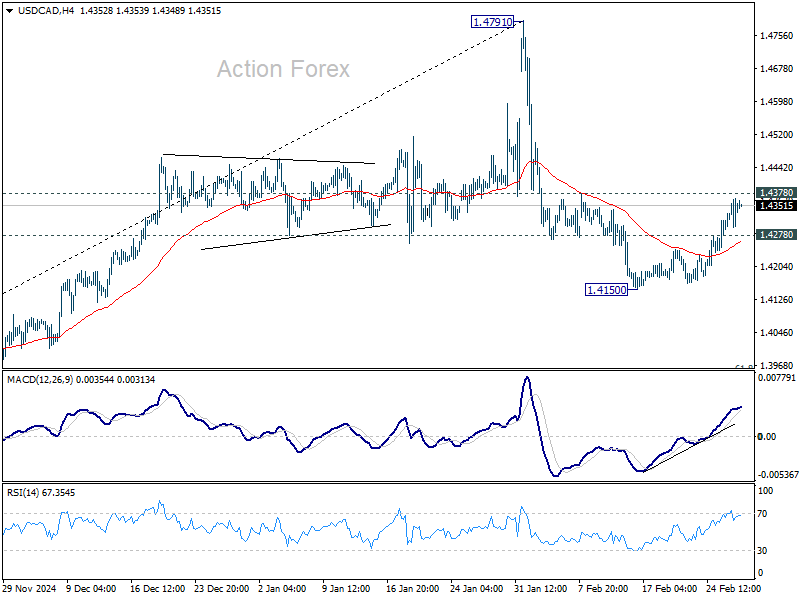
Intraday bias in USD/CAD remains neutral, with focus on 1.4378 resistance. Firm break there will suggest that the correction from 1.4791 has completed, and turn bias back to the upside for retesting 1.4791. Below 1.4278 minor will bring turn bias to the downside for 1.4150. Firm break there will resume the fall from 1.4791 to 1.3946 cluster support (61.8% retracement of 1.3418 to 1.4791 at 1.3942).
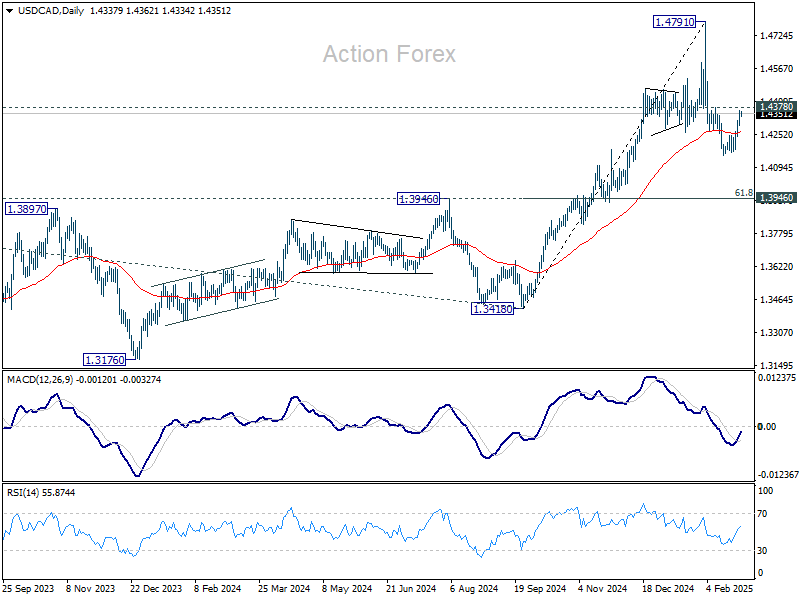
In the bigger picture, long term up trend is tentatively seen as resuming with prior breach of 1.4667/89 key resistance zone (2020/2015 highs). Next target is 100% projection of 1.2401 to 1.3976 from 1.3418 at 1.4993. This will remain the favored case as long as 1.3976 resistance turned support holds (2022 high), even in case of deep pullback.
AUD/USD Daily Report
Daily Pivots: (S1) 0.6283; (P) 0.6318; (R1) 0.6341; More...
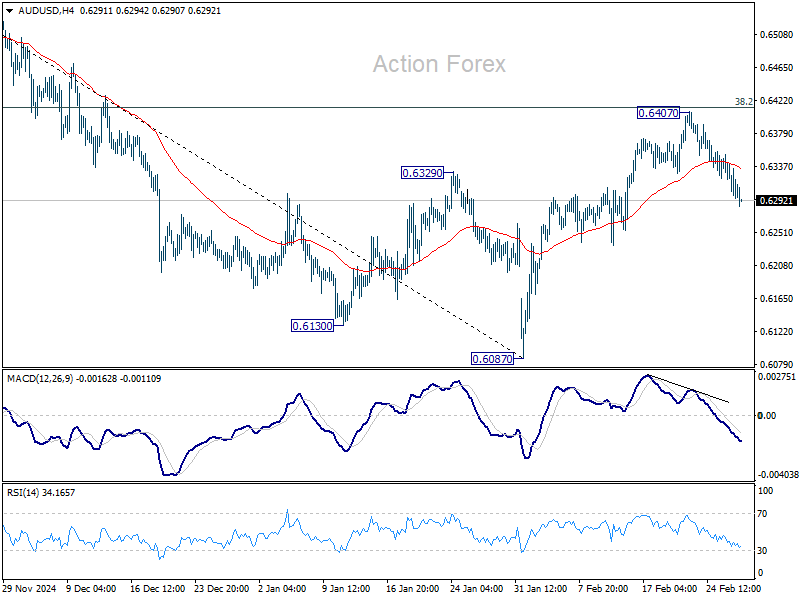
Intraday bias in AUD/USD remains on the downside for the moment. Corrective rebound from 0.6087 could have completed ahead of 38.2% retracement of 0.6941 to 0.6087 at 0.6413. Deeper fall should be seen to retest 0.6087. For now, risk will stay on the downside as long as 0.6407 holds, in case of recovery.
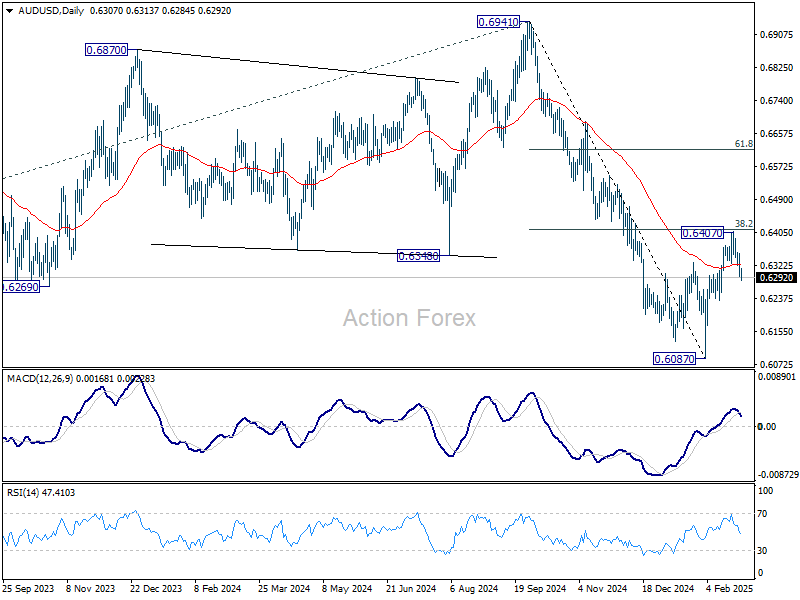
In the bigger picture, fall from 0.6941 (2024 high) is seen as part of the down trend from 0.8006 (2021 high). Next medium term target is 61.8% projection of 0.8006 to 0.6169 from 0.6941 at 0.5806. In any case, outlook will stay bearish as long as 55 W EMA (now at 0.6505) holds.
EUR/USD Daily Outlook
Daily Pivots: (S1) 1.0464; (P) 1.0496; (R1) 1.0518; More...
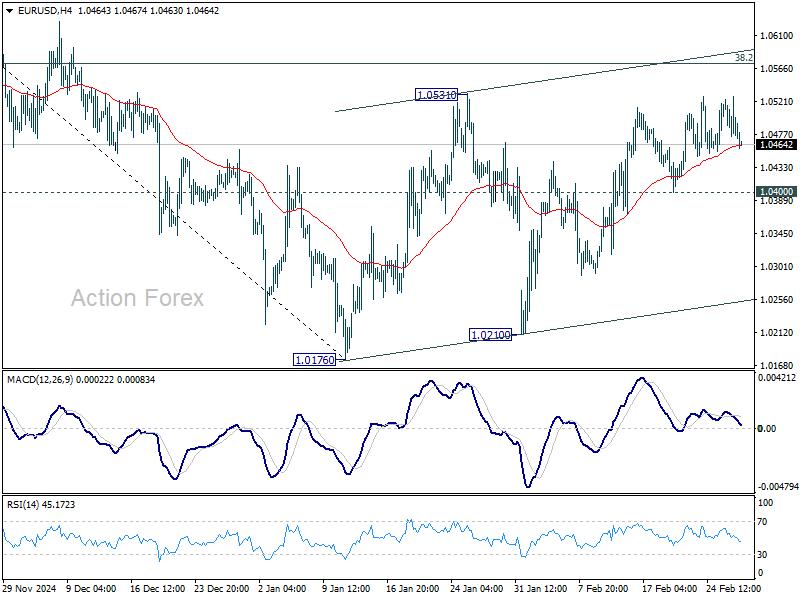
Outlook in EUR/USD is unchanged and intraday bias remains neutral. Price actions from 1.0176 are seen as a corrective pattern only. Strong resistance is expected from 38.2% retracement of 1.1213 to 1.0176 at 1.0572 to limit upside. On the downside, break of 1.0400 support will turn bias back to the downside for 1.0176/0210 support zone. However, decisive break of 1.0572 will raise the chance of reversal, and target 61.8% retracement at 1.0817.
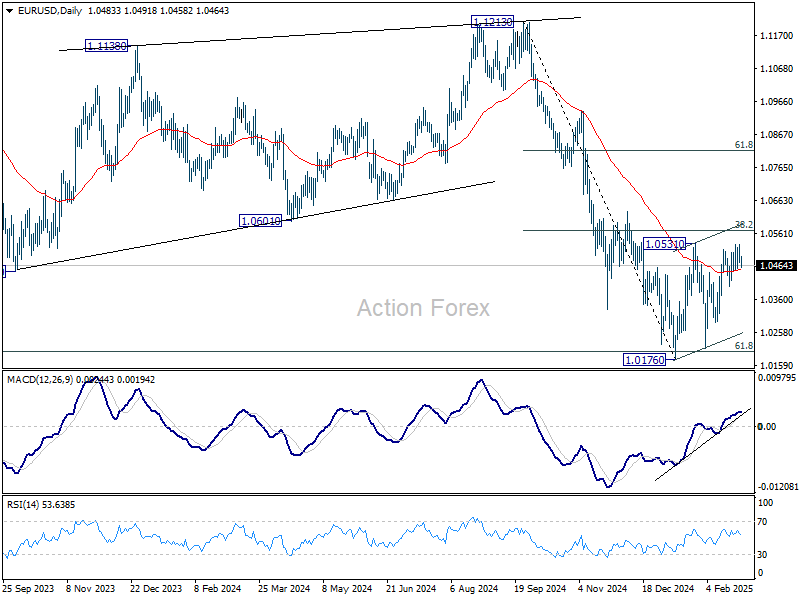
In the bigger picture, immediate focus is on 61.8 retracement of 0.9534 (2022 low) to 1.1274 (2024 high) at 1.0199. Sustained break there will solidify the case of medium term bearish trend reversal, and pave the way back to 0.9534. However, reversal from 1.0199 will argue that price actions from 1.1274 are merely a corrective pattern, and has already completed.
GBP/USD Daily Outlook
Daily Pivots: (S1) 1.2635; (P) 1.2676; (R1) 1.2716; More...
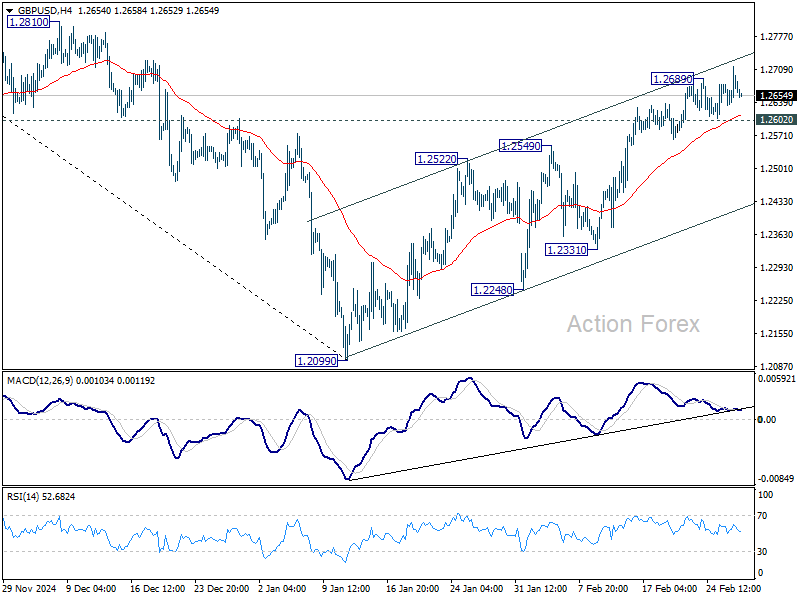
Intraday bias in GBP/USD is back on the upside with breach of 1.2689 temporary top. Rise from 1.2099 should target 1.2810 resistance next. However, firm break of 1.2602 support will now indicate short term topping and turn bias back to the downside.
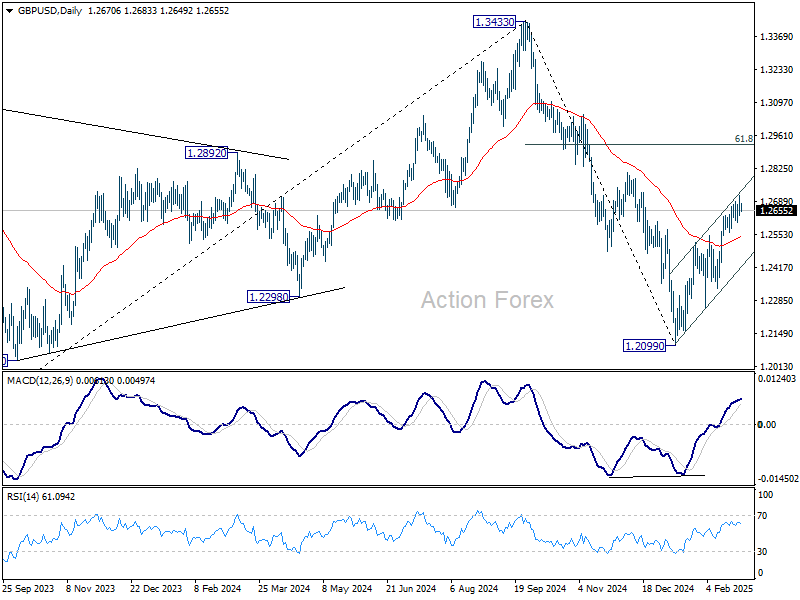
In the bigger picture, rise from 1.0351 (2022 low) should have already completed at 1.3433 (2024 high), and the trend has reversed. Further fall is now expected as long as 1.2810 resistance holds. Deeper decline should be seen to 61.8% retracement of 1.0351 to 1.3433 at 1.1528, even as a corrective move. However, firm break of 1.2810 will dampen this bearish view and bring retest of 1.3433 high instead.
USD/JPY Daily Outlook
Daily Pivots: (S1) 148.52; (P) 149.20; (R1) 149.78; More....
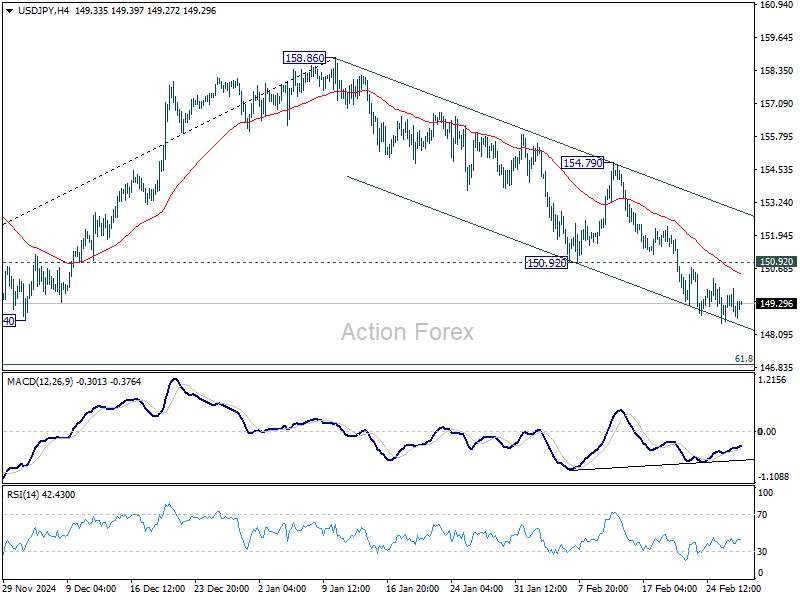
Further decline is expected in USD/JPY with 150.92 support turned resistance intact. Current fall from 158.86 is seen as the third leg of the pattern from 161.94 high. Deeper decline should be seen to 61.8% retracement of 139.57 to 158.86 at 146.32 next. On the upside, however, break of 150.92 will indicate short term bottoming and bring stronger rebound.
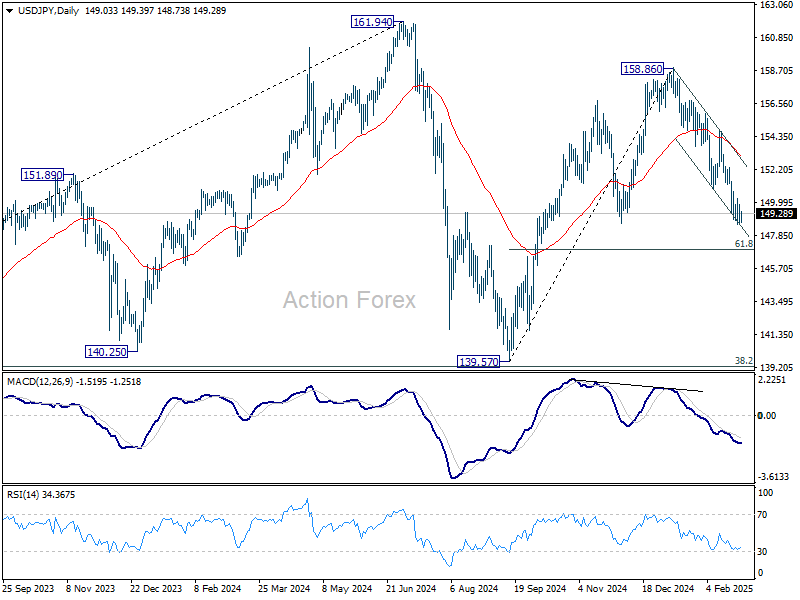
In the bigger picture, price actions from 161.94 are seen as a corrective pattern to rise from 102.58 (2021 low). In case of another fall, strong support should be seen from 38.2% retracement of 102.58 to 161.94 at 139.26 to bring rebound. However, sustained break of 139.26 would open up deeper medium term decline to 61.8% retracement at 125.25.
USD/CHF Daily Outlook
Daily Pivots: (S1) 0.8920; (P) 0.8943; (R1) 0.8969; More…
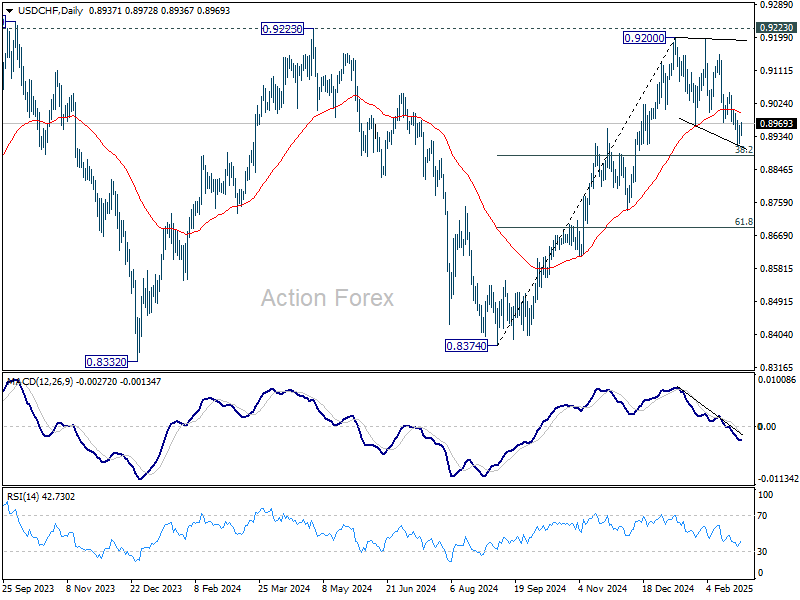
USD/CHF recovered notably but stays below 0.9053 resistance and intraday bias remains neutral. The corrective pattern from 0.9200 could still extend lower. But strong support should be seen from 38.2% retracement of 0.8374 to 0.9200 at 0.8884 to complete it, and bring larger rise resumption. On the upside, above 0.9053 will bring retest of 0.9200 resistance. However, sustained break of 0.8884 will indicate bearish reversal, and target 61.8% retracement at 0.8690 instead.
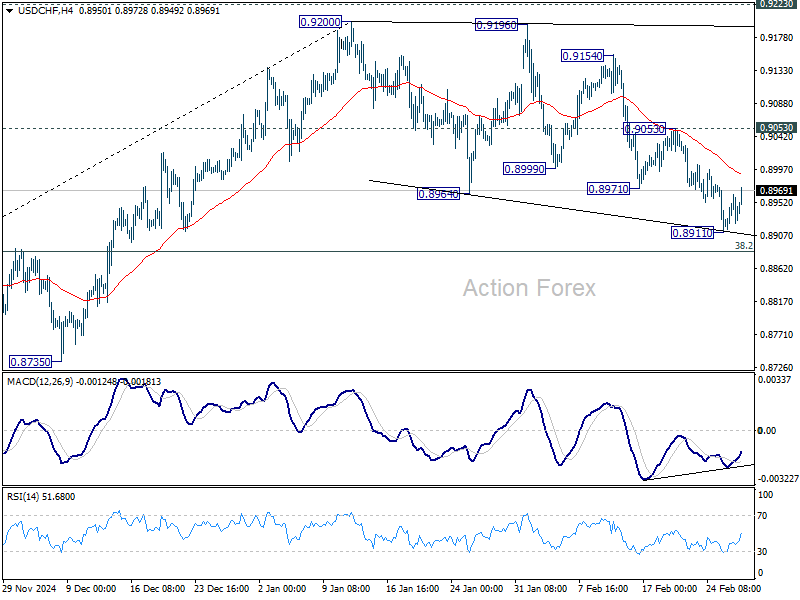
In the bigger picture, decisive break of 0.9223 resistance will argue that whole down trend from 1.0342 (2017 high) has completed with three waves down to 0.8332 (2023 low). Outlook will be turned bullish for 1.0146 resistance next. Nevertheless, rejection by 0.9223 will retain medium term bearishness for another decline through 0.8332 at a later stage.
Dollar Attempts Another Comeback, Aussie Lags
Dollar traded broadly higher in Asian session, trying to stage a comeback after a failed rally attempt overnight. Renewed focus on tariffs appears to be driving some of the greenback’s momentum. Meanwhile, broader market sentiment is just steady following Nvidia’s strong earnings report, with lingering concerns over competition from China’s DeepSeek AI continue to weigh.
Tariffs are back in headlines after US Commerce Secretary Howard Lutnick revealed that the “big transaction” involving reciprocal tariffs is set for April 2. The date was pushed from April 1, as US President Donald Trump—citing superstition—chose to avoid making major policy moves on that day.
Lutnick also noted that Canada and Mexico could avoid the planned 25% tariffs if they can demonstrate sufficient progress on border security and fentanyl control. However, he added that Trump would ultimately decide whether to pause again or proceed with the tariffs.
Despite Nvidia reporting an impressive 78% year-over-year sales increase and a 93% jump in data center revenue, its struggle to rebound with momentum. The company has yet to fully recover from its 17% drop on January 27—its worst single-day decline since 2020—amid growing concerns about China’s emerging AI competitor, DeepSeek.
Elsewhere, Aussie is struggling despite comments from a top RBA official suggesting that rate cuts are not on auto-pilot and that further easing would require more disinflation evidence. This cautious stance should have provided some support for the Aussie, but broader risk-off sentiment is keeping the currency under pressure.
For now, Aussie is sitting at the bottom of today's performance chart. Kiwi is also underperforming, while Swiss Franc is the third worst performer of the day so far. At the top of the performance table, Dollar leads, followed by Yen and Loonie. Euro and British Pound are positioning in the middle.
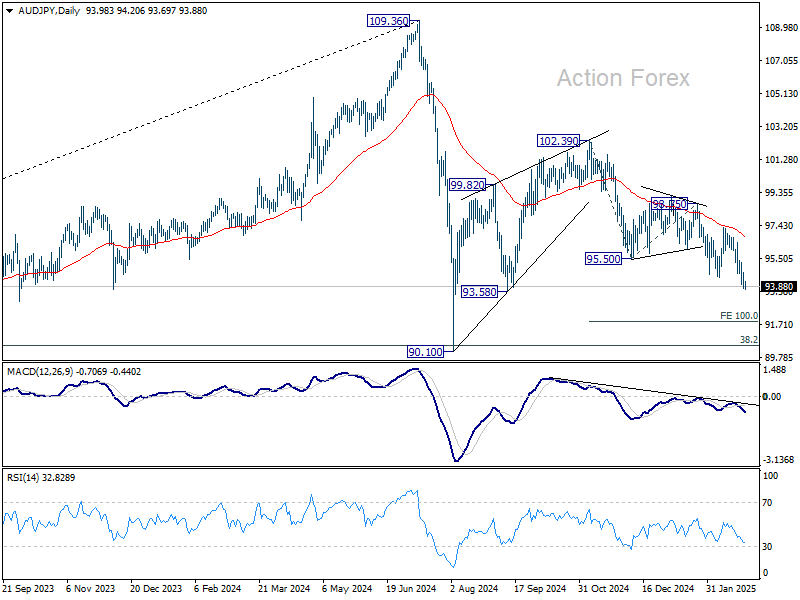
Technically, AUD/JPY's fall from 102.39 resumed this week and further fall should now be seen to 100% projection of 102.39 to 95.50 from 98.75 at 91.86. As this decline is seen as the second leg of the corrective pattern from 90.10, strong support should be seen around there to bring reversal. But risk will continue to stays on the downside as long as 55 D EMA (now at 96.74) holds, in case of recovery.
In Asia, at the time of writing, Nikkei is up 0.14%. Hong Kong HSI is down -0.76%. China Shanghai SSE is down -0.49%. Singapore Strait Times is down -0.13%. Japan 10-year JGB yield is up 0.036 at 1.402. Overnight, DOW fell -0.43%. S&P 500 rose 0.01%. NASDAQ rose 0.26%. 10-year yield fell -0.049 to 4.249.
RBA’s Hauser: Global uncertainty justifies rate cut, but more easing depends on disnflation evidence
RBA Deputy Governor Andrew Hauser told the parliament today that mounting global uncertainty had a chilling effect on economic activity, which played a role in the board’s decision to cut the cash rate by 25 bps this month.
He noted that businesses are becoming increasingly cautious, delaying investment projects and expansion plans as they wait for clearer economic signals, "just to see how things pan out."
This hesitation, he suggested, made a slight easing of monetary policy a "sensible" response to support economic stability.
However, Hauser emphasized that further rate cuts are not guaranteed and will depend on incoming inflation data. Policymakers remain optimistic about further disinflation but need to see clear evidence before committing to additional policy easing.
NZ ANZ business confidence rises to 58.4, on the path to recovery
New Zealand’s ANZ Business Confidence rose from 54.4 to 58.4 in February. However, the Own Activity Outlook, slipped slightly from 45.8 to 45.1, highlighting that while sentiment is improving, actual activity remains uncertain.
Pricing and cost indicators painted a mixed picture. Inflation expectations for the next year eased from 2.67% to 2.53% and cost expectations fell from 73.6 to 71.3. But wage expectations remained elevated at 79.2 despite fall from 83.1, and pricing intentions ticked up from 45.7 to 46.2.
ANZ noted that the economy is on the "path to recovery," supported by lower interest rates and stronger-than-expected commodity export prices. However, the bank cautioned that the next phase of growth remains "a point of debate."
The pace of expansion will depend on how households perceive current interest rates, the extent to which global uncertainty influences business investment, and whether firms push forward despite challenges. Additionally, potential labor shortages could emerge as a key constraint on further growth.
BoE’s Dhingra: Orderly trade fragmentation unlikely to require monetary policy response
BoE MPC member Swati Dhingra suggested that the inflationary impact of rising global tariffs could be tempered by weaker economic growth.
She added that if the global economy undergoes a "fragmentation in an orderly way," monetary policy might not need to react immediately as prices readjust to new geopolitical shifts.
However, she cautioned that in an "extreme scenario" where multiple major economies erect significant trade barriers similar to those proposed by the US, "severe strain on a few sources of supply" could lead to sharp price spikes, reminiscent of those seen following Russia's 2022 invasion of Ukraine.
Despite the risks, Dhingra downplayed the likelihood of a severe disruption, noting that "the world economy seems to be moving closer to an orderly fragmentation."
Looking ahead
Swiss GDP, Eurozone M3 monthly supply will be released in European session. ECB will publish meeting accounts.
Later in the day, US will release GDP revision, durable goods orders and pending home sales.
USD/CHF Daily Outlook
Daily Pivots: (S1) 0.8920; (P) 0.8943; (R1) 0.8969; More…
USD/CHF recovered notably but stays below 0.9053 resistance and intraday bias remains neutral. The corrective pattern from 0.9200 could still extend lower. But strong support should be seen from 38.2% retracement of 0.8374 to 0.9200 at 0.8884 to complete it, and bring larger rise resumption. On the upside, above 0.9053 will bring retest of 0.9200 resistance. However, sustained break of 0.8884 will indicate bearish reversal, and target 61.8% retracement at 0.8690 instead.
In the bigger picture, decisive break of 0.9223 resistance will argue that whole down trend from 1.0342 (2017 high) has completed with three waves down to 0.8332 (2023 low). Outlook will be turned bullish for 1.0146 resistance next. Nevertheless, rejection by 0.9223 will retain medium term bearishness for another decline through 0.8332 at a later stage.
RBA’s Hauser: Global uncertainty justifies rate cut, but more easing depends on disnflation evidence
RBA Deputy Governor Andrew Hauser told the parliament today that mounting global uncertainty had a chilling effect on economic activity, which played a role in the board’s decision to cut the cash rate by 25 bps this month.
He noted that businesses are becoming increasingly cautious, delaying investment projects and expansion plans as they wait for clearer economic signals, "just to see how things pan out."
This hesitation, he suggested, made a slight easing of monetary policy a "sensible" response to support economic stability.
However, Hauser emphasized that further rate cuts are not guaranteed and will depend on incoming inflation data. Policymakers remain optimistic about further disinflation but need to see clear evidence before committing to additional policy easing.
GBP/USD Shows Signs of Strength—More Gains Incoming?
Key Highlights
- GBP/USD remained in a bullish zone above the 1.2600 support.
- A key bullish trend line is forming with support at 1.2550 on the 4-hour chart.
- EUR/USD could gain pace if it clears the 1.0535 resistance.
- The US GDP could grow by 2.3% in Q4 2025 (Preliminary).
GBP/USD Technical Analysis
The British Pound started a decent increase above 1.2550 against the US Dollar. GBP/USD even cleared the 1.2620 resistance before it started a consolidation phase.
Looking at the 4-hour chart, the pair settled above the 1.2600 support, the 100 simple moving average (red, 4-hour), and the 200 simple moving average (green, 4-hour). There was a minor pullback from the 1.2690 high, but the pair remained supported.
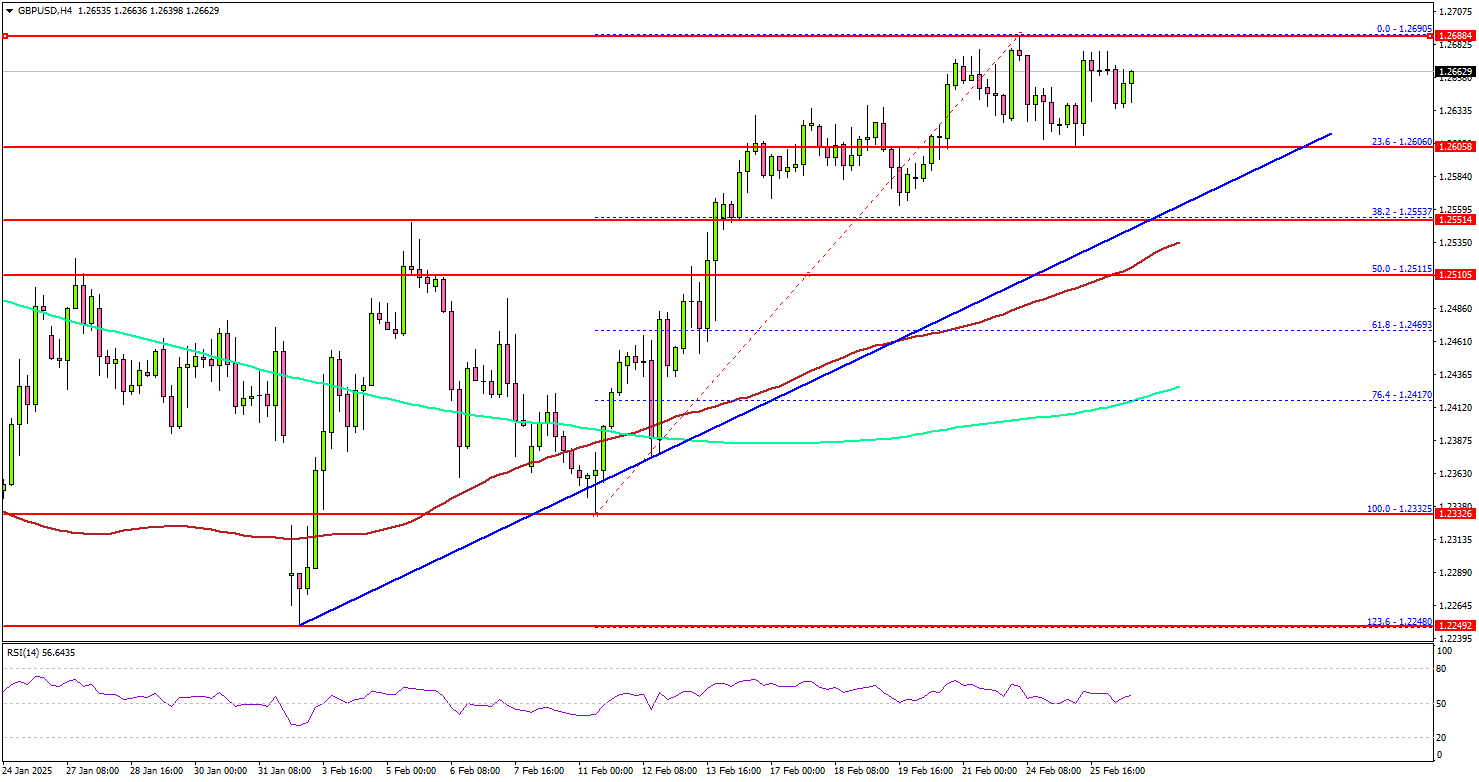
On the downside, immediate support sits near the 1.2620 level. The next key support sits near the 1.2600 level. The first major support is near the 1.2550 level and the 100 simple moving average (red, 4-hour.
There is also a key bullish trend line forming with support at 1.2550 on the same chart. Any more losses could send the pair toward the 1.2465 level.
On the upside, the pair seems to be facing hurdles near the 1.2690 level. The next major resistance is near the 1.2720 level. The main resistance is now forming near the 1.2750 zone. A close above the 1.2750 level could set the tone for another increase. In the stated case, the pair could even clear the 1.2800 resistance.
Looking at EUR/USD, the pair remained stable above 1.0450 and might aim for more gains above the 1.0535 resistance.
Upcoming Economic Events:
- US Gross Domestic Product for Q4 2025 (Preliminary) – Forecast 2.3% versus previous 2.3%.
- US Initial Jobless Claims - Forecast 221K, versus 219K previous.
- US Durable Goods Orders for Jan 2025 – Forecast +2% versus -2.2% previous.