

Sample Category Title
Fed’s Beige Book: Modest growth, rising price pressures, and tariff concerns
Fed’s Beige Book report indicated that "economic activity rose slightly" since mid-January, with mixed regional performances. While four Districts saw modest or moderate growth, six reported no change, and two experienced slight contractions.
Consumer spending was generally lower, with essential goods seeing steady demand but discretionary spending weakening, particularly among lower-income consumers. However, business expectations remained "slightly optimistic" for the coming months.
On the labor front, employment "nudged slightly higher" overall, though wage growth slowed modestly compared to the previous report.
While price pressures remained moderate, several Districts noted an uptick in the pace of increase, particularly in manufacturing and construction. Many firms struggled to pass higher input costs onto customers, but expectations of tariffs on imports were already prompting preemptive price hikes in some sectors.
What is the Impact of Tariffs on the U.S. Economy?
The effective U.S. tariff rate is now at its highest level since the 1940s after U.S. President Donald Trump signed an executive order to impose 25% tariffs on Canada and Mexico on March 4. A new order was also signed for China, increasing tariffs to 20% from 10%.
In our previous notes (here, here, and here), we estimated the potential shock to the North American economy resulting from a prolonged trade war. If these tariffs are kept in place in the months ahead, we expect to see slowing growth, an uptick in inflation, and a hit to consumer and business confidence. As we continue to monitor the situation, we have put together a list of frequently asked questions about the impact of these tariffs on the U.S. economy.
1. How important is U.S. trade with Canada, Mexico, and China?
Canada, Mexico, and China combined account for 40% of U.S. trade. These regions make up a sizeable share of essential imports for energy products and groceries, alongside automobiles and intermediate products necessary for U.S. manufacturing. American consumers rely on these imports since consumer demand exceeds domestic production for many goods. The implementation of tariffs is likely to have a significant near-term impact on the U.S. economy, because the U.S. is not able to immediately ramp up oil production, grow more produce or increase production capacity for many goods.
2. Will there be a recession and how will this impact U.S. growth?
We are not expecting the impact of tariffs to cause a recession in the U.S. However, if tariffs are left in place for three months or more, we will likely see no growth for the U.S. economy in 2025. We do expect Canada to fall into a recession in this scenario. For now, we don’t know how long the tariffs will last, especially since they are not solely economically motivated. But, if the current political climate is any indication, trade disruption will continue to be a key theme throughout the year and will add to uncertainty. That uncertainty will continue to weigh on investment activity as businesses struggle to make decisions amid a noisy and volatile backdrop.
3. Which sectors will be hit the hardest?
North America’s manufacturing sector is highly integrated and would, therefore, be hit the hardest from tariffs on imports with key trading partners. The auto manufacturing sector is, particularly, exposed. U.S. intermediate products account for a significant share of imported goods from Canada and Mexico as it crosses the border through multiple stages of auto production. Agriculture is another sector that would be significantly impacted since Canada, Mexico, and China account for roughly half of U.S. agricultural imports. China accounts for close to $100 billion of U.S. non-durable imports including chemicals, pharmaceuticals, paper products, and textiles.
4. How easy is it for the U.S. to “reshore” the most impacted sectors?
Reshoring is not as simple as it sounds. In fact, in the short term, reshoring is very difficult as significant levels of capital investment take years to plan and execute. The ability to produce goods domestically requires investment in land, factories, and machinery equipment and those decisions are challenging in a high-interest-rate environment. In the medium term, new supply chains would need to be established, adding to operating costs. In the longer term, the U.S. is facing labor supply constraints, limiting the production capacity of any new factories. The aging population is resulting in a record number of retirements. In particular, 26% of workers in manufacturing are over age 55. Added to this, the decline in immigration and notable geographic and skills mismatches in the manufacturing sector suggests reshoring activity may need to be capital intensive and could result in limited job creation.
5. How might tariffs show up in U.S. inflation measures?
Tariffs will very likely result in higher prices for U.S. consumers. Since it is difficult to substitute away from many imports from key trading partners, we expect to see the cost of tariffs passed on to domestic producers (as measured by the Producer Price Index), and ultimately, consumers (as measured by the Consumer Price Index). This would likely create sticky inflation above 3% through year-end. Prices for essentials will likely increase the most including groceries and energy. Goods prices will face upward pressure, removing much of the deflationary forces seen over the past year. We estimate that inflation could increase by 50 bps by year-end if tariffs are enforced beyond 3 months.
6. How will tariffs impact U.S. consumers?
Tariffs will impact all U.S. consumers, but the burden will be heavier for low-and-middle-income earners, who devote a greater share of their take-home pay to purchasing essentials. In the aftermath of the pandemic when inflation surged, the 25% uptick in energy prices felt more like 30% for America’s lower-and-middle income households. Tariff-driven price increases will add to the pressure these households are still contending with and will erode consumer confidence further.
7. How much revenue could tariffs generate for the U.S.?
Based on 2024 import data from Canada, Mexico, and China, the announced tariffs could boost total U.S. tariff revenues by about $300 billion, assuming demand remains unchanged. This would amount to roughly one-third of the annual cost of Trump’s proposed extension to the Tax Cuts and Jobs Act. However, this doesn’t take into account the fact that demand for imports from regions affected by tariffs is likely to shrink as producers attempt to source products from non-tariffed countries. This could be particularly acute for consumer-related sectors as U.S. consumers continue to be squeezed by inflation and look to reduce their demand for goods with rising prices. The ultimate boost to revenue is likely to be smaller than the $300 billion noted above, considering reduced demand and potential substitution effects.
8. How easy or difficult is it to substitute away from tariffed imports?
Many of the imported goods are not easily substituted in the U.S. economy. For example, Canada, Mexico, and China account for 60% of aluminum, lumber, and energy product imports. Energy infrastructure takes years to develop, and the U.S. is highly dependent on Canada for electricity imports (specifically in the Northeast) in addition to crude oil due to geographic proximity. Moreover, nearly one-third of fruits and vegetables consumed in by Americans are imported from Canada, Mexico, and China. Agricultural production is constrained by environmental factors, and the U.S. would need to import from other regions. Distance adds to logistical challenges, which would likely add to shipping costs.
9. How might the U.S. Federal Reserve respond?
The Fed is in a tough position since the U.S. will likely face both higher inflation and weaker demand for U.S. products from abroad and domestic consumers grappling with higher prices. According to our U.S. Rates Strategist, Blake Gwinn, “The downside risks of additional cuts have significantly increased. The longer these tariffs remain in place, and the broader the trade war gets, the more likely it gets that we will be adding cuts back into our 2025 outlook.”
GBP/USD Pushes Higher Amid Bullish Momentum
Key Highlights
- GBP/USD started a fresh increase above the 1.2750 resistance.
- A major bullish trend line is forming with support at 1.2670 on the 4-hour chart.
- EUR/USD surged above the 1.0535 and 1.0620 resistance levels.
- Crude oil prices remained in a bearish zone below $68.50.
GBP/USD Technical Analysis
The British Pound formed a base and started a fresh increase against the US Dollar. GBP/USD surged above the 1.2635 and 1.2720 resistance levels.
Looking at the 4-hour chart, the pair gained pace for a move above 1.2750. It even settled above the 1.2750 level, the 100 simple moving average (red, 4-hour), and the 200 simple moving average (green, 4-hour).
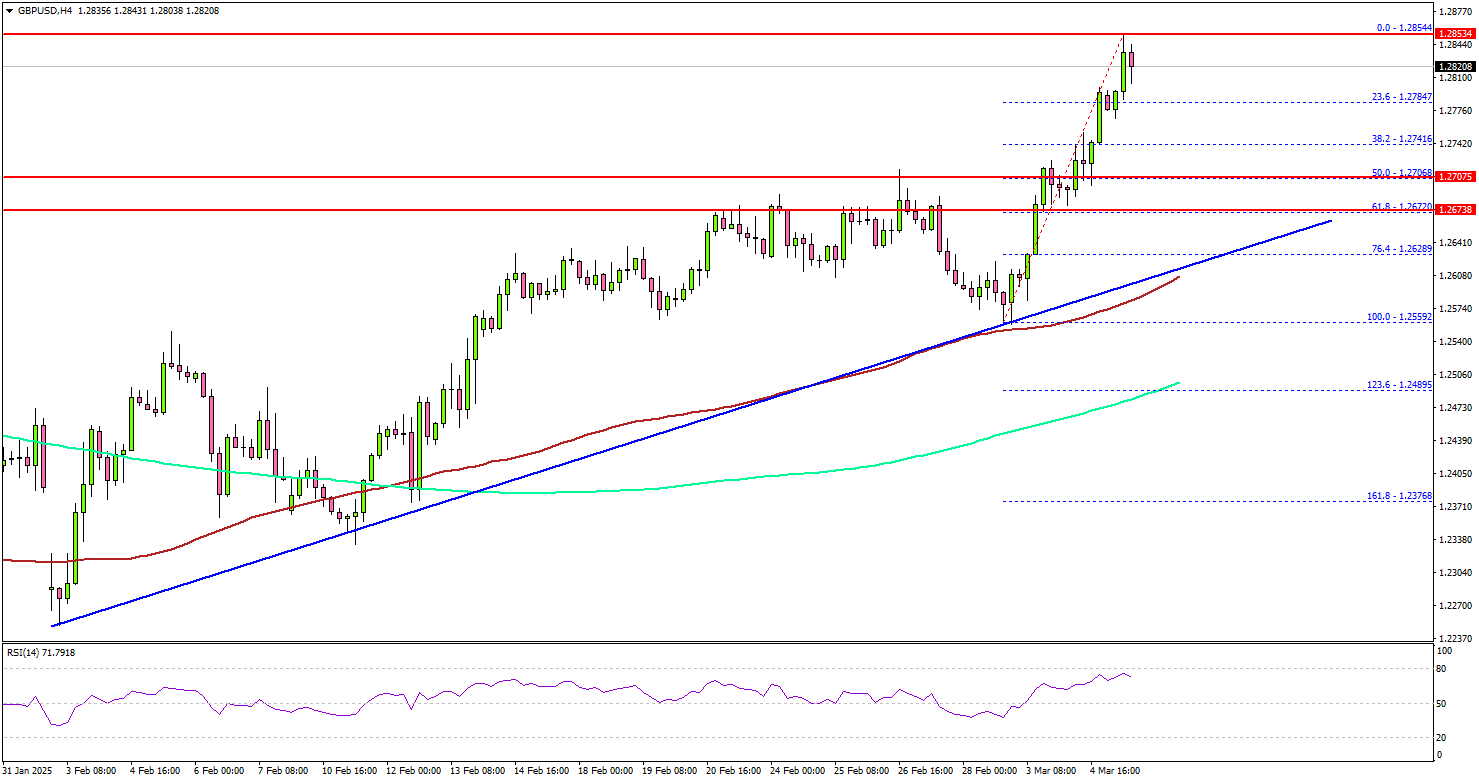
It tested the 1.2850 resistance. On the upside, the pair seems to be facing hurdles near the 1.2850 level. The next major resistance is near the 1.2880 level. The main resistance is now forming near the 1.2920 zone.
A close above the 1.2920 level could set the tone for another increase. In the stated case, the pair could even clear the 1.3000 resistance.
On the downside, immediate support sits near the 1.2740 level. The next key support sits near the 1.2680 level. There is also a major bullish trend line forming with support at 1.2670 on the same chart. Any more losses could send the pair toward the 1.2620 level.
Looking at EUR/USD, the pair also started a decent increase and the pair even cleared the 1.0650 resistance zone.
Upcoming Economic Events:
- BoE Interest Rate Decision - Forecast 2.5%, versus 2.75% previous.
- US Initial Jobless Claims - Forecast 235K, versus 242K previous.
Dow Jones (DJIA) Holds Support: Tariffs, Data & US Auto Tariff Exemption
- US stock markets (Dow Jones, S&P 500) are experiencing volatility due to Trump administration tariffs.
- A one-month tariff exemption for US automakers has temporarily eased market pressure, but the long-term sustainability of this is uncertain.
- US economic data is mixed, with a services PMI showing growth but rising input costs.
- Technically, the Dow Jones is in a bearish trend but holding key support levels.
Wall Street Indexes remain under pressure today but have held above the lows we saw on Tuesday as the Trump administration tariffs came into force. The announcement of tariffs on Mexico, Canada and China was met with retaliatory tariffs by Canada and China with Mexico expected to announce tariffs on Sunday.
However, US Commerce Secretary Lutnick yesterday stated that President Trump could relax some tariffs after talks with his Mexican and Canadian counterparts which has arrested the slide in Wall Street indexes for now.
A recent update from the White House revealed ongoing discussions between President Trump and Canadian Prime Minister Justin Trudeau. However, these talks have yet to yield any significant breakthroughs. Despite the lack of progress, market sentiment remains cautiously optimistic. The absence of fresh lows on U.S. indexes suggests that investors still believe in the possibility of a repeal or rollback of certain tariffs.
SPX 500 Heatmap
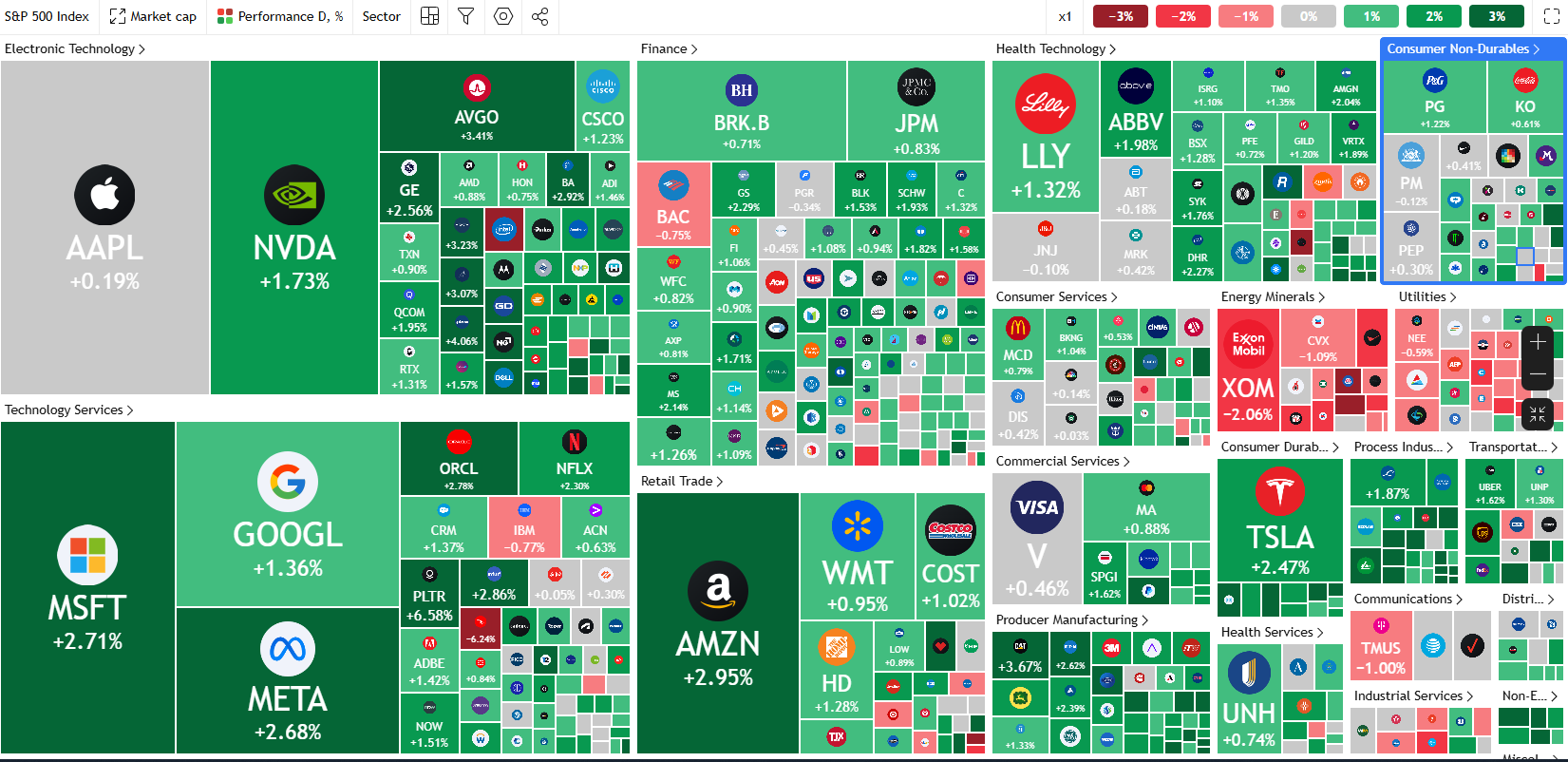
Source: TradingView
US indexes were helped a short while ago as the White House announced a one-month tariff exemption for automakers General Motors, Stellantis, and Ford on Wednesday afternoon.
“We are going to grant a one-month exemption on any autos passing through the USMCA [United States–Mexico–Canada Agreement],” a spokesperson stated during a press briefing. They added, “Reciprocal tariffs will still take effect on April 2, but at the request of companies associated with USMCA, the President is allowing this exemption to prevent any economic disadvantage.”
This move should not come as a surprise as automakers warned that tariffs could lead to significant price increases for consumers due to tariffs. The question however is whether such gains will remain sustainable moving forward or just temporary, as risk and uncertainty remain in play.
US Data continues to throw up warning signs however with a mixed US services PMI data print earlier in the day. February data revealed an unexpected uptick in growth within the services sector. However, optimism was moderated by emerging signs of rising input costs.
A sign that market participants remain concerned about future developments is reflected in the systematic equity positioning chart below. As you can see, systematic equity positioning is in the 60th percentile which indicates that it is not far from a neutral position and does not exhibit a strong bias towards either bullish or bearish positions, a sign of the markets uncertainty.
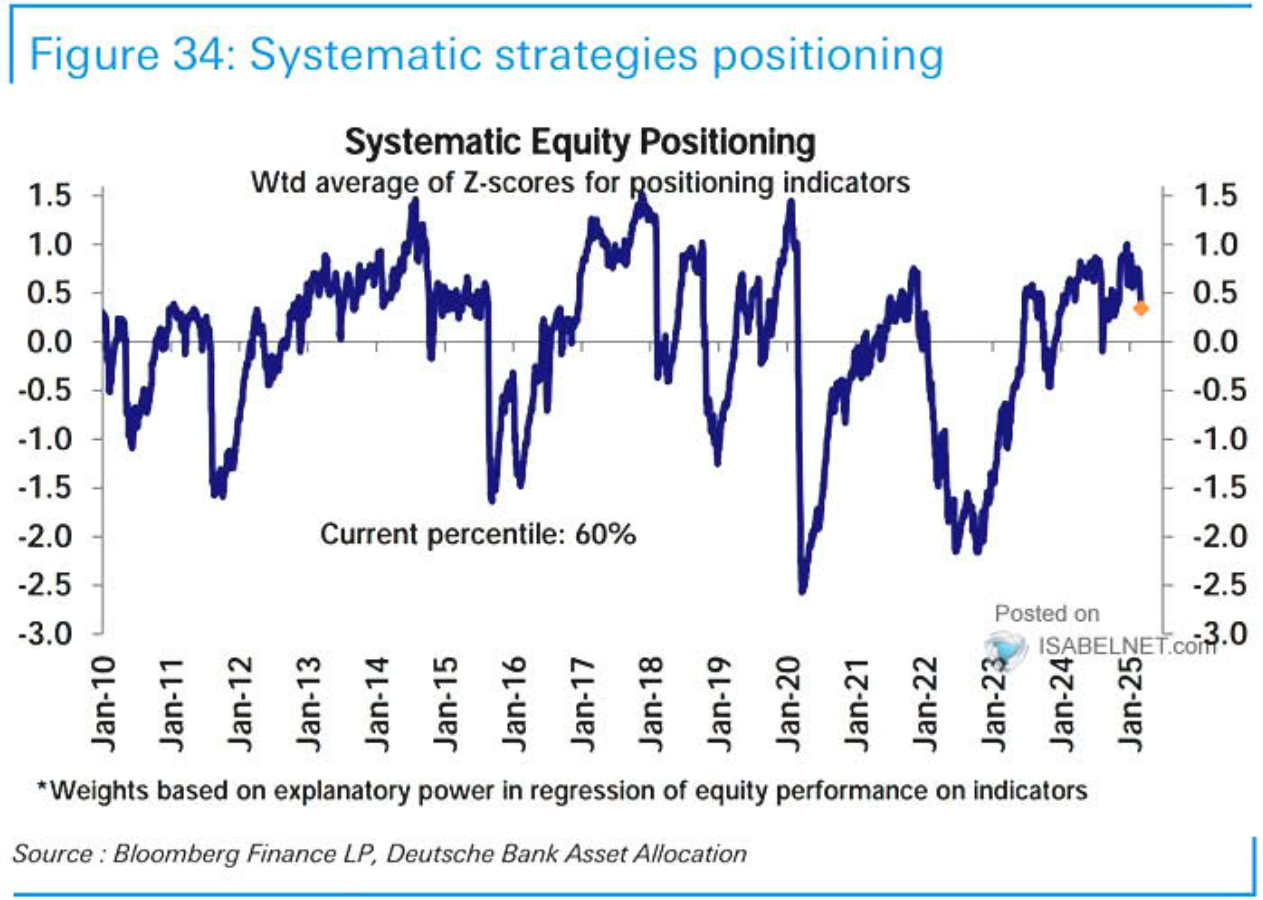
Source: Isablenet (click to enlarge)
US Data Ahead
US jobs payroll data still lies ahead on Friday and it should prove to be an interesting one.
New data from ADP showed the private sector added 77,000 jobs in February, much lower than the expected 140,000 jobs. This number is also far below the 186,000 jobs added in January, which was revised up from the earlier estimate of 183,000.
Tomorrow market participants will get a glance at initial jobless claims data before the all important NFP print on Friday.
Technical Analysis
Dow Jones
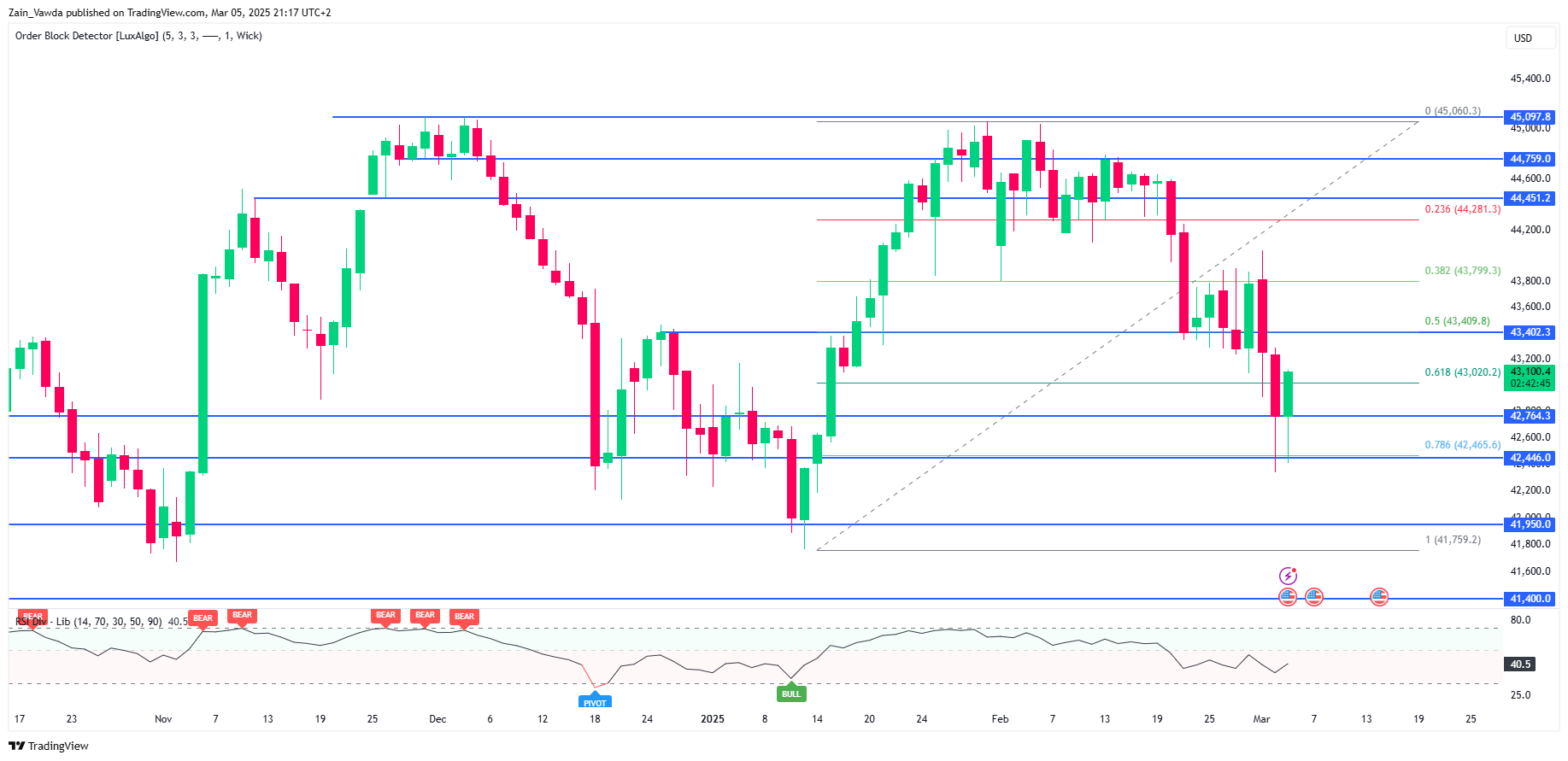
From a technical standpoint, the Dow Jones remains in a bearish trend but has shown some resilience holding above key support levels for now.
The index is trading at a confluence level as it hovers in the 61.8%-78.6% fibonacci retracement zone and between two key levels of 42764 and 42446. The longer price holds these levels the greater the probability of a recovery as we are seeing today.
The question is how far can a potential recovery run and a lot of this will depend on tariff development over the coming days.
Immediate resistance rests at 43402 and 43800 with a daily candle close above the 43800 leading to a change in structure. This would put bulls back in control from a technical analysis standpoint.
Immediate support rests at 42764 and 42446 before the 42000 handle comes back into focus.
Dow Jones (US30) Daily Chart, March 5, 2025
Source: TradingView (click to enlarge)
Support
- 42764
- 42446
- 42000
Resistance
- 43402
- 43800
- 44451
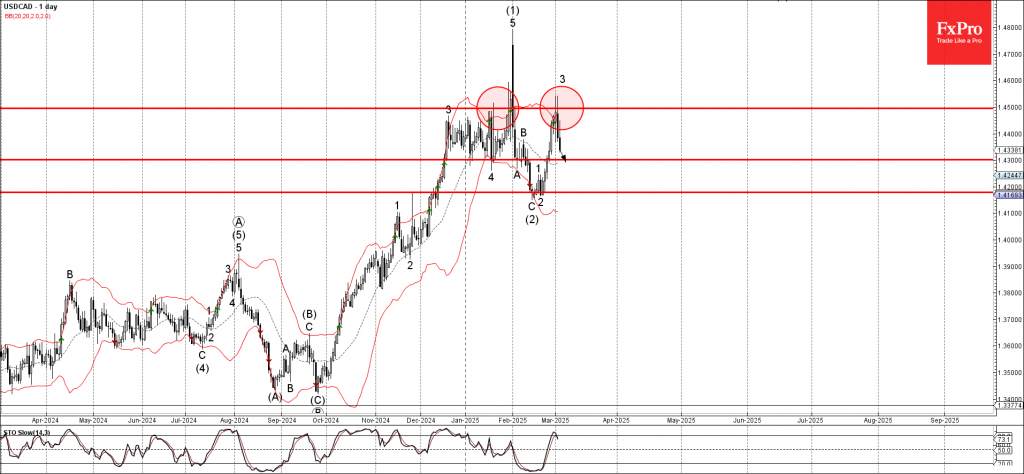
USDCAD Wave Analysis
- USDCAD reversed from the resistance zone
- Likely to fall to support level 1.4300
USDCAD recently reversed down from the resistance zone between the resistance level 1.4500 (which has been reversing the price from January) and the upper daily Bollinger Band.
The downward reversal from this resistance zone created the daily Japanese candlesticks reversal pattern Bearish Engulfing – which stopped the earlier impulse wave 3.
Given the strength of the resistance level 1.4500, USDCAD can be expected to fall to the next support level 1.4300.
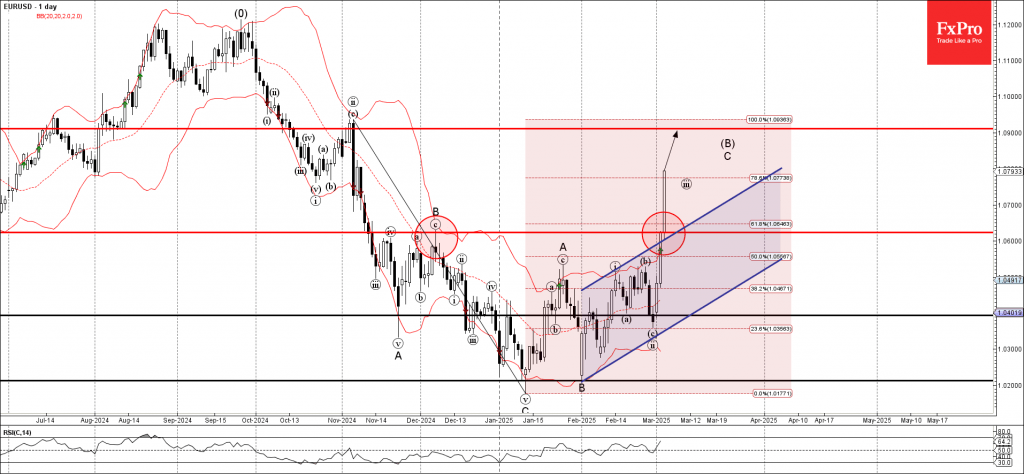
EURUSD Wave Analysis
- EURUSD broke the resistance zone
- Likely to rise to resistance level 1.0900
EURUSD currency pair recently broke the resistance zone between the resistance level 1.0625 (former monthly high from December), 61.8% Fibonacci correction of the downward impulse from November and the resistance trendline of the daily up channel from January.
The breakup of this resistance zone accelerated the active impulse wave C of the medium-term ABC correction B from January.
Given the strongly bearish US dollar sentiment, EURUSD can be expected to rise toward the next resistance level 1.0900, the target price for the completion of the active impulse wave C.
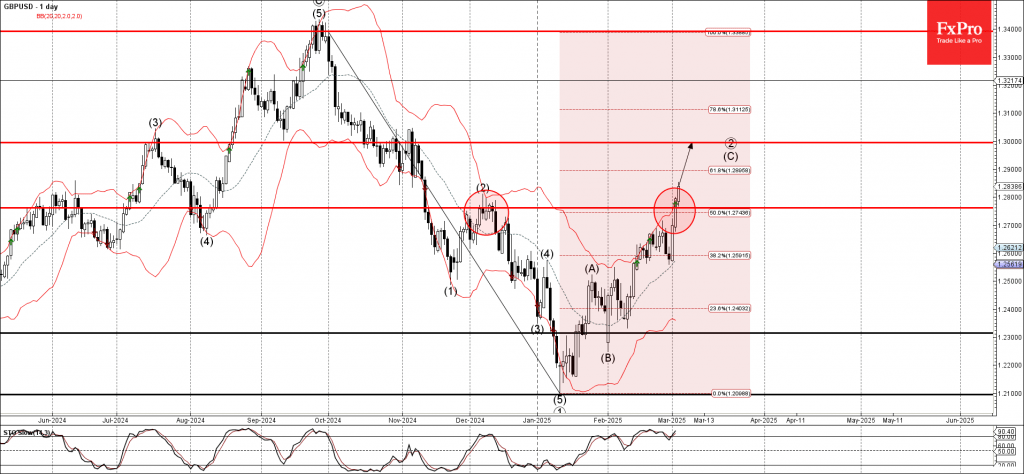
GBPUSD Wave Analysis
- GBPUSD broke the resistance zone
- Likely to rise to resistance level 1.3000
GBPUSD currency pair recently broke the resistance zone between the resistance level 1.2760 (which stopped wave (2) in December) and the 50% Fibonacci correction of the downward ABC correction from September.
The breakup of this resistance zone accelerated the active impulse wave (C) which belongs to the primary ABC correction 2 from January.
GBPUSD can be expected to rise toward the next resistance level 1.3000, the target price for the completion of the active impulse wave (C).
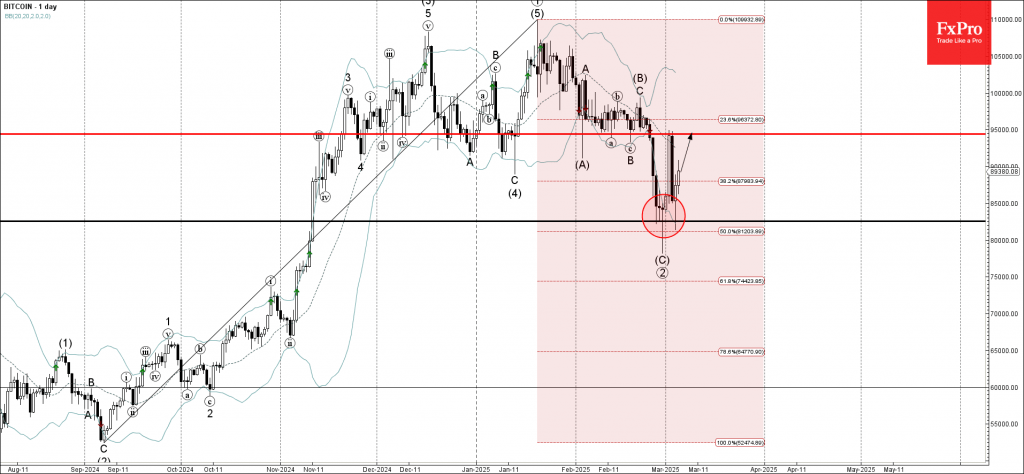
Bitcoin Wave Analysis
- Bitcoin reversed from support zone
- Likely to rise to resistance level 95000.00
Bitcoin recently reversed up multiple times from the support zone located between the key support level 82550.00 standing near the lower daily Bollinger Band and the 50% Fibonacci correction of the upward impulse from September.
The upward reversal from this support zone created the daily Japanese candlesticks reversal pattern Hammer Doji.
Bitcoin can be expected to rise toward the next resistance level 95000.00, which reversed the price sharply earlier this month.
Sunset Market Commentary
Markets
“Whatever it takes.” These words by former ECB president Draghi in July 2012 are widely considered the turnaround in the sovereign debt crisis that had the euro (area) staring into the abyss. Germany’s upcoming chancellor Merz used them again to announce a similar seismic shift on a fiscal level. With a €500bn infrastructure investment fund and essentially unlimited defense spending (exempted from the debt brake) the country addresses two of the most pressing challenges. As a welcome side-effect it could give a cyclical boost to the ailing economy in general. The way Germany’s upcoming government coalition partners struck the agreement – in the dying days of parliament to avoid blocking minorities in the new one – only adds to its already historical status. For it to be approved with the necessary two-thirds majority, the CDU/CSU & SPD still need the support of the Greens, though. In another sign of how the tides have turned, Germany is now urging the EU to ease the fiscal rules quickly. A temporary suspension of the 3% deficit limit rule was one of the options presented by EC president von der Leyen yesterday ahead of tomorrow’s special EU defense summit. Germany’s big and bold move triggers a “Make Europe Great Again” wave of optimism. Stocks in the region add 2.5% (EuroStoxx50) with Germany (+3.3%) outperforming lead by defense, infrastructure and cars. German yields sear up to 25 bps (!). The 30-yr topped 3% again and its 10-yr yield moves beyond the 2024 high. Bund vs swap (10-yr) spread moved to its highest ever (14 bps). The common currency surges for a third day straight, taking out the EUR/USD 1.0533 and 1.0677 resistance levels in the process. Next up is 1.0804.
We see opposite dynamics playing out in the US again. The stagflationary genie is out of the bottle, set free by ruthless DOGE department and a raft of tariff announcements, regardless the chance of being watered down in the Canadian and Mexican case – as Commerce Secretary Lutnick suggested. US Treasuries greatly outperformed Bunds with much weaker than expected ADP job growth adding to the spread. Coming in at about half of the 140k expected, the US 2-yr yield fell 8 bps to intraday lows. The long end slips 2.5-4.5 bps. The dollar trades at the backfoot, against the euro in the first place, but against all global peers in a broader perspective. DXY (trade-weighted) breaks below 105.17 support (50% retracement on the Sep-Jan rally) to slip to a four-month low. The next reference from the current 104.7 is 103.94/104.
The US services ISM, released when wrapping up this report, came in better than expected. The headline figure in February improved from 52.8 to 53.5 with details printing stronger as well. New orders rose to 52.2 and employment to 53.9. Prices paid ticked higher to 62.6. US yields and the dollar pared some of their previous losses but remain down for the day.
News & Views
Czech inflation rose by 0.2% M/M, matching consensus. On an annual basis, inflation moderated from 2.8% to 2.7%. Inflation remains slightly above the CNB's staff estimate (2.6%) and will not see significant changes in March. There may be a more visible slowdown due to a negative base effect in April. The CNB should have this number at its May meeting with a new staff forecast. Recall that we expect a another rate cut at that meeting. Core CPI, excluding energy, food, alcohol and tobacco rose by 0.6% M/M (3.2% Y/Y from 3.1%). Details also showed services prices rising by 0.7% M/M and stabilizing at 4.7% Y/Y with goods prices falling by 0.2% M/M to be up 1.4% Y/Y (from 1.7%). The Czech koruna obviously didn’t respond to the data. EUR-strength is pushing EUR/CZK away from the 25 support zone.
Swiss inflation accelerated to 0.6% M/M in February to be up 0.3% Y/Y (from 0.4% in January). The monthly increase is due to several factors including rising prices for housing rentals and for air transport. International package holidays also recorded a price increase. In contrast, prices for hotels decreased, as did those for berries and second-hand cars. Details showed overall goods prices rising by 0.2% M/M to be down 1.8% Y/Y while services inflation increased by 0.8% M/M to be 1.7% higher Y/Y. Euro strength is the key driver in EUR/CHF as well with the pair taking out the previous YtD high at 0.9518 today.