Mon, Apr 13, 2026 18:03 GMT
More

    Sample Category Title

    NZDUSD Wave Analysis

    FxPro
    • NZDUSD broke long-term support level 0.5770
    • Likely to fall to support level 0.5500

    NZDUSD currency pair earlier broke below the long-term support level 0.5770 (which acted as the lower border of the weekly sideways price range inside which the pair has been trading from the start of 2023).

    The breakout of the support level 0.5770 accelerated the active impulse wave C of extended downward ABC correction (2) from last year.

    NZDUSD can be expected to fall further to the next support level 0.5500 (former multiyear low from 2022 and the target price for the completion of the active impulse wave C).

    Gold Wave Analysis

    • Gold under bearish pressure
    • Likely to fall to support level 2555.00

    Gold under the bearish pressure after the earlier breakout of the key support level 2617,00 (which is the lower border of the sideways price range inside which the price has been trading from November).

    The breakout of the support level 2617,00 stopped the earlier impulse wave 3 of the higher order impulse wave (5) from last month.

    Gold can be expected to fall further to the next support level 2555.00 (which stopped the earlier medium-term correction (4) in November).

    Eco Data 12/19/24

    GMT Ccy Events Actual Consensus Previous Revised
    21:45 NZD GDP Q/Q Q3 -1.00% -0.20% -0.20% -1.10%
    00:00 AUD Consumer Inflation Expectations Dec 4.20% 3.80%
    00:00 NZD ANZ Business Confidence Dec 62.3 64.9
    02:52 JPY BoJ Interest Rate Decision 0.25% 0.25% 0.25%
    07:00 EUR Germany GfK Consumer Confidence Jan -21.3 -22 -23.3 -23.1
    07:00 CHF Trade Balance (CHF) Nov 5.42B 6.20B 8.06B 8.03B
    09:00 EUR Eurozone Current Account (EUR) Oct 25.8B 33.5B 37.0B 38.8B
    12:00 GBP BoE Interest Rate Decision 4.75% 4.75% 4.75%
    12:00 GBP MPC Official Bank Rate Votes 0-3--6 0--2--7 0--8--1
    13:30 USD Initial Jobless Claims (Dec 13) 220K 240K 242K
    13:30 USD GDP Annualized Q3 F 3.10% 2.80% 2.80%
    13:30 USD GDP Price Index Q3 F 1.90% 1.90% 1.90%
    13:30 USD Philly Fed Manufacturing Index Dec -16.4 1.9 -5.5
    15:00 USD Existing Home Sales Nov 4.15M 4.11M 3.96M
    15:30 USD Natural Gas Storage -125B -123B -190B
    GMT Ccy Events
    21:45 NZD GDP Q/Q Q3
        Actual: -1.00% Forecast: -0.20%
        Previous: -0.20% Revised: -1.10%
    00:00 AUD Consumer Inflation Expectations Dec
        Actual: 4.20% Forecast:
        Previous: 3.80% Revised:
    00:00 NZD ANZ Business Confidence Dec
        Actual: 62.3 Forecast:
        Previous: 64.9 Revised:
    02:52 JPY BoJ Interest Rate Decision
        Actual: 0.25% Forecast: 0.25%
        Previous: 0.25% Revised:
    07:00 EUR Germany GfK Consumer Confidence Jan
        Actual: -21.3 Forecast: -22
        Previous: -23.3 Revised: -23.1
    07:00 CHF Trade Balance (CHF) Nov
        Actual: 5.42B Forecast: 6.20B
        Previous: 8.06B Revised: 8.03B
    09:00 EUR Eurozone Current Account (EUR) Oct
        Actual: 25.8B Forecast: 33.5B
        Previous: 37.0B Revised: 38.8B
    12:00 GBP BoE Interest Rate Decision
        Actual: 4.75% Forecast: 4.75%
        Previous: 4.75% Revised:
    12:00 GBP MPC Official Bank Rate Votes
        Actual: 0-3--6 Forecast: 0--2--7
        Previous: 0--8--1 Revised:
    13:30 USD Initial Jobless Claims (Dec 13)
        Actual: 220K Forecast: 240K
        Previous: 242K Revised:
    13:30 USD GDP Annualized Q3 F
        Actual: 3.10% Forecast: 2.80%
        Previous: 2.80% Revised:
    13:30 USD GDP Price Index Q3 F
        Actual: 1.90% Forecast: 1.90%
        Previous: 1.90% Revised:
    13:30 USD Philly Fed Manufacturing Index Dec
        Actual: -16.4 Forecast: 1.9
        Previous: -5.5 Revised:
    15:00 USD Existing Home Sales Nov
        Actual: 4.15M Forecast: 4.11M
        Previous: 3.96M Revised:
    15:30 USD Natural Gas Storage
        Actual: -125B Forecast: -123B
        Previous: -190B Revised:

    FOMC Cuts Rates, but Pace of Easing Ahead Likely Will Slow

    Summary

    • As widely expected, the FOMC cut the target range for the federal funds rate by 25 bps at today's meeting. However, one Committee member, who preferred to keep rates on hold, dissented.
    • Wording in the post-meeting statement was changed to signal that further easing may proceed at a slower pace.
    • The median dot for 2025 in the so-called "dot plot" was raised by 50 bps. In September, the median FOMC member looked for 100 bps of policy easing next year. The median forecast today looks for only 50 bps of rate cuts next year.
    • The wide dispersion in the dot plot for next year may reflect some uncertainty regarding the policy agenda that the incoming administration may pursue. Notably, the range of core PCE inflation forecasts for 2025 widened considerably.

    Fed Cuts Rates but Forward Guidance Is Hawkish

    As widely expected by market participants, the Federal Open Market Committee (FOMC) reduced its target range for the federal funds rate by 25 bps at its policy meeting today (Figure 1). The FOMC has now cut its target range by 100 bps from its peak of 5.25%-5.50% through moves of 50 bps in September, 25 bps in November and 25 bps today. Although the Committee eased policy today, we would characterize the decision as a "hawkish" rate cut.

    For starters, Beth Hammack, the president of the Federal Reserve Bank of Cleveland, dissented today, voting to keep rates on hold instead. In that regard, Chair Powell noted in his post-meeting press conference that today was a "closer call" to cut rates by 25 bps than it was in November. Secondly, the Committee made a notable change to its post-meeting statement. The statement that was released following the last FOMC meeting on November 7 contained the following clause: "In considering additional adjustments to the target range for the federal funds rate..." This clause implied that the FOMC thought last month that it would continue to ease policy in coming months. That clause was changed to the following in today's statement: "In considering the extent and timing (emphasis ours) of additional adjustments to the target range for the federal funds rate..." This rewording of the clause implies to us that the FOMC may now pause in the next meeting or two to ascertain how much additional policy easing may be appropriate.

    The FOMC also released its quarterly Summary of Economic Projections (SEP) today. As we projected in our recent Flashlight report, the median forecast for real GDP growth in 2025 was revised a touch higher, the unemployment rate forecast for the end of next year edged down from 4.4% in the September SEP to 4.3% in today's projections, while the core PCE inflation rate for 2025 was pushed up from 2.2% to 2.5%. Accordingly, the median dot in the so-called "dot plot" rose by 50 bps for 2025 (Figure 2). In September, the median FOMC member thought that a target range for the federal funds rate of 3.25%-3.50% would be appropriate at the end of 2025. The median FOMC member today now thinks that a range of 3.75%-4.00% will be appropriate. In other words, the median member now thinks that only 50 bps of additional easing next year will be warranted if conditions evolve as expected.

    That said, the dots for next year are widely dispersed. The most dovish Committee member thinks that 125 bps of additional easing would be appropriate next year, while the most hawkish member sees no additional rate cuts from today's level. This dispersion may reflect uncertainty surrounding the policy agenda that the incoming Trump administration may pursue in 2025. Notably, the range of forecasts among FOMC members for core PCE inflation, which the Fed believes is the best measure of the underlying rate of consumer price inflation, widened meaningfully for next year between September and December. The range for 2025 core PCE inflation in the September projection was 2.1% to 2.5%. The range in today's SEP widened to 2.1% to 3.2%. Some FOMC members may be assuming that tariff hikes, should they go into effect, will raise inflation next year. (See the report we wrote in July for further discussion of the macroeconomic effects of tariffs.)

    In sum, today's FOMC meeting leads us to believe that, barring some dramatic unexpected development, the Committee likely will keep rates on hold at its next meeting on January 29. However, we believe the FOMC will continue to ease policy next year, albeit at a slower pace than over the past few months. Chair Powell seemed to support this expectation when he noted in his presser that the stance of monetary policy is "significantly closer to neutral" than it was previously, but that policy is "still meaningfully restrictive."

    Fed Cuts by 25 bps, Signals Slower Pace in 2025

    The Federal Reserve Open Market Committee (FOMC) cut the federal funds rate to the 4.25% to 4.50% range and announced it would continue its balance sheet runoff.

    The Fed maintained its language on growth and inflation, stating "economic activity has continued to expand at a solid pace", that the "labor market conditions have generally eased" and that "inflation has made progress toward the Committee's 2 percent objective but remains somewhat elevated."

    On the future path of policy, the statement added more specificity that it is considering "the extent and timing" of additional adjustments to the target range. Seemingly setting up the possibility of a pause in interest rate cuts.

    The Fed's Summary of Economic Projections was updated from September:

    • The median projection for real GDP growth was upgraded to 2.5% in 2024, 2.1% in 2025, 2.0% in 2026, 1.9% in 2027, and 1.8% over the long run (from 2.0%, 2.0%, 2.0%, 2.0% and 1.8%).
    • The median unemployment rate forecast was upgraded slightly to 4.2% in 2024, 4.3% in 2025, 4.3% in 2026, 4.3% in 2027, and 4.2% over the long run (from 4.4%, 4.4%, 4.3%, 4.2%, and 4.1%).
    • On inflation, the median estimate for core PCE was raised to 2.8% in 2024, 2.5% in 2025, and 2.2% in 2026, and 2.0% in 2027 (from 2.6%, 2.2%, 2.0%, and 2.0%).
    • The median projection for cuts to the fed funds rate was reduced by 50 basis points over 2025 and 2026. This raised the level of the fed funds rate to 3.9% in 2025, 3.4% in 2026, 3.1% in 2027, and the long-run neutral rate was assumed to be 3.0% (from 3.4%, 2.9%, 2.9% and 2.9%).

    President of the Cleveland Fed, Beth Hammack, voted against today's decision, having preferred for the Fed to have paused at this meeting.

    Key Implications

    After confirming that the Fed followed through on its 25 bp cut, everyone immediately moved to see how the central bank's view on future rate cuts shifted. No surprise, the Fed expects to be more cautious in 2025 than it forecast prior to the election of President Trump. It has removed 50 bps in cuts, while it has marked up its outlook for inflation. We'd also note that more members are aligned to the median view of 50 basis points in cuts than were aligned on 100 bps in September.

    Market pricing agrees with the Fed's more cautious approach, with an increasing likelihood that the Fed will have to pause rate cuts in January. While we don't think investors should rule out a January cut completely, with the Fed's preferred inflation rate stuck at 2.8% year-on-year, and expectations that President Trump will follow through on his inflationary political strategy, it makes sense that the Fed will be much more cautious come the New Year.

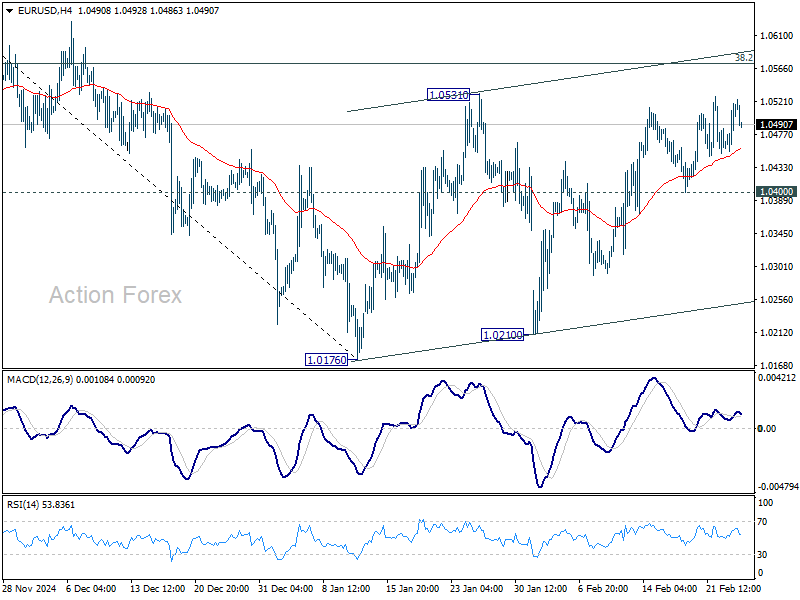
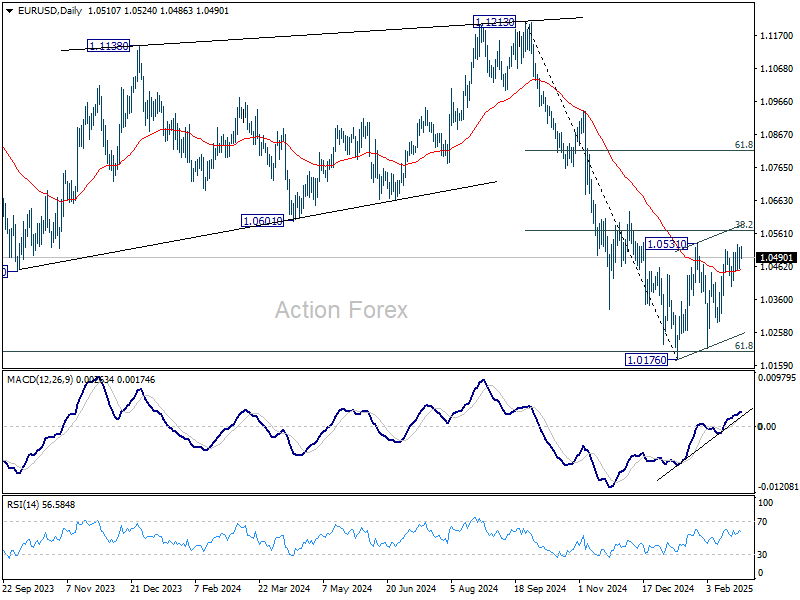
    EUR/USD to fall towards 1.0330 after FOMC

    Dollar jumps across the board after Fed's hawkish rate cut, with economic projections giving a strong nod to market expectations of slower policy easing, and a higher terminal rate.

    EUR/USD's fall from 1.0629 resumed by breaking through 1.0452. Decline from 1.1213 might also be resuming and break of 1.0330 will target 61.8% projection of 1.0936 to 10330 from 1.0629 at 1.0254.

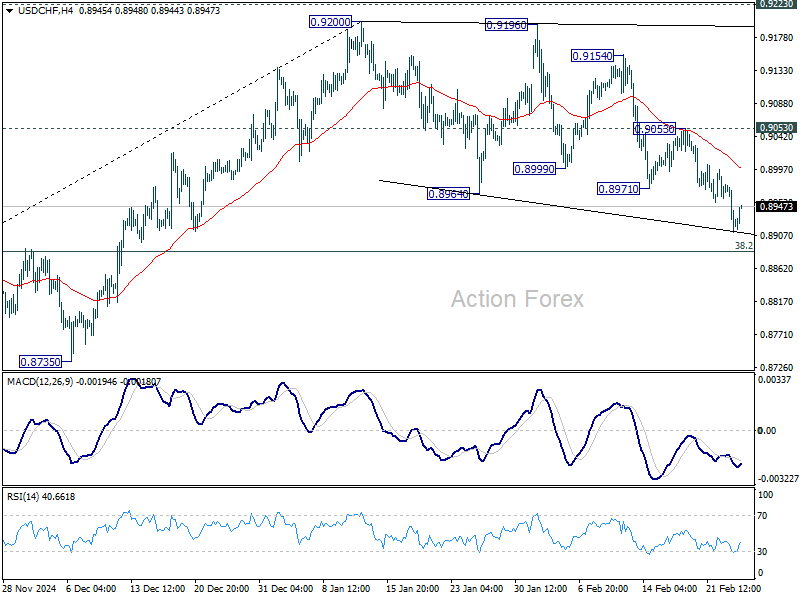
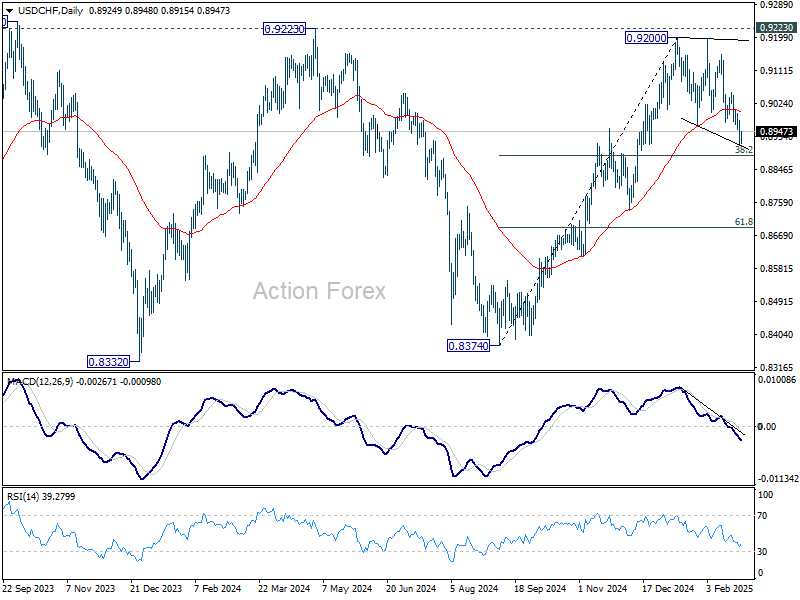
    USD/CHF's breach of 0.8974 suggest that the brief retreat has completed. Further rise should be in progress as rally from 0.8374 resume to 61.8% projection of 0.8374 to 0.8956 from 0.8735 at 0.9095.

    Fed cuts 25bps, projects slower easing Path amid higher inflation expectations

    Fed lowered its benchmark interest rate by 25 bps to 4.25–4.50%, as widely expected. However, the decision was not unanimous, with Cleveland Fed President Beth Hammack dissenting, favoring a pause in rate cuts.

    The updated median economic projections reflect a more cautious approach to easing.

    Fed now expects rates to fall to 3.9% by the end of 2025, equivalent to just two additional 25bps cuts, a notable shift from the 3.4% projected in September.

    Rates are forecast to decline further to 3.4% by the end of 2026 and 3.1% by 2027, both revised up from 2.9%. The longer-run neutral rate was also adjusted upward from 2.9% to 3.0%, indicating that the Fed anticipates rates will reach neutrality only by 2027, underlining a much slower easing pace.

    Inflation projections also revised higher, justifying the Fed’s cautious outlook. The headline PCE inflation forecast for 2025 was raised from 2.1% to 2.5%, while core PCE inflation was increased from 2.2% to 2.5%, reflecting persistent inflationary pressures that warrant a more measured approach to policy normalization.

    Full FOMC statement here.

    Full Fed Summary of Economic Projections here.

    (FED) Federal Reserve Issues FOMC Statement

    Recent indicators suggest that economic activity has continued to expand at a solid pace. Since earlier in the year, labor market conditions have generally eased, and the unemployment rate has moved up but remains low. Inflation has made progress toward the Committee's 2 percent objective but remains somewhat elevated.

    The Committee seeks to achieve maximum employment and inflation at the rate of 2 percent over the longer run. The Committee judges that the risks to achieving its employment and inflation goals are roughly in balance. The economic outlook is uncertain, and the Committee is attentive to the risks to both sides of its dual mandate.

    In support of its goals, the Committee decided to lower the target range for the federal funds rate by 1/4 percentage point to 4-1/4 to 4-1/2 percent. In considering the extent and timing of additional adjustments to the target range for the federal funds rate, the Committee will carefully assess incoming data, the evolving outlook, and the balance of risks. The Committee will continue reducing its holdings of Treasury securities and agency debt and agency mortgage‑backed securities. The Committee is strongly committed to supporting maximum employment and returning inflation to its 2 percent objective.

    In assessing the appropriate stance of monetary policy, the Committee will continue to monitor the implications of incoming information for the economic outlook. The Committee would be prepared to adjust the stance of monetary policy as appropriate if risks emerge that could impede the attainment of the Committee's goals. The Committee's assessments will take into account a wide range of information, including readings on labor market conditions, inflation pressures and inflation expectations, and financial and international developments.

    Voting for the monetary policy action were Jerome H. Powell, Chair; John C. Williams, Vice Chair; Thomas I. Barkin; Michael S. Barr; Raphael W. Bostic; Michelle W. Bowman; Lisa D. Cook; Mary C. Daly; Philip N. Jefferson; Adriana D. Kugler; and Christopher J. Waller. Voting against the action was Beth M. Hammack, who preferred to maintain the target range for the federal funds rate at 4-1/2 to 4-3/4 percent.

    EURGBP Bears Remain in Control

    • EURGBP retreats after hitting resistance at 0.8325
    • Broader downtrend remains intact, but momentum weakens
    • Break below 0.8225 could confirm trend continuation
    • Rebound above 0.8450 may signal bullish trend reversal

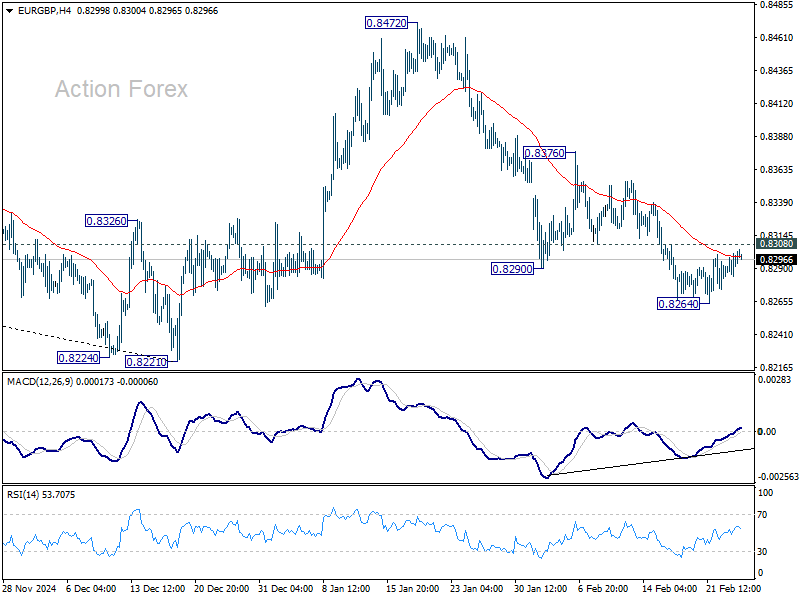
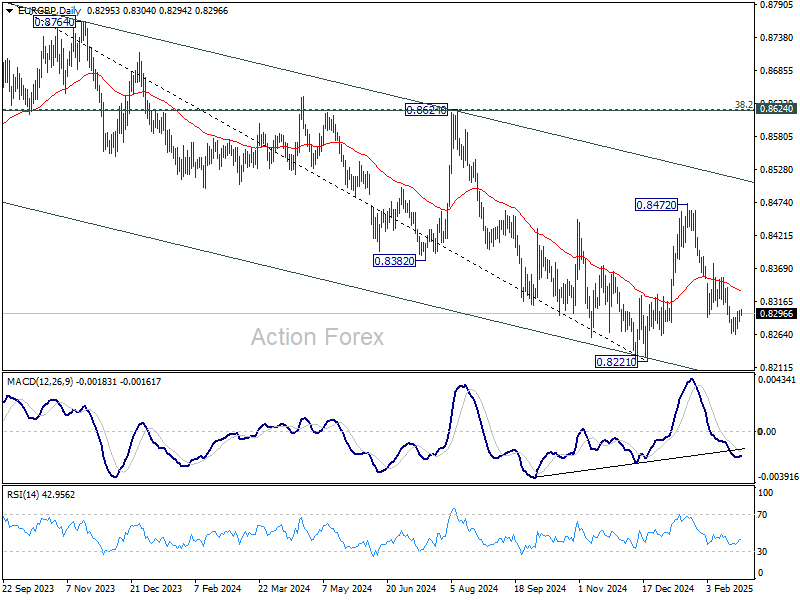
    EURGBP traded lower this week, after hitting resistance near the key territory of 0.8325. Overall, the pair is trading below all three of the plotted moving averages, below the near-term downward sloping line drawn from the high of August 8, and well below the longer-term downtrend line taken from the high of February 2, 2023.

    This keeps the overall outlook negative, but the short-term oscillators suggest that there may be another bounce before the next leg south. The RSI, although below 50, has ticked up, while the MACD, despite hovering below zero, has bottomed and just poked its nose above its trigger line. Both indicators detect weakening bearish momentum.

    If or when the bears decide to take charge again, a dip below 0.8225 may be needed for the prevailing downtrend to extend. Such a dip would confirm a lower low and may see scope for declines towards the 0.8120 zone, marked by the inside swing highs of April 2016. If the sellers do not stop there, the next line of defense may be the round figure of 0.8000.

    On the upside, a break above the long-term downtrend line and the key resistance zone of 0.8450 may be needed to confirm a bullish trend reversal. In such a case, the bulls may feel confident to climb towards the 0.8545 area, or even higher, to the 0.8525 zone, marked by the high of August 8.

    To sum up, EURGBP remains in a downtrend and a dip below the latest low of 0.8225 could take the price into territories last seen back in 2016.

    UK Inflation Jumps to 8-mth High, Pound Shrugs

    British pound is showing little movement on Wednesday. Early in the North American session, GBP/USD is trading at 1.2679, down 0.07% on the day.

    UK inflation climbs to 2.6%

    Inflation in the UK climbed to 2.6% in November, its highest level since March. The rise was driven by higher costs for petrol and food as well as an increase in the tobacco duty in the budget. Services inflation, which has been persistently high, was unchanged at 5%. The CPI reading was in line with the market estimate and the pound has showed almost no reaction. Monthly, CPI increased 0.1%, compared to 0.6% in October and also matching expectations.

    Core inflation, which is considered a more reliable gauge of inflation trends, climbed to 3.5% y/y, up from 3.3% in October and just below the market estimate of 3.6%. This was the highest level since August. The acceleration in core inflation will be a source of concern for the Bank of England, as will be service inflation and Tuesday’s employment report which showed wage growth excluding bonuses rising to 5.2% from 4.4%.

    The rise in inflation cements a pause from the BoE at Thursday’s rate meeting. The central bank has cut rates twice since June, bringing the cash rate to 4.75%. The BoE has largely contained inflation but will want to see evidence that inflation is moving towards the 2% target before delivering further rate cuts.

    The BoE is widely expected to maintain the benchmark rate at 4.75% at Thursday’s rate meeting. The central bank lowered rates for a second time this year in November but will want to see inflation fall closer to the 2% target before resuming rate cuts.

    The Federal Reserve makes its rate announcement later today. There isn’t much excitement around the decision, with the market pricing in a quarter-point cut at close to 100%. Investors will be interested in the updated economic and interest rate projections. President-elect Trump will take office in January which adds significant uncertainty for Fed policymakers.

    GBP/USD Technical

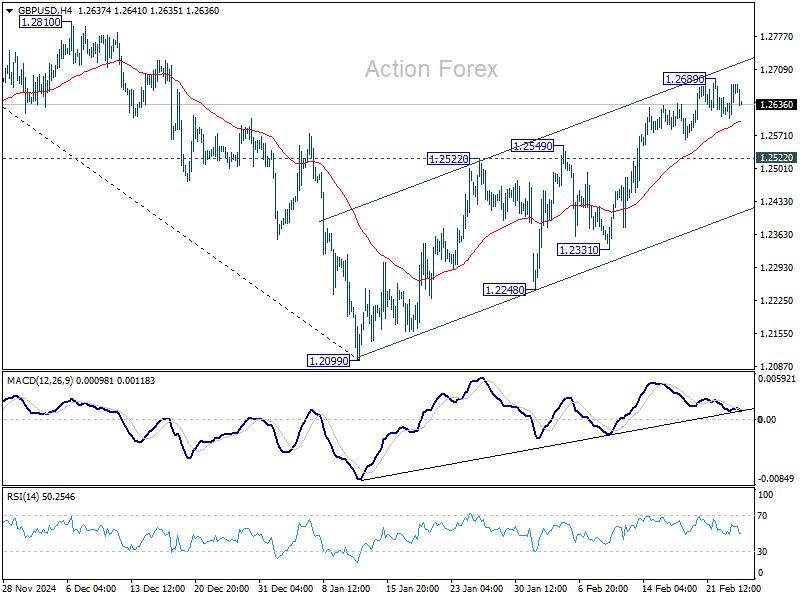
    • GBP/USD is testing support at 1.2703. Below, there is support at 1.2676
    • 1.2739 and 1.2766 and the next resistance lines