Sample Category Title
Aussie Awaiting Inflation Data
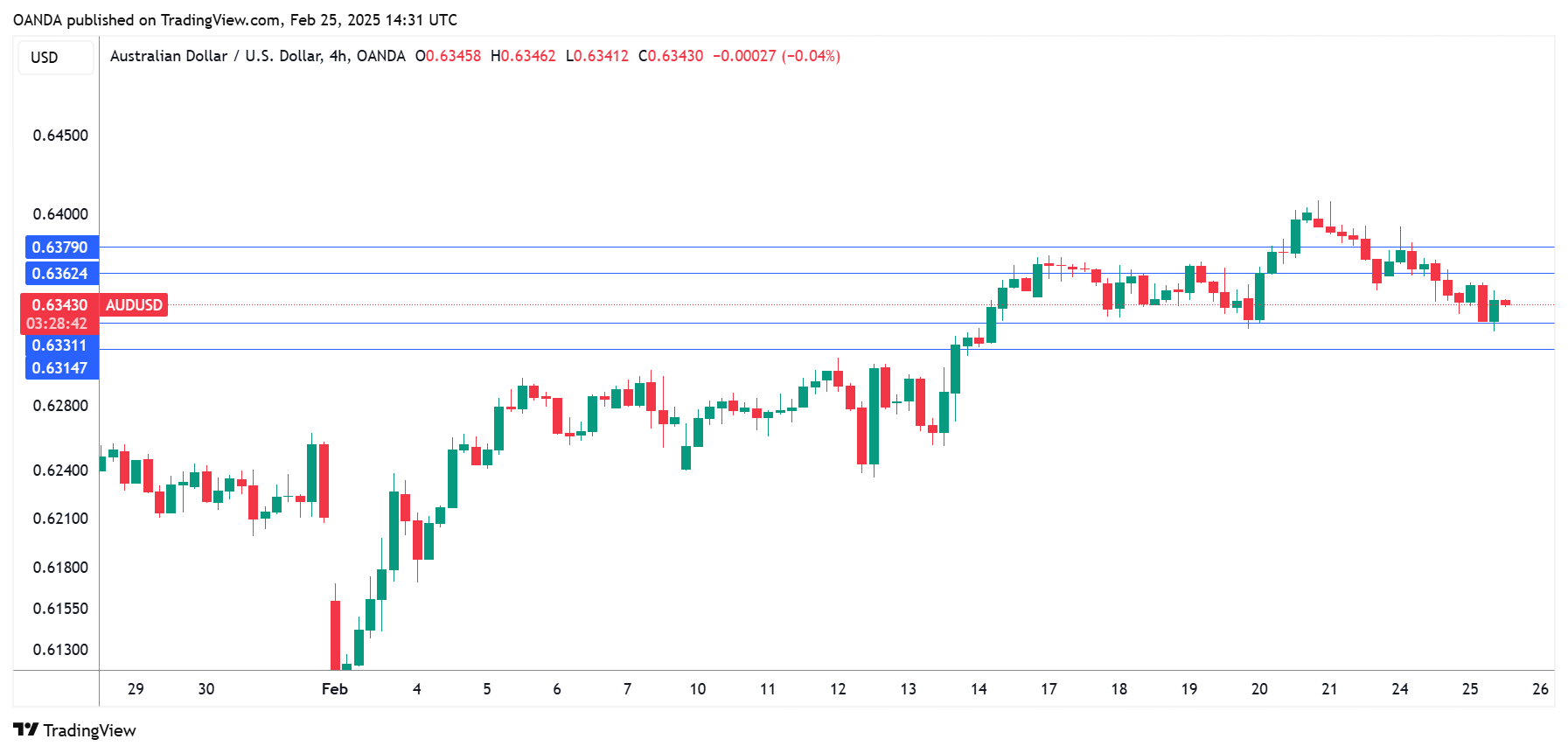
The Australian dollar is steady after two straight losing trading days. In the North American session, AUD/USD is trading at 0.6343, down 0.09% on the day.
Australia’s CPI expected to tick higher
Australia releases the consumer price index for January on Wednesday. Inflation has been moving higher, as CPI accelerated in December to 2.5% y/y, up from 2.3% and its highest level since August. The market estimate for January stands at 2.6%.
Inflation remains within the Reserve Bank of Australia’s target band of 2%-3% but the central bank remains concerned about upside risks to inflation. The RBA finally lowered rates last week after maintaining rates for over a year and joined most of the major central banks which are in the midst of an easing cycle. The RBA delivered a “hawkish cut” as the central bank stated it “remains cautious” on the possibility of further cuts and the markets aren’t expecting a rate cut before May.
The latest headache for RBA policymakers is the Trump administration which has hit China with tariffs and threatened to apply tariffs to other trading partners. This could lead to another trade war with China which would likely raise inflation and hurt China’s economy. China is Australia’s largest trading partner and a slowdown in China would hurt Australia’s key export sector.
The US releases the Conference Board consumer confidence index later today. The market estimate stands at 102.5 for January, down from 104.1 in December. The US consumer is spending, as retail sales for December rose 0.4% m/m and 5.5% annualized from November. The labor market is strong, wages are outpacing inflation and the economy is humming. This rosy picture means that the Federal Reserve isn’t under pressure to lower rates and the markets aren’t expecting another rate cut before June.
AUD/USD Technical
- AUD/USD tested support at 0.6331 earlier. Below, there is support at 0.6314
- 0.6362 and 0.6379 are the next resistance lines
Sunset Market Commentary
Markets
US bond yields slid further in moves that greatly outpace those in Germany. Declines vary between -5.7 and 7.5 bps with some minor outperformance by the belly of the curve. Rates showed signs of fatigue by mid-February. At that time markets were priced for growth perfection with elevated inflation embraced as the necessary byproduct. Such a stretch was only tenable in case of near-perfect data. Enter Friday’s US PMIs. Inflation fears swapped for a growth scare and pushes the US 2-yr yield towards first support at 4.06-4.09% - the 38.2% retracement on the Sep-Jan rally and lower bound of the sideways trading range in place since November last year. The 10-yr tenor moves to new YtD lows at 4.31% today and breaks below the 38.2% retracement (4.34%) of that same Sep-Jan rally in the process. Moves in Germany are limited to 2 bps. The front end of the curve is more or less locked in to the downside with the bar to add to the current amount of expected ECB easing getting higher by the day. ECB’s Nagel, Kazaks and Schnabel all showcased that by calling either for caution when cutting rates further or saying that rates below neutral are not a discussion for now. Today’s euro area negotiated wage index underscored their view. Wage growth slowed from Q3’s record 5.4% in Q3 but the pace remains at a high 4.1%. The ECB’s own tracker a few weeks ago suggested wages would continue to grow fast at least through the first half of this year. Longer-term yields are better protected now Europe’s largest economy, Germany, is on the verge of loosening the fiscal reins, in first instance to increase its military capacity but later perhaps to jumpstart broader business and consumption. Bloomberg reported that the upcoming chancellor Merz of the winning CDU/CSU party is in talks with the SPD to change the constitution to create a special €200bn fund. The aim is to do so ahead of the new legislature (March 24) in which the far right and left have blocking minorities. The SPD indicated they are open to do so as well as to adjust the debt brake that’s limiting the amount of annual borrowing to just 0.35% of GDP. Sticking to the subject, UK PM Starmer today outlined plans to increase defense spending from 2.3% to 3% of GDP over the next decade. He added that it would be funded through spending cuts rather than higher taxes or borrowing. In a first step he wants to raise it to 2.5% by 2027, from 2.3% currently. This amounts to around £5bn. UK yields (-6 bps)are caught in the broader downtrend though. Currency markets are relatively calm. The dollar trades with a slight negative bias. EUR/USD rises to 1.05, the trade-weighted DXY returned to the recent lows around the 38.2% support of the Sep-Jan move higher at 106.35.
News & Views
UK retail sales volumes in February declined (Y/Y) for the fifth consecutive month according to the Confederation of British Industry’s (CBI) quarterly distributive trades survey. The weighted balance printed at -23. Retailers even expect sales to fall at a somewhat faster pace in March. ‘Retailers remain downbeat about their future business situation, and this sentiment was reflected in their expectations to cut back on headcount and capital expenditure going forward. In particular, investment intentions worsened to the greatest extent since May 2019.’, CBI said. Sales for the time of year are judged to be “poor” and firms expect their business to deteriorate over the coming quarter (-19) too. Retailers especially expect to reduce investment in the next 12 months. Headcount in retail declined at a moderate pace and is anticipated to fall at a broadly similar rate in March. CBI blames persistently weak demand and the impact of the Autumn budget to have dampened sentiment and urges the government to take measures.
Brazilian consumer prices in Brazil accelerated sharply from 0.11% M/M and 4.50% Y/Y in January to 1.23% M/M and 4.96% Y/Y in February, the highest level since October 2023. The M/M rise was the highest since April 2022 and even the fastest pace for the month February since 2016. According to IBGE statistical agency, the jump in inflation was mainly due to housing related costs and education. While at elevated levels, the market consensus still expected an even slightly faster rise (5%+ Y/Y). The central bank targets inflation at 3.0% with a deviation of +/- 1.5ppt. The Banco do Brazil resumed its tightening cycle in September of last year and in January for the second consecutive meeting raised its policy rate by 100 bps to 13.25%. The slightly softer than expected February reading won’t change the banks intention the raise the policy rate again by 100 bps at the March meeting as its seeks to reign in an de-anchoring of inflation expectations. The real trades marginally softer against the dollar today (USD/BRL 5.784).
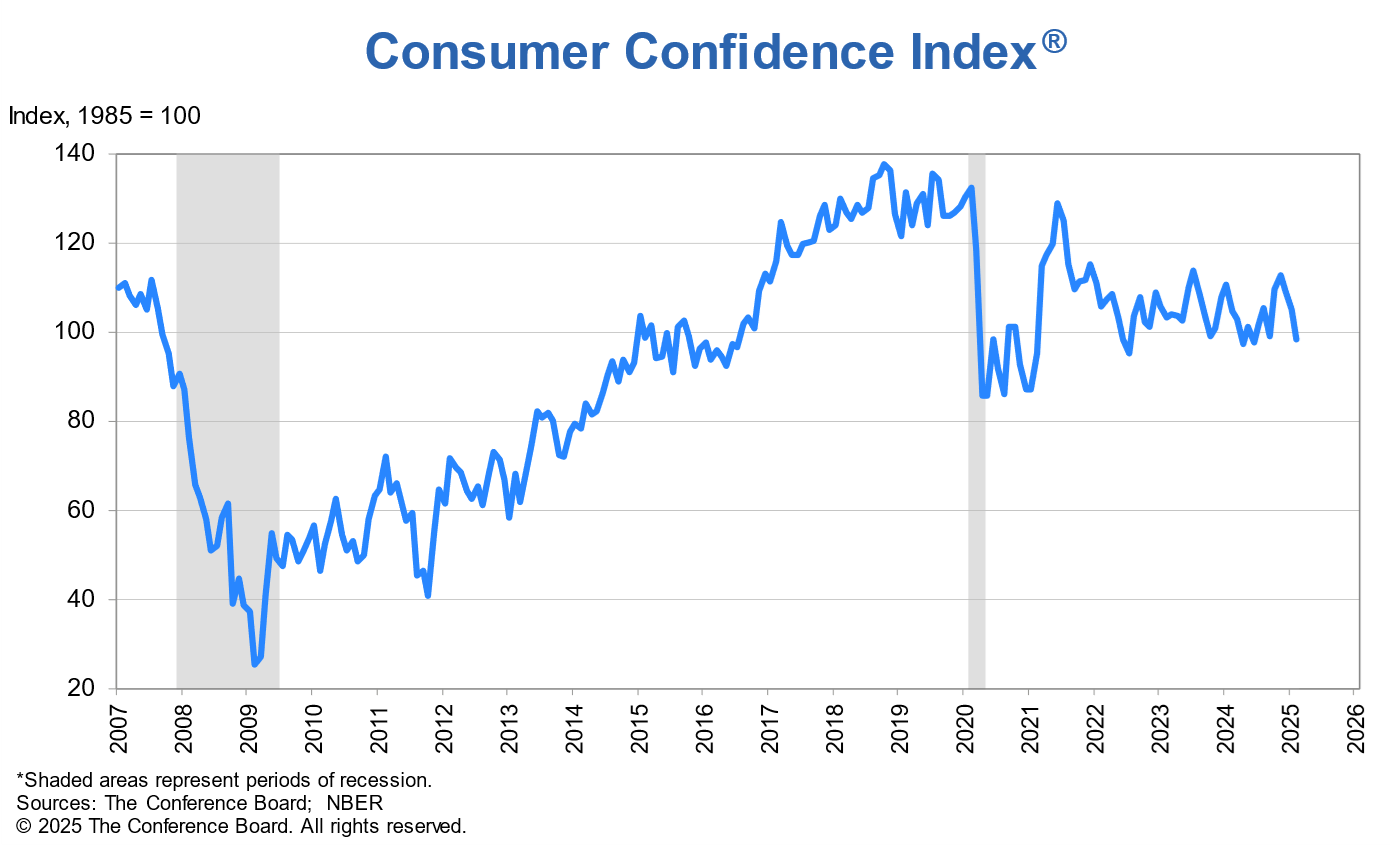
US consumer confidence plunges to 98.3, signals recession risk
US. Conference Board Consumer Confidence tumbled from 104.1 to 98.3 in February, marking the largest monthly decline since August 2021 and falling well short of expectations at 103.3. The deterioration was broad-based, with Present Situation Index dropping -3.4 points to 136.5, while Expectations Index sank -9.3 points to 72.9. This is the first time since June 2024 that the Expectations Index has fallen below the critical threshold of 80, which historically signals elevated recession risk.
Stephanie Guichard, Senior Economist at The Conference Board, highlighted that consumer sentiment has now declined for three consecutive months, pushing the index to the bottom of its two-year range. She pointed out that pessimism about future business conditions, income, and employment prospects has worsened, with job market expectations hitting a ten-month low.
A key concern is the sharp rise in inflation expectations, which surged from 5.2% to 6% in February. Guichard attributed this to a combination of sticky inflation and a spike in household staple prices, as well as the anticipated impact of new trade tariffs. Notably, mentions of trade and tariffs in consumer surveys have surged to levels not seen since 2019.
Monetary Policy Divergence and FX Exchange Rate Impacts: EURCAD & AUDCAD Analysis
Talking Points
- ECB and BOC Monetary Policy Divergence – EURCAD Exchange Rate Fluctuations
- RBA and BOC Monetary Policy Divergence – AUDCAD Exchange Rate Fluctuations
- Canada and Australia Inflation Data and Interest Rate Expectations
- AUDCAD Technical Analysis: Trend Break and Support
Following the inflation peak of 2022 and as central banks globally began raising interest rates, the global disinflation process has progressed at different paces for each economy. This divergence has created arbitrage opportunities for their respective currency exchange rates.
ECB and BOC Monetary Policy Divergence – EURCAD Exchange Rate Fluctuations
For example, in early 2022, the Bank of Canada (BOC) was the first to raise interest rates in March, and the European Central Bank (ECB) followed suit in July.
The monetary policy divergence between the respective central banks caused fluctuations in FX exchange rates, impacting multiple major, minor, and cross FX pairs due to changes in the supply and demand balance.
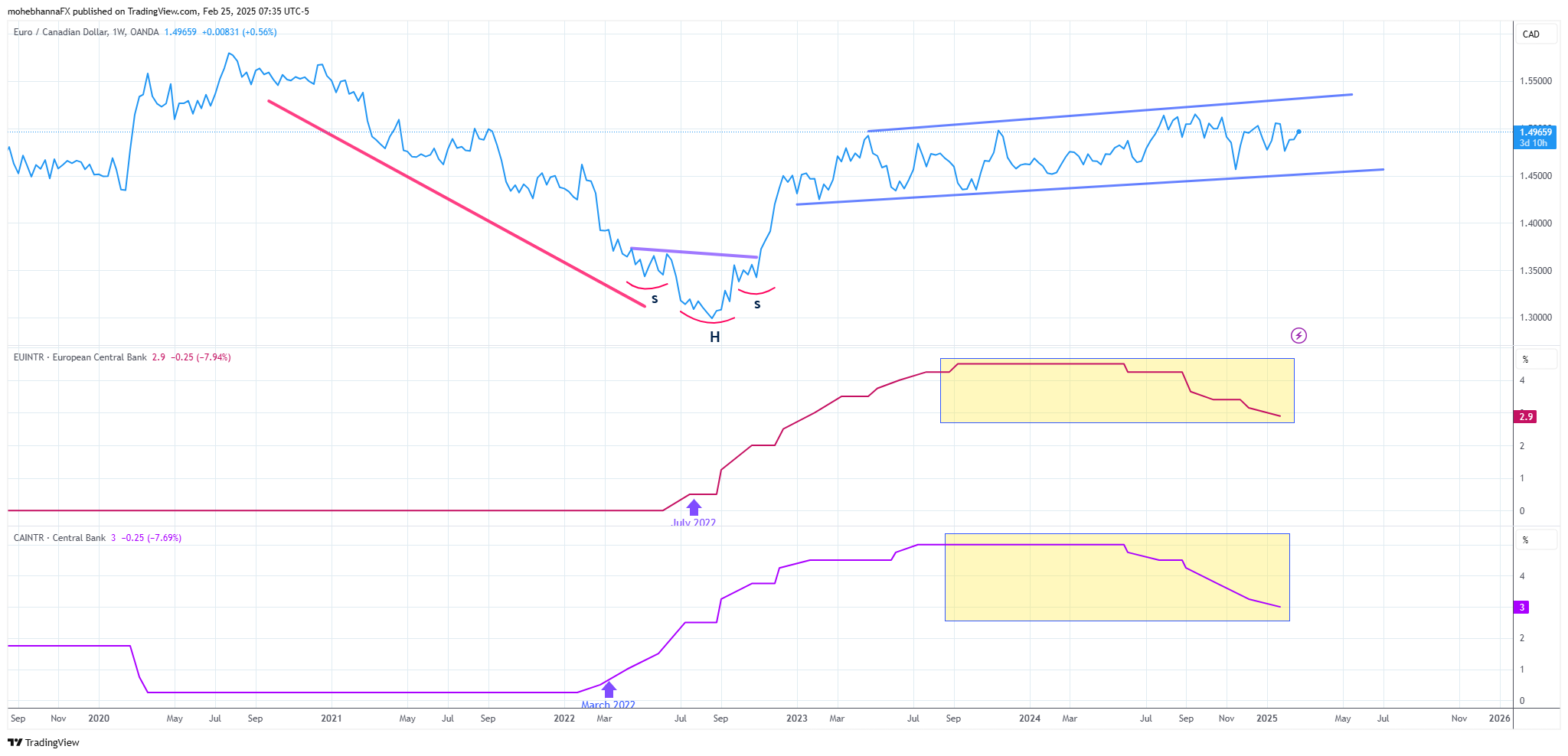
Source: https://www.tradingview.com
The chart shows the EURCAD exchange rate’s reaction to the rate hikes by both banks. The pair was initially trading in a downtrend. However, as the BOC began its rate hikes in March 2022, the trend weakened, followed by a reversal pattern: an inverted complex head and shoulders.
By August 2023, the two central bank monetary policies aligned, and the uptrend began to lose momentum. Price began to trade within a confined range, as marked on the chart. The sideways price action continued as the central banks’ monetary policies converged, as they held and began cutting rates in mid-2024 (highlighted rectangles).
RBA and BOC Monetary Policy Divergence – AUDCAD Exchange Rate Fluctuations
Inflation and interest rates remain a hot topic, especially given that global inflation indicators moved slightly higher in the second half of 2024, and concerns about trade wars persist.
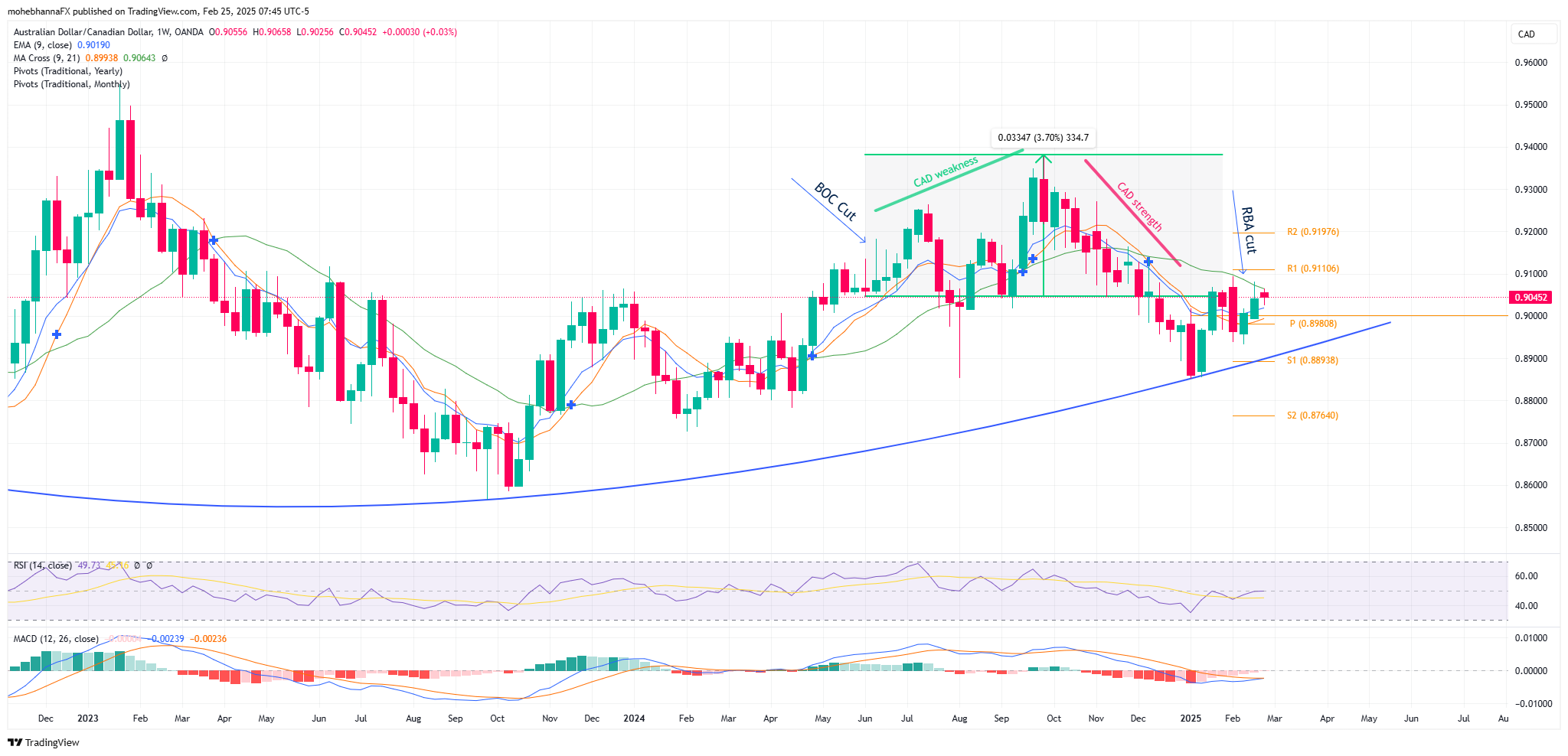
This section will examine the monetary policies of the Bank of Canada and the Reserve Bank of Australia monetary policy divergence. The Canadian and Australian dollars are considered commodity currencies because both are impacted by commodity prices. Therefore, they may have more exposure to tariff risks. However, these risks are not equal, and the pace at which the BOC and RBA manage their monetary policies may differ, thus creating FX exchange rate arbitrage opportunities.
Source: https://www.tradingview.com/
In June 2024, as global central banks began cutting interest rates, the BOC cut its rates by 25 basis points, while the RBA preferred to wait until February 2025 for its first 25 bps cut. The BOC’s earlier move resulted in a stronger Australian dollar against its Canadian counterpart. The AUDCAD exchange rate rose by approximately 3.7% between June and September 2024, as shown on the chart.
By October 2024, ahead of the RBA’s first actual cut, market participants began to anticipate the move, and the trend reversed. The Australian dollar fell against its Canadian counterpart back to the same price level from which it had initially risen in June 2024, when the BOC first cut rates
Canada and Australia Inflation Data and Interest Rate Expectations
Canada’s inflation data, released on February 18, 2025, was higher than forecast, with both Median CPI and Trimmed (Core) CPI at 2.7%. This, along with an upward revision to last month’s Median CPI, has led traders to reduce bets on the BOC’s interest rate cut path. According to Bloomberg’s analyst survey, 42.8% of participants expect a 25 basis point rate cut for the upcoming March 12th BOC interest rate decision, down from 100% earlier that month.
Markets are looking forward today to inflation data from Australia, according to the Bloomberg analyst surveys, the CPI Y/Y is forecasted at 2.6%, compared to 2.5% for last month. The analysts’ survey shows that 16.8% of participants expect the RBA to cut rates by 25 basis points at their upcoming April 1st 2025 meeting.
AUDCAD Technical Analysis: Trend Break and Support
Source: https://www.tradingview.com/
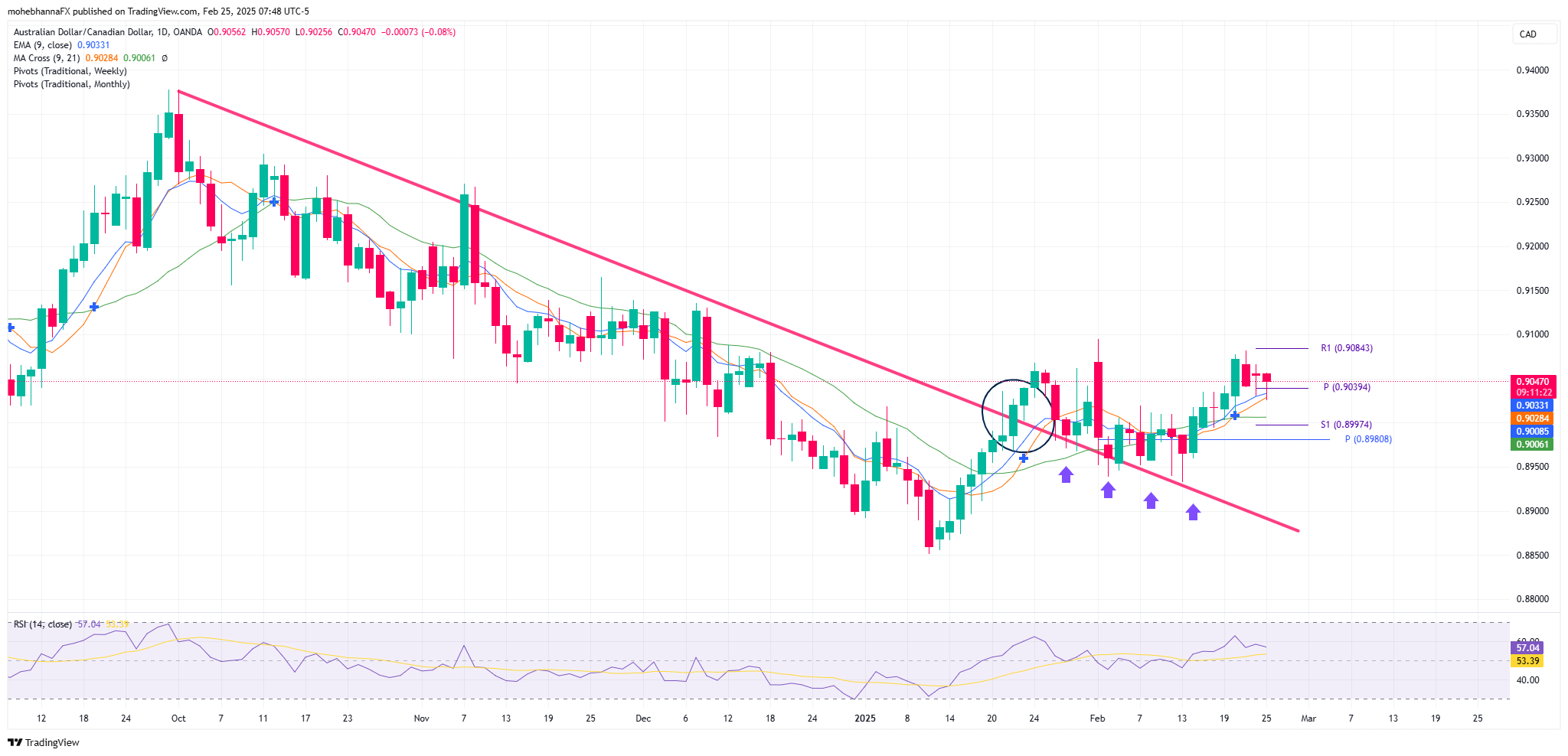
- Price action was trading in a downward trend which was broken in January 2025, marked by a circle on the chart, multiple throwbacks followed through which were able to find support above the trendline extension, marked by purple arrows.
- A confluence of support lies below price action represented by the intersection of EMA9, SMA9, SMA20 and the weekly PP of 0.9039.
- RSI is in line with the price action and near its neutral level.
In conclusion, the divergence in monetary policies between central banks, exemplified by the BOC, RBA, and ECB, has created significant fluctuations in currency exchange rates. As inflation rates change and central banks adjust their interest rate stances, arbitrage opportunities arise for traders. Analyzing these divergences, coupled with technical analysis of price action and support levels, provides valuable insights into potential future movements in the FX market. The shifting expectations surrounding interest rate hikes/cuts, driven by evolving inflation data, will likely continue to influence currency valuations, making it crucial for market participants to stay informed and adapt their strategies accordingly.
USD/CAD Eyes Breakout as Tariff Deadline Approaches
- The US Dollar’s recovery on tariff talk is causing the USD/CAD pair to bounce.
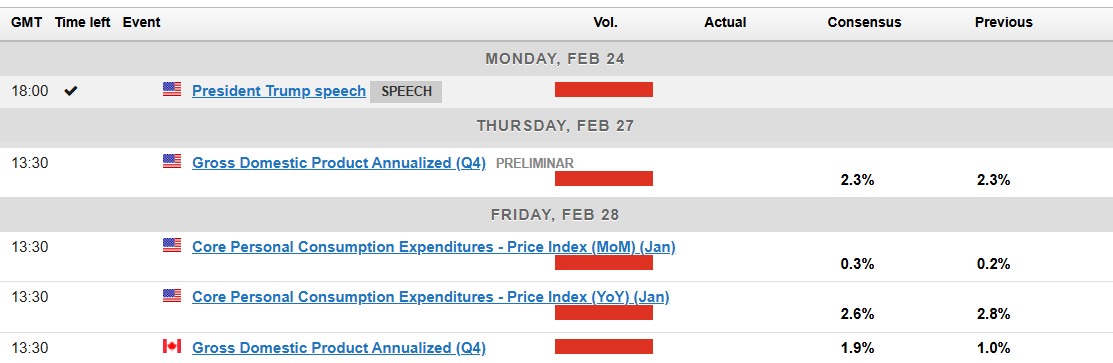
- The main events to watch out for this week are the US PCE data and Canadian GDP for Q4.
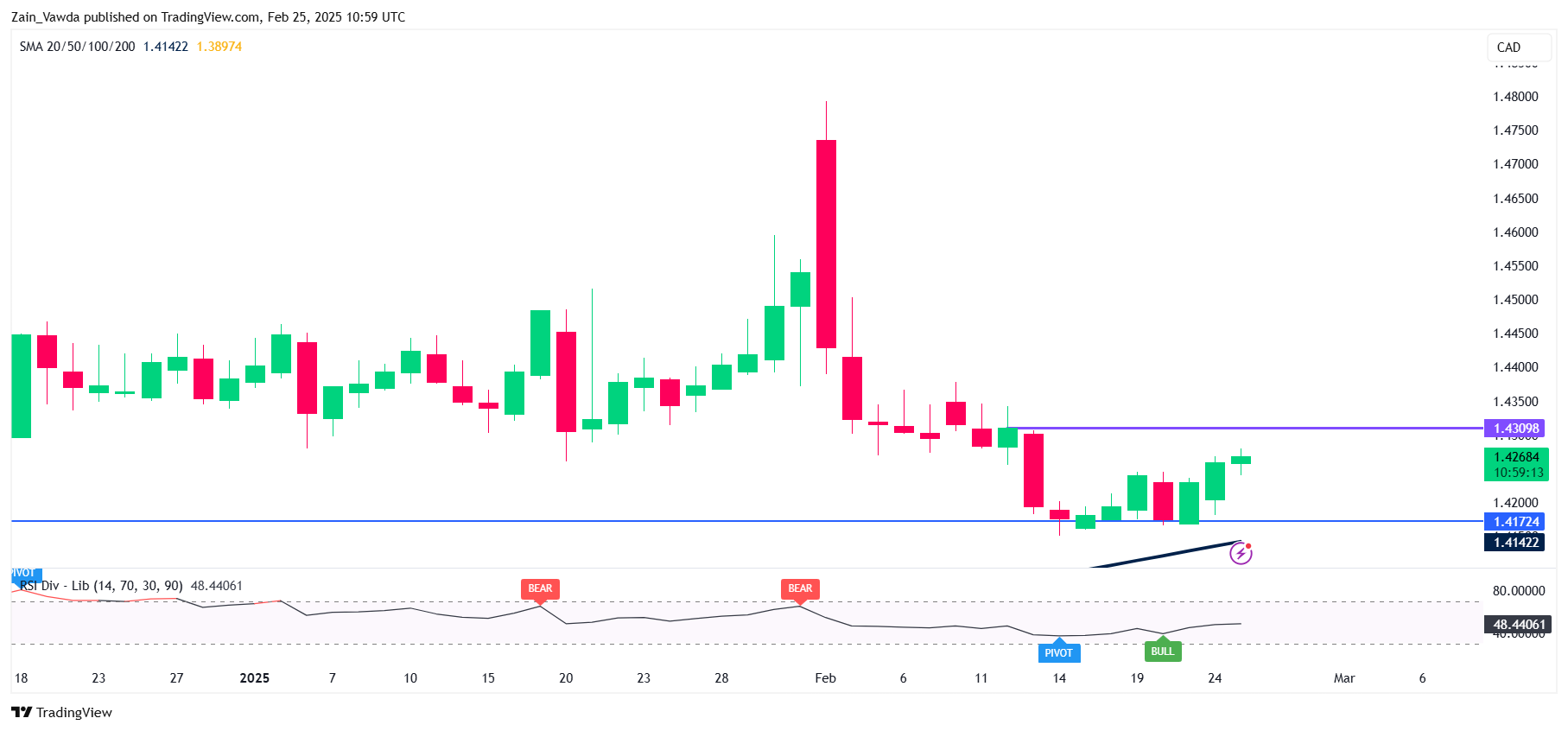
- A close above 1.43100 on the daily candle chart would signal a structural shift that could empower bulls.
USD/CAD has enjoyed a bounce to start the week as the US Dollar eyes a recovery. The pair has been caught in a tight range since February 14, but does appear to be consolidating ahead of a potential breakout.
President Trump’s Tariff Pledge
US President Donald Trump announced yesterday that tariffs for Canada and Mexico would go ahead on March 3. This message lent support to the US Dollar and allowed USD/CAD to record another bullish day.
Given that approximately 75% of Canadian exports head to the US, tariffs and a potential tit-for-tat trade war may prove detrimental to the Canadian economy.
Bank of Canada Awaits Tariff Confirmation
Bank of Canada Governor Macklem recently acknowledged that tariffs have added to
uncertainty.
Depending on how the tariff scenarios develop it could impact the decision by the Bank of
Canada (BoC) at its March 12, 2025, as pressure from consumers continue to mount.
Tariff developments may also prove to be a key driver for the pair this week as the deadline
approaches. Keep an eye out for any comments or more details from both US and Canadian
officials.
The Week Ahead – US & Canada
The economic calendar is full this week with a lot of US data and Federal Reserve policymakers speak. Today we have housing starts data before we focus on comments from Federal Reserve policymakers Barr and Logan.
The main data events affecting USDCAD will be released on Friday with Canadian GDP for Q4 before attention shifts to the much anticipated PCE data release from the US.
Technical Analysis and Outlook
USDCAD had been stuck in a range for nearly a month now as price continued its grand higher yesterday.
Overall, on a daily timeframe the trend remains bearish which is supported by the 14-period SMA which remains below the 50 level, a sign that bearish momentum remains in play. A daily candle close above the 1.43100 will lead to a shift in structure and could embolden bulls.
USD/CAD Daily Chart, February 25, 2025
Source: TradingView (click to enlarge)
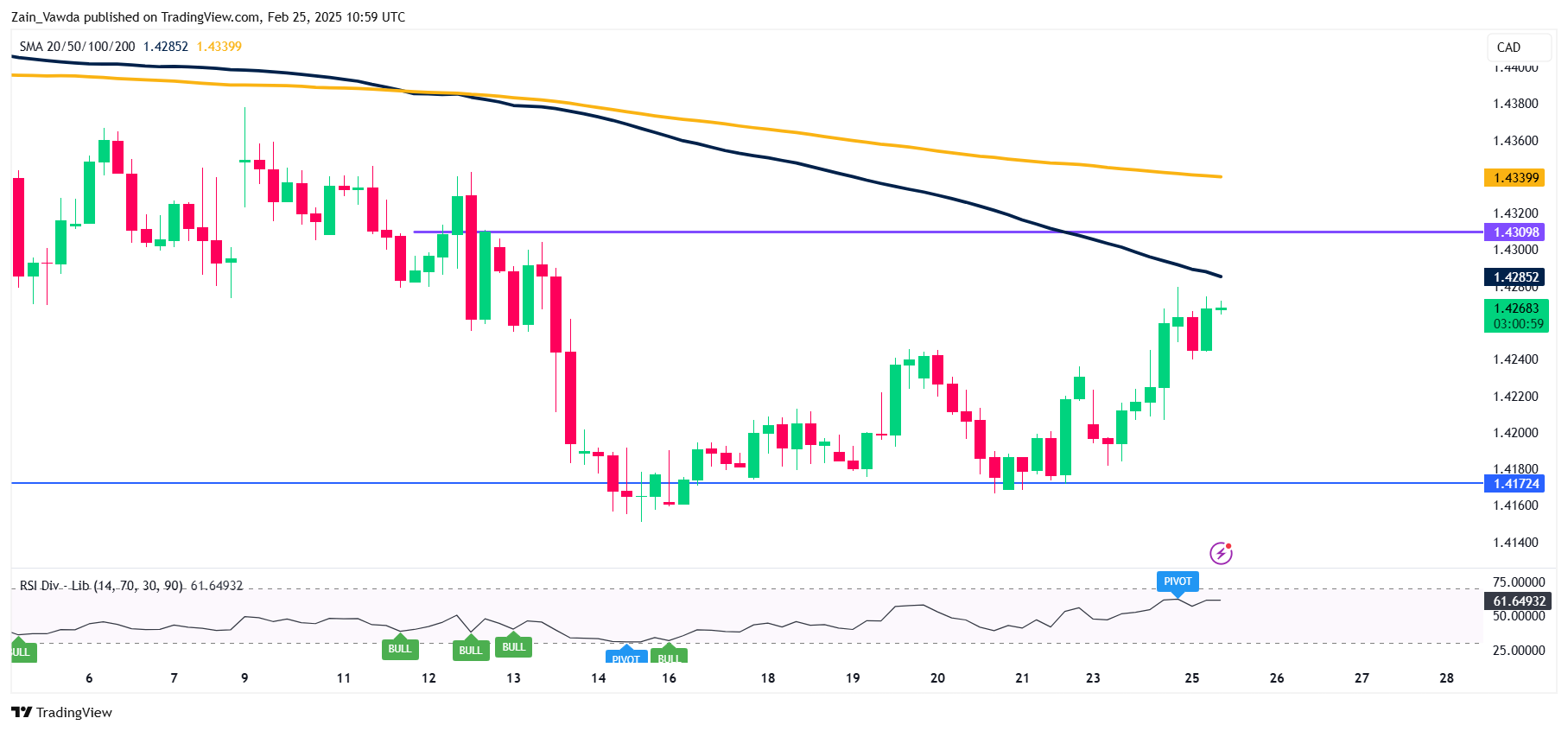
Dropping down to a H4 chart, and as you can see price bottomed out on February 14, printing a series of higher highs and higher lows.
However my concern is with the two moving averages resting at 1.4285 and 1.4340 which could cap any move to the upside.
USD/CAD Four-Hour Chart, February 25, 2025
Source: TradingView (click to enlarge)
Support
- 1.4172
- 1.4000
- 1.3956
Resistance
- 1.4310
- 1.4500
- 1.4594
EUR/USD Mid-Day Outlook
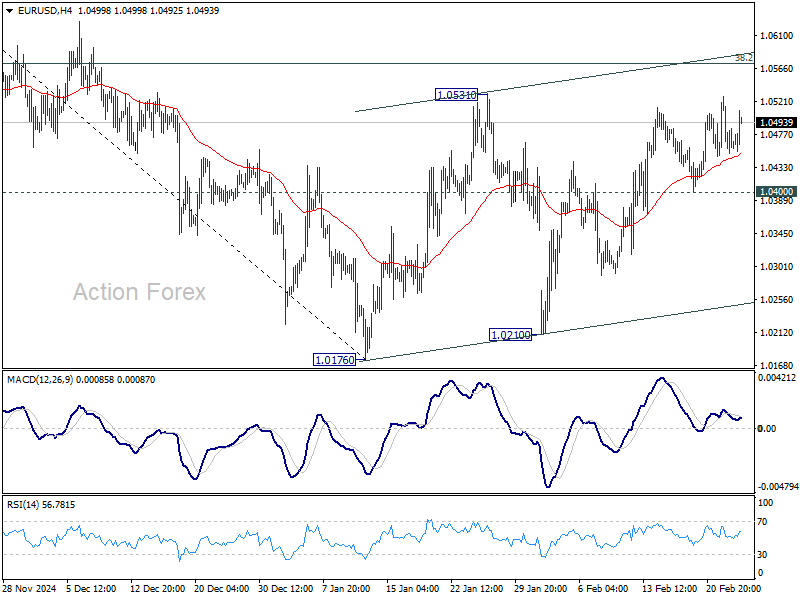
Daily Pivots: (S1) 1.0438; (P) 1.0483; (R1) 1.0513; More...
Intraday bias in EUR/USD stays neutral for the moment. Price actions from 1.0176 are seen as a corrective pattern only. Strong resistance is expected from 38.2% retracement of 1.1213 to 1.0176 at 1.0572 to limit upside. On the downside, break of 1.0400 support will turn bias back to the downside for 1.0176/0210 support zone. However, decisive break of 1.0572 will raise the chance of reversal, and target 61.8% retracement at 1.0817.
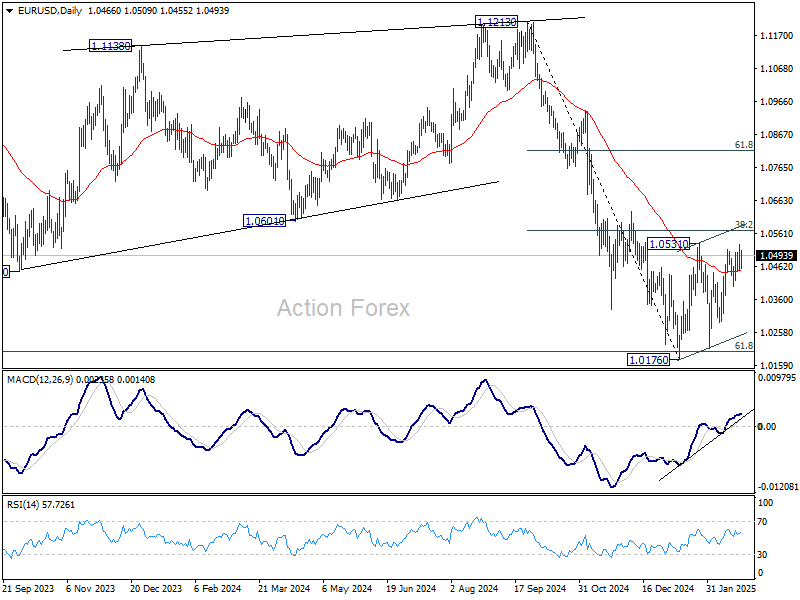
In the bigger picture, immediate focus is on 61.8 retracement of 0.9534 (2022 low) to 1.1274 (2024 high) at 1.0199. Sustained break there will solidify the case of medium term bearish trend reversal, and pave the way back to 0.9534. However, reversal from 1.0199 will argue that price actions from 1.1274 are merely a corrective pattern, and has already completed.
USD/CHF Mid-Day Outlook
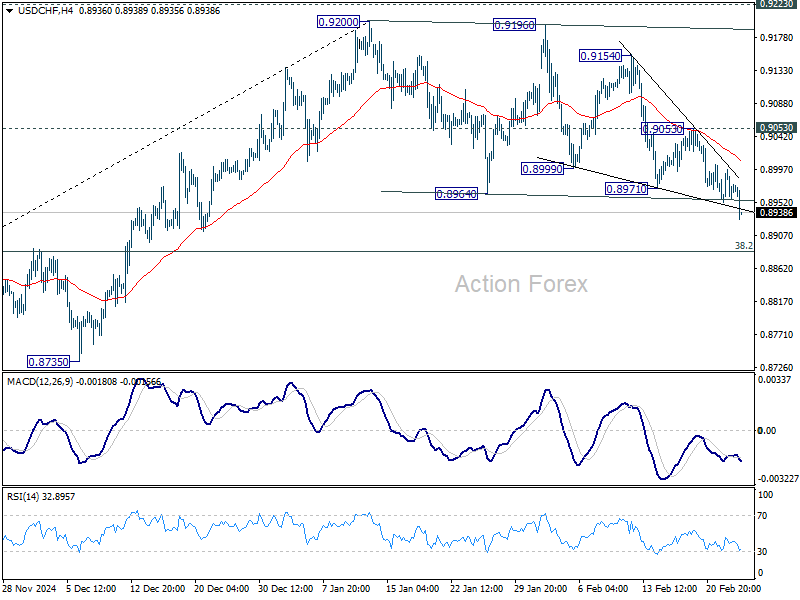
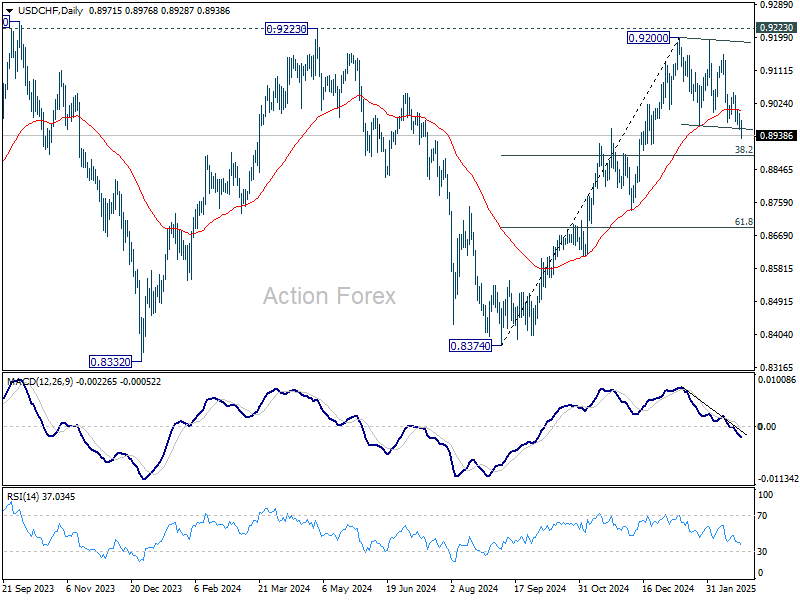
Daily Pivots: (S1) 0.8951; (P) 0.8974; (R1) 0.8995; More…
USD/CHF's price actions from 0.9200 are seen as a corrective pattern only. While deeper pull back might be seen, larger rally is still expected to continue as long as 38.2% retracement of 0.8374 to 0.9200 at 0.8884 holds. On the upside, above 0.9053 will bring retest of 0.9200 resistance. However, sustained break of 0.8884 will indicate bearish reversal, and target 61.8% retracement at 0.8690 instead.
In the bigger picture, decisive break of 0.9223 resistance will argue that whole down trend from 1.0342 (2017 high) has completed with three waves down to 0.8332 (2023 low). Outlook will be turned bullish for 1.0146 resistance next. Nevertheless, rejection by 0.9223 will retain medium term bearishness for another decline through 0.8332 at a later stage.
USD/JPY Mid-Day Outlook
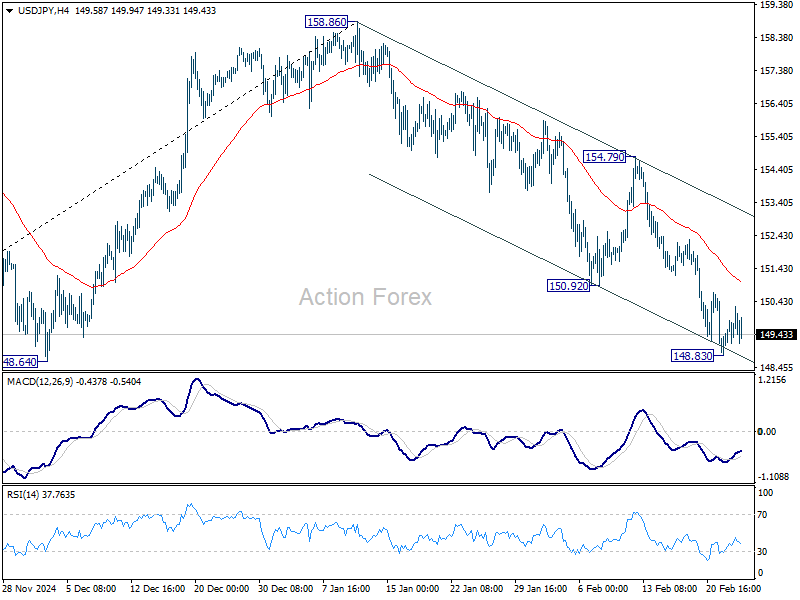
Daily Pivots: (S1) 149.09; (P) 149.48; (R1) 150.12; More...
Intraday bias in USD/JPY stays neutral for consolidations above 148.83 temporary low. Further decline is expected as long as 154.79 resistance holds. Fall from 158.86 is seen as the third leg of the pattern from 161.94 high. Below 148.83 will target 61.8% retracement of 139.57 to 158.86 at 146.32 next.
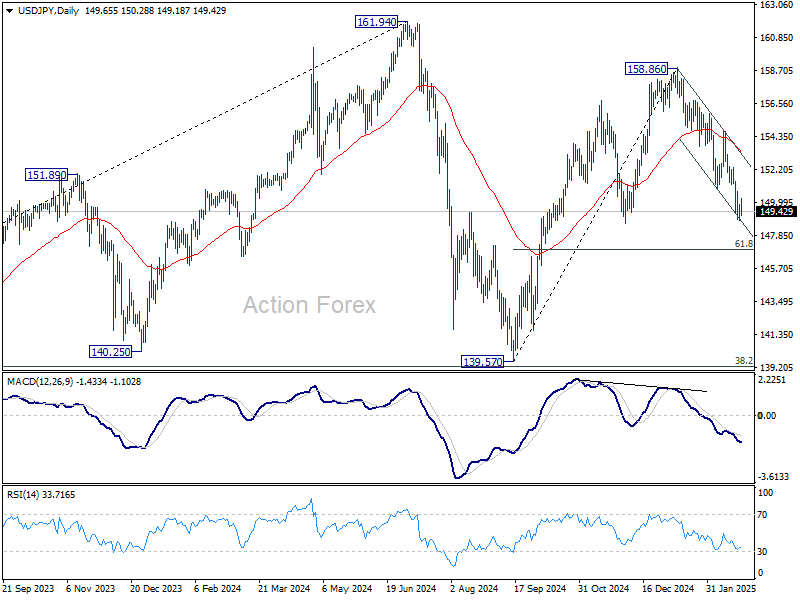
In the bigger picture, price actions from 161.94 are seen as a corrective pattern to rise from 102.58 (2021 low). In case of another fall, strong support should be seen from 38.2% retracement of 102.58 to 161.94 at 139.26 to bring rebound. However, sustained break of 139.26 would open up deeper medium term decline to 61.8% retracement at 125.25.
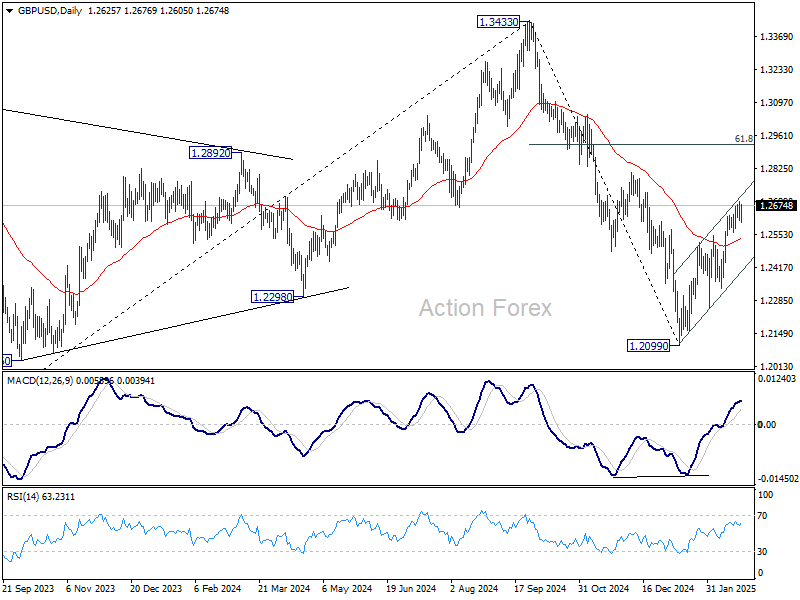
GBP/USD Mid-Day Outlook
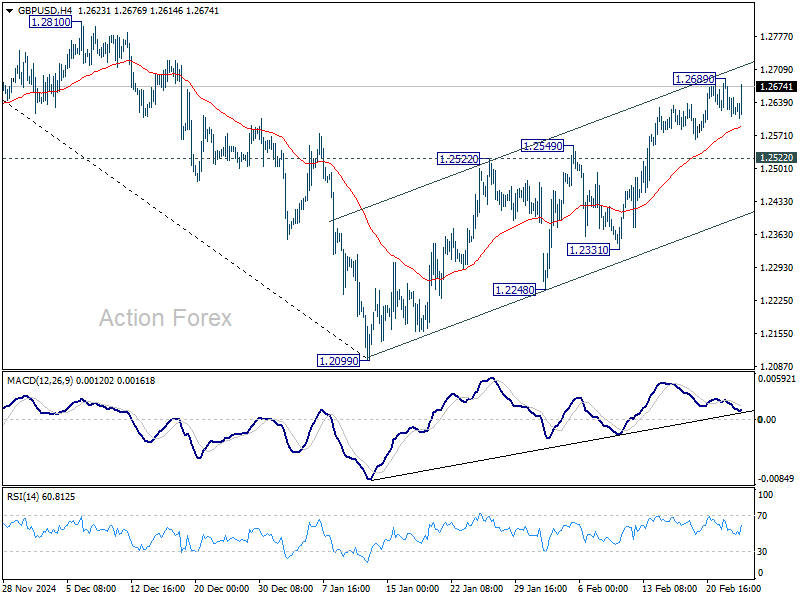
Daily Pivots: (S1) 1.2594; (P) 1.2643; (R1) 1.2673; More...
Intraday bias in GBP/USD stays neutral at this point. Further rise will remain in favor as long as 1.2522 resistance turned support holds. Above 1.2689 will resume the rally from 1.2099 to 1.2810 resistance next. However, firm break below 1.2522 will argue that the rebound might have completed, and bring deeper fall to 1.2331 support.
In the bigger picture, rise from 1.0351 (2022 low) should have already completed at 1.3433 (2024 high), and the trend has reversed. Further fall is now expected as long as 1.2810 resistance holds. Deeper decline should be seen to 61.8% retracement of 1.0351 to 1.3433 at 1.1528, even as a corrective move. However, firm break of 1.2810 will dampen this bearish view and bring retest of 1.3433 high instead.