Sample Category Title
Technical Outlook: AUDUSD Returns To Daily Cloud After Recovery Rejection, Near-Term Bias Remains Bearish
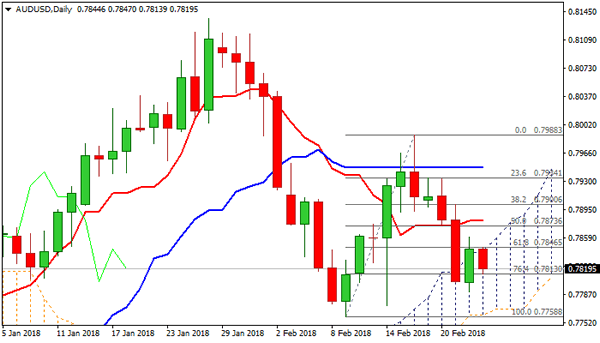
The pair turned to red on Friday and is back into daily cloud after failing to capitalize from Thursday’s rally and marginal close above cloud top.
Near-term focus shifts lower again, supported by bearish setup of daily MA’s (10,20,30) and negative momentum studies.
Close within daily cloud will be bearish signal for final push towards key supports at 0.7773 (converged 100/200SMA’s) and 0.7758 (09 Feb low).
The pair is also on track for bearish weekly close which would add on existing negative outlook.
To neutralize immediate downside risk, close above 10SMA (0.7875) is needed.
Res: 0.7847, 0.7875, 0.7906, 0.7940
Sup: 0.7813, 0.7790, 0.7773, 0.7758
USD Better Bid Ahead Of The Weekend
USD gets stronger as fears ease
After taking a breather on Thursday, the US dollar extended gains Friday amid easing rate concerns. US treasuries were better bid, which sent yields lower. The 10-year fell 3bps to 2.90%, while on the short-end of the curve the 2-year one was unchanged around 2.245%. Since the beginning of the week, the buck has extended gains higher against all G10 currencies, making the biggest gains against the Swedish krona (+2.25%), the Norwegian krone (+1.30%) and high quality commodity currencies such as the Canadian, New Zealand and Australian dollar (+1.20%, +1.10% and +1%, respectively).
With the exception of the publication of the January FOMC minutes on Wednesday, which didn’t really bring new information, it was a quiet week. However, several Fed members will have the opportunity to expose their view on the US economy and monetary policy today. Dudley and Rosengren will speak on Fed Balance Sheet, while Williams will speak on the US economic outlook. The three of them are voting members, so their opinion matters.
Next week will be busier in terms of economic data will the publication of January new home sales on Monday, wholesale inventories, durable goods orders for January on Tuesday, an update of Q4 personal consumption and GDP growth on Wednesday and personal income and spending as well as PCE for January on Thursday. The latter is by far the most anticipated report. Indeed, over the last few weeks market participants were quite nervous about a potential acceleration of inflation, since it could force the Fed to accelerate tightening, which could ultimately cap economic growth.
EUR/USD has stabilised around 1.2110 as selling pressure may have lessen for now. The currency pair is right in the middle of its monthly range (1.2165-1.2555), while the RSI has return at 50. We do not expect much movement today; however, this evening speeches from Fed members could trigger sharp movement, especially should they hawkish/dovish comments about the current situation.
Asian markets head higher on Friday
Asian markets were heading higher on Friday, led by South Korean Kospi, surging at 2’451 (+1.54%), followed by Hong Kong Hang Seng valued at 31’290 (+1.05%) and Japanese Topix increasing at 1’760 (+0.82%) while Nikkei 225 closed the day at 21’893 (+0.72%), supported by Energy (+2.98%), Real Estate (+1.84%), Materials (+1.50%) and Utilities (+1.35%) due to higher oil-related stocks performance after oil price overnight gains (JXTG Holding +3.64%, Showa Shell Sekiyu +2.88% and Inpex +2.39%).
On economic data side Japan’s January Core Consumer Price Index Y/Y rose by 0.90% (consensus: 0.80% - M/M basis: 0.10%), in line with previous month and confirming the view of a rather slow headline inflation rate.
US treasury yields decrease, as the 10-year and 2-year are given at 2.9080 (-1.55%) and 2.2420 (-1.07%), despite Fed’s minute on Wednesday that maintained the stance of improving economic conditions and confirming more rate hikes for the coming year. US Equities remained stable on Thursday: Dow Jones Industrial Average, S&P500 and Nasdaq were closing at 24’962 (+0.66%), 2’704 (+0.1) and 7’210 (-0.11%).
Euro Steady As German GDP, Eurozone CPI Match Forecasts
The euro has ticked lower in the Friday session. Currently the pair is trading at 1.2313, down 0.14% on the day. On the release front, German Final GDP dipped to 0.6% for the fourth quarter, matching the estimate. The markets also correctly predicted eurozone inflation reports, as Final CPI and Final Core CPI came in at 1.3% and 1.0%, respectively. In the US, there are no data releases, but we’ll hear from three FOMC members – William Dudley, Loretta Mester and John Williams. Traders should be prepared for possible movement if any of these policymakers weigh in on the Fed’s future monetary policy.
The Federal Reserve did not raise rates in January, but the minutes of that policy meeting were highly anticipated, with investors looking for clues regarding upcoming rate hikes. Although the policymakers did not discuss a quicker pace of rate hikes, the minutes hinted that further rate hikes could be in the cards, due to strong economic conditions in the US. In the words of the minutes, policymakers “anticipated that the rate of economic growth in 2018 would exceed their estimates of its sustainable longer-run pace and that labor market conditions would strengthen further”. At the December meeting, the Fed penciled in three rate hikes in 2018, but there is growing sentiment in the markets that the Fed may have to raise rates four or even five times this year. As for inflation, the minutes did not reveal any concern, with most Fed members were of the opinion that inflation would rise towards the Fed target of 2 percent. Global investors, however, seem much more concerned about US inflation levels, as worries that higher inflation would trigger more interest rate hike precipitated the recent stock market correction, which wiped off some $4 trillion in valuations.
This week’s German and eurozone indicators have pointed downwards, and the euro has responded with losses of close to 1% this week. The well-respected ZEW economic sentiment reports dropped in February in Germany and the eurozone, although both indicators managed to beat their estimates. Eurozone consumer confidence remains weak, and the indicator dipped to zero, shy of the forecast of 1 point. On the manufacturing front, eurozone and German PMIs both fell in February and missed the forecasts. At the same time, both releases pointed to strong expansion, a reflection of strong global demand for European products, which has boosted the eurozone manufacturing and export sectors.
Forex Technical Analysis: EUR/USD, USD/JPY, GBP/USD
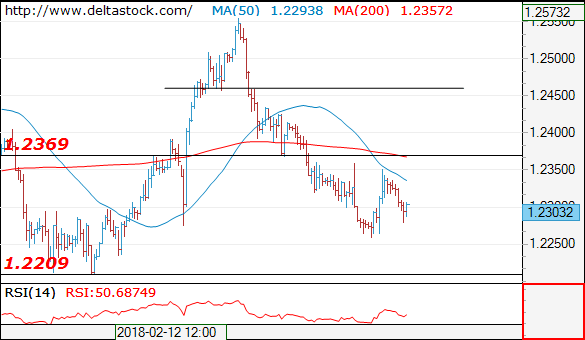
EUR/USD
Current level - 1.2303
The violation of 1.2300 resistance imposes a risk of a more significant reversal and a break through 1.2370 crucial area will target 1.2460.
| Resistance | Support | ||
| intraday | intraweek | intraday | intraweek |
| 1.2370 | 1.2460 | 1.2260 | 1.2210 |
| 1.2460 | 1.2560 | 1.2210 | 1.2090 |
USD/JPY
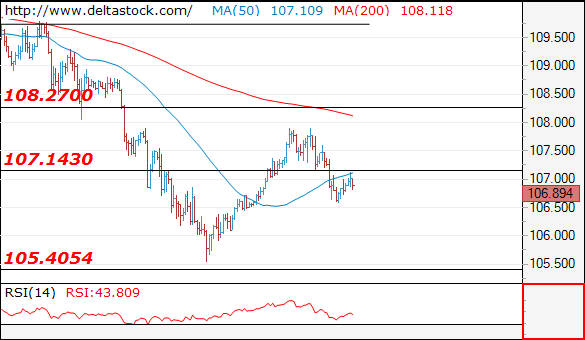
Current level - 106.89
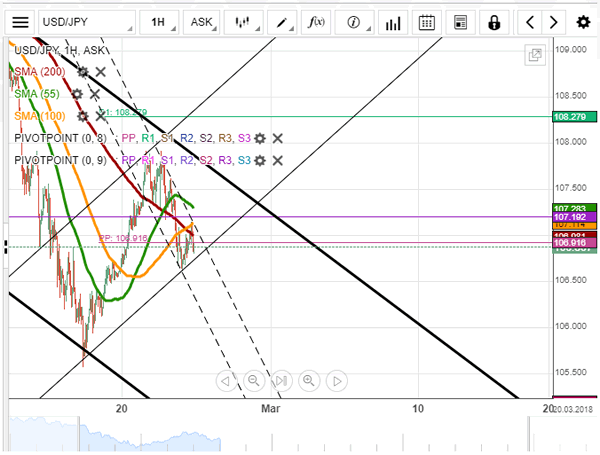
The bias remains bearish, for a slide towards 105.40 lows. Initial resistance lies at 107.15.
| Resistance | Support | ||
| intraday | intraweek | intraday | intraweek |
| 107.15 | 108.30 | 106.40 | 105.40 |
| 108.30 | 110.40 | 105.40 | 102.40 |
GBP/USD
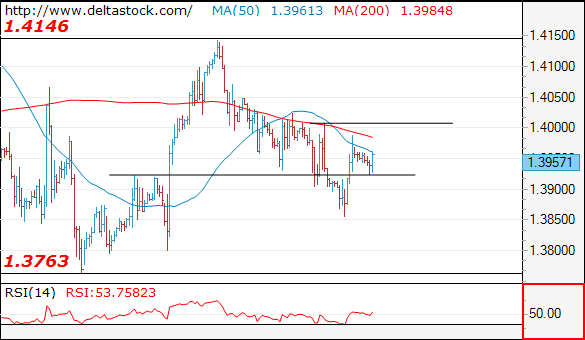
Current level - 1.3957
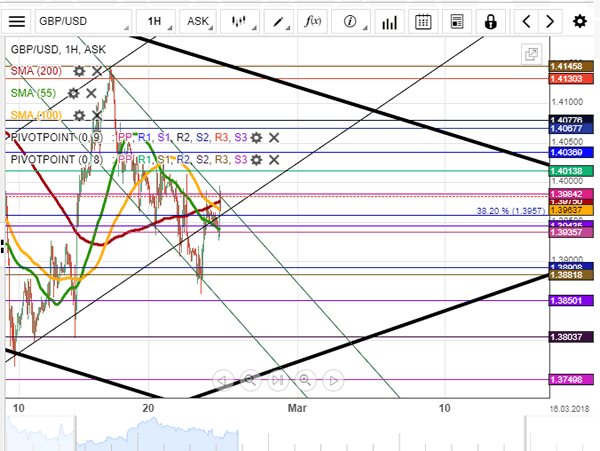
The reversal at 1.3850 has initiated a break through 1.3920 and the bias is positive, for a rise through 1.4010 crucial high, towards 1.4150.
| Resistance | Support | ||
| intraday | intraweek | intraday | intraweek |
| 1.4010 | 1.4280 | 1.3920 | 1.3760 |
| 1.4150 | 1.4340 | 1.3850 | 1.3620 |
Technical Outlook: USDJPY – Near-Term Bias Turns Negative After Thursday’s Fall
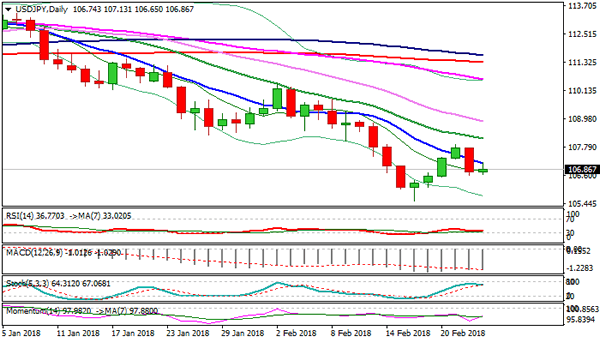
The pair is consolidating on Friday after suffering heavy losses previous day. Near-term action is holding below 107 handle (broken Fibo 38.2% of 105.54/107.90 upleg, reinforced by falling 10SMA) for now and maintains downside pressure, following repeated failure under technical / psychological barrier at 108.00 (50% of 110.48/105.54 bear-leg) and subsequent strong bearish acceleration.
Underlying bear-trend received fresh negative signal on Thursday's fall which turned near-term bias to bearish mode.
Near-term action is weighed by Thursday's long red candle, keeping focus at next pivotal support at 106.44 (Fibo 61.8%) break of which would confirm lower top and open way towards key near-term support at 105.54 (2018 low, posted on 16 Feb).
Alternative scenario requires close above 108 barrier to sideline near-term bears.
Res: 107.00, 107.34, 107.66, 107.90
Sup: 106.59, 106.44, 106.10, 105.54
USD/JPY Trapped Within The Descending Channel
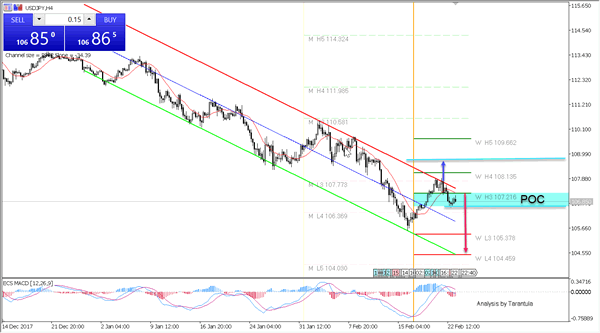
The USD/JPY has reached the upper part of a descending channel and we could see a rejection towards 106.40 M L4 level followed by 106.00. The POC zone is 107.00-20 and we might see a rejection from the zone. However, since it's Friday, we need to be wary of the profit taking. In that case ,buyers could possible get in control if W H4 107.75 breaks to the upside and the pair could target 108.13 followed by 108.50.
W H3 -Weekly Camarilla Pivot (Weekly Interim Resistance)
W L3 - Weekly Camarilla Pivot (Weekly Interim Support)
W H3 - Weekly Camarilla Pivot (Weekly Interim Resistance)
W H4 - Weekly Camarilla Pivot (Strong Weekly Resistance)
M H4 - Monthly Camarilla Pivot (Very Strong Monthly Resistance)
M L3 – Monthly Camarilla Pivot (Monthly Support)
M L4 – Monthly H4 Camarilla (Very Strong Monthly Support)
POC - Point Of Confluence (The zone where we expect price to react aka entry zone)
EUR/USD Fails To Overcome 1.2350
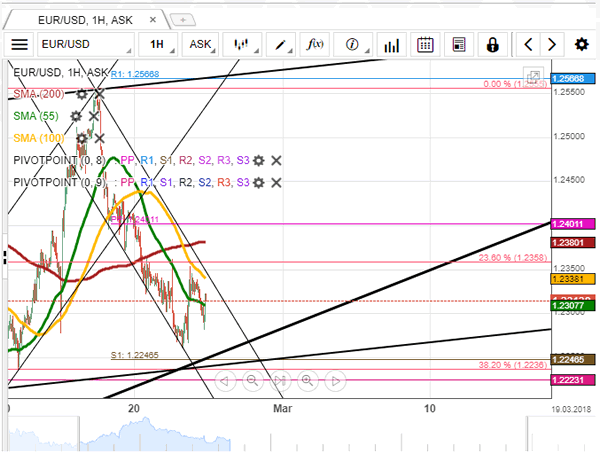
Bulls managed to regain some of their lost positions on Thursday, as the pair bounced off the bottom boundary of the junior channel and tested the 1.2350 mark later in the day. The nearest resistance cluster formed by the 100-hour SMA and the 23.60% Fibo retracement proved to be an unbreakable barrier which sent the Euro for a slight decline.
Technical indicators demonstrate that the bullish sentiment should continue dominating in this session. However, the aforementioned resistance circa 1.2360, likewise reinforced by the 200-hour SMA, could put downward pressure on the rate once again, especially when no significant fundamentals are scheduled for today.
The Euro might even push lower just to reach the bottom boundary of the four-month channel near the 1.2250 mark.
GBP/USD Surrenders Near 1.40
Downside risks dominated USD/JPY on Thursday, as the pair closed the session with a 100-pip fall. Along the way, some significant support levels, such as the 55-, 100– and 200-hour SMAs, the monthly S1 and the weekly PP, were breached.
By Friday morning, the rate had returned near the 107.15 mark to re-test the longer-term moving averages. However, technical indicators flash strong sell signals, especially given the strength of the nearest resistance. Thus, traders might fail to see a test of the senior channel circa 107.50 today.
If looking at the nearest support, no southern barriers are restricting the pair until the 105.65 mark where the lowest point since November 2016 is located. In case bears prevail, the Greenback is unlikely to move below this level.
USD/JPY Strongly Bearish Today
Downside risks dominated USD/JPY on Thursday, as the pair closed the session with a 100-pip fall. Along the way, some significant support levels, such as the 55-, 100– and 200-hour SMAs, the monthly S1 and the weekly PP, were breached.
By Friday morning, the rate had returned near the 107.15 mark to re-test the longer-term moving averages. However, technical indicators flash strong sell signals, especially given the strength of the nearest resistance. Thus, traders might fail to see a test of the senior channel circa 107.50 today.
If looking at the nearest support, no southern barriers are restricting the pair until the 105.65 mark where the lowest point since November 2016 is located. In case bears prevail, the Greenback is unlikely to move below this level.
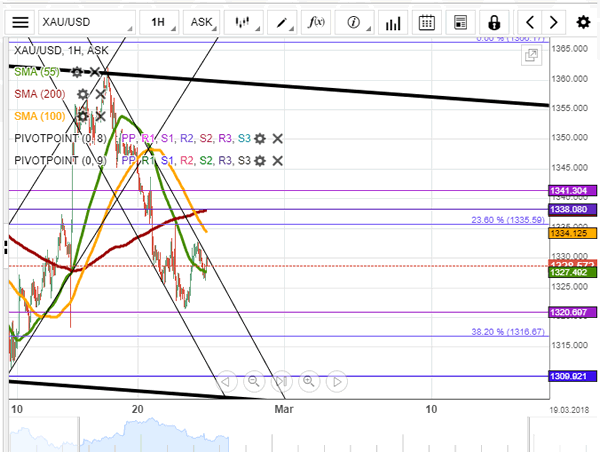
Gold Unlikely To Surpass 1,340.00
Following a test of the weekly S1 at 1,320.70, bulls took over the market and managed to push the yellow metal 0.8% higher within a couple of hours. The pair, however, stopped short of the expected daily high of 1.338.00, as the Asian session introduced some minor downward pressure.
By early Friday, Gold was testing the support of the 55-hour SMA circa 1,326.00. Even though technical indicators flash bullish signals in this session, the pair might fail to breach the massive resistance cluster formed by the 100– and 200-hour SMAs, the 23.60% Fibo and the monthly PP. Thus, this 1,340.00 might be the daily high for today.
In terms of support, the rate could halt near the weekly S1 at 1,320.00 and spend the day fluctuating between this level and the above 1,340.00 area.