Sample Category Title
USD Gains From Indices Selloff
The USD-indices inverse relation was bolstered today as the US returned from a holiday Tuesday and the climb in USD continued for a third day. The dollar was the top performer while CHF and CAD lagged. A full slate of data from Australia, Japan and the UK is due up next. A 3rd USD trade was issued in the Premium Insights. Indices extend losses after Friday's doji action.
The dollar showed some better signs Tuesday as it climbed in a more-liquid market. EUR/USD appears to have stalled after two attempts at 1.25 and is consolidating in the 1.22-1.25 range in part due to softer (but still healthy) ZEW and eurozone consumer confidence readings.
Treasury yields continued to march higher with the entire curve hitting fresh multi-year highs. The enthusiasm was dampened slightly after a 2-year auction but sales of 5 and 7-year notes in the next two days could flip the script.
One particularly soft currency this month is CAD, which now at the bottom of the YTD performance chart. December Canadian wholesale sales fell 0.5% compared to a +0.4% reading expected but retail sales and CPI numbers later this week will be the numbers to watch.
In the immediate term, the focus will first shift to AUD, which hit a six-day low Tuesday. Job vacancies, construction work and wages data is all due early in Asia-Pacific trading. The Q4 wage index is forecast to rise 2.0% and it will likely be the market driver barring another big surprise in construction data. There are currently 2 AUD trades in the Premium Insights, both at break-even.
The focus then moves to Japan with the Nikkei PMI at 0030 GMT and the all-industry activity index at 0430 GMT. Both are unlikely to be market movers and China remains on holiday.
The big headlines in the day ahead will be from the UK jobs/wages report due at 0930 GMT. The path of UK economy at the moment remains opaque so all the numbers will be watched closely for any sign of Brexit strain or resilience. Wages numbers will be especially important with avg weekly earnings forecast to rise 2.5% y/y. The January FOMC minutes follow in Wednesday evening.
Eurozone PMIs Forecast to Ease But Still Point to Solid Growth
Markit's eurozone flash PMI data for the month of February for the manufacturing and services sectors are due on Wednesday at 0900 GMT. The figures are expected to slightly ease relative to January, though still remain comfortably in expansion territory above 50 and continue to support the view that growth in the euro area is picking up steam.
February's flash manufacturing, services and composite PMIs are anticipated at 59.3, 57.6 and 58.5 respectively. These compare to January's respective figures of 59.6, 58.0 and 58.8. The composite PMI is the measure that blends the two sectors - manufacturing and services - together.
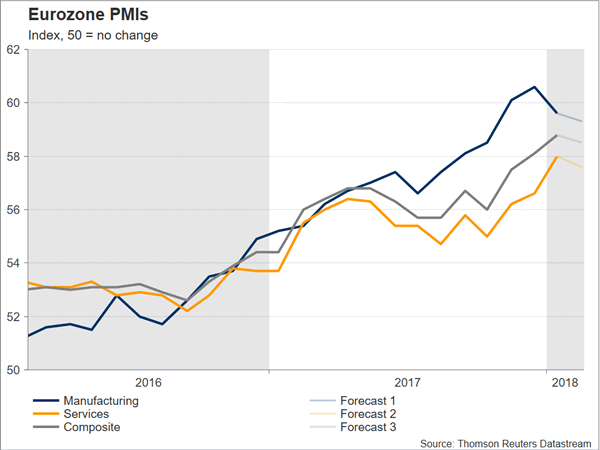
January's composite PMI stood at its highest in more than a decade, outstripping all analyst estimates and pointing to eurozone Q1 2018 quarterly GDP growth of 1.0% according to IHS Markit, this being the fastest pace of quarterly expansion since before the global financial crisis. The rise in the measure was driven by increasing activity in the services industry, the euro area's dominant sector. However, the manufacturing industry's performance fell short of forecasts in January, with the rising euro and the pick up in oil prices possibly weighing on the sector. It should be mentioned though, that the manufacturing PMI's three-month average which is less susceptible to Christmas period volatility as a result of factory closures, stood at its highest on record in January.
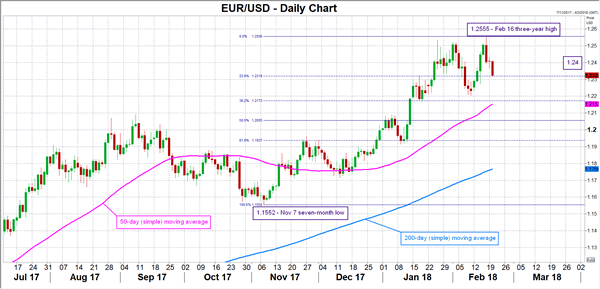
Overall, despite the expected slowdown, February's figures are projected to show a continuation of positive momentum in the eurozone economies, with stronger-than-anticipated figures even having the capacity to spur investors to push closer in time their expectations for further policy tightening by the European Central Bank. In this respect, a data beat is likely to be met with long euro/dollar positions, with the range around the 1.24 handle, an area of congestion recently as well as 1.24 being a level of potential psychological significance, possibly providing resistance. An upside break would start to increasingly shift the focus to last week's three-year high of 1.2555.
A data miss on the other hand, could see the pair posting losses. Euro/dollar could at the moment be finding support around the 23.6% Fibonacci retracement level of the November 7 to February 16 upleg. It seems that investors are repositioning ahead of other risk events as the week unfolds - for example the release of the official record of Janet Yellen's last meeting as Fed chief on Wednesday. A violation of this range - something which could occur even before the release of PMI numbers - would turn the attention to the area around the 38.2% Fibonacci mark at 1.2173 as additional support, with the current level of the 50-day moving average (1.2154) being part of this range.
On the ECB front, it is of interest that Spanish Economy Minister Luis de Guindos' nomination to succeed Vitor Constancio as the Bank's Vice President has led some to expect somebody from central Europe (Luis de Guindos being a southern European) to succeed Mario Draghi when his term expires in 2019. One of the names at play is Bundesbank chief Jens Weidmann, an individual that could tilt the central bank towards a more hawkish direction.
Finally, Germany, the largest, and France, and second-largest eurozone economy, will see the release of their respective PMI figures earlier on Wednesday; France at 0800 GMT and Germany at 0830 GMT. Other data to watch out of the eurozone pertain to the bloc's final inflation readings for the month of January due on Friday at 1000 GMT.
Australian Wages to Dictate the Aussie’s Short-Term Path
Subdued wage growth has been a major source of concern for the Reserve Bank of Australia (RBA) for years now. While the Bank expects wages to pick up, it does not expect that to happen quickly and has thus shown little urgency to raise interest rates. Against that backdrop, traders will keep a close eye on the upcoming wage prints, as they could determine whether the RBA will change its neutral tune anytime soon, or whether it will remain sidelined for longer.
Australia's Wage Price Index for the fourth quarter will be released on Wednesday at 0030 GMT, and expectations are for wage growth to have held steady at 2.0% in yearly terms, and at 0.5% in quarterly terms. Looking at the forecasts alone, one might be tricked into thinking that unchanged readings might mean little for RBA policymakers and by extent, the Aussie.
In fact, though, the RBA takes every opportunity to remind investors that the combination of subdued wage growth and high household debt levels in Australia is an extremely worrisome cocktail, as it could limit consumption and thus economic growth in the future. Households that are already heavily indebted are unlikely to raise their spending in an environment where their incomes are growing at a very slow pace. Thus, the Bank is very hesitant about raising interest rates and making the debt burden of Australian households even heavier, at least not until wages have accelerated substantially.
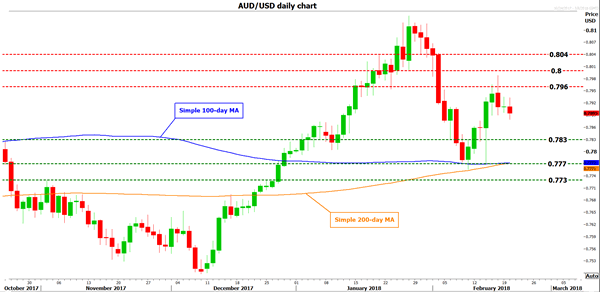
Which puts all the more emphasis on wage growth. If the actual print meets the forecast and remains unchanged at 2.0%, that could be viewed as a discouraging development for the Bank, as it would indicate that the rapid tightening in the labor market over recent months has yet to translate into higher wages. Such an outcome may weigh on the Aussie, but perhaps only modestly as it is already largely anticipated by markets. Aussie/dollar could drift lower and aim for a test of the 0.7830 support zone, marked by the lows of February 6.
Now, should wage growth surprisingly slow, say to 1.9% or lower, that would probably curb bets regarding whether the RBA will raise rates this year. The Aussie is likely to fall much more aggressively in this scenario. A clear break below 0.7830 in aussie/dollar could open the way for a test of the pair's latest lows near 0.7770, which also coincides with both the 100-day and 200-day moving averages. If sellers manage to overcome that zone, then the 0.7730 area may come into play, identified by the lows of October 6.
On the contrary, in case wages surprise to the upside, for instance if the yearly rate clocks in at 2.1% or above, that would most probably raise speculation that the RBA could proceed with a rate hike sooner rather than later. Such an outcome is likely to boost the Australian currency. Aussie/dollar is possible to climb and initially test the 0.7960 area. A decisive break above that hurdle could pave the way for the psychological territory of 0.8000. In case of even further advances, resistance may be met around the 0.8040 barrier, identified by the inside swings low on January 30 and 31.
As for which outcome is more likely, wage gauges did not paint a clear picture during the quarter. The NAB business survey for December found that labor costs had risen at the same pace as in the previous quarter, which is in line with the market forecasts. However, the NAB's quarterly survey for Q4 made it clear that the availability of suitable labour is increasingly becoming a major concern for firms, which in isolation, suggests that the risks surrounding the wage growth forecast may be tilted somewhat to the upside.
Gold Eases Near 23.6% Fibonacci Level; Looking Bearish in Short-Term
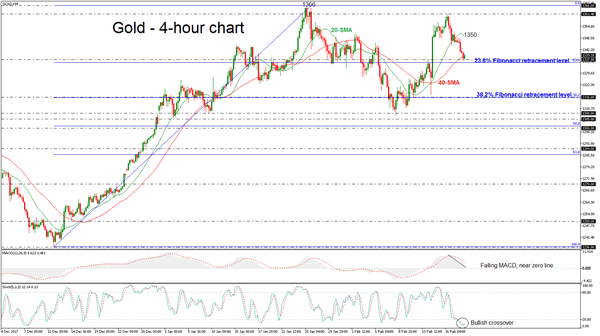
Gold is heading south following the strong pullback on the 1361.40 resistance level on Friday. Having a look at the short-term timeframe the price almost hit the 23.6% Fibonacci retracement near the 1335 level of the last up-leg with the low of 1236 and the high of 1366. The bearish correction is confirmed by the MACD oscillator.
In the 4-hour chart, the MACD is falling near the zero line and below its trigger line, while the stochastic oscillator posted a bullish crossover in the oversold zone, suggesting weaker bearish movement and a possible bullish retracement.
If the precious metal drops below the 23.6% Fibonacci mark, it could hit the 1316.80 support level, which coincides with the 38.2% Fibonacci level. As a side note, the price is currently trading below the 20 and 40 simple moving averages in the short-term timeframe.
Conversely, upside moves are likely to find resistance around 1350, which overlaps with the 40-SMA at the time of writing. Moreover, a bullish rally could extend gains towards the 1361.40 resistance barrier.
Sunset Market Commentary
Markets:
Global core bonds started on a weak footing this morning. US Treasuries had some catching up to do following yesterday's President's Day Holiday, but the Bund lost ground as well. Higher-than-expected German PPI data were probably to blame. The intraday downside was rapidly exhausted with core bond markets returning to opening levels by European noon despite a stronger German ZEW (expectations component). The corrective move higher continued during US trading. US Treasuries underperformed German Bunds. The start of this week's heavy US supply operation (2-yr Note auction tonight) plays a role. The auctions draw attention against a background of an uptrend in yields and a projected increase in the US's twin deficit. Last time around, demand was smaller than usual, weighing additionally on US Treasuries. The US yield curve bear flattens at the time of writing with yields 2.9 bps (2-yr) to 1 bp (30-yr) higher. German yields decline around 1.5 bps across the curve. 10-yr yield spread changes vs Germany are nearly unchanged with Greece underperforming (+11 bps) . Spain successfully launched a new 30-yr benchmark today (€6 bn Oct2048). The orderbook closed above €25bn. The bond was prices to yield MS+105 bps, tighter than MS +109 bps guidance.
The dollar extended the gradual rebound that started at the end of last week. We didn't saw much high profile news behind the move. German ZEW economic sentiment was better than expected, but didn't help the euro. European equities outperformed US equity futures. On the other hand, interest rate differentials moved slightly in favour of the dollar as Bunds outperformed Treasuries. Admittedly, these factors were often ignored of late. So technical considerations probably remained an important driver. EUR/USD declined further in the 1.23 big figure, creating some breathing space vis-à-vis the key 1.2555/98 resistance area. The pair trades currently in the 1.2350 area. USD/JPY hovers in the low 107 area. So, the dollar staged a cautious comeback, but still didn't regain any important technical level yet, especially not in the EUR/USD cross rate. The focus on global (FX) markets now turns to the US Treasury auctions starting this evening.
The news flow on Brexit remained mixed. The bickering between the EU and the UK on potential measures and negative consequences in case of no Brexit deal continued. On the other hand, the EU Parliament was said to prepare a text that calls for flexibility in the EU-UK Brexit talks. In a 'road to Brexit speech', UK Brexit secretary Davis also advocated an approach of mutual recognition of rules that should ensure both parties to maintain access to each other's' markets. He also dismissed 'rumours' that the UK would intend to undercut EU regulation to improve its competitive position. For sterling traders, the positive news outweighed the negative headlines. After the rejected test of the 0.8930 area last week, EUR/GBP declined further in the 0.88 big figure. CBI order data were softer than expected, but had only a temporary impact on sterling. The decline of EUR/USD was also a slightly negative for EUR/GBP. The pair trades currently in the 0.8825 area. Cable resisted the USD rebound quite well and holds in the 1.40 area.
News Headlines:
The German economy is expected to improve in the next six months despite a slight deterioration in current investor morale in February, according to the ZEW-survey. German producer prices rose more than expected in January (0.5% M/M & 2.1% Y/Y).
Business insider reports that the European Parliament is pushing for a future relationship with the United Kingdom which could allow for Britain to retain "privileged" access to the single market. That's a break from the position of the chief EU negotiator Barnier.
If planned US import restrictions on steel and aluminium affect European companies, the EU could react in days with counter-tariffs on major US products ranging from orange juice to motorcycles and whiskey, Frankfurter Allgemeine Zeitung reports, citing unidentified EU Commission officials
AUD Hampering GDP Growth
The Australian dollar has reached February highs against the USD last week. This was because of both the fundamentals and the negative attitude towards the greenback which allowed the other currencies to grow in value.
The Reserve Bank of Australia meeting statement was released today, and it says the information coming from Australia and other economies is mainly positive. The conditions of the global economy system keep improving, which allows the RBA keep the expectations unchanged.
The business conditions have also been improving in Australia during 2017, while weak consumer growth may add some risks to it. Household consumer spending is limited, and neither job growth nor the opportunities for rising wages can currently help it.
The RBA is somewhat cautious about the inflation. The Australian economy is strengthening, and the consumer price index will probably rise, but not very eagerly.
As for the figures, the RBA forecasts the GDP at 3% and the inflation at a bit higher than 2%. With the AUD rate so volatile, GDP and inflation are unlikely to increase sharply.
The overall RBA's economic outlook is quite neutral. The interest rate is very likely to remain unchanged at 1.5%, with no economic rises or falls expected.
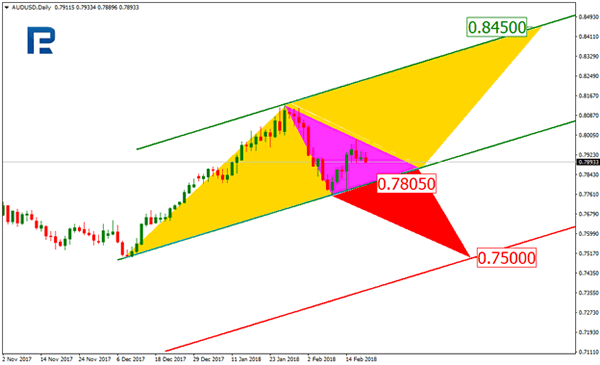
Technically, AUD/USD on D1 is looking somewhat mixed. Both the overall major trend and the short term one are ascending, while the latest bounce off the trend channel was unable to trigger a new uptrend impulse. Current uptrend target is around the upper channel boundary at 0.8450, with the support at 0.7805. If this support gets broken out, this may cause a downtrend with a target at around 0.7500.
Dollar Punches Above 107 Yen, Fed Minutes Ahead
The Japanese yen has posted losses in the Tuesday session. In North American trade, USD/JPY is trading at 107.18, up 0.55% on the day. On the release front, there are no US events on the schedule. Later in the day, Japan will release Manufacturing PMI and All Industries Activity. On Wednesday, the Federal Reserve will release the minutes of its January meeting. As well, the US will release Existing Home Sales.
The yen looked sharp last week, as the currency gained 2.5% against the retreating dollar. However, the greenback has bounced back on Tuesday, pushing the yen above the 107 line. Have investors regained their appetite for risk? The stock markets could continue to set the direction for the yen – if the markets remain in green territory, the safe-haven yen could continue to lose ground.
Bank of Japan Governor Harohiko Kuroda has been reappointed to another 5-year term, the first time that a BoJ governor has been re-elected to a second term in 60 years. The move is a clear message from the Bank that it is no rush to make any change to the massive stimulus program, a key component of Abenomics. Kuroda has made it a priority to raise inflation, but this has proven a daunting task, as inflation is still below of the BoJ's inflation target of 2%. In this period of strong volatility in the currency markets, Kuroda's re-election may have a calming effect on the markets. What's next for the BoJ? The yen has jumped 4.9% in 2018, and if the rise continues, policymakers could consider further easing in order to curb the yen's value and protect the export sector, which has improved due to stronger global demand.
It's been an busy start for Jerome Powell, who has just commenced his stint as chair of the Federal Reserve. Strong US data in recent weeks has raised speculation that the Fed may need to accelerate the pace of interest rate hikes in 2018. The Fed is currently projecting three rate hikes this year, but if inflation continues to move upwards, many analysts are expecting that the Fed could press the rate trigger four, or even five times in 2018. Meanwhile, concern over higher inflation and more rate hikes sent the stock markets into a frenzy earlier in February. Powell sought to reassure the markets that the Fed was monitoring the situation, but it's doubtful that the Fed can do much to prevent volatility in the markets.
EURGBP Dips to Pivotal 0.88 Support after Fresh Weakness Broke a Cluster of Supports
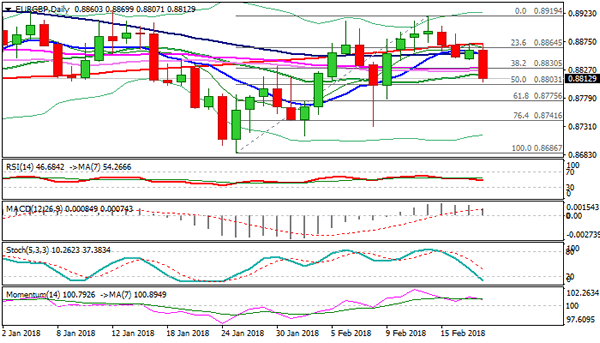
The cross came under renewed pressure at the beginning of American trading and probes through European session low at 0.8810, posted after strong bearish acceleration on media comments which improved Brexit outlook and boosted pound. Fresh weakness surged through thin daily cloud (0.8851/38) and took out daily MA's between 0.8830 and 0.8820 (55/30/20SMA's) in extension, also triggering a number of stops parked in this zone. Fresh bullish sentiment signals further recovery of sterling, which could extend higher against the Euro on sustained break below 0.8800 zone (psychological support / weekly cloud base / weekly Tenkan-sen). Bearish scenario would open way for further retracement of 0.8686/0.8919 (25Jan / 14 Feb upleg) and expose its Fibo 61.8% at 0.8775, with break here to open 0.8732 (08 Feb spike low and key s/t support at 0.8686 (25 Jan low). Alternatively, failure to close below a cluster of MA's (0.8820/30) would ease immediate bearish pressure, however, return above broken 200SMA (0.8873) which capped the action in past three days, is needed to reverse current bearish bias.
Res: 0.8830; 0.8860; 0.8873; 0.8888
Sup: 0.8800; 0.8775; 0.8732; 0.8716
Dollar Flexes its Muscles… But for How Long?
The Dollar was king against a basket of major currencies on Tuesday, as investors shrugged off heightened fears about the U.S budget deficit.
With the Greenback currently rebounding from three-year lows, could this be the start of an incredible rally or another dead cat bounce? There is a suspicion that the bull's argument for the Dollar to extend gains is likely based on optimism over stronger U.S economic growth and rising inflation. However, the prospect of other major central banks gradually tightening monetary policy could inspire bears to re-enter the scene. Price action continues to suggest that the Dollar remains affected by a variety of key fundamental drivers, and it will be interesting to see where the currency concludes this month.
Much attention will be directed towards January's FOMC meeting minutes, that are scheduled for release on Wednesday. With the probability of a Fed hike in March currently standing at 83.1%, according to CME's FedWatch Tool, investors may closely scrutinize the minutes for fresh insights on rate hike timings beyond Q1. The Dollar could extend gains, if January's meeting minutes are presented with a hawkish touch.
Taking a look at the technical picture, the Dollar Index breached above 89.50 during Tuesday's trading session. A solid daily close above this level may invite an incline higher towards 90.00 and 90.55, respectively. Alternatively, a failure for prices to keep above 89.50 could encourage a decline back to 89.00.
Gold melts ahead of FOMC minutes
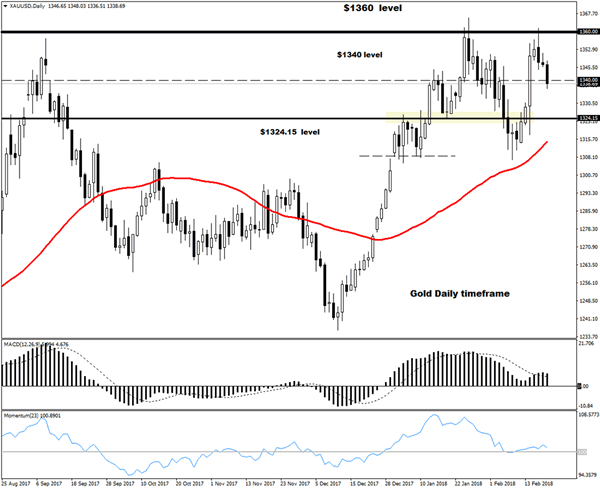
Gold found itself vulnerable to losses during Tuesday's trading session, with prices dipping below $1340 as the Dollar appreciated.
With expectations heightened over the Federal Reserve raising U.S interest rates in March, Gold, which is zero-yielding, could be exposed to further pain. Bears may be injected with fresh inspiration to drag the price of Gold lower if the minutes from January's FOMC meeting are hawkish. From a technical standpoint, the yellow metal is at risk of depreciating further, if prices fail to keep above $1340. Sustained weakness below $1340 could encourage a decline towards $1324.15. Alternatively, a breakout above $1340 may open a path back towards $1360.
Currency spotlight – GBPUSD
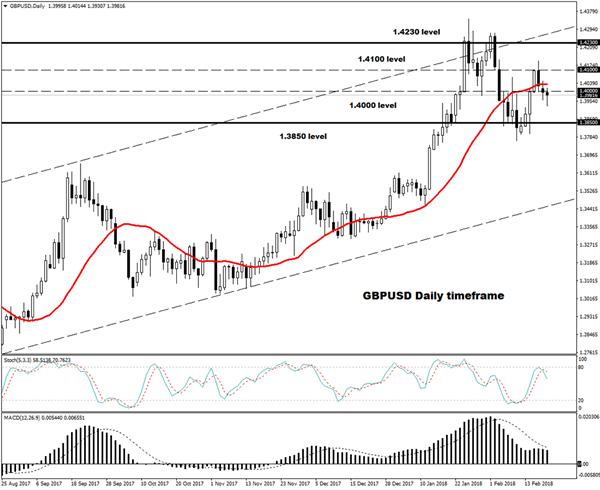
Sterling struggled to hold ground against a strengthening Dollar on Tuesday, with the GBPUSD dipping towards 1.3940 as of writing.
Price action suggests that Pound bulls are tired, exhausted and in need of fresh inspiration to keep the GBPUSD afloat. The U.K jobs report, scheduled for release on Wednesday, could offer Sterling some support if average earnings exceed market estimates. From a technical standpoint, the GBPUSD is vulnerable to further losses below the 1.4000 level. Sustained weakness under 1.4000 could spark a decline towards 1.3850. Alternatively, a daily close back above 1.4000 may inspire bulls to challenge 1.4100.
Bitcoin punches above $11500
Bitcoin extended recent gains during Tuesday's trading session, with prices punching above $11500. With the cryptocurrency securing a solid weekly close above the psychological $10,000 level, speculation may heighten over Bitcoin bulls re-entering the scene. Focusing purely on the technical perspective, much attention will be directed towards how prices behave around the $10,000 level this week. A failure for prices to keep above $10,000 could trigger further downside. If bulls are able to maintain control from current levels, prices could challenge $12,000.
EURUSD: Bearish, Extends Weakness
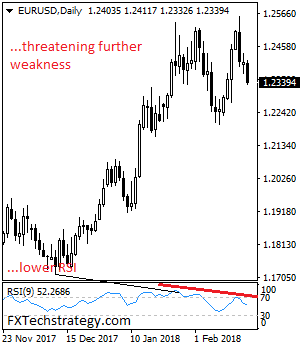
EURUSD: With the pair retains weak and vulnerable to the downside on correction. On the upside, resistance comes in at 1.2400 level with a cut through here opening the door for more upside towards the 1.2450 level. Further up, resistance lies at the 1.2500 level where a break will expose the 1.2550 level. Conversely, support lies at the 1.2300 level where a violation will aim at the 1.2250 level. A break of here will aim at the 1.2200 level. Below here will open the door for more weakness towards the 1.2150. All in all, EURUSD faces further bear threats on correction.