Sample Category Title
Fed Chair Powell Is ‘Yellen In Disguise’ Amid Discussions About Price Level Targeting
Yesterday, the US Senate officially confirmed Jerome Powell as the next Fed Chair when Yellen's term expires on 3 February. This was as expected, but it has taken a long time for the Senate to actually approve Powell as Yellen's successor (so long that Trump actually needed to renominate Powell).
We expect Powell to stick to the current monetary policy strategy in the short run by raising the Fed funds target range three times this year, as he has always voted with Yellen and expressed similar views on the economy. The first hike is expected to come at the March meeting, the first meeting he chairs. The Fed is not expected to move at Yellen's last meeting, which ends on Wednesday 31 January, as this is one of the small meetings without a press conference and updated projections (the Fed has only hiked at the larger meetings). Markets have priced in a March hike but underestimate the likelihood of a June hike, where we expect the second hike.
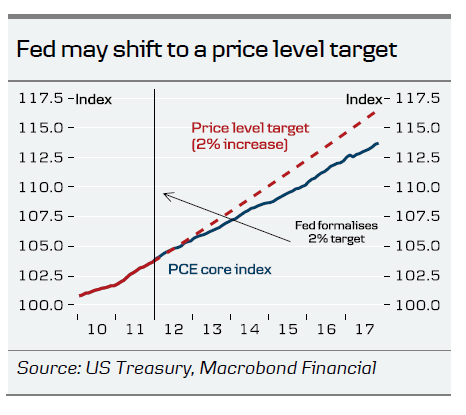
In the long run, there is increasing discussion among Fed members about whether to change the 2% inflation target to a price level target over the next few years in order to get ready for fighting the next crisis whenever it comes. Powell is expected to set up a subcommittee, which will dig into this.
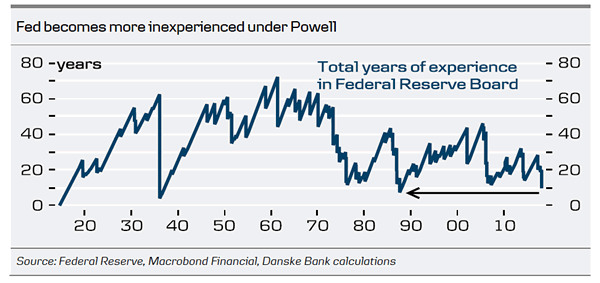
One problem though is that Powell is less qualified than his predecessors (he is a lawyer not an economist) and the full FOMC is becoming more inexperienced, as besides a new Fed Chair there are also many new Fed governors on the board (Trump still needs to nominate a Fed Vice Chair and two ordinary board governors while Marvin Goodfriend has not been approved yet). This is not necessarily a problem when the Fed runs on autopilot but may be a problem if the economy is hit by a shock in either direction (an economic downturn or overheating) or in discussions about changing the long-run framework as mentioned in the previous bullet. We have previously argued that a more inexperienced Fed might be a drag on the dollar.
In The UK, The Jobs Report For November Is Being Released Today
Market movers today
In the euro area, the preliminary PMI figures for January are due for release. Both manufacturing and service PMIs rose yet again in December, climbing to 60.6 and 56.6 respectively. Activity remains high in the euroarea and we expect the PMIs to remain at high levels. However, in line with the decline observed in IFO expectat ions in December, we believe January’s PMI will show a decline. We estimate manufacturing PMI at 60.1 and service PMI at 56.2.
In the UK, the jobs report for November is being released today. There are some signs that employment is no longer increasing at the same pace as previously or possibly has even stagnated. So, in this jobs report we will look for signs of whether this was just transitory or not . We est imate the unemployment rate (three-month average) was unchanged at 4.3%. We estimate the annual growth in average weekly earnings ex bonuses (three-month average) declined to 2.2% y/y from 2.3% y/y, underlining that there is no big wage pressure present in the UK yet .
In the US, the important preliminary PMIs release for January are due out . Although Markit PMI manufacturing trended up over the past six months, it is st ill a puzzle that the index is below the equivalent ISM manufacturing index. Given the big discrepancy, we think Markit PMI could rise further although the bad weather may have pulled in the other direct ion. We estimate an increase to 55.7 from 55.1. Since August , Markit PMI services has fallen 2.3 index points to 53.7, which we think is too much – we expect a rebound to 54.5.
In Sweden, Flodén is due to talk about monetary policy and the economic out look and Prospera inflation expectations are due out.
Selected market news
Earnings set the tone for US equity markets last night with both the S&P500 and the NASDAQ indices trading higher. The bearish momentum in the fixed income market seems to have faded ahead of tomorrow’s ECB meeting and after the dovishtone from the Bank of Japan yesterday. Yields on 10Y US Treasuries were little changed last night , still trading around 2.62%.
In Asia, risk sentiment is generally weaker this morning. In particular, Japanese equity markets are trading lower along with an appreciation in JPY. USD generally sells off and the broadbased dollar index, the DXY index, has dropped below 90 for the first time since January 2015. The sell-off in Japanese equities comes after the Nikkei index yesterday rose to the highest level since 1991 and thus looks very much like a correct ion driven by profit taking and a weaker USD.
Yesterday, the US Senate officially confirmed Jerome Powell as the next Fed Chair when Yellen’s term expires on 3 February. This was as expected, but it has taken a long time for the Senate to actually approve Powell as Yellen’s successor. We expect him to stick to the current monetary policy strategy in the short run by raising the Fed funds target range three times this year. The first one is expected to come at the March meeting, the first meeting he chairs.
Australia’s Westpac Leading Index Rose In December
For the 24 hours to 23:00 GMT, the AUD declined 0.25% against the USD and closed at 0.7995.
LME Copper prices declined 2.0% or $144.0/MT to $6905.0/MT. Aluminium prices declined 1.0% or $21.5/MT to $2213.5/MT.
In the Asian session, at GMT0400, the pair is trading at 0.8001, with the AUD trading 0.08% higher against the USD from yesterday's close.
Overnight data indicated that Australia's Westpac leading index recorded a rise of 0.27% on a monthly basis in December, after advancing by a revised 0.05% in the previous month.
The pair is expected to find support at 0.7968, and a fall through could take it to the next support level of 0.7935. The pair is expected to find its first resistance at 0.8023, and a rise through could take it to the next resistance level of 0.8045.
The currency pair is trading above its 20 Hr and 50 Hr moving averages.

Euro-Zone’s Economic Sentiment Jumped To A 6-Month High Level In January, While Germany’s Investor Mood Improved To An 8-Month...
For the 24 hours to 23:00 GMT, the EUR rose 0.32% against the USD and closed at 1.2297, following better-than-expected ZEW economic sentiment surveys across the common currency region as well as robust consumer confidence data in the Euro-zone.
The Euro-zone's ZEW economic sentiment index climbed to a 6-month high level of 31.8 in January, thus pointing to a strong pick-up in economic confidence as the region continues its strong growth momentum. The index had recorded a reading of 29.0 in the prior month.
Another data revealed that the region's flash consumer confidence index climbed more-than-anticipated to a level of 1.3 in January, highlighting the increasingly positive mood among consumers as the region is in the midst of a solid economic expansion. In the previous month, the index had registered a level of 0.5, while investors had envisaged for a rise to a level of 0.6.
Separately, ZEW investor morale in Germany surged to an 8-month high level of 20.4 in January, beating market expectations for an advance to a level of 17.7, as investors shrugged off political uncertainty in Berlin and focused on brighter economic prospects in the Euro-bloc's largest economy. In the previous month, the index had registered a level of 17.4. Also, the nation's ZEW current situation index jumped to an all-time high level of 95.2 in January, topping market anticipation for a rise to a level of 89.6 and compared to a level of 89.3 in the prior month.
In the US, data indicated that the Richmond Fed manufacturing index registered a more-than-anticipated drop to a level of 14.0 in January, compared to a reading of 20.0 in the prior month, while markets were expecting the index to fall to a level of 19.0.
In the Asian session, at GMT0400, the pair is trading at 1.2317, with the EUR trading 0.16% higher against the USD from yesterday's close.
The pair is expected to find support at 1.2254, and a fall through could take it to the next support level of 1.2191. The pair is expected to find its first resistance at 1.2349, and a rise through could take it to the next resistance level of 1.2381.
Trading trends in the Euro today is expected to be determined by the release of the flash Markit manufacturing and services PMIs for January across the Euro-zone, scheduled in a few hours. Later in the day, the release of US preliminary Markit manufacturing and services PMIs for January, followed by the existing home sales data for December, would garner significant amount of investor attention.
The currency pair is trading above its 20 Hr and 50 Hr moving averages.

UK Public-Sector Net Borrowing Reported A Deficit In December
For the 24 hours to 23:00 GMT, the GBP rose 0.13% against the USD and closed at 1.4002.
Macroeconomic data revealed that UK’s public sector net borrowing posted a deficit of £1.0 billion in December, falling short of market anticipations for a deficit of £4.3 billion. In the prior month, public sector net borrowing had registered a revised deficit of £6.6 billion.
Meanwhile, the nation’s CBI industrial trends total orders fell less-than-anticipated to a level of 14.0 in January, compared to a level of 17.0 in the prior month, while markets were anticipating it to ease to a level of 12.0.
In the Asian session, at GMT0400, the pair is trading at 1.4037, with the GBP trading 0.25% higher against the USD from yesterday’s close.
The pair is expected to find support at 1.3954, and a fall through could take it to the next support level of 1.3872. The pair is expected to find its first resistance at 1.4081, and a rise through could take it to the next resistance level of 1.4126.
Ahead in the day, all eyes would be on the release of UK’s ILO unemployment rate and average weekly earnings data for the three months to November, to gauge strength in the nation’s labour market.
The currency pair is trading above its 20 Hr and 50 Hr moving averages.

Japan’s Manufacturing Activity Hit Highest Level In Almost 4 Years In January
For the 24 hours to 23:00 GMT, the USD declined 0.6% against the JPY and closed at 110.28.
In the Asian session, at GMT0400, the pair is trading at 109.95, with the USD trading 0.3% lower against the JPY from yesterday's close.
The Japanese Yen climbed against the USD, following strong manufacturing sector report in Japan.
Data revealed that Japan's preliminary Nikkei manufacturing PMI climbed to a level of 54.4 in January, notching its highest level since February 2014 and pointing to a strong economic activity in the new year. The PMI had recorded a reading of 54.0 in the previous month.
On the other hand, the nation's adjusted merchandise trade surplus narrowed more-than-anticipated to ¥86.8 billion in December, after recording a surplus of ¥364.1 billion in the previous month. Markets were anticipating the country's adjusted merchandise trade surplus to drop to ¥276.7 billion.
Other data showed that the nation's exports advanced 9.3% on an annual basis in December, missing market expectations for a gain of 10.0%. In the previous month, exports had risen 16.2%. Also, the nation's imports climbed 14.9% YoY in December, higher than market estimates for a rise of 12.4%. Imports had advanced 17.2% in the previous month.
Early morning data revealed that Japan's final leading economic index climbed to a level of 108.3 in November, while the preliminary print had indicated a rise to a level of 108.6. The index had registered a level of 106.5 in the previous month. Additionally, the nation's final coincident index was revised lower to a level of 117.9 in November, compared to a level of 116.4 in the prior month. The preliminary figures had recorded a rise to 118.1.
The pair is expected to find support at 109.49, and a fall through could take it to the next support level of 109.04. The pair is expected to find its first resistance at 110.79, and a rise through could take it to the next resistance level of 111.64.
The currency pair is trading below its 20 Hr and 50 Hr moving averages.

Swiss Franc Extends Its Gains In The Morning Session
For the 24 hours to 23:00 GMT, the USD declined 0.45% against the CHF and closed at 0.9578.
In the Asian session, at GMT0400, the pair is trading at 0.9554, with the USD trading 0.25% lower against the CHF from yesterday’s close.
The pair is expected to find support at 0.9527, and a fall through could take it to the next support level of 0.9499. The pair is expected to find its first resistance at 0.9608, and a rise through could take it to the next resistance level of 0.9661.
Amid no macroeconomic releases in Switzerland today, investor sentiment would be determined by global macroeconomic factors.
The currency pair is trading below its 20 Hr and 50 Hr moving averages.

Loonie Trading On A Stronger Footing This Morning
For the 24 hours to 23:00 GMT, the USD declined 0.18% against the CAD and closed at 1.2425.
In the Asian session, at GMT0400, the pair is trading at 1.2414, with the USD trading 0.09% lower against the CAD from yesterday’s close.
The pair is expected to find support at 1.2384, and a fall through could take it to the next support level of 1.2353. The pair is expected to find its first resistance at 1.2468, and a rise through could take it to the next resistance level of 1.2521.
The currency pair is trading below its 20 Hr and 50 Hr moving averages.

Market Update – Asian Session: Dollar Weakness Continues
Headlines/Economic Data
General Trend: Asian equity markets trade mixed, energy companies outperform
Chinese cities start to issue 2018 GDP targets: Shanghai and Beijing are both targeting around 6.5% growth
Dollar trades below 110 for first time since Sept: PBoC fixed yuan at multi-year high for 4th straight session
US Dollar (USD) Index moves below 90 for first time since late 2014
Japan Jan Prelim Manufacturing PMI nears 4-year high
Japan Dec exports growth at slowest pace since April 2017, yet monthly export amount hits highest since 2008 (exports to Asia and China hit record)
Japan 2017 Trade Surplus with the US +3.1% y/y (2-year high)
Japan
Nikkei 225 opened -0.4%; closed -0.8%
Topix Electric Appliances Index -1.7% (Fanuc -3% due to report earnings on Friday after the close)
Mega banks trade broadly weaker: Sumitomo Mitsui -2.5%, Mitsubishi UFJ -2.5%, Mizuho Financial -1.5%
TOPIX Real Estate Index +1.1% (tracked Tuesday’s outperformance in S&P500 Real Estate Index)
Nidec [6594.JP] -3% (expected to report earnings after the close)
(JP) JAPAN DEC TRADE BALANCE: ¥359.0B V ¥535.0BE; ADJ ¥86.8B V ¥276.7BE; Exports y/y: 9.3% (13th consecutive rise, slowest growth since April 2017) v 10.0%e; Imports y/y: 14.9% v 12.4%e
(JP) JAPAN JAN PRELIM PMI MANUFACTURING: 54.4 V 54.0 PRIOR
(JP) Japan Trade Union Confederation Chief Kozu: Rising monthly wages will boost consumer spending
(JP) Japan Nov Final Leading Index CI: 108.3 v 108.6 prelim; Coincident Index: 117.9 v 118.1 prelim
(JP) BOJ announcement related to daily bond buying operation: leaves amounts unchanged
(JP) Japan Econ Min Motegi: Believes that start date for Trans-Pacific-Partnership will not change; March 8th is the target date for signing the agreement (after the close)
(JP) Japan Cabinet Office report indicates Japan will not be able to achieve a primary budget surplus until FY27 (2-yrs longer than prior indications) unless it manages to dramatically curb spending - Nikkei
Korea
Kospi opened -0.1%
Banks trade generally lower following gains on Tuesday: Hana Financial -3%, KB Financial -1.3%, Woori -1.6%
LG Household & Health Care [051900.KR] -5.5% (reported FY17 results on Tuesday’s session)
LG Electronics [066570.KR]: -5.5% (Reported final FY17 results after Tuesday’s close; Trade concerns)
LG Display +2% (positive broker commentary following Q4 earnings report and guidance)
(KR) South Korea removed from EU blacklist of tax havens - Korean press
(KR) Main opposition party has called on North Korea to delay military parade - Korean press
(KR) S&P: Corporates in South Korea show improvement in creditworthiness; Hyundai Motors rating faces downgrade pressure due to US market; LG Electronics may be 'greatly' impacted by US safeguard issue related to washing machines
Looking Ahead: Q4 Prelim GDP due for release on Thursday
China/Hong Kong
Hang Seng opened -0.1%, Shanghai Composite +0.2%
Hang Seng Info Tech Index -0.9%, Materials -0.7%, Consumer Goods -0.8%, Property/Construction -0.7%, Financials -0.3%; Energy +2.2%
Leshi Internet [300104.CN]: Opens limit down (-10%) after being halted for 9-months
(CN) China said to be prepared to support stocks after trading resumption for shares of Leshi Internet
USD/CNY (CN) PBOC SETS YUAN REFERENCE RATE AT 6.3916 V 6.4009 PRIOR (strongest setting since Dec 4th, 2015)
(CN) China PBOC OMO: Injects CNY220B v CNY170B injected in 7,14 and 63-day reverse repos prior
(CN) China Official: CNY100B in solar subsidies are unpaid as of 2017; To roll out solar subsidy-free pilot projects in 2018
(CN) former PBOC vice gov Zhu: Interest rates are likely to remain unchanged given govt's current focus on reducing debt levels, and a stable inflation rate - Chinese press
(CN) China MoF sells 3-yr bonds, avg yield 3.56%, bid to cover 2.33x; 7-yr upsized bonds at 3.8592% v 3.91%e, bid to cover 2.51x
Australia/New Zealand
ASX 200 opened flat; closed +0.3%
ASX 200 Energy Index +0.8%, Utilities +0.6%, Financials +0.4%
Santos, STO.AU Reports Q4 Rev $861M v $753M y/y; FY17 sales volumes 83.4Mt (record high)
(AU) Australia Dec Westpac Leading Index M/M: 0.3% v 0.1% prior
(NZ) New Zealand Dec Credit Card Spending M/M: 0.6% v 0.8% prior; Y/Y: 6.3% v 9.1% prior
(NZ) New Zealand government delays law banning foreigners from purchasing property - NZ press
(AU) Australia Treasury is expected to boost its global forecasts in the May budget, due to a surge in confidence across advanced and emerging market economies - AFR
Looking Ahead: New Zealand Q4 CPI to be released on Thursday
Other Asia
(MY) MALAYSIA DEC CPI Y/Y: 3.5% V 3.5%E [**Note: The data is above Malaysia’s 2-3% inflation target for the 12th straight month]
(MY) There is press speculation that Malaysia Central Bank (BNM) may raise interest rates by 25bps at Thursday’s meeting – US financial press
(TW) Taiwan Jan 1-22nd foreign capital flow $3.28B - Taiwan press
UMC Corp [2303.TW]: -1.5%: expected to report Q4 earnings after close
AU Optronics [2409.TW] +3.5% (positive broker commentary)
TSMC [2330.TW] Chairman: Sees negative impact from NT$ gains
Moody's: Asia high-yield corporate bond covenant quality score declines to weakest level on record
(VN) Vietnam shut main Ho Chi Minh City stock exchange for second day amid technical malfunction
North America
US equities closed mostly higher: Dow -0.1%, S&P500 +0.2%, Nasdaq +0.6%, Russell 2000 +0.1%
S&P500 Real Estate Sector +1.5%, Utilities +1%
Texas Instruments [TXN] Down over 6% afterhours: Reports Q4 $1.09*(ex $0.75 tax expense) v $1.09e, Rev $3.75B v $3.73Be; Guides Q1 $1.01-1.17 (adj) v $1.07e, Rev $3.49-3.79B v $3.64Be
United Continental [UAL]: Down over 4% afterhours Guides initial FY18 $6.50-8.50 v $6.63e; Guides initial FY18 non fuel CASM -1% to 0%; FY18 capacity +4-6% - earnings call comments
(US) Senate confirms Jerome Powell as incoming Fed Chair (as expected)
(US) Fed nominee Goodfreind: transparency could be improved regarding reference rules for monetary policy
(US) White House Econ Adviser Cohn: Trump's message at Davos will be to invest in America, not that hes withdrawing the US from the global trade scene – press
(US) TREASURY SELLS $26B IN 2-YEAR NOTE AUCTION; DRAWS 2.066%; BID-TO-COVER RATIO: 3.22 V 2.52 PRIOR AND 2.82 AVG OVER THE LAST 12 (first 2-year auction above 2.00% since 2008)
(US) Weekly API Oil Inventories: Crude: +4.8M v -5.1M prior
(US) US AIA Dec Architecture Billings Index: 52.9 v 55.0 prior; New projects inquiry index 61.9 v 61.1 prior
Looking Ahead: US Dec Existing Home Sales due for release, along with Weekly DoE Crude Oil Inventories
Corporate earnings are expected out of companies including Comcast, Discover, Ford, General Dynamics, GE, Las Vegas Sands, SL Green, United
Technologies, Whirlpool
Europe
(UK) Conservative MPs have told PM May that the UK must not be bound by EU rules during the Brexit transition period
(UK) EU Chief Brexit Negotiator Barnier: hope UK will indicate what it wants in Brexit talks by March
(EU) EURO ZONE JAN ADVANCE CONSUMER CONFIDENCE: 1.3 V 0.6E; *(EU) EURO ZONE JAN ADVANCE CONSUMER CONFIDENCE: 1.3 V 0.6E ( Reading is highest since Aug 2000)
Looking Ahead: Euro Zone Prelim Jan Manufacturing and Services PMIs due for release (Euro Zone, France, German); UK Nov Avg Earnings and Unemployment Rate, Dec Claimant Count Change; France Jobseekers data (US session)
Levels as of 01:00ET
Nikkei225 -0.8%, Hang Seng -0.1%; Shanghai Composite +0.3%; ASX200 +0.3%, Kospi -0.0%
Equity Futures: S&P500 +0.0%; Nasdaq100 +0.0%, Dax +0.1%; FTSE100 -0.2%
EUR 1.2335-1.2291; JPY 110.34-109.81; AUD 0.8017-0.7993;NZD 0.7377-0.7349; GBP 1.4049-1.3997
Feb Gold +0.3% at $1,340/oz; Mar Crude Oil +0.0% at $64.45/brl; Mar Copper +0.6% at $3.14/lb
Elliott Wave View: GBPUSD Doing An Ending Diagonal
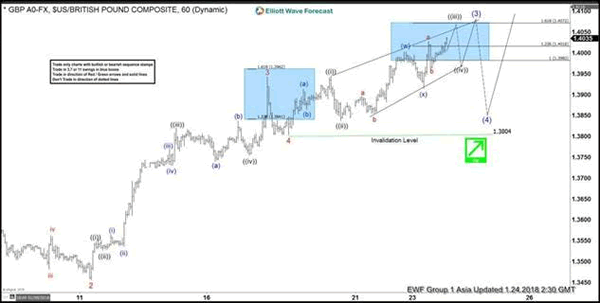
GBPUSD Short Term Elliott Wave view suggests that the pair rallies as 5 waves impulse Elliott Wave structure from 16 December 2017 low. Up from 16 December 2017 low (1.33), Minor wave 1 ended at 1.3613, pullback to 1.3456 ended Minor wave 2, rally to 1.3943 ended Minor wave 3, and Minor wave 4 ended at 1.3803. Pair has broken above Minor wave 3 at 1.3943, suggesting that Minor wave 5 is currently in progress.
Internal of Minor wave 5 is proposed to be unfolding as an Ending Diagonal where Minute wave ((i)) ended at 1.3945 and Minute wave ((ii)) ended at 1.3838. As far as pivot at 18 January 2018 low (1.3803) stays intact, expect the pair to extend higher to end Minor wave 5 of (3) towards 1.40s area. Afterwards, pair should pullback in Intermediate wave (4) to correct cycle from 16 December 2017 low (1.33) in 3, 7, or 11 swing before the rally resumes. We do not like selling the pair.
GBPUSD 1 Hour Elliott Wave Chart