

Sample Category Title
Gold Pushes Higher Against Sagging Greenback
Gold prices continue to head higher, and has posted slight gains in the Monday session. In North American trade, the spot price for an ounce of gold is $1341.40, up 0.22% on the day. There are no US indicators on the schedule, as the markets are closed in observance of Martin Luther King Day. On Tuesday, the sole indicator is the US Empire State Manufacturing Index.
Gold has reeled off five straight winning weeks, taking advantage of a broadly lower US dollar. Gold has climbed an impressive 3.0% in January, as the metal is trading at its highest level since September 2016. Although US numbers have generally been strong of late, this has not stemmed the gold rally. If major currencies such as the euro and yen continue to make inroads against the dollar, traders can expect the gold rally to continue.
On Friday, gold prices pushed higher, as the markets were not impressed with US consumer numbers. CPI slowed to 0.1%, down from 0.4% a month earlier. Core CPI was stronger, improving to 0.3%. Both indicators were within expectations, but pointed to weak inflation levels. On the bright side, consumer spending remained strong. December retail sales, boosted by Christmas shopping, were up 5.4% compared to a year ago. Although investors were not impressed with the December data, as the euro rally continued, the spending numbers point to a strong finish for the economy in 2017. Earlier in the week, gold gained ground after hawkish ECB minutes raised speculation that the ECB could wind up its asset purchase program later this year. The minutes sent the US dollar to lower ground.
USD/JPY – Yen Rally Continues, Drops Below 111
The Japanese yen continues to head higher, and has posted gains in the Monday session. Currently, USD/JPY is trading at 110.64, down 0.37% on the day. US markets are closed for Martin Luther King Day, so there are no US events. In Japan, PPI is expected to slow to 3.3%. On Tuesday, the US releases Empire State Manufacturing Index.
The yen posted four straight winning sessions last week, and is trading in green territory on Monday as well. The Japanese currency has gained 1.8% against the greenback in January, as the US dollar continues to show broad weakness. The Bank of Japan gave the yen a boost last week, after the BoJ reduced its bond purchases. The Bank trimmed its purchase of 10 to 25 year bonds and 25 to 40 bonds by JPY 10 billion yen each, to JPY 190 billion yen and 80 billion respectively. The cut to the 10-25 year bonds was the first in more than a year. This has raised speculation that the Bank will taper its massive stimulus program, which would likely bode well for the Japanese yen.
The US dollar remains under pressure, as consumer data for December was a mixed bag. CPI slowed to 0.1%, down from 0.4% a month earlier. Core CPI was stronger, improving to 0.3%. Both indicators were within expectations, but pointed to weak inflation levels. On the bright side, consumer spending remained strong. December retail sales, boosted by Christmas shopping, were up 5.4% compared to a year ago. Although investors were not impressed with the December data, as the euro rally continued, the spending numbers point to a strong finish for the economy in 2017.
Sunset Market Commentary
Markets:
US markets are closed today for Martin Luther King Day. Changes on the German yield curve ranged between -0.7 bps (2-yr) and +0.5 bps (30-yr) amid an empty eco calendar. The Bund hovered sideways near opening levels and near the recent sell-off lows in low volume trading. From a technical point of view, German yields remain below key resistance levels (2017 tops). Brent crude trades stable a tad below $70/barrel and changes on European stock markets are limited (small losses). 10-yr yield spread changes versus Germany widen up to 2 bps. The Kingdom of Belgium announced the launch of new 10-yr syndicated benchmark (OLO 85 Jun2028) in the near future (likely tomorrow).
The trends in the dollar and the euro from the end last week continued unabatedly today even as US markets are closed in observance of Martin Luther King Day. EUR/USD enjoys further follow-through gains after Friday's break above the 1.2092/1.2167 resistance, pushing the pair to the highest level in more than 3 year. There was little additional news to explain the move. Investors continue to adapt positions as the minutes from the December meeting indicated that the ECB will probably change its communication early this year and prepare markets for a gradual scaling back of policy stimulation. This euro strength coincides with broader USD weakness. USD/JPY is also drifting further south as BOJ-Kuroda sounded optimistic on the economic recovery and on Japan's inflation going forward. EUR/USD trades in the 1.2280 area. USD/JPY hovers just north of 111.50. The trade-weighted dollar (90.40) trades at the lowest level since the start of 2015.
Sterling remains in good shape. Cable profits from the overall decline of the dollar. The pair has rebounded to the 1.38 area, revisiting the levels that were on the screens at the at time of the outcome of the Brexit referendum in June 2016. In technical trade, EUR/GBP gained a few ticks. The pair trades again in the 0.89 area. Even so, the gains of EUR/GBP remain modest given the upswing in EUR/USD, confirming recent signs of sterling resilience as markets ponder the chances of a soft Brexit. Tomorrow, the focus will turn to the UK December CPI.
News Headlines:
The EMU trade surplus widened further in November to its highest in eight months. Exports growth outpaced imports, despite a stronger euro. Eurostat reported an EMU trade surplus to €26.3 bn, up from €18.9 bn in October.
Brent crude oil hovered within reach of a three-year high near $70 p/b a barrel. Production cuts by OPEC and Russia are still reported to tightening supplies, but analysts are warning of "red flags" due to surging US production.
Economic activity in Brazil expanded for a third straight month in November. The economic activity index of the central bank rose 0.49% from October. The report is an indication that the momentum in the economy probably improved further at the end of 2017.
Scotland will suffer a 8.5% hit to the size of its economy by 2030 if Britain leaves the EU with no trade deal, the Scottish regional government said in an economic impact assessment. Scotland's first minister Nicola Sturgeon, said Britain remaining in the EU's single market, if not the bloc itself, was now the best realistic option but it would still hurt Scotland.
Euro Flirts With $1.23; European Stocks Steady
Here are the latest developments in global markets:
FOREX: Euro/dollar challenged the 1.23 key level, rising to fresh three-year highs during the early European session as investors were increasingly confident that the ECB would trim its balance sheet, while easing political uncertainties in Germany provided further support to the common currency. The dollar index extended its downtrend towards 90.44 (-0.56%), approaching three-year lows, while against the yen, the dollar dived to a four-month trough of 110.51 (-0.40%). The greenback's weakness pushed the antipodean currencies ever higher, with the aussie and the kiwi surging near four-month peaks. Pound/dollar held onto gains as well, touching 1.3818 for the first time since referendum took place. On Friday, the pair gained positive momentum after reports that Spain and the Netherlands were willing to back a deal which promises close ties between the UK and the EU.
STOCKS: A strengthening euro pressured eurozone stocks on Monday. The pan-European STOXX 600 was down by 0.14% at 1040 GMT. Healthcare and financials were among sectors dragging the index. The blue-chip Euro STOXX 50 was weaker by 0.25%, driven mainly by losses in utility shares. The German DAX 30 was down by 0.35%, while the British FTSE 100 retreated by 0.11% mainly due to weaker technological shares. In other news of the UK, the British construction firm Carillion collapsed after the government's efforts to reach an agreement with the company's creditors failed. Even if Carillion shares trade off the FTSE 100, banking sectors listed in the index might have seen some losses arising from the news.
COMMODITIES: Oil prices were slightly down during midday European session, not far away from three-year peaks reached last week. WTI crude stood at $64.17 per barrel ( -0.06%) and Brent was last seen at $69.78 (-0.17%). Gold consolidated gains around $1,342 per ounce after reaching a fresh four-month high earlier in the day.
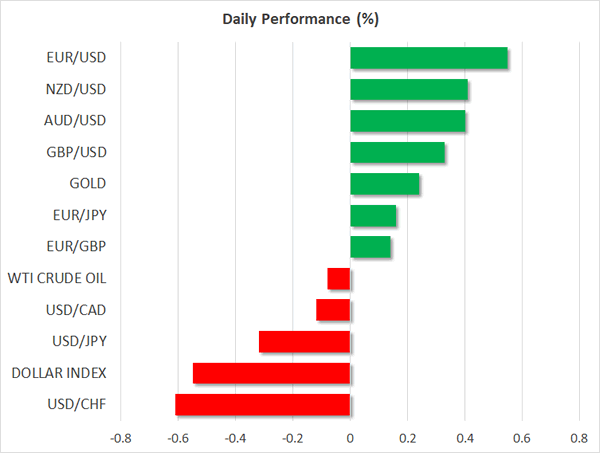
Day ahead: New Zealand reports on business confidence and electronic retail sales
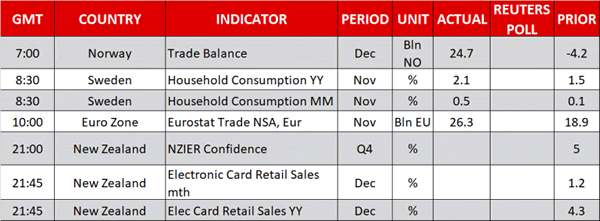
Data releases will be limited to the remaining of the day as US markets will be closed for Martin Luther King Jr. Day. Investors, though, will keep a close eye on the kiwi to see whether today's figures on business confidence (2100 GMT) and electronic card retail sales (2145 GMT) will add further gains to the currency.
Regarding New Zealand's business confidence, it will be interesting to see whether the business outlook continued to deteriorate in the fourth quarter of 2017, as the index has been slowing down since the beginning of the year when it touched a 2½-year high. In the third quarter, the measure hit the lowest growth mark seen in 2017, rising by 5.0%.
On the other hand, electronic transactions in New Zealand increasingly grew from September onward, reaching a 10-month high of 1.2% m/m in December. If the measure continues to extend its uptrend, this would mirror further improvements in consumption and constitute a positive contribution to the country's economic expansion.
The euro will be in the spotlight as well, with traders waiting for any political updates in Germany the following weeks. Note that Merkel's Conservatives managed to make progress on coalition talks with their former partners, the Social Democrats last week, sending negotiations to the next level. The Social Democrats said on Sunday they would make efforts to improve the blueprint and gain the trust of their skeptical members, hoping for a deal at a congressional meeting on January 21, when a vote on the agreement will take place. Formal negotiations will be able to start only if the vote is positive.
Investors will also keep a close eye on several earnings reports due this week which have the potential to move stock markets.
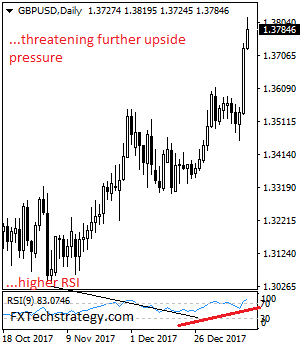
GBPUSD: Bullish, Remains On Upside Offensive
GBPUSD - The pair faces further upside pressure as it was seen building up on its past gain during Monday trading session. Support lies at the 1.3750 level where a break will turn attention to the 1.3700 level. Further down, support lies at the 1.3650 level. Below here will set the stage for more weakness towards the 1.3600 level. Conversely, resistance stands at the 1.3800 levels with a turn above here allowing more strength to build up towards the 1.3850 level. Further out, resistance resides at the 1.3900 level followed by the 1.3950 level. Its daily RSI is bullish and pointing higher suggesting further strength. On the whole, GBPUSD looks to move further higher on bull pressure.
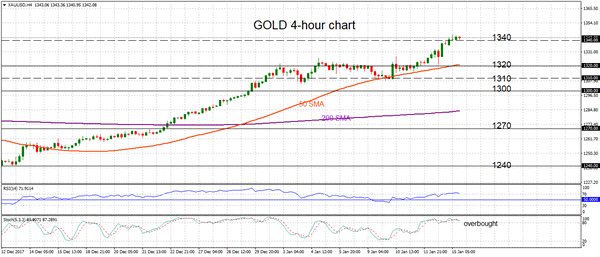
Gold Continues Bullish Run to 4-Month High
Gold continues its bullish run to hit its highest level since September 2017, maintaining its strong upside momentum since breaching the 1320 level. The commodity has been in an uptrend since reversing losses in mid-December 2017.
Looking at the 4-hour chart, the market is looking a little overstretched as indicated by the stochastic and RSI both being in overbought territories. Despite this, gold is expected to hold its bullish bias but will likely pause the rally in the near-term.
Support is expected at 1340, a level which the market seems to be holding after pulling back from the 1344.71 high earlier today. A deeper correction would see prices target an important level at 1320, which is an area that saw significant congestion recently. Below this, 1310 is also seen as minor support before the focus turns to the key psychological level at 1300. A move lower would likely increase downside pressure and shift the bias to a more bearish one.
For now, the bias remains bullish despite the overbought conditions on the 4-hour chart, with scope to rise to the 1357.47 peak of September 8. For the time being, there are no technical signs indicating a trend reversal.
Brent Crude Oil Futures Post 3-Year High; Hold above Short-Term Uptrend Line
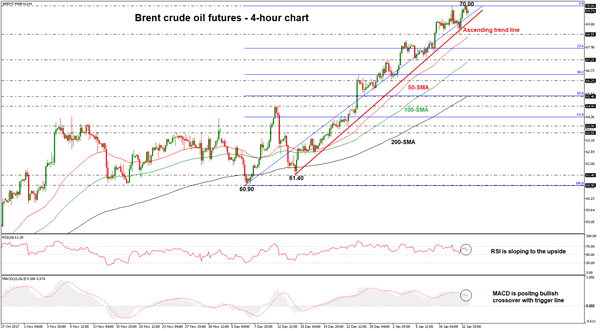
Brent crude oil futures rose to a new more than 3-year high on Thursday slightly above the strong psychological level of 70.00. During today's European session, the price headed for a test of the aforementioned level and retreated over the next hours.
The price continues to print higher peaks and higher troughs above the uptrend line taken from the low of December 14 and as such the short-term outlook remains positive.
In the 4-hour chart, momentum indicators are also pointing to a continuation of the bullish bias. The RSI holds above the 50 level, while the MACD is posting a bullish crossover with its trigger line. Additionally, the three simple moving averages (50, 100 and 200) are following the upside movement on price in the 4-hour as well as the daily charts, pointing to a positive picture in both the short and medium term.
A dip back below the ascending trend line could confirm the case for a bearish correction until the 68.55 support level or moreover until the immediate resistance of the 23.6% Fibonacci retracement mark at 67.84 of the up-leg from a more than a one-month low of 60.90 to a high of 70.00.
On the flip side, if traders boost the price further, it could come around the next resistance barrier of 76.80, defined by the bottom of November 2014. As a side note, strong resistance obstacles could come from the next psychological levels where the price may have a pause.
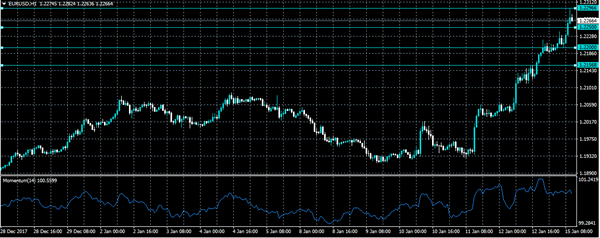
EURUSD Further Bullish above 1.2250 Level
The EURUSD pair has moved to its highest level since December 2014, reaching 1.2296 during Monday's European trading session. The euro has now pulled back towards the 1.2260 level, after the decline in the U.S dollar index quickly reached extreme oversold levels. Trading conditions in the foreign exchange are increasingly volatile, with exaggerated intraday price-movement, as financial markets in the United States are away on holiday, celebrating Martin Luther King Day.
The EURUSD buyers are firmly in control while price-action trades above the 1.2250 level, further upside towards 1.2300 and 1.2345 remains possible.
Should price-action on the EURUSD pair move below the 1.2250 level, technical selling towards the 1.2200 region now seems likely.
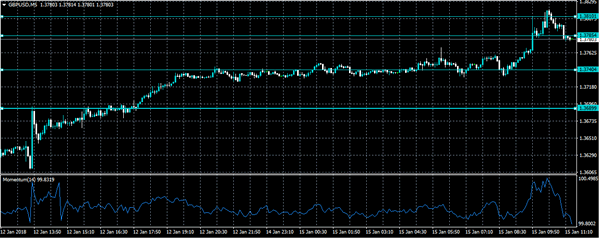
GBPUSD Buyers in Control above 1.3740 Level
The British pound has moved sharply higher against the U.S dollar on Monday, hitting 1.3819, after the U.S dollar index collapsed towards the 90.20 level. Price-action has now retreated underneath the 1.3800 handle, with the GBPUSD pair currently testing intraday demand around the 1.3770-80 region. With financial markets away in the United States, sterling traders will likely focus on the 1.3800 barrier, and the release of key December CPI inflation data from the United Kingdom economy on Tuesday.
The GBPUSD pair remains strongly bullish while trading above the 1.3740 level, buyers can may push price-action towards the 1.3810 and 1.3890 resistance levels.
Should price-action on the GBPUSD pair move below the 1.3740 zone, intraday support is located at the 1.3689 and 1.3657 technical levels.
DAX Subdued in Quiet Day for Fundamentals
The DAX has started the week with slight losses. In the Monday session, the index is at 13,205.50, down 0.30% on the day. On the release front, there is only one indicator, as trade surplus climbed to EUR 22.5 billion, edging above the estimate of EUR 22.4 billion. US markets are closed for Martin Luther King Day.
German stock markets jumped at the start of the year, but has since steadied. The DAX failed to gain ground on Friday, despite positive news out of Germany on the political front. After months of coalition negotiations, there was major progress to report, as Angela Merkel's conservative bloc and the Social Democrats have agreed on a coalition blueprint. This ends months of political uncertainty,which has eroded Merkel's standing and also sidelined Germany on issues such as Brexit and political reform in the eurozone. Still, the talks are only in the preliminary stage, and further negotiations will be continuing in the coming weeks. Any coalition deal must be approved by all members of the Social Democrats camp, and this could present a challenge for party head Martin Shulz. The draft which Shulz and Merkel hammered out calls for an annual limit of 220,000 immigrants, and many Social Democrats oppose any cap on immigration. News of the breakthrough sent the euro higher on Friday, and if the agreement is ratified, the DAX could post strong gains.
An improving eurozone economy has raised speculation that the ECB could wind up its massive stimulus program in September, and that move could be followed by an interest rate hike. The last time the ECB raised rates was back in 2011, so even a hint at such a move could send European stock markets sharply higher. The ECB minutes, published last week, have increased sentiment that we could see tighter policy in 2018. In the minutes, policymakers said that risks to the current outlook were to the upside, which could necessitate a gradual shift in guidance in the next few months. As for the eurozone, the minutes stated that the economy was displaying "continued robust and increasingly self-sustaining economic expansion".