Sample Category Title
GBPUSD: Bullish, Resumes Short Term Uptrend
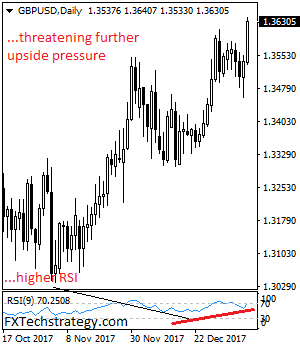
GBPUSD: The pair faces further move higher as it builds up on its Thursday gain. Support lies at the 1.3600 level where a break will turn attention to the 1.3550 level. Further down, support lies at the 1.3500 level. Below here will set the stage for more weakness towards the 1.3450 level. Conversely, resistance stands at the 1.3650 levels with a turn above here allowing more strength to build up towards the 1.3700 level. Further out, resistance resides at the 1.3750 level followed by the 1.3800 level. On the whole, GBPUSD looks to move further higher in the days ahead.
EURUSD Records Fresh 3-year High; Further Bullish Run is Expected
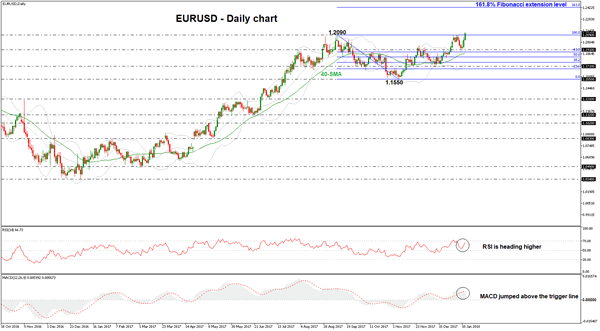
EURUSD reached a new three-year high of 1.2136 during European session today and touched the upper boundary of the Bollinger band breaking the 1.2090 strong barrier.
The single currency is poised for an upward movement against the greenback and could extend those gains until the 161.8% Fibonacci extension level, at 1.2420, from the down-leg with the low at 1.1550 and the high at 1.2090.
If the 1.1910 support fails, then the focus would shift to the downside towards the 50.0% Fibonacci mark at 1.1820, which if breached, would increase downside pressure until the 38.2% Fibonacci level at 1.1760.
In the daily timeframe, the price posted the second consecutive green day following the strong rebound on the 1.1910 support level, which overlaps with the 20-day simple moving average of the Bollinger band. Moreover, the RSI indicator is pointing north in the positive territory, approaching the overbought zone, signaling further bullish tendency, while the MACD oscillator has just created a bullish crossover with its trigger line.
Having a look at the weekly timeframe, the world's most traded currency pair is still developing within an ascending move since last January and is on track to post its fourth bullish week in a row.
GBPUSD Breaches Critical 1.36 Level; Can Rally Be Sustained?
https://server2.actionforex.com/administrator/index.php?option=com_content&view=article&layout=edit#publishing
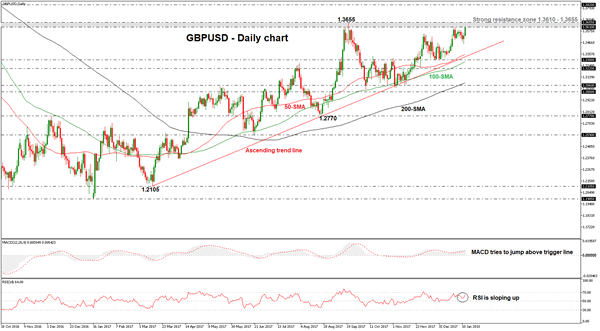
GBPUSD jumped to a 16-week high during today's European session, challenging the 1.3620 price level. The price has been moving in an uptrend since March 2017 confirmed by higher peaks and higher bottoms.
Prices broke above 1.3610 and are trading above their medium-term simple moving averages (50, 100 and 200). The bullish picture in the short to medium-term is further supported by the momentum indicators. The MACD oscillator is trying to climb above its trigger line in the bullish area, whilst the RSI indicator is following the bullish path.
Further gains should see the February 2016 high of 1.3820 act as major resistance. However, the pair would first need to surpass the 1.3610 – 1.3655 significant area, with 1.3655 being the 15-month top achieved in September 2017.
In the event of a downside reversal, the 1.3300 psychological level could act as a barrier before being able to penetrate the ascending trend line. A break below the aforementioned diagonal line would take the price to the next support at 1.3220.
Euro at Three Year High on Possible Coalition Deal
Friday January 12: Five things the markets are talking b
On Thursday, the European Central Bank (ECB) delivered some good cheer to the EUR with a set of monetary policy minutes that supported market expectations that it will shift to a more 'hawkish' view this year.
The minutes noted that forward guidance and language regarding policy could be revisited in early 2018. They also noted increased confidence that inflation would take hold and that near-term downward pressure on core inflation is probably temporary.
Note: This increases the chances of the ECB ending asset purchases in September and may prompt speculation that rates could rise earlier than previously thought.
Pushing the single unit to new three-year highs (€1.2126) outright early Friday are reports that Germany's two biggest parties, the CDU/CSU and SPD, have reached a preliminary deal on a formal coalition, which paves the way for the formation of a government.
Today's U.S data could be seen as possibly reinforcing the 'mighty' dollar's recent softness. The December readings, on U.S retail sales and CPI (08:30 am EDT), should again show a mix of good growth and subdued inflation. That, then, would likely reinforce the dollar's recent softness. CPI could miss after yesterday's PPI report showed some softness in services.
1. Stocks mixed results
In Japan, the Nikkei share average edged lower overnight as weakness in exporters weighed on the index, but strong gains in index-heavy Fast Retailing on record quarterly profit limited the losses. The Nikkei ended -0.2%, while the broader Topix declined -0.6%.
Elsewhere in Asia, most regional bourses recorded gains. The Shanghai Composite Index rose +0.1%, a record-tying 10th consecutive gain, while Hong Kong's Hang Seng and South Korea's Kospi were up +0.8% and +0.3% respectively.
Down-under, Aussie shares rose marginally overnight, as gains for miners outweighed losses for bank stocks, but the main index still had its worst week in tw0-months. The S&P/ASX 200 index closed up +0.04%, though it lost -0.9% this week. In New Zealand, the benchmark S&P/NZX 50 index erased earlier gains to end -0.1% lower, its worst week in over a year.
In Europe, regional indices trade flat to slightly higher across the board following on from another record close stateside overnight.
Futures on the S&P 500 Index have gained +0.2% to the highest on record.
Indices: Stoxx600 flat at 397.40, FTSE +0.1% at 7772, DAX +0.1% at 13219, CAC-40 +0.1 at 5492, IBEX-35 +0.4 at 10472, FTSE MIB 0.5% at 23417, SMI +0.3 at 9529, S&P 500 Futures +0.2%
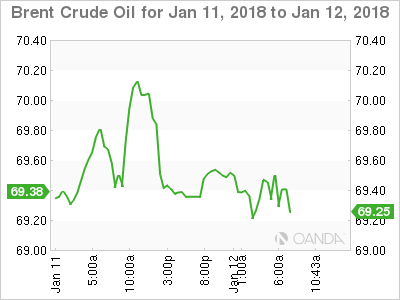
2. Oil prices are set for fourth straight week of gains, gold higher
Oil prices have eased from their three-year highs in the Euro session, but remain on track to end the week higher for a fourth consecutive week.
Brent crude futures are trading -15c lower at +$69.11 a barrel. The contract broke above +$70 a barrel yesterday for the first time in three years. U.S West Texas Intermediate (WTI) crude futures CLc1 are at +$63.45 a barrel, down -35c. On Thursday, WTI rallied to +$64.77, its strongest price since December 2014.
Note: Many analysts continue to warn about the risks of a price correction since the start of 2018, but they say overall market conditions remain strong, mainly due to output cuts led by OPEC and Russia.
Oil prices have also found support from eight consecutive weeks of U.S crude inventory drops. Data this week showed that U.S commercial crude oil stocks fell almost -5m barrels in the week to Jan. 5, to +419.5m barrels, or slightly below the five-year average of just over +420m barrels, the target for OPEC and others involved in output cuts.
Note: A recent market survey suggest that crude price expectations remain in a range of +$60 to +$70 per barrel for 2018.
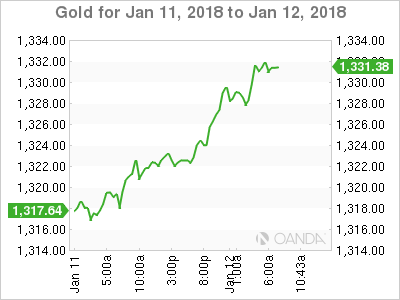
Gold prices are set for their fifth week of gains, mostly supported by slump in 'big' dollar. Ahead of the U.S open, spot gold prices are up +0.1% at +$1,324 an ounce.
Note: Prices hit a near four-month high at +$1,326.56 an ounce on Wednesday.
3. Long date product yields back up
U.S Treasury's yields have backed up again after minutes yesterday from the ECB December meeting suggests that the central bank was nearing a move to wind down its giant bond-buying program (QE).
Stateside, the yield on the U.S 10-year notes have been flirting with the psychological +2.6% handle this week - this reflects a growing market view that U.S inflation is about to pick up at the same time as G10 central banks shift to a 'tighter' monetary poly. Ahead of the open, the U.S 10-year yield trades atop of +2.564%. Investors will take guidance from this morning U.S inflation number.
In Germany, the 10-year Bund yield has hit a fresh five-month high of +0.539% this morning after Chancellor Merkel's conservatives and the Social Democrats agreed a blueprint for formal coalition negotiations.
In the U.K, the 10-year Gilt yield has climbed +1 bps to +1.317%, the highest in six weeks.
4. Dollar on the back foot again
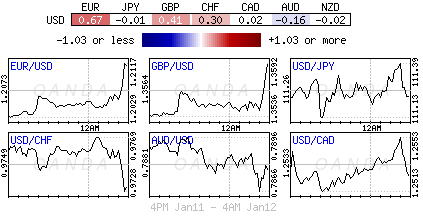
The USD is on soft footing against G10 currency and commodity-related pairs as the markets focus turns to this mornings U.S Dec CPI data and its impact on the rate outlook. The greenback turned softer yesterday after a disappointing PPI data.
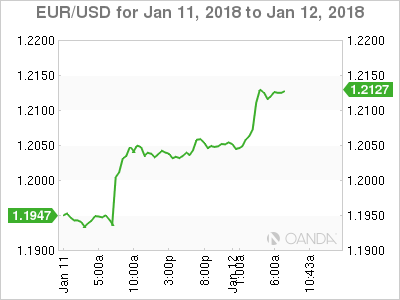
EUR/USD (€1.2126) has managed to print a new three-year high ahead of the open stateside. Its initial boost higher came from yesterday's perceived hawkish ECB Minutes from December that seemed to suggest that QE operations would probably end in September. The 'single' unit is also receiving support on news that negotiations to put together a Grand German coalition were optimistic.
GBP/USD (£1.3629) has moved above the pivotal £1.36 level on the back of overall USD weakness. This area has been a key technical resistance area in the aftermath of the GBP descent following the Brexit referendum in Jun 2016.
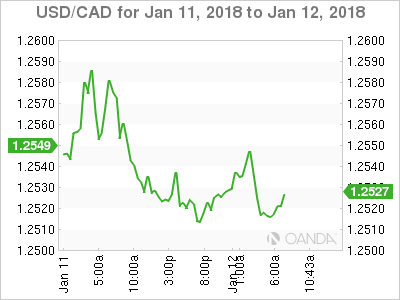
USD/CAD (C$1.2525) is off its recent highs as the pair has moved towards the lower end of the C$1.25 handle as the loonie has found some traction on rate differentials - the Bank of Canada (BoC) meet next week Jan 17 and fixed income traders are pricing in a +73% odds of a +25 bps rate hike. All of the loonies' weakness this week has come on the back of the dissolution of NAFTA.
5. China reports biggest-ever annual trade surplus with U.S.
Data overnight from the world's second largest economy - China - shows that its trade surplus with the U.S has hit a new record level in 2017.
Stronger growth in the U.S has pushed up demand for Chinese exports, expanding China's trade surplus in goods by +10% to +$275.8B in 2017. Expect numbers like this to egg on the Trump administration criticisms about Chinese trade practices.
Note: The trade deficit with China is the U.S.'s largest with any trading partner and the 2017 print is the biggest with China in the nearly five decades. China's surplus has now officially surpassed the previous record of +$261B in 2015. U.S figures put the 2015 deficit with China at +$367B.
DAX Yawns Despite Breakthrough in German Coalition Talks
The DAX has posted small gains in the Friday session. Currently, the index is at 13,217.50, up 0.11% on the day. On the release front, Eurozone Industrial Production posted a strong gain of 1.0%, above the estimate of 0.8%. Later in the day, ECB will release the minutes of the December policy meeting.
German coalition talks have been dragging for several months, but Friday brought reports of a major breakthrough, as Angela Merkel's conservative bloc and the Social Democrats have agreed on a coalition blueprint. This ends months of political uncertainty,which has eroded Merkel's standing and also sidelined Germany on issues such as Brexit and political reform in the eurozone. Still, the talks are only in the preliminary stage, and further negotiations will be continuing in the coming weeks. The conservatives and Social Democrats composed the last government, and Merkel and Social Democrat leader Martin Shulz will be trying to drum up support for the deal
The ECB minutes, released on Wednesday, were hawkish in tone. Policymakers said that risks to the current outlook were to the upside, which could necessitate a gradual shift in guidance in the next few months. As for the eurozone, the minutes stated that the economy was displaying "continued robust and increasingly self-sustaining economic expansion". When the ECB announced the taper in late 2017, it extended the program until to September 2018. However, with the strong economy, there are signals that QE may not be extended beyond September. On December 30, Benoit Coeure, who is in charge of the program, said on Dec. 30 there was a "reasonable chance" it would not be extended. On Sunday, Bundesbank President Jens Weidmann said the ECB should set a date to end QE. Talk of an end to QE has raised speculation that the ECB could follow up with a rate hike late in 2018. This would be a monumental move, as the ECB hasn't raised rates since 2011.
Euro Soars to 3-Year High as German Coalition Talks Show Progress
On Friday, EUR/USD has posted strong gains for a second straight session. Currently, EUR/USD is trading at 1.2119, up 0.73% on the day. The catalyst for the boost was a report that German coalition talks have made substantial progress. On the release front, there are no major releases out of the eurozone. In France, French Final CPI improved to 0.3%, matching the forecast. This marked a 4-month high. In the US, it's a busy day, with the release of CPI and retail sales reports.
The euro rally has continued on Friday, following reports from Germany that Angela Merkel's conservative bloc and the Social Democrats have agreed on a coalition blueprint. This ends months of political uncertainty,which has eroded Merkel's standing and also sidelined Germany on issues such as Brexit and political reform in the eurozone. Still, the talks are only in the preliminary stage, and further negotiations will be continuing in the coming weeks. The conservatives and Social Democrats composed the last government, and Merkel and Social Democrat leader Martin Shulz will be trying to drum up support for the deal.
The ECB minutes, released on Wednesday, were hawkish in tone. Policymakers said that risks to the current outlook were to the upside, which could necessitate a gradual shift in guidance in the next few months. As for the eurozone, the minutes stated that the economy was displaying "continued robust and increasingly self-sustaining economic expansion". When the ECB announced the taper in late 2017, it extended the program until to September 2018. However, with the strong economy, there are signals that QE may not be extended beyond September. On December 30, Benoit Coeure, who is in charge of the program, said on Dec. 30 there was a "reasonable chance" it would not be extended. On Sunday, Bundesbank President Jens Weidmann said the ECB should set a date to end QE. Talk of an end to QE has raised speculation that the ECB could follow up with a rate hike late in 2018. This would be a monumental move, as the ECB hasn't raised rates since 2011.
An interest rate increase from the ECB? That kind of language hasn't been bandied about for years – the last time that the ECB raised rates was in 2011. However, there is growing speculation that the Bank could raise rates, if it decides to terminate its massive stimulus program (QE) in September. This month, the ECB started its taper of the program, reducing monthly purchases from EUR 60 billion to EUR 30 billion. With the eurozone economy continuing to perform well, the ECB has been sending out signals that the stimulus program could end in 2018. On December 30, Benoit Coeure, who is in charge of the program, said on Dec. 30 there was a "reasonable chance" it would not be extended. On Sunday, Bundesbank President Jens Weidmann said the ECB should set a date to end QE.
ECB Minutes Stall Euro’s Declines
The ECB meeting minutes from the December monetary policy meeting released yesterday came with some hawkish surprises. According to the minutes, ECB officials discussed about tweaking its forward guidance during the coming months, depending on the economic data.
The markets reacted with the euro being bid higher on the day, halting a three day losing streak. The U.S. dollar was already weaker from the previous day as news about the BoJ's tapering on the long term bond yields had sapped the strength out of the U.S. dollar, which was showing signs of recovery.
On the economic front, data from the U.S. showed that producer prices fell for the first time since August 2016. Headline PPI declined 0.1% on the month, while core PPI was also weaker declining 0.1%. Both data points missed the economists' forecasts and posted a drag following a 0.4% and a 0.3% increase previously.
Looking ahead, the consumer prices data will be coming out and the market forecasts are already pointing to a weaker pace of increase in consumer prices. Retail sales numbers will also be coming out at the same time.
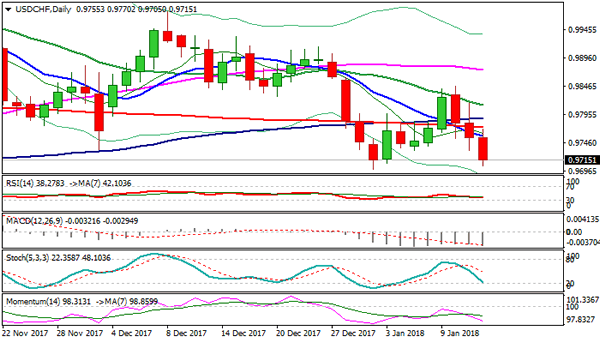
Technical Outlook: USDCHF – Bears Pressure Key Support At 0.9699
The pair remains under strong pressure and holding firmly in red for the third straight day, following repeated upside rejection at daily cloud base earlier this week.
Today’s fresh bearish extension pressures key support at 0.9699 (02 Jan low) and threatening for break lower which would trigger extension of broader downtrend from 1.0038 (27 Oct high) towards next strong supports at 0.9656 (Fibo 61.8% of 0.9420/1.0038) and 0.9652 (weekly 200SMA).
Firm bearish setup of daily techs is supportive for further weakness, however, bears may show hesitation at 0.9699 support and enter consolidative phase before resuming.
Falling 10SMA (0.9757) is expected to ideally cap and keep intact next strong barrier at 0.9772, provided by 200SMA.
Res: 0.9757, 0.9772, 0.9788, 0.9812
Sup: 0.9699, 0.9652, 0.9600, 0.9565
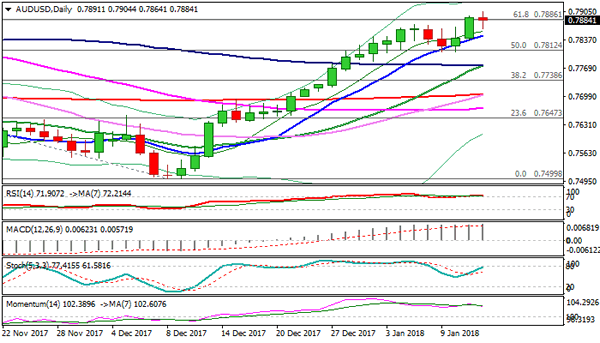
Technical Outlook: AUDUSD Bulls Are Taking A Breather After Cracking Strong Barriers
The Aussie eases on Friday after hitting new high at 0.7904 on probe above key barriers at 0.7886 (Fibo 61.8% of 0.8124/0.7500) and 0.7897 (13 Oct lower high).
The pair came under pressure on downbeat China imports data (4.5% in Dec vs 13.0% f/c and 17.7% previous month).
The structure remains firmly bullish, favoring clear break above 0.7900 handle for extension towards 0.7977 (Fibo 76.4% of 0.8124/0.7500 descend) and test of psychological 0.8000 barrier in extension.
The pair is on track for the fifth straight bullish weekly close which is also positive signal.
Rising 10 SMA continues to track the advance and offers solid support at 0.7846 (support is reinforced by the top of thick 4-hr cloud, spanned between 0.7846 and 0.7792) which is expected to contain corrective dips.
Release of US CPI / retail sales data today would provide fresh direction signals.
Res: 0.7904, 0.7916, 0.7941, 0.7977
Sup: 0.7864, 0.7846, 0.7836, 0.7807
Further USDJPY Losses Expected Below 111.45
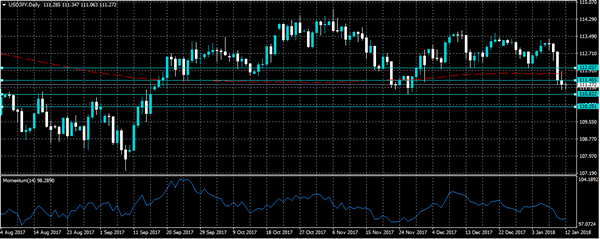
The U.S dollar continues to move lower against the Japanese Yen, with the pair again weakening back towards the 111.00 handle. Overall Japanese yen strength and a weakening U.S dollar index are weighing on the USDJPY pair on Friday, following the release of negative U.S PPI figures for the month of December. Price-action currently holds around the 111.20 region, with USDJPY traders now focused on the release of December CPI inflation data from the United States economy later today.
USDJPY sellers retain control of the pair while price trades below the 111.45 level, further intraday losses towards the 110.82 and 110.25 levels remains possible.
Should the USDJPY pair start to move above the 111.45 level, price-action may start to head towards the 111.78 and 112.03 levels.