

Sample Category Title
Pound Gains Ground As US Inflation, Jobless Claims Fall Short
The British pound has posted gains in the Thursday session, erasing the losses seen on Wednesday. In North American trade, GBP/USD is trading at 1.3549, up 0.30% on the day. In economic news, British Manufacturing Production slowed to 0.4% in November, down from 0.7% a month earlier. Still, this beat the estimate of 0.3%. Over in the US, Import Prices slowed to 0.1%, short of the estimate of 0.4%. On Thursday, the US releases PPI reports and unemployment claims.
The US dollar is under pressure, after a report on Wednesday that China was considering slowing or halting the purchase of US government bonds. China boasts the largest currency reserves, estimated at $3 trillion. It is also the biggest holder of US government bonds, in the amount of $1.19 trillion. Why would China make this move? One reason is that it may consider US treasuries less attractive compared to other assets. As well, it could be part of China’s strategy to flex some muscle as a possible trade war looms between the US and China, which are the two largest economies in the world. The report has pushed US Treasury yields higher and sent the US dollar downwards.
What can we expect from the Bank of England in early 2018? The BoE raised rates in November for the first time in 10 years, but maintained rates at the December meeting. With serious concerns about how Brexit will affect the economy, the BoE will be hesitant to raise rates, even with inflation higher than the Bank’s target of 2%. The BoE holds its next policy meeting in February, and policymakers are not expected to raise rates at that time.
Brexit negotiations have been difficult and progress has been slow, as Europe is not keen on rewarding Britain for departing the European Union. There are serious divisions within the British government with regard to the talks. and May has to walk carefully, as she has a razor thin majority in parliament, Prime Minister May can ill afford any mistakes, and if her government runs into trouble, she may be forced to call elections, which could shake up the markets and send the pound downwards. The public is almost evenly split on whether Brexit is a good idea, and there are serious concerns that the British economy will take a hit, even if a deal is worked out before the March, 2019 deadline. The parties do not have a lot of time to hammer out a host of trade issues, and all indications are that the negotiations road will be bumpy and difficult. One card that Britain may hold is that the EU, which has been united so far in its position on Brexit, may see the unified front fall apart find that some countries try to cut favorable trade deals with Britain.
China Changes Renminbi Fixing Mechanism And Considers Buying Less US Treasury
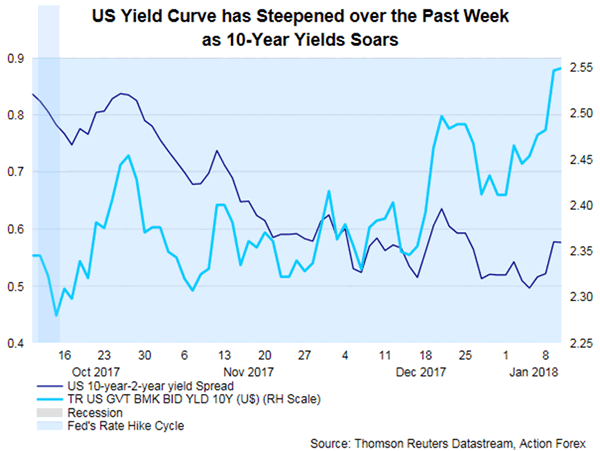
Two issues happened in China have roiled the market over the past two days. While the adjustment of renminbi fixing mechanism has resulted in a weaker currency, a news report citing an anonymous Chinese official as recommending to trim or halt purchases of US Treasuries has sent the longer-dated US Treasury (UST) yield higher, thus steepening the UST yield curve. While the former reveals that the Chinese government continues to actually intervene the FX market, putting its commitment to internationalize the currency in question, the latter is merely an act to maintain currency stability and a response as the US-China trade friction once again heats up.
Suspension of the Use of 'Countercyclical Factor' in Renminbi Fixing
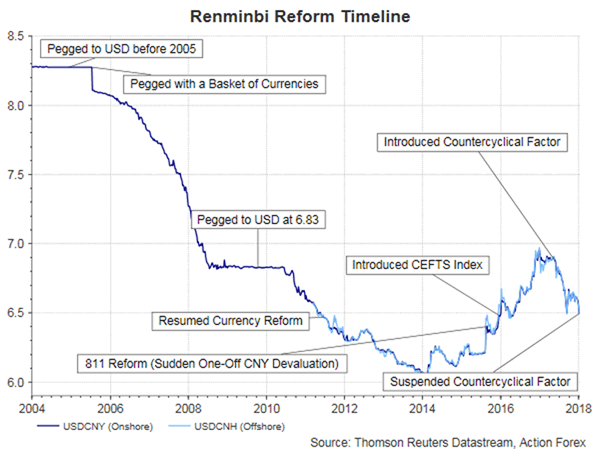
A new piece on Tuesday suggested that the Chinese government has abruptly suspended the use of 'countercyclical factor' in the renminbi fixing mechanism. The instant market reaction was weakness in the currency against US dollar. Recall that back in May 2017, the Chinese government introduced the countercyclical factor as one of the determinants, together with the previous day's close price of USDCNY and USD movement overnight against the CFETS basket, of the daily renminbi fixing rate. The government explained that use of the 'countercyclical factor' was to curb volatility. It is not coincidental that a new ingredient was added during the time when renminbi was staying at the lowest level in 9 years. Indeed, the 'countercyclical factor' is just another tool (besides stringent capital control and selling of FX reserve) for the authority to contain renminbi's depreciation.
Goldman Sachs' analysis revealed that a negative correlation of the 'countercyclical factor' and the previous intra-day price change. Moreover, the factor displayed 'asymmetric response' to the exchange rate: the countercyclical factor's offsetting reaction was bigger following renminbi depreciation in the previous day than following renminbi appreciation. This evidenced that the authority favored stronger renminbi at during the period. Removal of the 'countercyclical factor' in the fixing mechanism might signal that the government is not in favor of renminbi appreciation from the current level. Similar to other currencies, USD's weakness over the past weeks has lifted renminibi, sending the CNYUSD pair to the highest level since September 2017 on January 8. Removal of the 'countercyclical factor' suggests that renminbi movement would be more market-determined. However, it is the government's frequent and unpredictable change in its pricing mechanism that makes it difficult for renminbi to gain the status of a global currency
China to Trim Purchases of US Treasuries
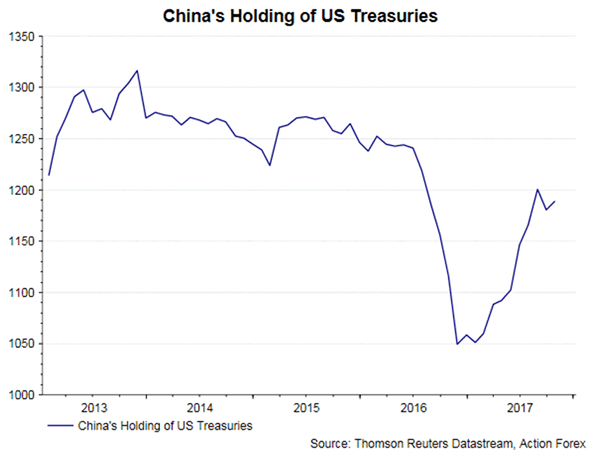
Another news report cited a senior Chinese official recommending to lower or stop purchases of US government bonds. This had sent 10-year yields to a 10-month high of 2.597% at one point before pullback. Undeniably, China is the biggest foreign creditor of US Treasury with a holding of US$ 1.19 trillion as of October 2017. However, China's calculus in terms of US Treasury purchases is on trade and currency stability. The chart below shows that China had been trimming US Treasury holding in 2016 during the time of massive selloff of renminibi It has resume buying 2017 but the pace accelerated in the mid-year as renminibi movement stabilized.
Yen Extends Gains As Investors Digest BoJ’s Announcement
The Japanese yen continued to strengthen significantly across the board and investors digested news about the potential tapering. On Tuesday, BoJ announced that it would reduce its bond purchases on the longer term 20 and 40 year bonds. This led the markets to react to the news as a form of tapering from the BoJ. Following through on the gains from Tuesday, the Japanese yen rose 1.07% on the day on Wednesday.
Economic data remained sparse with the exception of the manufacturing and industrial output data from the UK. According to the report from the ONS, UK's manufacturing output rose 0.4% on the month beating estimates of a 0.3% increase. Industrial output was also stronger, rising 0.4% on the month as expected. Construction output was weaker at 0.4%, missing estimates of a 0.7% increase.
Looking ahead, economic data will shift to the U.S. with the producer price index data expected to show a 0.2% increase on the headline and 0.2% increase on the core. FOMC Member, Dudley will be speaking later in the day.
Bitcoin Made 2018 Low | China Is The Banker & US Should Understand
Regulators are haunting cryptocurrencies
China says it is only diversifying its options
Tesco needs to have better suppliers
Bitcoin price made another low on Thursday for 2018, thanks to South Korea’s Justice Minister. It is another bad day for cryptocurrencies and once again the news which is hitting the cryptomarket is on the regulatory. According to South Korea’s Justice Minister, the country is busy in preparing a bill which will ban all cryptocurrencies trading. His stance towards digital currencies seems to be far-fetched given the market cap of South Korea’s cryptocurrency exchanges. Yes, the price of bitcoin in South Korea pride at a premium of around 30 percent and developments like today are designed to reduce that premium. We do think this is what the regulators are trying. Banning cryptocurrencies altogether would be difficult given that the country is one of the biggest market in the world especially for bitcoin and Ethereum.
It is important to keep in mind that this is not the first time that the regulators have gone after the cryptocurrency market. During this week alone, we have seen two headlines emerging from South Korea aimed at Bitcoin by using the regulatory tactic. There is no doubt that the demand for Bitcoin in South Korea is massive and some elements of the public behaviour (when it comes to trading the cryptocurrencies) aren’t far from gambling habits.
Nonetheless, traders should not read too much into the South Korean situation because even once the bill is drafted, it would require a backing of 297 members of the National Assembly, a process which could easily take months or even years.
China and US treasuries
‘China has reduced their purchase of US treasuries’ was the news which crashed the prices of the US Treasuries and pushed the dollar index lower yesterday. But the Chinese officials clearly labelled this as fake news and assured markets that China is only diversifying its options. We do know that China is the largest buyer of the US Treasuries, and if there is any reduction in the Chinese appetite for the US Treasuries, it would have serious consequences for the global markets.
In 2018, the US is looking to boost its debt supply significantly and without the Chinese demand for the US Treasuries, the situation would have a different outcome. The US extending its hand of friendship towards Taiwan does make the situation more arduous (China and Taiwan are old rivals). Therefore, the underlying message should not be neglected; the US should tread very carefully. China is currently holding 1.2 trillions of US debt and it has the ability and power to jolt the US markets. President Trump should think more seriously towards the Chinese trade surplus situation. Every action would have its consequences, whether it is geared towards how China is dealing with a North Korean nuclear crisis or something else. China is certainly not tied under any agreement to buy US bonds and the message is clear that there are other debts which the country can always look to buy.
Tesco Disappoints
Christmas sale was disappointing, that is the message from the U.K.’s biggest grocery retailer, Tesco. Weeks leading up to Christmas were the most important ones and the firm had a major problem with its supplier, Palmer and Harvey. The company did experience a 1.9 percent rise in like for like sales (3Q LFL sale; Act, 2.3%, Est, 2.4%). However, looking at competitors such as Sainsbury and Morrison, both have beaten their forecast for Christmas trading. This doesn’t put Tesco in a strong position at all. The retailer which dominates the British High Street needs to make sure that it keeps its tools sharp to fight inflationary pressure by keeping the prices low. There is no doubt that Tesco has turned the corner and avoided a Debenhams style disaster but it needs to make sure that it stays on track to deliver on its medium-term ambition. This is mainly because the competition is fierce in this space and discounters such as Lidl and Aldi have performed extremely well. Lidl’s Christmas sales increased by 16% and Aldi saw 15%.
USDJPY Sees Near Term Risk Skewed To The Downside
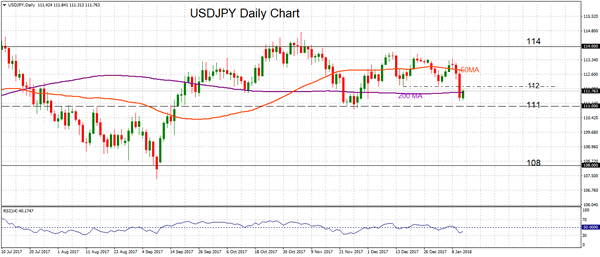
USDJPY has turned more bearish in the near term after the break below the key 112 level and 200-day moving average yesterday to reach its lowest level in six weeks. Momentum is weak and the daily RSI is indicating a bearish bias after dipping below 50. Risk remains skewed to the downside until prices make a sustained move back above 112.
USDJPY is making a modest bounce in early trading today but there is scope for further weakness if there is a rejection at the 112 level, which is now seen as firm resistance. However, further downside may be limited as long as support holds at the key 111 level. A deeper decline would see prices target 108.
Since late September the pair has been trading in a range mostly between 111 and 114. In the bigger picture, the market does not have any clear direction and this lack of trend is indicated by the horizontal 50-day and 200-day moving averages. This could change if USDJPY breaks below 111 in the next few sessions.
Forex Analysis: Markets Move On China News
During yesterday's trading session headlines broke that China would reduce or halt its purchase of US Treasuries. This set off moves in Currencies, Commodities, Bonds and Stock. Gold reached a high of 1327.5, the US 10-Year got to a high of 2.59%, SPX 500 fell to 2736.50, while USDJPY fell to 111.285. GBPUSD jumped up to 1.35617, EURUSD rose to 1.20176, while even pairs that would seem to be unaffected by such a move, like EURGBP, rose to 0.88720. Overnight a Chinese government source corrected the situation by saying the report could have been based on wrong information. The source said that ‘China has been diversifying its FX reserves investments, and China's investments in US Treasuries is market-driven.' Much of the moves following the initial headline have been reversed or partially reversed, with the US 10-Year, for example, now at 2.531%.
UK Industrial Production (MoM) (Nov) was released with the number coming in at 0.4% v an expected reading of 0.3%, from a prior of 0.0% that was revised to 0.3%. Industrial Production (YoY) (Nov) was 2.5% v a consensus reading of 1.8%, with a prior of 3.6% that was revised up to 4.3%. Manufacturing Production (MoM) (Nov) was 0.4% v an expected 0.3%, with a previous reading of 0.1% that was revised up to 0.3%. Manufacturing Production (YoY) (Nov) was 3.5% v an expected 2.8%, from a prior of 3.9% that was revised up to 4.7%. Traders of GBP pairs will be watching these data points closely. GBPUSD sold off to 1.34814 after this data was released.
UK NIESR GDP Estimate (3M) (Dec) data was released at 0.6% v 0.5% expected. The previous data came in at 0.5% but was revised up to 0.6%. GBPUSD moved higher after the data was published, rising to 1.35391.
US 10-Year Note Auction. The rate was 2.59% from previous auction's interest rate of 2.384%. US FOMC Member Bullard spoke in St Louis, stating that the US economy looks good for 2018. The FED's inflation miss is starting to look persistent and he doesn't believe there is a high chance of a US recession.
EURUSD is down -0.09% overnight, trading around 1.19380.
USDJPY is up 0.38% in early session trading at around 111.847.
GBPUSD is down -0.10% to trade around 1.34905.
USDCAD is up 0.05%, trading around 1.25511.
Gold is up 0.10% in early morning trading at around $1,317.90.
WTI is down -0.06%, trading around $63.37.
Major data releases for today:
At 09:30 GMT, UK BOE Credit Conditions Survey will be released. GBP pairs will be influenced by this data point.
At 10:00 GMT, Eurozone Industrial Production w.d.a. (YoY) (Nov) will be released, with the consensus pointing to a value of 3.0%, from a prior of 3.7%. Industrial Production s.a. (MoM) (Nov) is expected at 0.8% from 0.2% previously. The EUR may be moved by this data.
At 12:30 GMT, Eurozone ECB Monetary Policy Meeting Accounts will be published. EUR crosses could react to this data.
At 13:30 GMT, US Continuing Jobless Claims (Dec 29) is expected at 1.915M, from a previous number of 1.914M. Initial Jobless Claims (Jan 5) is expected to come in at 245K, from a prior reading of 250K. USD crosses could see increased volatility around this data release.
At 19:00 GMT, US Monthly Budget Statement (Dec) which came in previously at $-139B.
At 20:30 GMT, US FED's William Dudley will be speaking at the Securities Industry and Financial Markets Association in New York. The speech may affect USD crosses, stocks, commodities and bonds.
At 21:45 GMT, New Zealand Building Permits s.a. (MoM) (Nov) will be released. The previous reading was -9.6%. NZD pairs could be moved by this data.
At 23:50 GMT, Japanese Foreign Investment in Japan stocks (Jan 5) will be released, with a previous number of ¥76.2B. Foreign Bond Investment (Jan 5) will also be released, with a prior number of ¥434.2B.
Currencies: Dollar Rebounds As Chinese Rumours On US Treasuries Are Dismissed
Sunrise Market Commentary
- Rates: Fake news causes volatility
'Fake news' caused quite some volatility in the US Note future yesterday. All intraday losses were eventually whipped out following a strong 10-yr Note auction and as Chinese officials denied rumours about halting/stopping buying US T's. Today's focus turns to US producer prices and German wage negotiations. Positive outcomes have most market-moving potential. - Currencies: Dollar rebounds as Chinese rumours on US Treasuries are dismissed
The dollar came temporary under pressure yesterday on headlines that China was considering holding less US Treasuries. The dollar regains ground this morning as the headlines were dismissed by Chinese officials. Today's focus for USD trading is on US PPI data. Strong price data might propel US yields and the dollar.
The Sunrise Headlines
- US stock markets partially recovered from a difficult start yesterday, ending with (tiny) losses for the first time this year. Asian bourses lose slightly ground as well overnight with Japan underperforming (-0.5%).
- The China State Administration of Foreign Exchange says a media report on China's purchase of US treasuries might have quoted a 'wrong source', or it might be 'fake news', according to a statement on the administration's website.
- Australian November retail sales rose by 1.2% M/M (Black Friday), significantly beating 0.4% M/M consensus and printing at the strongest level since 2013. The Aussie dollar profited, pushing AUD/USD to the highest level since October.
- Polish interest rates will 'probably' stay at current level by end of this year, central bank Governor Glapinski said. He doesn't expect any discussion on rate increase within MPC rate-setting panel and such situation may extend for 2019.
- China's Premier Li Keqiang said the world's second-biggest economy is expected to have grown around 6.9% last year, the official Xinhua news agency reported, accelerating from a 26-year low in 2016 (6.7%).
- Both the White House and Canadian officials shot down a report that Canada is increasingly convinced that President Donald Trump will shortly announce the US is pulling out of Nafta. The loonie and Mexican peso trimmed losses.
- Today's eco calendar contains US producer prices, weekly jobless claims, EMU industrial production and Minutes of the previous ECB meeting. Italy and the US tap the market. NY Fed Dudley speaks on the US economic outlook
Currencies: Dollar Rebounds As Chinese Rumours On US Treasuries Are Dismissed
Modest USD damage from Chinese headlines
Markets were spooked by headlines that China considered holding less US Treasuries. Treasuries, equities and the USD were sold even as interest rate differentials widened in favour of USD. Investors feared that China could reduce the USD share in its reserves. The story initially weighed also on US markets but Treasuries, equities and the dollar rebounded off the intraday lows. EUR/USD spiked temporary above 1.20, but closed the day at 1.1948. USD/JPY remained in the defensive and finished the day with a substantial losses at 114.44.
Overnight, Asian markets remain in a modest risk-off modus, but trading still develops orderly. Chinese officials indicated that yesterday's headlines ‘might have cited wrong sources or may be fake news', easing tensions further. Especially USD/JPY (currently 111.80) regains part of yesterday's decline. EUR/USD hovers in the mid 1.19 area. The Aussie dollar (AUD/USD 0.7875) profits from strong domestic retail sales. The Canadian dollar (USD/CAD 1.2550) stays in the defensive even if comments from Canadian officials that president Trump might leave NAFTA were afterwards also denied/labelled 'fake news'.
EMU production data and the Minutes of the ECB December meeting will be published today. Markets will look for ‘alternative views' on the soft policy approach of president Draghi. US PPI data might get more attention than usual as markets are growing more sensitive to indications of higher inflation. Headline PPI is expected at 0.2% M/M and 3.0% Y/Y (from 3.1%). An upward surprise might be slightly USD supportive, but tomorrow's CPI is more important. Yesterday, the USD was temporary hit by the China headlines but USD/EUR stayed resilient. The USD/JPY sell-off slows this morning. EUR/USD reversed most of yesterday's up-tick. So, the day-today momentum looks not too bad for the dollar. The topside in EUR/USD remains probably rather well protected and a sustained break beyond 1.2092 is not evident unless US price data really undershoot expectations
Yesterday, sterling trading was mainly driven by the moves in EUR and USD. EUR/GBP rose in line with EUR/USD. Some sterling softness was also at work, probably as markets were disappointed by the government reshuffle. There are no important UK data today. UK Fin Min Hammond and Brexit minister Davis tried to seek common ground with Germany on a Brexit deal. There are no indications of a big step forward. We keep a neutral bias on EUR/GBP short-term. We keep a EUR/GBP buy-on-dips in case of return action to 0.87.
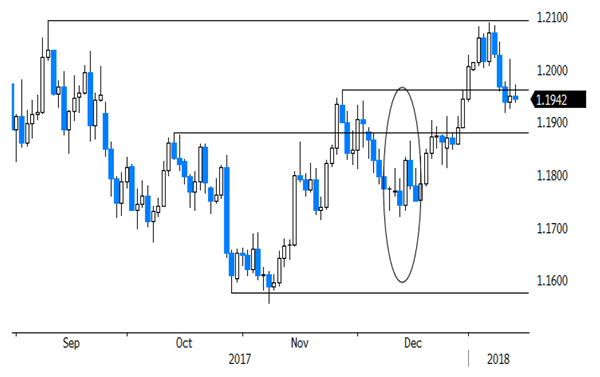
EUR/USD stays off range top despite Chinese comments
Fixed Income Markets To Dominate FX & Equities Moves
The outstanding performance for equities which sent many major indices to record highs may have just paused.
Asian stocks were trading broadly lower on Thursday after Wall Street notched its first daily decline in 2018. It was neither economic data nor earnings thatprompted the declines, but rather the selloff in U.S. Treasuries which sent 10-year yields to a 10-month high. The jump in government yields was triggered by reports that China is recommending slowing or haltingthe accumulation of Treasuries. Although China has reduced U.S. debt holding in the past, we haven’t seen an announcement of this nature. However, China’s foreign exchange regulator stated on Thursday that the report could be based on erroneous information.
So far, it seems that the news from China is politically driven and an indirect message to President Trump who iscontemplating trade sanctions against China as a response to the massivetrade deficit. Given that the U.S. is poised to boost its debt in 2018 to fund the deficit widened by tax reforms,the result of China selling off a considerable share of its Treasury holdings, would likely precipitate the beginning of a bond bear market.
Treasuries steadied in Asia trade and 10 year yields declined six basis points from highs of 2.60%. Whether we’ll see another test of this critical level will likely depend on tomorrow’s U.S. CPI report. If the data surprises to the upside, market participants will have to adjust their expectations of Fed tightening. Although interest rate projections have so far impacted only the short end of the yield curve, inflation expectations will drive the longerend, thus, the inflation report tomorrow should be of great importance.
With the Cboe’s VIX trading below 10, investors seem unfased about the spike in yields. However, another sharp spike in interest rates will bring equity valuations into question which may trigger a long-awaited correction in stocks.
Although higher long-term yields ought to be good news for the U.S. dollar, this is only true when they are moving for good reasons, such as economic expansion and the return of inflation. If news breaks that China slows or halts the purchase of Treasuries, expect the dollar to continue selling off, particularly against the Yen.
It’s a sad day for the Crypto world. Bitcoin, Ethereum, and Ripple all fell double digits on Thursday. After the Legendary investor Warren Buffett warned that cryptocurrencies would come to a bad ending, South Korea’s justice minister said the government was working on a bill to ban cryptocurrency trading. If the bill is passed by the country’s parliament, expect to see further selloff as more regulators are likely to join the clampdown on digital currencies.
ECB Has Had No Need To Change Its Position Just Yet
Market movers today
The ECB minutes from the December meeting are the highlight in the euro area this week. The meeting carried new staff projections and no batch of measures such as those at the October meeting. Hence, we intend to look primarily for nuances in the assessment of the new staff project ions (including 2020), in particular on inflation. Following the decisions taken at the October meeing, the ECB has had no need to change its position just yet . We expect the next change in guidance to come only towards the summer.
German GDP growth for the year 2017 is due to be released and expected at 2.3%. It would be the highest German growth since 2011.
Other data due today includes euro industrial product ion, US jobless claims and US PPI.
In Scandies, Sweden will release average house prices (SCB).
Selected market news
Overnight , China's St at e Administration of Foreign Exchange (SAFE) dismissed the story that China may cut back on US Treasury buying, saying that it may have been due to wrong sources or ‘fake' news. Also out of China, Premier Listated that the economy grew 6.9% in 2017.
Anonymous Canadian government officials indicated yesterday that they see a rising possibility that US President Trump will withdraw the US from the North American Free Trade Agreement (NAFTA). CAD and MXN sold off temporarily on the news. A White House official later said t hat not hing has changed in US P resident Trump's stance on NAFT A. The next round of negotiat ions on NAFTA is set to start on 23 January.
The St . Louis Fed President James Bullard yesterday expressed sympathy for the idea of the Fed adopting price level targeting. In general terms, he advocates a policy that allows inflation to be above 2% for a period and further said that it would be appropriate for the Fed to focus on a single mandate of inflation. Dallas Fed Robert Kaplan supports a policy of three interest rate hikes this year, while also alerting that the Fed will not move so far as to invert the yield curve.
The weekly EIA inventory report posted a 5mb drop in US crude stocks – about half that seen in API data on Tuesday. In addition, the report showed that US crude product ion fell 290kb/d last week. Freezing US winter weather is likely to be an important reason for both the draw on stocks and the drop in output . On a separate note, speculation has started that OPEC may actively cap further price increases with the price on Brent nearing the USD70/bbl mark.
Australia’s Retail Sales Surged By The Most Since 2013 In November
For the 24 hours to 23:00 GMT, the AUD rose 0.28% against the USD and closed at 0.7844.
LME Copper prices rose 0.7% or $48.5/MT to $7140.5/MT. Aluminium prices rose 0.7% or $15.5/MT to $2159.0/MT.
In the Asian session, at GMT0400, the pair is trading at 0.7871, with the AUD trading 0.34% higher against the USD from yesterday's close, following upbeat Australian retail sales numbers.
Data indicated that Australia's seasonally adjusted retail sales accelerated by the most in nearly 5 years, after it jumped 1.2% on a monthly basis in November, driven by a spree on iPhone purchases and Black Friday sales, stirring hopes that robust consumer spending would fuel the nation's economic growth. Retail sales had registered a gain of 0.5% in the prior month, while market had expected for a rise of 0.4%.
The pair is expected to find support at 0.7827, and a fall through could take it to the next support level of 0.7782. The pair is expected to find its first resistance at 0.7899, and a rise through could take it to the next resistance level of 0.7926.
The currency pair is showing convergence with its 20 Hr moving average and trading above its 50 Hr moving average.
