Sample Category Title
Euro-Zone’s Consumer Confidence Surged To Its Highest Level Since January 2001 In December
For the 24 hours to 23:00 GMT, the EUR marginally declined against the USD and closed at 1.1868, despite a jump in Euro-zone's consumer confidence index.
On the economic front, data showed that the flash consumer confidence index in the Euro-zone rose more-than-expected to a level of 0.5 in December, notching its highest level in 17 years, suggesting that consumers continued to enjoy a strong period of economic performance across the common currency region. The index had registered a revised level of 0.0 in the previous month, while markets had expected for an advance to a level of 0.2.
Macroeconomic data released in the US indicated that the final annualised gross domestic product (GDP) was revised lower to 3.2% on a quarterly basis in the third quarter of 2017, amid a slight weakness in consumer spending. Meanwhile the preliminary figures had indicated an advance of 3.3%. Nevertheless, it was the strongest reading in nearly three years. In the previous quarter, the nation's GDP had climbed 3.1%. On the contrary, the nation's initial jobless claims climbed to a level of 245.0K in the week ended 16 December, beating market consensus for a rise to a level of 233.0K and compared to a level of 225.0K in the prior week.
Other economic data revealed that the Philadelphia Fed manufacturing index unexpectedly advanced to a level of 26.2 in December, defying market expectations for a fall to a level of 21.0. The index had recorded a level of 22.7 in the previous month. Moreover, the nation's leading indicator increased 0.4% in November, after recording a rise of 1.2% in the previous month, while investors had envisaged for a gain of 0.4%.
In the Asian session, at GMT0400, the pair is trading at 1.1850, with the EUR trading 0.15% lower against the USD from yesterday's close, after Catalonian election results indicated a victory for separatists, thus threating to further escalate tensions between Barcelona and Madrid.
The pair is expected to find support at 1.1815, and a fall through could take it to the next support level of 1.1779. The pair is expected to find its first resistance at 1.1888, and a rise through could take it to the next resistance level of 1.1925.
Going ahead, market participants will draw their attention to the release of Germany's GfK consumer confidence index for January, scheduled to release in a few hours. Also, the US flash durable goods orders, new home sales, personal income and spending data, all for November along with the Michigan Consumer Sentiment Index for December, slated to release later in the day, would pique significant amount of investor attention.
The currency pair is trading below its 20 Hr and 50 Hr moving averages.

UK’s Lloyds Business Confidence Jumped To A 5-Month High Level In December
For the 24 hours to 23:00 GMT, the GBP rose 0.08% against the USD and closed at 1.3384.
On the economic front, UK's public sector net borrowing posted a less-than-expected deficit of £8.1 billion in November, following a revised deficit of £7.2 billion in the previous month. Market participants had anticipated public sector net borrowing to post a deficit of £8.3 billion.
In the Asian session, at GMT0400, the pair is trading at 1.3380, with the GBP trading slightly lower against the USD from yesterday's close.
Data released overnight showed that the Lloyds business barometer increased to a level of 28.0 in December, surging to its highest level since July 2017, compared to a reading of 24.0 in the prior month.
The pair is expected to find support at 1.3345, and a fall through could take it to the next support level of 1.3311. The pair is expected to find its first resistance at 1.3401, and a rise through could take it to the next resistance level of 1.3423.
Looking forward, UK's final 3Q GDP numbers, due to release in a few hours, will attract significant amount of market attention.
The currency pair is trading above its 20 Hr moving average and showing convergence with its 50 Hr moving average.

Oil Trading Marginally Higher In The Asian Session
For the 24 hours to 23:00 GMT, the USD traded flat against the JPY and closed at 113.35.
Yesterday, the Bank of Japan (BoJ) Governor, Haruhiko Kuroda, played-down hopes of a near-term monetary policy tightening, stating that the central bank would continue to hold onto its easing measures to achieve its 2.0% inflation target, despite signs of improving economy.
In the Asian session, at GMT0400, the pair is trading at 113.33, with the USD trading a tad lower against the JPY from yesterday’s close.
The pair is expected to find support at 113.19, and a fall through could take it to the next support level of 113.04. The pair is expected to find its first resistance at 113.56, and a rise through could take it to the next resistance level of 113.78.
Next week, market participants would look forward to minutes of the Bank of Japan’s (BoJ) October meeting along with the summary of opinions report from its December meeting, due next week. Also, Japan’s jobless rate and national consumer price inflation data, due to release next week, will be on investors’ radar.
The currency pair is trading below its 20 Hr moving average and showing convergence with its 50 Hr moving average.

Switzerland’s Trade Surplus Advanced In November
For the 24 hours to 23:00 GMT, the USD rose 0.2% against the CHF and closed at 0.9886.
Macroeconomic data indicated that trade surplus in Switzerland expanded to CHF2.63 billion in November, after recording a revised surplus of CHF2.45 billion in the previous month.
In the Asian session, at GMT0400, the pair is trading at 0.9887, with the USD trading slightly higher against the CHF from yesterday's close.
The pair is expected to find support at 0.9858, and a fall through could take it to the next support level of 0.9829. The pair is expected to find its first resistance at 0.9913, and a rise through could take it to the next resistance level of 0.9939.
Ahead in the day, all eyes would be on Switzerland's KOF leading indicator for December.
The currency pair is showing convergence with its 20 Hr moving average and trading above its 50 Hr moving average.

Canada’s Annual Inflation Surged To Its Highest Level Since January 2017 In November
For the 24 hours to 23:00 GMT, the USD declined 0.76% against the CAD and closed at 1.2738.
The Canadian Dollar gained ground against the USD, following a pair of upbeat Canadian economic reports.
Data showed that Canada's consumer price index (CPI) jumped more-than-expected by 2.1% on a yearly basis in November, rising by the most in ten months and led by an increase in gasoline and food prices. In the prior month, the CPI had advanced 1.4%, while market participants had envisaged for a gain of 2.0%.
Additionally, the nation's retail sales grew at its fastest pace in nine months, after it climbed 1.5% on a monthly basis in October, thus offering evidence of strength in the nation's consumer spending. Investors had anticipated retail sales to rise 0.3%, after recording a revised advance of 0.2% in the previous month.
In the Asian session, at GMT0400, the pair is trading at 1.2742, with the USD trading marginally higher against the CAD from yesterday's close.
The pair is expected to find support at 1.2682, and a fall through could take it to the next support level of 1.2621. The pair is expected to find its first resistance at 1.2821, and a rise through could take it to the next resistance level of 1.2899.
Trading trend in the CAD today is expected to be determined by the release of crucial Canadian gross domestic product (GDP) report for October, due later in the day.
The currency pair is trading below its 20 Hr and 50 Hr moving averages.

Market Morning Briefing: Dollar-Yen Tested Resistance
STOCKS
Going into the holiday mood from next week, equities may remain quiet without much movement. Some range-trade looks likely near current levels.
Dow (24782.29, +0.23%) is trading below 25000 and could remain sideways today, with narrow movement in the 25000-24600 region. As mentioned yesterday there could be scope on the downside towards 24400 before the index starts to rise towards 25200.
Dax (13109.74, +0.31%) has bounced a bit from support at 13000. In case that holds in the medium term, we could see a rise back to levels near 13400.
Nikkei (22860.18, -0.03%) is trading within the channel up trend within 23200-22400 region as visible on the daily charts. Narrow trade is likely to continue in the near term. Unless a break on either side is seen, it is difficult to predict any sharp movement just now.
Shanghai (3302.25, +0.09%) is trading sideways and is likely to continue its trade within 3320-3260 region in the early next week too.
Nifty (10440.30, -0.04%) and Sensex (33756.28, -0.06%) are almost stable near current levels and could attempt a short term fall in the next few sessions. Near term looks weak.
COMMODITIES
Gold (1265.90) tested 1270 yesterday and may not breach 1280 in the near term. Rather a rejection from current levels is possible taking the price back towards 1260 or slightly lower.
Brent (64.720) and WTI (58.15) are stable just now. Brent could move up towards 65-68 levels while a breach of 59 resistance on WTI could initiate some bullishness for the longer term.
Copper (3.1960) is stable near current levels. A test of earlier high of 3.25 is possible from where a short dip could be seen.
FOREX
We have been seeing little movement in the Dollar-Index (93.408) for the past 2 days. It saw a high of 93.5 achieved yesterday, while today it reached 93.56; however it has been trading around 93.3-93.4 for the greater part of the day. It is likely to decline towards 93 and then towards 92.5 (support on weekly line chart) by early next month.
Euro (1.1848) had seen a high of 1.19 day before yesterday and has been trading in the 1.185-1.19 range after that. It did reach a low of 1.1817 today but has currently been pulled back up to near 1.185. It is likely that after seeing minimal movement during the holiday season, it will again test resistance near 1.19 and in case of a breach of the same, attempt to move towards 1.25, seen as medium term resistance on weekly line charts.
Dollar-Yen (113.31) tested resistance (113.5) on daily candles and daily line charts yesterday, reaching a high of 113.64, but dipped to close at 113.32, where it is currently trading. US-Japan yield spread is increasing (2.423 currently) and till the time it rises towards 2.45, we could see Dollar-Yen stay ranged between 113 to 113.5. However, with a dip in the yield spread and with likely weakness in the Dollar next month, we could see Dollar Yen move down towards support near 112.3-112.5 on daily candles.
Pound (1.3380) saw a low of 1.3332 yesterday, testing support near 1.334-1.335, but has mostly been trading around 1.337-1.338. We can expect rangewise movement between 1.335 – 1.345 to continue next week as well.
Aussie (0.7716) after having tested support on weekly line charts around 0.75 in the first 10 days of the month, is now gaining strength and is slowly approaching 0.7792 (near the current 21 day moving average). With expected Dollar weakness, we could see Aussie attempt 0.78-0.79 next month post which there could be some sideways oscillation before resuming a possible upmove towards 0.80.
Rupee (64.0575) looks likely to move between 64 and 64.20 till there is no decisive movement in the Euro past 1.19 or below 1.17. A rise in the Nifty towards 10550-10600 is also likely to play a major role in taking Rupee below 64.
INTEREST RATES
Immediate resistances on the US yields seem to be holding well. The yields have come off a bit and could continue its downward correction in the coming sessions. The 10YR (2.49%) is down from 2.50% as expected while the 30YR (2.84%), came off from 2.88% instead of moving higher towards 3%. The 10YR could move down to 2.45% while the 30YR may come off to test 2.80%.
The US-Japan 10YR yield spread (2.43%) is up by 1bps and could head higher towards previous highs of 2.53% seen in Mar’17.
The German-Us 10Yr (-2.07%) could face resistance just above current levels and come off towards -2.10% or lower in the coming week.
And Just When You Thought It Was Safe To Head For Airport
And just when you thought it was safe to head for Airport
The Euro trades lower by 0.5% amid Germany's Sigmar Gabriel reportedly warning of minority government -, this will weigh on short-term EUR sentiment even more so coming on the heels of the Catalan surprise.But as we ‘ve seen so often in the past, EU political risk makes for attractive opportunity to buy Euro, but it usually occurs Monday morning not entering an extended holiday break with the market long EUR . None the less dips are being bought.
Overnight
The sell-off in global bond markets has paused for a sanity check overnight with ten year UST holding steadily at 2.48%. Q3 GDP growth was revised a whiff lower, and the overall markets inflexion is still very much favourable supported by the Philadelphia Fed's Manufacturing Business Outlook Survey which jumped to a reading of 26.2 in December
U.S. stocks resumed their rally as the US Treasury sell-off was held in check overnight and energy stocks underpinned primary index. A positive glean from US economic data and the house passing the stopgap funding bill, although just kicking the can down the road to January 19, added to investors confidence.
Pro-independence parties in Catalonia were on track to win an absolute majority of seats in regional elections on Thursday, which would deal a significant blow Spanish prime minister Mariano Rajoy that could potentially escalate, but so far ther is still no EUR response from Catalan curiosity.
Although APAC traders are all but done for the year. There's still a buzz on NY desk heading into tomorrows PCE data. Mind you the Global FX markets laboured overnight to find any enthusiasm.
CNBC also reports Larry Lindsey is in the running for Fed Vice Chair. Interesting enough Lindsey is famous identifying the emergence of the US. stock market bubble back in 1996 while a Governor of the Federal Reserve, Hopefully for stock investors this is not a foreshadowing of things to come
G-10
The Japanese Yen
The BoJ and subsequent dollar trade played out in the queue as expected
As widely expected, the BoJ left policy unchanged at today's board meeting, keeping targets for the short-term rate and 10yr JGB yield at -0.1% and when Kuroda, as expected, played down the ” reversal rate. All in all a predictable bounce on the dollar which as then retraced through the course of London and NY trade
Australian and New Zealand Dollars
We've had a lot of interest for the Antipodeans after the robust GDP data out of New Zealand.
Given the slow unwind of political risk after Adrian Orr was appointed the new Reserve Bank governor last week, the Kiwi is better positioned to benefit from stronger domestic economic data.and firmer dairy prices
Commodity vs Aussie correlation is leading the charge into year end.
Given what's expected to be a dovish Fed in 2018 there been far too much energy sapped paying too much attention to the dwindling differential trade as that only comprises one component in the 3 ‘C's for trading the Aussie (Carry, Commodities and China)
Commodities are ending the year on a strong note with Oil prices firming while Copper is back at the highs for the year.
And while China economy could moderate next year as policies designed to reduce leverage unhurriedly unfold. And sure deleveraging could lead to a drop in overall domestic investment, prudent monetary policies and greater liberalisation of mainland markets will be viewed favourably by international investors which should keep China's economic engine well oiled in 2018.
Asia Fx
The Yuan
CNH has remained very active on retail and interbank trading platforms this past week. Driven in part by long dollar position unwind.But the expectations of more prudent monetary policy from the Pboc and the anticipation of strong investment inflows in 2018 have the Yuan basking in the limelight at year end
Undoubtedly last weeks boost on both repo and MLF interest rates highlights the dogged determination of regulators to continue with a deleveraging campaign causing interest rates to move higher and luring bond investors in for the carry. Indeed, the Chase for Asia next big trade in 2018 has started earlier than expected
The Malaysian Ringgit
With global bond yields held in check overnight and firmer oil prices, it should bode well for the Ringgit as we close out this subdued trading week for the local note. Investors, however, continue to tread lightly in riskier assets.But given the improving domestic and external landscape not to mention a likely interest rate hike from the BNM in early 2018. Malaysia's ringgit is emerging as one of Asia's most-promising currencies entering 2018
Friday Morning Market Musings
Trading FX in 2018
I've been fielding a lot of question from clients on the shifting dollar narratives this. Identifying dollar trends will be a bit trickier next year as we're already witnessing idiosyncratic storyline emerge, not only in Asia EM but G-10 and traditionally correlations may start to diverge. Some G-10 bankers will begin the arduous process of policy normalisation, but given that each country could have a different response to changes in their domestic inflation narrative, unquestionably trading will be a bit more complicated and relying on just a broader US dollar narrative could provide false clues.
Bond curve Bear Steepener
I don't agree with the view that the Bond Curve is a reaction to the prospects of a stronger US economy although that seemed to be a prevailing narrative. But looking at Global Bond markets as a whole and in particular EU and US. I surmise the sell-off is more a function of anticipated supply.
IN the EU reports continue to circulate Germany will flood the market with Ultra Long Term Dept which is driving long yields higher.
In the US I think we're about to enter the long-awaited reality check.First Tax Cuts, now keeping the government lights on and then pivoting to an infrastructure Bill? While infrastructure bill could struggle given, there could be midterm election swings based on Trumps poor showing in the polls, but the bottom line is who is going to pay for all this ?? The US will issue a massive amount of debt to fund these bills and could lead to a further steeper as ten-year yields could widen to 3% in early 2018.But the bear steepener is not based on an expected higher rate of policy normalisation from the Fed
Gold Inches Higher As GDP Within Expectations
Gold continues to creep higher, and has pushed to a 2-week high in the Thursday session. In North American trade, the spot price for an ounce of gold is $1267.04, up 0.12% on the day. On the release front, Final GDP looked sharp in the third quarter, as the gain of 3.2% was just shy of the estimate of 3.3%. Elsewhere, the Philly Fed Manufacturing Index jumped to 26.2, above the forecast of 21.5 points. However, unemployment claims disappointed, climbing to 245 thousand. This was much higher than the estimate of 232 thousand. On Friday, there are three key events in the US – Core Durable Goods, New Home Sales and UoM Consumer Sentiment.
Tax reform was a major theme for President Trump during the election campaign. Just one year in office, Trump and fellow Republicans are celebrating passage of their landmark tax reform legislation, marking Trump’s first major legislative victory in office. On Wednesday, the House of Representatives voted to pass the tax reform bill, after it narrowly passed in the Senate, by a vote of 51-48. Trump is expected to sign the bill into law next week. The tax legislation marks the first major overhaul of the US tax code in 30 years, and reduces corporate taxes from 35% to 21%. After failing to overturn Obamacare, the Republicans finally scored a big win. The Republicans have promised significant tax relief to the middle class, but polls show that the American public remains skeptical. With congressional elections next November, tax reform promises to be a key issue, and could determine which party will control Congress in 2018.
With the US economy posting growth above 3% for another quarter, the Federal Reserve remains on track for another rate hike in January. The CME Group has pegged the odds of a January hike at 98%, and if the economy continues its current pace, the Fed could raise rates up to four times in 2018. Inflation remains a sore point, as the Fed target of 2.0% remains well out of reach. Fed Chair Janet Yellen and other FOMC members have said they expect that the strong labor market will lead to higher inflation, but the Fed has demonstrated that it is willing to press ahead with rate hikes despite low inflation.
Pound Remains Quiet, US GDP Shows Strong Expansion
The British pound continues to have a quiet week and is showing little movement in the Thursday session. In North American trade, GBP/USD is trading at 1.3367, down 0.06% on the day. On the release front, British Public Sector Net Borrowing increased to GBP 8.1 billion, below the estimate of GBP 8.3 billion. In the US, Final GDP looked sharp in the third quarter, as the gain of 3.2% was just shy of the estimate of 3.3%. Other US data was a mix. The Philly Fed Manufacturing Index jumped to 26.2, above the forecast of 21.5 points. Unemployment Claims disappointed, climbing to 245 thousand. This was much higher than the estimate of 232 thousand. Friday will be busy on both sides of the pond, so traders should be prepared for some movement from GBP/USD. The UK releases Current Account and Final GDP, while there are three key events in the US – Core Durable Goods, New Home Sales and UoM Consumer Sentiment.
Negotiations between the European Union and Britain over Brexit have been arduous from the start, but the talks are finally shifting to trade relations, as sufficient progress has been made on other issues, such as the size of Britain’s divorce bill and the Northern Ireland border. What will a trade relationship between Britain and the European Union look like? That remains unclear, but it’s no secret that the two sides have very different views of a future trade agreement. For example, will financial services be covered by a new trade deal? BoE Governor Mark Carney waded into the thorny issue on Wednesday, in testimony before a parliamentary committee. Carney took issue with comments by Michel Barnier, the EU’s senior negotiator. Barnier said Britain’s financial services would not be included in a Brexit deal, as no free trade agreements have included financial services. Carney disputed Barnier’s reasoning, saying that British financial system is “effectively the banker for Europe” and there was no reason why the UK and the EU couldn’t maintain some type of free trade in financial services. Clearly, the sides remain far apart on the “end phase” of what a Brexit agreement will look like, and both Britain and the EU will have to show some flexibility in order to hammer out an agreement by March 2019, when Britain leaves the club.
Tax reform was a major theme for President Trump during the election campaign. Just one year in office, Trump and fellow Republicans are celebrating passage of their landmark tax reform legislation, marking Trump’s first major legislative victory in office. On Wednesday, the House of Representatives voted to pass the tax reform bill, after it narrowly passed in the Senate, by a vote of 51-48. Trump is expected to sign the bill into law next week. The tax legislation marks the first major overhaul of the US tax code in 30 years, and reduces corporate taxes from 35% to 21%. After failing to overturn Obamacare, the Republicans finally scored a big win. The Republicans have promised significant tax relief to the middle class, but polls show that the American public remains skeptical. With congressional elections next November, tax reform promises to be a key issue, and could determine which party will control Congress in 2018.
US PCE Inflation Not Much of Worry for Dollar
The Fed expressed that it is planning to tighten monetary policy in the coming years even if inflation continues to undershoot its target. However, a surprising rise in the core PCE index on Friday might raise the odds of further rate hikes in the future and relief policymakers that the current monetary policy direction is the right one. This would also provide some support to the dollar.
The US could be facing symptoms of a broken Philips curve, this being the theory that explains the inverse relationship between the unemployment rate and inflation. Although the unemployment rate dropped to a 16-year low of 4.1% in November, below the Fed's long-term target of 4.6%, upward pressure on wage growth and consequently inflation remains subdued. Particularly, the annual core PCE index – the Fed's preferred measure of price growth – has been trending below the Fed's goal of 2.0% since 2012 and was last seen at 1.4% in October.
Now, analysts expect the gauge to inch up to 1.5% y/y in November. Yet, this might have a modest impact to the dollar as there is currently little room for uncertainty reduction given that the long-awaited tax reforms by the Trump administration intended to deliver massive tax cuts to businesses and individuals have passed Congress, while whether markets price in a third rate hike for 2018 (currently they have priced in slightly less than two), as the Fed projects, is more of an issue that will clear out next year rather than in the remaining few days of 2017. Recall that FOMC members have raised interest rates for the third time this year in December, reiterating that a tighter labor market would drive inflation towards the target in 2019.
But projections for stimulus reduction might alter after Jerome Powell, the next Fed chair replaces Janet Yellen in February and Trump fills four other empty board positions. Despite Powell signaling continuity in policy, the newcomers to join the board could step back and reconsider the current strategy on monetary policy.
Data on personal consumption and personal income are also due on Friday, with analysts projecting personal spending to grow by 0.5% m/m and personal income to stand flat at 0.4% m/m in November.
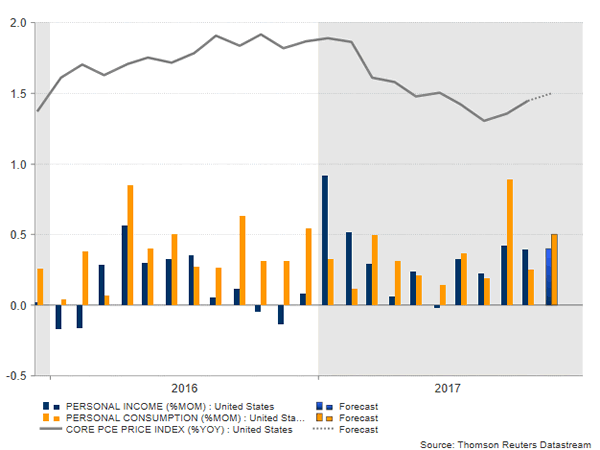
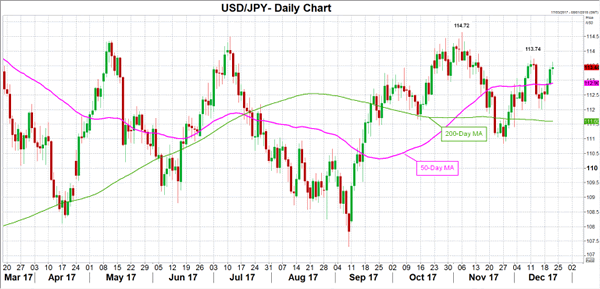
Looking at the forex markets, dollar/yen could climb to break the previous top at 113.74 if the PCE index surpasses forecasts, opening the scope for a re-test of the eight-month high of 114.72. In the adverse scenario though, worse-than-expected readings could pressure the pair down to meet the 50-day moving average at 112.90. Stepper declines could also find strong support at the 111-112 key area which has been repeatedly tested in the past.