Sample Category Title
Equities Soar , While The USD Looks For Its Mojo
Equities soar, while the USD looks for its Mojo
Equity markets have started the week in an extremely enthusiastic manner anticipating Tax Reform holiday cheer. The House will presumably hold a vote on the tax reform bill Tuesday afternoon, paving the way for the Senate to vote either Tuesday or Wednesday and the bill will finally land on President Trump's desk shortly after that.
Wall Street's S&P 500, Dow and Nasdaq all close at fresh records with Tech-laden index courting the 7,000 level for the first time but closed just below.
There's a definite buzz on the street as we approach the finishing line as there are few if signs of buyers fatigue. Senate leaders feel incredibly confident that the bill will pass, but hey, crazier things have happened.
The dollar is still looking for its mojo and despite the US yields rising and effervescent US equity market the dollar fell under some minor pressure perhaps reflecting the expected market tone in 2018. For the dollar to stage a significant rally, it's in desperate need of an inflation injection as at this moment, as markets remain overly sceptical that this tax reform bill will deliver a substantial bump to the US economy. But it's not only Forex Traders, Moody's also chimed in with a pessimistic long-term view.
Outside of the rangy year-end G-10 markets, the focus was on EM political development with both the South African Rand, and the Indian Rupee stealing the show.
The Rand was the best performer overnight as the street views Cyril Ramaphosa election enormously market friendly. But while the market remains in a state of euphoria, at some point, a sanity check will take place.The South African economy has enormous structural issues, so ultimately it will be the incoming reforms and economic policy that will eventually decide the market future direction. I suspect the market will position for an eventual correction.
The Rupee was taken for a wild ride yesterday as the market read far too much into the first headline story that the ruling party was in tight competition sending the market to 64.72 in a frenzied manner. But in the end, the BFP party claimed a victory of sorts but M Modi lost 14 seats to the main opposition parThe one-month NDF held steady trading ranges overnight as spot traded just above 64.20. But the 14 seat swing has left an element of political doubt in traders minds, and the Rupee rally could bottom out heading for year-end as dealers start to reduce positive election speculative wagers.
Fed Chatter
The Federal reserve boards opposite bookends were on the wires overnight. Minneapolis Federal Reserve President and noted dove, Neel Kashkari said low inflation, wage weakness and a flattening yield curve caused him to dissent at last week's vote.
His hawkish colleague, San Francisco Fed President John Williams, said: “We are operating on all cylinders which are, I think, a positive sign of the sustainability of the expansion.”
Oil prices
Oil gains back peddled after a last-minute resolution as the oil workers in Nigeria called off the strike, easing supply concerns.
Oil prices remain supported by Forties pipeline issues and with no definite timeline for the repairs to finish it will presumably underpin Brent in the near term. However, US production continues to ramp up. And with the IEA chiming in shale supply is expected to grow more than OPEC estimates, tomorrows inventory report is shaping up to be an all hands on deck event.
Overnight the US production worries won the day. WTI dropped from $57.65 to $56.80/b.. but Prices bounced to $57.15/b at the close on short covering.
The Euro
The Euro traded above 1.1800, but the move was tempered by Political noise which may rear its head at the end of the week, with the Catalonia election in Spain this Thursday. Polls are suggesting a tight race between the two opposing party views on independence.
The ECB will likely continue to subdue Euro topside moves, and for the Euro to take off it requires a hawkish ECB narrative that might not be forthcoming in early 2018.,
The Japanese Yen
Given the lack of action, overnight its hard not to think traders are looking to buy the rumour sell the fact on the tax bump. Too dull of trade in my view and time is probably better spent planning Xmas dinner.
The Australian Dollar
RBA minutes are kicking off the trading session in Singapore. After last week hawkish policy statement, the bar was set relatively high for a roaring followup in the minutes. The Aussie barely blinked as the RBA offered up little new
The Malaysian Ringgit
The market remains very quiet heading into year-end, but the optimistic side of global growth and resilient commodity prices should steer the MYR through year-end on an even keel.
Gold Improves To 10-Day High As Greenback Under Pressure
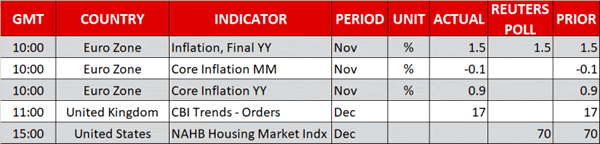
Gold has posted considerable gains at the start of the week. In Monday's North American session, the spot price for an ounce of gold is $1262.63, up 0.60% on the day. On the release front, the sole US event, the NAHB Housing Market Index, improved to 74, beating the forecast of 70 points. On Tuesday, the key indicator is Building Permits. We'll also get a look at Current Account and Housing Starts.
Gold prices remain high, but the metal could face some headwinds this week if Congress passes President Trump's tax reform bill. If this happens, it would mark Trump's first major legislative victory in office. Thanks to feverish efforts by Republican lawmakers, tax reform is quickly moving through Congress, with a final vote expected this week. The House and Senate have hammered out their differences, and the uniform bill, which must be approved in both houses, is expected to muster the necessary votes, even with all Democrat lawmakers expected to vote against the bill. Crucially, two Republican senators who were opposed to the bill have now lent their support to the bill. The legislation is the first major overhaul of the US tax code in 30 years, and is expected to strengthen the US economy.
The US economy continues to impress, but analysts remain stumped as to why strong growth and a red-hot labor market has not led to higher inflation. The labor market continues to operate at full capacity and various sectors in the economy are reporting a lack of workers. Still, this has not translated into stronger wage growth, despite predictions from Janet Yellen and other Fed policymakers that a lack of workers is bound to push up wages. The Fed appears ready to continue to jack up rates, despite the lack of inflation. The markets are preparing for another quarter-point increase next month, with the odds of a rate hike standing at 98%, according to the CME Group.
Pound Climbs To 1.34 As Manufacturing Orders Surge
The British pound has started the week with gains, after strong losses on Friday. In Monday’s North American trade, GBP/USD is trading at 1.3395, up 0.52% on the day. On the release front, British CBI Industrial Order Expectations remained unchanged at 17, beating the estimate of 14 points. There were no major events in the US. On Tuesday, the key event on the schedule is US Building Permits.
President Donald Trump appears on his way to claiming his first major legislative victory in office. Thanks to feverish efforts by Republican lawmakers, tax reform is quickly moving through Congress, with a final vote expected this week. The House and Senate have hammered out their differences, and the uniform bill, which must be approved in both houses, is expected to muster the necessary votes, even with all Democrats expected to vote against the bill. Crucially, two Republican senators who were opposed to the bill have now lent their support to the bill. The legislation is the first major overhaul of the US tax code in 30 years, and is expected to strengthen the US economy.
As expected, the Bank of England stayed pat and kept the benchmark interest rate at 0.50% late last week. The vote by MPC members was significant in that there were no dissenters, as all 9 policymakers were in agreement for the first time since February. BoE Governor Mark Carney will certainly be pleased with the unanimous vote, but could be on the hot seat as inflation continues to creep higher. CPI climbed to 3.1% in November, edging above the forecast of 3.0%. Inflation is now running at its highest level since March 2012, and Carney will have to write an open letter to open letter to the British finance minister, explaining how the BoE plans to lower inflation closer to the Bank’s target of 2.0%. Carney would rather not raise rates in the next few months, but that could be the most effective tool in bringing down inflation, which is at uncomfortably high levels.
Cross Currency Swaps In EURUSD
Note how the US dollar rebounded following the sell-off that was caused by last week's Federal Reserve announcement. The recent rise in the US currency against the euro and other currencies has been mainly attributed to end-of-year borrowing of US dollars by non-US financial institutions and banks. Their main aim has been shoring up their accounts for regulatory purposes. These are known as cross currency swaps. We take a look at these financial flows and whether they are likely to last beyond the usual 2-3 weeks.
What are cross currency swaps?
A cross-currency basis swap is a contract whereby two parties borrow/lend from/to each other an equivalent amount of money denominated in two different currencies for a predefined period of time. For example, party A would borrows EUR 100 mln from party B in return for USD 117 mln.
The interest rate payments made during the swap are usually made on a quarterly basis and are determined off the interbank market, such as LIBOR (London Interbank Overnight Rate).
At the end of the swap, the nominal amounts are repaid at face value, which means the sums are not impacted by foreign exchange rate.
What is the ‘basis' in cross-currency basis swaps?
Basis reflects the theory of interest rate parity shaping foreign exchange rates and interest rates. Interest rate parity theory states that the interest rate differential between holding two currencies over a stated of period of time, is covered by the difference between the spot and forward exchange rates over that same period of time.
When the theory stops working?
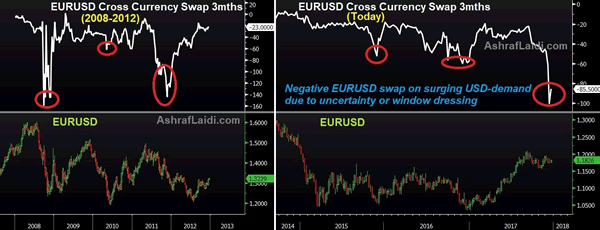
Does covered interest rate parity always works? No. And when it doesn't, that's where the 'basis' comes in. An example: if EURUSD forward exchange rate is 2.10% above the spot rate, and the differential between US and Euro interest rates is 2.95 percentage points, the difference is minus 84 basis points. In this case, the basis of -84 points represents the difference between the spot and forward exchange rates that is not covered by the interest rate differential between the two currencies. In this example of negative EURUSD basis, the European entity seeking to borrow in USD pays a premium of 84 basis points as a cost of USD demand.
Who needs cross currency swaps?
A European bank or company in need of US dollar liquidity at year-end may find it difficult in terms of costs and regulatory requirements to take out a USD loan from a US bank. Therefore, the European entity is more likely to use its contacts in Europe to borrow in euros before exchanging these into dollars with another entity that needs euros.
Why is the negative basis occurring now in EURUSD?
Cross currency basis borrowing generally occurs when demand for a certain currency emerges during economic or financial shocks. Surging demand for US dollars during the 2008 housing crisis and 2010 Eurozone crisis. But in the case of today, GDP growth in the Eurozone is at its strongest levels in over 5 years, banks are healthier and market volatility is low. The negative basis seen today in EURUSD is mainly a result of European entities rebalancing their deposits/reserves in order to either avoid the risk of holding excess of euros, or to hold more US dollars so as to meet regulatory requirements such as the upcoming MIFID II (Markets in Financial Instruments Directive part 2).
How long will it last?
In today's circumstances, the reasons to the negative basis in EURUSD are nothing more than shifting flows, rather than major fundamental developments related to the US, Eurozone or their respective central banks. Whether this process dissipates in late December or January, I stick with my forecast for EURUSD to find support $1.1680 before interest re-emerges forces it towards $1.23 early next quarter.
Trade Idea Wrap-up: USD/CHF – Stand aside
USD/CHF - 0.9868
Most recent candlesticks pattern : N/A
Trend : Near term up
Tenkan-Sen level : 0.9885
Kijun-Sen level : 0.9901
Ichimoku cloud top : 0.9895
Ichimoku cloud bottom : 0.9884
New strategy :
Stand aside
Position : -
Target : -
Stop : -
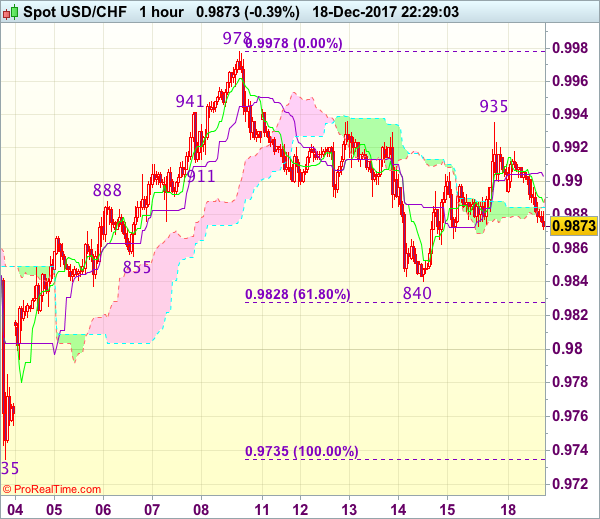
Despite rising to 0.9935, failure to extend such a rebound and the subsequent retreat dampened our bullishness and further consolidation is in store, initial downside risk is seen for weakness towards support at 0.9840, however, only break there would extend the fall from 0.9978 top to 0.9820-25, then 0.9800 which is likely to hold from here due to near term oversold condition.
In view of this, would not chase this fall here and stand aside in the meantime. Above 0.9900 would bring another test of said resistance at 0.9935-36, however, break of this level is needed to revive bullishness and signal the pullback from 0.9978 has ended at 0.9840, bring retest of this level later.
Trade Idea Wrap-up: GBP/USD – Hold short entered at 1.3390
GBP/USD - 1.3411
Most recent candlesticks pattern : N/A
Trend : Sideways
Tenkan-Sen level : 1.3377
Kijun-Sen level : 1.3361
Ichimoku cloud top : 1.3392
Ichimoku cloud bottom : 1.3383
Original strategy :
Sold at 1.3390, Target: 1.3290, Stop: 1.3425
Position : - Short at 1.3370
Target : - 1.3270
Stop : - 1.3425
New strategy :
Hold short entered at 1.3390, Target: 1.3290, Stop: 1.3425
Position : - Short at 1.3390
Target : - 1.3290
Stop : - 1.3425
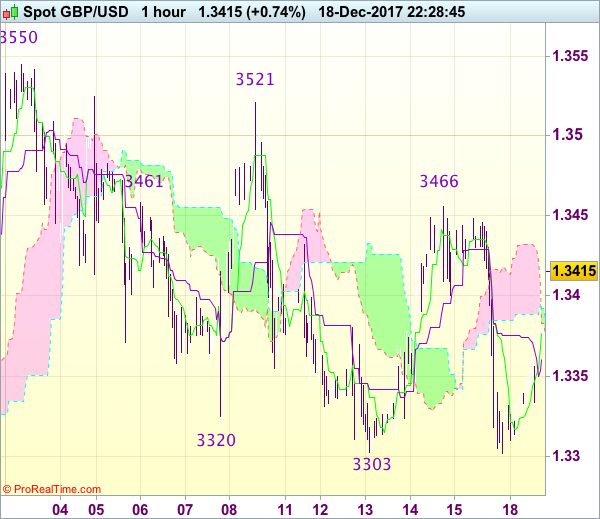
Although the British pound has staged a strong rebound today after marginal fall to 1.3302, reckon upside would be limited and mild downside bias remains for another decline, below 1.3360-65 would bring test of 1.3330-35 but break there is needed to signal the rebound from 1.3302 has ended, bring retest of this level, break there would extend recent decline from 1.3550 top to 1.3280, then towards 1.3250, however, still reckon previous support at 1.3221 would remain intact.
In view of this, we are holding on to our short position entered at 1.3390. Above 1.3420-25 would defer and risk rebound to 1.3445-50 but said resistance at 1.3466 should remain intact and bring another decline later.
Trade Idea Wrap-up: EUR/USD – Stand aside
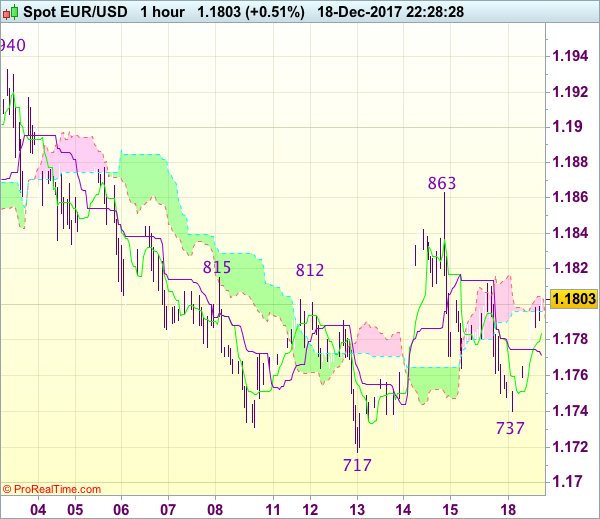
EUR/USD - 1.1807
Most recent candlesticks pattern : N/A
Trend : Near term down
Tenkan-Sen level : 1.1785
Kijun-Sen level : 1.1773
Ichimoku cloud top : 1.1804
Ichimoku cloud bottom : 1.1796
New strategy :
Stand aside
Position : -
Target : -
Stop : -
Despite intra-day initial fall to 1.1737, the subsequent rebound suggests further consolidation above last week’s low at 1.1717 would be seen and gain to 1.1815-20 cannot be ruled out, however, reckon upside would be limited to 1.1840-45 and price should falter below last week’s high at 1.1863, bring further choppy trading later. Only a break above this level would signal the rebound from 1.1717 is still in progress for further subsequent gain to 1.1880, then 1.1900 but price should falter well below resistance at 1.1940
On the downside, expect pullback to be limited to 1.1760 and said intra-day low at 1.1737 should hold, bring another rebound. A break of 1.1737 would bring retest of last week’s low at 1.1717 but break there is needed to confirm recent decline from 1.1961 top has resumed for weakness to 1.1695-00, then 1.1670-75. As near term outlook is mixed, would be prudent to stand aside for now.
Trade Idea Wrap-up: USD/JPY – Stand aside
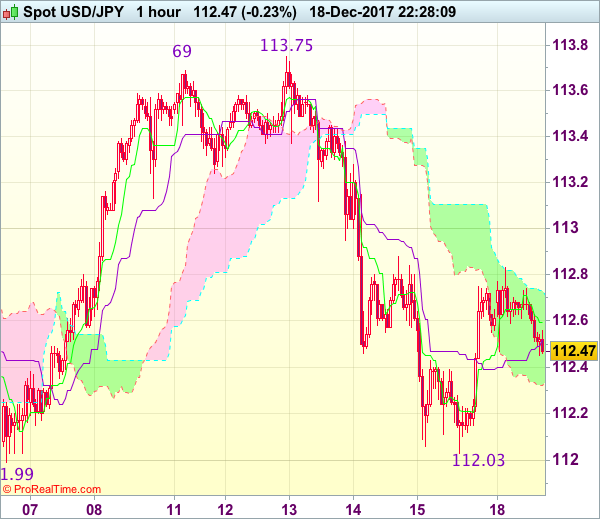
USD/JPY - 112.48
Most recent candlesticks pattern : N/A
Trend : Near term up
Tenkan-Sen level : 112.60
Kijun-Sen level : 112.52
Ichimoku cloud top : 112.73
Ichimoku cloud bottom : 112.32
New strategy :
Stand aside
Position : -
Target : -
Stop : -
As the greenback has staged a strong rebound after holding above indicated previous support at 111.99, suggesting consolidation above last week’s low at 112.03 would be seen and gain to resistance at 112.88 cannot be ruled out, however, reckon upside would be limited to 113.12 (previous support) and bring another decline later.
On the downside, expect pullback to be limited to the lower Kumo (now at 112.32) and bring another rebound later. A drop below 112.20 would bring another test of said support at 111.99-03 but break there is needed to retain bearishness and signal the rebound from 110.84 low has ended at 113.75, then the fall from there may extend weakness to 111.65-70 but reckon previous support at 111.41 would hold from here. As near term outlook is still mixed, would be prudent to stand aside for now.
Trade Idea: USD/CAD – Hold long entered at 1.2765
USD/CAD - 1.2879
Trend: Near term up
Original strategy :
Bought at 1.2765, Target: 1.2915, Stop: 1.2705
Position: - Long at 1.2765
Target: - 1.2915
Stop: - 1.2705
New strategy :
Hold long entered at 1.2765, Target: 1.2915, Stop: 1.2765
Position: - Long at 1.2765
Target: - 1.2915
Stop:- 1.2765
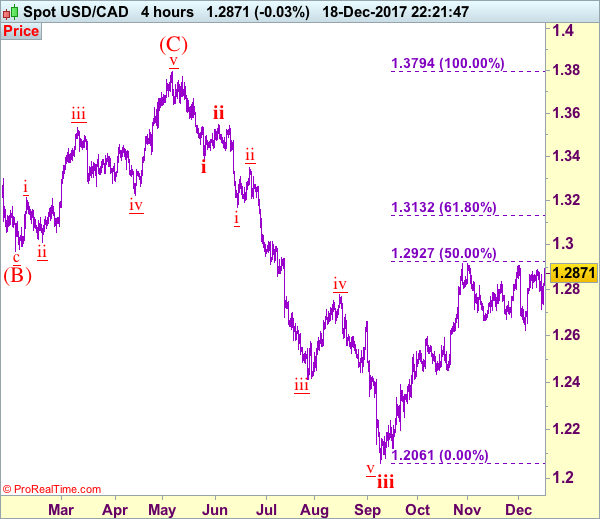
Although the greenback retreated quite sharply on Friday, as renewed buying interest emerged at 1.2713 and the pair has rallied since, retaining our bullishness and upside bias remains for another test of resistance at 1.2917 but break there is needed to confirm upmove has resumed for headway to 1.2975-80 (61.8% Fibonacci retracement of 1.3547-1.2061), then towards psychological resistance at 1.3000.
In view of this, we are holding on to our long position entered at 1.2765. Below said support at 1.2713 would abort and prolong choppy trading, bring weakness to 1.2650-55, however, downside should be limited and price should stay above said support at 1.2623, bring another rebound later.
To recap, wave B from 1.3066 is unfolding as an a-b-c and is sub-divided as a: 1.2192, b: 1.2716 and wave c is a 5-waver with i: 1.1983, ii: 1.2506, extended wave iii with minor iii at 1.0206, wave iv ended at 1.0781 and wave v as well as wave iii has ended at 0.9931, hence the subsequent choppy trading is the wave iv which is unfolding as (a)-(b)-(c) with (a) leg of iv ended at 1.0854, followed by (b) leg at 1.0108 and (c) leg as well as the wave iv ended at 1.0674. The wave v is sub-divided by minor wave (i): 0.9980, (ii): 1.0374, (iii): 0.9446, (iv): 0.9913 and (v) as well as v has possibly ended at 0.9407, therefore, consolidation with upside bias is seen for major correction, indicated target at 1.3700 and 1.4000 had been met and further gain to 1.4700 would be seen later.
Dollar Falls on Tax Doubts as Stocks Climb; May Plans on Transition Period
Here are the latest developments in global markets:
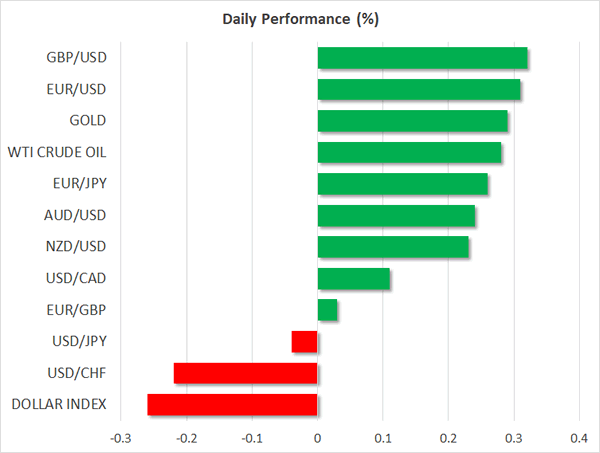
FOREX: The dollar was weaker versus a basket of major currencies during early European trading hours as investors played down the post-growth effects of the proposed tax cuts. The dollar index touched intra-day lows at 93.68 (-0.26%). Euro/dollar was on track to break above 1.1800, reversing most of its Friday's losses (+0.31%), as sentiment on the Eurozone's economy remained positive. Dollar/yen was flat at 112.56 and pound/dollar was trading higher at 1.3360 (+0.32%).
STOCKS: Merger and acquisition deals lifted European stocks on Monday. At 1100 GMT the pan-European STOXX 600 – driven by gains in the tech sector – was up by 0.82%, trading near six-week high levels, while the blue-chip Euro STOXX 50 jumped by 0.75%. The German DAX 30 climbed by 1.40%, the French CAC 40 rose by 1.18% and the British FTSE 100 increased by 0.40%.
COMMODITIES: Oil prices extended their uptrend as the British North Sea pipeline remained closed and a strike by Nigerian oil workers on Monday raised fears over a potential restriction in Africa's oil production and exports. A fall in US oil drilling rigs reported by Baker Hughes on Friday also supported the market. WTI crude rose by 0.31% to $57.48 per barrel and Brent moved up by 0.22% to $63.37. Gold rose by 0.30% to $1,259.00 per ounce.
Day ahead: May to propose plans on transition period
The UK Prime minister, Theresa May, will meet with her Cabinet today to inform ministers on the latest developments in negotiations with the EU in Brussels. She is also expected to report her plans on the transition period which aim to help individuals and businesses to smoothly adjust to post-Brexit conditions; She is anticipated to say that the UK will not be part of the union during the transition period. Note that May accepted the EU's offer to begin trade talks only after March and give priority to transition deal discussions at the EU's summit last week. Still, internal preparations on future relations could begin before then.
In the US, investors are looking forward to the crucial tax vote in the Congress as soon as this Tuesday, pricing that the promised-by-Republicans tax cuts might turn into law in the coming days or early next year. Yet some uncertainty remains on the post-growth effects of the bill, while markets are also wondering whether the US lawmakers will be able to pass the bill before the year-end as some Senate Republicans are currently facing health issues.
Moreover, the clock is also ticking down for government spending which expires on December 22, spreading fears of a potential government shut down if the Republicans fail to extend the budget beyond the deadline.
In the US president, Donald Trump, will reveal his national security strategy on Monday with sources familiar with the matter claiming that Trump will likely propose a tougher stance on China, underlying his concerns over the US-China trade relations.
In terms of data, the NAHB housing market index for the month of December will be out of the US at 1500 GMT. The index approached 13-year high levels the previous month, rising to 70.