Sample Category Title
Euro Steady As German Inflation Matches Forecast
The euro is showing little movement in the Wednesday session. Currently, EUR/USD is trading at 1.1750, up 0.07% on the day. In economic news, German Final CPI improved to 0.3%, matching the estimate. This marked a 4-month high. In the eurozone, Employment Change improved remained unchanged at 0.4%, matching the forecast. Industrial Production rebounded with a gain of 0.2%, above the forecast of 0.0%. In the US, CPI is expected to improve to 0.4%. The Federal Reserve meets for its monthly policy meeting, and is widely expected to raise rates to a range between 1.25% to 1.50%. Wednesday will be busy. Germany and the eurozone release manufacturing PMIs, and the ECB will make a rate announcement. The US will release retail sales reports as well as unemployment claims.
All eyes are on Janet Yellen & Co., as the Federal Reserve meets later on Wednesday. The CME Group has priced in a quarter-point rate hike at 87%, so it would be a huge surprise if the Fed doesn’t press the rate trigger.Even though this move has been priced in, rate hikes tend to trigger a surge of confidence among investors, and also makes the US dollar more attractive against its rivals. Traders should therefore be prepared for the US dollar to move higher after the rate announcement. Today’s move could be the start of a series of incremental hikes, as the odds of a January increase stand at 86%. The Fed has hinted that it could raise rates up to three times in 2018, but the pace of increases will depend to a great extent on the strength of the economy and inflation levels. The US labor market remains at full capacity and various sectors in the economy are reporting a lack of workers. Still, this has not translated into stronger wage growth, despite predictions from Janet Yellen and other Fed policymakers that a lack of workers is bound to push up wages.
Investors remain confident about the German and eurozone economies, but the optimism was more measured in December. The well-respected ZEW Economic Sentiment indicator, a confidence barometer of institutional investors, slowed in December in Germany and the eurozone. Economic conditions are good, but investors have to keep an eye on political developments as well, and there are some worrisome developments. Germany still remains without a government, and uncertainty over Brexit continues to hover over the European Union. The euro reacted to the soft ZEW reports with slight losses on Tuesday.
Fed To Raise Rates But Dollar Eyes FOMC Forecasts
The Federal Open Market Committee is widely expected to raise interest rates for the third time this year and for the fifth time since the end of 2015 on Wednesday. But what seems to matter the most to investors regarding the outcome of the meeting, is the update on the country’s economic outlook and the speed of the delivery of stimulus reduction in the upcoming years. However, investors are already having doubts on future rate increases as recent data on average earnings surprised to the downside.
According to the CME FedWatch tool, markets have already priced in an interest rate hike by the end of the two-day meeting by the Federal Reserve on Wednesday. In November, policymakers had acknowledged the strength of the US economy, saying that the labour market “will somewhat strengthen further” pushing inflation higher towards the Fed’s target of 2.0%, while the next Fed chief, Jerome Powell, argued during his confirmation hearing that “conditions are supportive” for another rate hike in December.
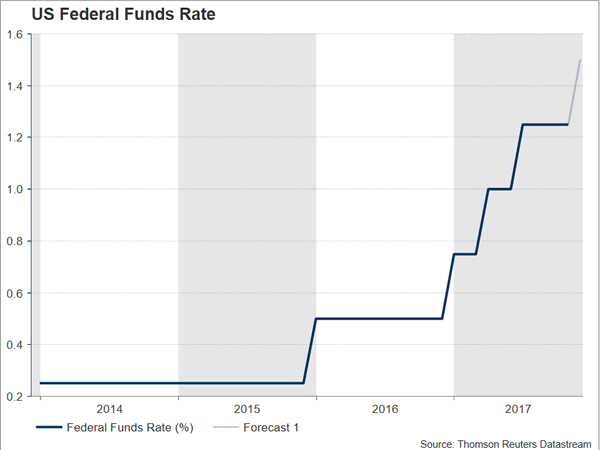
In the June forecasts, policymakers projected three more rate hikes in 2018. However, in the September projections, although FOMC members were more optimistic about the growth outlook in 2018, the persistent soft patch in inflation has kept rate-setters more cautious about the speed of further monetary tightening. Besides that, November’s nonfarm payrolls report indicated that average earnings react little even if the economy operates near full-employment conditions, with the unemployment rate currently standing at 17-year lows.
Potential tax cuts promised by Republicans could also bring some headache to the Fed as Republicans would likely pressure policymakers to avoid faster rate increases as those would offset benefits from their tax legislation. Still, Fed officials have so far avoided taking any position over the tax cuts, with Powell recently expressing that the central bank will not seek to forecast the impact of tax reforms until this turns into law.
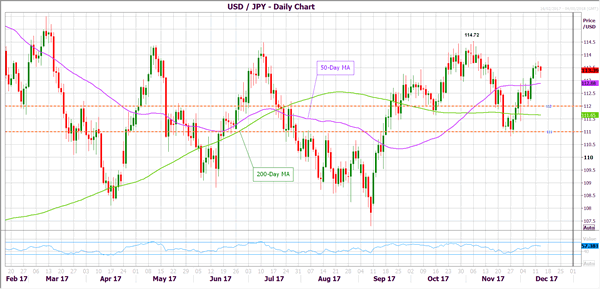
Since a rate hike is priced in by the markets, the financial statement and Fed chair Janet Yellen’s last press conference (as her term expires in February) following the rate decision are anticipated to be the main market movers. The dollar is currently consolidating gains around the 113 key-level, but the bullish short-term picture remains in place as the RSI is still above 50 and the bullish cross between the moving average lines is still intact. Optimistic statements from FOMC members could push the pair towards the nine-month high of 114.72. In the alternative scenario, a dovish take might drive the pair down to meet the area around the 112 and 111 key levels.
Wednesday will also see the release of US CPI figures for the month of November (1330 GMT). The headline index is expected to rise by 0.2 percentage points relative to the preceding month’s pace to 2.2% y/y in November, while the core measure which excludes volatile items is anticipated to stand flat at 1.8% y/y. Note that the Fed compares its inflation target of 2.0% with the core PCE index instead and adjusts its monetary strategy accordingly, as this includes a wider range of consumer products.
EURJPY Sees Risk To The Downside In The Short Term After Recent Rally Reverses
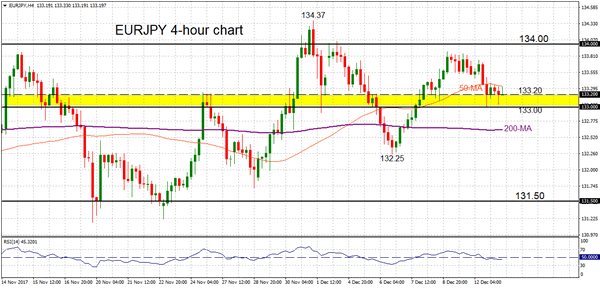
EURJPY has been in a neutral phase for the past three months as the pair has been trading sideways in the 131-134 area when the uptrend from April to September lost steam.
Looking at the 4-hour chart, EURJPY is capped at the 50-period moving average at 133.33. Support is in the zone between the key 133.00 level and at 133.20 and the market is consolidating recent losses following a reversal just ahead of 134.00.
A sustained break below 133.00 would increase downside pressure and propel EURJPY towards the 200-MA at 132.64 and then to the December 6 low at 132.25. A move lower would push the market towards the lower end of the range.
While immediate downward pressure has eased, a strong recovery cannot be expected in the near term since RSI is flat and showing an absence of momentum in the market. This suggests EURJPY will likely consolidate for now but further weakness cannot be ruled out as long as prices trade below the 50-MA and while RSI is below 50. EURJPY would need to clear 134.00 to shift to a more bullish outlook.
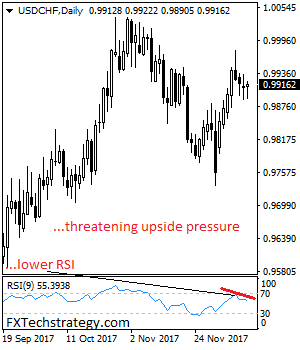
USDCHF – Hesitates, Upside Risk Builds Up
USDCHF - The With the pair continuing reject lower prices risk of a recovery higher is likely. On the downside, support lies at the 0.9900 level. A turn below here will open the door for more weakness towards the 0.9850 level and then the 0.9800 level. On the upside, resistance resides at the 0.9950 level where a break will clear the way for more strength to occur towards the 1.0000 level. Further out, resistance comes in at the 1.0050 level. Above here if seen will turn attention to 1.0100. All in all, USDCHF faces further upside pressure but with caution
Forex Technical Analysis: EUR/USD, USD/JPY, GBP/USD
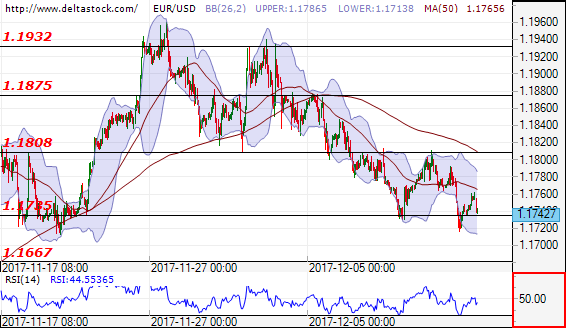
EUR/USD
Current level - 1.1742
The outlook is positive for test of the resistance level at 1.1808. In opposite direction the support level is at 1.1735. A breakthrough of that level will lead to test of the next support level at 1.1667.
| Resistance | Support | ||
| intraday | intraweek | intraday | intraweek |
| 1.1808 | 1.1932 | 1.1735 | 1.1690 |
| 1.1875 | 1.2090 | 1.1667 | 1.1550 |
USD/JPY
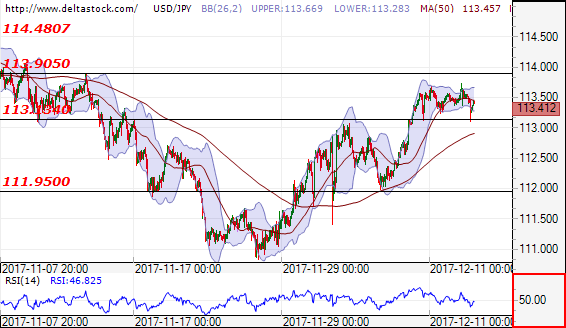
Current level - 113.41
The forecast is negative for test of the resistance level at 113.13. A breakthrough of that level will lead to the next support level at 110.90. In positive direction a breakthrough of the resistance level at 113.90, might lead to the next resistance level at 114.48.
| Resistance | Support | ||
| intraday | intraweek | intraday | intraweek |
| 113.90 | 113.90 | 113.13 | 109.50 |
| 114.50 | 114.70 | 111.95 | 107.30 |
GBP/USD
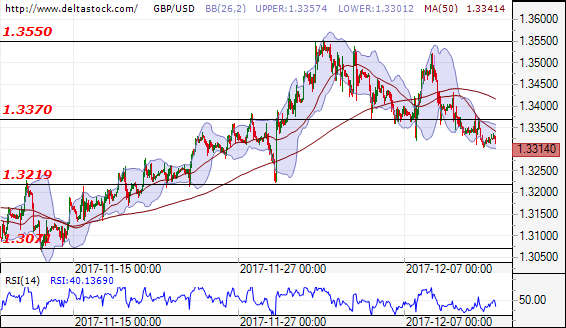
Current level - 1.3314
The outlook is positive for test and breakthrough of the resistance level at 1.3370 and movement up to 1.3550. In negative direction a breakthrough of the support level at 1.3219, will lead to another test of the next support level at 1.3071.
| Resistance | Support | ||
| intraday | intraweek | intraday | intraweek |
| 1.3370 | 1.3460 | 1.3219 | 1.3219 |
| 1.3550 | 1.3660 | 1.3071 | 1.3020 |
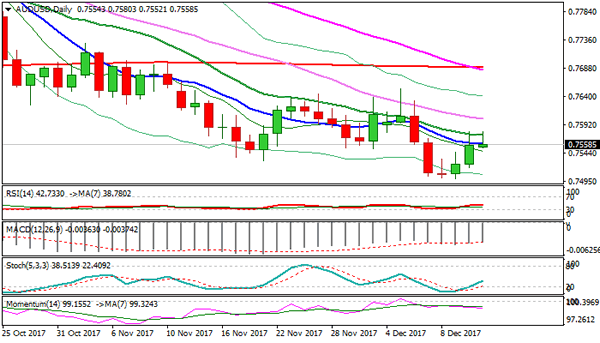
Technical Outlook: AUDUSD – Recovery Shows Strong Signs Of Stall At 20 SMA Barrier
Recovery rally from near-term base that is forming at 0.7500 is shows signs of losing traction after being repeatedly capped by 20SMA (0.7575).
Overall bearish structure warns of recovery rally stall, as solid offers at 0.7575/0.7600 zone (20SMA / 30SMA) maintain pressure.
Repeated close below 20SMA would be an additional bearish signal for fresh weakness and retest of key near-term support at 0.7500, with sustained break here to signal bearish continuation towards another strong support at 0.7482 (bull-trendline off 0.6826, 20 Jan 2016 low).
Conversely, firm break above 0.7600 resistance zone would signal extended recovery and expose key near-term barrier at 0.7653 (05 Dec high).
Res: 0.7574, 0.7600, 0.7633, 0.7653
Sup: 0.7552, 0.7518, 0.7500, 0.7482
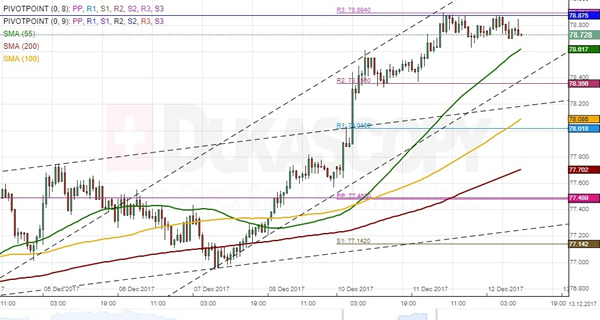
NZD/JPY 1H Chart: Kiwi Likely To Fall In Short Term
The dominant pattern which has guided NZD/JPY for the last two years is an ascending channel. The pair bounced off its upper boundary mid-July and has since been driven by bearish momentum. During the past four weeks, the Kiwi has been gradually moving towards the upper boundary a new medium-term pattern circa 80.50; thus, this upward movement might hold for the following weeks, as well. In the short term, however, the pair has failed to move above the combined resistance of the monthly R1 and the weekly R3 near the 78.88 mark. This suggests that a possible decrease in price might be due soon. The ultimate downside target for this week could be the weekly and monthly PPs at 77.50, while the 55-, 100– and 200-hour SMAs are likely to provide support for some time or even reverse the rate.
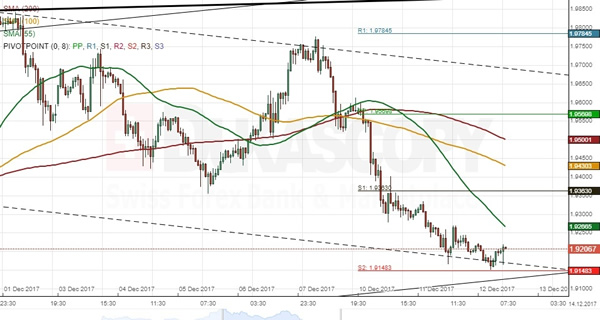
GBP/NZD 1H Chart: Pair Edges Lower In Channel
The Sterling has been trading in a long-term channel up against the New Zealand Dollar since September, 2016. The Pound tested its upper boundary two weeks ago prior to starting a new wave down. As apparent on the chart, the Pound is located near the bottom boundary of a medium-term channel which has been guiding the given currency during its latest up-wave. Thus, two scenarios are possible. On the one hand, the pair might breach this medium pattern southwards and thus continue depreciating towards the senior channel circa 1.88. On the other hand, technical indicators suggest that the rate might still go for another price increase. A possible upside target is the 200-hour SMA and the weekly PP circa 1.9550. The 55– and 100-hour SMA could also provide some resistance along the way.
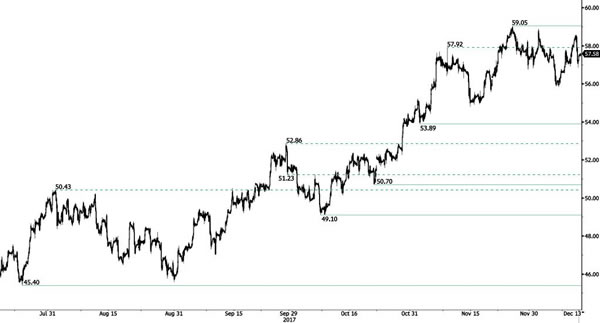
CRUDE OIL Triple Top
Crude oil is has failed to break resistance given at 59.05 (24/12/2017 high). Support is given at a distance at 54.81 (14/11/2017 low). Expected to bounce back.
In the long-term, crude oil has recovered after its sharp decline last year. However, we consider that further weakness are very likely. For the time being the pair lies in an upside momentum. Strong support lies at 35.24 (05/04/2016) while resistance can now be found at 55.24 (03/01/2017 high).
SILVER Monitoring Strong Support
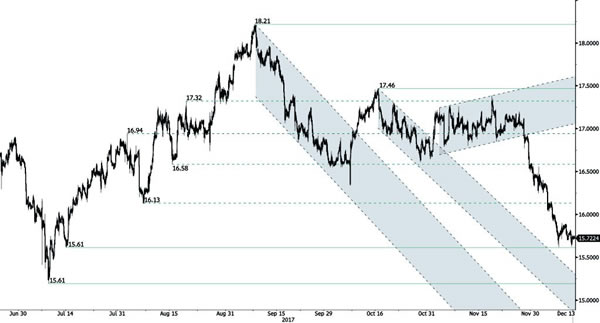
Silver has been bouncing on hourly support at 15.61 (14/07/2017 low). Hourly resistance is given at 17.46 (13/10/2017 high). Expected to keep pushing lower.
In the long-term, the trend is rater negative. Further downsides are very likely. Resistance is located at 25.11 (28/08/2013 high). Strong support can be found at 11.75 (20/04/2009).