Sample Category Title
GBP/USD Daily Outlook
Daily Pivots: (S1) 1.3146; (P) 1.3186; (R1) 1.3241; More....
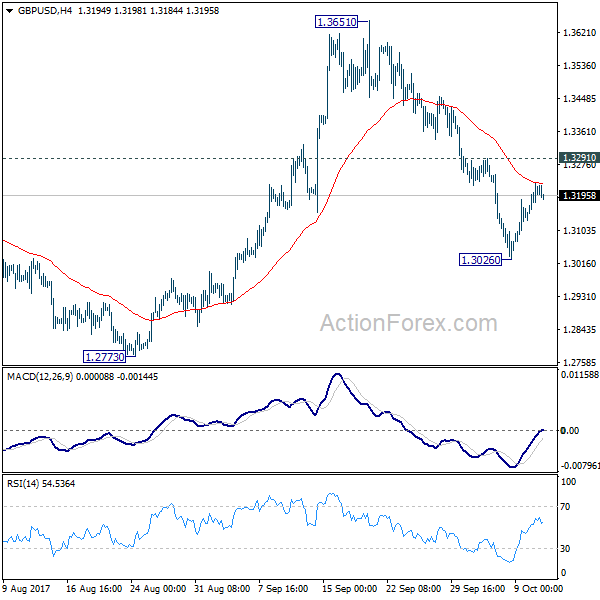
Intraday bias in GBP/USD remains neutral for consolidation above 1.3026 temporary low. At this point, deeper fall is mildly in favor as long as 1.3291 minor resistance holds. Below 1.3026 will target 1.2773 key support level. Decisive break there will affirm the bearish case of medium term reversal. Nonetheless, break of 1.3291 will suggest that the pull back from 1.3651 is completed and turn bias back to the upside.
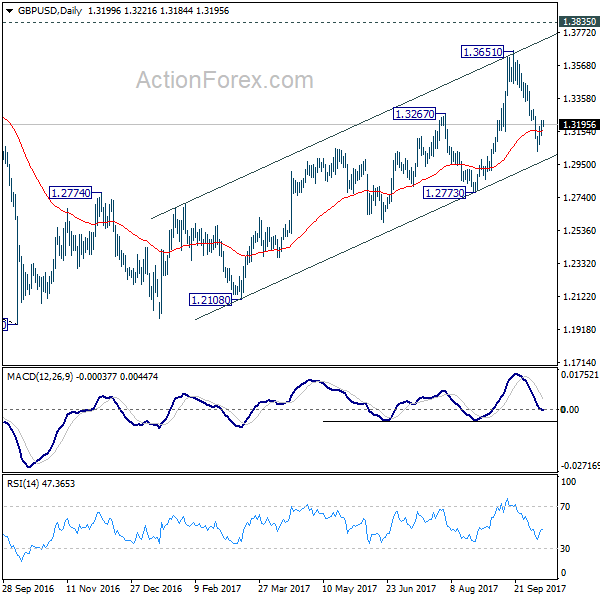
In the bigger picture, while the medium term rebound from 1.1946 was strong, GBP/USD hit strong resistance from the long term falling trend line. Outlook is turned a bit mixed and we'll turn neutral first. On the downside, decisive break of 1.2773 key support will argue that rebound from 1.1946 has completed. The corrective structure of rise from 1.1946 to 1.3651 will in turn suggest that long term down trend is now completed. Break of 1.1946 low should then be seen. On the upside, break of 1.3835 support turned resistance will revive the case of trend reversal and target 38.2% retracement of 2.1161 (2007 high) to 1.1946 (2016 low) at 1.5466 .
UK’s Manufacturing And Industrial Production Advanced In August
For the 24 hours to 23:00 GMT, the GBP rose 0.49% against the USD and closed at 1.3202, as the release of upbeat UK economic data sparked a fresh wave of optimism over the health of the British economy.
Data showed that Britain's manufacturing production rose 0.4% on a monthly basis in August, beating market consensus for an advance of 0.2%. In the previous month, manufacturing production had registered a revised similar rise. Moreover, the nation's industrial production recorded a rise of 0.2% MoM in August, meeting market expectations. In the previous month, industrial production had risen by a revised 0.3%. Further, the nation's construction output unexpectedly rebounded 0.6% on a monthly basis in August, rising for the first time in four months and confounding market expectations for a flat reading. Construction output had registered a revised drop of 1.0% in the previous month.
However, other economic data revealed that total trade deficit in the UK surprisingly widened to £5.6 billion in August, while investors had envisaged the total trade deficit to narrow to £2.8 billion. The UK had reported a revised total trade deficit of £4.2 billion in the prior month. On the contrary, the NIESR estimated UK's gross domestic product (GDP) climbed 0.4% in the three months to September, after recording a revised expansion of 0.5% in the June-August period.
Separately, the IMF stated that it still expects UK economy to grow by 1.7% in 2017 and 1.5% in 2018.
In the Asian session, at GMT0300, the pair is trading at 1.3193, with the GBP trading 0.07% lower against the USD from yesterday's close.
The pair is expected to find support at 1.3155, and a fall through could take it to the next support level of 1.3118. The pair is expected to find its first resistance at 1.3228, and a rise through could take it to the next resistance level of 1.3264.
The currency pair is showing convergence with its 20 Hr moving average and trading above its 50 Hr moving average.

Australia’s Westpac Consumer Confidence Climbed In October
For the 24 hours to 23:00 GMT, the AUD rose 0.32% against the USD and closed at 0.7779.
LME Copper prices rose 0.5% or $34.0/MT to $6641.0/MT. Aluminium prices declined 0.1% or $2.0/MT to $2133.0/MT.
In the Asian session, at GMT0300, the pair is trading at 0.7781, with the AUD trading marginally higher against the USD from yesterday's close.
Earlier today, data indicated that Australia's Westpac consumer confidence index advanced to a level of 101.4 in October, compared to a level of 97.9 in the prior month.
The pair is expected to find support at 0.7767, and a fall through could take it to the next support level of 0.7753. The pair is expected to find its first resistance at 0.7802, and a rise through could take it to the next resistance level of 0.7823.
Going ahead, investors will focus on Australia's consumer inflation expectation for October, due to release overnight.
The currency pair is showing convergence with its 20 Hr moving average and trading above its 50 Hr moving average.

Germany’s Trade Surplus Rose In August
For the 24 hours to 23:00 GMT, the EUR rose 0.52% against the USD and closed at 1.1803, after data indicated that Germany's seasonally adjusted trade surplus climbed more-than-anticipated to €20.0 billion in August, as growth in exports outpaced that of imports, thus soothing concerns that a surge in Euro would impact German trade. In the prior month, the nation had registered a revised trade surplus of €19.3 billion, while markets had expected for a surplus of €19.5 billion.
The International Monetary Fund (IMF), in its twice-yearly World Economic Outlook, revised up the Euro-zone's growth forecast by 0.2% for both 2017 and 2018 to 2.1% and 1.9% respectively, amid a strong economic recovery. Additionally, the organisation raised its global growth economic forecast for 2017, citing brightening prospects in the world's biggest economies. It now projects the global economy to grow 3.6% this year and 3.7% next, both up by 0.1%. However, the organisation warned that medium-term risks to global economic growth are tilted to the downside, highlighting threats from tightening financial conditions and sluggish inflation in advanced economies.
The greenback lost ground against a basket of currencies, amid concerns that the US President, Donald Trump's tax overhaul plan would stall.
In the US, data showed that the NFIB small business optimism index declined to a level of 103.0 in September, more than market expectations for a drop to a level of 105.0. The index had registered a reading of 105.3 in the prior month. Additionally, the nation's IBD/TIPP economic optimism index surprisingly eased to a level of 50.3 in October, defying market expectations for a rise to a level of 54.2 and following a level of 53.4 in the preceding month.
Meanwhile, the IMF maintained its growth outlook for the US at 2.2% in 2017 and 2.3% in 2018.
In the Asian session, at GMT0300, the pair is trading at 1.1803, with the EUR trading flat against the USD from yesterday's close.
The pair is expected to find support at 1.1767, and a fall through could take it to the next support level of 1.1732. The pair is expected to find its first resistance at 1.1833, and a rise through could take it to the next resistance level of 1.1864.
Amid a lack of macroeconomic releases in the Euro-zone today, investors would anxiously await the release of latest FOMC meeting minutes, due later in the day, which may shed further light on the central bank's monetary policy trajectory. Additionally, the release of US MBA mortgage applications followed by JOLTS job openings for August, will be on investors' radar.
The currency pair is showing convergence with its 20 Hr moving average and trading above its 50 Hr moving average.

EUR/USD Daily Outlook
Daily Pivots: (S1) 1.1754; (P) 1.1790 (R1) 1.1843; More...
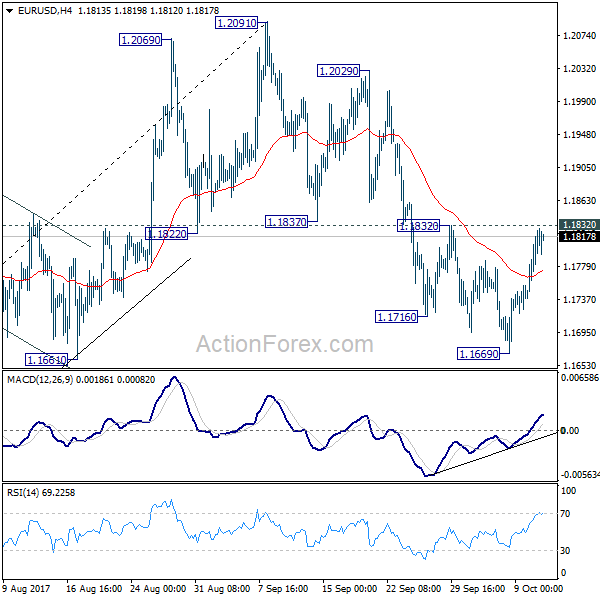
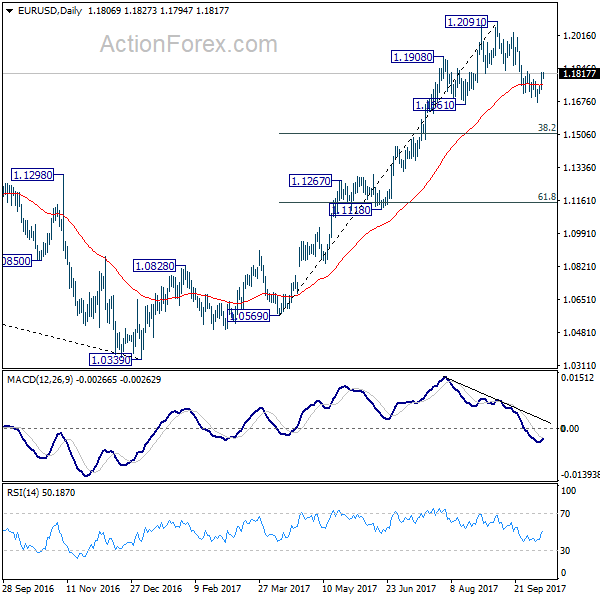
Intraday bias in EUR/USD remains neutral with focus on 1.1832 resistance. Decisive break there will suggest that the correction from 1.2091 is completed at 1.1669, ahead of 1.1661 support. In that case, intraday bias will be turned back to the upside for retesting 1.2091 high. On the downside, break of 1.1669 will extend the correction to 1.2091 to 38.2% retracement of 1.0569 to 1.2091 at 1.1510. We'd expect strong support from 1.1510 to bring rebound.
In the bigger picture, rise from medium term bottom at 1.0339 is not finished yet. It's expected to continue after pull back from 1.2091 completes. And, next target will be 38.2% retracement of 1.6039 (2008 high) to 1.0339 (2017 low) at 1.2516. However, it should be noted that there is no confirmation of trend reversal yet. That is, such rebound from 1.0399 could be a correction. And the long term fall from 1.6039 (2008 high) could resume. Hence, we'd be cautious on strong resistance from 1.2516 to limit upside.
Japan’s Machinery Orders Sharply Rebounded In August
For the 24 hours to 23:00 GMT, the USD declined 0.25% against the JPY and closed at 112.38.
Macroeconomic data indicated that Japan's Eco-Watchers Survey for the future outlook dropped less-than-expected to a level of 51.0 in September, compared to a reading of 51.1 in the previous month, while markets were expecting it to ease to a level of 50.5. On the contrary, the nation's Eco-Watchers Survey for the current situation advanced to a level of 51.3 in September, compared to a level of 49.7 in the previous month and beating market expectations for an advance to a level of 50.2.
In the Asian session, at GMT0300, the pair is trading at 112.45, with the USD trading 0.06% higher against the JPY from yesterday's close.
Overnight data revealed that Japan's machinery orders rebounded 4.4% on an annual basis in August, compared to a drop of 7.5% in the previous month and surpassing market consensus for a gain of 0.7%.
The pair is expected to find support at 112.05, and a fall through could take it to the next support level of 111.66. The pair is expected to find its first resistance at 112.78, and a rise through could take it to the next resistance level of 113.12.
Looking ahead, investors would eye Japan's tertiary industry index for August, due to release tomorrow.
The currency pair is trading above its 20 Hr moving average and showing convergence with its 50 Hr moving average.

Dollar Lower as Trump’s Feuds with Republicans Threatens Tax Plan
Dollar is trading generally lower, together with treasury yield, as weighed down by uncertainty over tax overhaul. Dollar index breached 94.14 resistance briefly last week but it's now back at 93.30. Similarly, 10 year yield breached 2.396 resistance last week but is back at 2.345. On the other hand, Euro remains broadly firm as Catalonia risk has eased at least for now. EUR/USD is having 1.1832 near term resistance in sight. This level will be closely watched and break there will probably trigger steeper selloff in Dollar and spread to other pairs.
Tax plan's fate uncertainty as Trump feuds with Republicans
Dollar and treasury yields are clearly weighed down by uncertainty over US President Donald Trump's tax overhaul. The Republicans have done their job last week on passing a a spending 2018 spending blueprint. With that, the tax bill could be passed by simple majority vote in the Senate. As there are 52 out of 100 Republicans there, the Democrats could be bypassed. The tax plan looked to be on track to go through the Congress by the end of the year.
However, the situation is now complicated by the feud between Trump with Republican Senator Bob Corker, and also with Secretary of State Rex Tillerson. Trump's attacks on the latters are, intentionally or unintentionally, alienating him from the people he should be relying on. And that also arouse concerns of other key lawmakers. With that thin majority, the tax plan could fail with just a few Republicans turning their back on it.
At the same time, the tax plan has drawn heavy criticisms for favoring the wealthy. And Trump seems to be trying to respond to those criticism and he said that "we'll be adjusting a little bit over the next few weeks to make it even stronger." No information is released on what Trump will adjust. And, his Pres Secretary Sarah Huckabee just said that "the final piece of legislation hasn't been finalized." And, "the framework is still the same."
IMF is not convinced by the tax plan neither
The International Monetary Fund lowered US growth forecast to 2.2% in 2017 and 2.3% in 2017, down from April's projection of 2.3% and 2.5% respectively. IMF noted that "the downward revision relative to April forecasts reflects a major correction in U.S. fiscal policy assumptions." And it noted that due to "significant policy uncertainty", the passing of tax reform shouldn't be counted on. Meanwhile, IMF chief economist Maurice Obstfeld also warned that "whatever the tax reform plan looks like, it should not increase the deficit." And over the medium term "tax reform should be revenue enhancing."
IMF projected global economy to growth 3.6% in 2017 and 3.7% in 2018, up from April projection of 3.5% and 3.6% respectively. Obstfeld also warned that "a closer look suggests that the global recovery may not be sustainable -- not all countries are participating, inflation often remains below target with weak wage growth, and the medium-term outlook still disappoints in many parts of the world."
Risk of Catalonia fades for now
The risk of Catalonia independents seem to have temporary eased now. Catalonia's President Carles Puigdemont proclaimed independence in his address to the regional parliament yesterday. But at the said time, he suspended form declaration immediately to allow for talks with the Spanish government. Spanish Prime Minister Mariano Rajoy will meet with his Cabinet today regarding the issue.
Brexit negotiation in slow pace
European Council President Donald Tusk warned that Brexit negotiation is have a "slow pace" and that "sufficient progress" hasn't be reached. And if it continues like that, UK and EU "will have to think about where we are heading". UK Prime Minister May said earlier this week that they have to prepare for all eventualities, hinting on the preparing for a "no deal" Brexit. Chancellor of Exchequer, however, said that taxpayers' money shouldn't be spent on preparing for a "no deal". And he would not commit the cost for no-deal preparing in his budget.
On the data front
Australia Westpac consumer confidence rose 3.6% in October. Japan machine orders rose 3.4% mom in August. FOMC minutes will be the main feature in US session later today. Fed presidents Robert Kaplan, Charles Evans and John William are due to speak. At the September meeting, the Fed formally announced to begin balance sheet reduction in October, and affirmed that there would be one more rate hike this year in December
EUR/USD Daily Outlook
Daily Pivots: (S1) 1.1754; (P) 1.1790 (R1) 1.1843; More...
Intraday bias in EUR/USD remains neutral with focus on 1.1832 resistance. Decisive break there will suggest that the correction from 1.2091 is completed at 1.1669, ahead of 1.1661 support. In that case, intraday bias will be turned back to the upside for retesting 1.2091 high. On the downside, break of 1.1669 will extend the correction to 1.2091 to 38.2% retracement of 1.0569 to 1.2091 at 1.1510. We'd expect strong support from 1.1510 to bring rebound.
In the bigger picture, rise from medium term bottom at 1.0339 is not finished yet. It's expected to continue after pull back from 1.2091 completes. And, next target will be 38.2% retracement of 1.6039 (2008 high) to 1.0339 (2017 low) at 1.2516. However, it should be noted that there is no confirmation of trend reversal yet. That is, such rebound from 1.0399 could be a correction. And the long term fall from 1.6039 (2008 high) could resume. Hence, we'd be cautious on strong resistance from 1.2516 to limit upside.
Economic Indicators Update
| GMT | Ccy | Events | Actual | Forecast | Previous | Revised |
|---|---|---|---|---|---|---|
| 23:30 | AUD | Westpac Consumer Confidence Oct | 3.60% | 2.50% | ||
| 23:50 | JPY | Machine Orders M/M Aug | 3.40% | 1.00% | 8.00% | |
| 6:00 | JPY | Machine Tool Orders Y/Y Sep P | 36.20% | |||
| 14:00 | USD | JOLTS Job Openings Aug | 6.06M | 6.17M | ||
| 18:00 | USD | FOMC Meeting Minutes |
Swiss Unemployment Rate Surprisingly Fell In September
For the 24 hours to 23:00 GMT, the USD declined 0.5% against the CHF and closed at 0.9749.
On the data front, Switzerland’s seasonally adjusted unemployment rate recorded an unexpected drop to 3.1% in September, while markets had anticipated it to remain steady at 3.2%.
In the Asian session, at GMT0300, the pair is trading at 0.9760, with the USD trading 0.11% higher against the CHF from yesterday’s close.
The pair is expected to find support at 0.9733, and a fall through could take it to the next support level of 0.9707. The pair is expected to find its first resistance at 0.9788, and a rise through could take it to the next resistance level of 0.9817.
The currency pair is showing convergence with its 20 Hr moving average and trading below its 50 Hr moving average.

Canada’s Building Permits Plunged In August, Housing Starts Declined In September
For the 24 hours to 23:00 GMT, the USD declined 0.3% against the CAD and closed at 1.2517.
On the economic front, Canada's building permits declined more-than-anticipated by 5.5% on a monthly basis in August, easing for the second straight month and compared to a revised drop of 2.8% in the previous month. Market anticipation was for building permits to drop 1.0%. Further, the nation's seasonally adjusted housing starts dropped to a level of 217.1K in September, compared to market consensus for a fall to a level of 212.0K. Housing starts had recorded a reading of 223.2K in the previous month.
In the Asian session, at GMT0300, the pair is trading at 1.2515, with the USD trading a tad lower against the CAD from yesterday's close.
The pair is expected to find support at 1.2490, and a fall through could take it to the next support level of 1.2464. The pair is expected to find its first resistance at 1.2535, and a rise through could take it to the next resistance level of 1.2554.
The currency pair is showing convergence with its 20 Hr moving average and trading below its 50 Hr moving average

Daily Wave Analysis: EUR/USD Builds Wave 3 Momentum In Bullish Channel
Currency pair EUR/USD
The EUR/USD is in a bullish channel (blue lines) which could challenge the resistance trend lines. It is unclear whether price is in a wave 5 or in an expanded wave 4 at the moment, which depends on how price develops the bullish trend.
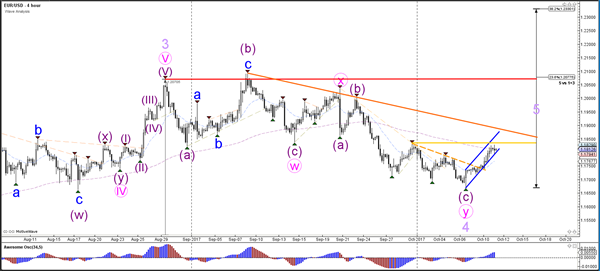
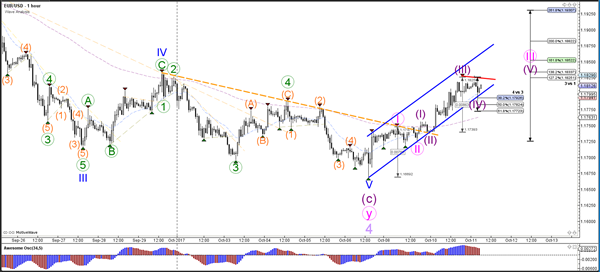
The EUR/USD seems to be in a smaller wave 4 (purple) within the bullish channel. A break below the channel and 61.8% Fibonacci invalidates the wave 3 (pink).
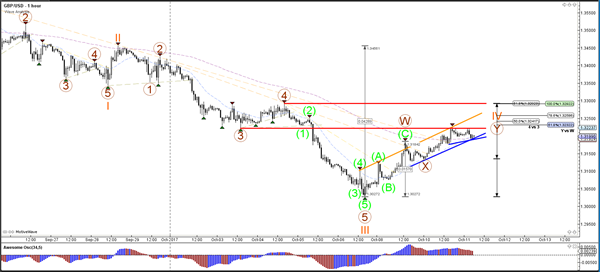
Currency pair GBP/USD
The GBP/USD bullish channel (blue lines) has broken resistance of the bearish channel (dotted orange) but horizontal resistance and the Fibonacci levels of wave 4 (orange) still could turn price back down. A break above the 61.8% Fib makes a wave 4 less likely.
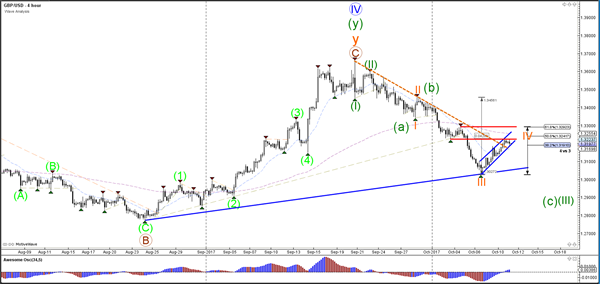
The GBP/USD bearish break below the bullish channel (blue) could indicate the completion of wave 4 (orange) and the continuation of the downtrend.
Currency pair USD/JPY
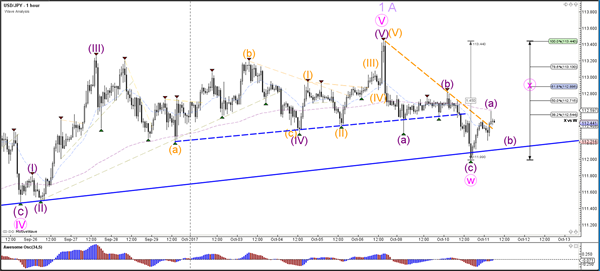
The USD/JPY broke below the support trend line (dotted blue) and fell towards the 23.6% Fib, which in turn acted as a support. This could be a larger correction within wave 2 or B (purple).
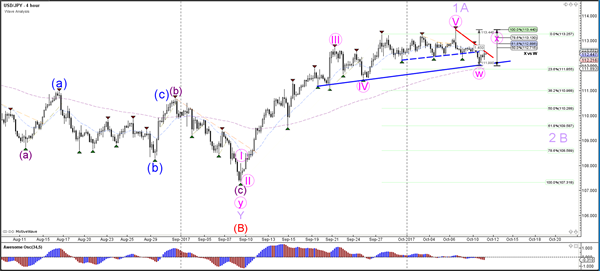
The USD/JPY could be building a potential ABC (purple) correction.