Sample Category Title
US: Still A Long Way To Go For Tax Reform
Yesterday, the 'Big 6' Republicans published the tax framework for tax reform. For a quick overview, see the table to the right. The release is nothing more than a blueprint in the sense that we have not got any details about estimated costs, for instance. However, the Committee for a Responsible Federal Budget (CRFB, a non-partisan organisation analysing US fiscal policy) estimates the proposal will cost around USD2,200bn over 10 years (i.e. approximately 1% of GDP per year over 10 years) although this is based on a number of assumptions as the blueprint is missing a lot of details. For more, see 'Big 6 Tax Frameworkd Could Cost $2.2 Trillion', 27 September. However, easier fiscal policy may not increase growth, as it would most likely be offset by tighter monetary policy, although uncertainty remains high about which direction the Fed will go in next year due to the vacant seats in the Board of Governor (see also FOMC preview, 15 September).
A headache for the Republicans is that USD2,200bn is more than there is room for in the Senate draft budget (reportedly USD1,500bn over 10 years), which also by the way is not aligned with the House yet. So, unless changes are made, Republicans cannot pass all of the elements in the framework via budget reconciliation (which the Republicans need to in order to pass tax legislation with only 51 votes and avoid Senate filibusters by Democrats, see page 2 for more details), as it will become too expensive. Two other problems are that tax reform may not add to deficits after 10 years ('sunset provisions').
Although the troublesome House Freedom Caucus (conservative Republicans, usually fiscal hawks) has supported the tax framework in a statement, the question is whether the caucus remains supportive if tax reform increases government deficits and hence government debt. While the Republicans agree on the goal, they disagree on the means. We still think the two most likely scenarios are a smaller tax reform or no deal at all, not least given that Congress is in session for less than 50 days this year, meaning that the Republicans are running out of time. As we might face a new government shutdown in December when the short-term government funding deal ends, Trump also has other topics on his agenda and the mid-term election is coming up in November next year, the Republicans need to act fast and the Republicans' attempt to repeal and replace Obamacare indicates this is easier said than done.
It is worth noting that Trump and the White House are still working on a bipartisan tax reform with moderate Democrats (something for example House Speaker Paul Ryan has rejected completely) in order to side-line Republican 'troublemakers'. After the debt limit deal with the Democrats, this scenario has become more likely, not least given that one reason why Trump struck the deal was because he has become increasingly frustrated with the Republicans' inability to govern. Previously, the Democrats sent a letter to Trump writing that they will not participate in tax reform cutting taxes for the wealthiest, which is something Trump can live with, at least according to his recent tax speeches. The Democrats also want a revenue-neutral tax reform, which means it is still very difficult. One advantage though is that tax reform would become more permanent, as Trump can avoid sunset provisions if he is able to find 60 votes in Senate.
Aussie Dollar Trading On A Weaker Footing This Morning
For the 24 hours to 23:00 GMT, the AUD declined 0.37% against the USD and closed at 0.7854.
LME Copper prices rose 0.05% or $3.0/MT to $6426.0/MT. Aluminium prices rose 0.05% or $1.0/MT to $2117.0/MT.
In the Asian session, at GMT0300, the pair is trading at 0.7826, with the AUD trading 0.36% lower against the USD from yesterday’s close.
The pair is expected to find support at 0.7806, and a fall through could take it to the next support level of 0.7787. The pair is expected to find its first resistance at 0.7865, and a rise through could take it to the next resistance level of 0.7905.
Looking ahead, traders will look forward to Australia’s private sector credit data for August, slated to release in the early hours tomorrow.
The currency pair is trading below its 20 Hr and 50 Hr moving averages.

Euro Trading A Tad Lower, Ahead Of Germany’s Inflation Data
For the 24 hours to 23:00 GMT, the EUR declined 0.36% against the USD and closed at 1.1745.
On the macro front, French consumer confidence index unexpectedly dropped to a level of 101.0 in September, hitting a five-month low level. Market participants had anticipated the index to remain steady at 103.0.
On the other hand, Italy's consumer confidence index surprisingly climbed to a twenty-month high level of 115.5 in September, defying market expectation for a decline to a level of 110.6 and following a revised level of 111.2 in the previous month.
The greenback gained ground against its major counterparts, after data showed that flash durable goods orders in the US rebounded more-than-expected by 1.7% MoM in August, pointing to a continued upswing in the nation's business investment. Durable goods orders had registered a drop of 6.8% in the prior month, while markets were anticipating for a rise of 1.0%.
On the contrary, the nation's pending home sales slid more-than-anticipated by 2.6% on a monthly basis in August, hitting its lowest level in nearly two years, amid a tighter supply of homes and rising prices. Pending home sales had recorded a drop of 0.8% in the prior month, while market participants had envisaged for a drop of 0.5%.
Gains in the US Dollar were boosted further, after the US President, Donald Trump, proposed the biggest US tax overhaul in three decades.
The US President offered to slash corporate income tax rates to 20.0% from 35.0%, cut taxes for small businesses and reducing the highest individual income tax rate to 35.0% from 39.6%.
In the Asian session, at GMT0300, the pair is trading at 1.1740, with the EUR trading slightly lower against the USD from yesterday's close.
The pair is expected to find support at 1.1707, and a fall through could take it to the next support level of 1.1675. The pair is expected to find its first resistance at 1.1782, and a rise through could take it to the next resistance level of 1.1825.
Moving ahead, investors will look forward to the Euro-zone's final consumer confidence index as well as Germany's flash inflation numbers, both for September, slated to release in a few hours. Moreover, the US 2Q GDP, advance goods trade balance for August and initial jobless claims data, all slated to release later in the day, will pique significant amount of investor attention.
The currency pair is showing convergence with its 20 Hr moving average and trading below its 50 Hr moving average.

Pound Trading On A Weaker Footing This Morning
For the 24 hours to 23:00 GMT, the GBP declined 0.4% against the USD and closed at 1.3398.
In the Asian session, at GMT0300, the pair is trading at 1.3387, with the GBP trading 0.08% lower against the USD from yesterday’s close.
The pair is expected to find support at 1.3352, and a fall through could take it to the next support level of 1.3316. The pair is expected to find its first resistance at 1.3435, and a rise through could take it to the next resistance level of 1.3482.
Moving ahead, a speech by the Bank of England’s Governor, Mark Carney, due in a few hours, will garner a lot of market attention.
The currency pair is showing convergence with its 20 Hr moving average and trading below its 50 Hr moving average.

Japanese Yen Trading Flat In The Morning Session
For the 24 hours to 23:00 GMT, the USD rose 0.52% against the JPY and closed at 112.86.
In economic news, Japan’s final machine tool orders registered a rise of 36.2% YoY in August, while the preliminary figures had recorded a rise of 36.3%. Machine tool orders had recorded a rise of 28.0% in the previous month.
In the Asian session, at GMT0300, the pair is trading at 112.86, with the USD trading flat against the JPY from yesterday’s close.
The pair is expected to find support at 112.35, and a fall through could take it to the next support level of 111.83. The pair is expected to find its first resistance at 113.32, and a rise through could take it to the next resistance level of 113.77.
Moving forward, market participants will focus on the Bank of Japan’s summary of opinions report along with Japan’s inflation and jobless rate data, both for August, all due to release overnight.
The currency pair is showing convergence with its 20 Hr moving average and trading above its 50 Hr moving average.

Switzerland’s ZEW Economic Expectations Index Advanced In September
For the 24 hours to 23:00 GMT, the USD rose 0.29% against the CHF and closed at 0.9721.
Macroeconomic data indicated that Switzerland's ZEW economic expectations index rose to a level of 28.0 in September, compared to a reading of 25.0 in the previous month. Further, the nation's UBS consumption indicator climbed to a level of 1.53 in August, after recording a revised reading of 1.46 in the prior month.
In the Asian session, at GMT0300, the pair is trading at 0.9731, with the USD trading 0.1% higher against the CHF from yesterday's close.
The pair is expected to find support at 0.9695, and a fall through could take it to the next support level of 0.9658. The pair is expected to find its first resistance at 0.9769, and a rise through could take it to the next resistance level of 0.9806.
With no macroeconomic releases in Switzerland today, investor sentiment will be determined by global macroeconomic factors.
The currency pair is showing convergence with its 20 Hr moving average and trading above its 50 Hr moving average.

BoC Poloz Signals Caution In Further Interest Rate Hikes
For the 24 hours to 23:00 GMT, the USD rose 0.96% against the CAD and closed at 1.2477.
The Canadian Dollar lost ground against the USD after the Bank of Canada (BoC) Governor, Stephen Poloz, diminished hopes of further interest rate hikes this year.
The BoC Governor indicated that the central bank will be cautious in its approach to monetary policy and stressed that there is no predetermined path for interest rate hikes while adding that any move will be data-dependent.
In the Asian session, at GMT0300, the pair is trading at 1.2493, with the USD trading 0.13% higher against the CAD from yesterday’s close.
The pair is expected to find support at 1.2388, and a fall through could take it to the next support level of 1.2284. The pair is expected to find its first resistance at 1.2545, and a rise through could take it to the next resistance level of 1.2598.
The currency pair is trading above its 20 Hr and 50 Hr moving averages.

Gold Crucial Breakdown
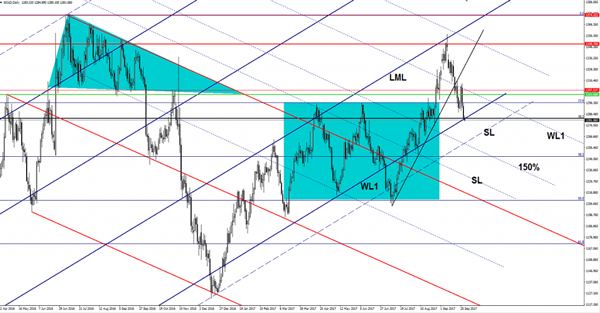
The yellow metal drops further on the short term and is almost to take out the major support from the confluence area formed at the intersection between the WL1 with the 38.2% retracement level. A valid breakdown below this confluence will accelerate the sell-off, the next target will be at the sliding parallel line (SL).
AUD/USD More Drop To Come
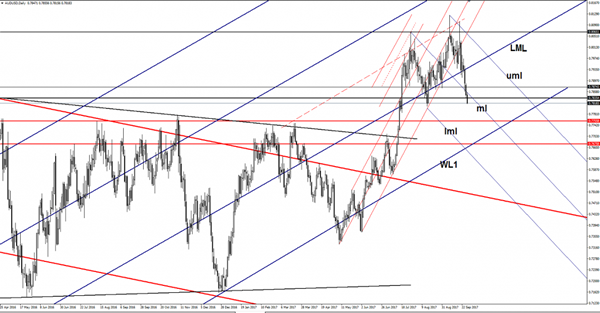
The AUD/USD drops as expected and erases everything in its way. Is trading in the red and is expected to drop further after the breakdown below the median line (ml) of the minor descending pitchfork. Technically, it should approach the lower median line (lml) of the descending pitchfork, but it could find support at the first warning line (WL1) of the major ascending pitchfork.
USD/JPY Fighting For More Gains
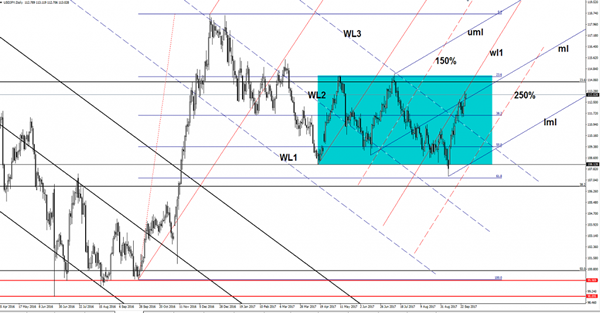
The USD/JPY is trading in the green on the short term and tries to extend the latest gains. Price is approaching the 113.25 yesterday’s high and a strong dynamic resistance level. Technically, it should reach new highs in the upcoming days as the USDX climbs higher and because the Yen is punished by the Nikkei’s potential further increase.
The currency pair continues to be trapped within an extended sideways movement, we’ll see how will react when will reach the upside line of this pattern.
The Nikkei stock index rallied aggressively in the yesterday’s session and closed the morning gap down. The index continues to move somehow sideways on the daily chart, but continues to stay above the 20320 previous highs. A further Nikkei’s increase will force the Yen to lose more ground versus all its rivals.
The BOJ Kuroda’s speech may bring some action on the USD/JPY later, so you should be careful.
Price increased and managed to stay above the median line (ml) of the minor blue ascending pitchfork. Could come to retest the first warning line (wl1) of the black ascending pitchfork. The next major upside target will be at the 23.6% retracement level, only a valid breakout will confirm a further increase in the upcoming period. Technically is somehow expected to stay above the median line (ml) of the blue ascending pitchfork. Only a failure to stabilize above the broke dynamic resistance will signal a minor drop.