

Sample Category Title
Euro, Kiwi Setback As Election Winners Seek Coalition, Gold Down Despite Another Round Of Threats
The euro and the kiwi were trading lower on Monday after the election weekend for Germany and New Zealand ended with expected outcomes but insufficient votes to form a government. Meanwhile, geopolitical tensions continued to escalate between the US and North Korea as another round of threats took place during the weekend. However, the markets ignored the fresh warnings, with the safe-haven gold retreating near to one-month lows.
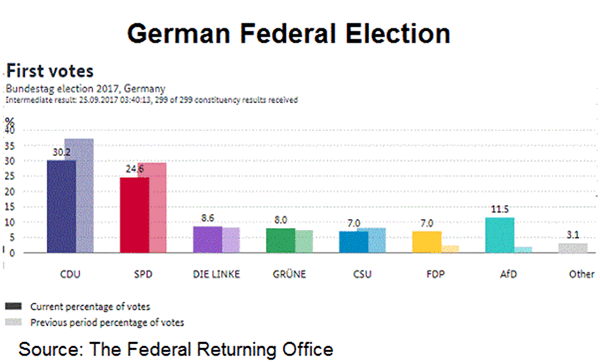
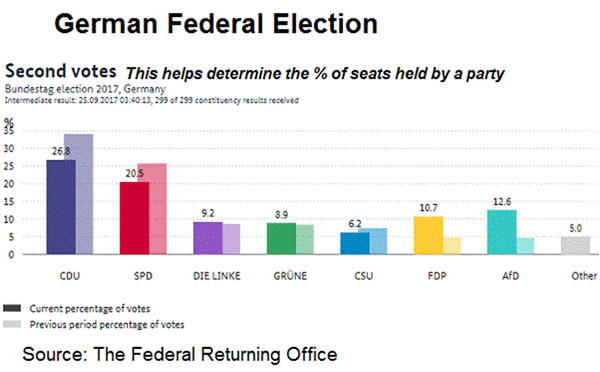
On Sunday, exit polls in Germany favored Chancellor Angela Merkel for the fourth time with the winning center-right party CDU/CSU earning 33% of the votes compared to 20.5% attracted by the center-left SDP party. This was the worst result for Merkel’s party as it was the lowest seen since 1949, while her current SDP coalition partner said they would go into opposition after their percentage of votes fell back to post-war levels. On the other hand, the far-right party ADF won 12%, gaining enough seats to enter the parliament after more than half a century. Now, rumors suggest that Merkel is likely to discuss with the FDP and the Greens (Jamaica coalition) to build a coalition.
In New Zealand, general elections held on Saturday showed a victory for the ruling National Party and the current Prime Minister Bill English, with the party winning 46% of the votes compared to 35.8% gained by the opposition Labour party. Despite leading the elections, the next leader is still unknown as the votes earned were not enough to form a government. Therefore, during the next few days, the National Party will start discussions with smaller parties to secure a majority and form a coalition government.
The euro tumbled by almost 0.50% to $1.1896 before it rebounded to $1.1913. The kiwi also lost ground against the dollar, dropping by 0.90% to $0.7269 but managed to climb to $0.7281 afterwards.
Japan is also said to head to polls next month after the Japanese Prime Minister, Shinzo Abe, called for snap elections last week to take advantage of his improved ratings. According to the Nikkei Business daily survey, 44% of the voters support Abe’s LDP party, while 8% prefer the opposition Democratic party. Besides that, Abe stated on Monday that he plans to deliver a stimulus package of $17.8bn by the end of the year.
The yen pulled back during early Asian session trading following the disappointing preliminary manufacturing PMI readings out of Japan for the month of September. However, it pared losses afterwards, with dollar/yen falling from 112.52 earlier to 112.28 before the Asian markets close.
Geopolitical tensions did not ease during the weekend as the US president, Donald Trump and North Korea’s foreign minister, Ri Yong Ho, exchanged threats after US airforce bombers flew over international airspace east of North Korea. At his speech before the UN General Assembly, Ri Yong Ho said on Saturday that targeting the U.S. mainland with its rockets was inevitable after “Mr. Evil President” Trump called Pyongyang’s leader a “rocket man” on a suicide mission”. A few hours later, Tump tweeted on social media, that if the Noth Korean foreign minister repeats Kim’s thoughts, “they won’t be around much longer”.
Despite this, gold was down by 0.41% on the day at $1,291.11 per ounce, as investors ignored the renewed war of words and preferred to look for riskier assets. The dollar index jumped by 0.20% 92.11.
The pound bounced up by 0.40% to $1.3534 following a deep fall on Friday, when fears rose over expectations that May will announce the country’s exit from the EU earlier than the determined date following her highly anticipated Brexit speech. Moreover, after May’s speech, Moody’s downgraded Britain’s credit rating from Aa1 to Aa2 with the justification that the government’s debt reduction plans were off course so far while Brexit would bring further economic uncertainties.
Regarding energy markets, WTI crude was trading lower by 0.28% at $50.52 and Brent was down by 0.11% at $56.80 per ounce.
Next up, currencies are expected to fluctuate on speeches made by ECB and Fed policymakers who are likely to give further clues on monetary policy.
Can Euro Hold 1.1860 Vs US Dollar?
Key Highlights
- The Euro remains in an uptrend, but struggling to hold gains against the US Dollar above 1.1850.
- There is a contracting triangle forming with support near 1.1860 on the 4-hours chart of EUR/USD.
- The US Services PMI for Sep 2017 (Prelim) released this past week posted a decline from 56.0 to 55.1.
- The US Manufacturing PMI preliminary reading (Sep 2017) increased from 52.8 to 53.0.
EURUSD Technical Analysis
The Euro remained in a broad range above 1.1850 against the US Dollar. However, the EUR/USD is under pressure and might attempt a downside break below 1.1850 in the near term.
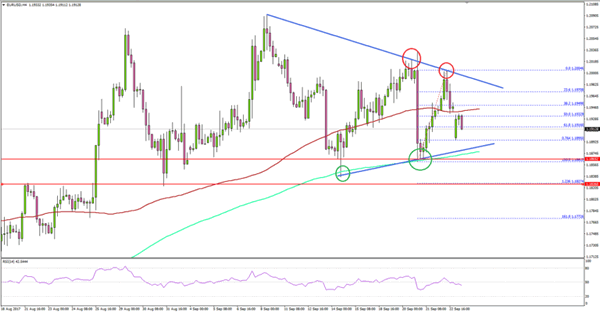
Looking at the 4-hours chart of EUR/USD, there is a contracting triangle forming with support near 1.1860. The triangle support at 1.1860-50 is also near the 200 simple moving average.
On the upside, an initial resistance is around 1.1940 and the 100 simple moving average (H4). Above 1.1940, the triangle resistance is at 1.1970. A proper close above 1.1970 is needed for the Euro buyers to gain momentum.
On the downside, a break of the triangle support or 1.1850 might ignite further losses towards the 1.1820 level. Below 1.1820, the next important support is at 1.1780.
US Manufacturing PMI
Recently in the US, the Manufacturing Purchasing Managers Index (PMI) for Sep 2017 (Prelim) was released by the Markit Economics. The forecast was slated for a rise from the last reading of 52.8 to 53.0.
The actual result was in line with the forecast, as the PMI rose to 53.0. On the other hand, the US Services PMI was forecasted to decrease from 56.0 to 55.9, but it declined to 55.1.
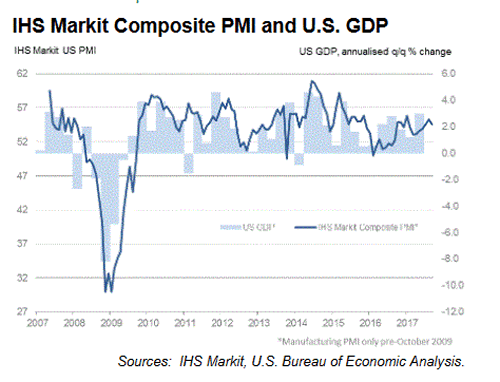
Commenting on the Manufacturing PMI report, the Chief Business Economist at IHS Markit, Chris Williamson, stated:
The US economy showed encouraging resilience in a month of hurricane disruption. Although the September surveys indicated a moderation in growth of business activity, the overall rate of expansion remained robust.
Overall, it seems like the EUR/USD pair is struggling to remain above 1.1860 and remains at a risk of a breakdown in the near term. Today’s European Central Bank’s President Mario Draghi’s speech might impact EUR/USD and could ignite a break either above 1.1970 or below 1.1860.
EUR/USD Candlesticks and Ichimoku Analysis
Weekly
• Last Candlesticks pattern: Shooting star
• Time of formation: 31 Jul 2017
• Trend bias: Near term up
Daily
• Last Candlesticks pattern: Shooting star
• Time of formation: 2 Aug 2017
• Trend bias: Up
EUR/USD – 1.1910
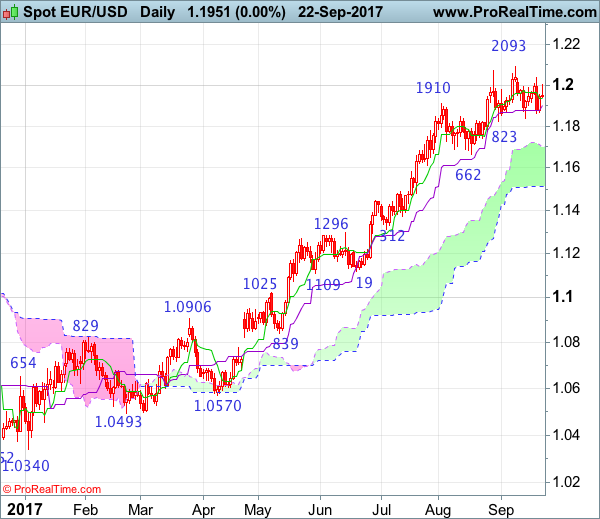
Despite staging another rebound to 1.2034 last week, the subsequent sharp retreat formed a black candlestick on the daily chart, suggesting recent upmove is not ready to resume yet, hence further consolidation below recent high at 1.2093 would take place and another retreat to 1.1861 support cannot be ruled out, however, euro needs to penetrate previous support at 1.1838 to confirm a temporary top has been made at 1.2093 earlier this month, bring retracement of recent upmove to 1.1800, then towards 1.1730-40 which is likely to limit downside and price should stay above support at 1.1662.
On the upside, expect recovery to be limited to 1.1950-60 and bring another retreat. Above said resistance at 1.2034 (last week’s high) would revive bullishness, bring retest of 1.2093 but break there is needed to confirm recent upmove has resumed and extend subsequent rise towards dynamic resistance at 1.2165-70 (50% Fibonacci retracement of 1.3993-1.0340) and later towards 1.2200-10 but loss of upward momentum should prevent sharp move beyond 1.2250-60 and reckon 1.2300-10 would hold from here.
Recommendation: Stand aside for this week.
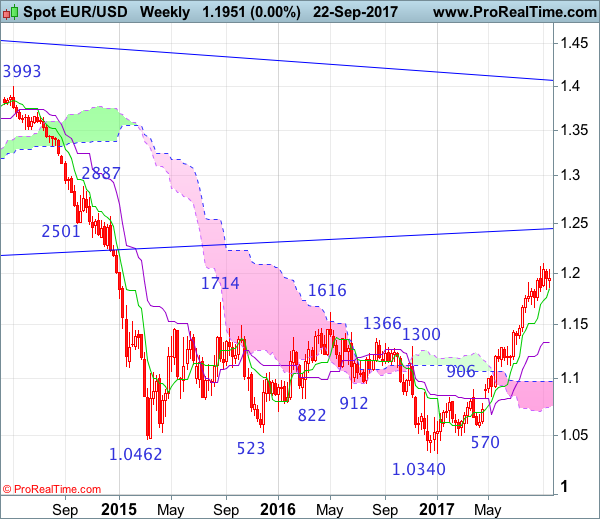
On the weekly chart, as euro met resistance at 1.2034 last week and has retreated, suggesting further consolidation below recent high at 1.2093 would take place and test of 1.1861 support cannot be ruled out, however, a drop below previous support at 1.1838 is needed to suggest a temporary top is possibly formed, bring further fall to 1.1730-35, having said that, only break of previous support at 1.1662 would add credence to this view, bring retracement of recent upmove to 1.1545-50, then towards 1.1500 but price should stay well above the Kijun-Sen (now at 1.1332).
On the upside, above 1.2000-05 would bring test of 1.2034 but break of latter level is needed to signal upmove has resumed for retest of 1.2093, above there would extend recent upmove from 1.0340 low to 1.2160-70 (50% Fibonacci retracement of 1.3993-1.0340) but loss of upward momentum should limit upside to 1.2220-30 and reckon 1.2300-10 would hold from here, price should falter well below 1.2390-00, bring another retreat later.
Forex: German & New Zealand Elections, Japan Next?
The results of the German Election have re-elected Chancellor Angela Merkel for a fourth term. Her CDU party won fewer votes than was expected and Chancellor Merkel commented that 'the CDU would have hoped for better result, but we mustn't forget – looking back at an extraordinary challenge – that we nevertheless achieved our strategic objectives: we are the strongest party. We have mandate to form the new government and we will form the new government.' Chancellor Merkel will now be tasked with forming a coalition Government which is likely to take several months. Per the latest results the CDU won 32.5% of the vote compared to the 2013 election that saw them win 41.5%. The normally strong SPD's 20% of the vote is a post war low for the party, whilst the right-wing nationalist AfD party, appears to have won 13.5% of the vote, making it the country's third largest party. With the AfD securing third place this may cause concerns, as it may disrupt Merkel's plans for further Eurozone integration.
In New Zealand, Prime Minister English's National Party won the most votes in their General Election, although it was not sufficient to ensure a majority. The uncertainty of when a majority coalition will be formed has weighed on the Kiwi.
In Japan, Prime Minister Abe is expected to announce that the country will hold a snap election in October.
GBP was sold against USD and its major counterparts on Friday on news that the credit ratings agency, Moody's, announced it had downgraded the United Kingdom' long term issuer rating to AA2 from AA1 and changed the outlook to stable from negative. GBP had suffered earlier in the day as Prime Minister Theresa May had failed to give any substantive details on how the United Kingdom might retain preferential access to the Eurozone's single market. Prime Minister May's speech in Italy gave little detail and provided no new information as to the direction of the discussions, and outcomes, between the UK and Europe.
North Korea's Foreign Minister, Ri Yong-ho, addressed the United Nations on Sunday, providing more rhetoric on the war of words between the US and North Korea. He told those assembled that 'it was all the more inevitable' that the regime's rockets would 'visit' the US mainland. Ri also added that it was Trump, not Kim, who was on a 'suicide mission'. He likened Trump to 'the sound of a dog barking' and commented that he felt sorry for Trump's aides when asked about the Presidents 'rocket man' nickname for Kim. There has been the inevitable flight to safe havens, with JPY and Gold improving against
USD. The markets are keenly watching for the next 'round' of rhetoric which could lead to more risk-off sentiment in the coming days.
EURUSD is 0.25% higher in the early trading session; currently trading around 1.1925.
USDJPY moved higher overnight to currently trade around 112.25.
GBPUSD suffered with a credit downgrade and lack of information from Prime Minister May on Brexit solutions on Friday. GBPUSD traded as low as 1.3449 on Friday, before retracing higher over the weekend to currently trade around 1.3540.
Gold is down 0.35% in early Monday trading, currently trading around $1,294.
WTI traded in a relatively narrow range on Friday and is little changed overnight. Currently, WTI is trading around $50.60pb.
Major economic data releases for today:
At 09:00 BST, the CESifo Group will release German IFO-Business Climate sentiment index, Current Assessment & Expectations for September. The Institute surveys more than 7,000 enterprises on their assessment of the business situation and their short-term planning. A release above consensus will see EUR gain, with a lower than forecast release putting downward on pressure on EUR.
Merkel Wins Fourth Term But Biggest Challenge Ahead
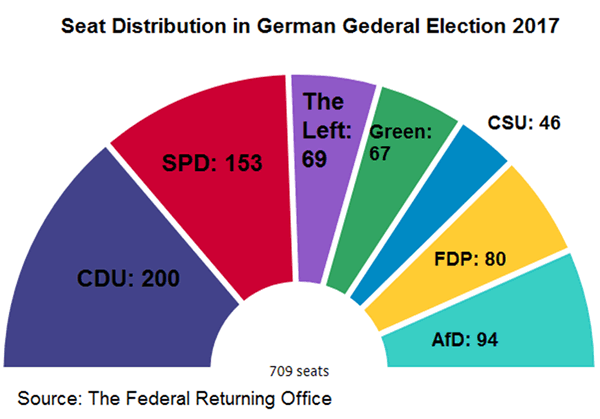
Despite the general perception that the German election would be a boring game, the outcomes contain several surprises and should drag the process of deeper EU integration. Angela Merkel's CDU and its sister party CSU have secured 246, out of 709 seats in the new Bundestag, marking a decline of -65 seats from the 2013 term. With CDU remaining the biggest party, Merkel will no doubt be the Chancellor for a fourth term. However, it is challenging for her to form a coalition government this time. Back in 2013, the CDU/CSU formed a Grand Coalition government, with SPD as its junior partner. This time, with SPD's number of seats sharply falling to 153 (down -40 seats from 2014), the party has pledged that it would head into opposition this time. Indeed, the SPD during the election period had been complaining about the loss of popularity after forming coalition with CDU/CSU. Yet, Merkel has asked Martin Schulz, SPD's leader, to re-think. The Grand Coalition is expected to be the best for the financial markets, providing the least uncertainty and most favorable for deeper EU integration.
Besides Grand Coalition, another possibility is Jamaica – CDU/CSU + FDP + Greens. While this combination appears the most likely after SPD refuses to a re-run, the hurdles are high.CDU/CSU has highly preferred to work with FDP given the similarities in ideologies and platforms. Yet, FDP and Green are traditional rivalries. The two parties have different very different views on various issues, ranging from labor and social policy, to immigration policy; from fiscal policy to EU integration. There are few cooperation between the two parties in local level, let alone federal level. For economic and EU integration prospects of different coalition combinations: please visit: https://www.actionforex.com/action-insight/special-topics/44648-german-election-not-as-boring-as-you-think
The biggest surprise is undoubtedly the surge of AfD. The far-right party has gained 94 seats with a record high 12.6% of votes. The party has pledged to be spread its anti-immigration, anti-euro ideologies in the parliamentary speeches. Should it become the biggest opposition party (in case of Grand Coalition), AfD would chair the budget committee and impede the passage of EU integration bills. AfD’s surge has strong implications for CDU. Surveys suggest that over 20% of people voted for AfD this time had voted for CDU in 2013. This might lead some CDU legislators to take a more hawkish stance on EU and immigration issues in the future.
In short, the new government, be it the Jamaica or a re-run of the Grand Coalition, would merely be a knife-edge majority, making it more difficult to implement significant reforms, both in domestic policies and EU integration. We foresee a challenging four years for Merkel, whom SPD’s Schulz described as the 'biggest loser'
USD/JPY Candlesticks and Ichimoku Analysis
Weekly
• Last Candlesticks pattern: Dark cloud cover
• Time of formation: 10 Jul 2017
• Trend bias: Down
Daily
• Last Candlesticks pattern: Evening doji
• Time of formation: 7 Aug 2017
• Trend bias: Down
USD/JPY – 112.23
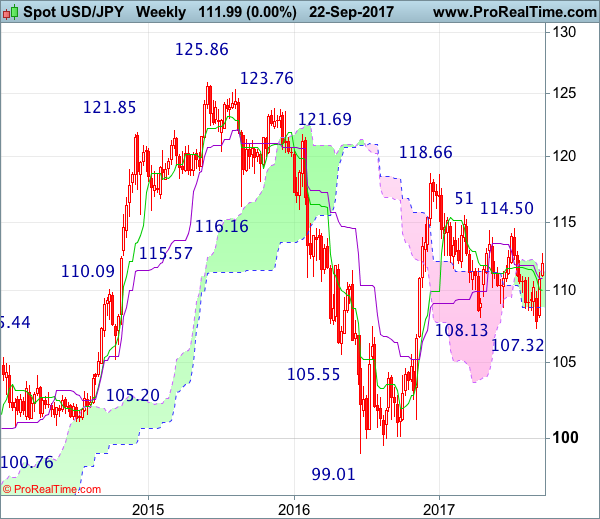
As the greenback has surged again after brief pullback to 111.11, adding credence to our bullish view that the rise from 107.32 low is still in progress for retracement of recent entire decline from 118.66 to 112.99-00 (50% Fibonacci retracement), then towards 113.50-60, however, loss of upward momentum should prevent sharp move beyond 114.30-35 (61.8% Fibonacci retracement) and resistance at 114.50 would hold from here, price should falter well below 115.00.
On the downside, whilst initial pullback to 111.65 cannot be ruled out, reckon said support at 111.11 would limit downside and bring another rise later to aforesaid upside targets. A daily close below the Tenkan-Sen (now at 111.01) would defer and suggest top is possibly formed, bring test of the lower Kumo (now at 110.50) and then towards the Kijun-Sen (now at 110.02) but it is necessary to see a break below support at 109.55 to indicate the rebound from 107.32 low has indeed ended.
Recommendation : Buy at 111.15 for 113.15 with stop below 110.15
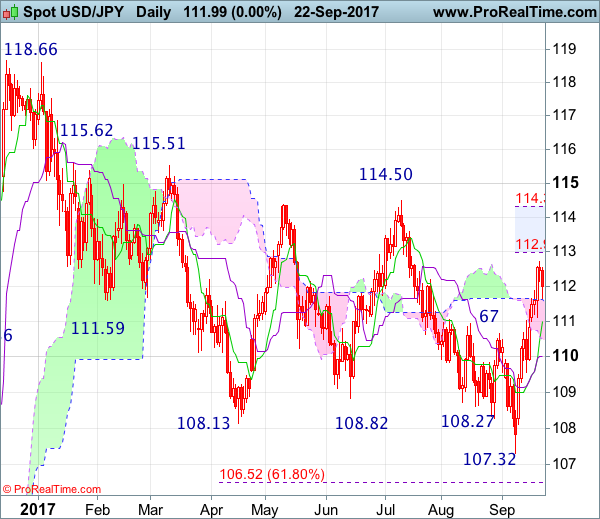
On the weekly chart, the greenback extended the rebound from 107.32 to 112.72 last week, adding credence to our view that a temporary low has been made at 107.32, hence consolidation with mild upside bias remains for further gain to 112.99-00 (50% Fibonacci retracement of 118.66-107.32), however, break there is needed to retain bullishness and signal recent entire decline from 118.66 has ended, bring stronger rebound to 113.50-60, then towards 114.30-35 (61.8% Fibonacci retracement) but resistance at 114.50 should hold from here, price should falter well below psychological level at 115.00 and bring retreat later.
On the downside, although initial pullback to the upper Kumo (now at 111.36) cannot be ruled out, reckon support at 111.11 would limit downside and bring another rise later. A drop below 111.11 support would risk test of the Tenkan-Sen (now at 110.02) but a weekly close below there is needed to suggest top is possibly formed instead, bring further fall to support at 109.55, a drop below this level would signal the rebound from 107.32 has ended, then weakness to 109.00 and possibly towards support at 108.12 would follow.
XAUUSD Intraday Analysis
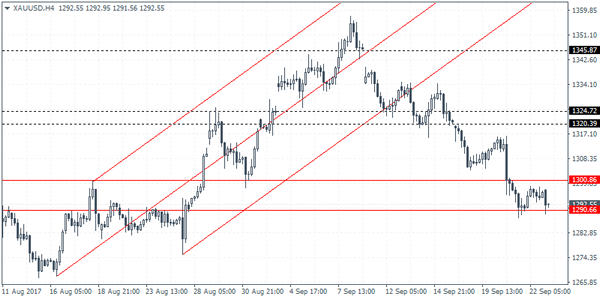
XAUUSD (1292.55): Gold prices were seen slipping back to test the support at 1290 levels. We can expect some consolidation to take place within the 1300 and 1290 levels in the near term. An upside breakout can be expected off this major support zone that will put gold prices on track to test the 1324 - 1320 levels. A breakout above this resistance will see gold prices rallying to eventually fill the gap from a few weeks ago at 1345 level of resistance. To the downside, in the event that gold prices slip below 1290, a breach of this support could send gold prices lower towards the 1270 - 1260 support.
GBPUSD Intraday Analysis
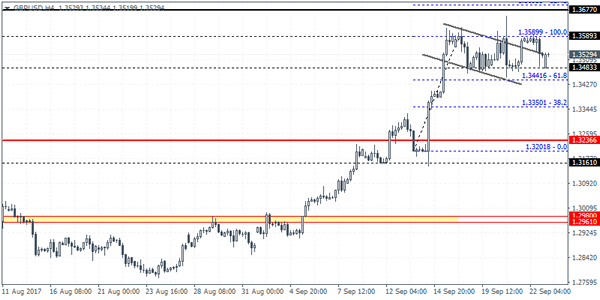
GBPUSD (1.3529): GBPUSD is seen posting a lower open today, but price action has quickly recovered to fill Friday's close. GBPUSD remains in a consolidation phase near the top end of the rally. The bullish flag pattern remains in play as GBPUSD was seen testing the support at 1.3483. Price needs to continue to the upside and preferably clear the resistance formed at 1.3589. A breach of this resistance is essential for the bullish flag to be validated. The current bias in GBPUSD remains to the upside unless we see a failure in the bull flag pattern. Resistance at 1.3677 will be initial target followed by 1.3829.
EURUSD Intraday Analysis
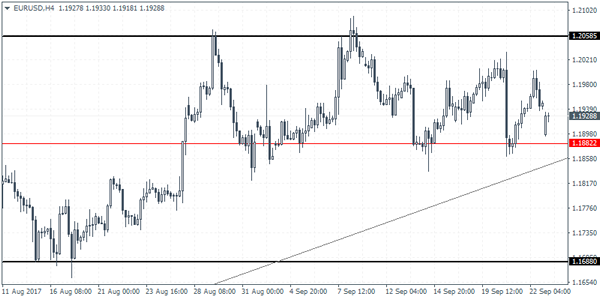
EURUSD (1.1928): EURUSD gapped lower on the open this morning, but theprice is currently looking to fill the gap from Friday's close. The resistance level at 1.1954 is currently the main level of interest. A breakout above this level could see further upside in price. On the 4-hour time frame, however, EURUSD is seen maintaining the ranging price action within 1.2085 and 1.1882 levels of resistance and support. This range is likely to persist until further breakout from this range will determine the future trend in prices.
Euro Gaps Lower But Recovers On German Elections
The markets were little changed this morning after the weekend elections from Germany and New Zealand. The German election results saw Angela Merkel winning another term as widely expected, but the fringe parties were seen making some inroads. This prompted Ms. Merkel to comment that she expected a better result but said that the good thing was that the status quo remains unchanged.
New Zealand also held elections over the weekend, and exit polls showed no clear winner. The election results are expected to be announced later in the week.
On the economic front, calendar today is marked mostly be speeches from central bankers. BoJ's Kuroda will be the first to speak, followed by a number of FOMC member speeches. The ECB President Draghi will also be speaking later today.