

Sample Category Title
Daily Technical Analysis: EURUSD, GBPUSD, USDJPY, USDCHF
EURUSD
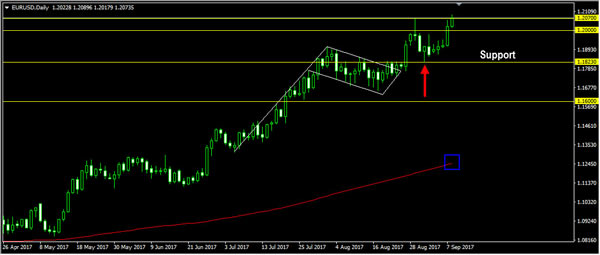
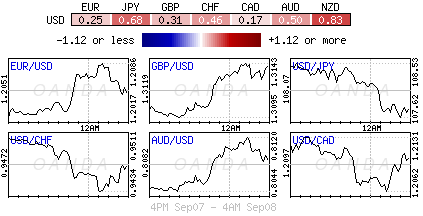
The EURUSD had a bullish momentum yesterday topped at 1.2059 and hit 1.2089 earlier today in Asian session. This fact ends the bearish correction phase. The bias is bullish in nearest term testing 1.2150/75 region. Immediate support is seen around 1.2017 (current low). A clear break below that area could lead price to neutral zone in nearest term testing 1.1980 region but overall I remain bullish and any downside pullback should be seen as a good opportunity to buy. On the upside, a clear break and daily/weekly close above 1.2150/75 would expose 1.2350 region next week.
GBPUSD
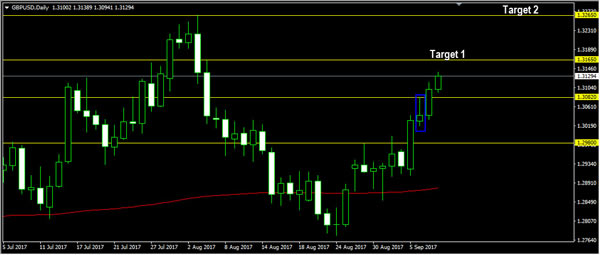
The GBPUSD had a bullish momentum yesterday topped at 1.3115 and hit 1.3138 earlier today in Asian session. This fact nullifies the bearish pin bar scenario and changes the technical bias to the upside. The bias is bullish in nearest term testing 1.3165. A clear break above that area could trigger further bullish pressure testing 1.3200 – 1.3265 resistance area. Immediate support is seen around 1.3082. A clear break below that area could lead price to neutral zone in nearest term as direction would become unclear.
USDJPY
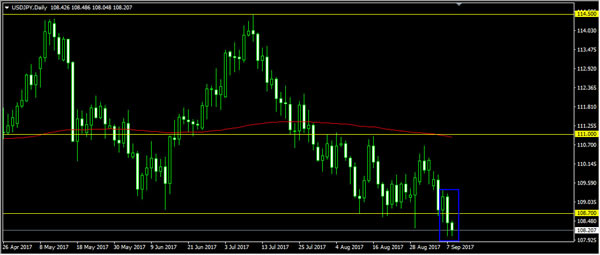
The USDJPY had a significant bearish momentum yesterday, closed below 108.70 key support as you can see on my daily chart below. This fact activates my bearish mode. The bias is bearish in nearest term testing 107.50/00 support area. Immediate resistance is seen around 108.70. A clear break back above that area could lead price to neutral zone in nearest term as direction would become unclear testing 109.25 resistance area.
USDCHF
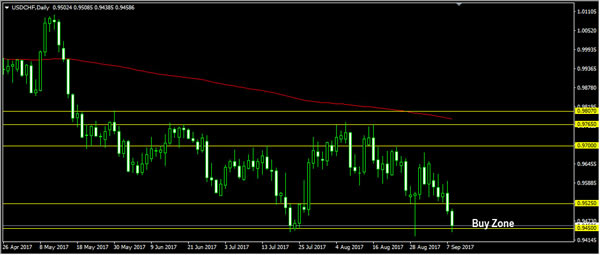
The USDCHF had a bearish momentum yesterday bottomed at 0.9493 and slipped below 0.9450 key support earlier today in Asian session. The bias is bearish in nearest term but 0.9450 region is a good place to buy with a tight stop loss. Immediate resistance is seen around 0.9525. A clear break above that area could lead price to neutral zone in nearest term testing 0.9580 – 0.9600 region. On the downside, a clear break and consistent movement below 0.9450 would expose 0.9250/00 region next week.
EUR/GBP Daily Outlook
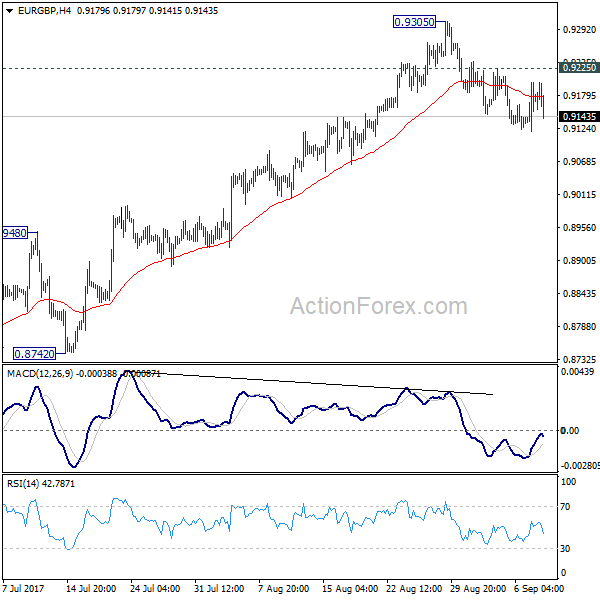
Daily Pivots: (S1) 0.9118; (P) 0.9141; (R1) 0.9159; More
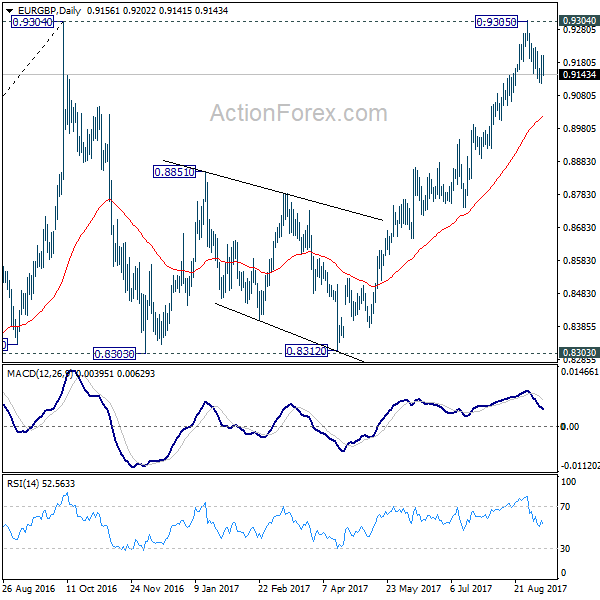
No change in EUR/GBP's outlook. With 0.9225 minor resistance intact, deeper fall is expected to target 55 day EMA (now at 0.9019). Sustained trading below there will likely start the third leg of the consolidation from 0.9304 and target 0.8303 key support again. On the upside, above 0.9236 minor resistance will turn bias back to the upside for 0.9225 minor resistance instead.
In the bigger picture, price actions from 0.9304 are viewed as a medium term corrective pattern. It's uncertain whether it is finished yet. But in case of another fall, we'd expect strong support from 0.8116 cluster support (50% retracement of 0.6935 to 0.9304 at 0.8120) to contain downside and bring rebound. Whole up trend from 0.6935 is expected to resume after consolidation from 0.9304 completes. Firm break of 0.9799 high will target 61.8% projection of 0.5680 to 0.9799 from 0.6935 at 1.1054.
Dollar’s Capitulation Trade
The 'mighty' dollar has deepened its dive against the majors as investor caution on the currency grows.
Currently, there is no get out of 'jail free card' for long dollar investors who weathered another night of fresh selling, a day after the dollar index notched a 2½-year low – year-to-date, the index is down -9.2%.
Yesterdays' broad move by investors favoured owning safe-haven assets – gold and sovereign debt – fuelled partially by the ECB's raised growth forecasts that helped support a stronger EUR to print a fresh 32-month high outright (€1.2057).
In the eurozone, a robust economic recovery amidst low inflation has helped the EUR to surge more than +14% outright this year. During Thursday's press conference, ECB President Draghi expressed concern about the currency's strength without offering any proposal on how to address it as policy makers' edge toward unwinding QE in the autumn.
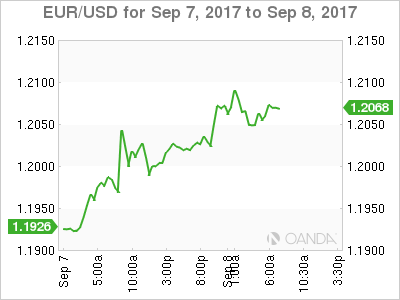
Note: The 'smart' money was short EUR's or small core 'long' heading into yesterday's ECB press conference – many had expected Draghi to address the pace of EUR appreciation, when that did not materialize, the market then scrambled to own the EUR to offset some shorts and for a positional buy looking for a further move up in EUR/USD on a 6-12 month horizon (€1.25-27).
The lack of progress and market faith in 'Trumponomics' – program of infrastructure spending, tax overhaul and regulatory cutbacks would cause long-muted U.S growth to accelerate – has the dollar struggling on growth and rate differentials.
Further market doubts that the Fed has the ammo, or the will, to hike interest rates again this year, given soft inflation, has intensified this week, in particular, after Hurricane Harvey mass destruction in Texas and the prospect of an even-stronger storm from Irma battering Florida this weekend.
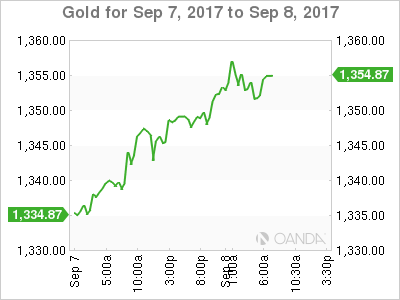
Haven moves are also at play, with rallies in precious metal and government debt.
Gold is at its highest in 12-months, printing +$1,350 an ounce, while there has been broad buying of global debt in recent days, further flattening sovereign yield curves.
The market is also concerned that North Korea will launch another missile in the next 24-hours, when the country celebrates its founding. The fear has caused a further uptick in the demand for sovereign debt – U.K 10-year Gilt yields fell back under the psychological +1% (+0.97%) overnight, while 10-year JGB's fell below zero and U.S 10-year product trades atop of the psychological +2%.

In China, authorities have strengthened the Yuan guidance for the tenth consecutive day.
The People's Bank of China (PBoC) set the 'fix' at ¥6.5032 vs. ¥6.5269. Still, the PBOC's guidance fell short of market expectations given yesterday's strength in the currency.
With the absence of intervention by China has given the market the 'thumbs up' to aggressively dump dollars – intraday, the yuan traded as high as ¥6.4617, its highest level in 18-months.
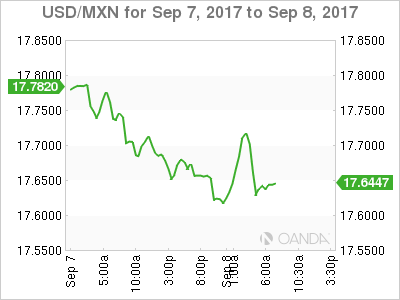
In Mexico, the most powerful earthquake (magnitude 8) this century has shook the country, adding to investor anxiety and sending the MXN ($17.64) lower.
In Canada, this morning's employment report (08:30 am EDT +17k e) will set the tone for the loonie (C$1.2117) heading into the weekend.
Three things that Bank of Canada's (BoC) Poloz has done with Wednesday's surprise hike – a gradual approach to rate rises is now a 'myth,' the hike came at a decision-only meeting (without press conference), and most importantly throws into the doubt the markets view that Poloz preferred a weaker CAD.
The BoC is now in rate 'hike' cycle, but data dependent – fixed income dealers are beginning to price in +1.75% by the end of 2018.
Intraday, CAD is very much overbought, but there is 'no' reason to want to sell it at the moment. C$1.2030 is very strong dollar support – the USD needs to break above C$1.2350 – C$1.25 with conviction to get any dollar traction. With another Fed rate hike being priced out this will be difficult to sustain.
In the medium term, any USD rallies will see CAD buying to target C$1.1950-1.20. However, the 'elephant' in the room remains NAFTA negotiations.
EUR/AUD Daily Outlook
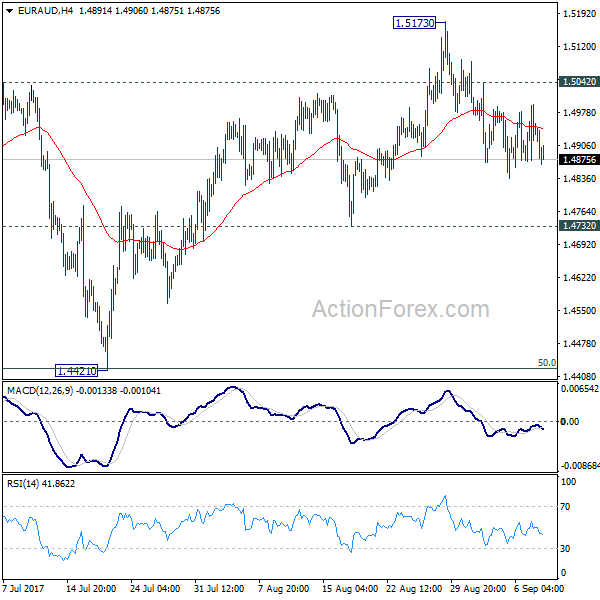
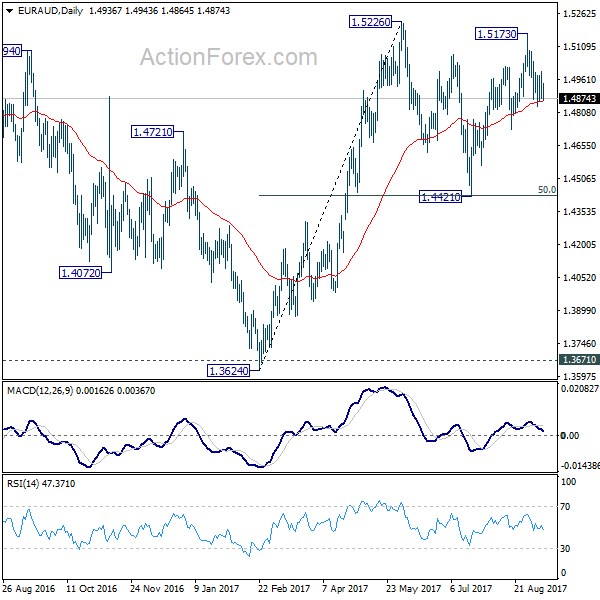
Daily Pivots: (S1) 1.4873; (P) 1.4934; (R1) 1.4998; More....
With 1.5042 minor resistance intact, deeper fall is expected in EUR/AUD to 1.4732 support. Break of 1.4732 support will confirm that fall from 1.5173 is the third leg of consolidation pattern from 1.5226. In that case, further fall should be seen to 1.4421 again. But we'd expect strong support from there to contain downside and bring rebound. On the upside, above 1.5042 minor resistance will turn bias back to the upside for 1.5173 resistance instead.
In the bigger picture, we're holding on to the view that corrective decline from 1.6587 medium term has completed at 1.3624. Rise from 1.3624 is expected to extend to retest 1.6587. The corrective structure of the price actions from 1.5226 is affirming this view. Above 1.5226 will target a test on 1.6587 key resistance. However, break of 1.4421 will dampen our view and would drag EUR/AUD lower to retest key support zone around 1.3624.
Euro Punches Past 1.20 On Draghi Tapering Comments
The euro rally continues, as EUR/USD has posted slight gains in the Friday session. Currently, the pair is trading at 1.2064, up 0.34% on the day. The euro has gained 1.4% this week, and is trading at its highest level since January 2015. On the release front, Germany’s trade surplus narrowed to EUR 19.5 billion, short of the forecast of EUR 20.3 billion. There are no major events in the US, but we’ll hear from FOMC member Patrick Harker.
The euro pushed above the symbolic 1.20 level on Thursday, after investors liked what they heard from ECB President Mario Draghi. As expected, the ECB maintained interest rates at 0.00%, and what investors wanted to hear was some guidance regarding the bank’s asset purchase program (QE), which is scheduled to end in December. The ECB announcement was surprisingly dovish, as policymakers said that QE would not be tapered before December, and left the door open to further stimulus in 2018, if necessary. However, Mario Draghi presented a more hawkish stance in his follow-up press conference, saying that the ECB would decide on tapering stimulus in October. Draghi made direct reference to the exchange rate, noting that “the recent volatility in the exchange rate represents a source of uncertainty which requires monitoring”. Draghi & Co. are clearly concerned by the euro’s appreciation, as the EUR/USD has soared 14 percent in 2017. The stronger euro has made imports less expensive, thus reducing inflation and hampering the ECB’s efforts to raise inflation levels. The ECB has now cut its inflation forecast to 1.2 percent in 2018 and 1.5 percent in 2019, well short of its target of just below 2 percent.
The markets have grown used to solid German numbers, so this week’s numbers have been a disappointment. Earlier this week, Factory Orders declined 0.7%, well off the forecast of a 0.2% gain. This marked a 3-month low. German Industrial Production followed suit, as the reading of 0.0% missed the estimate of 0.5%. On Friday, Germany’s trade surplus dropped to EUR 19.5 billion, the smallest surplus since January. Why the downturn? Global demand, which had been very strong in the first half of 2017, is showing signs of softening, and this had a negative impact on the manufacturing sectors in Germany and throughout the eurozone. This has also had a negative impact on exports, which was reflected in the Germany’s smaller surplus in July.
EUR/CHF Daily Outlook
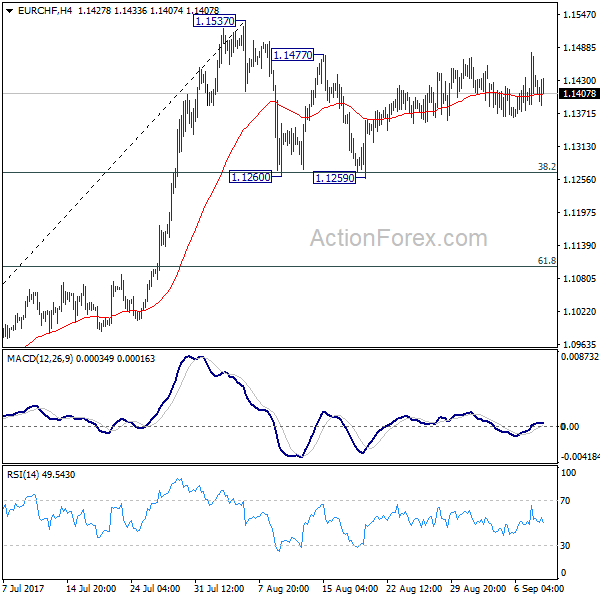
Daily Pivots: (S1) 1.1374; (P) 1.1428; (R1) 1.1478; More...
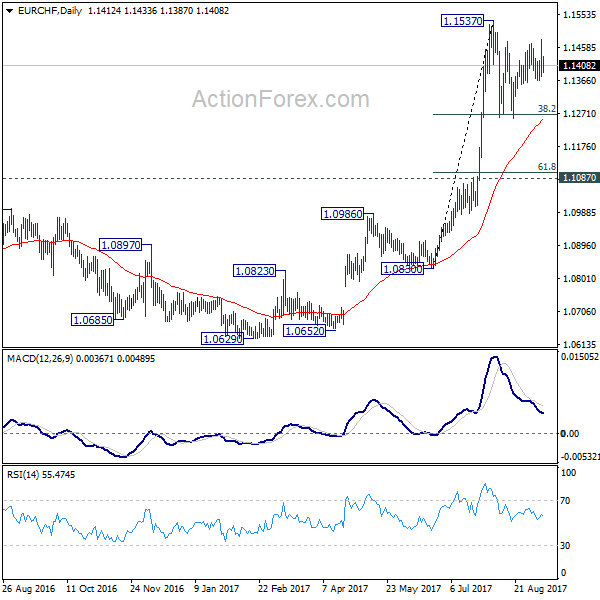
EUR/CHF is still bounded in consolidation from 1.1537 and intraday bias stays neutral. More sideway trading could be seen. On the upside, break of 1.1537 resistance will confirm resumption of larger rally from 1.0629. In that case, EUR/CHF should target 1.2 key resistance level next. On the downside, firm break of 38.2% retracement of 1.0830 to 1.1537 at 1.1267 will extend the correction to 61.8% retracement at 1.1100 before completion.
In the bigger picture, long term rise from SNB spike low back in 2015 is still in progress. EUR/CHF should now be heading back to prior SNB imposed floor at 1.2000. For now, this will be the favored case as long as 1.1087 resistance turned support holds.
Market Update – European Session: USD Can’t Find Love, ECB Said To Have Discuss 4 Options For QE Extension
Notes/Observations
USD at 2 1/2 lows over concerns of economic fallout from Hurricane Irma as doubts that the Fed has the firepower or the will to raise interest rates again this year
China CNY currency (yuan) at strongest level since Dec 2015 (both onshore and offshore markets) on speculation the PBoC will tolerate a stronger currency
France and UK July Industrial Production in-line with expectations
Overnight
Asia:
Japan Q2 Final GDP revised lower (Q/Q: 0.6% v 0.7%e; GDP Annualized: 2.5% v 2.9%e). Downward revision in annualized GDP growth was biggest under current calculation method adopted in 2010.
Japan govt official: Domestic economy continues to recover moderately as a trend, driven by domestic demand
China Aug Trade Balance registers a smaller surplus ($42.0B v $48.5Be); Components mixed (Exports Y/Y: 5.5% v 6.0%; Imports Y/Y: 13.3% v 10.0%)
PBOC set Yuan reference rate 6.5032 per USD (10th consecutive day of stronger setting with yuan fix at its strongest level since May 2016 (16-month high)
Europe:
Spain Constitutional Court suspended the Catalan referendum law, as requested by PM Rajoy
Greek PM Tsipras reiterates ready and determined to exit bailout in August of 2018
Americas:
Magnitude 8.0 Earth quake reported 87KM SSW of Tres Picos Mexico (near Gualamlia border) - Fed's Dudley (voter): Reiterates balance sheet rolloff likely to start relatively soon; Don't expect Harvey to alter trajectory of US economy. Reiterates appropriate to continue removing policy accommodation
FBI Director Wray: Have not detected any whiff of interference into Russian meddling in 2016 election
President Trump: US military action in North Korea remains option, but it's not inevitable. Lots of good reasons to get rid of the debt ceiling. Would have done a longer deal on debt ceiling but wanted to be able to spend more on military spending
President Trump and Senate Democratic Leader Schumer said to have agreed to seek a permanent repeal of the debt ceiling under a 'gentleman's agreement'
US Senate has sufficient votes to move Hurricane Harvey aid/three-month debt ceiling raise bill forward (as expected). Senate approved $15.25B in disaster aid, measures to fund Govt, raise debt limit through to Dec 8thBill now moves to the House, where it is also expected to pass
Economic data
(NL) Netherlands July Manufacturing Production M/M: -0.7 v -0.3% prior; Y/Y: 3.0% v 3.3% prior, Industrial Sales Y/Y: 5.7% v 4.7% prior
(JP) Japan Aug Eco Watchers Current Outlook: 49.7 v 49.5e; Outlook Survey: 51.1 v 50.1e
(CH) Swiss Aug Unemployment Rate: 3.0% v 3.0%e, Unemployment Rate (Seasonally Adj): 3.2% v 3.2%e
(DE) Germany July Current Account: €19.4B v €20.8Be; Trade Balance: €19.5B v €21.0Be; Exports M/M: 0.2% v 1.3%e; Imports M/M: 2.2% v 2.8%e
(DE) Germany Q2 Labor Costs Q/Q: 0.3% v 0.1% prior; Y/Y: 2.3% v 2.2% prior
(FR) France July Industrial Production M/M: 0.5% v 0.5%e; Y/Y: 3.7% v 3.6%e
(FR) France July Manufacturing Production M/M: 0.3% v 0.6%e; Y/Y: 3.9% v 4.2%e
(HU) Hungary Aug CPI M/M: 0.1% v 0.0%e; Y/Y: 2.6% v 2.5%e
(CZ) Czech Aug Unemployment Rate: 4.0% v 4.0%e
(TW) Taiwan Aug Trade Balance: $5.7B v $5.5Be; Exports Y/Y: 12.7% v 12.4%e; Imports Y/Y: 6.9% v 5.7%e
(UK) BoE/TNS Aug Inflation Expectations Survey Next 12-month: 2.8% v 2.8% prior
(UK) July Visible Trade Balance: -£11.6B v -£12.0Be, Overall Trade Balance: -£2.9B v -£3.3Be, Trade Balance Non EU: -£3.8B v -£3.9B prior
(UK) July Industrial Production M/M: 0.2% v 0.2%e; Y/Y: 0.4% v 0.4%e
(UK) July Manufacturing Production M/M: 0.5% v 0.3%e; Y/Y: 1.9% v 1.7%e
Fixed Income Issuance:
(IN) India sold total INR150B vs. INR150B indicated in 2024, 2027, 2034 and 2051 bonds
SPEAKERS/FIXED INCOME/FX/COMMODITIES/ERRATUM
Equities
Indices [Stoxx600 -0.3% at 373.7, FTSE -0.3% at 7374, DAX -0.1% at 12280, CAC-40 -0.3% at 5097, IBEX-35 -0.2% at 10108, FTSE MIB -0.4% at 21636, SMI -0.1% at 8897, S&P 500 Futures -0.3%]
Market Focal Points/Key Themes: European Indices drift lower this morning in quiet trade as markets digest developments from the ECB yesterday. Concerns over the effect of Hurricane Irma and an Earthquake in Mexico also weigh. On the corporate front Akzo Nobel trades lower after trimming its 2017 out, as well as announcing new management structure. Safestyle trades sharply lower after a profit warning, while Greene king trade sharply low bad weather slowed sales. Air France trades higher after strong August metrics whilst, Finnair trades higher after lifting its outlook.
Equities
Consumer discretionary [SafeStyle [SFE.UK] -29% (Profit warnings), Greene King [GNK.UK] -13.4% (LFL Sales), Air France [AF.FR] +1.7% (Aug metrics)]
Materials: [Akzo Nobel [AKZA.NL] -2.1% (New management structure, trims outlook)]
Healthcare: [Cellnovo [CLNV.FR] - 5% (FDA requests further info), Erytech [ERYP] +3.7% (Positive Study)]
Energy: [Bourbon [GBB.FR] -1.6% (New management)]
Speakers
ECB's Liikanen (Finland): Reiterates General Council view that monetary policy must remain accommodative. Exchange rate can impact inflation
ECB said to have discussed 4 QE scenarios which included 6-month and 9-month extension options. To study bond buying reduction to €40B/month or €20B/month (from current level of €60B)
British Chambers of Commerce (BCC): Medium outlook for UK economy downgraded citing weaker than expected contribution from trade and subdued consumer spending. Weaker GBP currency (pound) failing to boost UK growth
China policymakers said to be worry about a rallying CNY currency (Yuan) as exporters come under strain. Pace of appreciation could not be too fast but China unlikely to intervene forcefully due to worries of criticism by US (**Note: USD/CNY has fallen by almost 8% in 2017)
Currencies
USD maintains its soft tone against the major and commodity-related pairs. Dealers were looking for fresh factors to the greenback's woes. USD was at 2 1/2 year lows against a basket of currencies. One analyst noted that the recent Hurricane Harvey and imminent threat of Irma would likely push back any additional Fed hikes. Dealers also cited comments from Fed's Dudley who did not repeat his expectation for rate hike this year.
EUR/USD holding in the mid-1.20 area after ECB Draghi failed to jawbone the euro lower at Thursday's policy meeting. The pair hit a 32-month high during the Asian session just under the 1.21 level
USD/CNY price action moving up to the front burner. PBoC Yuan fixing was the 10th straight for a stronger Yuan currency. Various reports noted that China official were becoming concerned with any further one-way appreciation of the yuan versus the US dollar as its would put additional pressure on China's exports
Fixed Income
Bund futures trade at 163.26 up 8 ticks in risk aversion flows as futures hit target session highs of 163.43 to continue the upside momentum towards 163.83, to the downside 162.92 remains initial support followed by 162.53.
Gilt futures trade down 11 ticks at 128.01 having earlier hit 128.2. Yields have seen a slight lift after strong Manufacturing Data, and in line Industrial production data. Continued downside targets 127.48.
Friday's liquidity report showed Thursday's excess liquidity rose to €1.775T from €1.773T and use of the marginal lending facility fell to €1.01BM from €1.04B.
Corporate issuance saw a further $10.4B via 5 issuers come to market headlined by Discovery Communications $6.3B 6 part offering which brings the weeks issuance to over $45.5B above analysts forecasts of over $30B. For the week ending Sep 6th IG Funds reported outflows of $43M, marking the first outflows seen since Mid Dec 2016.
Looking Ahead
(UR) Ukraine Aug CPI M/M: -0.2%e v +0.2% prior; Y/Y: 16.0%e v 15.9% prior
(ES) Spain July YTD Budget Balance: No est v -€13.3B prior
(MX) Mexico Aug Nominal Wages Y/Y: No est v 5.8% prior
05:30 (ZA) South Africa to sell combined ZAR800M in I/L 2029, 2033 and 2046 bonds
05:30 (PL) Poland to sell Bonds
06:00 (PT) Portugal July Trade Balance: No est v -€1.0B prior
06:00 (IE) Ireland July Property Prices M/M: No est v 1.4% prior; Y/Y: No est v 11.6% prior
06:00 (UK) DMO to sell combined £6.0B in 1-month, 3-month and 6-month bills (£2.0B, £2.0B and £2.0B respectively)
06:30 (IS) Iceland to sell Bonds - 06:45 (US) Daily Libor Fixing
07:00 (CL) Chile Aug CPI M/M: 0.3%e v 0.2% prior; Y/Y: 1.9%e v 1.7% prior
07:30 (IN) India Weekly Forex Reserves
08:00 (UK) Aug NIESR GDP Estimate: No est v 0.2% prior
08:05 (UK) Baltic Dry Bulk Index
08:30 (CA) Canada Aug Net Change in Employment: +15.0Ke v +10.9K prior; Unemployment Rate: 6.3%e v 6.3% prior
08:30 (CA) Canada Q2 Capacity Utilization: No est v 83.3% prior
08:30 (US) Weekly USDA Net Export Sales
08:30 (HU) Hungary Central Bank Vice Gov Nagy
08:45 (US) Fed's Harker speaks on Consumer Finance in Philadelphia
10:00 (US) July Final Wholesale Inventories M/M: 0.5%e v 0.4% prelim; Wholesale Trade Sales M/M: 0.5%e v 0.7% prior
11:00 (EU) Potential sovereign ratings after EU close
(PL) Poland Sovereign Debt to be rated by Moody's
13:00 (US) Weekly Baker Hughes Rig Count data
15:00 (US) July Consumer Credit: $15.0Be v $12.4B prior
21:30 (CN) China Aug CPI Y/Y: 1.6%e v 1.4% prior; PPI Y/Y: 5.4%e v 5.5% prior
Dovish Draghi Seeks To Weaken Euro
- Exchange rate the key focus of ECB press conference
- Rising currency makes reaching inflation target more problematic
- Important QE decisions should be ready by October but ECB goes softly softly
No major surprises from ECB
There were no major surprises from the ECB policy meeting. Probably, the most notable feature of ECB president Mario Draghi’s press conference was the extent to which he endeavoured – not entirely successfully- to talk down the Euro. However, Mr Draghi’s dovishness did produce a further softening of market interest rates as traders concluded that ECB policy will remain easier slightly longer.
There was no prospect of any immediate change in ECB policy today but there was some expectation that Mr Draghi would provide some indications in relation to future changes in the ECB’s policy stance, particularly in terms of alterations to and/or exit from its Asset Purchase Programme.
Mr Draghi did indicate that there were ‘very preliminary’ discussions on various topic relating to the winding down and eventual exit from QE at today’s ECB meeting but he emphasised these were mostly confined to asking questions about the pros and cons of various scenarios entailing different lengths and purchase amounts that might be considered in the future.
Mr Draghi is right in his assertion that amending or ending the ECB’s ‘current very substantial degree of monetary accommodation’ will entail many complex decisions but the tenor of his comments suggested the key issues occupying the ECB are not technical in nature.
The ECB seems anxious not to tighten prematurely either by altering its QE programme or policy interest rates or, more immediately, by hinting at future policy moves and causing market moves that lead to a tightening of financial conditions. The clear and present danger in this regard is the risk of a further sharp rise in the exchange rate of the Euro.
Euro strength major concern
Unusually, the ECB press statement highlights FX developments - in its opening assessment of the economic environment, noting that ‘the recent volatility in the exchange rate represents a source of uncertainty which requires monitoring with regard to its possible implications for the medium-term outlook for price stability’.
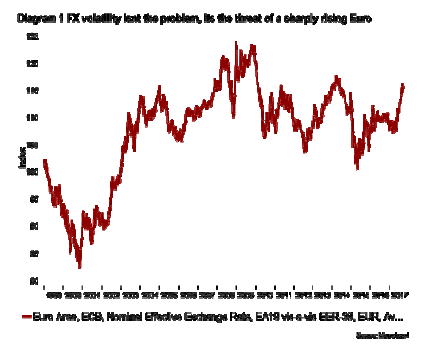
Of course, Mr Draghi and his colleagues aren’t really worried about volatility in the sense of exaggerated twoway moves or choppy market conditions. As diagram 1 below illustrates, the threat that concerns the ECB at present is that expectations of the looming announcement of tighter monetary policy could be the catalyst for a sharp trend move of the sort that has characterised the single currency’s performance since its inception.
Clearly, a rapid or large rise in the Euro’s exchange rate would weigh on economic growth and inflation in the Euro area. While Mr Draghi reiterated that the exchange rate is not a policy target, he added that it is very important for growth and inflation. Some sense of the difficulty a rapidly
rising exchange rate might pose is hinted at in the ECB’s latest projections which encompass a roughly 5% appreciation in the currency relative to the previous forecasts which were published in June.
Growth momentum is strong
Of course, the rise in the exchange rate is not the only notable development in the past three months. In the interim, a range of indicators have testified to the strength of the recovery in the Euro area at present. Economic growth in the second quarter of 2017 is now put at 2.3%, the fastest pace in six years and sufficient to support the strongest employment gains since early 2008. As a result, the ECB has revised up its GDP growth projection for this year from 1.9% to 2.3%. In other circumstance, it might be expected that momentum would build further in coming years but the ECB has maintained its previous estimates of 1.8% in 2018 and 1.7% in 2019.
Although domestic spending is expected to be stronger than was envisaged three months ago and is enhanced by stronger ‘real’ purchasing power, this is offset by a softening in export growth. As the ECB has not altered its outlook for world growth, this pullback is presumably due to the impact of a stronger Euro. Indeed, the press statement adds ‘developments in foreign exchange markets’ to its list of downside risks to growth.
Strong euro hinders return to 2% inflation
More fundamentally, from an ECB perspective, a rising exchange rate reduces its capacity to bring inflation back to target. The new projections are unchanged for 2017 but show a downward revision of 0.1% in each of the next two years to leave inflation at 1.2% in 2018 and 1.5% in 2019. Moreover, the new projections show a slightly larger downgrade to underlying inflation in 2019 from 1.7% to 1.5%, leaving this measure falling well short of the ECB’S target of ‘below, but close to, 2%’.
The coincidence of a strong economy and a strong exchange rate is not unusual but it does put Mr Draghi and his colleagues in a very awkward position at present. ECB research finds that a 1% movement in the exchange rate prompts a movement in consumer prices in the opposite direction of about 0.1% within a year and 0.2-0.3% within three years. In a world characterised by low inflation, further significant FX appreciation might be seen as threatening to prevent the ECB from reaching its inflation any time in the foreseeable future.
Some rationale for a particularly dovish stance in these circumstances might be suggested by ECB research (referred to by Mr Draghi) that suggests the impact of exchange rate movements on inflation varies depending on the cause of the currency move. This research finds that ‘when a monetary policy shock drives the nominal exchange rate, a relatively larger pass-through tends to be generated.’ (ECB bulletin 7 2016, p47).
This research would suggest that ECB policy ‘surprises’ are likely to have a particularly marked impact on inflation and would appear to argue for a ‘softly, softly‘ approach at present. Reflecting such considerations, Mr Draghi hinted that there was some significant discussion at today’s meeting as to the precise factors behind the Euro’s recent strengthening. A sense that opinions might differ on this issue might be hinted at in Mr Draghi’s remark that such considerations needed to take account of ‘the credibility of monetary policy’.
It might be an exaggeration to say the ECB press conference was all about the exchange rate, but it is clear that it is posing Mr Draghi and his colleagues particularly tricky questions at present. This is also postponing any prospect of clarity on when and how quickly the ECB will begin to exit from its QE programme. Mr Draghi indicated that there hadn’t been any discussions today on important issues such as the sequencing of policy changes or possible changes to the features of the Asset Purchase Programme such as issuer or issue limits.
These remarks may have been intended to emphasise that the point of departure remains some time away but, in an important sense, these sorts of uncertainty may be adding to pressure on the Euro as markets may have already priced the currency on the expectation of a looming first step away from QE.
If, as Mr Draghi suggested, many of the important decisions should be agreed by the ECB’s October policy meeting on October 26th, the reaction of interest rate or FX markets may not be that dramatic. Traders should be able to cope with the impact of a gradual phasing back of QE during 2018 to be followed by modest rate rises that wouldn’t commence until ’well past the horizon of our net asset purchases’.
Is ECB moving too slow?
However, problems could arise if the ECB delays too long in setting out some broad contours for its exit path. Such problems would be aggravated if Eurozone growth or inflation were to strengthen in coming months and these or other factors were to drive the Euro exchange rate higher. It is entirely understandable that the ECB would want to prepare properly for its exit from QE but there is a risk that in trying to be too careful, it ends up having less room for manoeuvre than it wants.
Mr Draghi repeatedly urged the need for ‘patience’, a commodity frequently in short supply in markets. However, he also indicated that he expected the ECB’s inflation target would be met by 2020- an outcome that should be revealed when formal forecasts for that year are produced in December.
In coming months, markets may begin to debate whether such an outcome would warrant a material shift in the required monetary stance of the ECB- perhaps on a larger scale than the ECB now envisages. Such developments could prompt notably more volatile conditions in FX and interest rate markets than either the ECB or investors now envisage
Risk Aversion Creeping Back In As USD Tumbles
- Traders seek shelter with weekend risk heightened by North Korean holiday;
- USD hits lowest since start of 2015;
- EURUSD higher as Draghi’s hawk is doves clothing act falls short;
- Safe haven Gold breaks above $1,350.
Risk aversion is creeping back into the markets on Friday as traders prepare for what could be another troubling weekend in the ongoing stand-off between the US and North Korea.
Weekend risk has been ramped up in recent months as tensions between the two countries has escalated. As recent as last weekend, a hydrogen bomb test from North Korea triggered safe haven flows at the open on Monday which caused a number of markets to gap at the open. It’s this that traders are concerned about, especially as the size of such gaps will be much larger should the outcome of these tests lead to a significant escalation.
What makes this weekend more concerning than others is that North Korea celebrates founding day on Saturday, which would be the perfect opportunity for it to display a show of strength, as it did on the same day last year. With that in mind, it will be interesting to see just how people trade into the close and whether the flight for safety starts early this week. We’re already seeing signs of this today with safe havens Gold, yen and the Swiss franc all higher. Equity markets are also a little mixed in a sign that risk appetite remains weak.
The US dollar is on course for its worst week since the end of June, down more than 1.5% at the moment and around 0.5% on the day. Traders have been bearish the dollar for the entire year so far and rather than ease up, this looks to have intensified this week. The US dollar index had stabilised around 92-93, which has repeatedly been a support zone since the start of 2015, but this eventually caved yesterday and more losses have followed.
Mario Draghi’s failed efforts to stem the euros rise against the dollar on Thursday with dovish remarks – well, as dovish as he could manage without intentionally misleading – has made matters worse for the greenback. With key technical levels now broken in a number of dollar pairs, I struggle to see any reason to be bullish on the currency. While other central banks are becoming less dovish, or in the case of the Bank of Canada more hawkish, the Fed is doing the opposite and the greenback is in freefall.
There is a danger when there’s such a broad market consensus such as this, that the market is primed for a correction, but I don’t think we’re quite there yet. Gold and other commodities are certainly feeling the benefit of the dollar’s decline and with the yellow metal now trading above $1,350 for the first time in over a year, further upside may lie ahead, with the next test coming around $1,375.
Draghi Tries To Jawbone EUR, But The Currency Does Not Obey
Yesterday, the European Central Bank decided to keep all three of is interest rates unchanged as was widely expected. In the statement accompanying the decision, the Bank left untouched the sentence saying that the QE can be expanded in needed, which was also more or less expected following last week's sources. EUR/USD slid only 30 pips at the time of the release, but surged less than an hour later on Draghi's comments at the press conference following the decision.
At the conference, Draghi tried to jawbone the common currency several times. He noted that the recent volatility in the euro requires close monitoring, and that it is a source of uncertainty. When asked by journalists if the recent appreciation of the bloc's currency has tightened financial conditions, the President replied that it has “unquestionably” done so, but conditions remain supportive. As for the QE program, everything he said was more or less in line with what last week's sources suggested, expect from the part that the ECB should be ready to take the bulk of a decision in October, which may be the main reason behind the euro's surge.
EUR/USD shot up at the time of the conference, broke above the psychological hurdle of 1.2000 (S1), and continued to trade north even in the aftermath of the event. During the Asian morning Friday, the pair hit resistance fractionally below 1.2100 (R1). The price structure continues to suggest a medium-term uptrend and thus we would expect a clear break above 1.2100 (R1) to open the way for our next resistance of 1.2170 (R2).
Now looking ahead, our own view is that the Bank may indeed slim down its monthly purchases to EUR 40bn in October, but we expect it to keep intact the aforementioned sentence with regards to QE extension, in order to maintain flexibility to adjust if unpredicted risks materialize. Basically, we expect the Bank to act in a similar manner as it did in December. The risks to that view relate to the euro, which if it continues to appreciate in such a rapid pace may weigh further on the inflation outlook and thus, prevent policymakers to take a decision at the October gathering.
As for today's events:
The most noteworthy data set we get is Canada's employment report for August. Expectations are for the unemployment rate to have remained unchanged, while the net change in employment is expected to have risen. On Wednesday, the BoC decided to hike rates by another 25bps, while it noted that future policy decisions will be guided by incoming economic data and financial developments as they inform the outlook for inflation. They also noted that consumer spending remains robust, underpinned by continued solid employment and income growth. As such, investors are likely to pay extra attention to this report as they try to assess the probability for another rate hike in 2017. At the time of writing, that probability is around 60% according to Canada's Overnight Index Swaps, and could rise further if the jobs report shows another month of stellar employment gains.
USD/CAD continued trading south yesterday, breaking below the support (now turned into resistance) barrier of 1.2120 (R1), marked by the low of the 18th of June 2015. The medium-term outlook of the pair remains negative and thus, we expect the dip below the 1.2120 (R1) hurdle to set the stage for extensions towards the psychological zone of 1.2000 (S1). The catalyst for such a slide may be a strong employment report from Canada today.
We also get the UK industrial production for July. IP is expected to have slowed in monthly terms, but to have accelerated on a yoy basis, as the expected monthly print is still higher than the one dropping out of the calculation.
We have two speakers on the agenda: RBA Governor Philip Lowe and Philadelphia Fed President Patrick Harker.
EUR/USD
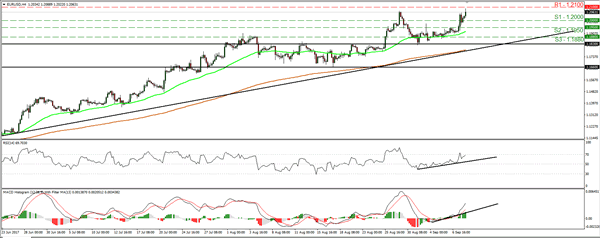
Support: 1.2000 (S1), 1.1950 (S2), 1.1880 (S3)
Resistance: 1.2100 (R1), 1.2170 (R2), 1.2250 (R3)
USD/CAD
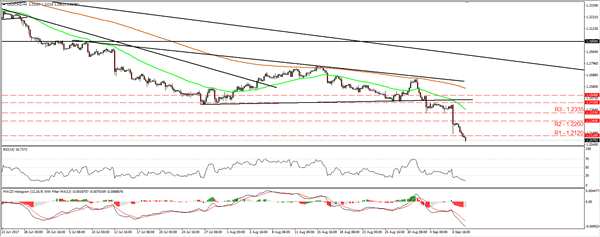
Support: 1.2000 (S1),1.1920 (S2), 1.1800 (S3)
Resistance: 1.2120 (R1), 1.2260 (R2), 1.2335 (R3)