Sample Category Title
Elliott Wave View: AUDUSD More Upside
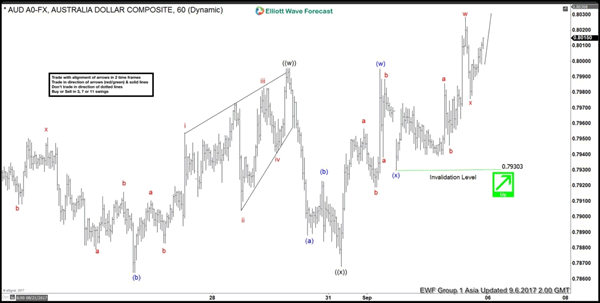
AUDUSD Short Term Elliott Wave view suggests that the rally from 8/15 low is unfolding as a double three Elliott Wave structure. Up from 8/15 low, Minute wave ((w)) ended at 0.79957 and Minute wave ((x)) ended at 0.7868. Minute wave ((y)) is in progress and the subdivision also unfolds as a double three. Minutte wave (w) of ((y)) ended at 0.7995 and Minutte wave (x) of ((y)) ended at 0.793. Near term, while pullbacks stay above 0.793, but more importantly above 0.7868, expect pair to extend higher towards 0.806 – 0.8108. We don’t like selling the pair.
AUDUSD 1 Hour Elliott Wave Chart
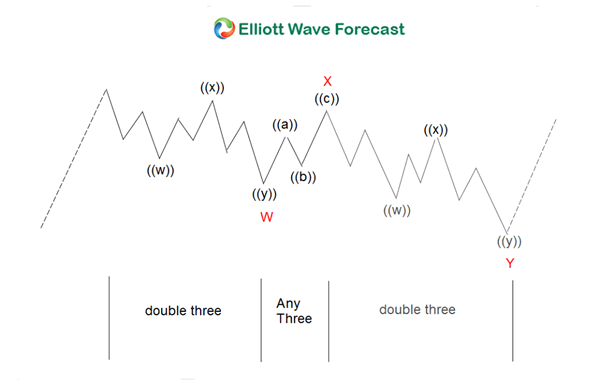
Double three ( 7 swings) is the most important pattern in Elliott wave’s new theory. It is also probably the most common pattern in the market these days. Double three is also known as a 7-swing structure. It is a very reliable pattern that gives traders a good opportunity to trade with a well-defined level of risk and target areas. The image below shows what Elliott Wave Double Three looks like. It has labels (W), (X), (Y) and an internal structure of 3-3-3. This means that all 3 legs has corrective sequences. Each (W) and (Y) is formed by 3 wave oscillations and has a structure of A, B, C or W, X, Y of smaller degrees.
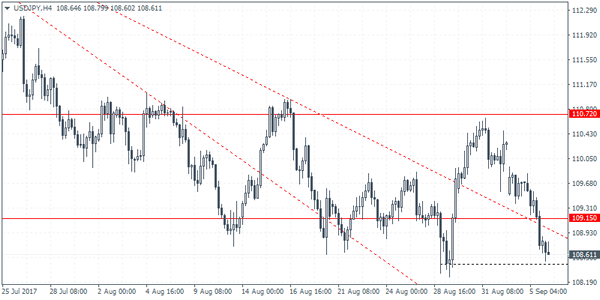
USDJPY Intraday Analysis
USDJPY (108.61): The USDJPY turned bearish yesterday as price action closed below 109.15. The declines could now see the US dollar slip towards the lower end of the support at 108.26. On the daily chart, this also increases the downside risk as the price is trading in this support level. With the descending triangle pattern being formed, a breakdown below 108.26 support could spell further declines. However, there is scope for USDJPY to form a double bottom pattern near 108.46 which falls with the daily chart's support zone. A reversal off this level cannot be ruled out, however, which could build the upside bias. The previously established support level at 109.15 will likely serve as resistance in the near term with further gains coming on a breakout above this level only.
GBPUSD Intraday Analysis
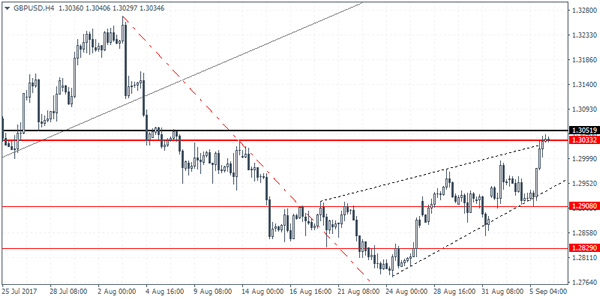
GBPUSD (1.3034): The British pound posted strong gains yesterday as the price reached 1.3033 resistance. A reversal off this level is essential for the potential head and shoulders pattern to be validated. Therefore a daily close below 1.3033 could signal an initial move to the downside towards the neckline support at 1.2847 followed by a move to 1.2628 which completes the measured move of the head and shoulders pattern to the downside. Watch for any potential reversal candlestick pattern on the 4- hour chart near the resistance level. A break out above 1.3051 could, however, signal further gains towards 1.3116.
EURUSD Intraday Analysis
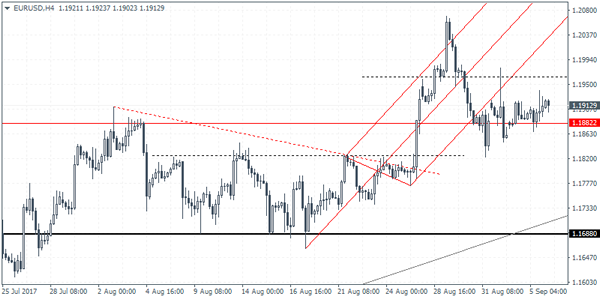
EURUSD (1.1912): The euro currency was seen trading subdued with price action trading with Friday's range. However, the common currency was seen attempting to post higher close in the past few days as it nears the 1.1963 resistance level. On the 4- hour chart, the short term bias remains to the upside with price supported above 1.1882. A reversal at the short-term resistance level at 1.1963 could potentially signal a move to the downside. EURUSD could remain trading within the range into tomorrow's ECB meeting with further gains or declines based on the market interpretation of the ECB meeting and press conference. Still, the bias remains for a correction to 1.1688. However, this could change should EURUSD manage to close above 1.1963 resistance.
Bank Of Canada Expected To Keep Rates Steady
The US dollar continued to suffer as latest threats from North Korea sparked heightened tensions in the region. Investors continued to shun the risk assets bidding up the safe haven assets.
On the economic front, the RBA held interest rates steady as expected in yesterday's meeting. Data from the US showed that factory orders fell 3.3% as forecast by economists. In the UK, the services PMI weakened to 53.2, missing forecasts but the British pound managed to post gains on the day.
Looking ahead, the Bank of Canada's interest rate decision is due later today. No changes are expected from the BoC, but the central bank could potentially signal another rate hike at the October meeting. Therefore, the comments from Governor Poloz will be important. In the US, the ISM's non-manufacturing PMI will also be coming out today. Forecasts expect a pick in the non-manufacturing activity in August.
Currencies: Dollar Has No Safe Haven Roll To Play, At Least For Now
Sunrise Market Commentary
- Rates: Risk sentiment and technical factors are favourable for US Treasuries
Risk aversion (North Korea, Irma, debt ceiling) is positive for core bonds via safe haven flows. The technical picture comes into play as well with US yields erasing last week's potential trend reversal signal and dropping below key support. A strong non-manufacturing ISM probably can't change the tide. The Bank of Canada meeting serves as a wildcard. - Currencies: Dollar has no safe haven roll to play, at least for now
The dollar remains in the defensive. Uncertainty on North Korea and several US political issues prevent the US currency to take up its usual safe have role. The US currency is also losing more interest rate support. EUR/USD looks some kind of immune to global uncertainty. This stalemate probably will continue till tomorrow's ECB meeting
The Sunrise Headlines
- US markets corrected up to 1% lower after returning from the long Labour Day Weekend. Tensions with North-Korea caused the risk aversion. Most Asian stock markets lose ground overnight, but to a lesser extent.
- Japanese workers' wages fell in July on a drop in summer bonus payments, casting some doubt on the sustainability of a recent improvement in consumer spending. Wages fell in both nominal and inflation-adjusted real terms.
- Minneapolis Fed Kashkari argued recent rate increases may be 'actually doing real harm to the economy'. Dallas Fed Kaplan said he could advocate for another hike this year, but he wants to see how inflation plays out. While Harvey will drag on third-quarter growth, it doesn't change his view on monetary policy.
- Britain is developing a strict post-Brexit immigration policy which will mean tougher hurdles to work in the UK for all but the highest-skilled EU migrants, according to a leaked Home Office document.
- Senate GOP leaders signaled they will tie an increase in the nation's borrowing limit to an aid package for victims of Harvey, a move that could boost the debt-limit legislation's chances of passage ahead of a deadline this month.
- The CNB does not need to rush with the next interest rate hike following strong economic data and can wait for the next quarterly update of its forecasts due in early November before deciding what to do next, Governor Rusnok said.
- Today's eco calendar only contains the US Non-manufacturing ISM. The Bank of Canada's rate decision will receive some attention as well with the market split on the possibility of a new hike. Germany sells bonds
Currencies: Dollar Has No Safe Haven Roll To Play, At Least For Now
For now , the dollar has no safe haven role to play
Yesterday, European equities and the dollar traded with a negative bias as investors still pondered the impact of the tensions on the Korean peninsula. The European and US eco data were softer than expected, but were not to blame. Sentiment deteriorated further during the US session and US yields nosedived. North Korea was maybe still partially to blame , but other political issues in Washington were also in play. The dollar remained under moderate pressure. EUR/USD closed the session at 1.1914. The loss of USD/JPY was more substantial. The pair finished the session at 108.81.
This morning, Asian markets trade with a modest risk-off bias, but the losses are limited compared to the US yesterday. The yen is holding near the recent highs against the dollar (108.65/70 area). EUR/USD remains immune for global uncertainty and is little changed at around 1.1915. Other euro cross rates (EUR/JPY, EUR/GBP, …) are feeling some stronger headwinds. The Australian Q2 GDP was slightly softer than expected. AUD/USD rebounded north of 0.80 on overall USD weakness yesterday, but loses slightly ground after the GDP this morning. (currently 0.7990).
The EMU eco calendar is empty ahead of tomorrow's ECB meeting. In the US, the July trade deficit is expected to have widened modestly in July but, if confirmed, net trade would still add positively to Q3 GDP. The August nonmanufacturing ISM is more important. The headline ISM fell sharply in June. Markets expect a rebound to 55.5. We see risks on the upside of consensus. The Fed Beige book probably will be in line with the eco data releases, but maybe there are already some signs about the impact of Harvey. All in all, it shouldn't affect markets much.
Yesterday, global investor sentiment turned again more fragile. The tension on Korea, a new hurricane in the US and other pending political issues clouded the (US) economic outlook. The yen remains the preferred safe haven. The dollar lags the other majors. The EUR/USD shows no clear pattern even as interest rate differentials between the dollar and the euro narrowed substantially. Global investors sentiment will remain cautious today , but the eco data (US ISM) might be slightly USD supportive. If US yields were to bottom out, it might contain further USD losses. However, sentiment on the dollar remains fragile. Will the trade-weighted dollar and USD/JPY sustain above the recent lows? EUR/USD shows not clear ST direction and this probably won't change ahead of tomorrow's ECB meeting.
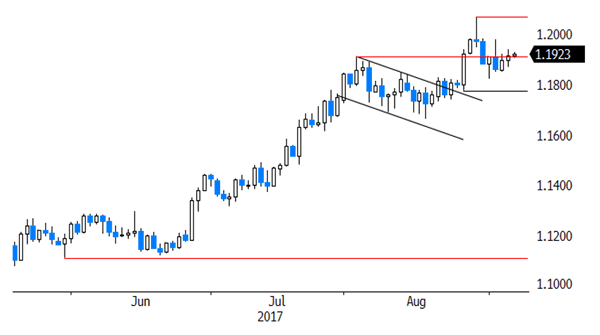
Global context. Dollar sentiment improved slightly after the Jackson-Hole selloff, but USD didn't regain any technically relevant level. There is no sign on a Uturn in favour of the dollar. The data might be USD supportive, but a (moderate) risk-off sentiment weighs on the dollar. Therefore, we maintain a EUR/USD neutral bias ahead of the ECB meeting. EUR/USD falling below the 1.18/1.1775 area would suggest more downside short-term. For such a move, the USD needs good data and higher US yields. On the euro side of the story, Draghi has to convince markets that low inflation is enough a reason for the ECB to maintain a loose monetary policy. On the topside, the 1.2070 correction top remains the first reference.
A downward correction in core (US and European) yields supported the yen in August. USD/JPY declined from mid-114 mid-July and came within reach of the key 108.13 range bottom, but the support did its job. We maintain the working hypothesis that this level won't be broken easily as a lot of USD bad news is discounted. A cautious buy-on-dips (with stop-loss protection below 108) may be considered. USD/JPY needs to regain the 110.95 level to suggest an improved upside momentum. Such a break might be difficult as long as global sentiment remains risk-off.
EUR/USD going nowhere even as global uncertainty mounts
EUR/GBP
Sterling rebounds despite Brexit stalemate
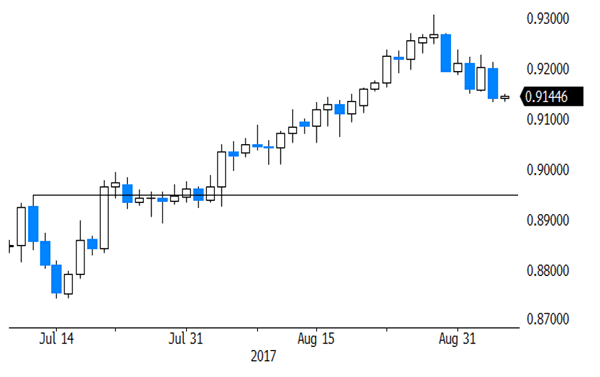
The technical rebound of sterling resumed yesterday. The UK data didn't provide a valuable explanation. The UK August services PMI even declined slightly more than expected. We consider the GBP rebound mainly as technical in nature. Last week's Brexit negotiations didn't yield any concrete progress, but sterling shorts apparently are taking some chips of the table, in particular against a strong euro. EUR/GBP drifted south even as EUR/USD stabilized. EUR/GBP closed the session at 0.9141 (from 0.9202). Cable rebounded north of 1.30.
Global factors, technical considerations and Brexit headlines will set the tone for sterling trading today. A risk-off context is usually a negative rather than a positive for the UK currency. However, this was not the case over the previous days. We have a long term sterling negative bias, but wait for a deeper correction higher of sterling before stepping in and sell sterling.
From a technical point of view, EUR/GBP cleared 0.8854/80 resistance (top end June), opening the way for further gains. The move was the result of euro strength. Simultaneously, UK price data were soft enough to keep the BoE sidelined. MT, we maintain a buy EUR/GBP on dips approach as we expect the combination of relative euro strength and sterling softness to persist. The 0.9415 ‘flash-crash spike' is the next target on the charts. However, we wait for a correction, e.g. to the technical support in the 0.88/89 area, to sell sterling again versus the euro.
EUR/GBP: sterling resumes (technical) rebound
AUD/JPY Candlesticks and Ichimoku Analysis
Weekly
• Last Candlesticks pattern: Shooting star
• Time of formation: 13 Mar 2017
• Trend bias: Down
Daily
• Last Candlesticks pattern: Bearish engulfing pattern
• Time of formation: 16 Feb 2017
• Trend bias: Near term down
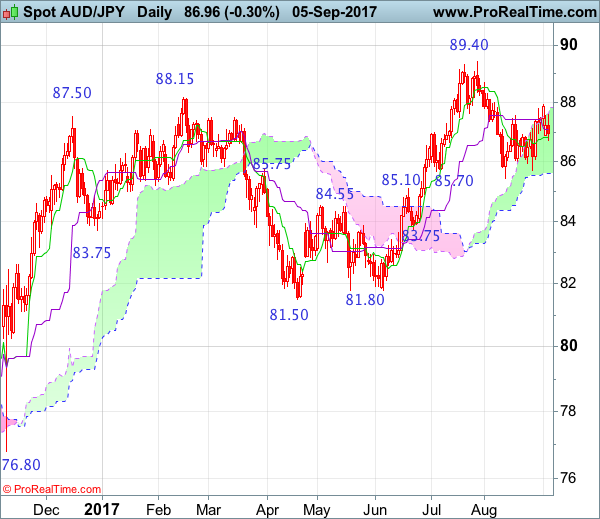
AUD/JPY - 86.80
Despite rising to 87.90 (just missed our upside target at 88.00), as aussie ran into heavy offers there and has retreated, dampening our bullishness and consolidation below this level would be seen, downside risk of weakness to 86.50 and possibly 86.05-10 cannot be ruled out, however, still reckon support at 85.70 (last week’s low) would hold and bring rebound later. Only a drop below 85.70 would signal the fall from 89.40 top has resumed and bring test of previous support at 85.45, break there would confirm and extend weakness bring retracement of recent rise to 85.00, then 84.50, having said that, near term oversold condition should limit downside to previous support at 83.75 and bring another rebound in late Q3.
On the upside, expect recovery to be limited to 87.20 and resistance at 87.60 should hold, bring another retreat later. Only break of said resistance at 87.90 would revive bullishness and extend the rebound from 85.45 low towards resistance at 88.70-75, however, break there is needed to signal the retreat from 89.40 has ended, bring another rise towards this level, otherwise, further choppy trading would take place. Looking ahead, only a break of this recent high would confirm medium term upmove from 2016 low of 72.50 has resumed and extend further gain to psychological resistance at 90.00, then towards previous chart resistance at 90.70.
Recommendation: Take profit on our long position entered at 85.75 and stand aside
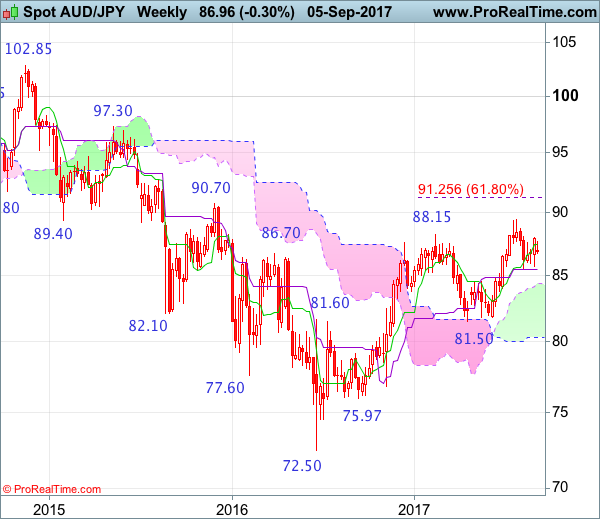
On the weekly chart, although aussie rebounded last week to 87.90, the subsequent retreat suggests further sideways consolidation would be seen and pullback to 86.00-10 cannot be ruled out, however, reckon support at 85.45 would hold and bring another rebound later. Above 87.90-00 would bring test of indicated resistance at 88.70-75 but break there is needed to signal the retreat from 89.40 has ended, bring retest of this level which is likely to hold on first testing. Looking ahead, above this recent high would confirm medium term upmove from 72.50 low (formed back in 2016) has resumed and may extend headway to psychological resistance at 90.00, then test of previous resistance at 90.70 but overbought condition should limit upside to 91.50-60 and price should falter below another previous chart resistance at 92.70, bring correction later.
On the downside, below said support at 85.45 (same level as current Kijun-Sen) would suggest a temporary top has possibly been formed at 89.40 and downside risk remains for retracement of recent upmove to bring further fall to 84.95-00, then test of the upper Kumo (now at 84.34) but reckon previous support at 83.75 would limit downside and price should stay above support at 82.55-60, bring rebound later.
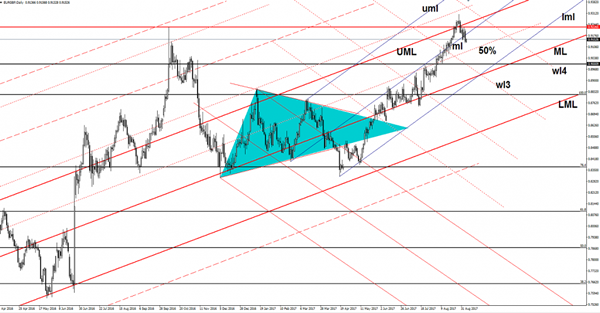
EUR/GBP Breakdown Occurred
Price has finally managed to breakdown below the median line (ml) of the minor ascending pitchfork. The next downside target will be at the 50% Fibonacci line (ascending dotted line), where he may find support again. Could come back to retest the broken median line (ml), signaling that we may have a larger drop.
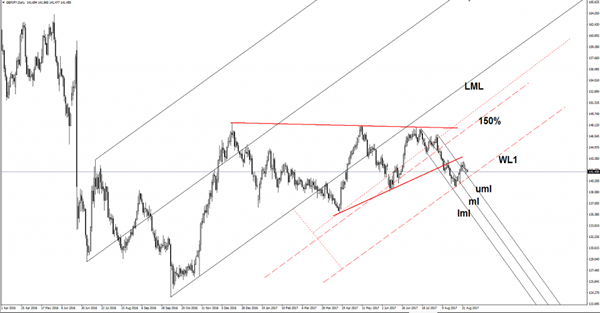
GBP/JPY Attracted By A Confluence Area
Price is trading in the red and is expected to reach new lows in the upcoming days. Could be attracted by the confluence area formed between the WL1 with the upper median line (uml) of the minor descending pitchfork.
Looks like that the minor rebound is completed, for now, price failed to retest the red uptrend line, signaling that the bulls are exhausted already. A rejection from the confluence area or from the WL1 will confirm another leg higher on the short term, but a valid breakdown will open the door for more declines in the upcoming weeks.
NZD/USD Downside Still An Option
Price dropped in the last hours and erased the morning gains. The Kiwi is trading in the red right now, while the USD is struggling to start another leg higher in the upcoming days. Is premature to talk about an important drop because the price is located much above the 0.7131 lowest low.
Now is very important how will react after the United States data will be released, some positive numbers will lift the greenback. USDX is still trading in the red, but technically, seems a little oversold on the Daily chart. The dollar index stays much above the 91.64 lowest low, a minor consolidation here will signal a reversal on the short term
The United States ISM Non-Manufacturing PMI is expected to increase from 53.9 to 55.8 points, a better report will boost the USD. The Trade Balance and the Final Services PMI will be released as well.
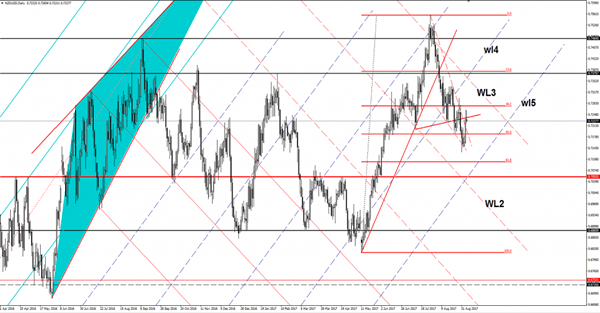
You can see on the Daily chart that the rate has come back to retest the Head and Shoulders neckline (minor red uptrend line). Price has jumped above this line in the yesterday’s session, but failed to close there, we had a false breakout above it today as well. NZD/USD is trading in the red right now and could come back to retest the minor Falling Wedge upside line.
Could drop also to retest the 50% Fibonacci level, I’ve said in the previous report that an accumulation above it will signal an increase at least till the third warning line (WL3).