Sample Category Title
AUD/USD Riding Downtrend Channel
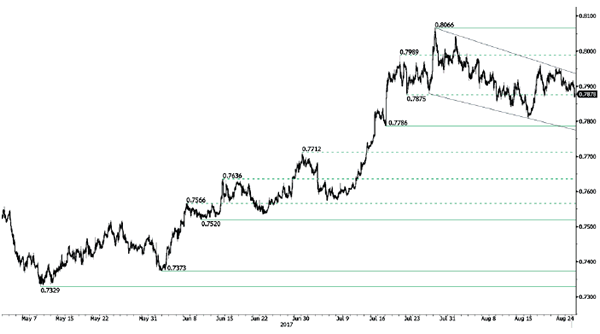
AUD/USD's short-term technical structure is bearish. Hourly support can be found at 0.7786 (18/07/2017 low). Hourly resistance is given at 0.8066 (27/07/2017 high). Expected to edge lower within downtrend channel.
In the long-term, we are waiting for further signs that the current downtrend is ending. Key supports stand at 0.6009 (31/10/2008 low) . A break of the key resistance at 0.8295 (15/01/2015 high) is needed to invalidate our long-term bearish view.
USD/CAD Continued Short-Term Weakness
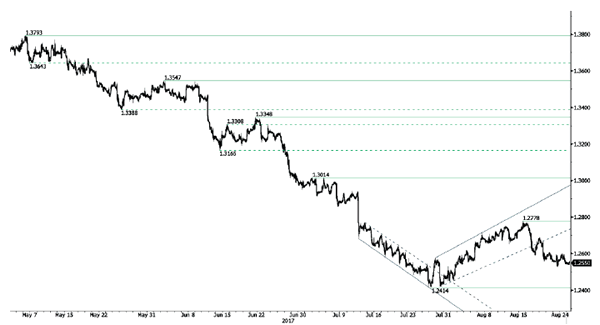
USD/CAD is having some weakness. Hourly support is given at a distance at 1.2414 (27/07/2017 low). Expected to show continued short-term bearish move.
In the longer term, the pair has broken longterm support that can be found at 1.2461 (16/03/2015 low) before bouncing back. Strong resistance is given at 1.4690 (22/01/2016 high). The pair should head further lower.
USD/CHF Sideways Price Action
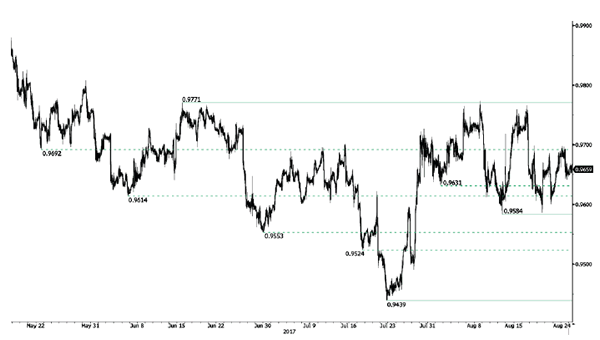
USD/CHF is trading mixed. Higher resistance is given at 0.9771 (15/06/2017 high). Hourly support lies at at 0.9584 (08/11/2017 low). Expected to show growing upside pressures.
In the long-term, the pair is still trading in range since 2011 despite some turmoil when the SNB unpegged the CHF. Key support can be found 0.8986 (30/01/2015 low). The technical structure favours nonetheless a long term bullish bias since the unpeg in January 2015
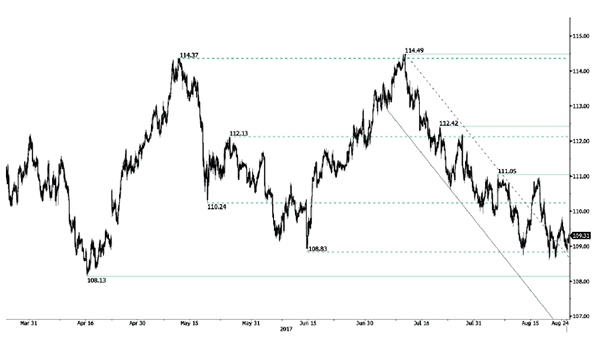
USD/JPY Selling Pressures Increase
USD/JPY's volatility is growing. The pair is likely to head back towards former support at 108.13 (17/04/2017 low). Expected to show another leg lower.
We favor a long-term bearish bias. Support is now given at 96.57 (10/08/2013 low). A gradual rise towards the major resistance at 135.15 (01/02/2002 high) seems absolutely unlikely. Expected to decline further support at 93.79 (13/06/2013 low).
GBP/USD Heading Lower
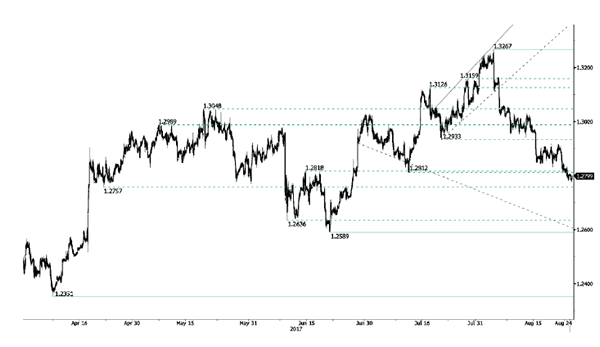
GBP/USD continues to move lower. Hourly resistance is given at 1.2917 (18/08/2017 high). Hourly support at 1.2812 (12/07/2017 low) has been broken. Expected to show continued bearish pressures.
The long-term technical pattern is even more negative since the Brexit vote has paved the way for further decline. Long-term support given at 1.0520 (01/03/85) represents a decent target. Long-term resistance is given at 1.5018 (24/06/2015) and would indicate a long-term reversal in the negative trend. Yet, it is very unlikely at the moment.
EUR/USD Ready To Bounce Lower
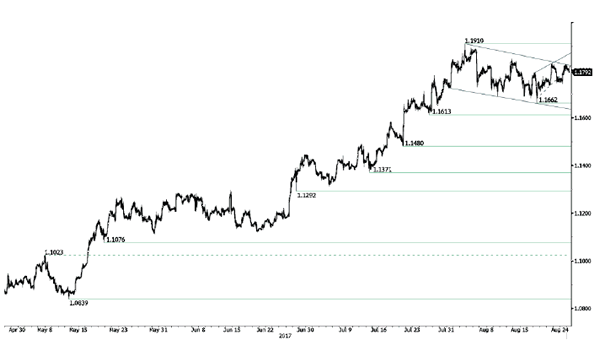
EUR/USD short-term bullish pressures are slowing down. Hourly resistance can be found at 1.1910 (02/08/2017 high) while hourly support lies at 1.1613 (26/07/2017 low). Expected to show renewed bearish pressures.
In the longer term, the momentum is now turning largely positive. We favour a continued bullish bias. Key resistance holding at 1.1871 (24/08/2015 high) has been broken while strong support lies at 1.0341 (03/01/2017 low).
All Eyes On Jackson Hole
Jackson Hole could surprise
After much hype, the annual Jackson Hole Economic Symposium is finally here. The highlight of the two day even will clearly be scheduled speeches by Fed Chair Yellen and ECB President Draghi (Aug 25th). Fed Chair Yellen expected to discuss “Financial Stability” which is likely to include views on current easing financial conditions. Perhaps it's the summer heat but the market remains blasé in not expected anything new from Yellen. However, Jackson Hole does have reputation for market moving events. Remember Draghi's game changing comment “whatever it takes to preserve the euro“. The FOMC minutes indicate the Fed is heading toward balance sheet reduction before rate hike. While balance sheet reduction are less supportive of USD we still expect a noticeable uptick as details and execution emerge.
It is possible judging from recent FOMC minutes at Yellen might argue that an increase in short-term interest rates will help support financial stability. Even if inflation outlook remains subdued (remaining view of transitory factors). In our view, confident Fed message in this direction should be viewed as hawkish and supports a rally in USD. From our perspective the markets is under-pricing Fed rate path due to recent softness in economic data and further concerns over trumps administration ability to achieve policy goals. Fed rate hikes market are pricing in a merger 40% probability of 25bp for 2017. A repricing will send short term yields higher (US 2-yr yields at 1.31%) and likely catch the markets flatfooted. Low yielding G10 currencies are particularly susceptible to a rise in US yields. In regards to Draghi we suspect he will let Yellen steer the conversations since hints on ECB monetary policy drives Euro bulls. ECB July meeting minutes revealed that members are worried about the risk of exchange rate overshoot.
Upside surprise in NZ trade balance fails to boost NZD
New Zealand's trade balance surprised to the upside in July as it rose to NZ$85m, while economists expected a deficit of NZ$200. This is the first time since 2012 that the country reports a trade surplus for the month of July. The good news came on the back of an unexpected increase in dairy exports, which jumped 51% to NZ$1.27bn. Overall, exports rose 17%y/y or NZ$668 million to reach NZ$4.63 billion. Imports were up NZ$232 (+5.4%y/y) amid sharp increase in vehicles, part and accessories imports (+15%y/y).
The unexpected surged in exports is particularly surprising as the Kiwie has been appreciating substantially since the beginning and reached 0.7558 at the end of July, its highest level against the greenback since May 2015.
In the FX market, the lack of reaction by traders showed that the rally that send NZD/USD to 0.72 wasn't driven by local economic developments but rather by the investors' appetite for higher yields. Indeed, both the Kiwi and the Aussie were in high during the summer month as the Federal Reserve prolonged the suspense about the future of its monetary policy.
Over the last three weeks, NZD/USD has broken several supports and is currently testing the key 0.7188 level (Fibonacci 50% on May-July rally). If broken the following one stands at 0.71 (Fibo 61.8% and psychological level), while on the upside a resistance lies at around 0.7330 (50-day MA). We remain bearish Kiwie - and Aussie- as we expect investors will slowly start to reload long USD position ahead of September FOMC meeting.
Euro Inches Up After Encouraging PMIs
The euro gained further yesterday, particularly versus sterling, following the release of Eurozone’s preliminary manufacturing and services PMIs for August. Even though the bloc’s services index slipped somewhat, the manufacturing print rose notably, which was enough to push the composite index higher. Despite the slowdown in services, if seen in combination, these prints signal that the bloc’s economy continues to recover at a solid pace, and they are consistent with our view that the ECB is set to announce QE changes soon.
As for Draghi, he did not reveal anything new on policy yesterday. Market focus remains on his Jackson Hole speech tomorrow. The euro could consolidate somewhat until then, given that there are no Eurozone data on the economic calendar, and that traders may be hesitant to assume new positions ahead of such a risk event. If anything, we believe there may be some hedging or liquidation of prior long-EUR positions ahead of his remarks, in case market participants are concerned that he may appear more worried than previously with regards to the latest strength of the euro.
Today’s highlights:
In the UK, the 2nd estimate of GDP for Q2 is expected to confirm the preliminary reading. If we were to see any revision, we think that it could be higher, as the only major indicator for Q2 released after the 1st GDP estimate was industrial production for June, which was stronger than expected. An upside revision could support GBP, but given the continued sell-off in the currency recently, any positive reaction may remain short-lived.
If the GDP print remains unchanged as expected, market focus may turn to the other key aspect of this data set; business investment. Back in June, BoE Governor Carney noted that a BoE rate hike may depend mainly on whether weaker consumption growth is offset by stronger business investment, and on whether wages begin to firm. Given that wages have shown little-to-no signs of firming in recent months, a pickup in business investment may be needed to keep alive some speculation for a near-term BoE hike. At the time of writing, the probability for a hike by year-end rests at 25%, according to the UK
Overnight Index Swaps.
EUR/GBP traded higher yesterday after it hit support near the 0.9150 (S1) level and at the time of writing, it is testing the resistance barrier of 0.9235 (R1). The rate continues to print higher peaks and higher troughs above the short-term uptrend line taken from the low of the 17th of July and as such, we consider the near-term outlook to be positive. A clear break above 0.9235 (R1) could set the stage for more bullish extensions, perhaps towards our next resistance level of 0.9300 (R2). Nevertheless, given that we see upside risks to the UK GDP data coming out today, we are mindful of a corrective setback before the bulls decide to take the reins again. Our short-term oscillators support the case for a pullback as well. The RSI shows signs of topping above its 70 territory, while the MACD, although above both its zero and trigger lines, has started topping as well.
Zooming out to longer-term timeframes, we see that the overall path of the pair is positive as well. The rate continues to trade above the long-term uptrend line taken from the lows of November 2015, something that increases the likelihood for EUR/GBP to continue trading higher in the foreseeable future.
In Norway, GDP data for Q2 have already been released and showed that the nation’s growth rate rose from the previous quarter, beating the forecast for remaining unchanged. This print is better than what the Norges Bank anticipated in its latest economic forecasts and thus, enhances the case for the Bank to continue shifting to a more hawkish stance at its upcoming meetings, in sync with the ECB.
USD/NOK dipped briefly below the support (now turned into resistance) of 7.8500 (R1) after the upside surprise in Norway’s GDP for Q2. The 7.8500 (R1) barrier acted as the lower bound of the sideways range that had been containing the price action since the 25th of July and as such, we think that the near-term bias may have just turned from neutral to negative. If the 7.7800 (S1).
As for the bigger picture, the break below the psychological zone of 8.000 (R3) on the 25th of July may have signaled a trend reversal on the weekly chart, which supports our view for further declines, at least in the weeks to come.
In the US, the annual Jackson Hole economic symposium will commence (24th - 26th). Even though the program with all of the speakers will only be released later today, both ECB President Mario Draghi and Fed Chair Janet Yellen have already been confirmed to speak on Friday. As for the US data, initial jobless claims for the week ended August the 18th and existing home sales for July are due out as well.
EUR/GBP
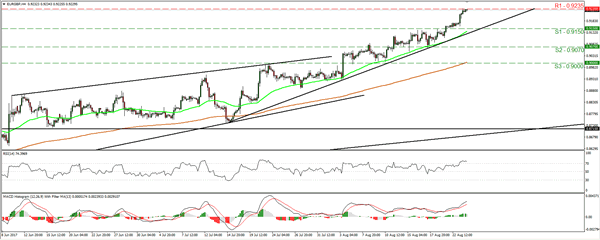
Support: 0.9150 (S1), 0.9070 (S2), 0.9000 (S3)
Resistance: 0.9235 (R1), 0.9300 (R2), 0.9415 (R3)
USD/NOK
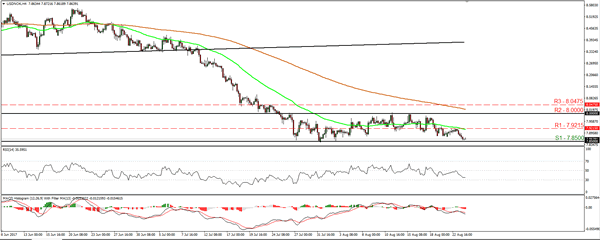
Support: 7.7800 (S1), 7.6800 (S2), 7.6000 (S3)
Resistance: 7.8500 (R1), 7.9215 (R2), 8.0000 (R3)
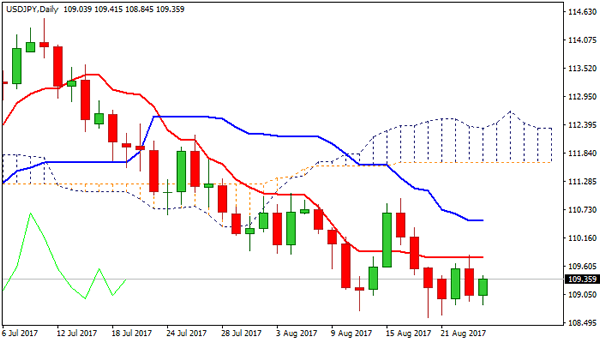
Technical Outlook: USDJPY – Daily Tenkan-Sen To Ideally Cap Extended Consolidation Above Weekly Cloud Base
The pair bounced above 109.00 handle in early Thursday's trading and recovered over 50% of previous day's losses on extension to 109.40 so far.
Near-term action is entrenched within 108.60/109.82 range in past few days, which is seen as consolidation of larger downtrend and strong support provided by weekly cloud base (108.83) as bears were unable to break support clearly.
The upper boundary of congestion is reinforced by daily Tenkan-sen (109.77) which should keep upticks limited before bears resume towards next key support at 108.11 (14 Apr low).
Recent attempts through supports at 108.83/80 (50% of larger 101.39/118.66 rally / 14 June low) so far failed to close below here and generate stronger signal for bearish resumption, signaling the pair may stay in extended consolidation before continuing lower.
Firm bearish setup of daily studies is supporting the notion.
Only sustained break above daily Tenkan-sen (109.77) and falling 20SMA (109.90) would bears on hold for stronger corrective action.
Res: 109.50, 109.77, 109.90, 110.52
Sup: 109.00, 108.84, 108.60, 108.11
NZDUSD Sees Increased Downside Pressure As Prices Test Key 0.72 Lvel
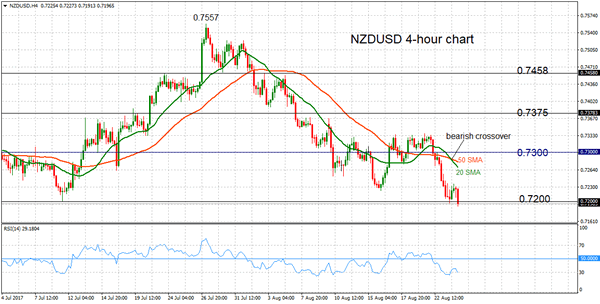
NZDUSD has shifted risk back to downside after a rebound lost steam and fell from 0.7235 to dip below the key 0.7200 level. The crossover of the shorter-period with the longer-period moving average gave a bearish signal. Yesterday the 20 SMA fell below the 50 SMA on the 4-hour chart. Meanwhile, RSI is in bearish territory below 50.
A daily close below 0.7200 would increase downside pressure and strengthen the bearish case. The market has been trading above this key level since June. An extension lower from this area would open the way towards a resistance-turned-support level at 0.7057. Breaking below the key psychological 0.7000 level would target the multi-month trough at 0.6817 (May 11 low).
Prices need to rise back above the 0.7235 high to shift the focus back to the upside towards the key 0.7300 level. Only a move above 0.7375 would retrace 50% of the downtrend from the 0.7557 peak (July 27) and indicate that near-term downward pressure has eased. A sustained break above resistance at 0.7458 could see a re-test of 0.7557 and change the short-term trend to bullish.