Sample Category Title
Technical Outlook: EURUSD Is Holding Bullish Near-Term Bias After Friday’s Strong Rally
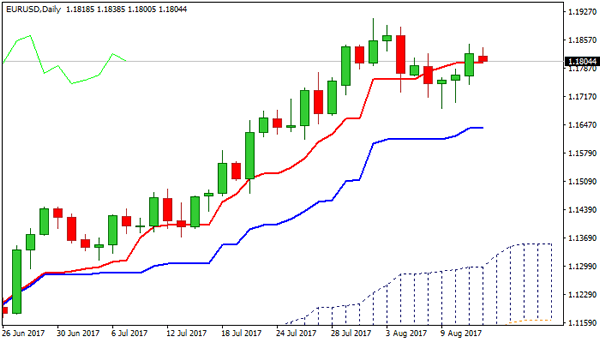
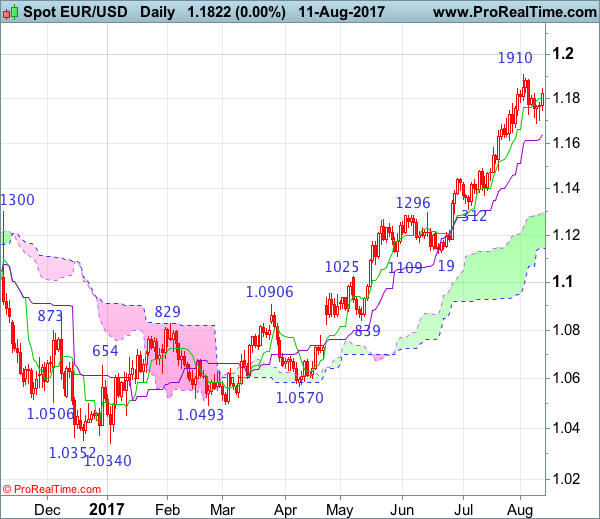
The Euro is holding within tight range in early Monday's trading, after strong rally on Friday, driven by weak US inflation numbers. Friday's rally returned and closed above daily Tenkan-sen (reverted to initial support at 1.1800), bringing daily technicals back to full bullish setup and suggesting further advance. Bullish and long-tailed weekly candle is seen as another bullish signal. Break above Friday's high at 1.1848 is needed to unlock next strong barrier at 1.1910 (top of broader uptrend, posted on 02 Aug) and re-expose psychological 1.2000 barrier. Daily Tenkan-sen is expected to ideally hold, while break lower would soften near-term structure and risk retest of next pivotal support at 1.1748 (Friday's low.
Res: 1.1846, 1.1889, 1.1910, 1.1950
Sup: 1.1800, 1.1748, 1.1732, 1.1689
Daily Technical Analysis: EUR/JPY Close To 78.6 Fib Retracement
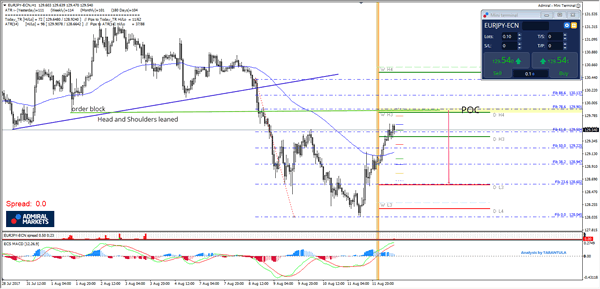
The EUR/JPY broke below the leaned head and shoulders pattern and touched the 128.04 before making a correction. At this point the price is close to possibly completing a correction due to a cluster of strong confluence points that make the POC zone. The POC 129.80-113.00 (W H4, D H4, bearish order block, 78.6, ATR high) could reject the price towards D H3 -129.40 but only a H1 momentum candle or H4 candle close below 129.40 could further tank the price towards 129.00 and 128.60.
EURUSD Consolidates Near 31-Month High, Bullish Market Structure Intact
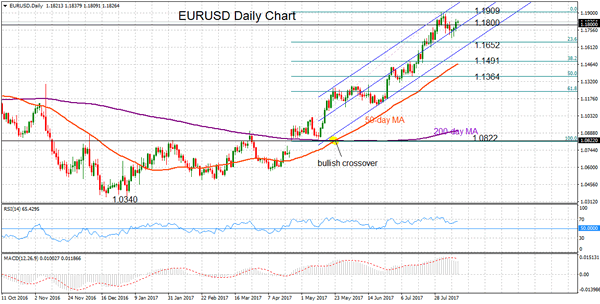
EURUSD maintains a broadly bullish technical set up above 1.1800 although there is evidence of a slowdown in upside momentum. The MACD and RSI indicators are no longer rising and are giving a neutral picture for the short-term. The market is in a consolidation phase near its 31-month high of 1.1909.
Recent price action shows firm support around the 1.1652 area, which is the 23.6% Fibonacci of the April 24 to August 2 rise from 1.0820 to 1.1909. A breakdown of this level would set up a possible move lower to 1.1491 (38.2% Fibonacci). From here the focus would shift to a key level – the 50% Fibonacci at 1.1364. A deeper decline would weaken the short-term bullish structure.
EURUSD is expected to stay underpinned as long as it can hold above 1.1800. A daily close above this level would set up a possible break above the August 2 peak of 1.1909, which would open the way for a move up to 1.2000.
The overall trend structure shows that the bull run is expected to remain intact, with EURUSD rising in an ascending channel. The crossover of the 50-day moving average (MA) above the 200-day MA on May 23 confirms the bullish outlook. A consolidation phase is seen in the near-term.
Forex Markets’ Reaction Muted On Economic Data, Dollar On Rise
Forex markets have had a muted reaction to the released economic data during the Asian session. The yen weakened against the greenback despite an upbeat string of figures out of Japan and still ongoing tensions between the US and North Korea. The aussie softened only modestly against its US counterpart even though Chinese data were disappointing.
Japan's economy annually grew 4% in the second quarter, preliminary data released today showed. This is the fastest pace of expansion since the first quarter of 2015 and it was much better than the expected rate of 2.5% and a pick up from the upwardly revised figure for the quarter to March-end of 1.5%. The economy expanded 1%, q/q as private consumption picked up. This was also better than the expected 0.5% and above the upwardly revised figure for the prior quarter of 0.4%. Despite such an upbeat set of data out of Japan, the yen weakened against the dollar for the pair to last trade at 109.56.
Yen's appeal as a safe haven asset in times of uncertainty such as the tensions between the US and North Korea pushed the currency up against the dollar during last week. As there are no signs of the tensions going away any time soon, yen's weakness seems muted to these events. In addition, the greenback recovered during today's session after it tumbled to 108.72 yen hit on Friday, its lowest since April 19, due to the disappointing inflation figures.
The aussie, which is considered a good proxy for the outlook on China's economy, pulled back after the latest industrial production figures out of China today, though only modestly. At 6.4% annual expansion, the production tempered in July, coming in below the 7.2% expected level and 7.6% recorded in the prior month. Retail sales in China in July also rose less than expected. Aussie/dollar fell to 0.7885 ahead of the European session, though the pair held above Friday's low of 0.7839, which was its lowest since July 18.
The euro gained against the dollar to trade at $1.1834 ahead of European trading. Other than industrial production figures for the eurozone for July, no other significant economic data is expected today. Sterling also gained against the dollar with pound/dollar last trading at 1.3016.
Gold weakened during the Asian session, erasing Friday's gains. The precious metal was trading at $1,268.60 an ounce ahead of the European session.
Oil prices fell linked to cooling refining activity in China and concerns that US shale output is on the rise. WTI was last trading at $48.68 a barrel while Brent was at $51.90.
EUR/USD Candlesticks and Ichimoku Analysis
Weekly
• Last Candlesticks pattern: Shooting star
• Time of formation: 31 Jul 2017
• Trend bias: Near term up
Daily
• Last Candlesticks pattern: Shooting star
• Time of formation: 2 Aug 2017
• Trend bias: Up
EUR/USD – 1.1800
Although the single currency found support at 1.1689 last week and has rebounded, as long as recent high at 1.1910 holds, further consolidation would take place and near term downside risk remains for another corrective fall, below said support at 1.1689 would bring retracement of recent rise to the Kijun-Sen (now at 1.1640), then towards 1.1590-00, however, reckon 1.1540-45 would contain correction and bring another rise later. Above said resistance at 1.1910 would signal recent upmove from 1.0340 low has resumed and extend headway to 1.1950, then psychological level at 1.2000, having said that, loss of upward momentum should prevent sharp move beyond 1.2165 and price should falter below 1.2220-30, bring retreat later.
On the downside, expect pullback to be limited to 1.1590-00 and bring another rise. Below 1.1540-45 would defer and risk test of 1.1490 (previous resistance turned support), a daily close below there would signal a temporary top is formed instead, bring retracement of recent rally to 1.1435, then 1.1390-00, however, still reckon downside would be limited to 1.1350 and price should stay above support at 1.1312.
Recommendation: Buy at 1.1590 for 1.1790 with stop below 1.1490.
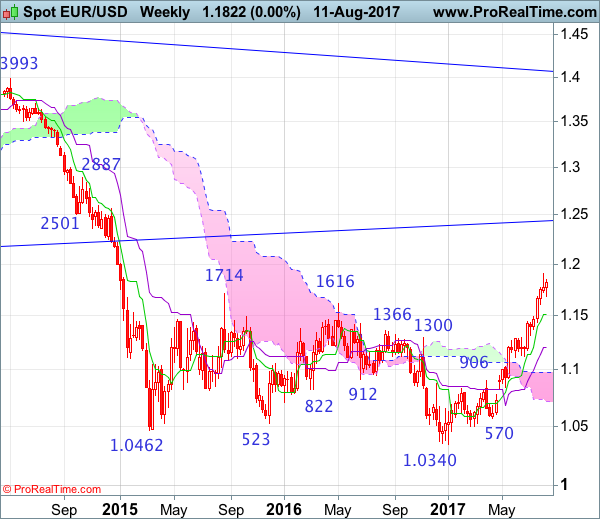
On the weekly chart, although the single currency formed a shooting star on the weekly chart after retreating from recent high of 1.1910, as a black candlestick did not materialize last week, suggesting minor consolidation would be seen, however, as long as said resistance holds, prospect of another corrective fall remains, below 1.1689 support would bring minor correction to 1.1613 support but break there is needed to suggest a temporary top is formed, bring retracement of recent upmove to the Tenkan-Sen (now at 1.1515) and later towards 1.1435, having said that ,downside should be limited to 1.1370 and support at 1.1312 should remain intact, bring rebound later.
On the upside, expect recovery to be limited to said resistance at 1.1910 and bring another retreat later. A break above said recent high at 1.1910 would signal the major rise from 1.0340 low is still in progress and may extend gain to 1.1950, then 1.1200, however, weakening of near term upward momentum would prevent sharp move beyond 1.2160-70 and reckon 1.2220-30 would hold, price should falter below 1.2300-10, bring another retreat later.
‘
China’s July Activities Disappoint, Further Slowdown Expected As Monetary Policy Gets Tighter
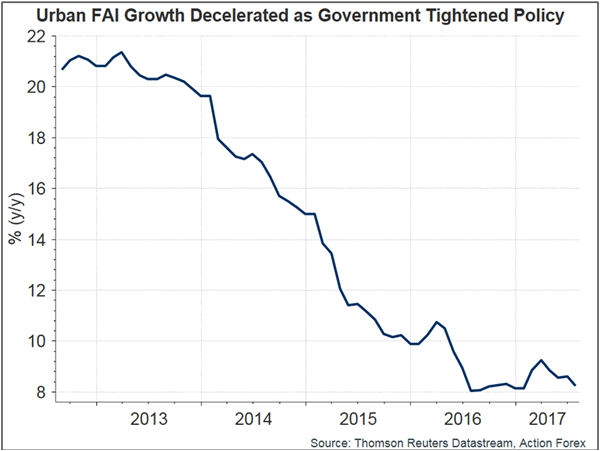
Chinese macroeconomic activities showed sharper than expected slowdown in July. Retails sales grew +10.4% y/y in July, down from +11% a month ago. The market had anticipated a milder moderation to +10.8%. Industrial production expanded +6.4% y/y in July, decelerating from +7.6% in the prior month. This came in weaker than consensus of +7.1%. Urban fixed asset investment expanded +8.3% in the first 7 months of the year, slowing from +8.6% in the first half of the year. The market had anticipated a steady growth of +8.6%. The slowdown in economic activities in China has been widely expected as the government pledged to deleverage in at attempted to defend and prevent systematic risks. However the abovementioned three major indicators came in even weaker than expectations. We expect Chinese economic growth to moderate in the second half of the year. Yet, the strength in the first half (GDP growth: +6.9%) signals that the government's full year target of 'around +6.5%' should be able to achieved.
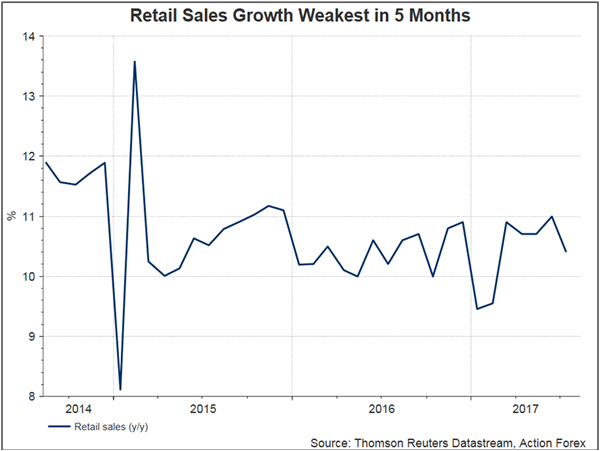
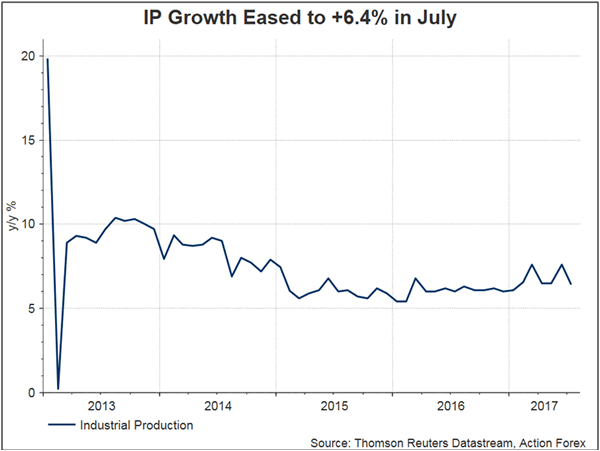
In the second quarter monetary policy report published last Friday, PBOC reiterated its stance to maintain a 'prudent and neutral' monetary policy. At the twice a decade National Financial Work Conference held last month, the post-meeting statement omitted the word of 'neutral'. This triggered speculations that China's monetary policy would be skewed more to the tightening side in the coming years. Indeed, PBOC drained a net RMB 30B from the market via the reverse repo agreements, following a net drain of RMB 40B in the prior week. Reuters' data showed that the volume-weighted average rate of the benchmark 7-day repo settled at 2.8373% last Friday, up +5 bps from the close in the prior week.
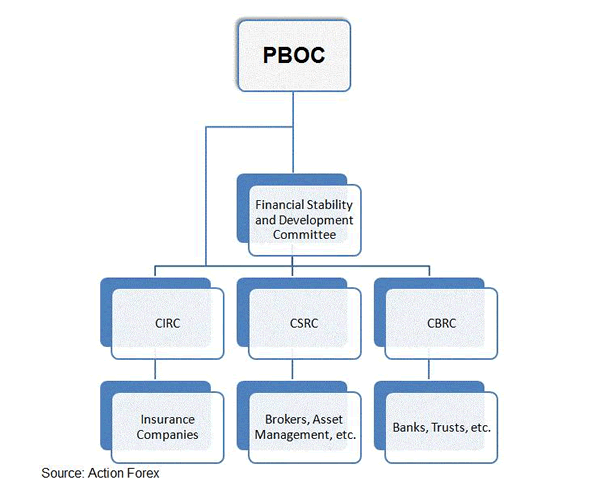
In his first appearance in the Work Conference, President Xi Jinping announced the establishment of a Financial Stability and Development Committee, an office stemming from PBOC with the objective of overseeing stability and the developments of the financial market. The power of the Committee is above the three existing regulators, namely the China Insurance Regulatory Commission (CIRC), the China Securities Regulatory Commission (CSRC), and the The China Banking Regulatory Commission (CBRC). Establishment of the new Commission also reflects the lack of execution capability of these three traditional agencies.
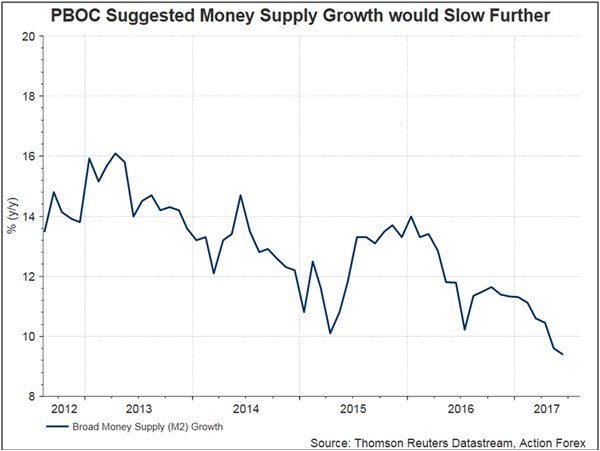
Reiterating President Xi's comments, PBOC at the monetary policy report noted that the monetary policy would focus on 'deleveraging' and to reform the financial sector to serve the real economy while guarding against systemic risks. The central bank suggested that the move might result in a lower growth in the M2 money supply.
Leveraging to Deleveraging
Over the past years, financial institutions, including banks, in China have developed a variety of highly-leveraged products (interbank deposits, off-balance sheet finance, etc.). It was estimated that China's total debt soared to almost 300% of GDP, while total corporate debt increased to about 170% of GDP, last year. More importantly, over half of the corporate debt came from state-owned enterprises (SOEs) which contributed only 22% of GDP. The lack of contribution to the real economy, accompanied by huge debts, is the key reason for Xi's command to deleverage to SOEs. Another area of focus in China's deleveraging activities is on 'vampire companies' which are subsidized by local governments and certain banks, despite their lack of productivity. The debt problems in local governments have become so serious that the central authority proposed a lifetime accountability system for local government debts.
Renminbi
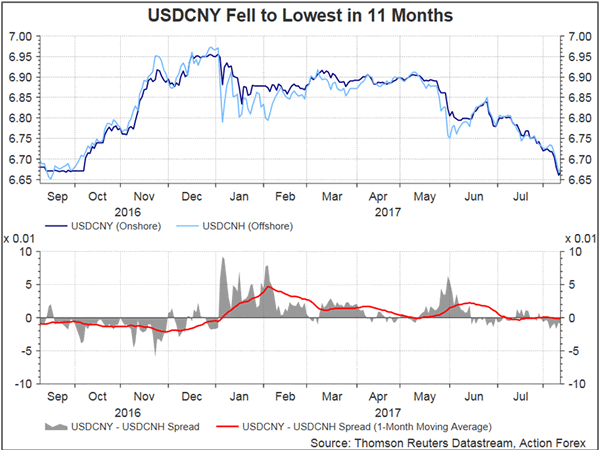
PBOC pledged to maintain a stable and two-way movement in its currency. The central bank affirmed that the 'counter-cyclical factor' introduced in May would help reduce the renminbi's volatility. Yet, we believe the lack of transparency of the components in the factor is a detriment to the internationalization of renminbi. The recent rally of renminbi against the US dollar is more due to weakness in the latter, though.
USD/JPY Candlesticks and Ichimoku Analysis
Weekly
• Last Candlesticks pattern: Dark cloud cover
• Time of formation: 10 Jul 2017
• Trend bias: Down
Daily
• Last Candlesticks pattern: Evening doji
• Time of formation: 7 Aug 2017
• Trend bias: Down
USD/JPY – 110.65
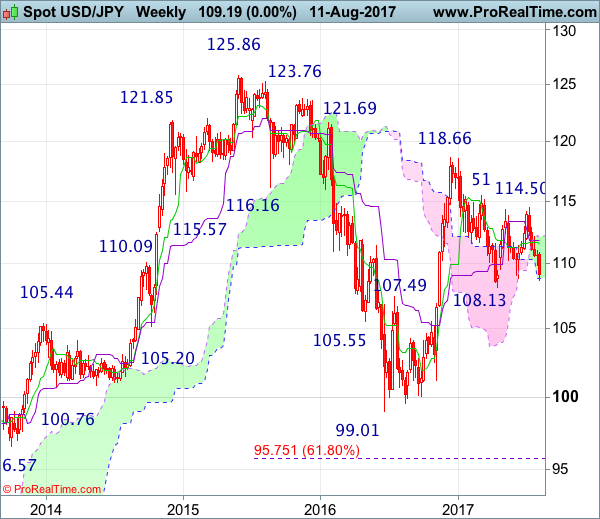
Although several hammer bullish reversal patterns were formed on the daily chart along recent selloff from 114.50 (some even followed by a long white candlestick), the greenback managed to ignore all these signs and continued heading south, suggesting bearishness remains for a test of previous support at 108.13 (this year’s low), however, break there is needed to retain bearishness and signal early decline from 118.66 top has indeed resumed and extend weakness to 107.50, then towards 106.50-55 (61.8% Fibonacci retracement of 99.01-118.66), having said that, near term oversold condition should prevent sharp fall below there and reckon previous resistance at 105.53 would hold from here.
On the upside, whilst initial recovery to the Tenkan-Sen (now at 109.90), then 110.70 is likely, reckon upside would be limited to resistance at 111.05 and bring another decline later. A daily close above the Kijun-Sen (now at 111.62) would defer and suggest a temporary low is formed instead, risk a stronger rebound to resistance at 112.20 but reckon upside would be limited to 112.40-45 and price should falter well below 113.00, bring another selloff later this month.
Recommendation : Sell again at 111.00 for 109.00 with stop above 112.00.

On the weekly chart, despite forming a doji star the week before, dollar failed to form a white candlestick last week and has dropped another (ended with another black candlestick), suggesting the selloff from 114.50 is still in progress, hence bearishness remains for another test of previous chart support at 108.13 (2017 low), however, the pair needs to penetrate this level to confirm early fall from 118.66 top has resumed and extend weakness to 117.40-50, then 117.00 but downside should be limited to 106.50-55 (61.8% Fibonacci retracement of 99.01-118.66) and previous resistance at 105.53 would turn into support, price should stay above 105.00, bring rebound later.
On the upside, although initial recovery to 110.00, then 110.50-60 cannot be ruled out, reckon resistance at 111.05 would limit upside and bring another decline later. Above the Tenkan-Sen (now at 111.62) would risk test of the Kijun-Sen (now at 111.82) but still reckon resistance at 112.20 would limit upside and bring another decline. A weekly close above resistance at 112.20 would suggest first leg of decline from 114.50 has ended instead, risk a stronger rebound to 112.90-00 but still reckon upside would be limited to 113.55-60 and price should falter well below resistance at 114.50, bring another decline later.
USDJPY Intraday Analysis
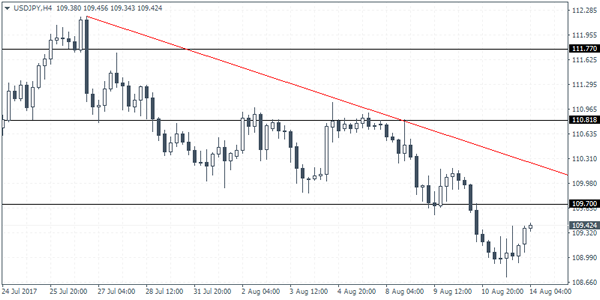
USDJPY (109.42): The USDJPY closed on Friday with a near doji candlestick pattern after breaking down below 109.58. Any retracements will come only on a strong rebound back above the 109.58 levels. On the 4-hour chart, the near-term resistance level is seen at 109.70. Therefore, any meaningful retracement can be expected only on a breakout above this level. For the moment, any downside is likely to be limited to the current level which was previously tested in early June this year.
GBPUSD Intraday Analysis
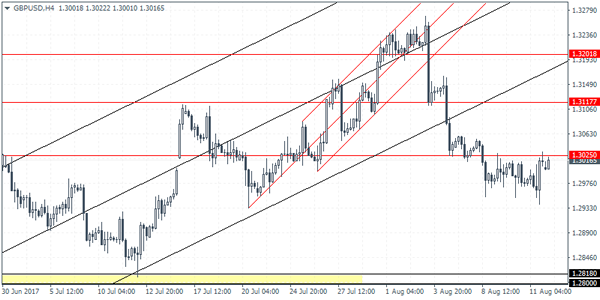
GBPUSD (1.3016): The British pound will be heading into a busy week. As expected price action rallied back to retest the resistance level at 1.3025. This near term pullback will suggest that price action could be looking to post a reversal. Friday's gains saw GBPUSD close with an outside bar. However, on the 4-hour chart, the reversal is currently taking shape. This would suggest a near-term decline. Support at 1.2818 remains in focus for the cable. Alternately, a breakout above 1.3025 will send the currency pair back to retest the next upper resistance level at 1.3117.
EURUSD Intraday Analysis
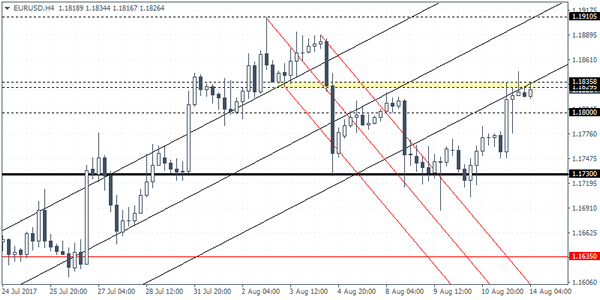
EURUSD (1.1826): The euro posted strong gains on Friday after briefly trading flat the previous two days. The currency pair managed to rally back above the 1.1800 level and thus broke above this short-term support/resistance level. The rally towards 1.1835 and the prompt pullback on the day suggests that we could see some near-term consolidation. Support is seen at 1.1730 which is likely to be the range that the EURUSD could move into. Unless the FOMC meeting minutes this week turn out to be strongly hawkish, no major new gains are expected in the EURUSD. Watch for a break out above 1.1835, in which case, we can expect further gains towards 1.1900, while to the downside a break down below 1.1730 would suggest a decline to 1.1635.