

Sample Category Title
Pound Quiet as BoE Holds Course on Rates
The British pound has ticked higher in the Thursday session. In North American trade, GBP/USD is trading at 1.2760. On the release front, the BoE maintained rates at 0.25%, but surprised the markets as three MPC members voted in favor of a rate hike. Retail Sales declined 1.2%, missing the forecast of -0.9%. Over in the US, unemployment claims dipped to 237 thousand, marking a 3-week low. On the manufacturing front, the news was mixed. The Empire State Manufacturing Index rebounded with a strong gain of 19.8, crushing the estimate of 5.2 points. The Philly Fed Manufacturing Index dropped sharply to 27.6, but still beat the estimate of 25.5 points.
British inflation levels continue to rise, and this has hurt the purchasing power of UK consumers. This was evident in the May retail sales report, which sagged badly, dropping from +2.3 percent to -1.2 percent. The weak reading was worse than expected, as the forecast stood at -0.9 percent. With inflation up and the pound and wages down, the UK consumer is understandably in a surly mood about lower living standards, and this sentiment may have played a key role in last week's election, which saw Prime Minister May humiliated, as she lost her majority in parliament. There are hopeful signs that the political turmoil which has rocked the country could end soon, with reports that May's Conservatives and the DUP, a small Irish party, have reached an agreement in principal, which would enable May to continue to govern. May's minority government may prove to be unstable, and she will go into the Brexit negotiations with a much weaker hand than prior to the election. This new set of circumstances may force a chastened May to be more flexible, and agree to a "soft Brexit", which would see the UK remain in a single market, in return for allowing free movement from the continent into Britain.
After preparing the markets with plenty of broad hints, the Federal Reserve pressed the rate trigger at its June meeting, marking its second rate hike in 2017 . The Fed increased rates by 25 basis points, to a target range of 1.00 percent to 1.25 percent. Janet Yellen & Co. appear sanguine about the US economy, and this optimism was reflected in a rate statement that was more hawkish than expected. The statement portrayed an optimistic picture, noting that the economy was growing and the labor market remained strong. Policymakers appear unfazed over stubbornly low inflation, as the statement noted that although inflation remains below the Fed's target of 2.0%, it expected that target to be reached in the "medium term". The Fed projected one more rate hike in 2017, and the markets are circling the December meeting as the most likely date. However, the markets don't seem to share the Fed's optimism as far as another rate hike this year. The odds for a September increase are at 18%, compared to 23% a week ago, according to the CME Group. As for a December increase, the odds stand at just 38%. One surprising development was that Fed Chair Janet Yellen outlined a plan to reduce its $4.2 trillion balance sheet (comprised of Treasury bonds and mortgage-backed securities). Yellen was short on specifics, saying that the goal was to begin the normalization "relatively soon". The balance sheet ballooned after the financial crisis in 2008, as the Fed implemented a massive quantitative easing program as part of its accommodative monetary policy, together with interest rates of zero. The gradual reduction in the purchase of these assets signifies an important vote of confidence in the strength of the US economy.
FTSE100 Index Fell on Retail Sales and Hawkish BoE
FTSE100
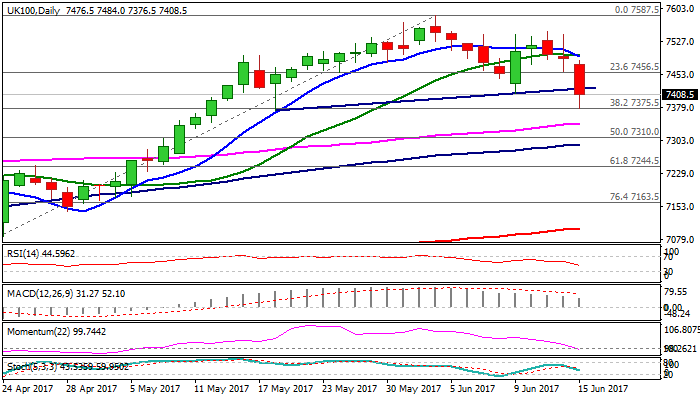
FTSE100 index fell on Thursday, being down over 1% so far, driven by weaker than expected UK retail sales and hawkish BoE.
The price remained at the back foot in past two days after recovery attempts were rejected at 7555, but showed indecision that was shaped in Wednesday's long-legged Doji.
Fresh acceleration lower on Thursday generated stronger bearish signal, which could result in extended correction of bull-phase from 7032 (19 Apr low) to 7587 (02 June low).
Today's action completed two bearish patterns that now strongly support negative scenario.
Completion of Failure Swing pattern on daily chart after support at 7410 (09 June low) was taken out, as well as formation of asymmetric H&S pattern on daily chart on break below the neckline at 7421, generated bearish signal.
Dips were so far contained by next pivotal support at 7375 (Fibo 38.2% of 7032/7587), with firm break here needed to confirm reversal and open next supports at 7341 (55SMA) and 7294 (100SMA).
Consolidation above 7375 handle could be expected before bears resume, as near-term studies are oversold.
Daily Tenkan-sen in steep descend offers solid resistance at 7463, with additional bearish pressure coming from 10/20SMA bear cross which formed at 7494.
Res: 7421; 7463; 7494; 7543
Sup: 7375; 7341; 7310; 7294
Trade Idea Wrap-up: USD/JPY – Buy at 109.90
USD/JPY - 110.60
Most recent candlesticks pattern : N/A
Trend : Near term up
Tenkan-Sen level : 110.13
Kijun-Sen level : 109.80
Ichimoku cloud top : 109.77
Ichimoku cloud bottom : 109.77
Original strategy :
Buy at 109.90, Target: 110.90, Stop: 109.55
Position : -
Target : -
Stop : -
New strategy :
Buy at 109.90, Target: 110.90, Stop: 109.55
Position : -
Target : -
Stop : -
The greenback has rallied again after staging a strong rebound yesterday and resistance at 110.35 was penetrated, suggesting recent decline has indeed ended at 108.82 and upside bias is seen for further gain towards resistance at 110.81, however, break there is needed to retain bullishness and extend the rise from 108.82 low for retracement of recent downtrend to 111.00 and possibly towards 111.25-30.
In view of this, we are looking to buy dollar on pullback as 109.85-90 should limit downside. Only below 109.45-50 would suggest an intra-day top is formed instead, risk weakness to 109.20-25 but price should stay well above said yesterday’s low at 108.82, bring another rebound later.

US$ Index (DXY), Major Bottom Nearing?
Nearer term $ index outlook :
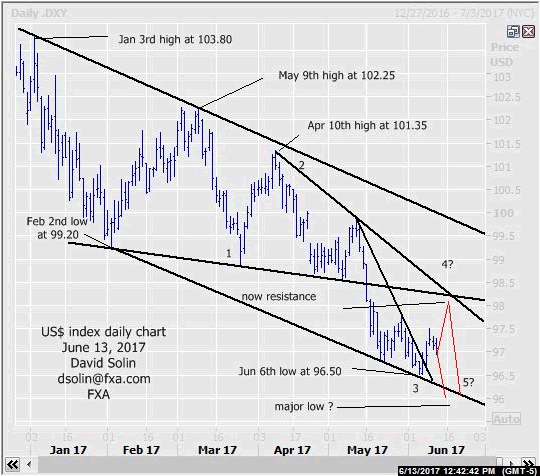
Bigger picture view since mid May of a month or so of downside chopping (as a more major bottom approaches, see longer term below) continues to play out. In the Jun 6th email, said that there was scope for a week or so of correcting within this larger decline. The market did indeed bounce from that day and though there is scope for another week of consolidating, is seen as a correction (wave 4 in the fall from the May 9th high at 102.25) and with new lows after (within wave 5, see in red on daily chart below). But suspect that further new lows would again be limited as that more major bottom approaches, with poor downside momentum and positive technicals (see buy mode on the daily macd) adding to that view. Nearby resistance is seen at the recent 97.50/65 high and 98.20/35 (both the falling support line from Feb and the bearish trendline from Apr). Nearby support is seen at 96.80/95 and that whole 96.25/50 area (Jun 6th low, falling support line from Feb and a 62% retracement form the May 2016 low at 91.90). Bottom line : view since mid May of a month (or more) of ranging with a downside bias continues to play out with no important bottom...yet.
Strategy/position:
Long Jun 8th above that bear t-line from May 11th (then 96.65, closed at 96.80) and for now would continue to stop on a close 15 ticks below that falling support line from Feb. However, with scope for that more extended period of ranging/bottoming, will switch to a more aggressive trailing stop on a close 15 ticks below a bull t-line from the early June low on a near term move above the recent 96.50 high, to reflect that risk.
Long term outlook:
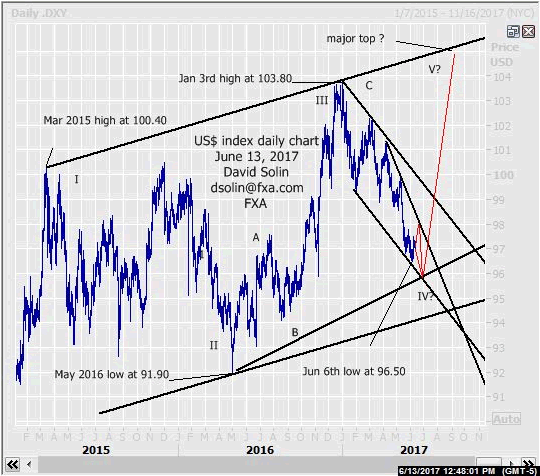
As discussed above, that view since mid May of a month (or more) of ranging with a downward bias as a more major bottom approaches, continues to play out. In the longer term, the 3 wave upmove from the May 2016 low at 91.90 to that Jan 3rd peak at 103.80 (A-B-C) argues a large "complex" topping, and favor the view of a large rising wedge since March 2015. Though rising wedges are top/reversal patterns, they break down into 5 legs and suggest that final upleg above 103.80 as part of the pattern. Note too this fits of the view of an approaching bottom and that further lows below 96.50 would likely be limited (see "ideal" scenario in red on daily chart/2nd chart below). However as discussed above, at least some further downside is favored but will be looking for more signs of that approaching, major bottom (continued poor downside momentum, 5 wave rally on very short term chart, etc.) on such lows.
Strategy/position:
With a potentially major bottom seen nearing, looking to switch the longer term bias to the bullish side. But the downside pattern from May 9th not "complete"/scope for further (but likely limited) lows, would be patient for a higher confidence entry before switching the longer term bias to bullish.
Current:
Near term : long Jun 8th at 96.80, scope for a further period of ranging/basing ahead.
Last : long May 5 at 98.75.stopped May 16 below t-line from Feb (98.45, closed 98.10).
Longer term : major bottom seen nearing, looking to switch bias to bullish ahead.
Last: :bull bias May 5 at 98.75 to neutral may 16th at 98.10.
Bank of England Review: Hawkish Wing but Neutral Core
BoE removes neutral stance
Against expectations, the Bank of England (BoE) made another hawkish surprise, as three members voted for an immediate hike and it removed its neutral stance by no longer saying that it can 'move in either direction'. There are two reasons for this despite slower growth: 1) inflation has moved higher than the BoE projected in May and 2) the unemployment rate has moved lower than the BoE projected in May. Note that Kristin Forbes (hawk) is leaving the BoE on 30 June, which leaves Ian McCaffertyand Michael Saunders as the two remaining hawks.
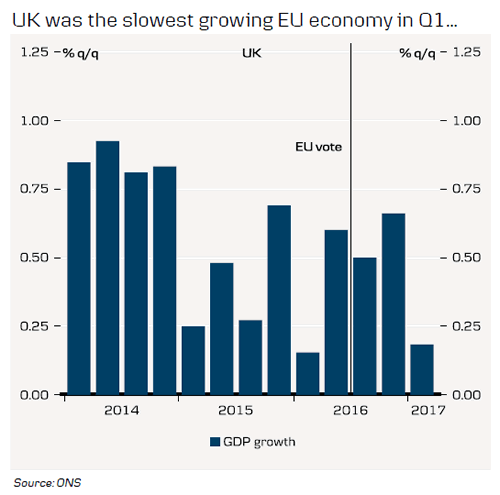
Markets were caught by surprise so UK yields moved higher and GBP strengthened due to the overall more hawkish message. Both we and markets had expected a more soft tone, as Q1 GDP growth was revised down to 0.2% from 0.3% (and not up to 0.4% as the BoE had expected) and economic indicators for Q2 have remained weak (although better in Q1).
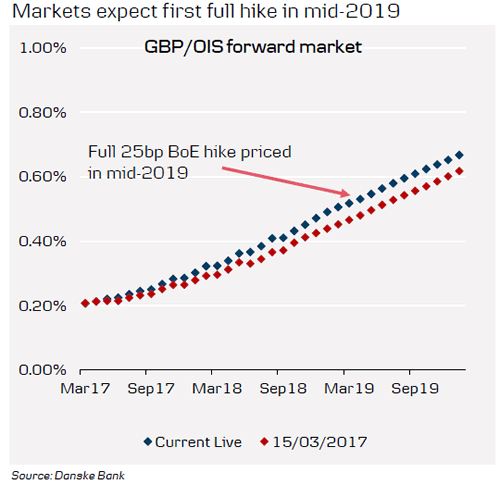
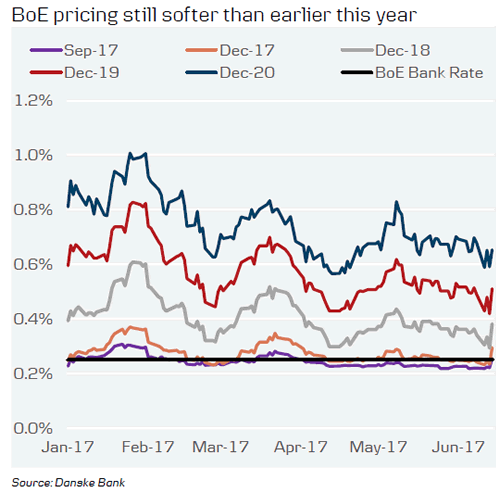
Market pricing seems fair at the moment with the first full BoE hike priced around mid-2019 after the Brexit negotiations under Article 50 are concluded.
Despite the overall more hawkish message, we do not expect a BoE rate hike before sometime in 2019. UK growth is slowing, high inflation is temporary due to the weak GBP caused by Brexit, wage growth is weak and does not indicate high underlying inflationary pressure and political uncertainty is high. Also we do not think one should over-interpret the removal of the 'move in either direction', as the likelihood of further easing was slim already. While we have a hawkish wing in the Monetary Policy Committee, the core of the committee (including BoE governor Carney) is still dovish.
We still forecast EUR/GBP in the range of 0.84-0.90 near term. In our view, we now have a 'government risk premium' on top of the 'Brexit uncertainty premium'. We expect GBP will remain sensitive to news on Brexit. See also Research UK: Hung parliament adds government risk premium to GBP, 9 June.
BoE pricing seems fair, in our view
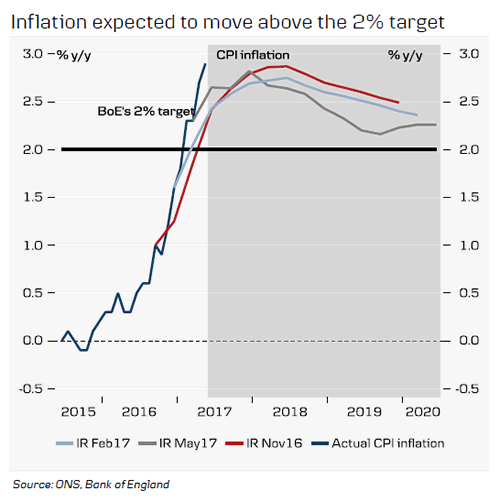
Economic data versus BoE's May projections
Actual inflation higher than expected in May
The BoE lowered its inflation projection in May but actual CPI inflation has been higher than expected. This (in combination with the low unemployment rate) is the main reason why three members voted for a hike.
BoE now says 'inflation could rise above 3% by the autumn, and is likely to remain above the target for an extended period as sterling's depreciation continues to feed through into the prices of consumer goods and services'.
Also the 2.5% fall in GBP since the May Inflation Report 'will add to that imported inf lationary impetus'.
We still think the core BoE members will see through higher inflation, as it is only temporary due to currency changes. A trigger for a more hawkish BoE will be higher domestically generated inflation (especially higher wage growth).
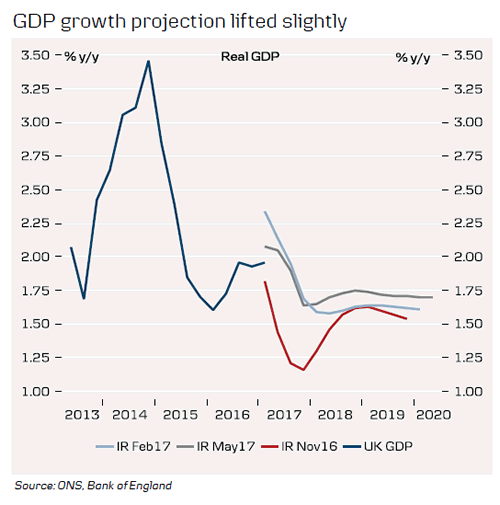
Q1 GDP growth was revised down, not up as BoE expected
UK Q1 GDP growth was revised down to 0.2% q/q from 0.3% against the BoE's own expectation of an upward revision to 0.4% q/q.
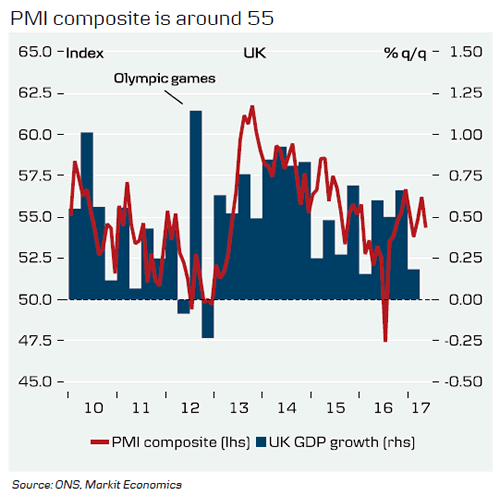
BoE says surveys point to a 'modest recovery in GDP growth in the second quarter'. In May, the BoE said it expects the economy to grow around 0.4% q/q in coming quarters.
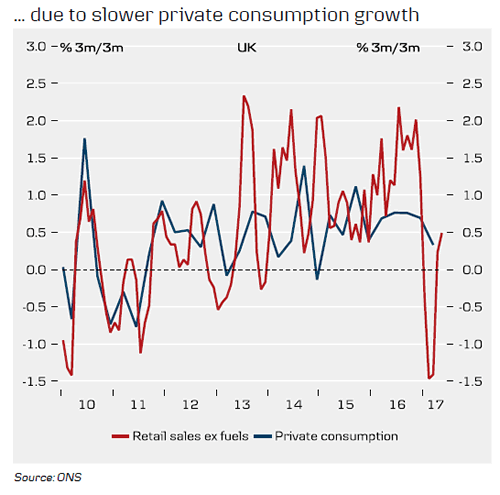
The BoE says slower private consumption of goods is offset by a pickup in exports and business investments.
We think the BoE seems a bit too optimistic on the UK growth outlook near-term.
BoE says it 'cannot prevent either the necessary real adjustment as the United Kingdom moves towards its new international trading arrangements or the weaker real income growth that is likely to accompany that adjustment over the next few years'.
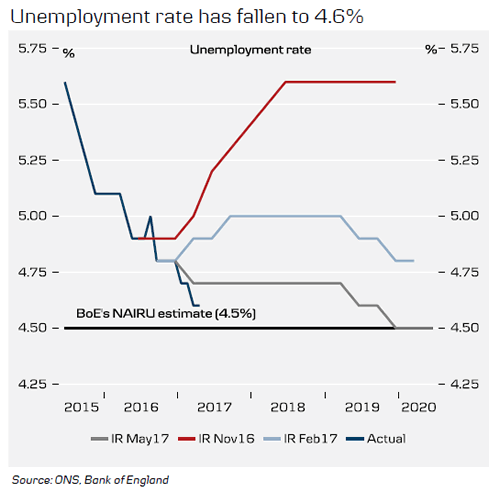
Unemployment rate lower than projected in May
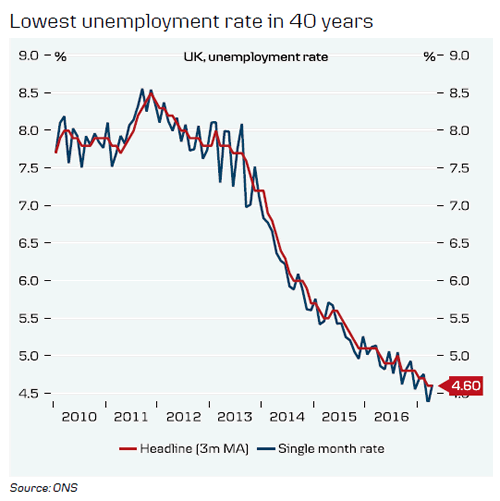
The actual unemployment rate has fallen to 4.6%, which is lower than the projections from May (which was revised down from the projections in February).
The BoE estimates the NAIRU at 4.5%, so sees only a 'small degree of spare capacity' left in the economy, especially as 'the continued growth of employment could suggest that spare capacity is being eroded'.
Macro charts
GDP growth slowed markedly in Q1
PMIs suggest growth has been slightly higher in Q2
Weaker GBP => higher import prices => higher inflation => eroding purchasing power
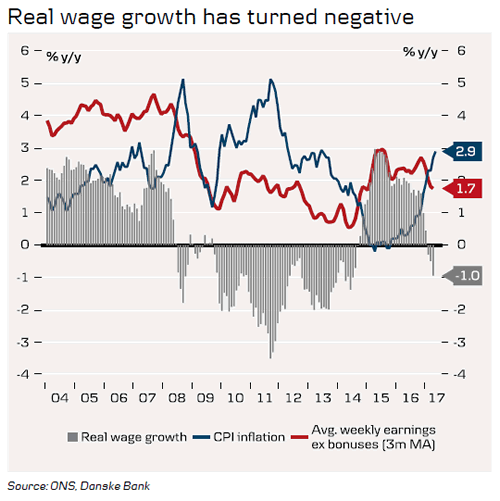
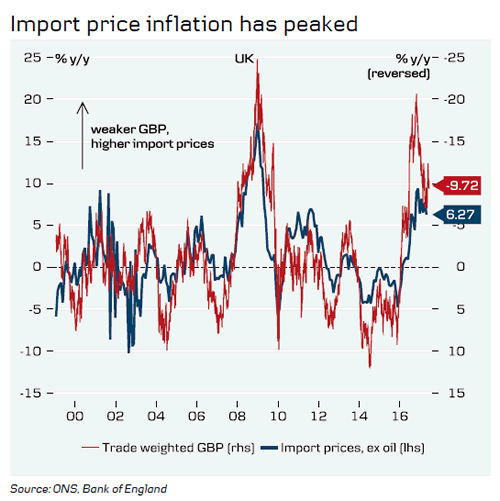
Commodity prices have also pushed up inflation
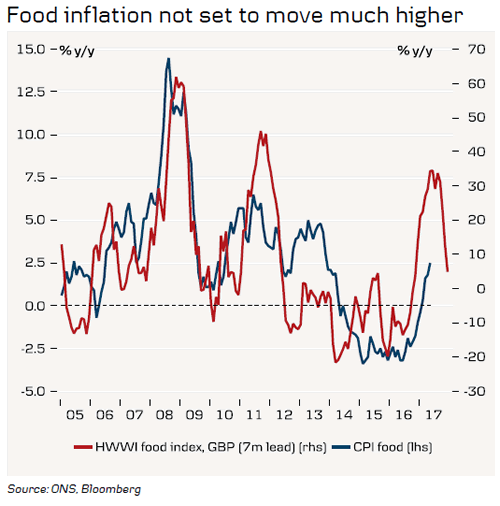
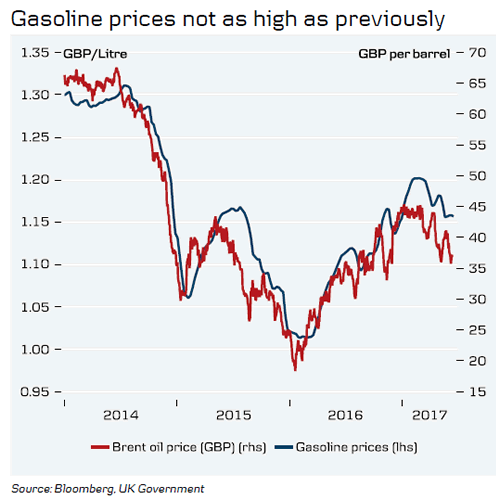
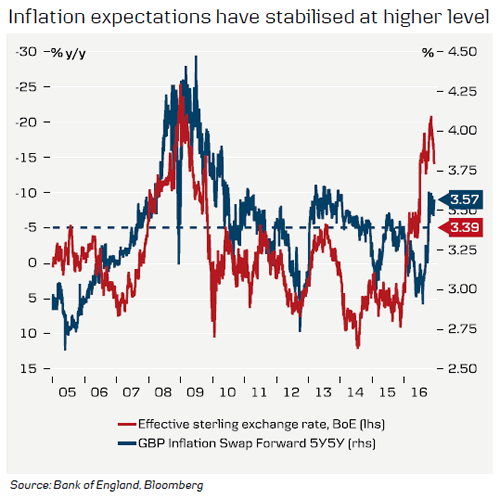
Inflation expectations have stabilised at higher level
Trade Idea: EUR/GBP – Buy at 0.8660
EUR/GBP - 0.8737
Recent wave: Major double three (A)-(B)-(C)-(X)-(A)-(B)-(C) is unfolding and 2nd (A) has possibly ended at 0.6936.
Trend: Near term up
Original strategy :
Buy at 0.8690, Target: 0.8880, Stop: 0.8650
Position : -
Target : -
Stop : -
New strategy :
Buy at 0.8660, Target: 0.8860, Stop: 0.8620
Position : -
Target : -
Stop : -
As the single currency has slipped again after meeting resistance at 0.8836, retaining our view that further consolidation below this week’s high at 0.8866 would be seen and initial downside risk remains for correction to 0.8700, however, reckon support at 0.8652 would limit downside and bring another rise later, above 0.8836 would signal the pullback from 0.8866 has ended, bring retest of this level first. A break above this resistance would extend recent erratic upmove from 0.8304 low to 0.8880, then 0.8900, having said that, as broad outlook remains consolidative, reckon current c leg of larger degree wave b should be limited to 0.8950 and price should falter well below 0.9000, bring retreat later.
In view of this, we are looking to buy euro on further subsequent pullback but one should exit on such rise. Below 0.8680 would defer and risk test of 0.8650-55 support but break there is needed to signal top is formed instead, bring further fall to 0.8620, then 0.8600 which is likely to hold from here.
Our preferred count is that, after forming a major top at 0.9805 (wave V), (A)-(B)-(C) correction is unfolding with (A) leg ended at 0.8400 (A: 0.8637, B: 0.9491 and 5-waver C ended at 0.8400. Wave (B) has ended at 0.9413 and impulsive wave (C) has either ended at 0.8067 or may extend one more fall to 0.8000 before prospect of another rally. Current breach of indicated resistance at 0.9043 confirms our view that the (C) leg has ended and bring stronger rebound towards 0.9150/54, then towards 0.9240/50.

Trade Idea: USD/CAD – Sell at 1.3350
USD/CAD - 1.3291
Recent wave: Only wave v of c has ended at 0.9407 and wave C of major A-B-C correction is underway for headway to 1.4700
Trend: Near term down
Original strategy :
Sell at 1.3330, Target: 1.3130, Stop: 1.3390
Position: -
Target: -
Stop: -
New strategy :
Sell at 1.3350, Target: 1.3130, Stop: 1.3410
Position: -
Target: -
Stop:-
The greenback has rebounded after finding support at 1.3165 yesterday, suggesting consolidation above this level would be seen and recovery to 1.3330 cannot be ruled out, however, reckon 1.3360-65 would limit upside and bring another decline later, below 1.3220 would suggest the rebound from 1.3165 has ended, bring retest of this level but break there is needed to signal recent decline from 1.3794 has resumed for weakness towards 1.3100 and possibly towards previous support at 1.3078.
In view of this, would be prudent to sell again on subsequent recovery as 1.3350-60 should limit upside. Above previous support at 1.3387 (now resistance) would defer and suggest low is possibly formed, bring a stronger rebound to 1.3420-25 but break there is needed to provide confirmation.
To recap, wave B from 1.3066 is unfolding as an a-b-c and is sub-divided as a: 1.2192, b: 1.2716 and wave c is a 5-waver with i: 1.1983, ii: 1.2506, extended wave iii with minor iii at 1.0206, wave iv ended at 1.0781 and wave v as well as wave iii has ended at 0.9931, hence the subsequent choppy trading is the wave iv which is unfolding as (a)-(b)-(c) with (a) leg of iv ended at 1.0854, followed by (b) leg at 1.0108 and (c) leg as well as the wave iv ended at 1.0674. The wave v is sub-divided by minor wave (i): 0.9980, (ii): 1.0374, (iii): 0.9446, (iv): 0.9913 and (v) as well as v has possibly ended at 0.9407, therefore, consolidation with upside bias is seen for major correction, indicated target at 1.3700 and 1.4000 had been met and further gain to 1.4700 would be seen later.

Sterling Gains on Growing Rate Hike Expectations; Stronger Dollar Following Fed
The Bank of England coming closer to an interest rate increase shocked currency market participants today, who reacted by placing long sterling positions and thus boosting the currency. The dollar stood stronger today following a more hawkish than expected Fed.
The Bank of England left rates unchanged at the record-low 0.25% upon completion of today's meeting. However, three of the eight Monetary Policy Committee (MPC) members on the Bank's board decided to support a rate hike, taking markets by surprise as expectations were for just one dissident from the consensus view. Governor Mark Carney once again voted in favor of keeping rates at their current level, while MPC members Ian McCafferty and Michael Saunders were the ones joining Kristin Forbes – who backed a rate rise in the past as well – in supporting a rate hike. Forbes' term on the MPC expires by month end. This brings the BoE the closest to an interest rate increase since the financial crisis started unfolding back in 2007. In terms of reaction in the forex markets, sterling recorded sizeable gains versus other currencies such as the dollar and the euro. Specifically, pound/dollar jumped to eventually reach its daily high of 1.2794 within fifteen minutes of the news hitting the markets. Previously, the pair traded at 1.2693. Euro/pound fell to as low as 0.8722 from 0.8795 before. The pound later gave up part of its gains relative to both currencies.
UK retail sales data negatively surprised as they showed a monthly decline by 1.2% in May. Analysts were expecting a fall by 0.8%, while April's figure was revised upwards to show a growth in sales of 2.5% from 2.3% before. On an annual basis, sales grew by 0.9%, significantly below projections of 1.7% and April's respective growth of 4.2% – the result of an upward revision from 4.0%. Excluding fuel, retail sales fell by 1.6% month-on-month in May, worse than the 0.8% fall that was expected and April's upwardly revised expansion by 2.2%. April's healthy numbers turned out to be a blip with British consumers now giving a clearer indication that they're feeling the impact of weak wage growth and rising inflation diminishing their purchasing power. An added layer of political uncertainty surrounding the country following the latest elections could negatively affect consumer sentiment as well. The pound had a muted reaction to the data relative to the dollar and the euro as investors seemed to have waited for the Bank of England's rate decision to place their sterling bets for the day.
Out of the US, last week's jobless claims fell by 8,000 relative to the week before, reaching 237,000. This was also below analyst forecasts projecting the number of claimants to stand at 242,000. Claims have been below 300,000, a level linked to a healthy job market, for 119 consecutive weeks, the longest since 1970. Continued claims, including those that still receive state help after an initial week of benefits, edged slightly higher but remained below 2 million for the ninth week in a row. Dollar/yen rose after the data, but did not manage to post significant gains.
Other US data later in the day pertained to industrial output numbers for the month of May. Output remained flat on a monthly basis, negatively comparing to expectations for a 0.2% growth and April's upwardly revised 1.1% from 1.0% before. Manufacturing output, a subset of industrial output, also surprised to the downside as it fell by 0.4% month-on-month. This is the second time in three months that manufacturing activity has declined. It is also worrisome that output contraction was broad-based across manufacturing industries, including automobile production. The greenback didn't react much to the data.
The dollar index, tracking the greenback against the currencies of major US trading partners, posted a rebound today after yesterday's seven-month low following the not so upbeat inflation and retail sales data. In particular, the index rose to a two-week high of 97.56 and was challenging that level for an even greater gain in late European session trading. The dollar gained positive momentum after the Federal Reserve's more-hawkish-than-anticipated stance yesterday. The Fed raised rates by a quarter basis point taking the target range for the fed funds rate to between 1.00 and 1.25%. The central bank also signaled that it is on track to raise rates once more this year, while it positively surprised market participants by outlining its plan on reducing the size of its balance sheet. Dollar/yen was last up nine-tenths of a percent at 110.56, while euro/dollar fell to a two-week low of 1.1132 today. It was last down seven-tenths of a percent on the day.
Concluding with a look at gold, the precious metal recorded losses today, falling to a three-week low of $1251.29 an ounce on the back of a stronger dollar.
Dollar Pushes Past 110 Yen on Hawkish Fed, BoJ Next
USD/JPY has reversed directions on Thursday, as the pair has climbed 0.70 percent. In the North American session, the pair is trading at 110.30. In the US, unemployment claims dipped to 237 thousand, marking a 3-week low. On the manufacturing front, the news was mixed. The Empire State Manufacturing Index rebounded with a strong gain of 19.8, crushing the estimate of 5.2 points. The Philly Fed Manufacturing Index dropped sharply to 27.6, but still beat the estimate of 25.5 points. The Bank of Japan will release a rate statement later in the day, with interest rates expected to remain pegged at -0.10%.
The BoJ will be on center stage later on Thursday, as it releases a rate statement, followed by a press conference with BoJ Governor Haruhiko Kuroda. The BoJ has maintained an ultra-loose monetary policy in order to prop up inflation and domestic demand. Although the economy has recently received a boost from stronger global demand, inflation remains well below the central bank's 2.0% target, and consumer demand has been soft. The BoJ is unlikely to shift directions and tighten policy anytime soon, but analysts will be combing through the rate statement and Kuroda's follow-up comments, looking for nuances in BoJ language. A key component of the BoJ's policy has been bond purchases, but the bank has slowly been reducing these purchases, and could make reference to the slowdown in the bond-buying program on Thursday. If the rate statement or Kuroda's comments are more hawkish than expected, the yen could respond with gains.
After months of broad hints from policymakers, the Federal Reserve raised rates on Thursday by 25 basis points, to a target range of 1.00 percent to 1.25 percent. The rate statement portrayed an optimistic picture, noting that the economy was growing, and the labor market remained strong. The statement acknowledged that inflation remains below the Fed's target of 2.0%, but expected that goal to be reached in the "medium term". The Fed projected one more rate hike in 2017, and the markets are circling the December meeting as the most likely date. The odds for a September increase are at 18%, compared to 23% a week ago, according to the CME Group. As for a December increase, the odds are currently at 38%. One surprising development was that Fed Chair Janet Yellen outlined a plan to reduce its $4.2 trillion balance sheet (comprised of Treasury bonds and mortgage-backed securities). Yellen was short on specifics, saying that the goal was to begin the normalization "relatively soon". The balance sheet ballooned after the financial crisis in 2008, as the Fed implemented a massive quantitative easing program as part of its accommodative monetary policy, together with interest rates of zero. The gradual reduction in the purchase of these assets signifies an important vote of confidence in the strength of the US economy.
US consumer indicators in May disappointed the markets, as CPI and retail sales reports missed estimates. CPI declined 0.1%, short of the estimate of 0.2%. This was the second decline in three months, as inflation is currently at 1.5%, well below the Federal Reserve's target of 2.0%. Retail Sales, the primary gauge of consumer spending was dismal, coming in at -0.3%, compared to a forecast of +0.1%. This marked the indicator's weakest reading since August 2016. Soft consumer spending could drag down GDP for the second quarter, as consumer spending accounts for more than two-thirds of economic growth. Although surveys continue to show that US consumers remain optimistic about the economy, this hasn't translated into stronger consumer spending.
Trade Idea Update: USD/CHF – Buy at 0.9710
USD/CHF - 0.9723
New strategy :
Buy at 0.9710, Target: 0.9810, Stop: 0.9675
Position : -
Target : -
Stop : -
Although the greenback slipped to 0.9641, lack of follow through selling and the subsequent rally on dollar’s broad-based strength suggest low has been formed at 0.9613 last week and mild upside bias is seen for the erratic rise from there to extend gain towards resistance at 0.9808, however, reckon previous resistance at 0.9825 would hold from here due to near term overbought condition, bring retreat later.
In view of this, we re looking to buy dollar on pullback as 0.9705-10 should limit downside. Below 0.9680 would defer and risk weakness towards said support at 0.9641 but only break there would abort and revive bearishness, this would also suggest the rebound from 0.9613 has ended instead, bring retest of this level later.
