Sample Category Title
The Weekly Bottom Line
HIGHLIGHTS OF THE WEEK
United States
- International events overshadowed domestic developments this week. Data on job openings and the non-manufacturing sector confirmed last Friday's payroll report of slowing job growth, something that is to be expected at this point in the cycle.
- The ECB kept its monetary policy broadly unchanged, tilting its forward guidance slightly hawkish given the strong economic performance. However, downward revisions to its inflation forecasts suggests that the ECB is unlikely to join the Fed in tightening monetary policy anytime soon.
- The UK election has charged a shaky Conservative coalition government with negotiating Brexit. Although the election result serves to weaken the UK's negotiating hand, it increases the likelihood that the UK maintains ties with the EU, favoring an arrangement similar to that between Norway and the EU.
Canada
- It was a relatively busy week in Canadian markets, with the loonie stumbling on the oil price drop midweek, before regaining some poise on robust economic data.
- Employment surged in May, with the economy adding 54.5 thousand jobs during the month. The gains were quite broad and all in full-time positions. Wages and hours remained weak but improved from previous months.
- Housing data pointed to resilience across most Canadian markets and a welcome cool-off in new and existing activity in Ontario. The Bank of Canada's June FSR highlighted a growing concern about both household indebtedness and housing market imbalances, with a sharp correction in home prices in overheated markets flagged as a key risk for financial stability.
UNITED STATES - EUROPE ON THE MIND
Geopolitical events overshadowed domestic developments this week, although as typical of the new normal, financial markets remained relatively calm.
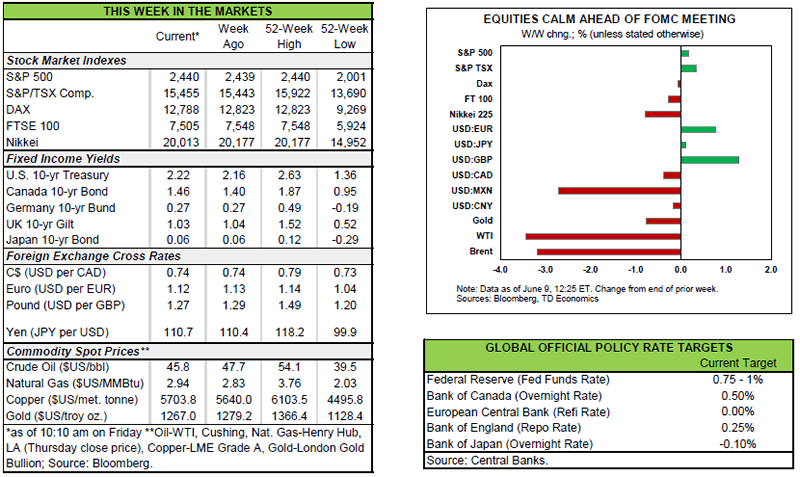
Following last Friday's payrolls report, there was little economic news to stir U.S. risk or fixed income markets ahead of next week's interest rate decision by the FOMC, in which it is widely expected to raise the federal funds rate by 25 bps. Both the job openings, turnover, and layoffs survey (JOLTS) for April and the ISM non-manufacturing survey for May were consistent with the message of slowing job growth from Friday's payrolls report. This shouldn't come as a surprise as employment growth tends to slow as the duration of an economic expansion lengthens.
Perhaps more insightful as to the health of the U.S. labor market are industry anecdotes and job openings data suggesting that the tight labor market is making it tougher for employers to find qualified help. Maybe this will provide the catalyst to ignite wage growth that has been subdued despite a tightening labor market, raising price pressures sufficiently for the FOMC to continue to normalize monetary policy with conviction.
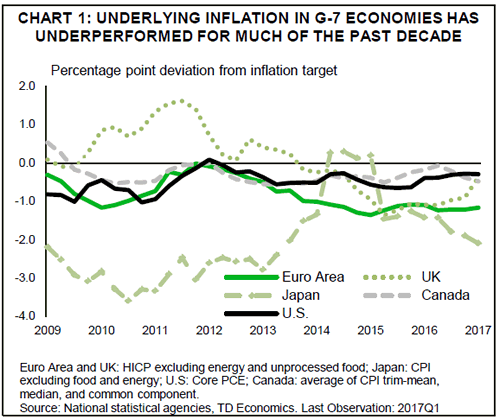
Weak underlying inflation is a phenomenon that has been plaguing many advanced economies for the better part of the last decade, accented by overly optimistic forecasts from inflation-targeting central banks. At this week's monetary policy meeting, the ECB left interest rates and monthly asset purchases unchanged, but tilted its forward guidance slightly more hawkish, a nod to the more balanced risks around the outlook for inflation given the strong economic performance of the Euro Area. Nonetheless, downward revisions to their inflation forecasts were widely interpreted by markets as dovish. A capitulation by the ECB, perhaps, to the fact that despite a rapid absorption of economic slack, underlying price growth will remain subdued over the next few years in the absence of significant wage pressures.
The ECB is right to remain dovish given the downside risks to the Euro Area outlook. Aside from the threat posed by a possible election of the anti-EU/euro M5S in Italy, perhaps a bigger threat to the region's outlook is what may be a messy Brexit negotiation. Overnight we learned that the Conservative government's gamble to ensure a strong majority in the UK parliament for the next four years failed. Instead, it appears that a shaky Conservative coalition government will negotiate exit terms with the EU, a result that only serves to further weaken their negotiating position, while raising policy uncertainty for businesses. On the bright side, this outcome increases the likelihood that the UK will maintain some existing ties with the EU, favoring an arrangement similar to that between Norway and the EU.
Lastly, this Sunday is the first of two rounds of French parliamentary elections. President Macron's En Marche! party, supported by its Democratic Movement ally, is expected to earn a majority, giving the newly elected president a strong mandate to pursue a pro-business reform agenda aimed at improving the long-run growth performance of the French economy. The strength of his mandate will be known after the conclusion of next week's second round ballot, but it appears that this election should deal another strong blow to French populism for the time being.
CANADA - ECONOMIC STARS ALIGNING FOR EARLY-2018 RATE HIKE
It was a relatively busy week in Canadian markets as investors digested fresh labour and housing market data and got an updated view from the Bank of Canada on the stability of the financial system. Equities and the loonie stumbled mid-week on a slump in oil prices related to a growing U.S. supply glut. But, Canadian markets recovered on solid economic numbers that painted a relatively healthy picture of the Canadian economy, and boosted the prospects for an earlier Bank of Canada rate hike. Markets are now pricing a one-third chance of a hike by year-end, with the odds of a move in the first quarter of 2018 better than even.
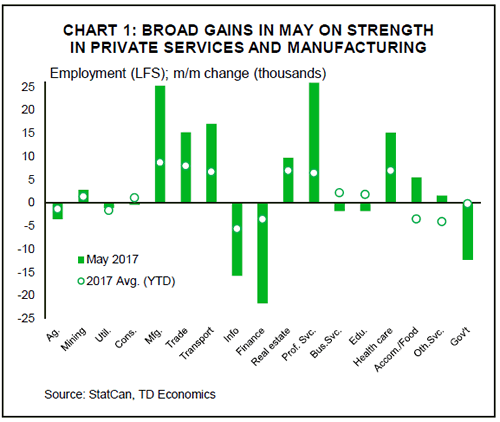
The renewed enthusiasm for the Canadian economy was highlighted by the strong employment numbers this morning. The Labour Force Survey indicated that 54,500 jobs were created across the country in May, with 77,000 full-time jobs added on the month. The May tally takes the twelve-month tally to 317,000, its fastest pace more than four years. Workers also flocked back into the labour force, which expanded by nearly eighty-thousand after a sizeable decline in the month prior, pushing the jobless rate up a tick to 6.6% in May. While P.E.I. registered the largest relative gain (+1,500), and is now leading the country in job growth at 4.7% y/y, most of the absolute gains were to be had in British Columbia (+12k), Quebec (+15k) and Ontario (+20k). Encouragingly, the job gains were relatively broad based, with manufacturing and most private services showing gains, while finance and construction had another weak month (Chart 1).
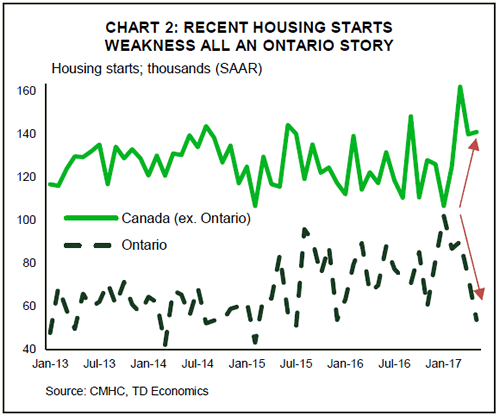
Softer finance and construction job numbers are in line with the cooling housing market. The pace of housing starts in May slowed to 194,000 annualized, down 20 thousand on the month and its slowest level in six months. All the weakness was in Ontario, where starts pulled back by 20 thousand after a 16 thousand drop in April (Chart 2), as developers digest the impact of the Fair Housing Plan introduced by the province on April 20th. In a complete reversal of the first-quarter story, the existing home market is also cooling. TREB figures released early this week pointed to a surge in new listings and decline in sales in May. Average transaction price dropped in the month, but this was more of a compositional effect given the skew towards condos. On the other hand, the quality-adjusted index increased slightly on the month, but decelerated to 29% from 31.6% year-on-year.
As outlined in our recent paper, this is a welcome cooloff for the red-hot market. The Bank of Canada's updated Financial System Review highlighted growing concern about both household indebtedness and housing market imbalances, with a sharp correction in home prices in overheated markets flagged as a key risk for financial stability. Other key risks identified include a severe nationwide recession, a sharp increase in long term rates driven by higher global risk premiums, and stress emanating from emerging markets. These risks will remain top of mind for policy makers, but are unlikely to sway the Bank of Canada from proceeding with rate increases. All in all, while we don't expect the Bank to move this year, an early-2018 hike is an increasingly likely scenario provided that economic data remains upbeat.
Week Ahead Central Banks to Attempt Return to Fundamentals
UK, Switzerland, Japan and US central banks to deliver statements
The US dollar is mixed against majors in a week that saw geopolitical factors drive markets. The surprising result of the UK elections with conservatives being forced to partner to form a government has the pound depreciating across the board. Commodity currencies (AUD, CAD and NZD) appreciated versus the greenback and the majors (CHF, EUR and GBP) traded lower. The JPY ended the week flat against the dollar ahead of a busy week in central banking.
The U.S. Federal Reserve will host the Federal Open Market Committee (FOMC) meeting on June 13 and 14. It will release its monetary policy statement on Wednesday, June 14 at 2:00 pm EDT. The Fed is highly anticipated to hike rates by 25 basis points for the second time this year, to a 100–125 basis points for the Fed funds rate. The CME FedWatch tool is showing a probability of 95.8 percent of a higher rate on Thursday. Fed Chair Janet Yellen will take part in a press conference at 2:30 pm EDT to give more details on the central bank's decision.
The Swiss National Bank (SNB) will publish the Libor policy assessment and a will kick-off a press conference on Thursday, June 15 at 3:30 am EDT. In the aftermath of the UK elections the Bank of England (BoE) is unlikely to make a drastic change. The BoE will publish its monetary policy summary and minutes of its policy meeting on Thursday at 7:00 am. The conservative party called a snap election to further solidify its majority and instead it is now forced into a partnership with Northern Ireland's Democratic Unionist party to form a working majority. The Bank of England will have to wait until there is more clarity on Brexit before it can raise rates.
The Bank of Japan (BOJ) will round up the week on Friday, June 16 with its monetary policy statement being released at midnight and BOJ Governor Haruhiko Kuroda hosting a press conference at 2:30 am EDT.
The BOJ is in a similar position to the European Central Bank (ECB) as it could deliver an optimistic assessment on the Japanese economy, but being cautious about inflation losing traction. The market is not forecasting any change to the interest rate or stimulus program at this time.
The EUR/USD lost 0.749 percent in the last five days. The single currency is trading at 1.1193 after the ECB met expectations by keeping the interest rate and QE program unchanged. The central bank did remove the reference to rate cuts, and President Mari Draghi praised the momentum of the economy, while at the same time warning of weak inflation. The USD was able to shake off some of the impeachment cloud surrounding the Trump administration after the testimony of James Comes. There was nothing new that emerged during the proceedings as Comey stuck to his notes on his meetings with President Trump. The USD was lifted by lack of evidence, but will remain under pressure as this is only a small part of the investigation surrounding his team and unofficial contact with Russian agents.
Political risk drove the direction of the pair last week, but going forward the US will release key economic data as well as the expected rate hike from the Fed further appreciating the dollar against the euro. The Trump administration continues to pledge a tax reform and infrastructure spending policies but until they materialize the June rate hike might be the last one for the US central bank in 2017.
The French parlimentary elections are not expected to bring as many fireworks as the UK elections but are nevertheless important as the results will define the type of government Emmanuel Macron gets to lead. The first round of elections will take place on June 11, with a second round if needed on the 18. Macron is expected to gain a majority with his newly formed party thanks to new rules put in place in 2014 that forbids representatives to hold two offices (local and federal) at the same time with the vast majority chasing to retain their local positions and not run again on this parliamentary elections. If Macron party gets a majority it would spell the end of the two party system in France.
Oil lost 3.612 percent in the last week. The price of West Texas Intermediate is trading at $45.71 after the massive buildup on Wednesday on the US weekly crude inventories. The forecast had called for another drawdown and instead the shock rise in inventories in the same week as the rift between Qatar and major Arab states put downward pressure on crude prices. The Organization of the Petroleum Exporting Countries (OPEC) has stabilized prices since they announced their production agreement with major producers last year that was put into effect in January. Nearing the end of the original six month duration members have agreed to a 9 month extension. Their goal of price stability has been met, but a glut in energy products remains as producers not part of the deal like the United States, Canada and Brazil have increased production. The US in particular has gone from a net importer of crude to an exporter offsetting the efforts from OPEC.
Weekly inventories are released every Wednesday at 10:30 am EDT. Last week there was a buildup of 3.3 million barrels when a drawdown of 3.1 million was expected. Oil disruptions have been the only factor that have driven oil prices higher, but due to the nature of the disruptions they are not consistent. Case in point the current Nigerian pipeline leaks. Nigeria and Libya due to disruptions are exempt form the production cut, but as soon as those go away the OPEC will face further internal pressure as the oil glut will continue due to stagnant demand for energy around the globe.
The GBP/USD lost 1.212 percent in the last five days. The shocking results of the UK election caused anxiety as the solid majority achieved in 2015 (itself a shock at the time) was wasted by a poor campaign that made the decision of a snap election questionable and could end the career of Theresa May. The election was supposed to put the Conservative party in better footing to deal with the EU in Brexit negotiations. Now needed a partner for majority the Conservative party will be more fractured as it misjudged the intentions of the British people once again. In a curious development it is the less likely probability of a hard brexit (that would have been pushed with a solid Conservative win) that is keeping the GBP from falling further. The Tories will be now forced to seek a more compromised soft Brexit but the EU is now more than ever in the driver seat.
Up ahead the Bank of England (BoE) will be tasked with riding out the political uncertainty of a Brexit outcome that is a moving target. The central bank is not expected to make any major interventions like it did when the Brexit referendum results were announced.
Market events to watch this week:
Tuesday, June 13
- 4:30 am GBP CPI y/y
- 8:30 am USD PPI m/m
- 10:00 pm CNY Industrial Production y/y
Wednesday, June 14
- 4:30 am GBP Average Earnings Index 3m/y
- 8:30 am USD CPI m/m
- 8:30 am USD Core CPI m/m
- 8:30 am USD Core Retail Sales m/m
- 8:30 am USD Retail Sales m/m
- 10:30 am USD Crude Oil Inventories
- 2:00 pm USD FOMC Economic Projections
- 2:00 pm USD FOMC Statement
- 2:00 pm USD Federal Funds Rate
- 2:30 pm USD FOMC Press Conference
- 6:45 pm NZD GDP q/q
- 9:30 pm AUD Employment Change
Thursday, June 15
- 3:30 am CHF Libor Rate
- 3:30 am CHF SNB Monetary Policy Assessment
- 3:30 am CHF SNB Press Conference
- 4:30 am GBP Retail Sales m/m
- 7:00 am GBP MPC Official Bank Rate Votes
- GBP Monetary Policy Summary
- GBP Official Bank Rate
- 8:30 am USD Unemployment Claims
- Tentative JPY Monetary Policy Statement
Friday, June 16
- Tentative JPY BOJ Policy Rate
- 2:30 am JPY BOJ Press Conference
- 8:30 am CAD Core Retail Sales m/m
- 8:30 am USD Building Permits
*All times EDT
FOMC, BoE, BoJ & SNB Policy Meetings, Key Data in Focus
Next week's market movers
- In the US, the FOMC is almost certain to raise interest rates, according to market pricing. Thus, focus will probably be on what signals policymakers send regarding the pace of future hikes.
- The BoE is expected to remain on hold. Even though the market may pay some attention to this meeting, given the UK's political situation, monetary policy is likely to be overshadowed by political developments in the short term.
- The BoJ and the SNB are both anticipated to keep their policies unchanged as well.
- We also get key economic data from the UK, the US, China, Australia, and New Zealand.
On Monday, we have a relatively quiet day, with no major events or indicators due to be released.
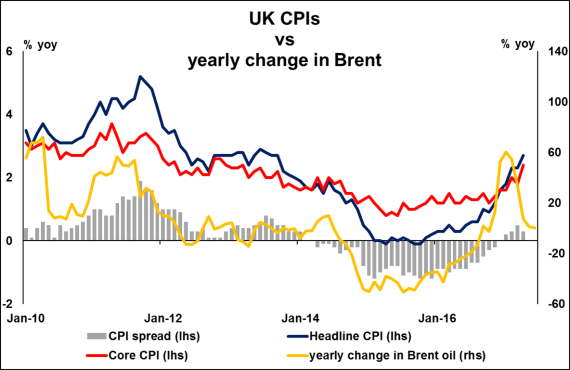
On Tuesday, the UK CPI data for May will be released. The forecast is for both the headline and the core rates to have remained unchanged. We view the risks surrounding those forecasts as skewed to the downside, perhaps for a slight pullback, considering that the nation's services PMI for the month showed the weakest increase in prices charged by service-sector firms since November. In any case, we think that market focus on the day is likely to be on politics rather than economics. Tuesday will be the first day the new UK Parliament meets, and also the first deadline Theresa May will have to put together a deal for keeping herself in power. May will likely have to reach a deal with another party in order to achieve a majority in the House of Commons. If she fails to present such a plan, then the focus turns to the 19th of June. On that day, Parliament will vote on the Queen's speech, a list of the laws the government hopes to get approved over the coming year. If Parliament rejects the Queen's speech, then Labour leader Jeremy Corbyn could be invited to form a government.
On Wednesday, in the US, all eyes will be on the much-awaited FOMC policy announcement. This will be one of the "bigger" meetings, meaning that besides the rate decision we will also get fresh economic forecasts for the US economy, an updated "dot plot", as well as a press conference by Chair Yellen. The forecast is for the Committee to raise borrowing costs by 25bps, something overwhelmingly supported by market pricing, which indicates a 99.6% probability for such action. Given that a rate hike is fully priced in at this stage, we think that market focus on the day will be on what signals policymakers send regarding the pace of future hikes and specifically, on any potential changes to the "dot plot". In addition, market participants will be looking for clues as to when the Fed will begin normalizing its enormous balance sheet, as the minutes of the May meeting showed "nearly all policymakers" expected it to start later this year.
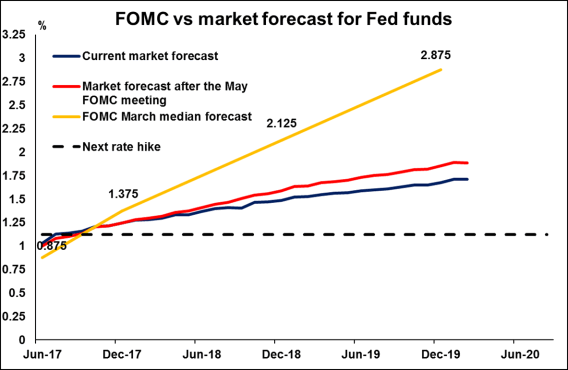
On balance, we think that the risks surrounding the dollar's reaction from this meeting may be tilted to the downside. In our view, policymakers are highly unlikely to accompany this rate hike with hawkish signals, considering the recent streak of disappointing economic data and developments. Slowing inflation, a sharp decline in inflation expectations, flat wage growth, and diminished expectations regarding the prospect of fiscal stimulus, are all solid arguments supporting a "dovish hike" by policymakers. Our view is enhanced by the latest comments from Fed Board Governor Brainard, who indicated that she sees some tensions between progress in employment and lack of progress on inflation. She added that if this persists, it may lead her to reassess her expectations with regards to the path of the Federal funds rate.
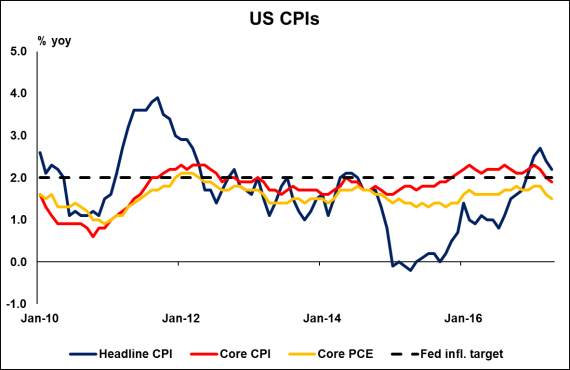
As for the US indicators, we get CPI and retail sales data, all for May. Kicking off with the CPIs, the headline rate is expected to have declined again, albeit marginally. The core rate is anticipated to have held steady. Even though a decline in the headline rate could be a somewhat discouraging development, as long as it remains above the Fed's target and the core rate remains unchanged as expected, we doubt that these data will be a game-changer for FOMC officials.
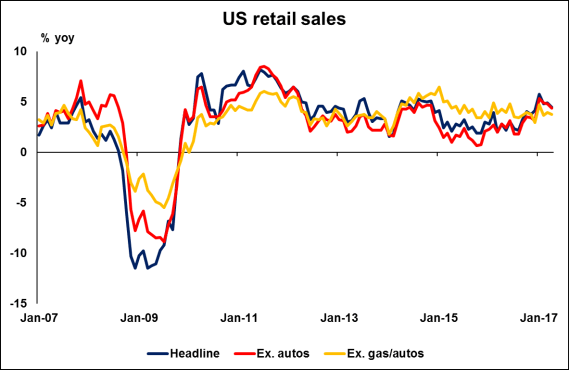
As for the US retail sales, the forecast is for both the headline and the core rates to have ticked down from previously, but to have remained within the positive territory. The consensus for a slight slowdown in sales is somewhat supported by the nation's consumer sentiment indices for the month. The Conference Board index declined, while the U of M figure remained more or less unchanged. In any case, considering that investors will probably have their gaze locked on the FOMC decision later in the day, a slight slowdown in sales may attract less attention than usual.
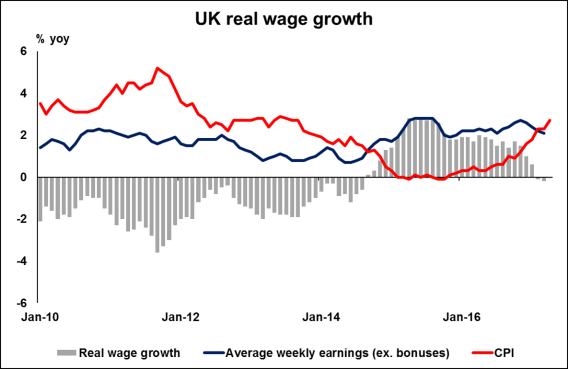
In the UK, employment data for April are due out, though no forecast is available yet. Our own view is that the unemployment rate likely remained unchanged, with risks titled to the downside, while average weekly earnings may have risen at the same pace as previously, with risks skewed towards an acceleration. The nation's services PMI for April indicated that job creation in the sector picked up to a four-month high, and that companies reported a strong rise in costs, due to higher salary payments among other factors. Considering that the service-sector accounts for roughly 80% of the nation's GDP, we consider it a decent gauge of the overall economy. However, nominal wages have to accelerate by more than April's inflation for real wages to turn back positive.
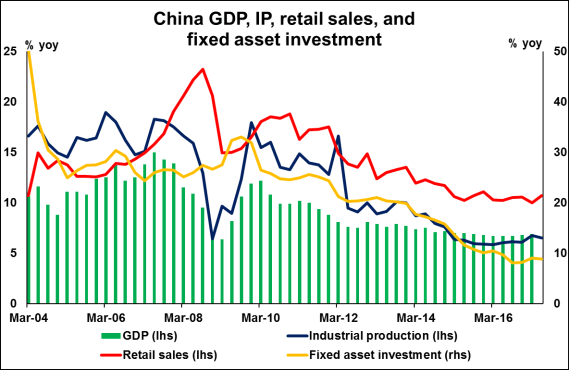
In China, focus will be on retail sales, industrial production and fixed asset investment, all for May. All of these figures are expected to have slowed, something that would likely add credibility to the recent signals from the nation's PMIs that economic growth may be easing again. Even though a potential slowdown in all of these indicators would probably be worrisome for the PBoC, we doubt that it will lead to any policy action anytime soon. The Bank has been tightening its policy recently despite signs of slowdown in economic growth and cooling inflationary pressures, mainly in order to curb financial stability risks, such as rapidly rising housing prices.
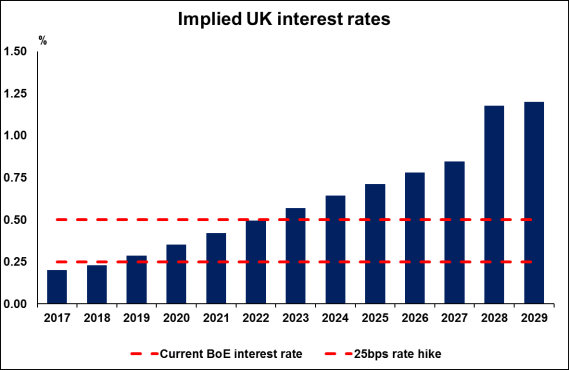
On Thursday, the Bank of England meets to decide on monetary policy. Expectations are for the MPC to keep policy untouched via a 7-1 vote. Once again, the lone dissenter is very likely to be Kristin Forbes, who has voted in favor of a rate increase in the last two meetings. Nevertheless, this will be the last gathering she participates in as an MPC member and thus, another dissent by her may carry little-to-no importance for market participants. Since the Bank's latest gathering, CPI data showed that inflation accelerated to +2.7% yoy in April from +2.3% yoy the previous month, which is in line with the Bank's forecast for the year, while GDP slowed notably in the first 3 months of the year. These data combined with the fact that in its latest Inflation Report, the Bank downgraded its inflation forecasts for 2018 and 2019, confirm our view that the BoE is likely to remain on hold for this year, and possibly beyond. Just for the record, according to the pound sterling overnight index swaps, the market sees interest rates rising only 10 basis points by 2020. In any case, considering the UK's political situation, with a hung parliament generating uncertainty and the Brexit negotiations set to begin soon, we think that monetary policy considerations will be overshadowed by political developments, at least over the next few weeks.
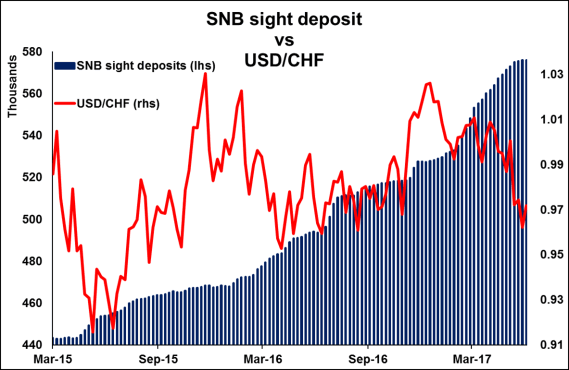
In Switzerland, the SNB will announce its rate decision and the forecast is for the Bank to keep its policy unchanged. Economic developments have been mixed since the SNB's latest meeting in March. On the inflation front, the CPI rate dropped in April, but rebounded somewhat in May. The unemployment rate ticked down and GDP growth accelerated in Q1, albeit slightly. As for the all-important franc, it appreciated against the dollar, but lost some ground against the euro. Given these mixed developments, we don't expect the SNB to change tune. We think policymakers are likely to repeat the usual mantra – that the franc remains significantly overvalued and that the Bank will remain active in the FX market as necessary in order to curb gains in the currency.
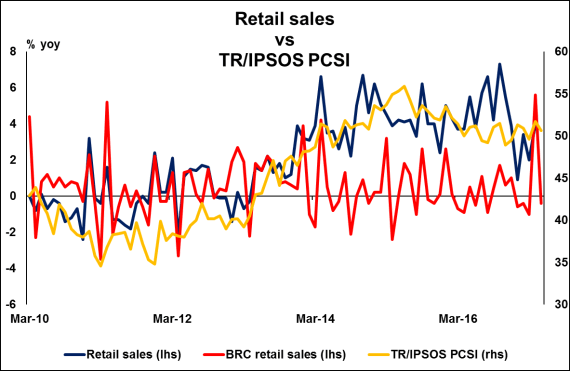
As for the economic data, in the UK, retail sales for May are due out and the forecast is for a decline following a remarkable +2.3% mom surge in April. The forecast is supported by the BRC retail sales monitor, which plunged during the month, with the yearly rate dropping to -0.4% from +5.6% previously. What's more, consumer sentiment indices were downbeat in the month, on balance. The TR/IPSOS figure declined and while the Gfk index rose, it did not manage to escape the negative territory.
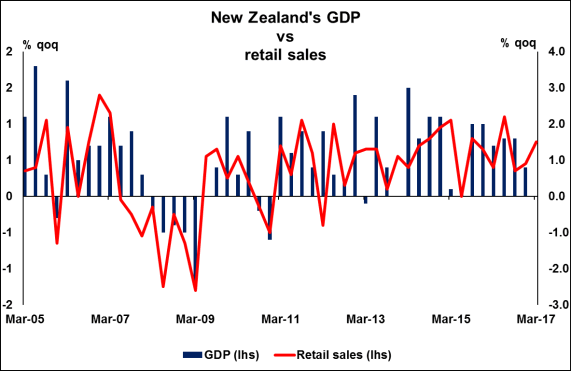
From New Zealand, we get GDP data for Q1. Without a forecast available, we see the case for the economy to have grown at the same pace as previously, with risks skewed to the upside. Economic indicators for Q1 painted a relatively upbeat picture. Retail sales accelerated notably in Q1, while the labor market continued to tighten at a very robust pace. However, even in case the GDP print is strong, we doubt that it will have much impact on the RBNZ's cautious bias. In its latest statement, the Bank made it clear that although domestic economic data are improving, numerous uncertainties remain and policy may need to adjust accordingly. Considering that policymakers were probably referring to global uncertainties, and that there have been signs of slowdown in China since that meeting, we think that for the time being, the RBNZ may continue to "look through" encouraging data.
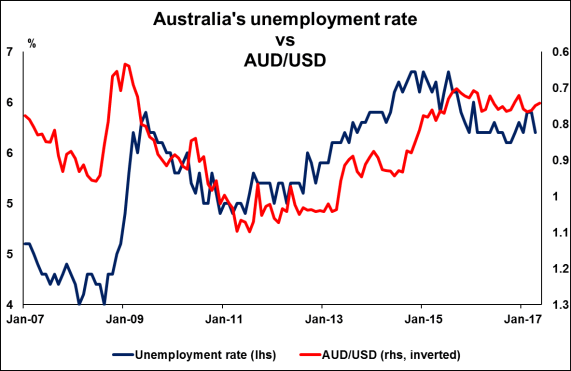
In Australia, employment data for May will be in focus. The forecast is for the unemployment rate to have held steady after declining to 5.7% in April from 5.9% previously. The net change in employment is expected to have declined somewhat, but to have remained in positive territory. The forecast for another month of decent employment gains is supported by the ANZ job advertisements indicator, which showed that job ads rose again in May, though at a slower pace.
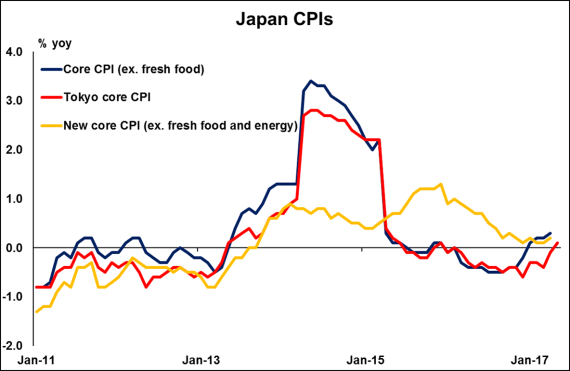
On Friday, during the Asian morning, the BoJ policy announcement will be in the spotlight. Looking back at the latest gathering, the Bank upgraded its assessment for the Japanese economy, but revised down its inflation forecasts. Ever since, developments on both of those fronts have been encouraging, on balance. In Q1, the economy grew at the same pace as the previous quarter, while the BoJ's core CPI rate for April rose, albeit marginally. In addition, the nation's forward-looking Tokyo core CPI rate for May rose and entered the positive territory for the first time since late 2015. Last but not least, wages surged by more than anticipated in April, which is likely to be pleasant news for policymakers, as wage growth is seen as a signal of future inflation. Nevertheless, we do not expect such modest signs of progress to lead to any change in the BoJ's QQE with yield-curve control framework, at least for the next few meetings.
Week Ahead – Key Central Banks in the Spotlight – FOMC, Bank of England, Bank of Japan Policy Meetings
Following the UK elections, the focus next week will continue to be on Britain as the outcome of the vote could have important ramifications for Brexit negotiations. Key events in the coming week revolve around central banks as the Bank of England, Federal Reserve and Bank of Japan all have policy meetings next week.
Bank of England
The Bank of England is widely expected to leave interest rates at 0.25% and it is considered unlikely that the Bank will cut rates further in response to the result of the vote as they did after the Brexit result last June. But if the UK economy suffers as a result of uncertainty from the new coalition Government then rates are set to stay low for the foreseeable future. Meanwhile, employment data will provide a key indication of the health of the labour market, while the May retail sales report is also due and are expected to drop 0.8% from April's 2.7% increase, the biggest gain since January 2016. Inflation data will be closely watched as well next week. CPI jumped to 2.7% in April from 2.3% in March, the highest since mid-2013. However, wage growth lagged inflation for first time since mid-2014. BoE policymakers attribute almost all of the inflationary upsurge to drop in the value of the pound since the Brexit vote.
Federal Reserve policy meeting
All eyes will be on the FOMC meeting, with high expectations for an interest rate hike of at least 25 basis points to bring the Fed funds rate to between 1.00-1.25%. The Fed's quarterly economic projections and Chair Janet Yellen's speech will be closely scrutinized. The data flow recently has been disappointing and this has reduced the odds of aggressive rate hikes after June. Aside from the weaker data, political controversies surrounding US President Donald Trump have led to growing doubts about the Trump administration's ability to pass tax and healthcare reforms through Congress. A slew of US economic data due next week includes CPI, PPI, retail sales, unemployment claims, industrial production, building permits, the preliminary University of Michigan consumer sentiment report and the Empire State manufacturing index.
Bank of Japan
Japan's central bank is not expected to make any changes to monetary settings as the Japanese economy is still a long way from meeting the BOJ's 2% inflation goal. Data that might be worth watching will be machinery orders for April. They are forecast to fall 1.3% month-on-month from a prior 1.4% gain.
China IP
Other key data highlights include China's data releases on industrial production and foreign direct investment and retail sales.
Australia and New Zealand
Jobs data are due from Australia, as well as the NAB business confidence survey. New Zealand releases GDP numbers.
Eurozone
The week also sees data out of the Eurozone which include industrial production and CPI as well as the German ZEW report.
With Events Out Of The Way, Buy Risk
- With Events Out Of The Way, Buy Risk - Peter Rosenstreich
- SNB's Period Of Relaxation Is Over - Arnaud Masset
- ECB Meeting: Draghi Disappoints Markets - Yann Quelenn
- "Brexit"
Economics - With Events Out Of The Way, Buy Risk
This last week has provided plenty of risk events that shifted investors' attention from fundamentals and on to flashy headlines. While the result of the hung parliament in the UK will likely hurt GBP and UK assets for the foreseeable future, the other key events will have only a transitory effect. While rogue bouts of risk aversion have provided a white-knuckle ride, we remain constructive on EM currencies based on fundamentals. The drivers of strong capital inflow, which have supported EM assets, are unchanged and are showing no signs of diminishing.
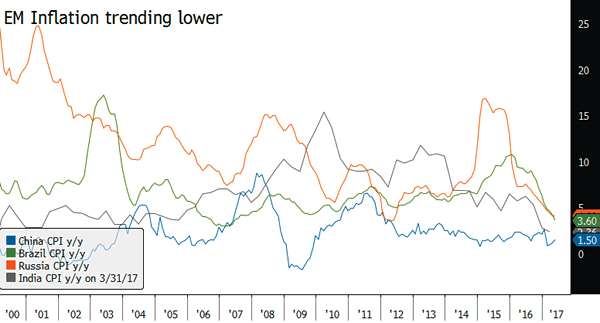
Emerging / developed markets growth differentials will support asset prices. The positive economic surprise in many EM nations has lifted the EM growth outlook. EM GDP for 2017 is expected to come in near 4.5%, well outpacing developed nations' soft 1.8% expansion. Yet, politics both domestically and internationally, such as President Trump's trade policy, provide a significant level of uncertainty to this forecast. Inflations remain in a sweet spot for investors. Solid economic activity, specifically in trade, has pressured price yet soft crude prices has pushed back on the reflation theme. Central banks are likely to keep policy loose as the outlook for energy prices remains subdued.
However, the strongest driver of EM appreciation is likely to be the delay of monetary policy tightening by the big three. Last week, the ECB lowered inflation outlook, which allowed Draghi to provide a dovish tone, despite clear movement toward the exits. The BoJ in comments are ready to let inflation overshoot despite general economic improvement and increasing pressure from politicians to begin normalisation.
Finally, this week's Fed 25bp hike is nearly completely priced in yet the probably of additional hikes in 2017 collapses. Disappointing US economic data (including weak core inflation data) and confusion in Washington has sapped investors' confidence of 2Q acceleration and therefore an aggressive Fed interest rate curve. With no impending G3 tightening, sustained higher volatility is unlikely benefiting EM in the mid-term.
Overall, global macro environments remain supportive to risk-taking and will further drive flows into EM assets. We continue to favour carry trades but remain nimble for shifts in sentiment.
Economics - SNB's Period Of Relaxation Is Over
The publication of the latest batch of economic data from Switzerland went largely unnoticed as market participants awaited several key events. The unemployment rate eased to 3.2% (seasonally adjusted) in May, beating median forecast of 3.3%, while the previous month's figure was downwardly revised to 3.2%. Investors also got a positive surprise on the inflation front as the headline measure printed at 0.5% y/y, well above estimates of 0.3%.
However, the HICP measure, which allows to compare inflation pressure with that of its European neighbours, shrunk 0.2% m/m in the previous month. On a year-over-year basis, the indicator eased to 0.4%, down from 0.7% in April. There is no reason to worry as core inflation continued to accelerate in May, highlighting the negative effect of the most volatile components, especially petroleum products.
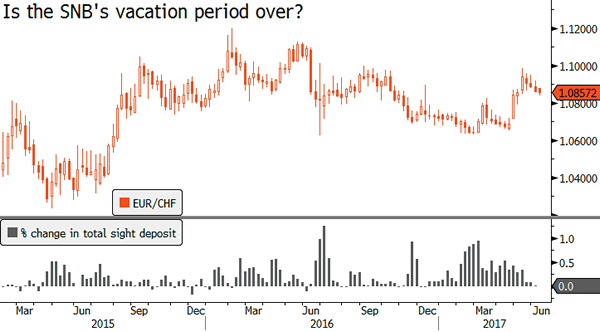
On the monetary policy side, the SNB has had some respite over the last few weeks as investors renewed their faith in a strong European Union amid Macron's victory at the French presidential election and an expected positive outcome for the Conservatives in the UK. The pace of increase of sight deposits within the Swiss National Bank have slowed down substantially during the weeks following the election of Macron as total sight deposits rose by a weekly average of CHF 357 million compared to almost CHF 2 billion during the month previous to the election. As of June 2nd, total deposits printed at a new all-time high and topped CHF 576 billion.
Yet the honeymoon may be over as both the political and monetary environments have worsened recently. Indeed, Mario Draghi's dovish speech last Thursday, together with May's failed attempt to reinforce its position in the House of Common, will put investors on the back foot and incite them to cut their long EUR position, which would ultimately weigh on EUR/CHF.
We expect EUR/CHF to come under renewed downside pressure as investors adjust their portfolio. After hitting 1.0987 amid Macron's victory, the pair has kept on moving lower to reach 1.0838 last Friday. In the short-term, we anticipate the single currency to return to around 1.0650.
Economics - ECB Meeting: Draghi Disappoints Markets
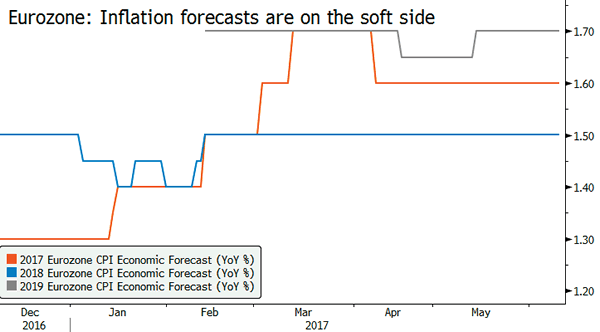
The euro has weakened amid the ECB meeting last week. The European Central Bank has slightly lowered its inflation forecast. Indeed the CPI expectations are now 1.5% in 2017, 1.3% in 2018 and growth should remain below 2% within the next three years.
Financial markets were clearly expecting for hints about a possible normalization of the monetary policy as we can consider the massive easing did not yet have the expected results. Actually Draghi mentioned that rates could go further lower despite what appeared to be the current ECB political stance. Concerns are also coming from German Chancellor Angela Merkel and also from Dutch officials. Recently at the end of a meeting with the Dutch parliament, Draghi was offered a plastic tulip to remind of bubble concern.
As widely expected, the rates remain unchanged. In our view, we still believe that we are approaching towards an inflexion point regarding monetary policy
In order to assess the Eurozone economy, the German economy is a great barometer. Last week, German Factory orders declined - surprisingly - more than expected in April at -2.1% m/m. Anyway, recent economic data were robust and showed that Germany was on a strong recovery road.
The factory orders forecast, even though negative, was way more optimistic. Markets estimated the data to slightly decline to -0.3%. We now wonder whether there is a reason to worry after the very positive first half of the year. It is anyway important to notice that the annualized data remains largely positive with a +3.5% print.
As explained above, other German economic fundamentals are positive. Growth is running at a strong pace above Eurozone average at 0.6% for Q1 and the labour market is widely recovering.
Unemployment has never been so low. So last week's factory orders seem to be contradicting the current momentum in Germany.
Amid the release of this German data and the ECB meeting, the single currency is trading mixed and is now back below 1.1200. We believe that markets are still optimistic of the Eurozone recovery and continue pricing in US difficulties.
Themes Trading - "Brexit"
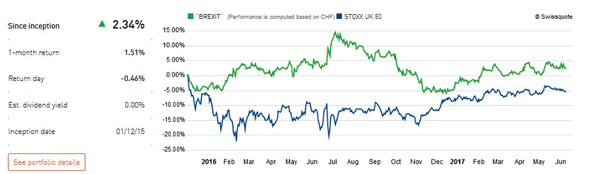
The decision of the United Kingdom to leave the European Union turned upside down financial markets as most investors were anticipating the UK to vote "no" at the EU referendum. This decision triggered a panic reaction in financial markets with investors fleeing risky assets to invest massively in safe haven ones such as gold or bonds. However, even though most equities suffered a massive sell-off, a few ones were to weather the turmoil.
The portfolio we built a portfolio composed of stocks that are expected to perform well in case of a Brexit. The portfolio offers a substantial indirect exposure to gold, which always performs well during turbulent periods due to its safe haven status, as well as stocks weakly correlated with equity indices, which usually performs well during period of high volatility.
British Drama Hurts Sterling; Dollar Advances Eyeing Fed Meeting
Political developments were dominating investors' attention today with the outcome of British national elections and the effect on sterling being number one on the watch-list.
Less than two weeks' time before Brexit negotiations get underway, UK Prime Minister Theresa May's Conservative party lost its majority in the House of Commons. May's call for snap elections was in the first place intended to give her a stronger hand in negotiating the nation's exit from the EU and the outcome turned out to be what she least likely wished for, introducing an additional layer of uncertainty going forward. Reports suggested that May would seek to gain Northern Ireland's Democratic Unionist Party support in order to secure parliamentary majority and govern the nation.
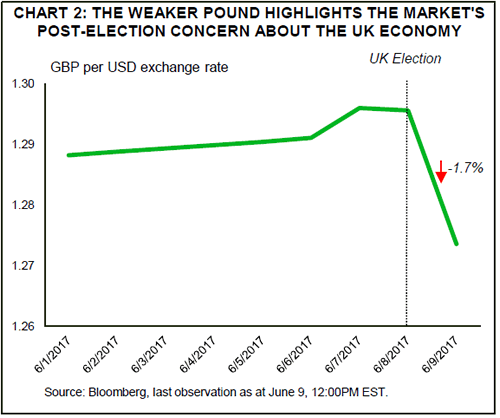
Sterling tumbled as the polls hit the markets. Relative to the dollar it fell by almost two and a half cents to reach a low of $1.2704 from the $1.2950 level it traded before, reaching a near two-month low. At the same point in time, the euro recorded a steep rise relative to the pound, rising to as high as 88.24 pence from 86.54. Later in the day, euro/pound posted a seven-month high of 0.8858. By afternoon European trading hours the British currency managed to recover part of those losses but was still significantly down on the day relative to both the greenback and the euro.
The former FBI director Jamey Comey's testimony before the US Senate was largely ignored by the currency markets despite him accusing President Donald Trump of lying and thus potentially diverting his administration's attention from delivering on campaign promises, such as a tax system overhaul. The focus now shifts to the Federal Reserve's policy meeting next week and predominantly on guidance on rate normalization moving forward, as a quarter percentage point interest rate hike seems to be already priced in by the markets. The CME Group's 30-day Fed Fund futures prices currently reflect a more than 90% chance of that materializing.
Dealing away with the week's risk events and being helped by rising US yields, the dollar index, a broader measure of dollar strength, opened with a gap higher that was mainly fueled by the greenback gaining versus the pound. The index was up by half a percent in late European trading hours at 97.38. Dollar/yen was last comfortably above the 110 level after starting the day slightly below it. Euro/dollar hit a more than one-week low of 1.1166 with the single currency building on negative momentum after the European Central Bank's decision yesterday to cut its inflation forecasts and the Bank not being ready yet to reduce its monthly pace of asset purchases.
Turning to today's data releases, UK industrial output numbers for the month of April showed output growing by 0.2% month-on-month, well below the 0.8% expected but above the 0.5% contraction in the previous month. Manufacturing output, a subset of industrial output, also grew by 0.2% on a monthly basis. Expectations were for growth to reach 0.9%, while March's respective figure stood at -0.6%. Both manufacturing and industrial output experienced contraction in January and February as well. In other UK data, the nation's goods trade deficit narrowed to 10.4 billion pounds in April with analysts expecting a 12.0bn deficit. Both exports and imports fell, with imports falling more sharply and thus resulting in a narrowing deficit. The pound didn't have much of a reaction to the data.
In other releases, the Canadian economy added 54,500 jobs in May, far exceeding projections of 11,000 additions and April's 3,200. The unemployment rate increased to 6.6% from 6.5% in the previous month, in line with expectations. The rise in the unemployment rate was attributed to more individuals entering the labor force (i.e. there was an increase in labor force participation), a positive for the economy. Also positive was the fact most positions added were full-time in nature. Dollar/loonie strongly reacted as the data hit the markets with the Canadian dollar gaining relative to its US counterpart. Specifically, dollar/loonie fell to as low as 1.3458 within a five-minute time frame of data release from 1.3511 previously. The pair was last further down at 1.3442.
Finishing with gold, as funds moved back into the dollar, the precious metal continued its retreat and looks set for a third straight daily decline. Today it recorded a one-week low of $1264.50 an ounce.
Weekly Focus: Too Early for Next Fed Hike
Market Movers ahead
- In contrast with the consensus expectation and market pricing, we think the Federal Reserve will keep rates on hold when it meets on Wednesday and instead make an announcement on balance sheet reduction.
- We expect US CPI inflation was 2.0% y/y in May down from 2.2% y/y in April.
- In the UK, the market will focus on the ramifications of the election results. Also the Bank of England will meet on Thursday.
- In Denmark and Sweden, attention will be on the release of CPI inflation data for May.
- The regional network report from Norway should paint a benign picture of the economy.
Global macro and market themes
- Markets are increasingly diverging with stocks keeping an upbeat tone while bond yields, commodity markets and inflation markets have moved lower.
- We see a rising discrepancy between the strong equity markets and disappointing data recently.
- We still recommend a more cautious stance on stocks in the short and medium term.
- Bund yields are set to stay in range.
- EUR/USD lower short term – higher medium term.
Sterling Facing Political Headwinds
- A weakened Theresa May began to form a fragile new U.K. government today as she battled to stay on as prime minister despite losing her parliamentary majority in a disastrous election gamble. May's Conservatives will need support from Northern Ireland's Democratic Unionist Party in order to pass laws in the House of Commons.
- The Catalan government announced today its plans to hold an independence referendum around October. The central government will challenge the legality of the referendum. This challenge will likely be upheld by the Spanish courts, potentially forcing the Catalan government into a position of open defiance against the country's judiciary.
- The UK economy had a weaker-than-expected start to the second quarter as industrial and manufacturing production posted only small increases (both +0.2%), after months of falling figures. ONS data showed the UK's goods trade deficit narrowed to £10.4bn mostly due to a fall in goods imports, almost reversing the surge in March.
- The markets are remarkable stoic by the first round of the National Assembly election in France this Sunday. The contrast with the presidential elections in May could not be bigger. Opinion polls currently predict Macron's party will gain around 30% of the votes on in the first round.
- As markets digested today's unexpected UK election results, Sterling depreciated strongly. This gave the FTSE 100 a boost, but the election's impact beyond the U.K. was muted. The other main equity indexes worldwide performed well today with Nasdaq reaching an all-time high today. Meanwhile, fears of a supply glut continue to weigh on oil.
Rates
Bonds hover sideways before profit taking kicks in
Today, despite the surprise UK election result, global core bonds hovered directionless in a tight range. The Conservatives lost their majority and have to start the Brexit negotiations with a weaker hand and a lame duck Prime Minister. That creates uncertainty, but core bonds couldn't gain. After a minor reaction to the soft ECB message yesterday, there was no follow through buying. The Bund meandered in a 164.90 to 165-10 range, after a slightly higher opening. Similarly the US T-Note future temporary spike during the Asian session (on the UK election result) but showed little animus during the European session, staying close to Thursday's official close. Going into the European close, core bonds slide slightly lower, maybe due to profit taking ahead of the weekend, given the preponderance of the long positions. The move lacks momentum though. Eco data were second tier and didn't impact trading. The German trade surplus was lower than expected, but due to a stronger increase of imports than exports, which suggests good domestic growth. French production fell more than expected, but following an outsized increase in the previous month. ECB Nowotny was quite dovish in his comments, saying the ECB took homeopathic changes to its guidance. He also sees downside risks to the ECB inflation forecasts, which are a challenge for the ECB. His comments didn't affect trading.
At the time of writing, the German yield curve bull steepens with yields 0.3 bp (2-yr) to 2.9 bps (30-yr) higher. US yields rise by 2.7 bps (2-yr) to 3.5 bp (5-yr), the belly underperforming the wings. On intra-EMU bond markets, 10-yr yield spread changes versus Germany continue to narrow on heavy follow through buying up to 6 bps (Spain/Greece) with Italy outperforming (-10 bps). Italian BTP's performed strongly on a positive APP ECB decision and as Italian early election plans took a snag.
Currencies
EUR/USD off the recent highs as Draghi stays soft
Today, the swings in the major cross rates excluding sterling were modest. In a session deprived of important eco data, the dollar continued yesterday's gradual comeback. At the same time, yesterday's cautious ECB approach also capped the topside of the euro. EUR/USD dropped below 1.12 (currently 1.1168). USD/JPY extended its journey north of 110 (currently 110.65).
Overnight, Asian equities traded mixed. The UK election result dominated the headlines, but was no big issue for Asian trading. The dollar maintained yesterday's limited gains. USD/JPY changed only modestly and traded in the low 110 area. EUR/USD lost a few ticks as cable sold off early in Asia, but changes were also limited. The pair again traded in the 1.12 area going into the start of European trading.
Continental European markets had a very calm trading session despite the high profile political events on the other side of the English Channel. European yields declined briefly in early dealings, but soon returned to yesterday's post-ECB levels. EMU eco data were second tier and had no impact on markets. The EMU equity markets remained well bid and completely ignored the UK uncertainty. In the FX market, yesterday's trading pattern more or less continued. The dollar showed tentative signs of a bottoming-out process and this cautious USD bid persisted. The Comey testimony is out of the way and didn't really bring negative news for President Trump. At the same time, the topside momentum of the euro has disappeared after yesterday's relatively soft ECB communication. Interest rate differentials widened slightly in favour of the dollar. EUR/USD drifted below the 1.12 mark (currently 1.1175). USD/JPY also rebounded further from the recent lows and traded in the 110.45 area. Will the USD momentum improve further next week going into the Fed policy decision?
Sterling facing political headwinds
This morning, investors adapted sterling positions as UK PM May's conservative party lost its majority in Parliament. The election outcome created an instable political context going into the Brexit negotiations and raised uncertainty on the short term UK growth outlook. Sterling selling started in Asia as soon as it became clear that the UK was heading for a hung Parliament and reaccelerated at the start of trading in Europe. EUR/GBP tested the 2017 top in the 0.8855 area. However, no sustained break occurred. On the contrary, the UK currency gradually found its composure and rebounded. Markets pondered whether the new political context could lead to a softer Brexit. Such a scenario could be less negative for sterling. The jury is still out on this issue as UK PM May joined forces with the Northern Irelands DUP. EUR/GBP currently trades in the 0.8775 area. Cable is changing hands in the 1.2735 area.
Elliott Wave Analysis: EURAUD Can Be In A Correction
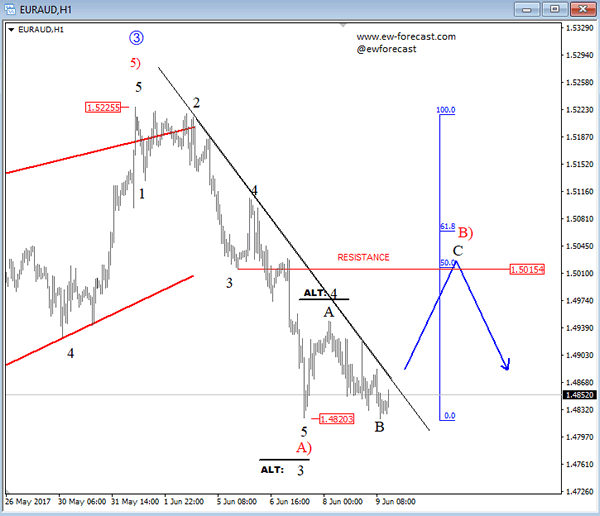
EURAUD made a sharp and strong fall away from 1.5226 high, where we labeled end of red wave 5). As such current fall may be start of a bigger three wave correction, with wave A) already completed. Current slow price action can be the second red wave B) in the making, with price now specifically trading in sub-wave B. A bounce into wave C is expected to follow, with a Fibonacci resistance ratio of 50.0 or 61.8.
EURAUD, 1H
China Inflation Remained Low on Historical Level; Trade Improved, FX Reserve Increased as Government Found New Way...
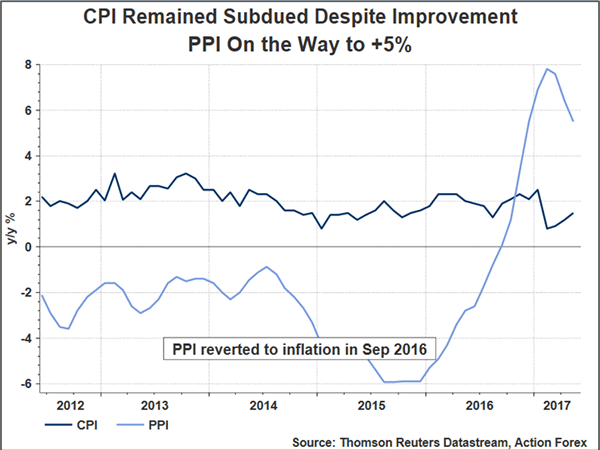
China's headline CPI inflation accelerated to +1.5% y/y in May, from +1.2% a month ago. for the first 5 months of the year, CPI has stayed at average of +1.4%, amongst the lowest levels in history. Core inflation steadied at +2.1% in May. Non-food CPI moderated to +2.3% from 2.4% in April. Food inflation remained in contraction but the decline narrowed to -1.6% y/y in May from -3.5% in the prior month. We believe it was the low base that had helped improve the reading. PPI inflation continued to slow, falling to +5.5% y/y in May from +6.4% in April. Weakness in commodity prices is expected to weigh on PPI, sending it lower to around +5% in coming months.
Trade
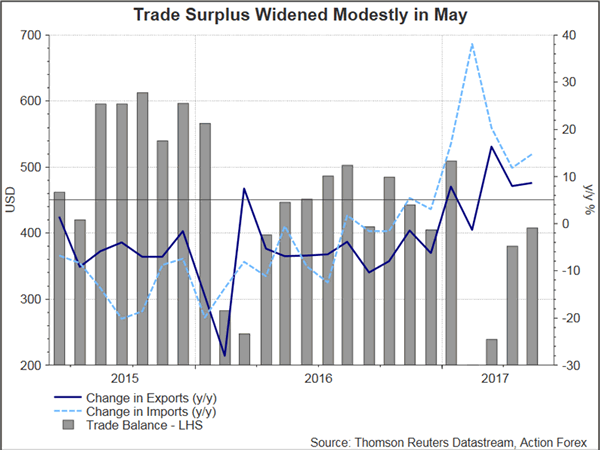
Both of China's exports and imports growth exceeded expectations in May. Exports growth accelerated to +8%y/y from +8.7% a month ago, thanks to the strong increase in shipment to the EU and, to a lesser extent, South Korea. Notwithstanding the high base the same period last year, imports growth accelerated to +14.8% y/y from +11.9% in April. G3 imports surged +15.6% in May, up from +3.6% y/y a month ago. Meanwhile, imports from the US jumped +27% y/y last month, compared with April's +1.5% growth. The country's trade surplus widened to US 40.8B in May, from +US$ 38.1B in the prior month. Indeed, we mentioned in our previous report that the widening gap between exports and imports in the official manufacturing PMI report signaled stabilization in China's trade balance.
Looking into commodity sector, China imported 8.8M bpd of crude oil in May, up 4.6% m/m and 15.4% y/y. The country's imports were mostly heavier, sweet West African grades. Net exports for preliminary petroleum product increased to 401M bpd in May, up +40.8% from the prior month. From a year ago, net exports of which soared +73.9%.
FX Reserve
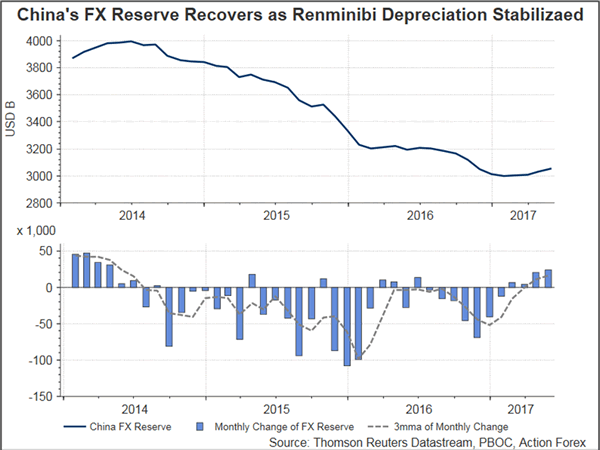
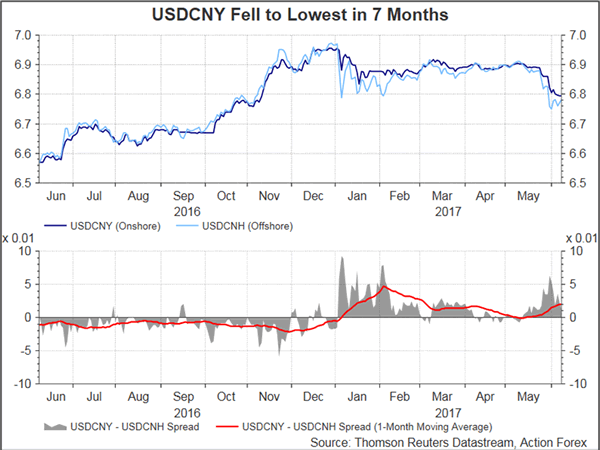
Separately, PBOC's FX reserve increased +US$ 24B to US$ 3.054 trillion, highest in 7 months, in May. This beat expectations of a +US$ 16B increase. The reading remains largely unchanged after adjusting for currency valuation effects. China returned to FX accumulation over the past few months as it faces less pressure on renminbi depreciation, thanks to its stringent capital control measures and Weakness in Us dollar. Note that USD tumbled to a seven-month low in recent weeks and sank -2.5% in May. We expect to see less aggressive sale of FX reserve for supporting renminbi in the futures as China has decided to add a "counter cyclical adjustment factor (CCAF)" to calculate renminbi. While such "factor" might lower the volatility of renminbi, its ambiguity would only make the movement of currency even less transparent.