Sample Category Title
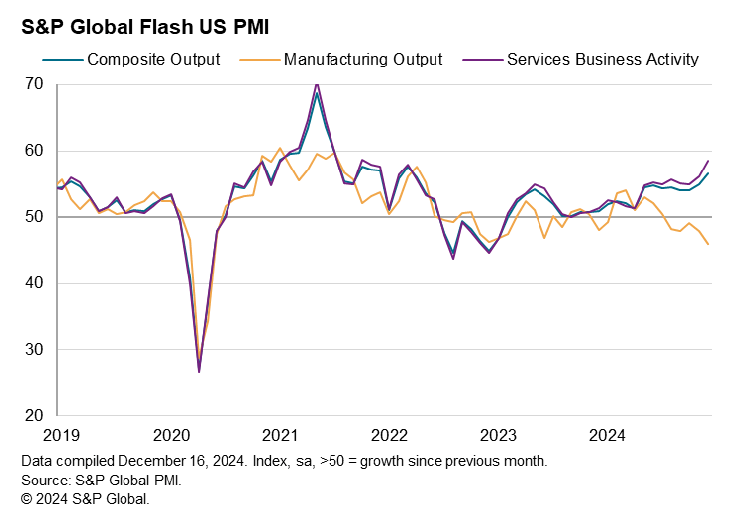
US PMI services surge to 38-mth high, upturn to persist into new year
The US economy ended 2024 on a strong note, propelled by robust activity in the services sector. December PMI Services index surged from 56.1 to 58.5, a 38-month high, highlighting the sector’s vital role in driving growth. This expansion lifted PMI Composite from 54.9 to 55.6, its highest level in 33 months, despite a continued contraction in the manufacturing sector, where PMI fell from 49.7 to 48.3.
According to Chris Williamson, Chief Business Economist at S&P Global Market Intelligence, "business is booming" in the services economy, which is experiencing its fastest growth since the post-COVID reopening in 2021. This momentum is consistent with GDP growing at an annualized rate of just over 3% in December.
Additionally, confidence in the 12-month outlook has reached a two-and-a-half-year high, suggesting that the current economic upturn could "persist into the new year" and broaden across more sectors.
However, challenges remain for the manufacturing sector, where optimism has been dampened by concerns over tariffs and their potential to increase costs.
December also saw sharp spikes in raw material prices, driven by supplier-led increases and higher shipping costs, reflecting busier supply chains ahead of anticipated protectionist measures in the new year. These inflationary pressures could present risks to the broader economy, even as services continue to underpin overall growth.
BoJ Rate Hike in Focus: USD/JPY, GBP/JPY Technical Analysis
- Markets are pricing in a less than 20% chance of a BoJ rate hike this Thursday, despite earlier expectations of a 70% probability.
- JPY weakness has resumed as rate hike expectations have fallen, potentially pushing the BoJ to act.
- USD/JPY shows strong bullish momentum, but a BoJ hike could lead to a significant decline.
- A surprise rate hike by the BoJ could strengthen the JPY significantly, with more room for gains against the GBP than the USD.
Bank of Japan: To hike or not?
The Bank of Japan (BoJ) is in the spotlight this week and looks to take center stage despite Central Bank meetings from the US and UK. The much anticipated normalization of policy from the BoJ may be upon us, hence all the interest in this week’s meeting.
The BoJ have for months been touting a more aggressive shift in policy. In 2024, the Bank of Japan have already made several changes to its monetary policy. Notably, in July, the BOJ increased its policy rate to around 0.25% while discontinuing its Quantitative and Qualitative Monetary Easing with Yield Curve Control policy framework.
Two weeks ago markets were pricing around a 70% probability of a 25bps hike by the BoJ. At the time I did think this was strange given the notoriously indecisive nature of the Central Bank. However, over the past two weeks, many reports have surfaced, leading the market to believe there’s less than a 20% chance the Bank of Japan will raise rates by 0.25% this Thursday.
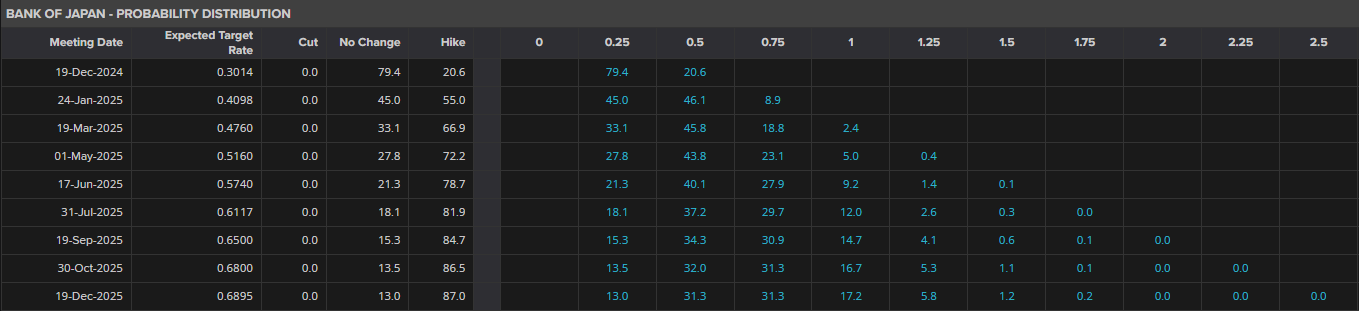
Source: LSEG (click to enlarge).
The BoJ do have a tendency to spring a surprise when one least expects it. One of the key issues over the past few months for the BoJ has been JPY weakness which has resumed over the past two weeks as market expectations for a rate hike were peeled back.
Given USD/JPY is now approaching the psychological 155.00 handle, will the BoJ act? I stand by my take that we are likely to see a BoJ hold now and a potential rate hike in the new year. However a surprise cannot be ruled out and that is precisely what makes this week’s meeting all the more exciting.
There is of course the US Federal Reserve and Bank of England meetings as well which could stoke volatility and impact USD/JPY and GBP/JPY. The consensus for these two meetings are a 25 bps cut from the Fed and a hold of rates by Bank of England.

If the BoJ do surprise and raise rate by 25 bps the Yen could strengthen significantly with more room for gains against the GBP than the US Dollar in my opinion. The reason lies with US Dollar strength which is likely to continue into early 2025 at least. US Treasury yields are expected to rise in 2025 as well which further supports the narrative and why GBP/JPY could see more downside on a BoJ hike.
Technical Analysis
USD/JPY
From a technical perspective, USD/JPY has been on a strong move to the upside since bottoming out on December 3, around the 148.600 handle.
The move to the upside has been swift and momentum was gained following a break of the descending trendline. As things stand, Bulls appear to be firmly in control heading toward the FOMC and BoJ meetings on Wednesday and Thursday respectively.
The 50-day MA is currently gearing up for a cross of the 100-day MA in what could be seen as a golden cross pattern hinting at further upside. Despite being a lagging indicator, this does demonstrate the bullish momentum that has built in USD/JPY over the month of December.
Historically the BoJ have relied on rhetoric at times to keep the exchange rate intact, but that ship has long sailed. One wonders if the central bank was trying to use a similar tactic heading into this BoJ meeting.
Looking at the chart below we have the inner and outer ascending trendlines which could come into play this week and present opportunity.
A hike by the BoJ could send USD/JPY tumbling toward the outer trendline and push toward 150.00 and beyond. Immediate support rests at 153.500 before the 151.80 and 150.00 handles come into focus.
Immediate resistance rests at the 155.00 handle with a break above this level, eyeing the swing high at 156.500.
USD/JPY Daily Chart, December 16, 2024
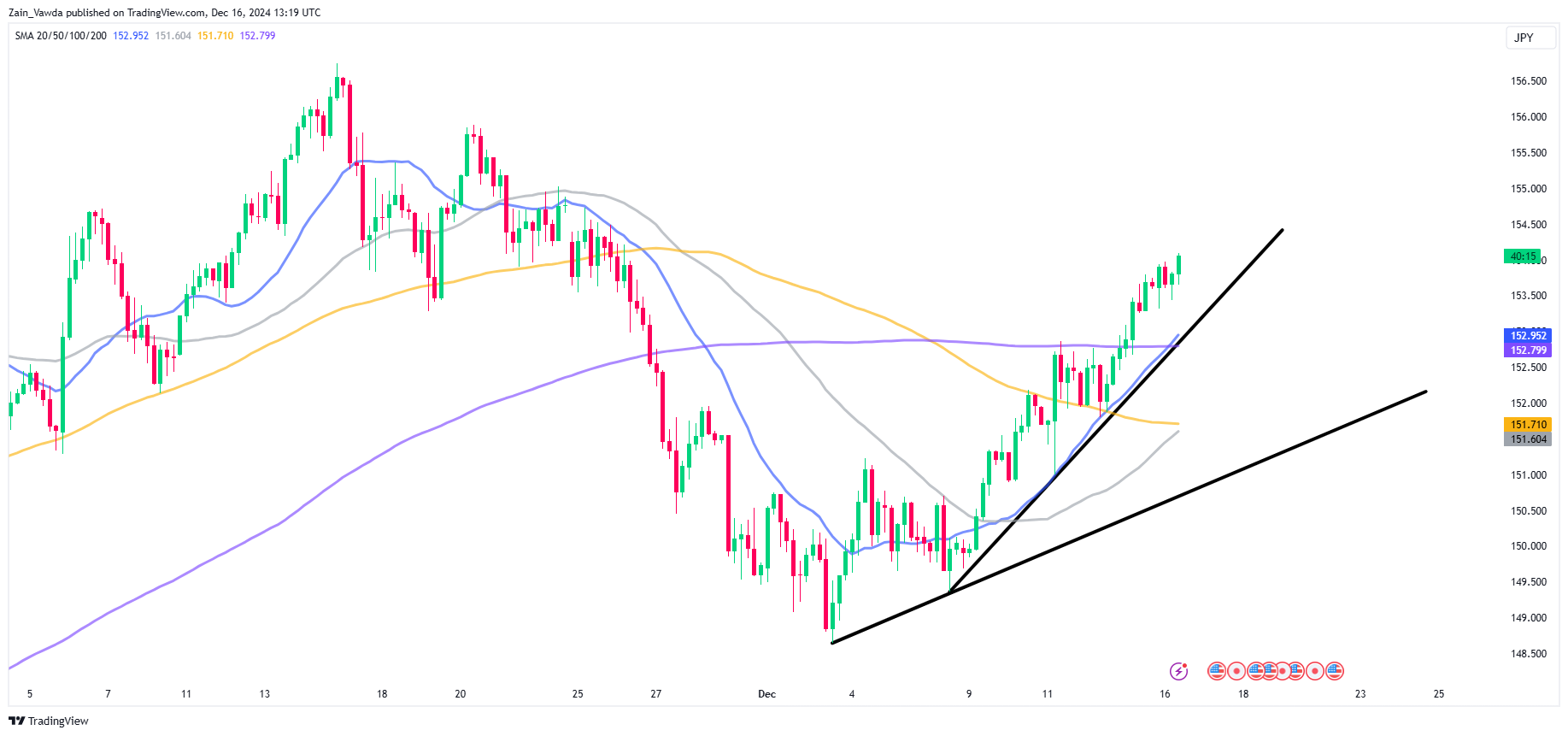
Source: TradingView (click to enlarge)
Support
- 153.50
- 151.80
- 150.00 (psychological level)
Resistance
- 155.00
- 156.500
- 157.74
GBP/JPY
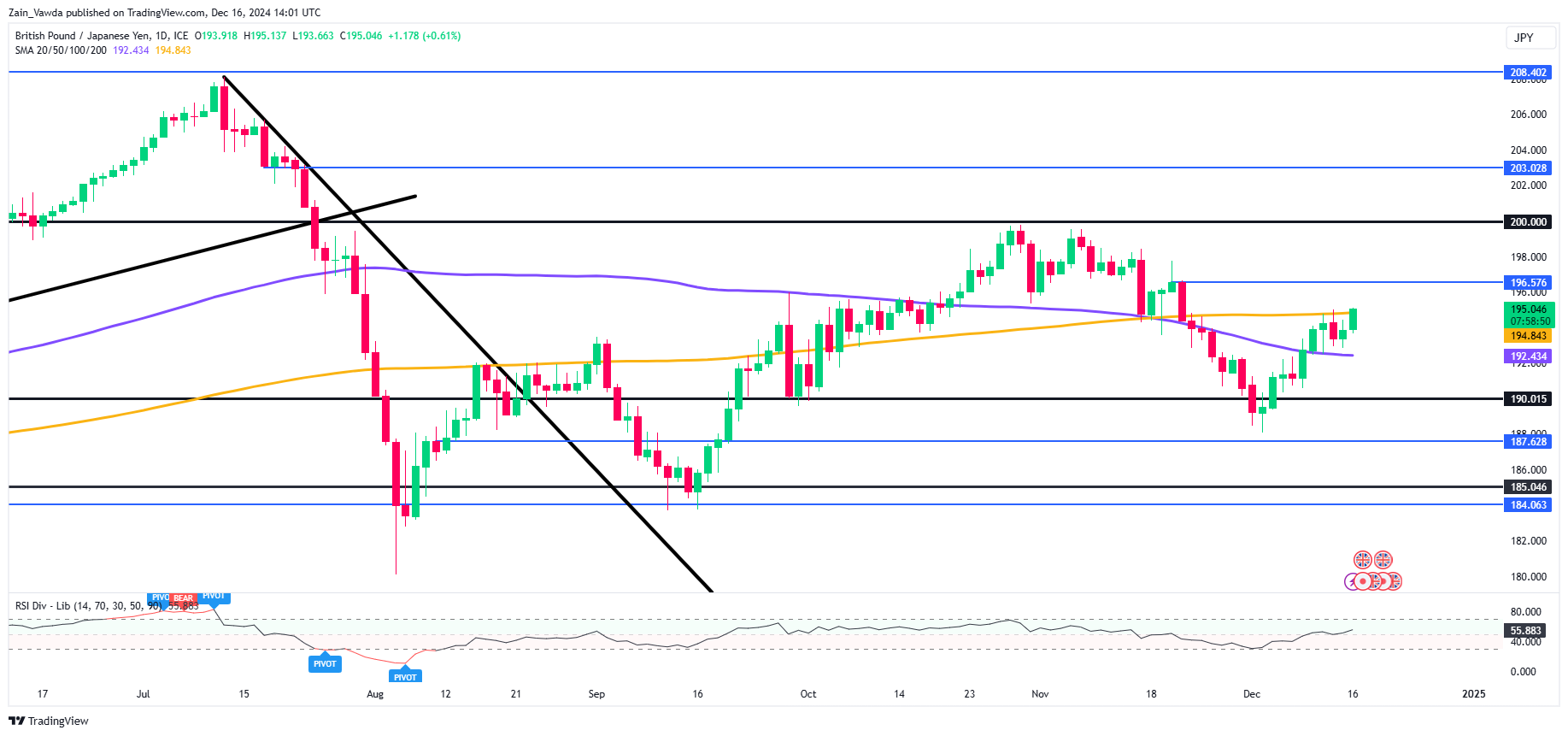
GBP/JPY continues to toil below the coveted 200.00 handle. Having breached the 200.00 hurdle, GBP/JPY has failed to find acceptance above this level since breaking below the 200.00 mark in August.
As things stand for GBP/JPY the bears remain in control for now with a break and daily candle close above the swing high at 196.57 needed for a change in structure to occur which could lead to increased bullish momentum.
Another sign of bullish momentum is presented by the RSI and the rejection of the 50 level which is now serving as a support of sorts.
GBP/JPY is flirting with a break above the 200-day MA which could embolden bulls and push for a break of the swing high at 196.57. A break of this level will bring focus toward the 198.00 handle before the psychological 200.00 mark comes into focus.
Alternatively, a move lower from here faces support at the 100-day MA which rests at 192.43 before the 190.00 handle comes back into focus.
GBP/JPY Daily Chart, December 16, 2024
Source: TradingView (click to enlarge)
Support
- 192.43
- 190.00
- 187.62
Resistance
- 196.57
- 198.00
- 200.00
EUR/USD Mid-Day Outlook
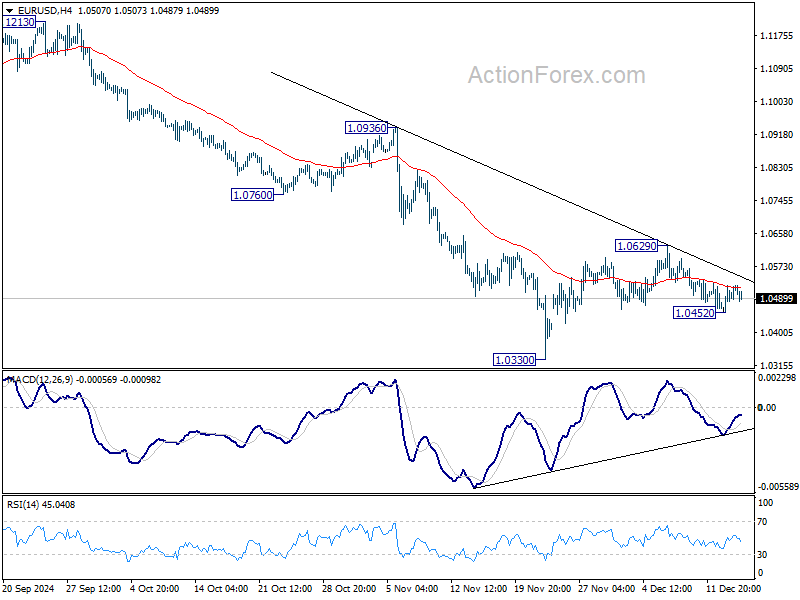
Daily Pivots: (S1) 1.0463; (P) 1.0493; (R1) 1.0534; More...
Range trading continues in EUR/USD and intraday bias stays neutral first. Corrective pattern from 1.0330 might extend further. But outlook will stay bearish as long as 55 D EMA (now at 1.0678) holds. On the downside, below 1.0452 will bring retest of 1.0330 low.
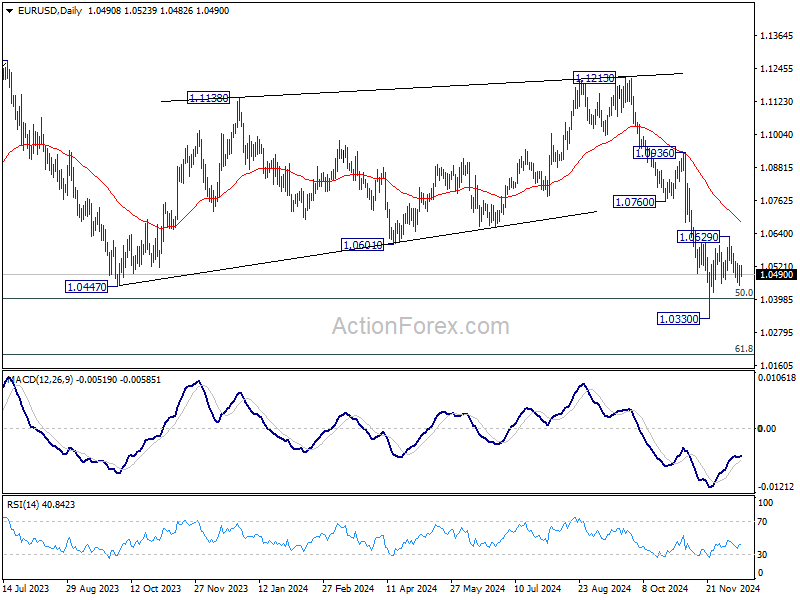
In the bigger picture, focus stays on 50% retracement of 0.9534 (2022 low) to 1.1274 at 1.0404. Strong rebound from this level will keep price actions from 1.1273 (2023 high) as a medium term consolidation pattern only. However, sustained break of 1.0404 will raise the chance that whole up trend from 0.9534 has reversed. That would pave the way to 61.8% retracement at 1.0199 first. Firm break there will target 0.9534 low again.
GBP/USD Mid-Day Outlook
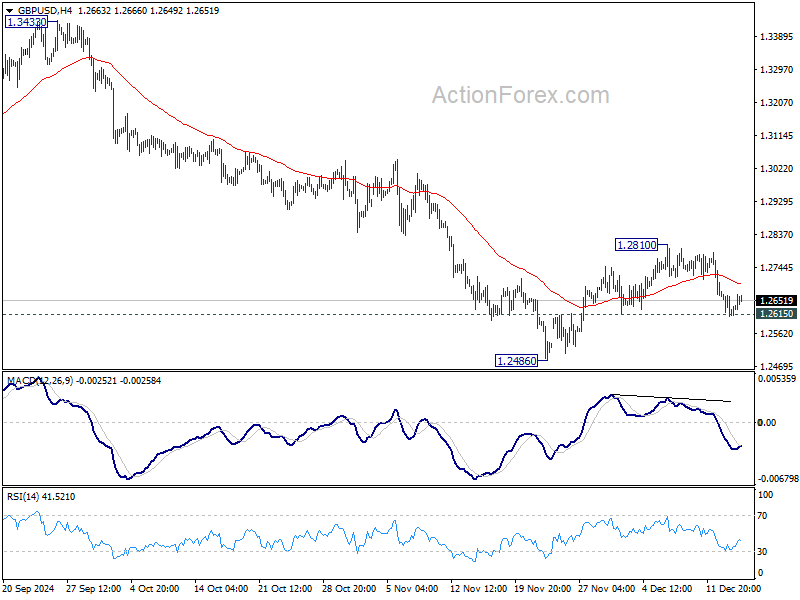
Daily Pivots: (S1) 1.2592; (P) 1.2638; (R1) 1.2668; More...
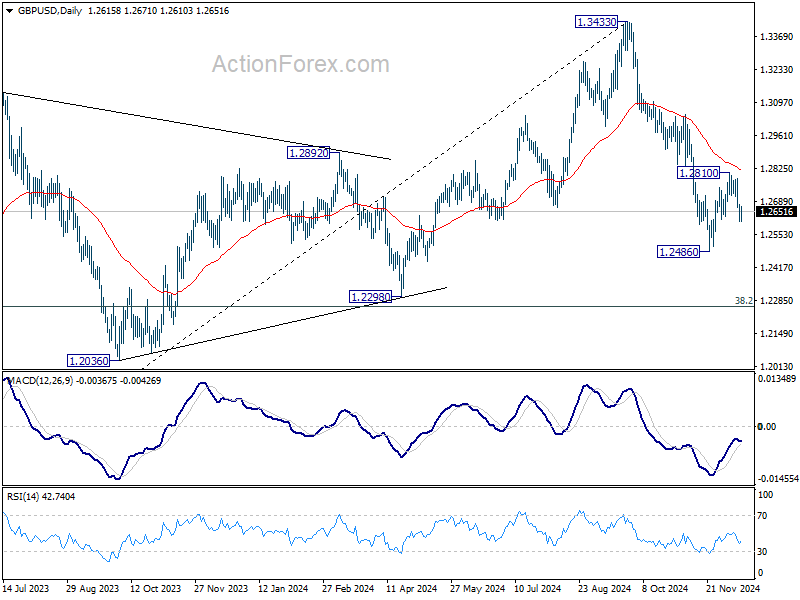
No change in GBP/USD's outlook and intraday bias remains neutral first. As noted before, corrective recovery from 1.2486 might have completed at 1.2810 already. Break of 1.2615 will resume the fall from 1.3433 through 1.2486 to 1.2298 cluster support zone.
In the bigger picture, price actions from 1.3433 medium term are seen as correcting whole up trend from 1.0351 (2022 low). Deeper decline could be seen to 38.2% retracement of 1.0351 to 1.3433 at 1.2256, which is close to 1.2298 structural support. But strong support is expected there to bring rebound to extend the corrective pattern.
USD/CHF Mid-Day Outlook
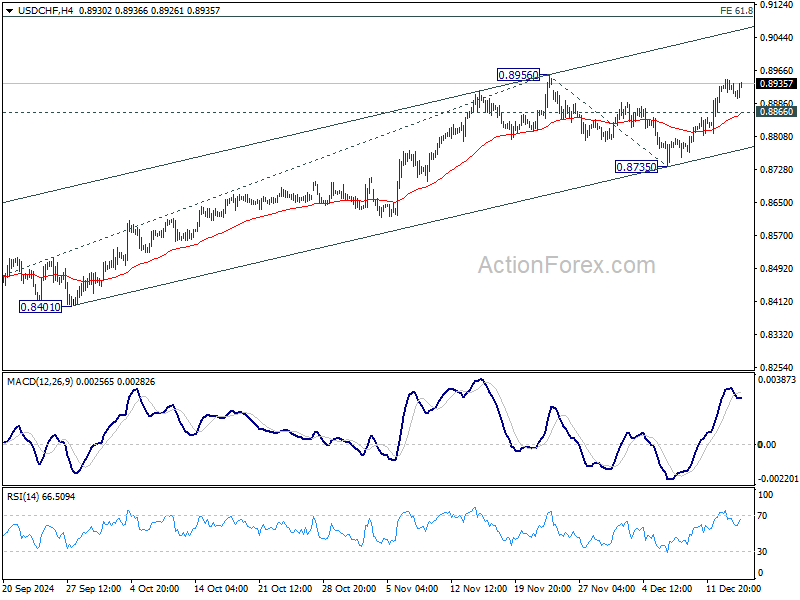
Daily Pivots: (S1) 0.8907; (P) 0.8927; (R1) 0.8947; More…
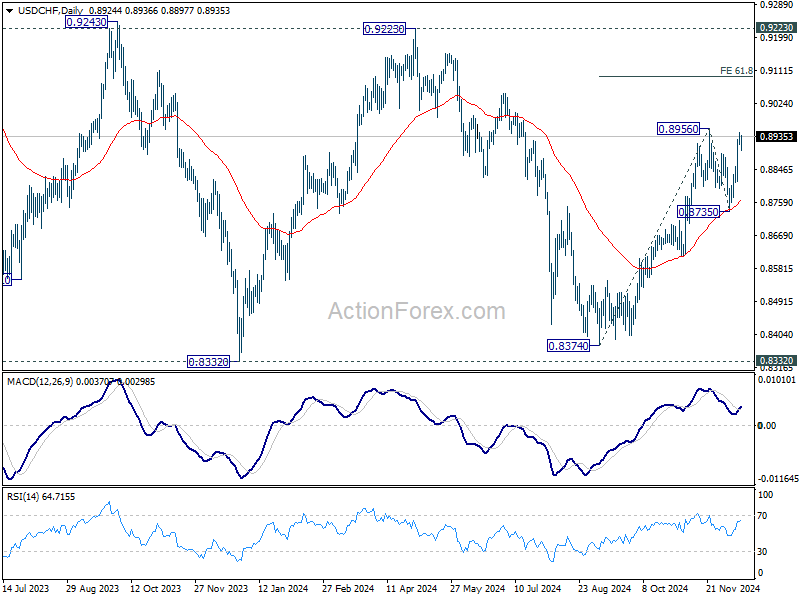
Intraday bias in USD/CHF remains mildly on the upside at this point. Decisive break of 0.8956 resistance will confirm resumption of whole rally from 0.8374. Next target is 61.8% projection of 0.8374 to 0.8956 from 0.8735 at 0.9095. On the downside, below 0.8866 minor support will delay the bullish case and bring more consolidations first.
In the bigger picture, price actions from 0.8332 (2023 low) are currently seen as a medium term corrective pattern, with rise from 0.8374 as the third leg. Overall outlook will continue to stay bearish as long as 0.9223 resistance holds. Break of 0.8332 low is in favor at a later stage when the consolidation completes.
USD/JPY Mid-Day Outlook
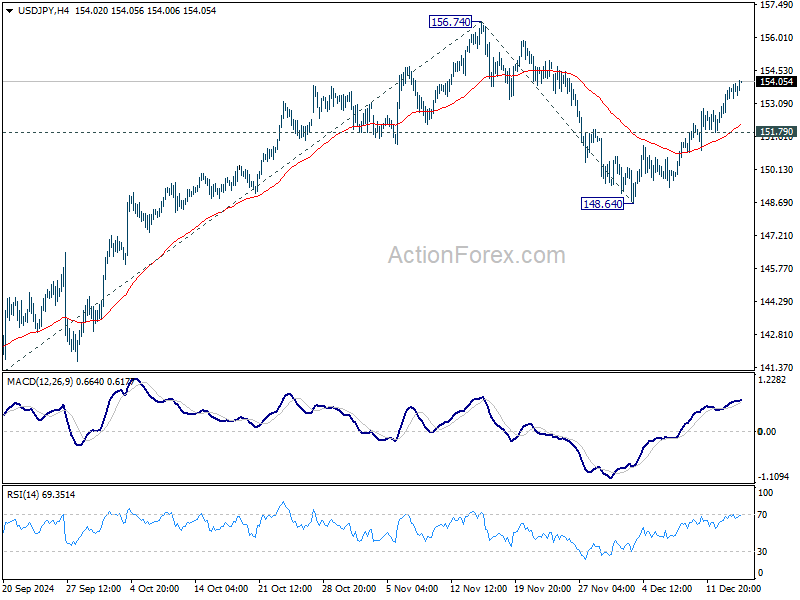
Daily Pivots: (S1) 152.80; (P) 153.30; (R1) 154.14; More...
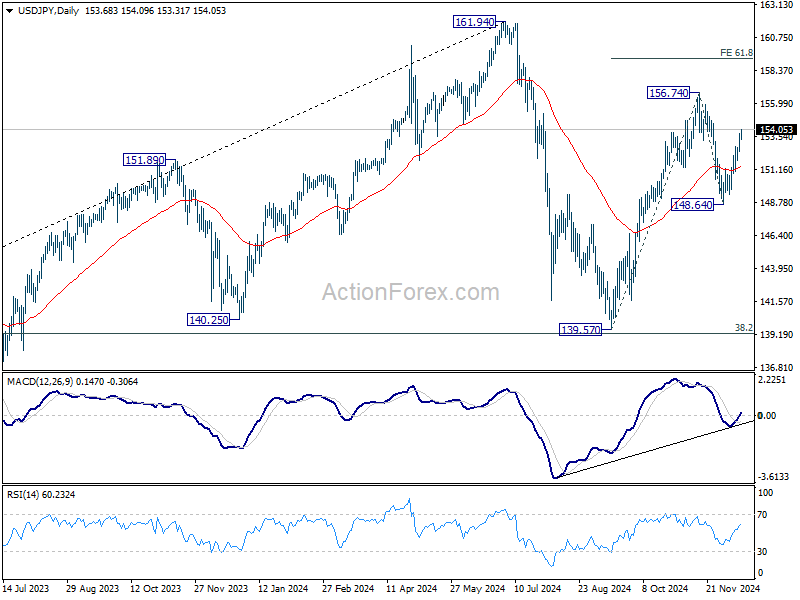
Intraday bias in USD/JPY remains on the upside as rebound from 148.64 is in progress. Further rally should be seen to retest 156.74 first. Firm break there will resume whole rally from 139.57, and target 61.8% projection of 139.57 to 156.74 from 148.64 at 159.25 next. On the downside, below 151.79 minor support will turn intraday bias neutral. But risk will stay on the upside as long as 148.64 support holds, in case of retreat.
In the bigger picture, price actions from 161.94 are seen as a corrective pattern to rise from 102.58 (2021 low). The range of medium term consolidation should be set between 38.2% retracement of 102.58 to 161.94 at 139.26 and 161.94. Nevertheless, sustained break of 139.26 would open up deeper medium term decline to 61.8% retracement at 125.25.
Yen Under Pressure on BoJ Expectations; Bitcoin Soars on Trump’s Bold Crypto Vision
Yen weakened across the board today in an otherwise consolidative market , as traders increasingly anticipate that BoJ will hold steady on monetary policy at its upcoming this week. BoJ policymakers appear to see no urgency in extending the tightening cycle this month, preferring instead to wait for January’s updated economic projections before deciding on further hikes. This cautious approach reflects both near-term and structural challenges, including uncertainty over domestic wage growth and shifts in US trade policies under the incoming administration.
A critical issue for Japan’s inflation outlook is whether wage increases can extend beyond large corporations to smaller and medium-sized enterprises. While Rengo, the country’s largest labor federation, has set a lofty target of at least 6% wage hikes for SMEs in 2025, early indications suggest businesses in this segment are hesitant to commit to such significant increases, due to their own challenges including surging import prices. Without broader wage gains, domestic demand may struggle to expand sufficiently, limiting the sustainability of inflation at BoJ's 2% target. This would complicate any sustained policy normalization and could keep the central bank cautious well into next year.
In the broader currency markets, British Pound is the day’s strongest performer so far, supported by UK PMI data. While, the underlying economic outlook for the UK remains fragile, resurgence of inflationary pressures is expected to keep the BoE on track for up to four rate cuts next year, at most. New Zealand Dollar follows as the second strongest, underpinned by a robust improvement in services sector data, while Dollar rounds out the top three. On the other hand, Swiss Franc and Canadian Dollar are among the weakest currencies alongside Yen, while Euro and Australian Dollar are mixed in the middle.
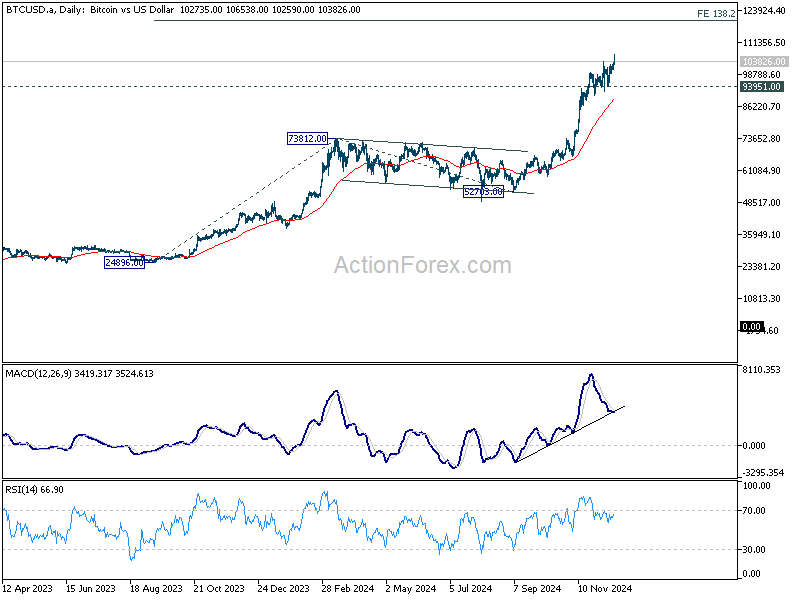
Meanwhile, in the cryptocurrency market, Bitcoin surged to a new all-time high following comments from US president-elect Donald Trump, who revealed plans to implement a strategic cryptocurrency reserve akin to the US oil reserve. Speaking to CNBC on Sunday, Trump promised “something great” for the cryptocurrency sector under his administration. Technically, outlook in Bitcoin will stay bullish as long as 93951 support holds. Current up trend is on track to 138.2% projection of 24896 to 73812 from 52703 at 120304, i.e. 120k handle.
In Europe, at the time of writing, FTSE is down -0.40%. DAX is down -0.30%. CAC is down -0.87%. UK 10-year yield is down -0.016 at 4.402. Germany 10-year yield is down -0.029 at 2.234. Earlier in Asian, Nikkei fell -0.03%. Hong Kong HSI fell -0.88%. China Shanghai SSE fell -0.16%. Singapore Strait Times rose 0.28%. Japan 10-year JGB yield rose 0.314 to 1.072.
ECB's Lagarde: Shifting focus to appropriate policy from prolonged monetary restriction
ECB President Christine Lagarde's speech today marked a departure from previous guidance shaped by high inflation and significant uncertainty.
Lagarde highlighted that the earlier approach, which aimed to maintain restrictive rates “for as long as necessary,” is no longer aligned with the ECB’s evolving outlook for inflation and risk balance.
However, with "disinflation process well on track" and growth risks becoming more pronounced, ECB now aims for an "appropriate" policy approach.
She reiterated that if data continues to confirm their expectations, ECB expects to lower rates further.
UK PMI composite unchanged at 50.5, triple whammy of growth, employment and inflation
UK PMI Manufacturing PMI slipped from 48.0 to 47.3, an 11-month low. Services PMI improved from 50.4 to 51.4. PMI Composite held steady at 50.5, signaling stagnation in overall economic activity.
Chris Williamson, Chief Business Economist at S&P Global Market Intelligence, described a "triple whammy" facing businesses: stalled growth, declining employment, and renewed inflationary pressures.
While the PMI suggests that the economy remained broadly stagnant in Q4, the outlook for 2025 appears increasingly uncertain. Weak confidence, labor market retrenchment, and inflation risks could weigh heavily on economic activity.
Williamson said BoE faces the difficult task of balancing support for growth against the need to maintain inflation control, suggesting a cautious approach to monetary easing in the coming months.
Eurozone PMI improves to 49.5 with potential positive surprises from politics ahead
Eurozone PMI Services rose notably from 49.5 to 51.4, marking a return to expansion territory. However, PMI Manufacturing remained static at 45.2, firmly in contraction. Consequently, PMI Composite edged up from 48.3 to 49.5, signaling ongoing weakness in overall economic momentum.
Cyrus de la Rubia, Chief Economist at Hamburg Commercial Bank, noted that the service sector's rebound is a "welcome boost" to the Eurozone economy, while manufacturing continues to face a severe downturn.
Inflationary pressures remain a concern, particularly in the services sector. Input costs have risen for the third consecutive month, largely due to higher wage agreements, with businesses passing these costs onto customers. This persistent inflation challenge informed ECB's cautious decision earlier this month to cut rates by just 25bps.
Germany and France, the Eurozone’s largest economies, add to the uncertainty with ongoing political challenges, delaying necessary reforms to stimulate growth. Despite this, de la Rubia suggested there is potential for "positive surprises" in 2025 if clearer economic policies emerge from future governments.
Japan's PMI composite rises to 50.8, stubborn inflation caps growth
Japan’s private sector activity showed a modest improvement in December, driven by a stronger services sector, while manufacturing continued to contract.
PMI Manufacturing index declined from 49.5 to 49.0, marking the fourth consecutive month of contraction. In contrast, PMI Services index rose from 50.5 to 51.4, lifting Composite PMI from 50.1 to 50.8, indicating mild overall growth.
Usamah Bhatti, economist at S&P Global Market Intelligence, pointed out the contrasting trends: “Services firms saw the strongest rise in new business in four months, while goods producers faced a sharper decline in orders.” This divergence highlights persistent weakness in manufacturing amid subdued demand and improving momentum in the services sector.
Inflationary pressures persisted, fueled by the Yen’s weakness, which increased the cost of imported materials. Input prices rose at the fastest pace in four months, while selling price inflation hit its highest level since May, as businesses passed on rising costs to consumers. Bhatti noted, “Stubborn inflation held back a stronger expansion of the Japanese private sector in December.”
Australian PMI composite falls to 49.9, bolsters case for early RBA rate cut
Australia's December PMI data pointing to a broad-based slowdown. The Manufacturing index fell from 49.4 to 48.2. Services PMI edged down from 50.5 to 50.3. Meanwhile, Composite PMI dropped from 50.2 to 49.9, slipping into mild contraction territory.
Jingyi Pan, Economics Associate Director at S&P Global Market Intelligence, noted that the data reflects growing strain across sectors, with manufacturing leading the downturn and services beginning to falter.
Forward indicators presented mixed signals. While business confidence reached its highest level in over two-and-a-half years, new business growth slowed, and unfinished work declined further. Employment gauge showed its first contraction since August 2021.
Muted selling price inflation provides room for RBA to consider rate cuts in early 2024. However, rising cost pressures remain a concern.
NZ BNZ services jumps to 49.5, closer to stability
New Zealand’s BusinessNZ Performance of Services Index rose significantly from 46.2 to 49.5 in November, signaling a move closer to stabilization. However, the index remains under the no-change threshold of 50.0 and well below its long-term average of 53.1.
Key subcomponents offered a mixed picture. Activity/sales improved from 44.4 to 48.6, and new orders/business rose to 49.8, nearing expansion territory. Employment showed only a slight uptick, from 46.4 to 46.8, reflecting continued caution among firms. Stocks/inventories and supplier deliveries moved into expansionary territory at 52.2 and 52.5, respectively, signaling some recovery in supply chain dynamics.
Negative sentiment among respondents eased, with the proportion of unfavorable comments dropping to 53.6% from October’s 59.1%. However, the ongoing concerns over the economic climate and the cost of living remain dominant themes, indicating persistent headwinds for the sector.
USD/JPY Mid-Day Outlook
Daily Pivots: (S1) 152.80; (P) 153.30; (R1) 154.14; More...
Intraday bias in USD/JPY remains on the upside as rebound from 148.64 is in progress. Further rally should be seen to retest 156.74 first. Firm break there will resume whole rally from 139.57, and target 61.8% projection of 139.57 to 156.74 from 148.64 at 159.25 next. On the downside, below 151.79 minor support will turn intraday bias neutral. But risk will stay on the upside as long as 148.64 support holds, in case of retreat.
In the bigger picture, price actions from 161.94 are seen as a corrective pattern to rise from 102.58 (2021 low). The range of medium term consolidation should be set between 38.2% retracement of 102.58 to 161.94 at 139.26 and 161.94. Nevertheless, sustained break of 139.26 would open up deeper medium term decline to 61.8% retracement at 125.25.
EURUSD Remains Under Pressure Below 20-day SMA
- EURUSD holds within tight range in near term
- MACD and RSI were below their mid-levels
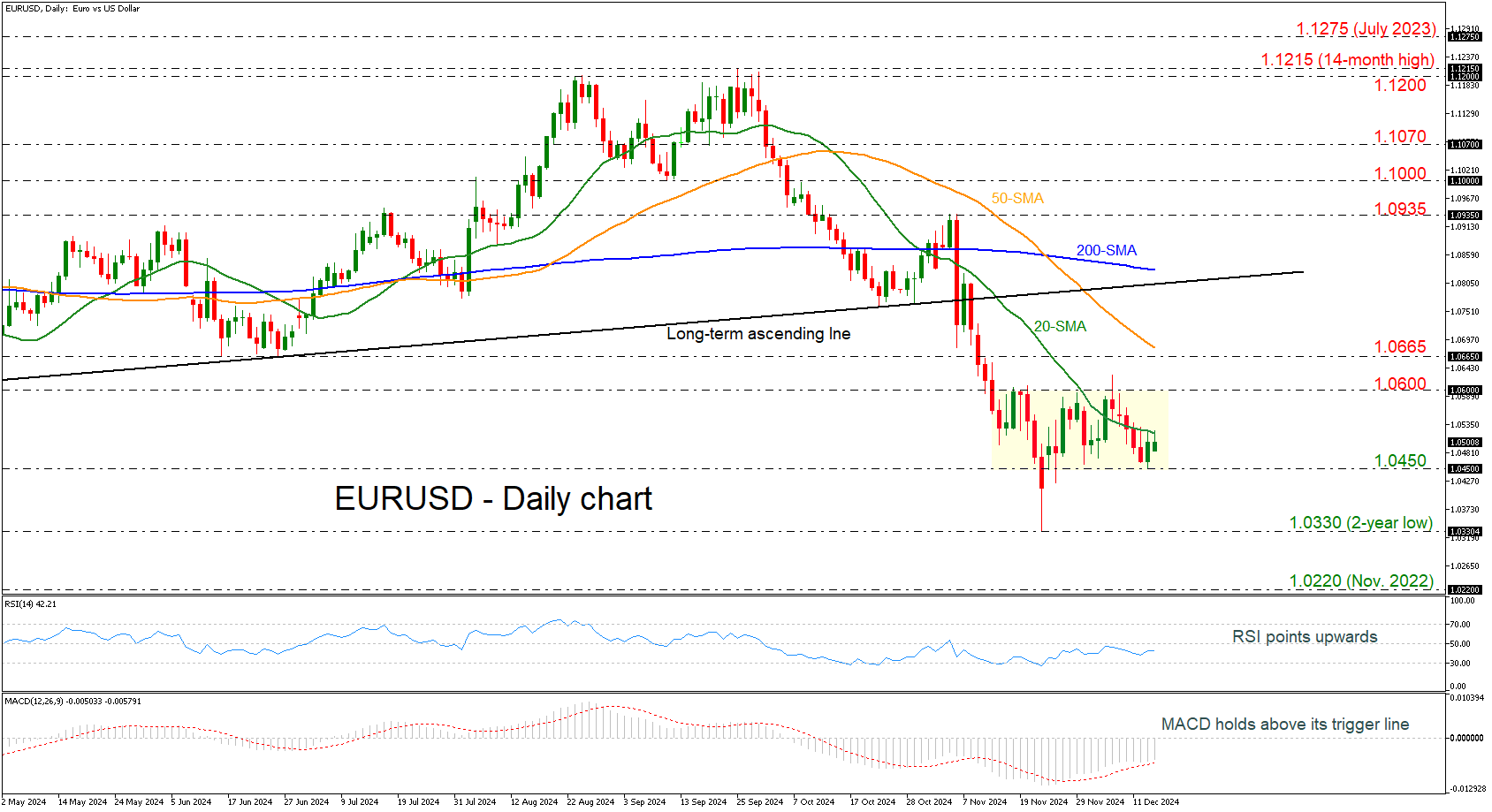
EURUSD had another pullback off the lower boundary of the short-term trading range within 1.0450–1.0600, but the 20-day simple moving average (SMA) seems to be a tough obstacle to surpass.
Technically, the RSI indicator is pointing upwards below the neutral threshold of 50, while the MACD is holding above its trigger line beneath the zero level. Both confirm an upside retracement in the market.
If the pair successfully breaks above the immediate 20-day SMA line at 1.0520, it will retest the 1.0600 mark. A move above this region would be the green light for more increases until the 1.0665 resistance and the 50-day SMA at 1.0680. Further upward pressure could pave the way for the 200-day SMA at 1.0830.
On the other hand, a slide below the 1.0450 key level could lead to a retouch of the two-year low of 1.0330, ahead of the November 2022 low at 1.0220.
All in all, EURUSD has been developing within a consolidation area since mid-November, and the current risks are negative.
Gold Technical: A Less Dovish Fed May Reinforce a Medium-Term Corrective Decline
- The proposed policies of Trumponomics 2.0 may ignite a further uptick in inflationary expectations in the US.
- Market-transacted inflationary expectations gauge, the 5-year and 10-year US breakeven inflation rates have been trending higher since September 2024.
- The Fed may switch its current dovish monetary policy to a “wait and see” pivot stance on 18 December FOMC.
- Watch the US$2,716 key medium-term resistance on Gold (XAU/USD).
Since our last publication, the price actions of Gold (XAU/USD) have staged a minor bounce of 7% to revisit the prior minor swing of US$2,710 printed on 8 November twice; on 22 November and 11 December but failed to make a significant breakout above US$2,710.
The yellow metal traded lower last Friday, 13 December, and reintegrated below its 50-day moving average which suggests that the bulls are being subdued as we head into a key event this week; the US Federal Reserve monetary policy decision and the release of its latest economic projections (“dot plot”) this Wednesday, 18 December.
Market participants in the Fed funds futures market have already priced in with near certainty (97.1% chance based on the CME FedWatch tool as of 16 December) that the Fed will proceed to cut by 25 basis points (bps), its third cut to bring to Fed funds rate to 4.25-4.50%.
A less dovish Fed may be on the horizon next
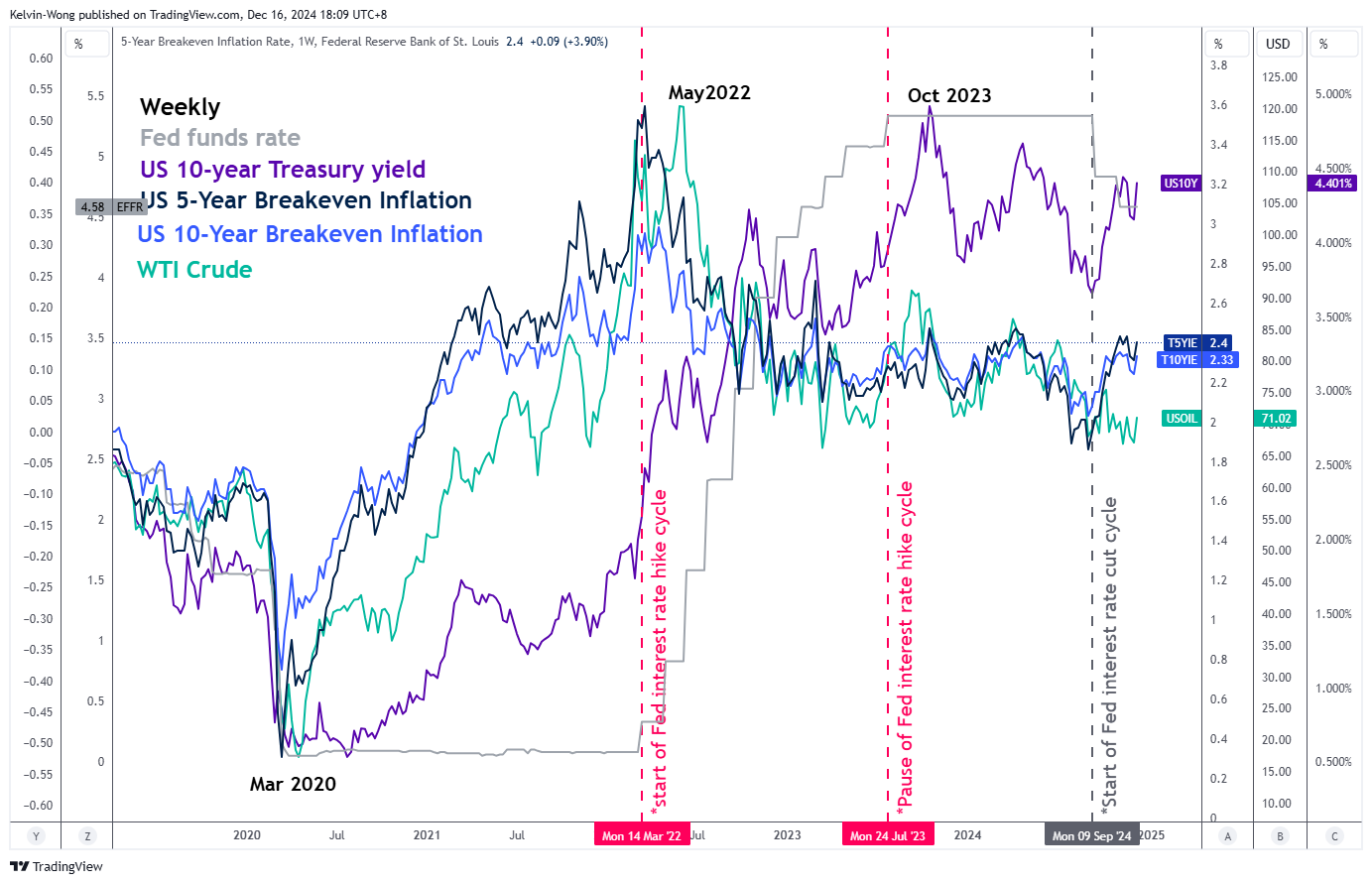
Fig 1: 5-year & 10-year US breakeven inflation rates major trends as of 13 Dec 2024 (Source: TradingView, click to enlarge chart)
Market-transacted financial instruments have started to price in a further uptick in US inflationary expectations as derived from the movements of both the 5-year and 10-year US breakeven inflation rates that have been trending upwards since the start of the current Fed’s interest rate cut cycle on September 2024, to hover at 2.40% and 2.33% respectively as of 16 December 2024, above the Fed’s long-term inflation target of 2% (see Fig 1).
The primary catalyst for the current medium-term uptrend movements of the 5-year and 10-year US breakeven inflation rates have been triggered by the proposed policies of Trumponomics 2.0 that consist of deeper corporate tax cuts and higher trade tariffs imposed on US imports that will likely revive inflationary pressures in 2025, and beyond.
Based on the CME FedWatch tool as of 16 December 2024, market participants are expecting another two potential Fed funds rate cuts of 25 bps each in 2025 to bring the Fed funds rate to 3.75-4.00%, which is lesser than the last “dot plot” implied projection released on 18 September FOMC meeting that highlighted an approximate of four interest rate cuts of 25 bps each in 2025 (to bring the Fed funds rate to 3.4%) based on a median projection from Fed officials.
Bullish reversal in 10-year US Treasury real yield
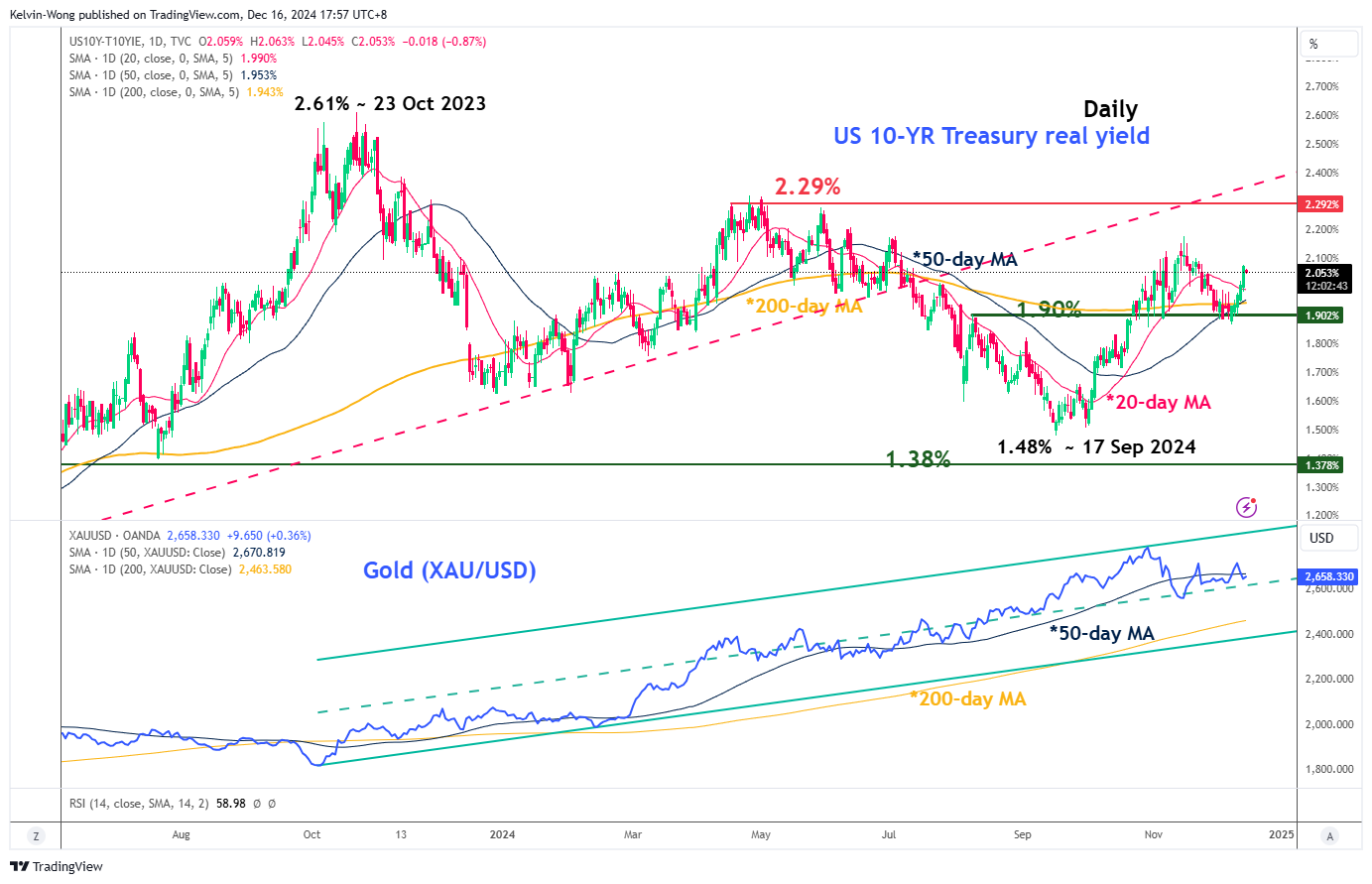
Fig 2: 10-year US Treasury real yield medium-term & major trends as of 13 Dec 2024 (Source: TradingView, click to enlarge chart)
Last week, the 10-year US Treasury real yield staged a significant V-shaped rebound of 16 bps after a retest on its key medium-term support at the 1.90% level on Monday, 9 December.
A potential further push up towards the 2.29% medium-term resistance will increase the opportunity cost of holding Gold (XAU/USD), and eventually cap its bullish strength at least in the short to medium-term horizon (see Fig 2).
An important point to note is that the major uptrend phase of Gold (XAU/USD) in place since October 2023 remains intact. Also, it is likely to be supported by the longer-term effects of higher trade tariffs component of Trumponomics 2.0 which may lead to a further escalation of deglobalization that can trigger headwinds to global economic growth where Gold (XAU/USD) may see higher demand due to its defensive hedging element.
Watch the US$2,716 key medium-term resistance on Gold (XAU/USD)
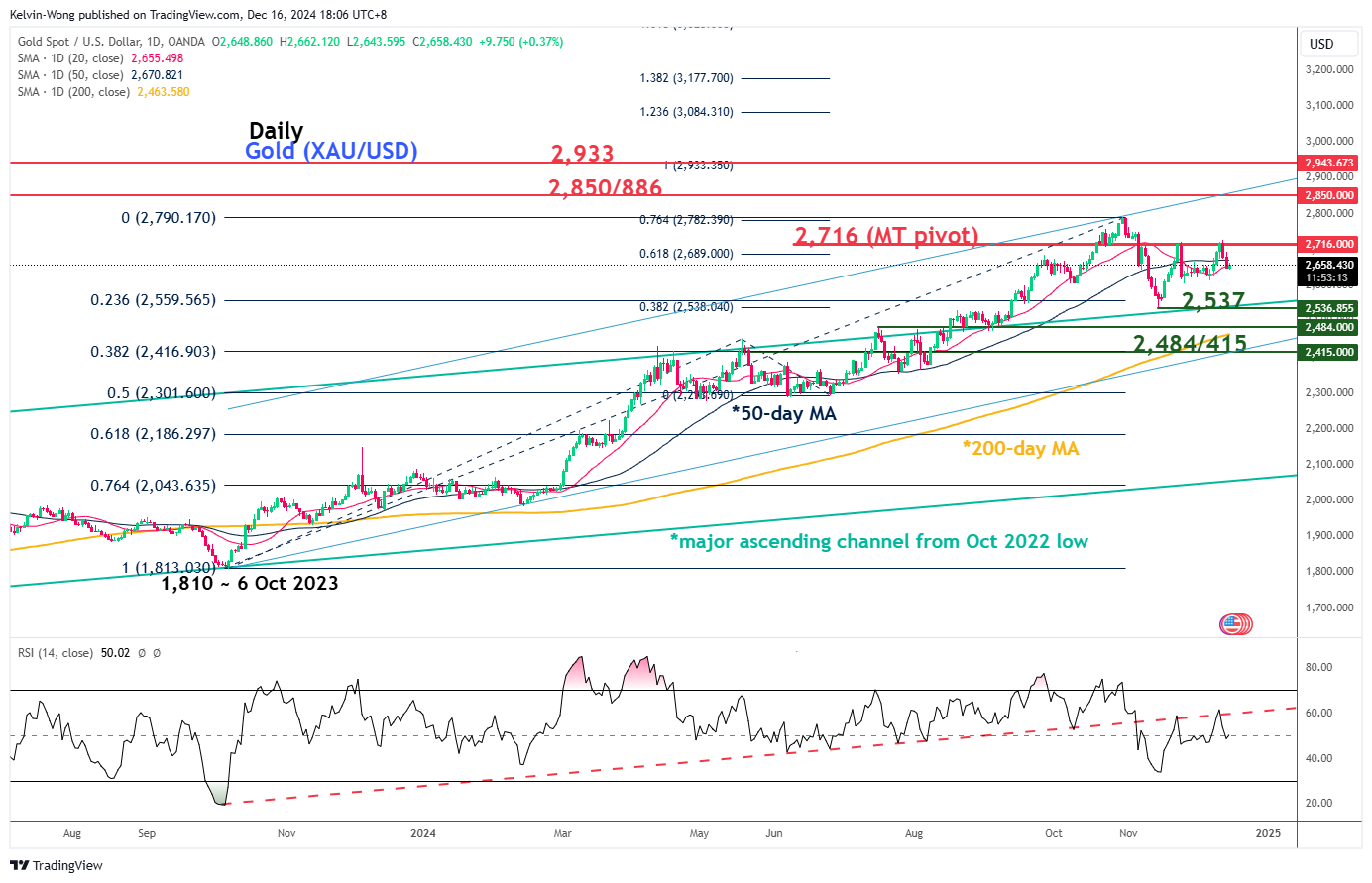
Fig 3: Gold (XAU/USD) medium-term & major trends as of 16 Dec 2024 (Source: TradingView, click to enlarge chart)
Since its recent current all-time high of US$2,716 printed on 31 October, the price actions of Gold (XAU/USD) have started to oscillate in consolidation configuration with a lingering risk of facing a multi-week corrective decline to retest its key 200-day moving average within its major uptrend phase in place since 6 October 2023.
A break below the US$2,537 first medium-term support may reinforce the corrective decline sequence to expose the next medium-term support zone of US$2,484/415. It is also a potential inflection zone to kickstart another potential bullish impulsive sequence for Gold (XAU/USD) (see Fig 3).
On the other hand, a clearance above US$2,716 invalidates the corrective decline bearish scenario to revive the bulls towards the next medium-term resistance zone of US$2,850/886 in the first step.
Pound Higher as Services PMI Rises, Job Report Next
The British pound has moved higher on Monday, after declining 1% last week. In the European session, GBP/USD is trading at 1.2747, up 0.30% on the day.
UK Services improves, manufacturing slips
The UK Services PMI rose to 51.4 in December, up from 50.8 in November, which was a 13-month low. This beat the market estimate of 51.0, but points to weak business activity as demand for UK exports has been weak and confidence among services providers remains subdued.
UK manufacturing is mired in a depression, and the PMI fell to 47.3 in December, down from 48.0 in November and shy of the market estimate of 48.2. This marked the lowest level in eleven months, as production and new orders showed an accelerated decrease.
The weak PMI data followed Friday’s GDP report, which showed a 0.1% decline for a second straight month in October. This missed the market estimate of 0.1%. GDP rose just 0.1% in the three months to October.
The UK releases employment and wage growth numbers on Tuesday. The economy is projected to have lost 12 thousand jobs in the three months to October, after a sparking 200 thousand gain in the previous report. Wages including bonuses is expected to climb to 5% from 4.8%.
The Bank of England meets on Thursday and is expected to hold the cash rate at 4.75% after cutting rates by 25 basis points in November. The economy could use another rate cut but inflation remains a risk to upside, with CPI climbing in October to 2.3% from 1.7%. The BoE will be keeping a close eye on wage growth, which has been a driver of inflation.
The US releases PMIs later today. Manufacturing remained in contraction territory in November at an upwardly revised 49.7 and there is optimism that the new Trump administration’s protectionist stance could benefit US manufacturers.
The services sector is in good shape and improved in November to 56.1, up from 55.0 in October. The uncertainty ahead of the US election is over and lower interest rates have contributed to stronger expansion in services.
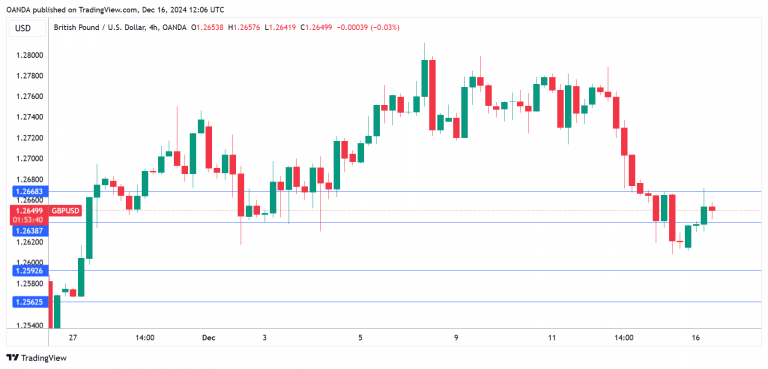
GBP/USD Technical
- GBP/USD is testing resistance at 1.2638. The next resistance line is 1.2668
- 1.2592 and 1.2562 are the next support levels