

Sample Category Title
Euro Holding Up in Spite of Greek Concerns
- GBP volatile after strong manufacturing data
- Euro holding up in spite of Greek concerns
- Aussie interest rates on hold as trade surplus booms
The Reserve Bank of Australia (RBA) left the Australian interest rates on hold at 1.5% when they met overnight. In an upbeat message the RBA saw global economic expansion, but were cautious about the slightly overheated domestic housing market. I suspect Aussie base rates will stay on hold for quite some time. Australia's trade surplus grew much more than expected to AUD 3.57 billion in February. That is almost double most forecasts and higher valued commodity exports were seen as the main reason. More sustainable growth in Australia's number one export market, China is a key element. The Aussie Dollar was volatile but is largely unchanged from yesterday's close against most other currencies.
Across the Tasman Sea, NZ business confidence slipped last month. A net 16% of businesses expect conditions to improve in the months ahead and that is a sharp drop from the 26% reported in the previous 3 month period. So, whilst the net figure is still in the positive, it is less optimistic than previously and that has weakened the NZ Dollar a little. The GBP-NZD rate still hasn't broken the NZ$1.80 barrier though.
Sterling slipped back from the spike we saw in early trade on Monday in spite of manufacturing data that was four times more positive than forecasters predicted. The lack of data later in the day allowed for profit taking and the lack of UK data today could bring more of the same. However, the service sector Purchasing Managers' Index (PMI) is due tomorrow and we think that should be supportive of the Pound. GBP buyers may seize the opportunity to take advantage during this dip.
The Euro is holding up well in spite of continued concerns over Greece. The funds owed by Greece to the EU have grown by €10 billion in the last two years and now amount to 6% of Greek Gross Domestic Product (GDP). That's unsustainable and the Greek Finance Minister is expected to travel to Brussels today to discuss their plight. Positive manufacturing data from the Eurozone failed to lift the shared currency yesterday.
The US Dollar is bouncing around as the ISM Manufacturing Index showed its 94th consecutive month of growth but was down to the slowest pace of growth in six months. The data was largely in line with expectations but served to remind us that unrelenting good news is not yet the picture in America. The Dollar weakened and then strengthened but may weaken again today because factory orders and durable goods orders (data due for release this afternoon) are likely to be poorer than the previous data.
And this is a momentous day in history. On 4th April in 1581, Sir Francis Drake completed a circumnavigation of the World, in 1918, the Battle of the Somme came to an end, in 1949 NATO came into being and in 1928, Maya Angelou was born. Maya was responsible for one of my favourite quotes, "I've learned that people will forget what you said, people will forget what you did, but people will never forget how you made them feel."
Seen online
"My boyfriend cheated on me, so I convinced him to get matching tattoos. He went first and I went home."
Risk Appetite Wanes ahead of Trump-Xi Summit
Stock markets were vulnerable to downside shocks on Tuesday as investors lost appetite for risk ahead of the Trump-Xi summit this week. Asian shares have already discarded short term gains amid the cautious trading mood with risk aversion exposing European equities to further losses. Although UK's FTSE100 attempted a miraculous rebound during early trading via Sterling weakness, sellers simply exploited the technical bounce to drag prices lower. Wall Street may be in store for further punishment moving forward as risk-off is the name of the game ahead of the meeting between Donald Trump and Chinese President Xi Jinping.,. While the fanatical optimism over Trump's proposed fiscal policies boosting US growth has fueled the phenomenal stock market rally, the rising protectionist fears and concealed concerns over the pro-growth agenda falling short of expectations could catalyze an unexpected selloff.
Flight to safety elevates Gold
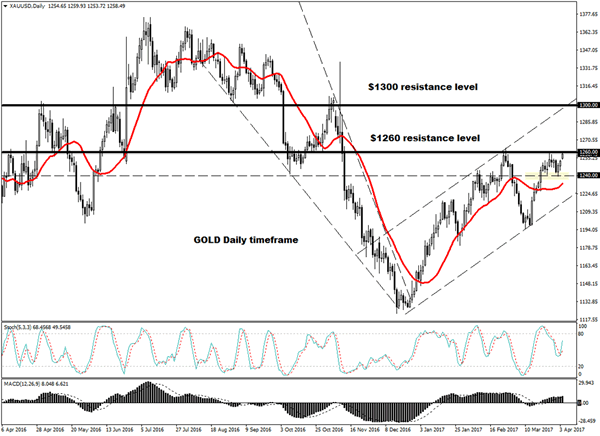
The amalgamation of overall geopolitical concerns, political risks in Europe, Brexit woes and Trump uncertainties have boosted the appetite for safe-haven assets with Gold in high demand. This yellow metal has sprung towards $1260 on Tuesday with further inclines expected as bulls exploit the market anxiety to install fresh rounds of buying. The source behind this wave of risk aversion is the uncertainty gravitating around the pending Trump-Xi summit which investors will be paying heavy attention towards. With participants already noticeably jittery, any potential complications in the meeting could accelerate the flight to safety ultimately elevating Gold's price further. The visible fact that Gold remains resilient despite Dollar's resurgence continues to highlight how risk aversion has become a key theme this week.
From a technical standpoint, the yellow metal fulfills the prerequisites of a bullish trend on the daily charts as there have been consistently higher highs and higher lows. A breakout and daily close above $1260 could open a path higher towards $1300. Bulls remain in firm control above the previous higher low at $1240. A situation where bears manage to bring prices back below $1240 simply invalidates this daily bullish setup.
Commodity spotlight - WTI
WTI Crude descended towards $50 on Monday after the rebound in Libya's oil output over the weekend and persistent increase in U.S drilling compounded to the oversupply concerns. The oversupply fears have been a major theme which has ensured oil remains depressed for prolonged periods. With global inventories remaining stubbornly high despite OPEC's valiant efforts to stabilize oil markets and U.S Shales resurgence questioning the effectiveness of the supply cuts, buying sentiment is frighteningly low. Although there are speculations of OPEC extending the supply cut deal by another 6 months to fight the oversupply woes, optimism is rapidly fading over the cartel's ability to elevate oil prices.
WTI Crude may be in the process of a technical bounce which could test the $51 pivotal level. Bears need to break back below $50 to reclaim control with targets stretching back towards $47.
RBA Remains on Hold, But Tilts Somewhat Dovish
The Reserve Bank of Australia remained on hold today, as was widely anticipated. However, the statement had a somewhat dovish tone compared to the previous one, in our view. The Bank indicated that some labor market indicators have softened recently, while it noted that the recently announced supervisory measures with regards to lending could ease financial stability risks.
This suggests to us that once these measures take effect, the Bank would be more flexible to cut rates again if needed, without being concerned that its actions would amplify risks to the economy. Thus, although our base case scenario is still for the RBA to remain on hold in the foreseeable future, further weakness in economic indicators, could encourage officials to act without much hesitation. We believe that the picture will become much clearer on the 26th of April, when we get the nation's CPI data for Q1.
AUD/USD tumbled following the release of the meeting statement, falling below the key support (now turned into resistance) obstacle of 0.7600 (R1). This move confirms a forthcoming lower low on the 4-hour chart and combined with the Bank's dovish language, increases the likelihood for the pair to stay on the back foot for a while. The upcoming meeting between US President Trump and Chinese President Xi Jinping on Thursday could also prove negative for the currency. Any talks of increased protectionism in the global arena could weigh on the currencies of heavily trade-oriented nations, such as AUD and NZD. At the time of writing, the rate is testing the 0.7580 (S1) area, where a decisive dip is possible set the stage for our next support of 0.7550 (S2).
Today's highlights:
During the European day, we get the UK construction PMI for March. The forecast is for the index to have declined, albeit marginally. Nonetheless, following the unexpected tumble in the manufacturing index for the month, we see the risks surrounding the construction forecast as skewed to the downside, perhaps for a greater than expected slide. In such a case, GBP could come under renewed selling pressure. We prefer to exploit further pound weakness against the yen, which continued to strengthen yesterday. GBP/JPY slid and is currently testing the 137.50 (S1) support zone. A disappointing construction PMI today could push the rate below that hurdle and pave the way for the key territory of 137.00 (S2). However, a clear close below that barrier is needed to turn the broader outlook negative as well.
From Eurozone, we get retail sales for February, while from the US, the trade balance and factory orders for the same month are coming out.
We have only one speaker on the schedule: ECB President Mario Draghi. Following the latest media reports that investors over-interpreted the ECB's signals at the March policy meeting, and the subsequent slowdown in the bloc's CPI prints for March, it would be interesting to hear what the ECB chief has to say.
AUD/USD
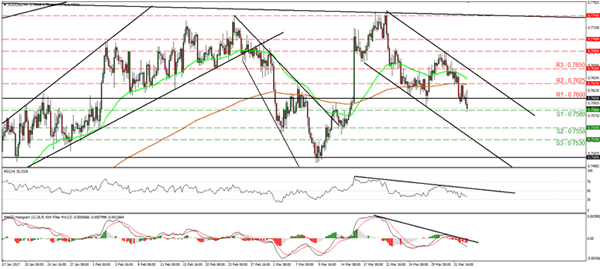
Support: 0.7580 (S1), 0.7550 (S2), 0.7530 (S3)
Resistance: 0.7600 (R1), 0.7625 (R2), 0.7650 (R3)
GBP/JPY
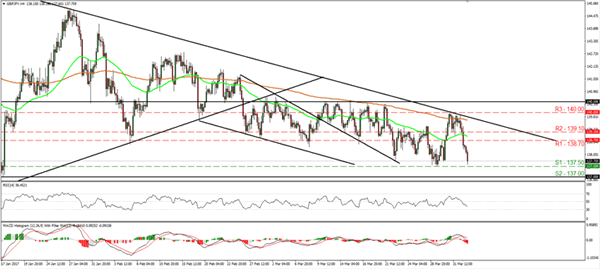
Support: 137.50 (S1), 137.00 (S2), 136.50 (S3)
Resistance: 138.70 (R1), 139.10 (R2), 140.00 (R3)
Canadian Dollar Dips To 3-Week Low, Trade Balance Next
USD/CAD continues to gain ground this week. In the Tuesday session, the pair has reached a high of 1.3447, its highest level since March 15. On the release front, Canada and the US will both release Trade Balance. Canada's trade surplus is expected to edge lower to C$0.7 billion. In the US, the trade deficit is forecast to narrow to $46.0 billion.
Canada's GDP expanded 0.6 percent, above the forecast of 0.3 percent. This marked a 7-month high for GDP, and raises hopes that a strong US economy will boost its northern neighbor. Although the Canadian economy has been churning out decent numbers, lower oil prices have had a negative impact on the Canadian economy and also weighed on the Canadian dollar, which continues to lose ground. Later in the week, we'll get a look at Canadian Employment Change, which is expected to post a modest gain of 5.7 thousand.
The US economy hasn't missed a beat in 2017, and the markets are expecting strong data for the first quarter. The CB consumer confidence report soared to 125.6 in March, and strong consumer confidence levels should translate into increased consumer spending, a key component of economic growth. GDP for the fourth quarter was revised to 2.1%, up from 1.9% in the previous GDP report. With the economy headed in the right direction, the discussions around the monetary policy tables are not whether the Fed will raise rates, but will it press the rate trigger two or three more times in 2017. The markets will be paying close attention to the minutes of the March meeting, when the Fed raised rates by a quarter-point, to a range of 0.75-1.00%. Any hints about the timing of the next hike, as well as the tone of the minutes are factors which could move the currency markets on Wednesday. The markets considered the rate statement overly cautious, and this sentiment sent the US dollar broadly lower. If the reaction to the minutes is one of disappointment, the dollar could again head downwards.
GBPCHF Beware Of Head And Shoulders At 1.2440
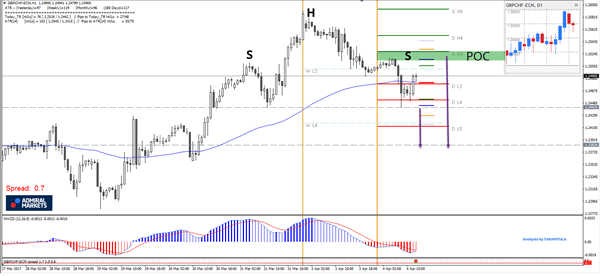
The GBP/CHF has formed head and shoulders pattern (Bearish SHS) with a clear double bottom at 1.2441. Bearish SHS could breakout below at 1.2440 aiming for D L5/ W L4 confluence 1.2415 and 1.2383. If the pair retraces to POC (top of the right shoulder, D H3, ATR pivot) 1.2515-30 we might see a rejection towards above mentioned targets. So traders should pay attention to POC rejection or breakout below 1.2440.
D H3 - Daily Camarilla Pivot (Daily Resistance)
POC - Point Of Confluence (The zone where we expect price to react - aka entry zone)
W L4 - Weekly L3 Camarilla (Very Strong Weekly Support)
D L4- Daily L4 Camarilla ( Very Strong Daily Support)
D L5- Daily L4 Camarilla ( Strongest Daily Support)
Trade Idea Update: USD/CHF – Buy at 0.9950
USD/CHF - 1.0027
Original strategy :
Buy at 0.9950, Target: 1.0050, Stop: 0.9915
Position : -
Target : -
Stop : -
New strategy :
Buy at 0.9950, Target: 1.0050, Stop: 0.9915
Position : -
Target : -
Stop : -
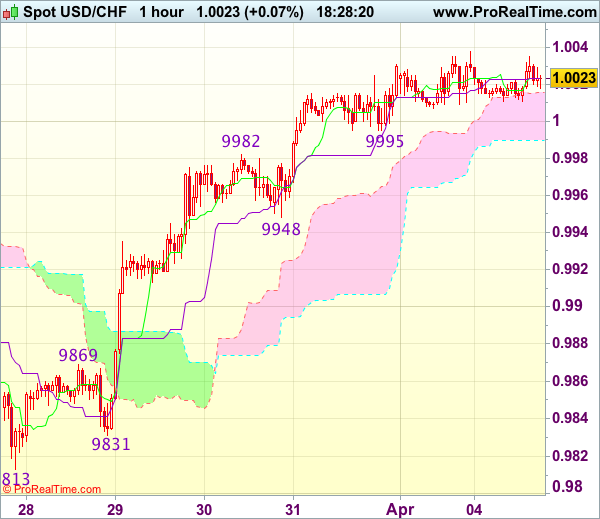
As the greenback has maintained a firm undertone after last week’s rally above 1.0003 resistance, suggesting recent rise from last week’s low at 0.9813 is still in progress and bullishness remains for this move to extend gain to previous support at 1.0060 (now resistance), however, loss of upward momentum should prevent sharp move beyond resistance at 1.0109, risk from there has increased for a retreat to take place later.
In view of this, would not chase this rise here and would be prudent to buy dollar on pullback as said support at 0.9948 should limit downside. Below 0.9931 (50% Fibonacci retracement of 0.9831-1.0031) would abort and signal top is formed instead, bring correction to 0.9905-10 (61.8% Fibonacci retracement) but reckon previous resistance at 0.9869 would hold from here.
Trade Idea Update: GBP/USD – Hold short entered at 1.2465
GBP/USD - 1.2457
Original strategy :
Sold at 1.2465, Target: 1.2365, Stop: 1.2500
Position : - Short at 1.2465
Target : - 1.2365
Stop : - 1.2500
New strategy :
Hold short entered at 1.2465, Target: 1.2365, Stop: 1.2500
Position : - Short at 1.2465
Target : - 1.2365
Stop : - 1.2500
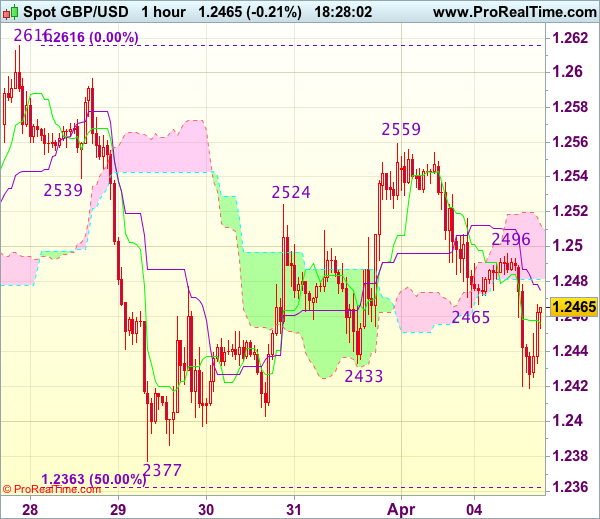
Although cable has rebounded after finding support at 1.2419 and minor consolidation above this level would be seen, reckon the Kijun-Sen (now at 1.2475) would limit upside and bring another decline later, below said support at 1.2419 would extend weakness to 1.2400, break there would add credence to our view that the rebound from 1.2377 has ended at 1.2559, bring further fall towards support at 1.2377. Looking ahead, only a drop below 1.2377 would confirm the fall from 1.2616 is still in progress for subsequent decline towards key support at 1.2335.
In view of this, we are holding on to our short position entered at 1.2465 but one should exit on such decline. Only break of said resistance at 1.2496 would abort and suggest an intra-day low is formed instead, risk a stronger rebound to 1.2525-30.
EUR/GBP Bulls Retreat Under Resistance At 0.8600
The European Central Bank president Draghi will make a speech at 15:30 BST today, it will likely affect the Euro and Euro crosses.
EUR/GBP has rebounded since yesterday, after hitting a 5-week low of 0.8485.
The bulls attempted to test the near-term major resistance level at 0.8600 in early morning, where the 10-day SMA converges (on the daily chart).
The bulls still have momentum, however, be aware that the selling pressure at this level is heavier. The bullish momentum is likely to be restrained here, prior to the next rally.
The 4-hourly Stochastic Oscillator reading is around 70, suggesting a retracement.
The resistance level is at 0.8565, followed by 0.8580 and 0.8600.
The support line is at 0.8550, followed by 0.8535 and 0.8520.


Trade Idea Update: EUR/USD – Sell at 1.0730
EUR/USD - 1.0651
Original strategy :
Sell at 1.0730, Target: 1.0610, Stop: 1.0765
Position : -
Target : -
Stop : -
New strategy :
Sell at 1.0730, Target: 1.0610, Stop: 1.0765
Position : -
Target : -
Stop : -
As the single currency has remained under pressure after falling to 1.0642 yesterday, adding credence to our bearish view that the decline from 1.0906 top is still in progress and bearishness remains for this fall to extend further weakness to 1.0620-25, then test of previous chart support at 1.0600, however, a sustained breach below the latter level is needed to retain downside bias for subsequent selloff to 1.0570-75 first, otherwise, risk from there is seen for a rebound later.
In view of this, would not chase this fall here and would be prudent to sell dollar on recovery as 1.0730-40 should limit upside. Only a firm break above resistance at 1.0773 would suggest low is formed instead, bring a stronger rebound to 1.0800 but resistance at 1.0827 should remain intact.

Market Update – European Session: Spain Continues With Its Improving Employment Trend
Notes/Observations
Quiet session; focus on key end-of-week events: US payroll data and President Trump/China President Xi meeting in Florida
Spain's Net Unemployment registers its biggest ever decline for the month of March (-48.8K v -40.9K)
Overnight:
Asia:
RBA keeps Cash Rate Target unchanged at 1.50% (as expected). Says view consistent with sustainable growth in the economy and achieving the inflation target over time. Reiterated view that domestic inflation remained quite low but was expected to pick up over the course of 2017
BOJ Gov Kuroda reiterated view that was too early to discuss an exit from current monetary policy. Exit strategy to vary depending on economy and markets. BOJ ETF purchases are not distorting market function
South Korea Mar CPI registered its highest annual pace since June 2012 (2.2% v 2.1%e)
Europe:
UK House of Commons Brexit committee noted that PM May had been urged by to carry out a full economic and legal assessment of the implications for Britain if it failed to sure a trade deal with the EU. Must publish cost reaching no deal in Brexit talks
Americas:
Fed's Harker (hawk, FOMC voter): reiterated three hikes in 2017 would be appropriate; US inflation was moving slowly but surely upward
Senate Judiciary Committee approved Gorsuch nomination to Supreme Court; sent nomination to full Senate floor. Senate Democrats now have 41 votes against cloture, sufficient to filibuster nomination of Neil Gorsuch to the Supreme Court
Economic Data
(ES) Spain Mar Net Unemployment M/M: -48.8K v 0.9Ke (Biggest decline ever for month of March)
(IT) Italy Q4 YTD Budget Deficit to GDP: 2.4% v 2.5% prior
(BR) Brazil Mar FIPE CPI (Sao Paulo) M/M: 0.1% v 0.1%e
(UK) Mar Construction PMI: 52.2 v 52.5e (7th month of expansion)
(EU) Euro Zone Feb Retail Sales M/M: 0.7% v 0.5%e; Y/Y: 1.8% v 1.0%e
Fixed Income Issuance:
(EU) EFSF opened book to sell 2024 and 2045 bonds via syndicate
(ES) Spain Debt Agency (Tesoro) sold total €4.63B vs. €4.0-5.0B indicated range in 6-month and 12-month Bills
(ID) Indonesia sold total IDR4.46 in 2-year, 4-year, 7-year and 15-year Project based Sukuk (PBS)
(AT) Austria Debt Agency (AFFA) sold total €1.32B vs. €1.32B indicated in 2023 and 2027 RAGB bonds
(ZA) South Africa sold total ZAR2.35B vs. ZAR2.35B indicated in 2026, 2036 and 2048 bonds
SPEAKERS/FIXED INCOME/FX/COMMODITIES/ERRATUM
Equities
Index snapshot (as of 10:00 GMT)
Indices [Stoxx50 -0.1% at 3,470, FTSE +0.4% at 7,314, DAX -0.1% at 12,241, CAC-40 flat at 5,086, IBEX-35 +0.1% at 10,337, FTSE MIB -0.2% at 20,193, SMI +0.1% at 8,643, S&P 500 Futures -0.2%]
Equities
Consumer discretionary [ASOS ASC.UK -6.2% (H1 results), Topps Tiles TPT.UK -6.9% (H1 update), Bunzl BNZL.UK +1.8% (2 acquisitions)]
Consumer Staples [Suedzucker SZU.DE -9.5% (Analyst downgrade), ITE Group ITE.UK +4.3% (Trading update), Carl Zeiss AFX.DE +1.3% (prelim H1)]
Materials: [Nanoco NANO.UK -18% (H1 results, lowers outlook)]
Financials: [Grenkeleasing GLJ.DE +3.5% (Q1 update)]
Technology: [Sophos Grp SOPH.UK +11.4% (Raised outlook, resolves patent dispute)]
Energy: [Seadrill SDRL.NO -41% (Amendments to Secured Credit Facilities), Polarcus PLCS.NO -3.5% (Vessel utilization)]
Speakers
BOE Financial Policy Committee (FPC) Mar 22nd Minutes: Concerned rapid growth in unsecured lending to British consumers; could principally represent a risk to lenders if accompanied by weaker lending standards
Sweden Central Bank (Riksbank) Dep Gov Floden: PMI data was a sign for growth but it remained to be seen what growth meant for inflation
RBA Gov Lowe: More home loan curbs would be considered if needed. Reiterates need to see improvement in job market to know economy is strengthening
Eurogroup Chief Dijsselbloem reiterated he had no intention to step down as Eurogroup chief; looking to speak in EU Parliament
EU Official: Greece talks in Brussels today could be an important stepping stone. Greek hurdles were political and not technical. Talks moving beyond July payments would be detrimental
Russia govt said not to be planning any measures to counter gains in RUB currency (ruble). It saw the Ruble currency weakening in H2 due to oil and rate cuts
Moody's on South Africa: Will not be issuing any decision on sovereign rating on Friday, Apr 7th. To issue decision after concluding downgrade review that could take 1-3 months from now
Turkey Fin Min Agbal: Inflation might be back to single digits by Dec; upward trajectory to continue
Currencies
US Treasury yields at 5-week low helping to push the USD/JPY pair below 110.50 in the session. Some dealers also noting that BoJ and government advisors had been floating the idea of how to move away from yield curve control. Nonetheless BoJ's Kuroda did reiterated his dovish stance that it was premature to discuss an exit strategy from the central bank's aggressive easing policy.
EUR/USD hovered in the mid-1.06 area as price action continued the repricing of ECB rate outlook as various officials noted . ECB chief economist Praet continues, after yesterday ' s push back of rate hikes from Praet
RBA kept its policy steady with a dovish tilt and this helped the AUD/USD hit a 3-week low below 0.7560 area.
Spot gold at 1-month highs aided by geopolitical worries with the metal at $1,258/oz
Fixed Income:
Bund futures trade at 162.35 up a further 26 ticks trading at new one month highs with further momentum higher targeting 162.65 followed by 162.98 then Feb contract high at 163.12. Analysts eye support at 161.63 followed by 161.34 then 161.06.
Gilt futures trade at 128.40 up 13 ticks aided by a slight miss in UK construction PMI data. Resistance moves to 128.96 followed by 129.24. Support moves to 127.75 then 127.34 followed by 127.05. Short Sterling futures curve continues to flatten with futures trading flat to up 2bp along the curve. Jun17Jun18 spread falls to 13.5/14bp down 2.5bp from yesterday.
Tuesday's liquidity report showed Monday's excess liquidity fell to €1.444T a fall of €68B from €1.512T prior. Use of the marginal lending facility fell to €212M from €285M prior.
Corporate issuance saw $2.75B come to market via 5 issuers in a slow start to the quarter, headlined by Progressive Corp $850M 30 year offering, and Cimarex Energy $750M 10 year offering. Issuance for the week is expected to be around $25B.
Looking Ahead
(RU) Russia Mar Sovereign Wealth Fund Balances: Reserve Fund: No est v $16.1B prior; Wellbeing Fund: No est v $72.6B prior
(BR) Brazil Mat CNI Consumer Confidence: No est v 104.4 prior
05.30 (UK) Weekly John Lewis LFL sales data - 05:30 (EU) ECB allotment in 7-Day Main Refinancing Tender
05:30 (HU) Hungary Debt Agency (AKK) to sell 3-month Bills
05:30 (DE) Germany to sell €1.0B in 0.1% Apr 2026 Indexed-bonds
05:30 (BE) Belgium to sell €1.3-1.7B in 3-Month and 6-Month Bills
06:00 (IE) Ireland Mar Unemployment Rate: No est v 6.6% prior
06:00 (TR) Turkey to sell Zero 2018 Bonds; Yield: % v 11.67% prior; bid-to-cover: x v 6.86x prior
06:45 (US) Daily Libor Fixing
07:30 (TR) Turkey Mar Real Effective Exchange Rate (REER): No est v 88.83 prior
07:45 (US) Weekly Goldman Economist Chain Store Sales
08:00 (BR) Brazil Feb Industrial Production M/M: +0.7%e v -0.1% prior; Y/Y: 0.4%e v 1.4% prior
08:00 (NO) Norway Central Bank (Norges) Gov Olsen speaks in Oslo
08:00 (RU) Russia announces weekly OFZ bond auction - 08:15 (UK) Baltic Dry Bulk Index
08:30 (US) Feb Trade Balance: -$44.6Be v -$48.5B prior
08:30 (CA) Canada Feb Int'l Merchandise Trade: C$0.6Be v C$0.8B prior
08:30 (SI) Slovenia Debt Agency to sell 12-month and 18-month Bills
08:30 (NZ) Fonterra Global Dairy Trade Auction
08:55 (US) Weekly Redbook Sales
09:00 (EU) Weekly ECB Forex Reserves
09:00 (MX) Mexico Feb Leading Indicators M/M: No est v -0.20 prior
09:30 (EU) ECB's Draghi speaks in Frankfurt
09:30 (EU) ECB announces Covered-Bond Purchases
10:00 (US) Feb Factory Orders: 1.0%e v 1.2% prior; Factory Orders Ex-Transportation: No est v 0.3% prior
10:00 (US) Feb Final Durable Goods Orders: 1.7%e v 1.7% prelim; Durables Ex-Transportation : No est v 0.4% prelim; Capital Goods Orders (Non-defense ex aircraft): No est v -0.1% prelim, Capital Goods Shipments (Non-defense/ex-aircraft): No est v +1.0%prelim; Durables Ex-Defense: No est v 2.1% prelim
10:00 (DK) Denmark Mar Foreign Reserves (DKK): 470.8Be v 466.6 prior
11:00 (BR) Brazil to sell I/L 2022, 2026, 2035 and 2055 Bonds - 11:30 (US) Treasury to sell 4-Week Bills
15:00 (CO) Colombia Mar Total PPI M/M: No est v -0.6% prior; Domestic PPI M/M: No est v -0.2% prior
16:30 (US) Weekly API Oil Inventories