Mon, Feb 16, 2026 01:41 GMT
More

    Sample Category Title

    USD/CAD Daily Outlook

    ActionForex

    Daily Pivots: (S1) 1.2956; (P) 1.3040; (R1) 1.3112; More...

    USD/CAD's decline and break of 1.3017 support invalidated our bullish view. Instead, the development revived the case that corrective rise from 1.2460 has completed at 1.3598 already, after hitting 50% retracement of 1.4689 to 1.3838. Whole correction from 1.4689 could be starting the third leg. Intraday bias is now back on the downside for a test on 1.2460 low. On the upside, though, break of 1.3168 minor resistance will mix up the outlook again and turn intraday bias neutral first.

    In the bigger picture, price actions from 1.4689 medium term top are seen as a correction pattern. The first leg has completed at 1.2460. The second leg could be completed at 1.3598 and fall from there is tentatively seen as the third leg. Break of 1.2460 will target 50% retirement of 0.9460 to 1.4689 at 1.2075 before completing the correction. In case of another rise, we'd look for reversal signal above 61.8% retracement of 1.4689 to 1.2460 at 1.3838.

    USD/CAD 4 Hours Chart

    USD/CAD Daily Chart

    Subscribe to our daily and mid-day newsletter to get this report delivered to your mail box

    AUD/USD Daily Outlook

    Daily Pivots: (S1) 0.7531; (P) 0.7549; (R1) 0.7570; More...

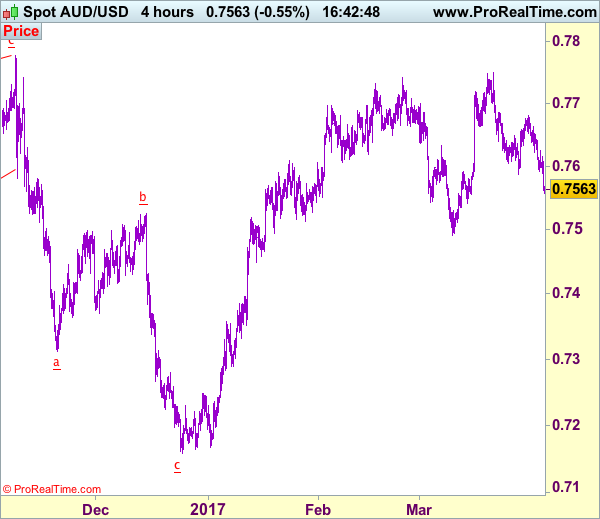
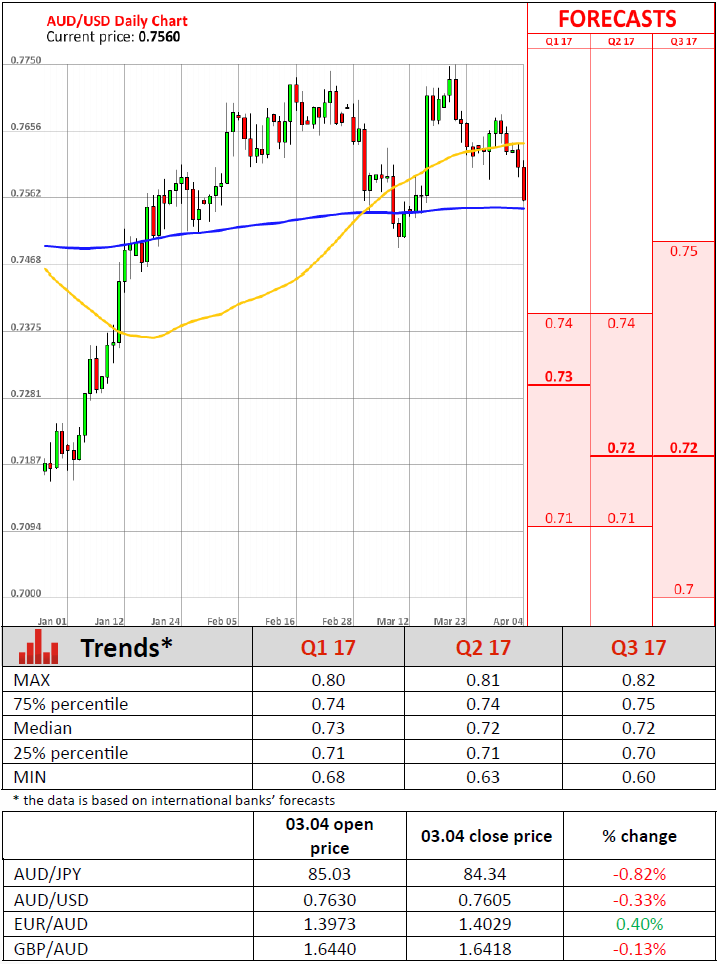
    AUD/USD's consolidation from 0.7608 is still in progress and intraday bias remains neutral first. Further rise could be seen with 0.7448 support intact. On the upside, above 0.7608 will extend the rebound form 0.7158. But we'd expect strong resistance from 0.7777/7833 resistance zone to bring near term reversal. On the downside, break of 0.7448 support will indicate that rebound from 0.7158 has completed. That will turn bias to the downside for 0.7144 key support level.

    In the bigger picture, AUD/USD is staying inside long term falling channel and it's likely that the down trend from 1.1079 is still in progress. Break of 0.6826 low will confirm this bearish case. We'll be looking for bottoming sign again as it approaches 0.6008 key support level. Meanwhile, sustained break of 0.7833 resistance will be a strong sign of medium term reversal.

    AUD/USD 4 Hours Chart

    AUD/USD Daily Chart

    Subscribe to our daily and mid-day newsletter to get this report delivered to your mail box

    Dollar Weak as Focus Now Turns to FOMC

    Dollar is trying to recover today but remains the weakest major currency as markets turn their focus to FOMC rate decision today. The greenback has been under much selling pressure since the start of drama of US president Donald Trump's executive order on immigration ban. And more certainties are added after Trump called China and Japan playing their money markets. Also, his trade adviser Peter Navarro complained that the Euro was "grossly undervalued". Markets' enthusiasm over Trump's expansive policies diminished much this week and that can clearly be seen in the sharp pull back in stocks. DJIA ended down -107.04 pts or -0.54% at 19865.09, moving further away from 20000 handle. 10 year yield also lost 0.032 to close at 2.451. Dollar index is back below 100 handle, trading at around 99.8 at the time of writing.

    Trump criticized that "you look at what China's doing, you look at what Japan has done over the years. They play the money market, they play the devaluation market and we sit there like a bunch of dummies." Japan's chief cabinet secretary, Yoshihide Suga, said Trump's criticism "completely misses the mark" and pledged that the central will continue to respond to "one-sided" moves in the markets. BoJ governor Haruhiko Kuroda sad earlier this week that nation's monetary policy "is not targeting exchange rates," but "is aimed at stabilizing prices and attaining a 2 percent inflation goal as soon as possible."

    At the interview with the Financial Times, Peter Navarro, head of Trump's new National Trade Council, indicated that the euro has been "grossly undervalued" and Germany has been a big beneficiary of it. He blamed that Germany has been manipulating the single currency, using it as "implicit Deutsche Mark", to "exploit" the US and its EU partners. He also blamed that Germany was the main obstacle to a trade deal between the US and European bloc. German Chancellor Angel Merkel responded emphasized that Germany "has always called for the European Central Bank to pursue an independent policy" and the country "will not influence the behavior of the ECB". And thus, she cannot and do not want to change the situation as it is."

    The focus today is on the FOMC meeting. It is widely expected that no change would be on the monetary policy. Yet, the market should pay attention to the accompanying statement. We expect policymakers to highlight the improvement in the employment market, noting that it's close to full employment. The questions remain on whether Fed would realize its projection of three rate hikes this year. Fed fund futures are pricing in less than 70% chance of a hike by June, slightly lower than last week.

    On the data front, New Zealand, employment rose 0.8% qoq in Q4, unemployment rate jumped to 5.2%. China manufacturing PMI dropped -0.1 to 51.3 in January, non-manufacturing PMI rose 0.2 to 54.6. UK BRC shop price dropped -1.7% yoy in January. UK nationwide house price rose 0.2% mom in January. PMI will be the main feature today. Swiss will release SVEM PMI in European session while UK will also release PMI manufacturing. US will release ADP employment, ISM manufacturing and construction spending.

    AUD/USD Daily Outlook

    Daily Pivots: (S1) 0.7531; (P) 0.7549; (R1) 0.7570; More...

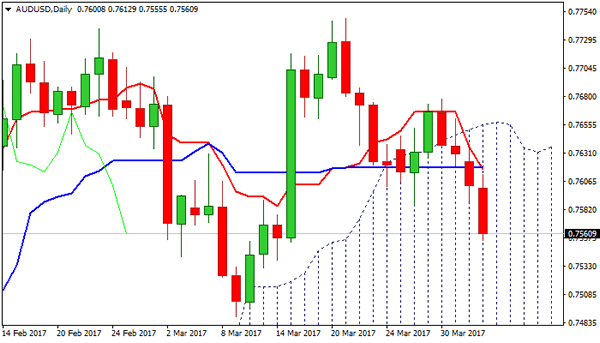
    AUD/USD's consolidation from 0.7608 is still in progress and intraday bias remains neutral first. Further rise could be seen with 0.7448 support intact. On the upside, above 0.7608 will extend the rebound form 0.7158. But we'd expect strong resistance from 0.7777/7833 resistance zone to bring near term reversal. On the downside, break of 0.7448 support will indicate that rebound from 0.7158 has completed. That will turn bias to the downside for 0.7144 key support level.

    In the bigger picture, AUD/USD is staying inside long term falling channel and it's likely that the down trend from 1.1079 is still in progress. Break of 0.6826 low will confirm this bearish case. We'll be looking for bottoming sign again as it approaches 0.6008 key support level. Meanwhile, sustained break of 0.7833 resistance will be a strong sign of medium term reversal.

    AUD/USD 4 Hours Chart

    AUD/USD Daily Chart

    Economic Indicators Update

    GMT Ccy Events Actual Consensus Previous Revised
    21:45 NZD Employment Change Q/Q Q4 0.80% 0.80% 1.40% 1.30%
    21:45 NZD Unemployment Rate Q4 5.20% 4.80% 4.90%
    0:01 GBP BRC Shop Price Index Y/Y Jan -1.70% -1.00% -1.40%
    1:00 CNY Manufacturing PMI Jan 51.3 51.2 51.4
    1:00 CNY Non-manufacturing PMI Jan 54.6 54.5
    7:00 GBP Nationwide House Prices M/M Jan 0.20% 0.00% 0.80%
    8:30 CHF SVME PMI Jan 55.9 56
    8:45 EUR Italy Manufacturing PMI Jan 53.3 53.2
    8:50 EUR France Manufacturing PMI Jan F 53.4 53.4
    8:55 EUR Germany Manufacturing PMI Jan F 56.5 56.5
    9:00 EUR Eurozone Manufacturing PMI Jan F 55.1 55.1
    9:30 GBP PMI Manufacturing Jan 55.9 56.1
    13:15 USD ADP Employment Change Jan 167K 153K
    15:00 USD ISM Manufacturing Jan 55 54.7
    15:00 USD ISM Prices Paid Jan 66 65.5
    15:00 USD Construction Spending M/M Dec 0.30% 0.90%
    15:30 USD Crude Oil Inventories 2.8M
    19:00 USD FOMC Rate Decision 0.75% 0.75%

    Subscribe to our daily and mid-day newsletter to get this report delivered to your mail box

    Team Trump Jump On The Dollar Strength

    So it is time to attack the Dollar? That was the name of the game yesterday after the Dollar was sent on a wild tumble following comments from Peter Navarro, the head of President Trump's National Trade Council that Germany was using a “grossly undervalued” euro to gain advantage over the US and its own European Union neighbours. This was later followed by outspoken comments from President Trump himself when he implied during a meeting with senior pharmaceutical bosses that currency devaluation from other countries had increased the probability of drug makers outsourcing their production as he calls on these companies to turn production back towards the United States.

    While the USD has stabilised somewhat since the attack on its strength yesterday, investors continue to be kept on their toes towards pricing in some political risk premium into the new US President after getting carried away beforehand on growth promises and these fundamentals are expected to continue driving the markets.

    Investors must be aware that the Trump rally was encouraged on promises of economic growth, deregulation, fiscal spending and job creation. Yet there is still a large element of political risk that was ignored with Trump famously known to favour protectionist and other far-right policies. It must also be remembered that in order for this era of protectionism to work,Trump does need a weaker Dollar, otherwise it will become counterproductive to his economic plan as President of the United States. You can promise to cut taxes, deregulate and offer additional incentives to encourage business in the United States, but unless you are as competitive as your competition overseas corporations will continue to favour doing business in locations where operating costs are lower.

    Dollar still slipping against emerging currencies

    Despite the Dollar having stabilised after suffering heavy losses against its main trading partners, the Greenback is still slipping lower against most emerging market currencies in Asia ahead of the Federal Reserve interest rate decision this evening. While the Federal Reserve is expected to continue indicating their bias towards raising US interest rates higher more than once in 2017, the general consensus is that interest rates will be left unchanged tonight and this is providing support to Asian currencies seen as being the most vulnerable to higher US interest rates.

    The biggest risk for the Dollar heading into the US interest rate decision is if the Federal Reserve indicates an air of unease around the unknown fiscal policy agenda of Donald Trump.

    British MPs set to vote on Brexit bill

    It shouldn't be forgotten that with Donald Trump continuing to attract all the limelight that MPs in the United Kingdom are set to vote later today on whether to give Theresa May the green-light to get Brexit negotiations underway. Today represents the conclusion of the debate in parliament that has lasted two days and is expected to end with Prime Minister Theresa May being awarded the nod of approval to begin Brexit negotiations, with reports circulating yesterday that May is aiming to invoke Article 50 on March 9.

    This should have some ramifications on the British Pound while the recent news that the UK economy is expected to slow down over the next couple of years also provides another risk to investor sentiment.

    On a general level however, global economics are being ignored with market volatility being driven by this new era of political risk becoming common across the developed world.

    Trump Administration ‘Attacks’ Trading Partners On Weak Currency


    Sunrise Market Commentary

    • Rates: Fed statement will probably sound more hawkish
      The US calendar is interesting with ADP employment report and manufacturing ISM, but they will be overshadowed by tonight's FOMC meeting. We expect an unchanged policy without hints to a March rate hike. The wording of the statement will be more hawkish. We only anticipate big market moves in case of a deviation from this ploy.
    • Currencies: Trump administration 'attacks' trading partners on weak currency
      Yesterday, the dollar declined as US president Trump and an one of his advisers openly accused Germany, China and Japan on keeping their currencies artificially weak. Today, the focus is on the Fed's policy statement. Will the Fed statement be hawkish enough to counterbalance the recent USD negatives coming from the Trump administration?

    The Sunrise Headlines

    • The S&P 500 and Nasdaq ended nearly unchanged while the Dow Jones underperformed (-0.5%). Overnight, most Asian stock markets eke out gains up to 0.50%. Strong Apple earnings are supportive.
    • Apple snapped out of 3 straight quarters of falling revenue as strong demand for the iPhone 7 raised investors' hopes that the technology giant is emerging from its roughest period since it reinvented the market for mobile devices.
    • China's manufacturing sector saw growth slightly soften in January (PMI: 51.3 from 53.4). Sub-indices for both output (53.1) and new orders (52.8) registered slower growth. Chinese services expansion increased (PMI: 54.6 from 54.5).
    • US President Trump and a top economic adviser unleashed a barrage of criticism against Germany, Japan and China, saying the three key US trading partners were engaged in devaluing their currencies to the harm of American companies and consumers.
    • Britain's economy now looks set to slow only slightly in 2017 after its resilient response to last year's Brexit vote, NIESR said. Its latest forecasts pointed to growth of 1.7% this year, only a moderate slowdown from 2% in 2016.
    • US President Trump picked Judge Gorsuch as nominee to the Supreme Court, a choice that would fill a nearly year-long vacancy on the bench and amount to the most transformational decision of his eventful first 12 days in office.
    • New Zealand's jobless rate jumped (5.2%) and wage growth stayed sluggish as more people flooded the workforce in the fourth quarter, suggesting interest rates can remain at record lows even as the economy hums along.
    • Today's eco calendar contains manufacturing PMI's in Europe (final), the UK and the US (ISM). ADP publishes its employment report and Germany taps the market, but most attention goes to tonight's FOMC meeting

    Currencies: Trump Administration 'Attacks' Trading Partners On Weak Currency

    Trump questions strong dollar policy

    On Tuesday, EMU data were excellent, but hardly supported the euro. The Trump administration stepped up its campaign against US trading partners by accusing them to profit from a weak currency. Trump's Trade adviser Peter Navarro said that Germany used a grossly undervalued euro to its advantage. Donald Trump made similar accusations to China and Japan as he said these countries used negative/low yields to keep their currencies weak. The dollar declined further, reinforced by disappointing US data. USD/JPY dropped to the low 112 area, but rebounded as US equities found a better bid. The pair closed the session at 112.80 (from 113.77). EUR/USD broke beyond the 1.0775 resistance and closed at 1.0790.

    This morning, Asian equities show modest gains despite yesterday's accusations FX manipulation by China and Japan. The dollar rebounds after yesterday's selloff. USD/JPY is trading in the 113.25/30 area. The Fed policy statement this evening is probably preventing further USD losses. EUR/USD is stabilizing in the high 1.07 area. The Kiwi dollar was sold on weak labour data. A rise in the unemployment rate and soft wage growth data make an RBNZ interest rate hike unlikely. NZD/USD dropped to the mid 0.72 area.

    Today, FOMC policy statement will take centre stage (20:00 CET). A rate hike is unlikely (markets are discounting a 13.5% chance). In December, the Fed confirmed a gradual pace of withdrawing accommodation. The March meeting will probably also be too soon to tighten policy. If the FOMC thinks (unlikely) that tightening might be appropriate in March, it might start to prepare markets by today's statement. We favour a next rate hike in June. Nevertheless, the tone of the FOMC members has become more hawkish as the Fed is coming closer to its objectives for employment and inflation. We do expect some hawkish changes to the statement. Several governors have focussed on the normalization of the Fed balance sheet and indicated the debate might have to be started in a not too far distance. We agree, but don't expect news on it in today's statement.

    Yesterday, the dollar was hammered as the Trump administration started its campaign against the artificially weak currencies of its major trading partners. The jury is still out, but some observers see it as the US moving away from its strong dollar policy/rhetoric. Question is whether today's Fed statement will be hawkish enough to counterbalance these new USD negatives. We are not a priori convinced this will be the case. In an addition, the Trump politics/communication is also becoming a sources of global uncertainty and weighs on the dollar. EUR/USD cleared a next minor resistance at 1.0775. Next resistance is coming in at 1.0874. The day-to-day USD momentum has become a more fragile. A return above EUR/USD 1.0874 would question the short-term USD positive outlook. At some point, the absolute interest rate support should provide a USD floor, but we are not in a hurry to play this card already now. We wait for technical signals that the USD correction has run its course. USD/JPY is trading well off the post- Trump highs (118.60/66). The rebound off the 112.57/53 reaction low was quite constructive, but is losing momentum. USD/JPY 111.16 (38% retracement of the 99.02/118.66 rally) is a key support.

    EUR/USD regains next resistance as Trump devaluation talk weighs on the dollar

    EUR/GBP

    Sterling still looking for a clear trend

    Yesterday's UK eco data triggered a significant, albeit temporary, move lower of sterling. UK December credit an money supply data were weaker than expected. Even more important, foreign investors were net sellers of Gilts for the first time since July, triggering an intraday sell-off of sterling. EUR/GBP jumped to the 0.8630/35 area. However, sterling rebounded later in the session even as risk sentiment remained fragile. So, sterling trading gave some mixed signals. EUR/GBP closed the session at 0.8584 (from 0.8566). Cable rebounded on broad USD weakness and finished the session at 1.2579.

    Overnight, the BRC shop prices were softer than expected at -1.7% Y/Y. Nationwide house prices were in line with expectations. Later today, the UK manufacturing PMI is expected to decline slightly from 56.1 to 55.9. Of late, sterling didn't react too much to UK eco data. However, we have to impression that the UK currency is becoming slightly more sensitive to negative eco news. There will also be plenty of headlines on the Brexit-debate in Parliament, but for now we assume that it won't be a major obstacle for PM May's government. Over the previous days, sterling gradually lost some momentum against the euro even as the reason behind the move was not always very clear. A softer global risk sentiment is probably at least one factor. Last week, EUR/GBP 0.8579 and 0.8515 supports (50% and 62% retracement of the 0.8304/0.8854 rebound) were broken. The correction low comes in at 0.8451 and should provide strong support. Yesterday's price action confirms this view. We still look to buy EUR/GBP on dips.

    EUR/GBP: 0.8450 support remains intact, tentative signs of a rebound”

    Download entire Sunrise Market Commentary

    Daily Technical Outlook And Review

    A note on lower timeframe confirming price action…

    Waiting for lower timeframe confirmation is our main tool to confirm strength within higher timeframe zones, and has really been the key to our trading success. It takes a little time to understand the subtle nuances, however, as each trade is never the same, but once you master the rhythm so to speak, you will be saved from countless unnecessary losing trades. The following is a list of what we look for:

    • A break/retest of supply or demand dependent on which way you're trading.
    • A trendline break/retest.
    • Buying/selling tails – essentially we look for a cluster of very obvious spikes off of lower timeframe support and resistance levels within the higher timeframe zone.
    • Candlestick patterns. We tend to only stick with pin bars and engulfing bars as these have proven to be the most effective.

    EUR/USD

    The EUR made considerable ground against its US counterpart yesterday, after US President Trump’s trade advisor commented that the euro was ‘grossly undervalued’. The move was further exacerbated by lower-than-expected US consumer sentiment and a disappointing Chicago PMI, as well as a decline in the 10-year treasury yield!

    The 1.07 psychological handle, along with H4 supply at 1.0765-1.0753 (now acting demand) were consumed amid the recent advance, which, as you can see, allowed price to shake hands with an interesting area of H4 resistance (green zone). In earlier reports we mentioned to keep an eye on this base as it consists of the following structures:

    • A H4 Quasimodo resistance level at 1.0796.
    • 1.08 handle.
    • H4 Fib 88.6% resistance at 1.0810.
    • Weekly resistance at 1.0819.
    • H4 symmetrical AB=CD approach terminating at 1.0805.

    Our suggestions: Although there is a chance that daily action may continue to advance in order to touch gloves with daily resistance at 1.0850, our desk is confident, given the confluence seen around the above noted H4 resistance area, that a bounce down to H4 demand at 1.0765-1.0753 will likely be seen. With that being the case, a market order was executed at 1.0798, with a stop placed 5 pips above the current weekly resistance level at 1.0824.

    Data points to consider: US ADP non-farm employment change at 1.15pm, ISM manufacturing PMI at 3pm followed by the Federal Reserve monetary policy decision at 7pm GMT.

    Levels to watch/live orders:

    • Buys: Flat (stop loss: N/A).
    • Sells: 1.0798 ([live position] stop loss: 1.0824).

    GBP/USD:  

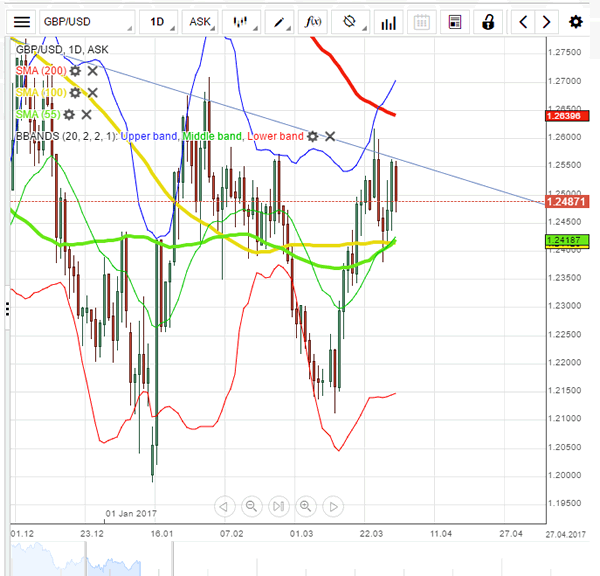
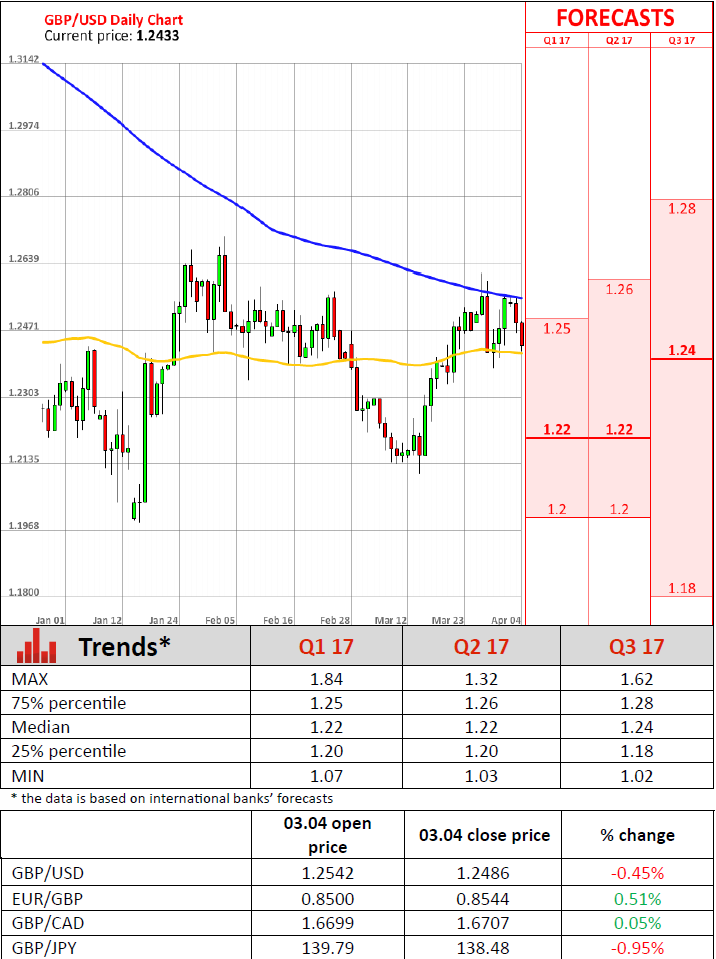
    For those who read Tuesday’s report on the GBP you may recall that our desk highlighted the 1.24/1.2440 region (yellow box) as a rather attractive H4 buy zone. It comprised of a H4 AB=CD 161.8% Fib ext., the 1.24 handle, a H4 trendline support taken from the high 1.2432 and boasted additional backing from a daily support area chiseled in at 1.2510-1.2415. Well done to any of our readers who took advantage of this convergence!

    Going forward, we can see that price recently made contact with a H4 supply area coming in at 1.2611-1.2589. While the H4 candles are currently seen holding firm below this area, we feel it will not be long before this zone is engulfed and price makes its way up to the H4 mid-way resistance at 1.2650, or even the H4 Quasimodo resistance level at 1.2699. As of now the better area for shorts, at least in our view, is the above noted H4 Quasimodo resistance that fuses beautifully with the 1.27 handle. Not only is it housed within daily supply at 1.2728-1.2657, it’s also sitting only 25 or so pips above the weekly Quasimodo resistance at 1.2673.

    Our suggestions: Be patient! Selling at a H4 supply that has no connection to the higher-timeframe structures is not something we’d advise. Should the unit strike the 1.27 region today/this week, this is an area one could possibly look to sell from without the need for additional confirmation as stops can be positioned above the aforementioned daily supply around the 1.2730 mark.

    Data points to consider: UK manufacturing PMI at 9.30am. US ADP non-farm employment change at 1.15pm, ISM manufacturing PMI at 3pm followed by the Federal Reserve monetary policy decision at 7pm GMT.

    Levels to watch/live orders:

    • Buys: Flat (stop loss: N/A).
    • Sells: 1.27 region ([possible area to look at selling from without the need for additional confirmation] stop loss: 1.2730 – 2 pips above daily supply).

    AUD/USD

    Across the board, the US dollar took a rather significant hit yesterday led by US President Trump’s trade advisor commenting that the euro was ‘grossly undervalued’, as well as poor US economic data. This, as you can see, bolstered the commodity currency forcing price to momentarily surpass the 0.76 handle and touch base with November’s opening line 0.7606. As a consequence of yesterday’s advance, daily price also ever so slightly closed above daily supply at 0.7581-0.7551, which could further confirm weekly upside from the top edge of the weekly support area at 0.7524-0.7450. Before our team looks to become buyers in this market, nevertheless, we’d need to see a decisive H4 bullish close above the 0.7606 region. That way, we can be relatively sure that offers within the current daily supply are exhausted.

    Our suggestions: Put simply, watch the H4 candles for a close above 0.7606 and then look to trade any retest seen thereafter. Still, following the retest we’d ultimately like to see either a lower-timeframe confirming buy signal form (see the top of this report) or a H4 bullish candle close, before committing to a position.

    Data points to consider: Chinese manufacturing at 1am. US ADP non-farm employment change at 1.15pm, ISM manufacturing PMI at 3pm followed by the Federal Reserve monetary policy decision at 7pm GMT.

    Levels to watch/live orders:

    • Buys: Watch for a H4 close to be seen above 0.7606 and then look to trade any retest seen thereafter ([waiting for a lower-timeframe confirming setup to form following the retest is advised prior to pulling the trigger] stop loss: dependent on where one confirms this area).
    • Sells: Flat (stop loss: N/A).

    USD/JPY

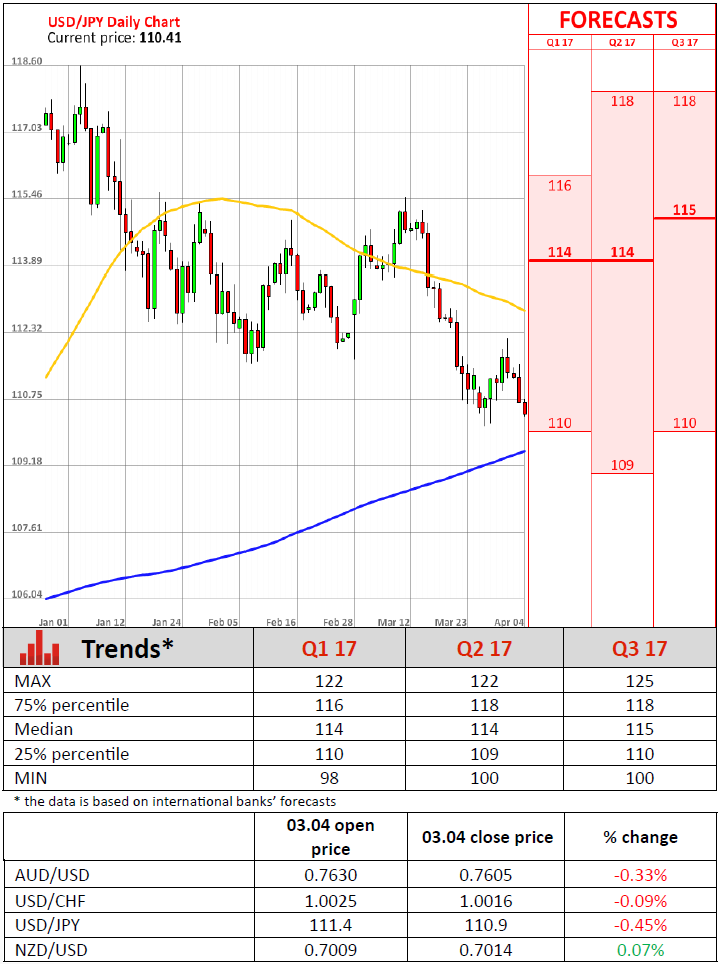
    In our previous report, we noted to keep an eyeball on the H4 demand area penciled in at 112.05-112.37. This base commanded the backing of the current daily demand at 111.35-112.37, which itself is further reinforced by a weekly support area at 111.44-110.10. As is evident from the H4 chart, the unit aggressively drove into the jaws of this zone yesterday and responded beautifully! The recent downside move was brought about by comments made by US President Trump’s trade advisor saying that the euro was ‘grossly undervalued’, along with disappointing US data. Well done to any of our readers who managed to secure a buy from the above noted H4 demand, as current H4 price looks set to continue northbound up until at least the H4 resistance at 113.25. Be that as it may, we would strongly advise taking some profits off the table around 113 and reducing risk to at least breakeven!

    Our suggestions: At the time of writing, we do not see much to hang our hat on in regards to trading opportunities. Therefore, we’re going to opt for the safest position of them all – flat.

    Data points to consider: US ADP non-farm employment change at 1.15pm, ISM manufacturing PMI at 3pm followed by the Federal Reserve monetary policy decision at 7pm GMT.

    Levels to watch/live orders:

    • Buys: Flat (stop loss: N/A).
    • Sells: Flat (stop loss: N/A).

    USD/CAD

    Strengthened by Canadian GDP figures coming in slightly better than expected the USD/CAD tumbled lower yesterday, momentarily surpassing the 1.30 handle and clocking a low of 1.2968. As of current price, we can see that the H4 candles are currently trading above the H4 mid-way resistance point at 1.3050, with the unit looking as though it may tap the underside of the 1.31 handle (bolstered by a H4 61.8% Fib resistance at 1.3091 and a H4 supply at 1.3123-1.3093) sometime today.

    Looking over to the bigger picture, daily demand at 1.3006-1.3041, which happens to be positioned within the lower edge of a weekly demand at 1.3006-1.3115, held steady yesterday despite suffering a minor breach to the downside. The next area of value seen from here is 1.3169-1.3116: a daily supply zone which happens to be glued to the top edge of the above noted H4 supply.

    Our suggestions: The current H4 supply, owing to its connection with daily structure, will likely bounce price today. How much of a bounce, well, that’s anybody’s guess, since let’s not forget that there’s also a weekly demand area also in play at the moment. With this being the case, waiting for a lower-timeframe sell signal (see the top of this report) to form before considering a sell from the H4 supply zone is, at least in our book, the safer route to take.

    Data points to consider: US ADP non-farm employment change at 1.15pm, ISM manufacturing PMI at 3pm followed by the Federal Reserve monetary policy decision at 7pm GMT.

    Levels to watch/live orders:

    • Buys: Flat (stop loss: N/A).
    • Sells: 1.3123-1.3093 ([wait for a lower-timeframe confirming setup to form before looking to execute a trade] stop loss: dependent on where one confirms this area).

    USD/CHF

    In recent sessions, the USD/CHF took out the H4 support at 0.9948 and snowballed south. Aggressively whipsawing through the 0.99 handle and touching gloves with a H4 demand at 0.9832-0.9865, the pair concluded Tuesday’s session closing a few pips below 0.99.

    What this recent move also accomplished was a break of weekly support at 0.9943. While yesterday’s daily candle portrays this break as an important cue for potentially more downside, let’s first consider the fact that the current weekly candle also recently shook hands with a weekly trendline support extended from the low 0.9943.

    Our suggestions: With the weekly chart indicating that the bulls may make an appearance, there’s a chance that a H4 close above the 0.99 could be at hand. Should this come to fruition and price retests 0.99 as support, a long could be a possibility on the condition that a lower-timeframe buy signal is seen following the retest (see the top of this report), targeting H4 supply at 0.9966-0.9949 and then maybe even parity (1.0000).

    Data points to consider: US ADP non-farm employment change at 1.15pm, ISM manufacturing PMI at 3pm followed by the Federal Reserve monetary policy decision at 7pm GMT.

    Levels to watch/live orders:

    • Buys: Watch for a H4 close to be seen above 0.99 and then look to trade any retest seen thereafter ([waiting for a lower-timeframe confirming setup to form following the retest is advised prior to pulling the trigger] stop loss: dependent on where one confirms this area).
    • Sells: Flat (stop loss: N/A).

    DOW 30

    US equities closed lower yesterday, consequently recording its third consecutive losing day. Daily price is now seen trading mid-range between a daily resistance level at 19964 and a daily support boundary coming in at 19747. Meanwhile, up on the weekly chart, the index is currently hovering just ahead of the 2017 yearly opening level at 19769. A decisive weekly close beyond this range could spark another wave of selling down to the weekly demand area at 19071-19222. Before this can be achieved, however, a daily close below the aforementioned daily support would, of course, also need to be seen!

    Marching across to the H4 candles, one can see that the H4 demand at 19785-19803 (positioned directly above the 2017 yearly opening barrier) held firm amid yesterday’s action, and helped lift prices to highs of 19897 by the closing bell. With this H4 demand likely weakened by the recent attack, the next level of interest seen beyond here comes in at 19759: a sneaky H4 Quasimodo support that is bolstered by the 2017 yearly opening base and the nearby daily support at 19747.

    Our suggestions: Given the confluence in place around the current H4 Quasimodo support, our team has placed a pending buy order at 19760, with a stop set just below the apex of the Quasimodo formation (see black arrow) at 19730.

    Data points to consider: US ADP non-farm employment change at 1.15pm, ISM manufacturing PMI at 3pm followed by the Federal Reserve monetary policy decision at 7pm GMT.

    Levels to watch/live orders:

    • Buys: 19760 ([pending order] stop loss: 19730).
    • Sells: Flat (stop loss: N/A).

    GOLD

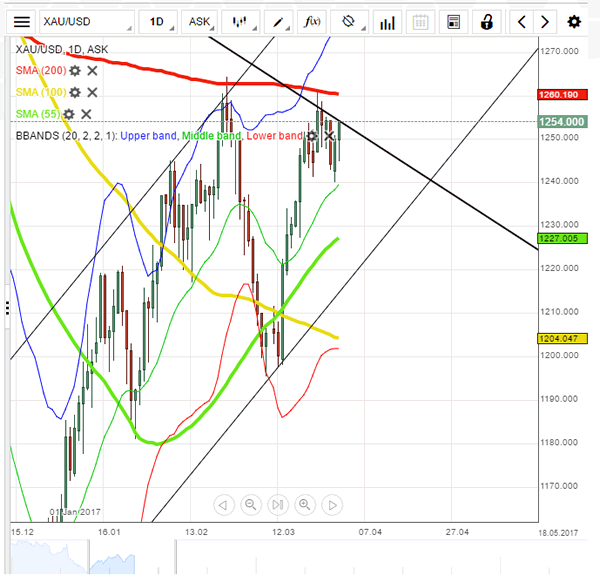
    With the dollar taking yet another hit to the mid-section yesterday, the yellow metal extended Monday’s advance. The H4 resistance area at 1198.4-1203.8 (now an acting support barrier) was taken out, leaving price free to challenge the H4 trendline resistance extended from the low 1187.7. As you can see, three H4 bearish wicks have printed off this line, indicating that the bears may take center stage today. Couple this with the fact that the daily candles are also now seen kissing the underside of a daily supply zone at 1220.9-1212.0, as well as trading nearby a weekly trendline resistance taken from the low 1130.1, we may have a very nice short opportunity here!

    Our suggestions: Before we look to press the sell button, nevertheless, one has to take into account the risk/reward offered here. If we enter at current price: 1210.1 and place our stop above the H4 bearish wicks at 1215.6, we have a little over one times our risk down to the next H4 support target: 1198.4-1203.8. If this is in line with your trading plan, by all means this is a high-probability short. Personally, what we’d look to do here is reduce risk to breakeven at the above noted H4 support area and take 50% of the position off the table, looking to hold the reminder of the trade down to H4 support at 1191.1.

    Levels to watch/live orders:

    • Buys: Flat (stop loss: N/A).
    • Sells: A short at current prices is valid, in our book, with stops placed at 1215.6.

    US Dollar Struggles To Find Strength During January

    Currency pair EUR/USD

    The EUR/USD turned around – yet again – for one more bullish push higher. The price action, however, remains very choppy and corrective. Price has also reached the next Fibonacci resistance: the 88.6% level. A break above the 88.6% makes a wave 2 (brown) unlikely and a break above 100% invalidates this wave structure. A break below support could spark waves 3.

    The EUR/USD bearish price action was an ABC correction (green) and price could have completed a bullish ABC correction too. The wave C (green) could continue higher if price breaks above resistance (red) and the 138.2% Fibonacci.

    Currency pair GBP/USD

    The GBP/USD broke above the bearish channel (dotted brown line). The price action in the channel is relatively choppy compared to the bullish price action and hence the wave count has been changed to reflect a potential bullish (green) wave count within wave 4 (purple).

    The GBP/USD could expand the wave B (green) correction via an expanded WXY (blue) correction. A break above the 138.2% Fibonacci level invalidates the wave X vs W.

    Currency pair USD/JPY

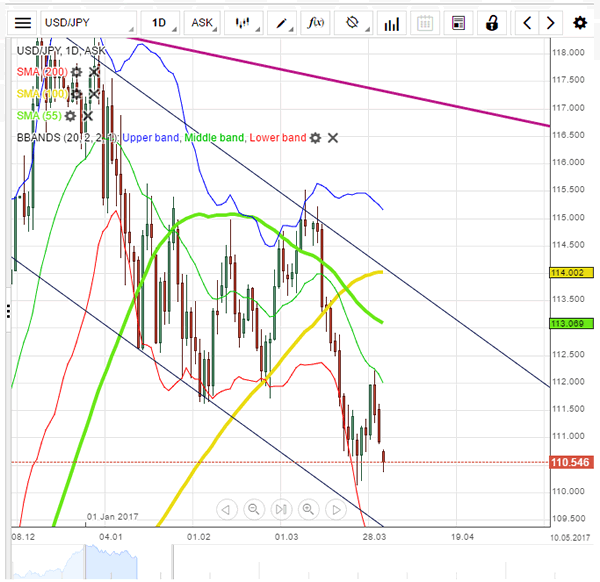
    The USD/JPY made another attempt to reach the 38.2% Fibonacci level of wave 4 (purple). Either the 38.2% or 50% are likely bounce spots for such a wave 4 (purple).

    The USD/JPY is building an ABC (orange) bearish zigzag within wave Y (brown).

    Asian Market Update: NZ Unemployment Rises As Participation Rate Hits Record High

    NZ unemployment rises as participation rate hits record high

    Asia Mid-Session Market Update: China manufacturing PMI still expanding but at 3-month low; NZ unemployment rises as participation rate hits record high

    US Session Highlights

    (US) Presidential trade adviser Navarro: Germany is benefiting from grossly undervalued euro - financial press

    German Chancellor Merkel: Do not want to influence Euro exchange rate; has always called upon ECB to have independent policy

    (US) Q4 EMPLOYMENT COST INDEX (ECI): 0.5% V 0.6%E

    (US) NOV S&P/CASE-SHILLER 20-CITY M/M: 0.88% V 0.65%E; Y/Y: 5.27% V 5.03%E; HOUSE PRICE INDEX (HPI): 192.14 V 191.77 PRIOR

    (US) President Trump: On Medicare and Medicaid, we need prices way down; prices have been astronomical - meeting with industry executives

    (US) JAN CHICAGO PURCHASING MANAGER: 50.3 V 55.0E (lowest since May 2016); new orders 49.1 v 56.5

    (US) JAN CONSUMER CONFIDENCE: 111.8 V 112.8E; 1-year consumer inflation expectation: 4.9% v 4.5% in Dec

    US markets on close: Dow -0.5%, S&P500 -0.1%, Nasdaq flat

    Best Sector in S&P500: Utilities

    Worst Sector in S&P500: Industrials

    Biggest gainers: TMO +6.4%, MNK +4.9%, MYL +4.7%, DHR +4.4%, ABC +4.4%

    Biggest losers: UA -23.4%, UPS -6.8%, VLO -3.6%, PNR -3.5%, NUE -3.3%

    At the close: VIX 12.0 (+0.1pts); Treasuries: 2-yr 1.22% (+2bps), 10-yr 2.45% (-3bps), 30-yr 3.05% (-3bps)

    US movers afterhours

    AMD: Reports Q4 -$0.01 v -$0.02e, R$1.11B v $1.07Be; Guides initial FY17 Rev " to grow" % y/y, GM to "increase"; +3.6% afterhours

    AAPL: Reports Q1 $3.36 v $3.22e, R$78.4B v $77Be; iPhone shipments 78.3M v 74.8M y/y (v 77Me); +3.0% afterhours

    CB: Reports Q4 $2.72 v $2.43e, Net premiums written $6.94B v $7.21B y/y; +1.1% afterhours

    EA: Reports Q3 $0.00 v -$0.14 y/y, net Rev $1.15B v $1.07B y/y; -1.1% afterhours

    X: Reports Q4 $0.27 (ex $0.88 in charges, unclear if comp) v $0.01e, R$2.65B v $2.67Be; guides initial FY17 adjusted EBITDA $1.3B v $510M y/y; -0.6% afterhours

    ILMN: Reports Q4 $0.85 v $0.81e, R$619M v $614Me; -1.5% afterhours

    Asia Key economic data:

    (CN) CHINA JAN MANUFACTURING PMI (GOVT OFFICIAL): 51.3 (6th consecutive month of expansion, 3-month low) V 51.2E; Non-manufacturing PMI: 54.6 v 54.5 prior

    (JP) JAPAN JAN FINAL PMI MANUFACTURING: 52.7 V 52.8 PRELIM (5th month of expansion, confirms highest level since Mar 2014)

    (AU) AUSTRALIA JAN AIG MANUFACTURING INDEX: 51.2 V 55.4 PRIOR (4th straight month of expansion, 3-month low)

    (AU) AUSTRALIA JAN CORELOGIC RPDATA HOUSE PRICES M/M: 0.7% V 1.4% PRIOR

    (NZ) NEW ZEALAND Q4 UNEMPLOYMENT RATE: 5.2% (3-quarter high) V 4.8%E; EMPLOYMENT CHANGE Q/Q: 0.8% (5-quarter low) V 0.7%E; Y/Y: 5.8% V 6.1%E;
    Participation rate 70.5% v 70.2%e (record high)

    (KR) SOUTH KOREA JAN PMI MANUFACTURING: 49.0 V 49.4 PRIOR (6th consecutive contraction)

    (KR) SOUTH KOREA JAN TRADE BALANCE: $3.2B V $5.3BE; Exports Y/Y: 11.2% v 9.0%e; Imports Y/Y: 18.6% v 10.1%e

    Asia Session Notable Observations, Speakers and Press

    Asian indices are cautiously higher as US immigration policy-driven selling subsides, even though the focus on Washington remains close after today's volatility in FX markets following claims by Trump's advisor that Germany benefits from undervalued Euro. Germany's Merkel defended EMU's monetary policy and Germany's independence from the ECB, while Japanese officials also stepped up their defensive rhetoric against claims that Japan is manipulating FX. Separately from the currency markets, Trump has nominated Colorado's Neil Gorsuch (age 49) for US Supreme Court seat, as speculated earlier.

    PMI data across Asia-Pacific have been mixed - China's manufacturing remained in expansion but slid to a 3-month low, as closely watched Input Price component fell to 64.5 from 69.6. Conversely, New Export Orders rose to 50.3 v 50.1 m/m and Employment rose to 49.2 v 48.9 m/m. Separately, Japan's manuf PMI was confirmed at the highest level in nearly 3 years, while Korea's PMI continued to retreat with 6th straight month of contraction.

    NZD was volatile earlier in the session as Q4 unemployment rate rose to a 3-quarter high, however economists were quick to point out that the jump was cushioned by participation rate hitting a record high thanks to strong arrivals.

    China

    (CN) China State-owned Assets Supervision and Administration Commission (SASAC): Debt risks of SOEs are controllable - China Daily

    (CN) China Stats Bureau: Coal production in 2016 fell 9.4% y/y to 3.36B tons - China Daily

    Japan:

    (JP) Japan PM Abe: Will tell Trump, Japan will contribute to US jobs and infrastructure

    (JP) Japan PM Abe adviser Hamada: Trump's one sided arguments on border tax and currencies are destructive to Japan and world economy

    (JP) Japan Chief Cabinet Sec Suga: Not setting exchange rate target, follows G7 on policy; watching fx closely with a sense of urgency

    (JP) Japan Vice Fin Min of International Affairs (currency chief) Asakawa: Japan's monetary policy is aimed at beating deflation, not FX market - press

    (JP) Former BOJ exec Momma: BoJ's next move will likely be to raise 10-yr bond yield target, could start discussions within BOJ on this later this year

    Australia/New Zealand:

    (AU) Morgan Stanley economist: Australia consumer companies to face more pressure in 2017 "as leading housing indicators soften, the savings rate is lower YoY and income growth remains weak" - press

    (NZ) Citigroup: Latest employment data show labor demand and supply are containing wage growth; Gives RBNZ some time before considering rate hike - press

    (NZ) New Zealand PM English calls for Sept 23 national elections - press

    Asian Equity Indices/Futures (00:00ET)

    Nikkei +0.6%, Hang Seng -0.7%, Shanghai Composite closed, ASX200 +0.5%, Kospi +0.5%

    Equity Futures: S&P500 +0.1%; Nasdaq +0.4%; Dax flat%; FTSE100 +0.1%

    FX ranges/Commodities/Fixed Income (00:00ET)

    EUR 1.0785-1.0805; JPY 112.65-113.25; AUD 0.7550-0.7585; NZD 0.7260-0.7340

    Apr Gold -0.1% at $1,211/oz; Mar Crude Oil -0.2% at $52.73/brl; Mar Copper -0.2% at $2.72/lb

    (US) Weekly API Oil Inventories: Crude: +5.8M v +2.9M prior; Biggest build since Nov 1st

    (AU) Australia MoF (AOFM) sells A$800M in 2.75% 2027 Bonds; avg yield: 2.7841%; bid-to-cover: 3.24x

    Asia equities / Notables / movers by sector

    Consumer discretionary: FXJ.AU Fairfax Media +6.1% (buyer interest report); 028150.KR GS Home Shopping +4.2%; 7419.JP Nojima Corp +9.7% (9-month result); 2802.JP Ajinomoto Co +3.2% (9-month result); ANN.AU Ansell -5.6% (JPMorgan cuts rating); SEA.AU Sundance Energy Australia -20.0% (guidance)

    Financials: CYB.AU CYBG -3.1% (Q1 trading update); OFX.AU OzForex Group -24.9% (guidance; CEO resigns); 8411.JP Mizuho Financial Group -1.1% (9-month result)

    Industrials: GUD.AU GUD Holdings +4.0% (H1 result); 5411.JP JFE Holdings +4.3% (9-month result); 5333.JP NGK Insulators +5.2% (9-month result); 7211.JP Mitsubishi Motors +12.7% (9-month result); 1911.JP Sumitomo Forestry +5.6% (raises guidance)

    Technology: 7974.JP Nintendo Co. -3.0% (guidance); 6502.JP Toshiba Corporation +0.8% (press speculates about exit nuclear construction); 6967.JP Shinko Electric Industries -17.5% (9-month result); YPB.AU YPB Group Ltd -13.6% (Q4 result); GBT.AU GBST Holdings -16.9% (guidance); 4902.JP Konica Minolta -8.5% (9-month result)

    Materials: 6988.JP Nitto Denko Corp +5.7% (9-month result); 581.HK China Oriental Group +51.7%; 5471.JP Daido Steel Co +12.9% (9-month result); ILU.AU Iluka -4.8% (JPMorgan cuts rating)

    Energy: 639.HK Shougang Fushan Resources Group -2.0%; SXY.AU Senex Energy +6.1% (affirms capital raising); 9532.JP Osaka Gas +2.9% (9-month result); 9506.JP Tohoku Electric +3.0% (9-month result); 9503.JP Kansai Electric Power +2.1% (9-month result)

    Healthcare: SRX.AU Sirtex Medical -1.0% (received draft claim alleging it misled market); 7459.JP Mediceo Paltac Holdings -0.9% (9-month result)

    Utilities: 9501.JPTokyo Electric Power Co +1.6% (9-month result)

    Markets Have Started To Price In A Higher Trump Risk Premium

    Market movers today

    Today, focus will be mainly on the FOMC meeting in the US, with the accompanying policy announcement at 20:00 CET. We expect the Fed to maintain the fed funds target range of 0.50-0.75% in line with market pricing and consensus. At the December meeting, the Fed signalled that the economic outlook was 'uncertain' due to 'Trumponomics' but that 'almost all' FOMC members thought there were upside risks to their growth forecasts (and hence the number of Fed hikes) due to the expectations of more expansionary fiscal policy. In line with markets, we expect the Fed to hike twice this year (in June and December), with risks skewed towards a third hike. Continued strong economic data and more information about Trump's fiscal policy may trigger the Fed to hike earlier than June.

    In the US, ISM manufacturing data for January is also due to be released. We expect a marginal move higher to 55.0 from 54.5 in December.

    Danish housing prices and Swedish PMI manufacturing data are due out.

    Selected market news

    Markets have started to price in a higher Trump risk premium, as it becomes increasingly clear that protectionism and tougher immigration policy seem to be higher on Trump's priority list than the growth-friendly policies for which investors are waiting. Yesterday, the Trump administration accused Germany and Japan of devaluing their currencies to gain a competitive advantage, drawing criticism from German and Japanese officials and heightening concerns that USD competitiveness could have a prominent role on Trump's policy agenda. The comments sent EUR/USD to an eight-week high and fuelled a risk-off mood that kept Asian stocks subdued this morning, as unease about the outlook for global trade as well as bilateral relations with Japan, Europe and China is growing. Trump's pick of the conservative judge Neil Gorsuch for the Supreme Court also did nothing to ease market concerns.

    Euro area HICP inflation surprised slightly on the upside yesterday (1.8% y/y from 1.1% y/y in December); however, core inflation remained below 1%. Higher inflation was seen across countries and hence, the ECB can conclude that it is not just German inflation picking up. We do not expect the higher inflation figures to change the ECB's monetary policy stance, as underlying price pressures are still weak. Although some ECB members have started to express a more hawkish stance recently, consensus in the ECB seems to be that core inflation also needs to rise before tapering will be discussed. See also Euro area inflation surprises on the upside - will core inflation follow the upward trend 31 January 2017.

    In the UK, the formal process of passing Article 50 legislation in Parliament has begun, with a first vote taking place today. However, the so-called 'committee stage', where members of parliament are allowed to put forward amendments to the bill, does not start until 6 February. Recently, there have been media reports (The Times, 31 January) that Theresa May could trigger Article 50 in connection with an EU summit on 9 March.

    AUD/USD: Australia’s Manufacturing Activity Slowed In January

    .

    For the 24 hours to 23:00 GMT, the AUD rose 0.28% against the USD and closed at 0.7579.

    In economic news, Australia's AiG performance of manufacturing index eased to a level of 51.2 in January, compared to a reading of 55.4 in the previous month.

    LME Copper prices rose 1.1% or $64.0/MT to $5921.0/MT. Aluminium prices rose 0.8% or $13.5/MT to $1820.5/MT.

    In the Asian session, at GMT0400, the pair is trading at 0.7558, with the AUD trading 0.28% lower against the USD from yesterday's close.

    Early morning data showed that, in China, Australia's largest trading partner, the NBS manufacturing PMI eased to a level of 51.3 in January, compared to market expectations of a fall to a level of 51.2 and after recording a level of 51.4 in the previous month. On the contrary, the nation's NBS non-manufacturing PMI edged-up to a level of 54.6 in January. In the previous month, the PMI had registered a level of 54.5.

    The pair is expected to find support at 0.7529, and a fall through could take it to the next support level of 0.75. The pair is expected to find its first resistance at 0.7596, and a rise through could take it to the next resistance level of 0.7634.

    Moving ahead, market participants will focus on Australia's trade balance and building approvals, both for December, slated to release tomorrow.

    The currency pair is trading below its 20 Hr moving average and showing convergence with its 50 Hr moving average.