Mon, Feb 16, 2026 01:41 GMT
More

    Sample Category Title

    Market Morning Briefing

    Kshitij Consultancy Service

    STOCKS

    The first FOMC meeting of Trump is going to be important as people have mixed views of what the new era has in store. For Indian investors, the Union Budget could trigger the next course of movement in the Nifty.

    Overall equities are in a corrective mode and have fallen sharply in the last couple of sessions. But while the immediate supports hold, we could expect a bounce back to higher levels in the near term. The next couple of sessions would be important.

    Nifty (8561.30, -0.83%) fell ahead of the Budget and could possibly bounce back from support near 8500. A break below 8500, could make it vulnerable to a fall towards 8300.

    Dow (19864.09, -0.54%) has fallen as expected and could test immediate support at 19720. A bounce from 19672-19720 levels is expected in the near term.

    Dax (11535.31,-1.25%) has fallen sharply and is heading towards the 11400 support. Although the price momentum looks very strong just now, in case it breaks below 11400, the correction could be deeper than expected and pull down the index towards 11200. But while 11400 holds, we remain bullish for the medium term.

    Nikkei (19040.74) recovered a bit yesterday from levels near 18916. As mentioned yesterday, the 18800-18700 support levels could produce a bounce back towards 19260.

    Nifty (8632.75, -0.10%) was almost stable yesterday and could trade within the 8600-8700 region today also. Some volatility may come into the markets after the Budget tomorrow.

    COMMODITIES

    Gold, Copper and Silver are trading higher on fresh weakness in the US Dollar but there is hardly any movement in the Crude prices. We could possibly expect the Crude prices to remain stable for a few more sessions before giving any further directional cue.

    Gold (1210.53) and Silver (17.50) shot up on fresh Dollar weakness and if the Dollar Index doesn’t move back from support near 99.00/50 just now, we could see the Gold prices move up towards 1220-1230 levels.

    Brent (55.40) and WTI (52.69) are almost stable and no clarity is visible on immediate direction. We need to see if the FOMC meeting tonight brings any major impact on the crude prices.

    Copper (2.7225) has risen in line with our expectation and could test resistance near current levels. A break above 2.75 could turn bullish in the near term taking the prices towards 2.80-2.85 levels, sooner than expected. But while 2.75 holds, we could see a dip back towards 2.60 in the coming sessions.

    FOREX

    Words from the US Trade Adviser that Euro is significantly undervalued has undermined Dollar strongly and boosted the majors.

    Dollar Index (99.65) has suffered a strong decline and it is now testing the major support zone of 99.50-00. The FOMC announcement tonight is expected to set the near term direction but the Dollar bulls need 99.50-00 to hold to keep any bullish possibilities open. On the other hand, a break below 99.00 may damage the technical structure considerably and open up much lower levels till 97.00 in the medium term. Inflection point.

    Euro (1.0797) has overshot our target of 1.0750 much sooner than expected as it got a boost from the US Trade Adviser and now faces the higher target/resistance area of 1.0820-50.

    Dollar-Yen (113.04) broke below our support of 112.50 temporarily but the quick bounce back helped it to get above 113 once again. It needs a break above the resistance of 113.40 to negate the immediate bearishness and open up 114.00-50.

    Pound (1.2566) tested the major support of 1.2400 and recovered strongly. The strong bounce has strengthened the near term bullishness and now it may rise further towards 1.28 in the next few sessions.

    Aussie (0.7553) has been resisted twice by the resistance of 0.7600-10 and the upside cap may push it towards 0.7400 in the coming days with a break below 0.75 required to confirm the downtrend.

    Contrary to expectations, Dollar-Rupee (67.87) is trading at 67.49 at the NDF, below our near term target/support of 67.70-60. Below the immediate support of 67.40, the decline may extend to 67.25 but a lot of intraday volatility is expected today during the Budget presentation. Prefer to wait and watch.

    INTEREST RATES

    It is interesting to see that Euro (1.0797) continues to rise despite the German-US 2 Yr yields differential (-1.92%) coming down in the last few sessions and German-US 10Yr (-2.04%) stable just below the resistance of -2.00%. Unless these differentials turn up and rise in the near term, it may be difficult for Euro to sustain the higher levels.

    US 30-Yr (3.08%) is stable in the range of 3.00-3.20% with the 5Yr (1.93%) sustaining above the near term support of 1.75%. With the 10Yr (2.48%) close to the immediate support around 2.45-40% too, the sideways phase for the US bonds may continue for the next few sessions even after the FOMC announcement tonight.

    With the 10Yr GOI (6.54%) still unable to rise above the major resistance of 6.60-65%, the chances of the yields coming down and strengthening Rupee to a certain extent can’t be ruled out.

    Shock Rattle And Roll

    Shock Rattle and Roll

    Loose lips sink ships and overnight comments in the Financial Times cited Peter Navarro, director of Trump's new National Trade Council and senior trade adviser, who said that Germany is using a “grossly undervalued” EUR to exploit the US and its EU partners. His comments sent the Greenback into a tailspin. It appears that no one is safe, friend or foe from the wrath of this new US administration when it comes to trade. Moreover, while I have been in utter shock about the new US government's attitudes towards global commerce, it is hard to argue that Germany has not benefited from the fixed exchange rate that the Euro secures between itself and its prime European markets. The fact is the Euro as a whole, is a much weaker currency than the standalone Deutsche Mark would be and is making German exports notably cheaper. While such comments are usually left unsaid, it is quickly becoming clear that partnership is not President Trump's primary objective on foreign policy.

    What was initially viewed as a few stray comments from Peter Navarro quickly cascaded into a dollar rout when the news wires lit up after President Trump stated, “Our country has been run so badly, we know nothing about devaluation”. He then went on to single out Japan and China again. The market viewed this as a classic case of verbal intervention sending newly minted long dollar positions into full unfurl mode. Whether this is nothing more than grandstanding to establish a position of strength before entering contentious trade negotiations, who knows? We are entering uncharted territory on the trade front.

    Indeed, the mighty Greenback has entered February like a lamb and only time will tell if it goes out like a Lion. However, one thing is sure; we should expect markets to get whipsawed again and again. Welcome to the Brave New Market of the political headline.

    The market awaits Trump's Supreme Court Pick.

    Australian Dollar

    The Aussie remains mired in the .75-76 range despite the heavy US dollar sell-off overnight which looks set to resume in early APAC trade. President Trump's verbal intervention directed at the USD has had muted impact on the Aussie as investors are now viewing commodity price action as a flimsy excuse to chase the topside. Also with little clarity offered on the US Fiscal front, the Aussie bulls are content to sit idle. Commodity bloc traders are concerned that much of the speculative run on prices came on the back of Trumpenomics, which at this stage is looking like a circumspect proposition.

    New Zealand Dollar

    The NZD wobbled and fell under immediate pressure as the unemployment rate came in above expectations which has will have future implication on the wage component of the CPI down the road. After the KIWI surged last week on the stronger Dec CPI print, raising expectation for a possible RBNZ rate hike, today bad miss on the Unemployment front brings huge doubt in the market's current RBNZ interest rate lean. The plot thickens in the Antipodeans

    Japanese Yen

    Bank of Japan's policy meeting offered little substance and had little influence on currency markets, but the JPY is so caught up in the verbal intervention, and risk aversion from President Trump's recent executive orders, which have undercut the USD dollar and effectively destabilized global markets.

    Market sentiment is horrible and would have to believe the USDJPY is extremely vulnerable to more headline-driven bouts of risk off. Not even sure a hawkish FOMC can turn the tide during this period of extreme dollar negativity.

    Chinese Yuan

    JPY and CNH are having a parallel conversation with the USD after President Trump singled out China and Japan in his recent trade tantrum. We are entering the “Twilight Zone” so discard market fundamentals and the usual asset class correlations for a top notch news reader, as Trump headlines will continue to take center stage for the foreseeable future.

    As an aside

    Back in 2007, ex-president of France, Nicolas Sarkozy, ramped up the political rhetoric on a visit to Washington DC because he was equally alarmed about the US dollar weakness, which at that time, boosted America's trade competitiveness over Europe. While these battles have raged behind closed doors for ages, the market is just not used to US Presidents airing their dirty laundry in public. Needless to say, we should.

    EURUSD – Strengthens, Eyes The 1.0774 level And Beyond

    EURUSD - With the pair strengthening strongly during Tuesday trading session today, more bull pressure is envisaged. We expect to first retarget its resistance located at 1.0774 level. On the upside, resistance comes in at 1.0800 level with a cut through here opening the door for more upside towards the 1.0850 level. Further up, resistance lies at the 1.0900 level where a break will expose the 1.0950 level. Conversely, support lies at the 1.0700 level where a violation will aim at the 1.0650 level. A break of here will aim at the 1.0600 level. Conversely, All in all, EURUSD faces further upside pressure short term.


    High Level Look At Oil

    A quick one for the commodity traders this hump day Asian Session morning. What better way to get through the toughest part of the work week than to keep your eye on the price of Oil!

    Taking a look at Oil from a higher time frame point of view, first up the weekly chart.

    Oil Weekly:

    The weekly shows a trend line break and price capped by a horizontal resistance level that price has rejected off in the past.

    Oil Daily:

    These Oil charts looks just just like Tuesday's GBP/JPY trend line break. A trend line break out into horizontal support/resistance. Without momentum, this is just waiting to be sold into the level and then for price to tuck back inside the trend line as it is sold off lower.

    So often we see trend lines reactivated this way. Could a reactivation of bearish trend line resistance be on the cards for Oil, or will it continue higher?

    (BOJ) Statement on Monetary Policy

    At the Monetary Policy Meeting held today, the Policy Board of the Bank of Japan decided upon the following.

    (1) Yield curve control

    The Bank decided, by a 7-2 majority vote, to set the following guideline for market operations for the intermeeting period. [Note 1]

    The short-term policy interest rate:

    The Bank will apply a negative interest rate of minus 0.1 percent to the Policy-Rate Balances in current accounts held by financial institutions at the Bank.

    The long-term interest rate:

    The Bank will purchase Japanese government bonds (JGBs) so that 10-year JGB yields will remain at around zero percent. With regard to the amount of JGBs to be purchased, the Bank will conduct purchases at more or less the current pace -- an annual pace of increase in the amount outstanding of its JGB holdings of about 80 trillion yen -- aiming to achieve the target level of the long-term interest rate specified by the guideline.

    (2) Guidelines for asset purchases

    With regard to asset purchases other than JGB purchases, the Bank decided, by a 7-2 majority vote, to set the following guidelines. [Note 2]

    a) The Bank will purchase exchange-traded funds (ETFs) and Japan real estate investment trusts (J-REITs) so that their amounts outstanding will increase at annual paces of about 6 trillion yen and about 90 billion yen, respectively.

    b) As for CP and corporate bonds, the Bank will maintain their amounts outstanding at about 2.2 trillion yen and about 3.2 trillion yen, respectively.

    2. The Policy Board also decided, by a unanimous vote, to extend by one year the deadlines for new applications for such measures as the Fund-Provisioning Measure to Stimulate Bank Lending, the Fund-Provisioning Measure to Support Strengthening the Foundations for Economic Growth, and the Funds-Supplying Operation to Support Financial Institutions in Disaster Areas affected by the Great East Japan Earthquake and by the Kumamoto Earthquake.

    Full release

    Canadian Economy Came Back Life in November

    The Canadian economy expanded by 0.4% in November. This was more than enough to offset the prior month's upwardly revised 0.2% contraction (initially reported as -0.3%).

    The goods-producing industries came back to life, expanding 0.9% during the month, led by mining and quarrying (+1.4%), manufacturing (+1.4%), and construction (+1.1%), all of which rebounded from their October contractions. Within the manufacturing sector, gains were fairly widespread, with output rising by more than 3% on the month in a number of industries, including electrical equipment, chemicals, petroleum and coal products, and machinery manufacturing. Transportation equipment manufacturing fell for a third consecutive month (-0.6%), with the 'miscellaneous' category leading the way lower (-5.4%).

    On the service-producing side of the economy, it was a generally positive story, as output rose 0.2% in November. Leading the way was finance and insurance (+1.5%; its largest gain in nearly two years), while healthy gains were also recorded in the retail trade (+0.7%), management (+0.4%), and transportation (+0.4%) sectors.

    Key Implications

    Canadians were busy in November, resulting in one of the healthiest monthly GDP reports in recent memory. Gains were fairly widespread, with manufacturing nearly reversing the previous month's losses, while the service side of the economy saw continued growth (although historic revisions undid what was shaping up to be a 15 month expansion streak). The healthy November GDP figures add to the evidence that the Canadian economy continues to shake off some of the setbacks earlier in the year.

    For the Bank of Canada, the November GDP figures are not likely to move the needle very much. Growth in the fourth quarter of 2016 is likely to come in ahead of the Bank's expectations of 1.5%, but a significant amount of economic slack will nevertheless remain. As such, the Bank of Canada will probably be happy to leave its policy interest rate at 0.50% well into the future, helping to support the ongoing absorption of the remaining slack.

    Canadian GDP Rises 0.4% in November

    • The increase in November GDP was stronger than the 0.3% expected going into the report and followed a smaller October decline of 0.2%, which was previously reported as down 0.3%.

    The reversal of the October weakness in November was most evident in the goods-producing industries where activity rose 0.9% that almost fully reversed the 1.0% drop in October. This strengthening pattern was evident in most of the key subsectors including: manufacturing (up 1.4% after dropping 1.7% October), construction (1.1% versus –0.6%) and mining (1.4% versus –0.5%). One area breaking with this pattern was utilities where unseasonably warm winter temperatures contributed to output dropping 3.0% in November after a 1.9% decline in October.

    Output in service-producing sectors rose 0.2% after a 0.1% gain in October. The month saw strong gains in retail trade, which rose 0.7% thus matching October's strong increase, and finance and insurance, which jumped 1.5% that more than reversed declines over the three previous months. Statistics Canada attributed this largest increase since December 2014 in finance and insurance to "higher investment revenues."

    Our Take:

    Today's data bode well for overall Q4 GDP growth to remain in positive territory pointing to a gain of 1.8% which is up from our previously-estimated 1.5%. Though this increase would still be down from the 3.5% increase recorded in Q3 that increase was temporarily buoyed by oil sands production rebounding from wildfire-related shutdowns in Q2 that sent GDP growth into negative territory declining 1.3%. Q4 growth is expected to be restrained by a major drawdown in inventories that look likely to subtract almost 4 percentage points from the growth rate though this will be offset by solid consumer spending and strengthening net exports. An expected return to inventory accumulation in the current quarter and continued strong household spending bodes well for positive growth to continue at an above-potential rate going forward. Our current forecast has Q1 growth of 1.9%. This will be below the Bank of Canada's latest forecasted increase of 2.5% though it will be sufficiently strong to put downward pressure on the unemployment rate. The prospect of tightening labour markets is expected to keep the Bank of Canada on the sidelines maintaining the current 0.50% overnight rate. Expected sustained above-potential growth going forward will eventually return the Bank of Canada to tightening mode though such is not expected until 2018.

    Euro Jumps on Stronger than Expected CPI

    Euro surges broadly today on much stronger than expected inflation reading. Flash CPI rose 1.8% yoy in January, up from prior month's 1.1% yoy, and beat expectation of 1.5% yoy. That's also the highest reading since February 2013. Core CPI, on the other hand, was unchanged at 0.9% yoy, in line with consensus. Eurozone Q4 GDP showed 0.5% qoq growth, up from 0.3% qoq, beat expectation of 0.4% qoq. Eurozone unemployment rate also dropped to 9.6% in December, better than expectation of being unchanged at 9.8%. That's also the lowest level since mid-2009.

    The set of solid data, in particular headline inflation, add to fuels of talk of stimulus exit by ECB. The headline CPI is now close to ECB's target or 2% even though core inflation remained sluggish. ECB hawk have already be pushing the end of its asset purchase program, including executive board member Sabine Lautenschlaeger and Bundesbank president Jens Weidmann. And, governing council member Ewald Nowotny also said earlier this week that ECB would get more information to review the quantitative easing program later this summer.

    Elsewhere from Europe, German retail sales dropped -0.9% mom in December versus expectation of 0.6% mom. German unemployment dropped -26k in January versus expectation of -5k. German unemployment rate dropped to 5.9% in January. French GDP grew 0.4% qoq in Q4, met expectation, up from prior quarter's 0.2% qoq. UK Gfk consumer sentiment improved to -5 in January. UK mortgage approvals rose to 68k in December. M4 money supply dropped -0.5% mom in December.

    Released in US session, Canada GDP rose 0.4% mom in November, above expectation of 0.3% mom. Canada IPPI rose 0.6% mom in December while RMPI rose 6.5% mom. From US, employment cost index rose 0.5% in Q4. S&P Case Shiller 20 cities house price rose 5.3% yoy in November.

    BoJ left monetary policies unchanged as widely expected. Short term interest rates was held at -0.10%. The target of annual asset purchase was kept at JPY 80T under the yield curve control framework. The central bank warned in the quarterly forecast report that "risks to both economic activity and prices are skewed to the downside". While it noted that "The momentum for achieving our 2 percent inflation target is maintained", BoJ also sounded cautious and said it "lacks strength". BoJ expects inflation to hit 2% target by around March 2019, unchanged from November projections.

    A bunch of data is also released from Japan today. Household spending dropped -0.3% mom in December, above expectation of -0.8% yoy. Industrial production rose 0.5% mom in December, above expectation of 0.3% mom. Unemployment rate was unchanged at 3.1% in December. Housing starts rose 3.9% yoy in December, below expectation of 7.4% yoy. Also from Asia Pacific, Australia NAB business confidence was unchanged at 6 in December.

    EUR/USD Mid-Day Outlook

    Daily Pivots: (S1) 1.0630; (P) 1.0685 (R1) 1.0751; More.....

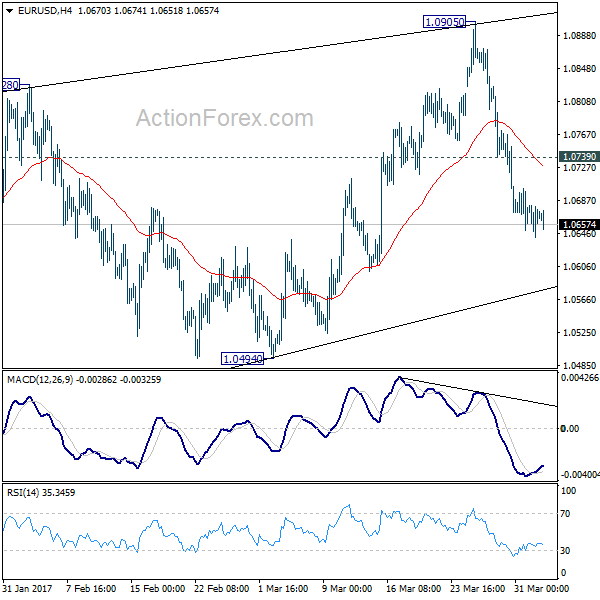
    EUR/USD recovers today but stays below 1.0774. Intraday bias stays neutral first. No change in the outlook that choppy rise from 1.0339 is seen as a corrective move. On the upside, above 1.0774 will extend the rise but upside should be limited by 1.0872 resistance. On the downside, break of 1.0588 will indicate that such rise is completed and turn bias to the downside for retesting 1.0339 low.

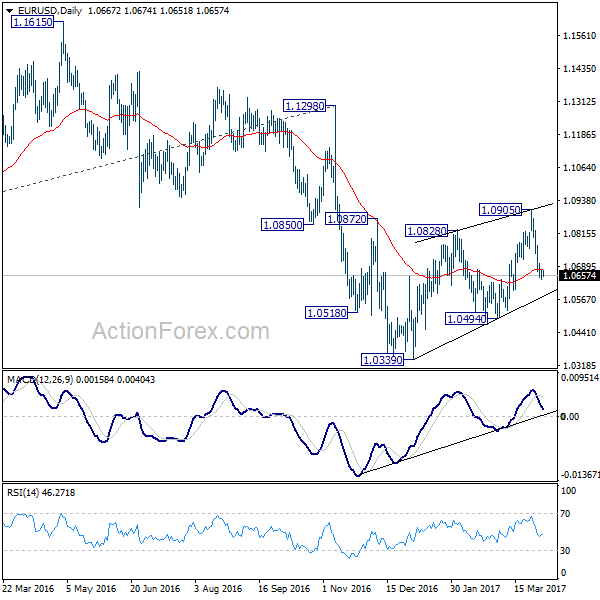
    In the bigger picture, whole down trend from 1.6039 (2008 high) is in progress. Such down trend is expected to extend to 61.8% projection of 1.3993 to 1.0461 from 1.1298 at 0.9115. On the upside, break of 1.1298 resistance is needed to confirm medium term bottoming. Otherwise, outlook will stay bearish in case of rebound.

    EUR/USD 4 Hours Chart

    EUR/USD Daily Chart

    Economic Indicators Update

    GMT Ccy Events Actual Consensus Previous Revised
    JPY BOJ Monetary Policy Statement
    23:30 JPY Jobless Rate Dec 3.10% 3.10% 3.10%
    23:30 JPY Household Spending Y/Y Dec -0.30% -0.90% -1.50%
    23:50 JPY Industrial Production M/M Dec P 0.50% 0.30% 1.50%
    00:01 GBP GfK Consumer Confidence Jan -5 -8 -7
    00:30 AUD NAB Business Confidence Dec 6 5 6
    05:00 JPY Housing Starts Y/Y Dec 3.90% 8.40% 6.70%
    06:30 EUR French GDP Q/Q Q4 A 0.40% 0.40% 0.20%
    07:00 EUR German Retail Sales M/M Dec -0.90% 0.60% -1.80% -1.70%
    08:55 EUR German Unemployment Change Jan -26K -5K -17K
    08:55 EUR German Unemployment Rate Jan 5.90% 6.00% 6.00%
    09:30 GBP Mortgage Approvals Dec 68K 69K 68K 67K
    09:30 GBP M4 Money Supply M/M Dec -0.50% 0.30% 0.40%
    10:00 EUR Eurozone Unemployment Rate Dec 9.60% 9.80% 9.80%
    10:00 EUR Eurozone GDP Q/Q Q4 A 0.50% 0.40% 0.30%
    10:00 EUR Eurozone CPI Estimate Y/Y Jan 1.80% 1.50% 1.10%
    10:00 EUR Eurozone CPI - Core Y/Y Jan A 0.90% 0.90% 0.90%
    13:30 CAD GDP M/M Nov 0.40% 0.30% -0.30% -0.20%
    13:30 CAD Industrial Product Price M/M Dec 0.40% 0.60% 0.30% 0.40%
    13:30 CAD Raw Materials Price Index M/M Dec 6.50% 2.80% -2.00% -1.60%
    13:30 USD Employment Cost Index Q4 0.50% 0.60% 0.60%
    14:00 USD S&P/Case-Shiller Composite-20 Y/Y Nov 5.30% 5.00% 5.10%
    14:45 USD Chicago PMI Jan 55 54.6
    15:00 USD Consumer Confidence Jan 112.9 113.7

    Subscribe to our daily and mid-day newsletter to get this report delivered to your mail box

    USD/JPY Mid-Day Outlook

    Daily Pivots: (S1) 114.50; (P) 114.94; (R1) 115.48; More...

    Intraday bias in USD/JPY remains neutral as range trading continues. No change in the view that choppy decline from 118.65 is seen as a correction. On the upside, break of 115.61 resistance will suggest that the correction is finished and turn bias to the upside for 118.65. Break will resume whole rise from 98.97 and target 125.85 key resistance. On the downside, below 112.51 will extend such decline but downside should be contained by 38.2% retracement of 98.97 to 118.65 at 111.13 and bring rebound.

    In the bigger picture, price actions from 125.85 high are seen as a corrective pattern. The impulsive structure of the rise from 98.97 suggests that the correction is completed and larger up trend is resuming. Decisive break of 125.85 will confirm and target 61.8% projection of 75.56 to 125.85 from 98.97 at 130.04 and then 135.20 long term resistance. Rejection from 125.85 and below will extend the consolidation with another falling leg before up trend resumption.

    Subscribe to our daily and mid-day newsletter to get this report delivered to your mail box

    EUR/USD Mid-Day Outlook

    Daily Pivots: (S1) 1.0630; (P) 1.0685 (R1) 1.0751; More.....

    EUR/USD recovers today but stays below 1.0774. Intraday bias stays neutral first. No change in the outlook that choppy rise from 1.0339 is seen as a corrective move. On the upside, above 1.0774 will extend the rise but upside should be limited by 1.0872 resistance. On the downside, break of 1.0588 will indicate that such rise is completed and turn bias to the downside for retesting 1.0339 low.

    In the bigger picture, whole down trend from 1.6039 (2008 high) is in progress. Such down trend is expected to extend to 61.8% projection of 1.3993 to 1.0461 from 1.1298 at 0.9115. On the upside, break of 1.1298 resistance is needed to confirm medium term bottoming. Otherwise, outlook will stay bearish in case of rebound.

    EUR/USD 4 Hours Chart

    EUR/USD Daily Chart

    Subscribe to our daily and mid-day newsletter to get this report delivered to your mail box