Sun, Feb 15, 2026 19:11 GMT
More

    Sample Category Title

    EUR/AUD Weekly Outlook

    ActionForex

    EUR/AUD recovered to 1.4274 last week but lost momentum since then. Price action from 1.4025 are seen as a corrective pattern and thus maintain near term bearishness. Initial bias stays neutral this week first. Break of 1.4025 will extend larger fall from 1.6587 to key support level at 1.3671. We'd expect downside to be contained there to bring reversal. Meanwhile, above 1.4251 minor resistance will turn focus back to 1.4721 resistance.

    In the bigger picture, price actions from 1.6587 medium term top are viewed as a consolidative pattern. 50% retracement of 1.1602 to 1.6587 at 1.4095 was already met. While further fall cannot be ruled out, we'd expect strong support above 1.3671 to contain downside and bring rebound. Up trend from 1.1602 should not be finished and will resume later. Break of 1.4721 resistance will be the first sign of resumption of up trend from 1.1602 and target retesting of 1.6587 high first.

    In the longer term picture, the rise from 1.1602 long term bottom isn't over yet. We'll keep monitoring the development but there is prospect of extending the rise to 61.8% retracement of 2.1127 to 1.1602 at 1.7488 and above. However, break of 1.3671 should confirm trend reversal and target 1.1602 long term bottom again.

    Subscribe to our daily and mid-day newsletter to get this report delivered to your mail box

    EUR/CHF Weekly Outlook

    EUR/CHF's sharp decline and break of 1.0677 support last week indicates resumption of recent decline. Initial bias stays on the downside this week for next key support level at 1.0620 first. Decisive break there will confirm resumption of whole fall from 1.1198. On the upside, break of 1.0749 resistance is needed to indicate near term reversal. Otherwise, outlook will remain bearish in case of recovery.

    In the bigger picture, the decline from 1.1198 is seen as a corrective move. Such correction is still in progress and retest of 38.2% retracement of 0.9771 to 1.1198 at 1.0653 would be seen. Sustained trading below 1.0653 will target 50% retracement at 1.0485. On the upside, break of 1.0897 resistance is needed to confirm completion of such fall. Otherwise, outlook will stay bearish.

    EUR/CHF 4 Hours Chart

    EUR/CHF Daily Chart

    EUR/CHF Weekly Chart

    EUR/CHF Monthly Chart

    Subscribe to our daily and mid-day newsletter to get this report delivered to your mail box

    Weekly Economic and Financial Commentary


    U.S. Review

    Trading Places

    • Real GDP growth slowed in Q4 to a 1.9 percent annualized rate. After providing a sizable boost to economic growth in Q3, net exports exerted a significant drag on growth in Q4. Business fixed investment continued its gradual recovery.
    • Full-year real GDP growth was 1.6 percent in 2016, matching the slowest annual pace since the recovery began. We expect real GDP to accelerate to a 2.3 percent pace in 2017, buoyed by a more a balanced composition of growth.
    • Existing and new home sales for December were weaker than expected, with a sharp dip for new home sales as higher mortgage rates weighed on sales activity.

    Real GDP Growth Slows to End 2016

    Real GDP growth in the United States slowed to end the year, registering a 1.9 percent annualized growth rate in Q4. International trade weighed heavily on economic growth in Q4, largely as a result of some payback due to the quirky surge in soybean exports that boosted growth in Q3. Real final sales to domestic purchasers, which exclude trade and the volatile inventory component, actually accelerated in Q4 to a 2.5 percent pace (top chart). This measure of underlying domestic demand had slowed over the past year and a half or so, but recent data suggest some firming, which we anticipate will continue in 2017.

    Within the sectors of the economy, personal consumption decelerated but remained solid at 2.5 percent, while business fixed investment increased at the fastest pace in more than a year (middle chart). A 3.1 percent annualized gain in real equipment spending halted the string of four straight quarterly declines in equipment capex. This spate of poor capex readings was unusual for a non-recessionary period, and the growth registered in Q4 is a welcome sign that business fixed investment has some modest momentum to start the new year. Residential investment also bounced back, increasing at a 10.2 percent annualized rate after two consecutive quarterly contractions. Government consumption and investment continued to plod along, rising at a 1.2 percent pace led by state and local governments.

    Full-year real GDP growth was 1.6 percent in 2016, matching 2011 for the slowest year of growth in the recovery. The sources of growth were rather uneven, with a solid domestic consumer but weak business spending. Real business fixed investment declined 0.4 percent in full-year 2016, the first outright contraction since 2009. The inventory drawdown that played out over 2016 also exerted the largest annual drag on economic growth from this sector since the recession. There are signs, however, that these sources of weakness have begun to see a reversal of fortunes. Oil prices have rebounded from their 2016 lows, and we expect a gradual appreciation from current levels, which should further reduce the energy drag on capital spending. Inventories have added to growth in two consecutive quarters for the first time in nearly two years and should play a more neutral role on growth in 2017. We expect real GDP to accelerate to a 2.3 percent pace in 2017 amid a more a balanced composition of economic growth.

    Other than this morning's GDP print, it was a light economic data week in the United States. Existing and new home sales for December were weaker than expected, with an especially sharp dip for new home sales. The new home sales report was the first chance to assess the effect of higher mortgage rates. Existing home sales measure closings and reflect mortgage rates from sales contracts signed a month or two earlier. Despite the 10.4 percent decline in new home sales in December, sales rose a solid 12.2 percent in full-year 2016 and continued their gradual improvement from the housing bust (bottom chart). We expect home sales to rise slowly in the first half of 2017, as consumers adjust to higher interest rates and look for continued improvement in sales over the course of the year.

    U.S. Outlook

    Personal Income & Spending • Monday

    The November personal income and spending release painted a disappointing picture for consumer activity over the month. Nominal personal income came in flat, as growth was largely held back by a 0.1 percent decline in wages and salaries. Despite easing in the savings rate, nominal spending was also weak, rising just 0.2 percent. We expect November's income stall was temporary and look for stronger readings for personal income and spending in December, rising 0.4 percent and 0.3 percent, respectively.

    The core PCE deflator, the Fed's preferred measure of inflation, came in flat in November, pulling the year-over-year rate down to 1.6 percent. We expect prices to recoup these losses in December, and edge up to a 1.8 percent year-over-year pace. Looking ahead, we expect further upward pressure on consumer prices in 2017, with the PCE deflator rising 2.0 percent year over year compared to an estimated 1.1 percent in 2016.

    Previous: 0.1% (Income) Wells Fargo: 0.4% Consensus: 0.4%

    ISM Manufacturing • Wednesday

    U.S. manufacturing activity ended 2016 on a strong note with the ISM manufacturing index rising to a two-year high of 54.7 in December. This barometer for the factory sector has improved significantly relative to a year ago when weakening global growth, collapsing commodity prices and a strengthening dollar led to outright contraction in the sector.

    Production and new orders surged in December, each rising above 60. The pickup in new orders signals that, in the near term, momentum in manufacturing looks set to continue. More manufacturers reported hiring additional employees in December, as the employment index rose to an 18-month high on the month. The positive trend in the ISM employment index coincided with a 17,000 gain in manufacturing payrolls—the first positive addition since July. We expect further stabilization in the factory sector, and look for the index to hold its recent gains in January.

    Previous: 54.7 Wells Fargo: 54.8 Consensus: 55.0

    Employment • Friday

    Payrolls increased by 156,000 jobs in December, pulling average monthly job growth for 2016 down to 180,000. The pace of hiring has slowed over the past two years, as tightening labor market conditions limit job gains. The unemployment rate edged up, capping the year at 4.7 percent, but remains consistent with full employment. Average hourly earnings jumped 0.4 percent higher in December, bringing the year-over-year rate to a cycle high of 2.9 percent. Taken together, the pickup in earnings and slowdown in job growth are consistent with reports of a tightening labor market and employers having difficulty finding qualified workers.

    Next week's release will likely draw heightened attention, given that it will be the first employment report of the new year and the first report of the Trump administration. Our forecast calls for a gradual easing of trend job growth in 2017; however, we still expect growth to be strong enough to pull the jobless rate lower over the year.

    Previous: 156,000 Wells Fargo: 155,000 Consensus: 175,000

    Global Review

    Stronger-than-Expected U.K. GDP Growth in Q4

    • Recent data continue to show that the U.K. economy remains resilient seven months after the Brexit referendum last June. That said, lingering uncertainties regarding the economic outlook probably mean that a rate hike by the Bank of England (BoE) is not on the docket in the near term.

    Uncertainty Clouds Mexican Economic Outlook

    • Economic activity in Mexico accelerated in November. However, much of the apparent acceleration was attributable to the inherently volatile agricultural sector. Recent monetary tightening by the Bank of Mexico and uncertainties related to the status of NAFTA cloud the Mexican economic outlook.

    Stronger-than-Expected U.K. GDP Growth in Q4

    Data released this week showed that real GDP in the United Kingdom grew 0.6 percent (2.4 percent at an annualized rate) on a sequential basis in Q4-2016 (see chart on front page). The outturn was stronger than most analysts had expected, Moreover, the British economy has shown few ill effects from the surprising Brexit referendum last June, at least not through Q4. The resilience in the economy in recent quarters is leading to a change in the inflation dynamics in the United Kingdom. The overall CPI inflation rate rose to its highest rate in more than two years in December, and the core rate of inflation has been creeping higher in recent months (top chart). Everything else equal, the Bank of England may be induced to tighten policy in the near term.

    As we describe in more detail in a recent report, however, everything else is not necessarily equal. (See U.K. Q4 GDP Growth: BoE Policy Implications?, which is posted on our website.) Growth in real retail spending lost some momentum in Q4, and the upcoming negotiations with the EU over the terms of the U.K.-EU divorce could still weigh on investment spending (see Topic of the Week on page 7). Although a rate hike by the BoE does not look likely in the near term, we acknowledge that monetary tightening could happen this year if the economy remains resilient.

    Uncertainty Clouds Mexican Economic Outlook

    Like the United Kingdom, Mexico is an economy that has its economic outlook clouded by recent political developments. Namely, the potential for re-negotiation of the NAFTA agreement that the Trump administration is seeking adds downside risk to the Mexican economic outlook. That said, data released this week showed that Mexican economic activity accelerated in November. Specifically, the economic activity index, which is a good proxy for GDP growth, rose 3.7 percent on a year-ago basis in November, up significantly from the 1.3 percent rate registered in October (middle chart).

    However, there is less than meets the eye to the economic activity data in November. For starters, most of the acceleration came from the inherently volatile agricultural sector. The more important industrial sector showed no acceleration between October and November. In addition, the data are from November, so the surprise from the U.S. presidential election probably has yet to be fully captured in the economic data.

    In that regard, the Mexican peso depreciated more than 15 percent against the U.S. dollar between Election Day and Inauguration Day. The CPI inflation rate in Mexico rose to 3.4 percent in December from 2.5 percent in June, and the depreciation of the peso puts further upward pressure on inflation. Due to rising inflation expectations, the Bank of Mexico has hiked its main policy rate 275 bps since December 2015 (bottom chart). Rising interest rates could choke off investment spending, thereby leading to slower GDP growth. Indeed, we believe that the combination of rising interest rates and uncertainty related to NAFTA will lead to a mild recession in the Mexican economy this year.

    Global Outlook

    Chinese PMIs • Tuesday

    The official Chinese manufacturing PMI, which is slated to be released on Tuesday, has expanded for the fifth consecutive month printing at 51.4 in December, down from 51.7 the month prior. A reading above the 50-threshold signifies that the sector is expanding, while a below-50 reading indicates a contraction. The weaker reading was due to sluggish factory output and a decline in new export orders and jobs. Markets are expecting the index to have declined a touch in January to 51.2 as the Chinese government has started to rein in rapid growth in residential investment.

    Additional data on the docket to be released next week include the Caixin manufacturing PMI, which is considered as a private gauge of manufacturing activity. The index climbed to 51.9 in December from 50.9 in November—beating market expectations and remaining in expansion territory. That said, the consensus expects the index to have declined in January as well.

    Previous: 51.4 Consensus: 51.2

    Mexico GDP • Tuesday

    The Mexican economy grew at a 4.0 percent annualized rate in Q3 2016—its fastest pace in more than two years. Much of the growth came from strong performance in the manufacturing sector, which has become a notable bright spot in the economy. The mining and construction sectors, however, weighed on growth. On a year-ago basis, the economy was up a more modest 2 percent, still beating market expectations of 1.9 percent.

    Earlier this week, Mexico's Economic Activity Index, which is highly correlated with overall GDP growth, showed that the economy had grown by 3.7 percent in November, on a year-ago, non-seasonally adjusted basis, driven by a surge in the primary sector, which is quite volatile. As such, we look for the Mexican economy to have expanded by a slower 1.8 percent year-over-year pace in Q4, as slowing fundamentals and rising interest rates and inflation point to weaker growth.

    Previous: 2.0% Wells Fargo: 1.8%

    Brazil Industrial Production • Wednesday

    On Wednesday, Brazil will release its industrial production index (IP) for December as markets look for some sort of a recovery. The Brazilian industrial sector rose 0.2 percent in November compared to the month prior, but is still 1.1 percent lower than its year-ago reading. The industrial sector was helped by an increase in its mining/extractive activities component, which is up 4.5 percent year over year. The all-important automobile production sector also saw a notable increase in growth, up 13.4 percent year to year. It is clear that the Brazilian industrial sector has hit bottom and is poised to recover during the next several quarters. However, the main concern, now, will be the speed and strength of the recovery.

    Additional data slated to be released next week include the Brazilian manufacturing PMI, which closely follows activity in the factory sector. In December, the index slipped further below the 50-demarcation line to 45.2, signaling contraction in this sector.

    Previous: -1.1% Consensus: 0.6% (Year-over-Year)

    Point of View

    Interest Rate Watch

    Anticipating the Promised Change

    Past good results are no guarantee of future success—nor are disappointing results. The Trump administration has promised to improve growth and this represents an intellectual challenge to market estimates of the future.

    More Growth: Three Is the New Two

    The past five years of economic growth, illustrated in the top graph, did not seem to be enough to please the American voter. The promise is now growth of 3 percent or more, achieved via tax cuts, infrastructure spending and less regulation. For decision makers, the challenge is to overcome the anchoring bias of two percent that may have set in and to focus on the transition to faster growth.

    At This Stage of the Business Cycle?

    Many decision makers are concerned that stimulus on the demand side, at this stage of the business cycle, will lead to higher inflation—another change to the recent past. Yes, it is our expectation that inflation, illustrated in the middle graph, will increase in 2017 at a pace of 2.0 percent compared to 1.1 percent in 2016. This upward shift that reaches the FOMC's target of two percent will generate a shift in psychology in the financial markets. Since 1992, inflation, as measured by the PCE deflator, has averaged just below 2 percent. Now that inflation has hit the FOMC's target, there is the expectation that the FOMC will be more aggressive in raising the funds rate going forward.

    Another Shift in the Wind

    In a reversal of recent trends, the FOMC decided to raise rather than lower the projected path of the funds rate (bottom graph). This shift reinforces the view that anchoring monetary policy expectations to the cautious pattern undertaken in prior years is not the right approach. We anticipate two increases in the funds rate by the FOMC at least, with the possibility of a third increase depending on the inflation pattern cited above. As a result, we anticipate a rise in the two-year Treasury rate to reflect the fed funds trend but a flatter yield curve out to 10 years, as global capital continues to flow to the U.S.

    Credit Market Insights

    Beige Book

    Credit conditions across the country remained stable or strengthened, according to the Fed's January Beige Book report. The Federal Reserve bank of San Francisco reported that while liquidity remains ample at the moment, that burdensome regulatory costs could constrain profitability moving forward. The reserve bank of New York highlighted the fact that credit conditions in retail and wholesale remain in good shape. It also noted that bankers in their region reported unchanging credit standards across all loan categories and lower delinquency rates for commercial mortgages and C&I loans.

    The reserve banks of Cleveland, Chicago, Kansas City, Dallas and Richmond also reported strong credit quality conditions with little change in loan-application standards. The Federal Reserve Bank of Philadelphia reported a significant increase in credit card volumes for the recent holiday period, much larger than in 2016 and 2015.

    Credit conditions within the St. Louis district improved at a moderate pace and overall lending experienced healthy growth across all lending categories. Increases in real estate lending made the largest contributions to total loan growth. Some banks reported increases in nonperforming loans in their agricultural loan portfolios, which they attribute to low commodity prices throughout last year. Firms across the country were said to be optimistic about growth in 2017.

    Topic of the Week

    Parliament Must Approve Brexit

    There has been a question running through British politics ever since the Brexit referendum last June. Namely, could Prime Minister May unilaterally invoke Article 50 of the Lisbon Treaty, thereby setting in process negotiations between the United Kingdom and the European Union over terms of their divorce, or would Parliament need to give its assent? The U.K. Supreme Court weighed in this week, and by a margin of 8-3 said that Parliament would need to give its approval to trigger Article 50.

    The decision means that Article 50 may not be triggered by the end of May as Prime Minister May had previously stated would occur. The elaborate procedure of debate and parliamentary tactics in both the House of Commons and the House of Lords inevitably will produce delay. In our view, however, Parliament will eventually trigger Article 50, which will mark the formal beginning of the Brexit process. Two-thirds of the voting precincts in the country voted in favor of Brexit on June23. Members of Parliament who represent these precincts would be committing political suicide if they voted against approval.

    There are deep financial and economic ties between the UK and the other 27 members of the EU. The EU accounts for one-half of the U.K.'s trade (top chart), London is the financial capital of Europe, and the list goes on and on. Negotiating the new terms under which these economic and financial interactions will occur in the future will be a long and laborious process that is bound to create some uncertainty.

    As noted on page 4, the Brexit referendum has had little visible effects on the British economy, at least so far. That said, stated investment intentions by businesses, which has a fair degree of correlation with actual investment spending, remains weak (bottom chart). The British economy could slow more sharply once the Brexit negotiations get underway. Stay tuned.

    The Weekly Bottom Line

    HIGHLIGHTS OF THE WEEK

    United States

    • Domestic data took a backseat to this week's developments out of the oval office, where several executive orders were signed by President Donald Trump. Markets cheered on the approval of the Keystone XL and Dakota Access pipelines, but were less thrilled about the administration's withdrawal from the TPP and signal to open negotiations on NAFTA.
    • Data out of the U.S. was somewhat less inspiring, with several misses in December following very strong prints in the prior month. The most noteworthy release, U.S. fourth quarter GDP, fell shy of expectations, but nonetheless painted a picture of a solid domestic demand, with consumer spending growing by 2.5%.
    • Next week will be much more exciting, with the FOMC convening for their first meeting of the year. Additionally, a slew of first-tier economic data will be released, including the highly anticipated employment report due out next Friday.

    Canada

    • Of the many executive orders signed by U.S. President Donald Trump this week, one could prove meaningful for Canada - reopening the request to build the Keystone Pipeline.
    • If approved, the pipeline could be a positive for Canadian economic growth, whereas the re-opening of NAFTA provides a bit more uncertainty and downside risk.
    • Communication suggests that renegotioating NAFTA is on the docket. However, with NAFTA still in place, the near-term outlook for the Canadian economy remains upbeat, particularly as strong underlying momentum in the U.S. consumer will help boost Canadian exports. As such, despite the rhetoric around NAFTA, markets and businesses remained relatively upbeat in Canada.

    UNITED STATES - ALL EYES ON POTUS

    Economic data did little to set the tone for markets this week. Instead, market participants globally paid close attention the new President's executive orders and Twitter messages in an attempt to discern President Donald Trump's agenda. To kick things off, the administration directed its attention towards the "America first" trade agenda, with President Trump signing an executive order to withdraw the U.S. from the previously signed Trans Pacific Partnership. Adding fuel to the fire, the President also put NAFTA partners on alert, signaling that steps would be taken to open negotiations up in the coming days.

    Nonetheless, the deterioration in risk sentiment that followed proved short-lived. President Trump quickly switched gears towards his mandate on deregulation, signing an executive order approving the Keystone XL and Dakota Access pipelines while putting forth a list of potential infrastructure projects. Markets applauded this development, and a rally in U.S. equities ensued, helped in part by strong earnings, which pushed the Dow Jones Industrial Average above the coveted 20,000 mark by mid-week.

    While developments out of the oval office were still unclear as far as their precise impacts on the economy, domestic economic data was somewhat less inspiring, albeit still strong. For one, U.S. existing home sales fell by 2.8% to 5.49 million annualized in December, a pace slightly below the estimated 5.52 million level. The pullback, was largely anticipated as buyers rushed to lock in rates before they climbed any further, and in doing so, brought demand forward at the expense of future sales (Chart 1). Furthermore, initial jobless claims also disappointed, rising by 9k more than what was expected to 259k in the week ended Jan. 21, and new home sales tumbled 10.4% in December.

    Global data out this week was more positive. Growth for the fourth quarter in the UK came in a hair above consensus at 0.6% q/q and PMIs across Europe broadly beat expectations. Perhaps the most noteworthy data release this week was the scorecard for the American economy at the end of 2016. The first reading on fourth quarter GDP came in at 1.9%. While falling short of the median consensus estimate of 2.2%, much of the weakness stemmed from a largerthan- expected rebound in imports (Chart 2). The details on domestic demand were much stronger, with consumer spending growing by 2.5% as spending on durable goods posted a third consecutive stellar quarter (10.9%).

    While there were some minor speedbumps in this week's data, the good news is that the domestic economy still appears to be on a good footing. Nonetheless, uncertainty will certainly cloud the outlook as policy changes continue to make their way out of Washington D.C. This theme will likely be highlighted next week in the statement following the Federal Reserve's first FOMC meeting of the year. This provides further reason to maintain a gradual hiking cycle, something Janet Yellen recently reiterated. Despite the Fed moving ever closer to its dual-objectives of full-employment and medium-price inflation of 2%, the Fed Chair believes that moving earlier but at a more measured pace is the preferred path, while waiting too long risks more rapid rate rises in the future - something that could potentially tip the economy into recession.

    CANADA - ONE STEP FORWARD FOR OIL, ONE STEP BACK FOR TRADE

    President Donald Trump has been in office just five short days and he's already signed many executive orders, one of which could prove meaningful for Canada - reopening the request to build the Keystone Pipeline. And, communication so far suggests that the renegotion of NAFTA is on the docket.

    The pipeline issue is less of a black box. The project still needs to go through a review process and perhaps meet new hurdles, but appears more likely to be approved. If so, it will give Canadian oil companies better access to the U.S. market . Still, even if it is not approved, the Canadian economy is likely no worse off than it was before and attention will turn back to other pipeline projects.

    The re-opening of NAFTA provides a bit more uncertainty and downside risk. So far, the focus of the Trump administration has been on Mexico and the size of America's trade deficit with the country. Fortunately, Canada, has, for the most part, been left out of the discussion. As we point out in a report this week, the United States does not have a trade deficit with Canada. While Canada has a slight surplus in goods exports, it has a deficit in services, which pushes the overall balance in the U.S.'s favour. Still, we have to pay attention. Exports to the United States represent one fifth of the entire Canadian economy and any thickening of the border would represent a meaningful downside risk to the outlook.

    For all the rhetoric around NAFTA, markets and businesses remained relatively upbeat in Canada. The Canadian dollar ended the week around 76 U.S. cents, following a small dip late last week. The S&P/TSX has risen to historically high levels, and didn't skip a beat with Trump's executive order re-opening NAFTA this week. The CFIB small business barometer showed that small business sentiment remained relatively stable in January. The index remained at 60, which is higher than the lows hit in 2015 following the collapse of oil, but still significantly lower than the highs reached in 2014 (Chart 1). Digging deeper into the details of the report suggests that businesses tied to domestic demand (construction and retail) remained more somber about the outlook, whereas optimism among industries tied to trade (wholesale, manufacturing and transport and warehousing) saw significant improvements in confidence in January.

    With NAFTA still in place, the outlook for the Canadian economy looks fairly bright in the near-term. Exports picked up significant momentum towards the end of last year, and next week's monthly real GDP report is expected to show a healthy gain in economic activity tied to international trade. Overall, it is estimated that the Canadian economy grew by over 2% annualized in the fourth quarter of the year, building on a strong 3.5% gain in the prior quarter. More importantly, the U.S. economic data out on Friday showed continued momentum in consumer spending and a rebound in investment, areas of the economy that are generally positive for demand for Canadian made goods. For now, trade will remain a positive story in Canada for 2017. We will revisit the trade story once more details on NAFTA renegotiations become available.

    Dollar Stumbles After Soft GDP and Trump Negotiation Skills

    Central banks to remain on hold with politics at the forefront

    The dollar is weaker after the Trump administration remained more focused on anti-trade policies than the fiscal stimulus and infrastructure spending that lifted inflation expectations in the U.S. The first 100 days of Trump' administration will be crucial. While he seemed bulletproof during the campaign his administration has stumbled over itself on an overall strong start, but lacking some strategy or political savvy. He has yet to bring markets onside with any tangible policy on fiscal stimulus or infrastructure spending. There is an expectation of higher inflation, which in turn has made the Fed up their rate hike forecasts to 3/4 this year. The Fed had the luxury of patience on monetary policy tightening in the past due to the stagnant inflation, but a government willing to spend to boost growth could force a faster pace of interest rate rises.

    The economic calendar for January 30 to February 2 is packed to the brim with important releases. Four central bank rate decisions: Bank of Japan (BOJ), U.S. Federal Reserve, Bank of England (BoE) and Reserve Bank of Australia (RBA). Manufacturing data from the United Kingdom, United States and China. Employment data out of the U.S. with the publication of the ADP private payrolls and the biggest indicator in the currency markets the U.S. non farm payrolls (NFP) to finish the week. Traders will have to keep a close eye on their calendars this week as a deluge of data will be hitting the wires.

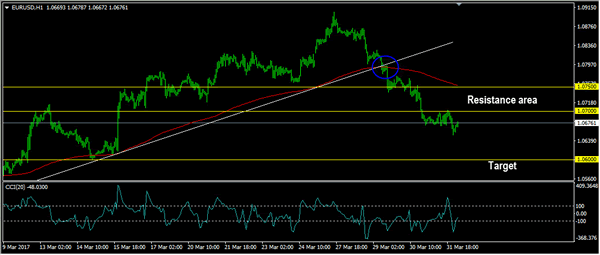
    The EUR/USD gained 0.012 percent in the last five days. The single currency is trading at 1.0694 in a week full of volatility but that ultimately ended flat for the most traded pair. The release of the disappointing first estimate of the U.S. gross domestic figures (GDP) at 1.9 percent growth in the fourth quarter of 2016. Last week President Trump pledged to hit 4 percent figures through fiscal stimulus and infrastructure spending. The softer economic indicators and Trump' lack of details on the two factors that sparked the rally in global markets put downward pressure on the dollar.

    The Fed has received the backing of U.S. Treasury Secretary nominee Steven Mnuchin regarding the independence of the central bank. The Federal Open Market Committee (FOMC) on Wednesday is not anticipated to bring any surprises after the December rate hike the central bank is expected to wait-and-see to gauge the impact of the first 100 days of the Trump administration and adjust the interest rate if needed. A rate hike is not forecasted in the first quarter of the year and the Fed is willing to let the economy run a little hot before stepping in. The lack of details from Trump policies on policies who could bump inflation higher have kept the probabilities of no changes in the interest rate at 96 percent in February according to the CME' FedWatch tool that tracks Fed Fund futures prices.

    US Growth was slowed down by imports, which brings trade to the forefront, but the rise in imports was fuelled by a strong dollar not a lack of tariffs. Currencies that have depreciated against the dollar enjoy a competitive advantage. Trump administration is creating a paradox by focusing on growth which will boost the USD versus wanting more exports that are hurt with a strong USD. There are few good outcomes of the trade spat with Mexico with the focus on the proposed wall between the two nations and who will pay for it. A questionable matter of national security has hijacked the conversation away from the promised policies on growth initiatives.

    American jobs are forecasted to have another 150,000 plus reading on Friday, February 3 with the release of the U.S. non farm payrolls (NFP) by the Bureau of Labor Statistics. The emphasis on market watchers will be on wages more than the headline jobs number. The positive wage growth in the December data was the highlight even if the headline number missed expectations. Worker' take home pay is expected to grow 0.3 percent in the last month.

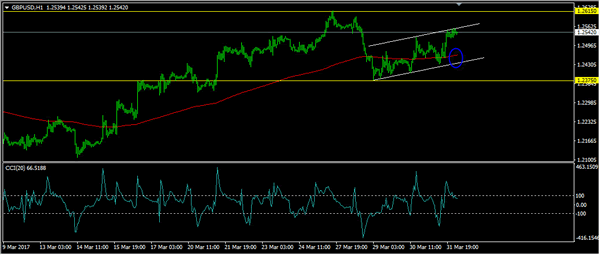
    The GBP/USD rose 1.828 percent in the last week. The pair is trading at 1.2548 after the U.K. supreme ruled against the government and forced it to go through parliament regarding the exit of the United Kingdom in the European Union. The idea of a softer Brexit boosted the pound as markets had punished the currency as PM Theresa May kept pushing for a clean break with no back up deal in place. The ruling will push back May' timeline for a Brexit and could indeed soften the end result. The British PM visit to Washington to meet President Trump will be a first approach with the goal of reaching a fast trade deal with the U.S. but in the current anti-trade climate in America that is easier said than done.

    The Bank of England (BoE) is expected to hold rates unchanged on the first Super Thursday of the year. Super because of the release of the inflation report, interest rate decision, minutes from the monetary policy committee and a speech by BoE governor Mark Carney. The threat of Brexit has loomed over the central bank, but with an unclear timeline all that is left for policymakers is to wait.

    Market events to watch this week:

    Monday, January 30

    • Midnight JPY Monetary Policy Statement
    • Midnight JPY BOJ Outlook Report
    • Midnight JPY BOJ Policy Rate

    Tuesday, January 31

    • 1:30am JPY BOJ Press Conference
    • 8:30am CAD GDP m/m
    • 10:00am USD CB Consumer Confidence
    • 4:45pm NZD Employment Change q/q
    • 4:45pm NZD Unemployment Rate
    • 5:35pm CAD BOC Gov Poloz Speaks
    • 8:00pm CNY Manufacturing PMI

    Wednesday, February 1

    • 4:30am GBP Manufacturing PMI
    • 8:15am USD ADP Non-Farm Employment Change
    • 10:00am USD ISM Manufacturing PMI
    • 10:30am USD Crude Oil Inventories
    • 2:00pm USD FOMC Statement
    • 2:00pm USD Federal Funds Rate

    Thursday, February 2

    • 4:30am GBP Construction PMI
    • 7:00am GBP BOE Inflation Report
    • 7:00am GBP MPC Official Bank Rate Votes
    • 7:00am GBP Monetary Policy Summary
    • 7:00am GBP Official Bank Rate
    • 7:30am GBP BOE Gov Carney Speaks
    • 8:30am USD Unemployment Claims
    • 7:30pm AUD RBA Monetary Policy Statement
    • 8:45pm CNY Caixin Manufacturing PMI

    Friday, February 3

    • 4:30am GBP Services PMI
    • 8:30am USD Average Hourly Earnings m/m
    • 8:30am USD Non-Farm Employment Change
    • 8:30am USD Unemployment Rate
    • 10:00am USD ISM Non-Manufacturing PMI

    *All times EST

    Weekly Focus: Central Bank Meetings and January US Jobs Report Set to Attract Attention

    Market movers ahead

    • Next week in the US, focus will be mainly on the FOMC meeting with the accompanying policy announcement on Wednesday and the January jobs report released on Friday.
    • In the euro area, the week ahead is packed with economic releases, e.g. HICP inflation figures for January, which are due out on Tuesday.
    • In the UK, the main event next week is the Bank of England (BoE) meeting on Thursday. This is one of the big meetings with an updated Inflation Report and a press conference, so watch out for an overload of information.
    • The Bank of Japan (BoJ) two-day monetary policy meeting ends on Tuesday. In connection with its monetary policy announcement, the BoJ is also due to publish its Outlook Report containing the bank's updated growth and inflation forecasts.

    Global macro and market themes

    • Markets are struggling to grasp the policy uncertainties given the binary possible outcomes.
    • However, the global economy is heading higher and the reflation theme remains intact.
    • US yields should rise on Fed risks and Donald Trump's first 100 days in office.
    • Over the coming three months, the USD should strengthen particularly versus the JPY and GBP.
    • We are bullish on Scandi currencies, particularly on NOK.
    • We remain positive on equities but note the risk of a correction in European equities.

    Full Report in PDF

    Headline Disappointment Masks Solid Details for Q4 GDP

    U.S. real GDP grew by 1.9% (annualized) in the fourth quarter according to the advance estimate, falling short of the median consensus estimate of 2.2%.

    U.S. consumers, however, did not disappoint. Spending grew 2.5% (matching the median forecast for 2.5%), as spending on durable goods poster a third consecutive stellar quarter (10.9%). Spending on services was relatively weak, advancing only 1.3%, which was in part due to unseasonably warm weather depressing utility consumption.

    Non-residential business investment accelerated in the fourth quarter. Total business spending grew 2.4%, as spending on equipment investment (3.1%) and intellectual property (+6.4%) outweighed a drop in structures (-5.0%).

    Residential investment was also up a hearty 10.2%, after declining in the previous two quarters.

    As expected, net-exports exerted a considerable drag on growth in the fourth quarter. Exports fell 4.3%, after jumping 10% in the third quarter, on a one time surge in soybean exports. More surprising was the 8.3% surge in imports. In total, net exports subtracted 1.7%-points from growth, after adding 0.9%-points in the third quarter.

    Inventory investment was another big contributor to the headline, adding 1.0%-point.

    Key Implications

    While the fourth quarter growth headline came in short of expectations, much of the weakness stemmed from a larger-than-expected rebound in imports. The details on domestic demand were much stronger. Final domestic demand was up 2.5%, a step up from 2.1% in the previous quarter. Domestic demand is a better predictor of future growth than headline GDP, and the strength augurs well for the next year. Moreover, this estimate of GDP growth relies on incomplete information. There has been a consistent pattern of upward revisions to growth estimates over the past year, so this is not the final word on fourth quarter growth.

    With all of 2016 now on the books, the economy grew by a modest 1.6% on an annual average basis, a step down from its 2.6% pace in 2015. However, this reflects a disappointing first half of the year. Looking at growth on a year-end to year-end basis, the U.S. economy grew by 1.9%, just slightly above the 2015 clip. We expect growth to accelerate above the 2.0% mark over the next year, supported by ongoing consumer spending growth and a firm rebound in business investment.

    Today's report continues to show a U.S. economy that is still taking up economic slack, and warrants a gradual pace of rate hikes by the Fed. The Fed's preferred inflation measure was up a tame 1.3% in the fourth quarter, underscoring why the Fed can afford to be patient on rate hikes. In our recent Dollars & Sense publication, we outline that we expect the Fed to raise rates twice over the next year, raising its key policy rate every six months or so.

    U.S. GDP Up 1.9% in Q4

    • The advance estimate of U.S. Q4 GDP growth was 1.9%, down from 3.5% in Q3 but still marking a slightly 'above-trend' pace of growth.
    • Net trade was the main source of drag in the quarter, although in part reflecting a reversal of a transitory food-led export gain in Q3. Excluding net trade and inventories, final sales to domestic purchasers rose 2.5%, marking the strongest increase since Q3/15.

    Net trade subtracted an outsized 1.7 percentage points from Q4 GDP growth, although in part reflecting a reversal of a transitory jump in Q3 food exports. Overall exports declined by 4.3% in Q4 after jumping 10.0% in Q3. Imports jumped 8.2% in Q4 (the largest increase in 2 years). The import gain was consistent with stronger domestic demand with final sales to domestic buyers rising 2.5%, led by another strong gain in consumer spending (+2.5% in Q4 following a 3.0% increase in Q3), a modestly stronger increase in business investment (+2.4% in Q4 vs 1.4% in Q3) and a 10.2% jump in residential investment following two quarterly declines.

    Our Take:

    Although slower in Q4 than the increase in Q3, average growth in the second half of the year was nonetheless significantly improved from the disappointing 1.1% average increase in the first half. The composition of growth in Q4 was also, arguably, somewhat better than the Q3 gain. Net trade was somewhat disappointing with the drag in Q4 from that component more-than-retracing a jump in Q3 (much of which reflected a transitory jump in food exports that unwound in Q4); however, the typically more stable final sales to domestic buyers measure rose by its strongest pace in more than a year, in part reflecting a jump in residential investment but also a third consecutive rise in business investment. Early data on capital goods shipments released separately this morning point to the potential for further improvement in Q1 in that latter component. Although much uncertainty about the future of U.S. fiscal policy remains, we continue to expect that underlying economic activity continues to improve at a pace that should be sufficient to allow the Fed to continue hiking interest rates at a modest pace. Our forecast assumes 2 additional 25 basis point hikes to the fed funds target range this year.

    EUR/USD Mid-Day Outlook

    Daily Pivots: (S1) 1.0636; (P) 1.0701 (R1) 1.0744; More.....

    Intraday bias in EUR/USD stays neutral for the moment. As noted before, choppy rise from 1.0339 is seen as a corrective move. Break of 1.0588 minor support will argue that it's completed and turn bias back to the downside for 1.0339 support. In case of another rise, upside should be limited by 1.0872 resistance.

    In the bigger picture, whole down trend from 1.6039 (2008 high) is in progress. Such down trend is expected to extend to 61.8% projection of 1.3993 to 1.0461 from 1.1298 at 0.9115. On the upside, break of 1.1298 resistance is needed to confirm medium term bottoming. Otherwise, outlook will stay bearish in case of rebound.

    EUR/USD 4 Hours Chart

    EUR/USD Daily Chart

    Subscribe to our daily and mid-day newsletter to get this report delivered to your mail box

    GBP/USD Mid-Day Outlook

    Daily Pivots: (S1) 1.2540; (P) 1.2607; (R1) 1.2657; More...

    Intraday bias in GBP/USD remains neutral at this point. Rise from 1.1986 is seen as the third leg of the consolidation pattern from 1.1946. Break of 1.2414 support will indicate that it's completed and turn bias to the downside for retesting 1.1946 low. In case of another rise, upside should be limited by 1.2774 to limit upside and bring down trend resumption eventually.

    In the bigger picture, fall from 1.7190 is seen as part of the down trend from 2.1161. There is no sign of medium term bottoming yet. Sustained trading below 61.8% projection of 2.1161 to 1.3503 from 1.7190 at 1.2457 will target 100% projection at 0.9532. Overall, break of 1.3444 resistance is needed to confirm medium term bottoming. Otherwise, outlook will remain bearish.

    GBP/USD 4 Hours Chart

    GBP/USD Daily Chart

    Subscribe to our daily and mid-day newsletter to get this report delivered to your mail box