Sun, Apr 26, 2026 03:14 GMT
More

    Sample Category Title

    EUR/AUD Daily Outlook

    ActionForex

    Daily Pivots: (S1) 1.6185; (P) 1.6232; (R1) 1.6264; More...

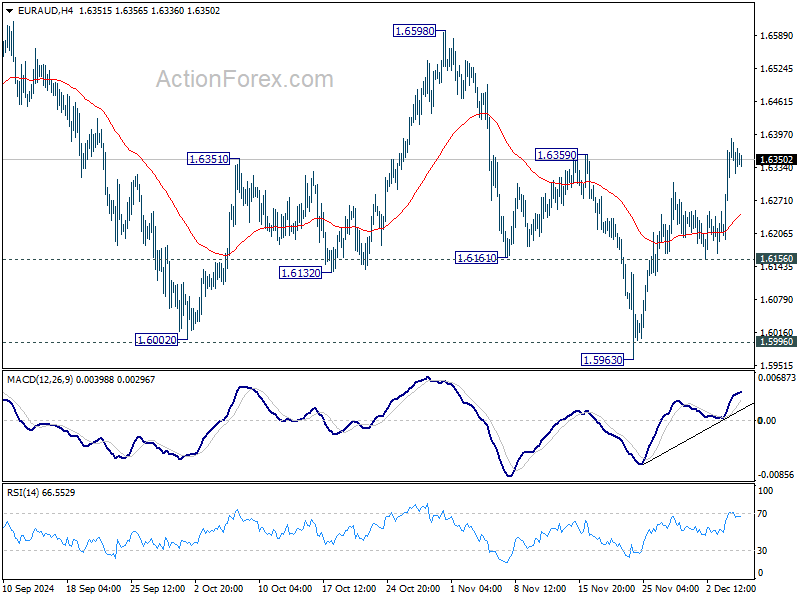
    Intraday bias in EUR/AUD remains mildly on the downside for the moment. Rebound from 1.6002 could have completed at 1.6351. Deeper fall would be seen back to retest 1.6002 low. On the upside, though, above 1.6351 will resume the rebound from 1.6002 to 38.2% of 1.7180 to 1.6002 at 1.6452.

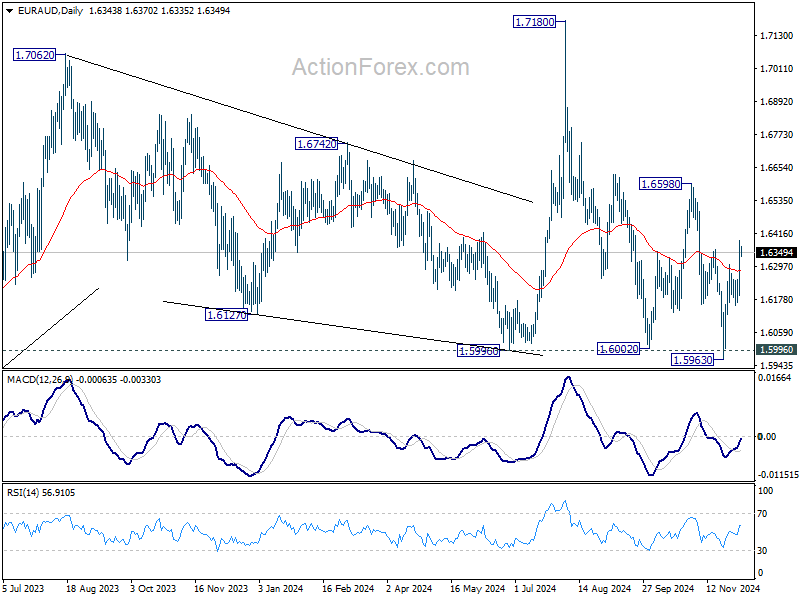
    In the bigger picture, as long as 1.5996 support holds, up trend from 1.4281 (2022 low) is still expected to resume at a later stage. However, decisive break of 1.5996 will argue that the medium term trend has reversed and turn outlook bearish.

    EUR/CHF Daily Outlook

    Daily Pivots: (S1) 0.9377; (P) 0.9403; (R1) 0.9434; More....

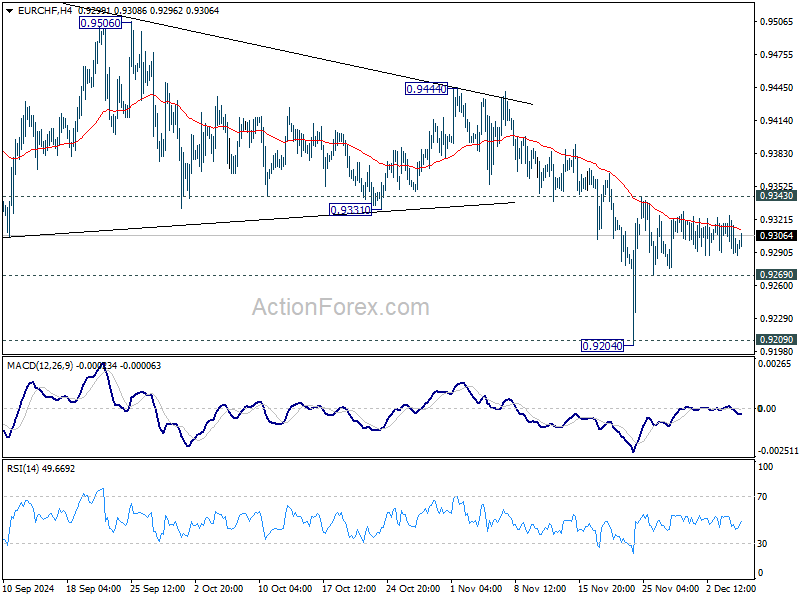
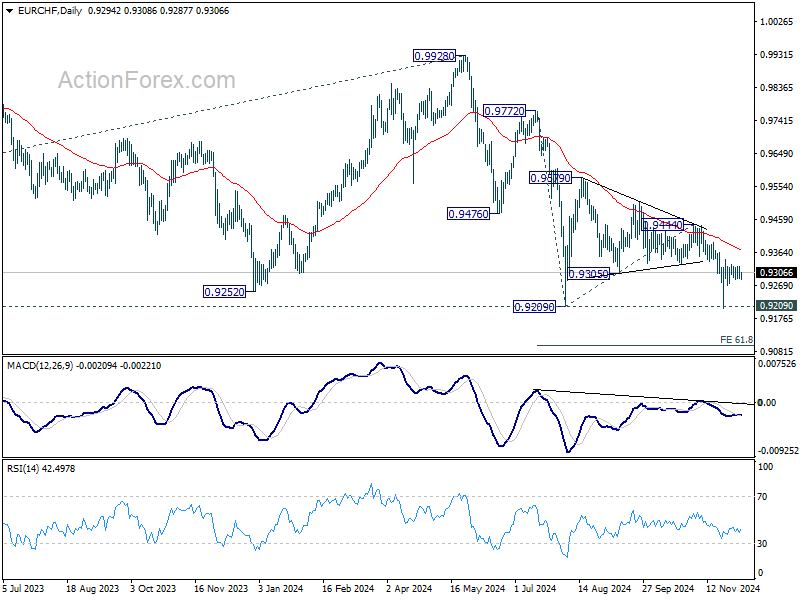
    EUR/CHF is still bounded in converging range and intraday bias stays neutral for the moment. ON the upside, break of 0.9506 resistance should resume whole rebound from 0.9209 through 0.9579 resistance. On the downside, break of 0.9332 will resume the fall from 0.9579 towards 0.9209 low.

    In the bigger picture, medium term corrective pattern from 0.9407 (2022 low) might have completed with three waves to 0.9928. Decisive break of 0.9252 (2023 low) will confirm long term down trend resumption. Next target will be 61.8% projection of 1.1149 to 0.9407 from 0.9928 at 0.8851. For now, outlook will stay bearish as long as 0.9928 resistance holds, even in case of strong rebound.

    Dollar is Better Bid

    Markets

    Fed governor Waller was the sole highlight of yesterday’s uninspiring, holiday-thinned (Columbus Day in the US) start of the trading week. The man touted as current chair Powell’s successor said the “totality of the data” favours “more caution on the pace of rate cuts than was needed at the September meeting”. He called the latest above-consensus inflation reading disappointing. Those came after a blow-out September payrolls report. Waller did note the October edition could show a payroll reduction of more than 100k due to recent hurricanes and the Boeing strike. But all in all He “continue[s] to judge that the U.S. economy is on a solid footing, with employment near the FOMC's maximum employment objective and inflation in the vicinity of our target” and that “if the economy continues in its current sweet spot, this [removing the considerable extent of policy restrictiveness] will happen gradually.” US stock markets were unlike bond markets open for business and rose to new record highs (DJI, S&P500). European equities struggled at first before closing higher as well. The German yield curve bear flattened with changes varying between +0.2 bps and 2.2 bps. French and Belgian bonds underperformed a bit following the rating outlook downgrades over fiscal sustainability concerns. The US dollar held the upper hand in currency markets. EUR/USD tested the 50% retracement on the April-September 2024 rise around 1.09. The trade-weighted dollar attacked parallel resistance at 103.34.

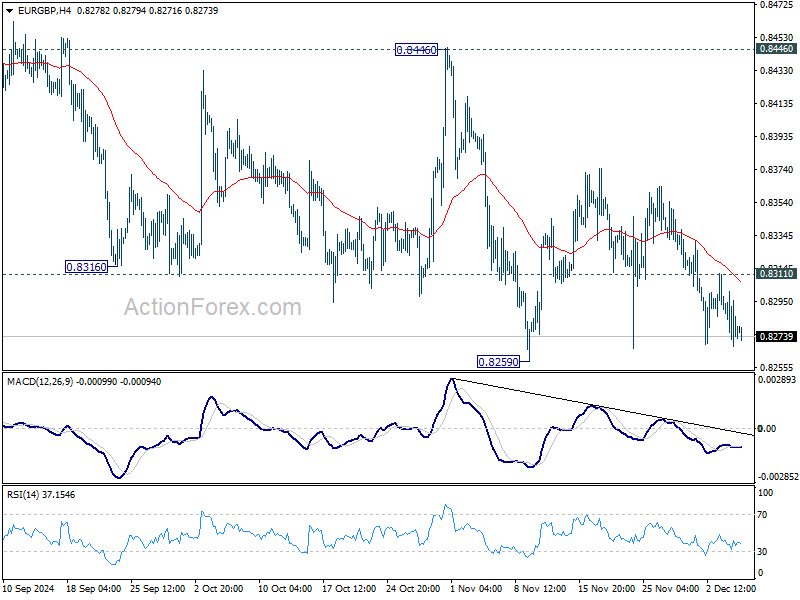
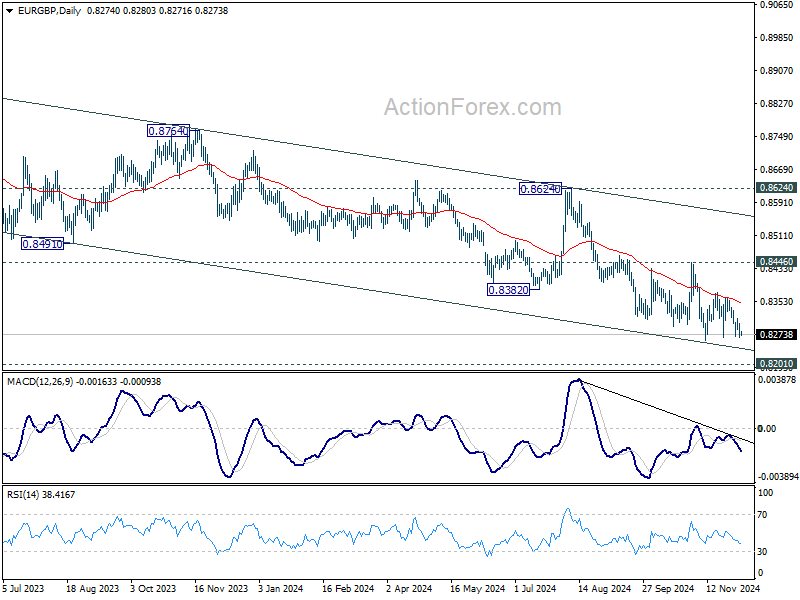
    US markets are back in full swing today but won’ have an awful lot guidance from the eco calendar. Waller’s speech barely left a mark on the bond cash markets’ reopening this morning. The dollar is better bid. The abovementioned technical levels are intensively tested and risk being broken. This kind of chart-based trading will continue through the day. The US Empire Manufacturing index is due later today but isn’t a market-defining variable. Meanwhile, the (financial) earnings season steams ahead. The UK kicked off its economic update with the labour market report this morning. The outcome was a tad stronger-than-expected with the unemployment rate dropping from 4.1% to 4% and employment (in the three months through August) rising by 373k compared to a 240k estimate. A preliminary September reading showed a 15k drop but came with a downward revision of the month before. Earnings growth came in line and was with 4.9% (3M/YoY) the first sub 5% reading since mid-2022. So far this doesn’t suggest Bailey’s getting the more activist approach he’d like to have but there are still CPI numbers and retail sales due later this week. EUR/GBP in late European dealings slipped towards 0.835 and hovers near these levels after today’s report.

    News & Views

    September CPI Inflation in India accelerated faster than expected from 3.65% Y/Y in August tot 5.49%. According to the Ministry of Statistics, the increase in September was likely due to a high base effect and whether conditions. The rise was nevertheless sharper than the 5.1% consensus expectation. Food price inflation which counts for almost half of the of the CPI basket, accelerated from 5.66% tot 9.24%. In a monthly perspective, headline inflation rose 0.62% with food prices rising 1.18% compared to August. Price rises for the likes of clothing and footwear (2.71% Y/Y) and housing (2.78% Y/Y) were more modest. Fuel and light prices even declined 1.39% compared to the same month last year. The faster than expected rise in inflation comes as the Reserve Bank of India at last week’s policy meeting shifted to a more neutral stance as it expects inflation to again cool after an uptick this autumn. The RBI has an inflation target of 4.0% and has its policy rate currently at 6.50%. Higher than expected inflation data question the room for the RBI to start gradual policy easing by the end of this year. At INR/USD 84.00+, the rupee trades near record low levels.

    Oil remains under pressure in Asia this morning with Brent trading below $75 p/b. OPEC yesterday indicated that it sees lower global demand of oil during 2024. In addition, the oil price declined further on headlines from an article in the Washington Post that Israeli Prime Minister Netanyahu had told the US government that he intends to strike miliary targets in Iran rather than oil or nuclear facilities, easing some of the supply concerns and reducing the risk-premium on oil.

    Graphs

    GE 10y yield

    The ECB cut policy rates by 25 bps in June and in September. Stubborn inflation (core, services) still is a source of concern, but very weak PMI’s and soft comments of Lagarde (and other MPC members) suggest the ECB is likely to step up the pace of easing with an October cut. Spill-overs from strong US data prevented a test of the 2.0% barrier. 2.00-2.35% might serve as a ST consolidation range.

    US 10-y yield

    The Fed kicked off its easing cycle with a 50 bps move. Turning he focus from inflation to a potential slowdown in growth/employment made markets consider more 50 bps steps. Strong US September payrolls suggest the economy doesn’t need aggressive Fed support for now, but the debate might resurface as the economic cycle develops. 3.60% acted as strong support before a rebound (and resumption of the steepening trend) kicked in.

    EUR/USD

    EUR/USD twice tested the 1.12 big figure as the dollar lost interest rate support at stealth pace. Bets on fast and large rate cuts trumped traditional safe haven flows into USD. An ailing euro(pean economy) offset some of the general USD weakness. After solid early October US data, the dollar regained traction, with EUR/USD breaking the 1.1002 neckline. Targets of this pattern are near 1.08.

    EUR/GBP

    The BoE delivered a hawkish cut in August. Policy restrictiveness was indicated to be further unwound gradually. The economic picture between the UK and Europe also (temporarily?) diverged to the benefit of sterling, pulling EUR/GBP below 0.84 support. Dovish comments by BoE Bailey ended by default GBP-strength. Uncertainty on the UK budget to be released end this month is becoming an additional headwind for the UK currency.

    S&P 500 Hits Fresh Record as Focus Shifts to Earnings

    The S&P 500 hit its 46th record high of the year on Monday, defying the recent and uncomfortable combination of stronger-than-expected jobs and higher-than-expected inflation numbers that hint that the Federal Reserve (Fed) should slow down the pace of whatever policy easing plan it had in head a month ago. The index traded at 5871, Nvidia erased all the summer weakness and flirted with ATH levels as well after the company CEO Jensen Huang said that the next generation Blackwell chip – which suffered some delay – is now ‘in full production’ and that the demand for it ‘is insane’. Nvidia is probably not done surprising and thriving. The bad news is that we must wait one more month before finding out its Q3 results, but the good news is that the earnings from TSM will give a first hint on the strength of the upcoming numbers already this week.

    And speaking of surprising, the earnings season kicked off well for the big US banks that announced their earnings so far. And beyond banks, around 6% of the S&P500 companies revealed their earnings and nearly 80% reported a positive EPS surprise according to FactSet. And positive vibes could continue as we dive deeper into the earnings season. If nothing, analysts cut their earnings expectations for the Q3 gradually to around 4% growth, whereas this expectation was near 8% in summer. Yet the companies themselves have a guidance for about 16% growth in earnings. The gap hints that the actual earnings could easily beat estimates. And better-than-expected estimates is the valuations’ best friend.

    Today, Goldman, Bank of America and Citigroup will go to the earnings confessional, tomorrow Morgan Stanley, again tomorrow ASML, then on Thursday we will focus on TSM and Netflix results. Voila. Fasten your seat belt.
    Fading optimism

    Enthusiasm around the Chinese stimulus measures fade, as investors digest the fact that the Chinese authorities didn’t give a headline number about what they expect to spend to prop up their economy.

    Whatever the plans, the Chinese authorities have not been good at communicating with investors and that will probably lead to some more profit taking in Chinese equities; vulnerability to potentially soft data is also growing with the fading enthusiasm. The CSI 300 is down by around 0.50% this morning, as Hang Seng is down by 1.34%. Copper futures come down gradually on fading China optimism, as iron ore futures consolidate in Singapore.

    Crude oil, on the other hand, kicked off the week with a 4% decline. US crude took out the 50-DMA support and slipped below the major 38.2% Fibonacci retracement that distinguishes between the summer negative trend and the latest bullish reversal. As such, US crude is back to the negative trend on fading optimism that China will succeed to boost growth with its stimulus measures and on softer demand prospects for the global oil demand. In fact, OPEC just trimmed its forecast for demand growth for the third straight month, and said that the global demand will grow less than 2% this year, and around 1.6% next year. The fact that OPEC is lowering its demand forecast could bring more delays to the cartel’s production restoration plans. But the recent reports suggested that Saudi is more willing to grab market share rather than chase a higher price per barrel. Consequently, the medium-term demand/supply dynamics remain in favour of the bears with one bemol: the Middle East tensions could trigger sudden, short-term price spikes. And that fear alone could limit oil’s downside potential. The next support for US crude is seen at $70pb level.

    USD extends gains

    The US dollar extends gains as the combination of better-than-expected jobs and higher-than-expected inflation figures continue to push the Fed doves to the sidelines. The Fed is still expected to offer another 25bp to the US economy next month, but given the economic data of late, if these expectations were to take another direction, it would rather be in favour of a no cut. The US dollar index has regained half of its summer losses and is presently drilling above its 100-DMA. Trend and momentum indicators remain comfortably positive for a further recovery, but the overbought market conditions call for a period of consolidation of the gains before a further advance.

    From the fundamental lenses, the dollar’s recent rebound makes sense as the Fed doves move aside, and other central bank doves gain field. The USDJPY, for example, is back to testing the 150 offers since the Bank of Japan (BoJ) considers no more interest rate hikes this year since its new PM said there was no need for further hikes.

    The EURUSD reflects the misery of its underlying fundamentals. The stagnating German economy, topped off with a sour French outlook downgrade from Fitch, dragged the EURUSD down to 1.0888. The pair now stands a few pips above the next natural target of 200-DMA, near the 1.0875 level, and the euro bears could swallow it in one bite.

    Elsewhere, the USDCAD just reached the 1.38 mark on the back of a broadly stronger US dollar and falling oil prices, while the Aussie bulls are giving in against a broadly stronger US dollar, as optimism around China is no longer enough to fuel the recent rally. The Aussie bears are gaining field below the major 38.2% Fibonacci level, which hints at a medium-term bearish reversal and the growing possibility of deeper losses.

    Oil Price Declines

    In focus today

    In Germany, we get the ZEW index for October, which will give an update on how investors asses the economic situation in Germany. In September, the assessment of the current situation declined to the lowest level since Covid, and expectations declined in a sign of the weakness in the German economy.

    In Sweden, the final inflation figures (08:00 CET) are likely to be in line with the preliminary estimates, that is, CPIF at 1.1% and CPIFxE at 2.0%. Instead, focus will be on the details behind the headline numbers. Separately, Public Employment Service releases labour market data for September this morning, where the trend has been one of a higher unemployment rate. Finally, the Riksbank board members testify before the Riksdag Finance Committee at 09:00 CET. Since the last forecast and monetary policy meeting, Swedish growth and inflation data has been in line with or slightly stronger than Riksbank forecasts. Hence, we expect that they will communicate that the baseline of 25bp in November still holds.

    We get the UK labour market report for August/September, which is expected to show broad easing in the labour market and wage growth. While still elevated, wage growth excluding bonus is expected to ease to 4.9% 3M/YoY (from 5.1%) and the unemployment rate is expected to remain steady at 4.1%. The notion of a cooling labour market supports a cut from the Bank of England in November.

    We also keep an eye on CPI data out of Canada and New Zealand.

    Economic and market news

    What happened overnight

    In China, a Caixin Global report said that China may raise USD 850bn over the next three years to finance its awaited fiscal stimulus package. The report comes after the Chinese finance minister Lan Fo'An announced on Saturday that China plans to significantly increase debt to stimulate the economy.

    In the US, Fed's Waller called for more caution on interest rate cuts going forward. Waller said that the US economy is in a sweet spot, and Fed's job is to keep the economy there, as labour market remains healthy, and inflation is coming back to the 2% target. After cutting interest rates by 50bp at the last meeting Fed now needs to continue at a deliberate pace, Waller said. Fed's Kashkari said that it would be appropriate to consider modest rate cuts going forward, while Fed is on the edge of the 2% inflation target.

    What happened yesterday

    OPEC revised down their forecast for global oil demand for 2024 and 2025. Now OPEC expects daily demand to increase by 1.93m barrels, which are 106,000 fewer than in their previous estimates, while for 2025 the demand forecast has been decreased by 100,000 barrels per day. In recent days markets have speculated in weak Chinese demand as a potential reason for lower oil demand. Later yesterday, Washington Post reported that Israeli prime minister Netanyahu had told the US government that an Israeli response to Iran's 1 October attack would not target energy infrastructure such as oil but rather military targets. Oil prices ended last week at nearly 79 USD/barrel, and this morning it has dropped to around 75.3 USD/barrel.

    In China, we received data on exports and credit growth. Export growth fell to 2.4% year- on-year from 8.7% in August, below the consensus forecast of 6.0%, and credit growth remained soft. Combined with the low core inflation in September the data highlights the need for further stimulus.

    In the Middle East, Israel expanded its attack in Lebanon to the northern town of Aitou, where at least 21 were killed. Until now Israel has hit primarily southern cities and suburbs of Beirut.

    FI: European rates traded in a very tight range yesterday (with a marginal upward trend of 2bp across the curve) with US out for Columbus Day, no key data releases and the ECB meeting on Thursday. Front-end pricing was steady at 23bp for the October meeting and a cumulative 150bp by year-end 2025. Bund-ASW hit new lows at 22.3bp (-2bp on the day).

    FX: In a relatively slow start to the week the USD has been the clear outperformer among FX majors while ZAR and NOK have traded heavy. EUR/USD has moved just below 1.09 while EUR/NOK is back close to 11.80. USD/JPY continues to trade just below 150 while EUR/GBP is setting new weekly lows amid speculations of an aggressive cutting cycle from the BoE easing. Finally, the recent range trading from EUR/SEK continues with the cross still being stuck in the mid-11.30s.

    UK payrolled employment falls -15k in Sep, unemployment rate dips to 4% in Aug

    In September, UK payrolled employment decreased -15k or -0.0% mom, but increased by 113k or 0.4% yoy, to 30.3m. Median monthly pay rose 5.3% yoy, down from prior 6.0% yoy, but stays well above June's 3.8% yoy. Claimant count rose 27.9k to 1.797m, above expectation of 20.2k.

    In the three months to August, unemployment rate fell from 4.1% to 4.0%, below expectation of 4.0%. Average regular earnings excluding bonuses rose 4.9% yoy, down from prior 5.1% yoy, below expectation of 5.0% yoy. Average regular earnings including bonuses rose 3.8% yoy, down from prior 4.0% yoy, matched expectations.

    Full UK labor market overview release here.

    USD/CAD Daily Outlook

    Daily Pivots: (S1) 1.3768; (P) 1.3786; (R1) 1.3816; More...

    USD/CAD's rally from 1.3418 is in progress and intraday bias remains on the upside, As noted before, corrective fall from 1.3946 should have completed at 1.3418 already. Further rally should be seen towards this resistance. On the downside, below 1.3724 minor support will turn intraday bias neutral first.

    In the bigger picture, sideway consolidation pattern from 1.3976 (2022 high) might still extend further. While another decline cannot be ruled out, strong support should emerge above 1.2947 resistance turned support to bring rebound. Rise from 1.2005 (2021 low) is still in favor to resume at a later stage.

    AUD/USD Daily Report

    Daily Pivots: (S1) 0.6703; (P) 0.6725; (R1) 0.6747; More...

    AUD/USD is staying in consolidation above 0.6701 temporary low and intraday bias stays neutral. Further decline is expected as long as 0.6809 minor resistance holds. On the downside, break of 0.6701 and sustained trading below 55 D EMA (now at 0.6743) should confirm rejection by 0.6941 fibonacci level. Intraday bias will be back on the downside for 0.6621 support next. On the upside, however, break of 0.6809 minor resistance will bring retest of 0.6941 high instead.

    In the bigger picture, overall, price actions from 0.6169 (2022 low) are seen as a medium term corrective pattern, with rise from 0.6269 as the third leg. Firm break of 100% projection of 0.6269 to 0.6870 from 0.6340 at 0.6941 will target 138.2% projection at 0.7179. However, break of 0.6621 support will argue that rise from 0.6269 has completed and bring deeper fall back to 0.6269/6348 support zone.

    USD/JPY Daily Outlook

    Daily Pivots: (S1) 149.20; (P) 149.59; (R1) 150.15; More...

    Intraday bias in USD/JPY stays on the upside as rise from 139.57 is in progress. This rally is seen as the second leg of the corrective pattern from 161.94, and should target 61.8% retracement of 161.94 to 139.57 at 153.39 next. On the downside, below 148.25 minor support will turn intraday bias neutral again first.

    In the bigger picture, price actions from 161.94 are seen as a corrective pattern to rise from 102.58 (2021 low). The range of medium term consolidation should now be set between 38.2% retracement of 102.58 to 161.94 at 139.26 and 161.94. Nevertheless, sustained break of 139.26 would open up deeper medium term decline to 61.8% retracement at 125.25.

    USD/CHF Daily Outlook

    Daily Pivots: (S1) 0.8583; (P) 0.8612; (R1) 0.8655; More

    Intraday bias in USD/CHF remains on the upside for the moment. Rise from 0.8374 short term bottom is in progress for 38.2% retracement of 0.9223 to 0.8374 at 0.8698. Sustained break there will argue that fall from 0.9223 has completed after defending 0.8332 low. Further rally should be seen to 61.8% retracement at 0.8899 next. On the downside, below 0.8557 minor support will turn intraday bias neutral again first.

    In the bigger picture, price actions from 0.8332 (2023 low) are currently seen as a medium term corrective pattern, with fall from 0.9223 as the second leg. Strong support could be seen from 0.8332 to bring rebound. Yet, overall outlook will continue to stay bearish as long as 0.9243 resistance holds. Firm break of 0.8332, however, will resume larger down trend from 1.0146 (2022 high).