Sample Category Title
USD/CHF Daily Outlook
Daily Pivots: (S1) 0.9884; (P) 0.9911; (R1) 0.9952; More.....
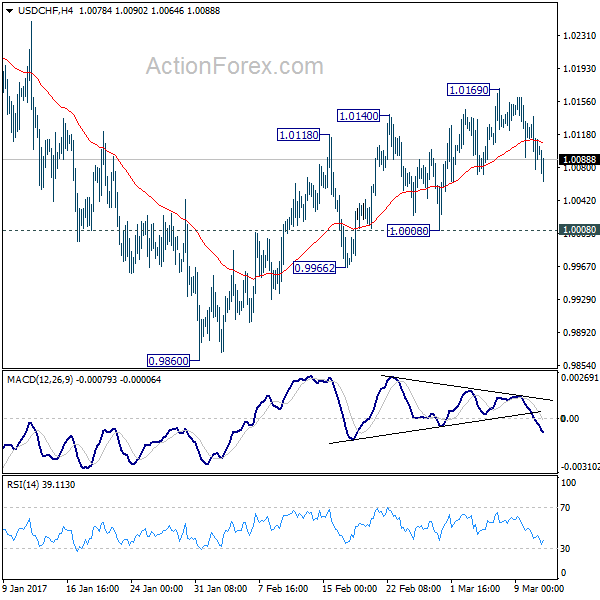
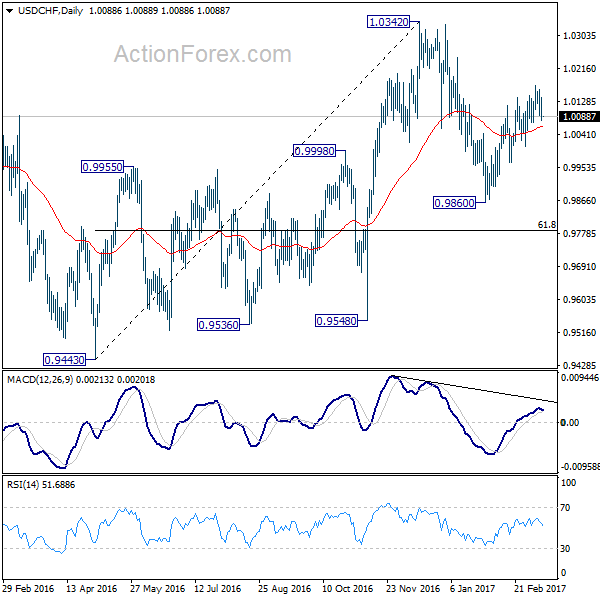
USD/CHF is staying in the consolidation pattern from 0.9860 temporary and intraday bias stays neutral first. Further decline is expected with 1.0043 minor resistance intact. As noted before, decline from 1.0342 is seen as the third leg of the pattern from 1.0327. Below 0.9860 will target 61.8% retracement of 0.9443 to 1.0342 at 0.9786 and below. On the upside, break of 1.0043 will indicate short term bottoming and turn bias back to the upside.
In the bigger picture, rejection from 1.0327 resistance suggests that consolidation pattern from there is still in progress. Fall from 1.0342 is seen as the third leg and retest of 0.9443/9548 support zone could be seen. But we'd expect strong support from there to contain downside. At this point, we're still expecting the larger rally to resume later to 38.2% retracement of 1.8305 to 0.7065 at 1.1359.


Subscribe to our daily and mid-day newsletter to get this report delivered to your mail box
USD/JPY Daily Outlook
Daily Pivots: (S1) 112.11; (P) 112.73; (R1) 113.42; More...
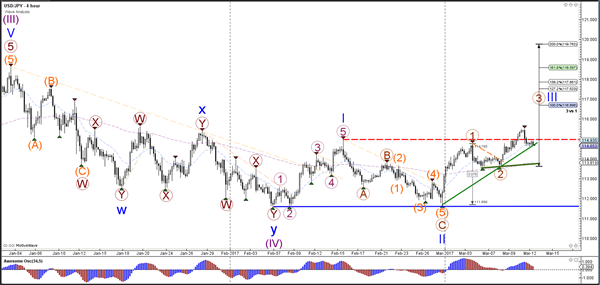
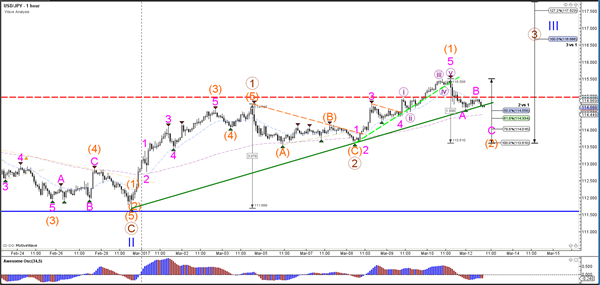
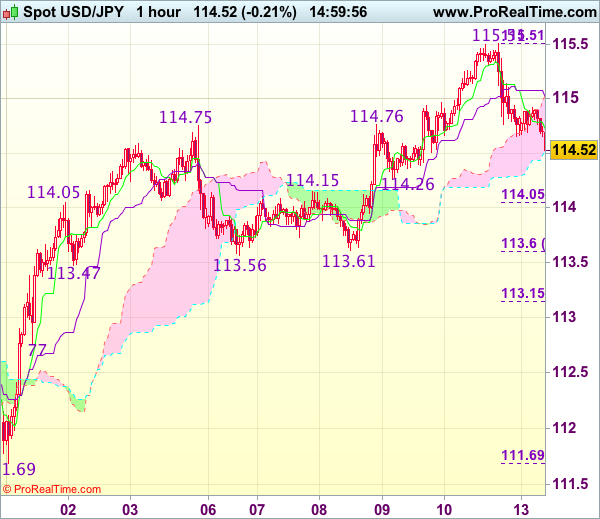
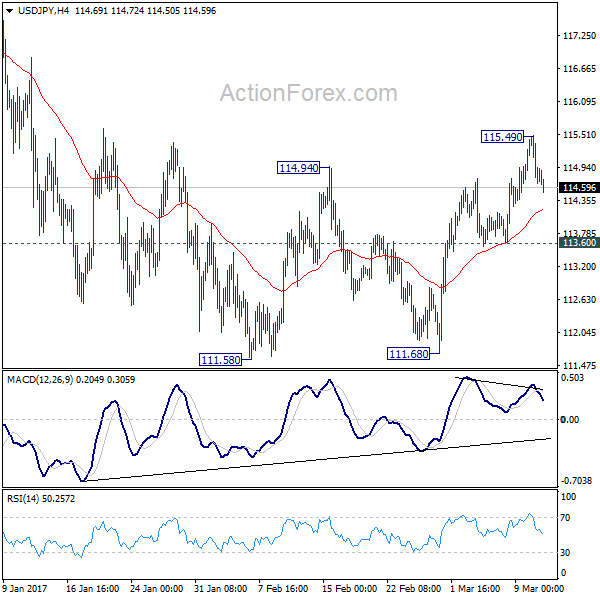
USD/JPY lost some downside momentum as 4 hours MACD crossed above signal line and intraday bias is turned neutral first. Choppy fall from 118.65 is seen as a corrective move. In case of another decline, we'd expect strong support from 38.2% retracement of 98.97 to 118.65 at 111.13 to contain downside an bring rebound. On the upside, above 115.36 resistance will argue that such correction is finished and turn bias to the upside for 118.65. Break will resume whole rise from 98.97 and target 125.85 key resistance.
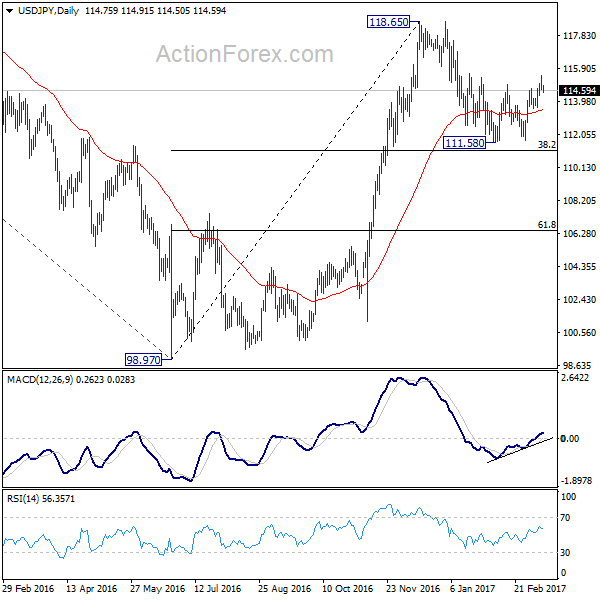
In the bigger picture, price actions from 125.85 high are seen as a corrective pattern. The impulsive structure of the rise from 98.97 suggests that the correction is completed and larger up trend is resuming. Decisive break of 125.85 will confirm and target 61.8% projection of 75.56 to 125.85 from 98.97 at 130.04 and then 135.20 long term resistance. Rejection from 125.85 and below will extend the consolidation with another falling leg before up trend resumption.
Subscribe to our daily and mid-day newsletter to get this report delivered to your mail box
Dollar Recovers Mildly as Markets Await Non-Farm Payroll
Dollar trades mildly higher in Asian session today but remains the second weakest major currency for the week, next to Sterling. Main focus is turning to employment data from US. Markets are expecting non-farm payroll report to show 175k growth in January while unemployment rate would be unchanged at 4.7%. Average hourly earnings are expected to grow 0.3% mom. Looking at other employment related data, ADP report showed 246k growth in January, much stronger than December's 151k. Four week moving average of initial jobless claims dropped 10k to 248k during the period. Employment component of ISM manufacturing surged to 56.1, up from 52.8. Conference board consumer confidence, however, dropped to 111.8, down from 113.3. Overall, other employment data points to a strong NFP report today. But the question is, based on current market sentiment, it's unsure if Dollar will respond positively to a set of good numbers.
Yesterday, BOE voted unanimously (9-0) to leave the Bank rate unchanged at 0.25% and the asset purchases program at 435B pound for UK gilts and 10B pound for non-financial GBP investment-grade corporate bonds. The members revised the growth forecasts significantly higher but left the inflation outlook largely unchanged. The latter was mainly due to the judgment that the labor slack was more than previously expected. Despite stronger growth outlook, Governor Mark Carney warned of the uncertainty over Brexit, cautioning that "there will be twists and turns along the way". While he reiterated that "we can see scenarios in either direction" for policy, we expect BOE to leave the monetary policy and the QE program unchanged at least in the first half of the year. More in BOE Upgrades Growth Outlook; Yet, Unemployment Slack More than Previously Expected.
From China, Caixin PMI manufacturing dropped to 51.0 in January, down from 51.9 and missed expectation of 51.8. Caixin noted in the release that "The rate of improvement slowed since December, as output and new orders increased at weaker rates amid a further reduction in employment. And, "the Chinese economy maintained stable growth in January. But the sub-indices showed that the current growth momentum may be hard to sustain. We must remain wary of downward pressures on the economy this year."
Looking ahead, UK services PMI is the main feature in European session. Eurozone will release services PMI revision and retail sales. US will release non-farm payroll report, ISM non-manufacturing and factory orders.
USD/JPY Daily Outlook
Daily Pivots: (S1) 112.11; (P) 112.73; (R1) 113.42; More...
USD/JPY lost some downside momentum as 4 hours MACD crossed above signal line and intraday bias is turned neutral first. Choppy fall from 118.65 is seen as a corrective move. In case of another decline, we'd expect strong support from 38.2% retracement of 98.97 to 118.65 at 111.13 to contain downside an bring rebound. On the upside, above 115.36 resistance will argue that such correction is finished and turn bias to the upside for 118.65. Break will resume whole rise from 98.97 and target 125.85 key resistance.
In the bigger picture, price actions from 125.85 high are seen as a corrective pattern. The impulsive structure of the rise from 98.97 suggests that the correction is completed and larger up trend is resuming. Decisive break of 125.85 will confirm and target 61.8% projection of 75.56 to 125.85 from 98.97 at 130.04 and then 135.20 long term resistance. Rejection from 125.85 and below will extend the consolidation with another falling leg before up trend resumption.


Economic Indicators Update
| GMT | Ccy | Events | Actual | Consensus | Previous | Revised |
|---|---|---|---|---|---|---|
| 1:45 | CNY | Caixin PMI Manufacturing Jan | 51 | 51.8 | 51.9 | |
| 8:45 | EUR | Italy Services PMI Jan | 52.6 | 52.3 | ||
| 8:50 | EUR | France Services PMI Jan F | 53.9 | 53.9 | ||
| 8:55 | EUR | Germany Services PMI Jan F | 53.2 | 53.2 | ||
| 9:00 | EUR | Eurozone Services PMI Jan F | 53.6 | 53.6 | ||
| 9:30 | GBP | Services PMI Jan | 55.8 | 56.2 | ||
| 10:00 | EUR | Eurozone Retail Sales M/M Dec | 0.30% | -0.40% | ||
| 13:30 | USD | Change in Non-farm Payrolls Jan | 175k | 156k | ||
| 13:30 | USD | Unemployment Rate Jan | 4.70% | 4.70% | ||
| 13:30 | USD | Average Hourly Earnings M/M Jan | 0.30% | 0.40% | ||
| 15:00 | USD | ISM Non-Manufacutring Composite Jan | 57 | 57.2 | ||
| 15:00 | USD | Factory Orders Dec | 1.00% | -2.40% |
Subscribe to our daily and mid-day newsletter to get this report delivered to your mail box
BOE Upgrades Growth Outlook; Yet, Unemployment Slack More than Previously Expected
BOE voted unanimously (9-0) to leave the Bank rate unchanged at 0.25% and the asset purchases program at 435B pound for UK gilts and 10B pound for non-financial GBP investment-grade corporate bonds. The members revised the growth forecasts significantly higher but left the inflation outlook largely unchanged. The latter was mainly due to the judgment that the labor slack was more than previously expected. Despite stronger growth outlook, Governor Mark Carney warned of the uncertainty over Brexit, cautioning that "there will be twists and turns along the way". While he reiterated that "we can see scenarios in either direction" for policy, we expect BOE to leave the monetary policy and the QE program unchanged at least in the first half of the year.
The Committee has revised the GDP growth forecasts significantly higher. The members now expect the economy to expand +2% in 2017, up from +1.6% previously, and +1.6% in 2018, up from +1.5% previously. Optimism comes mainly from better consumer spending expectations, as well as fiscal support, improved global growth outlook and financial conditions. The inflation outlook was largely unchanged. Headline CPI might reach +2.7% in 2017 and +2.6% in 2018, down -0.1 percentage point each from previous estimates, before slipping to +2.4% in 2019. The members suggested that the slack in the employment market might be more than previously anticipated. As noted in the statement, despite recent rise, pay growth has "remained persistently subdued by historical standards - strikingly so in light of the decline in the rate of unemployment to below 5%". They judged that "this is likely to have reflected somewhat stronger labour supply than previously assumed and, therefore, the presence of a greater margin of slack in the labour market, restraining wage increases". Other factors affecting the inflation outlook include the "3% appreciation of sterling and a somewhat higher yield curve over the past three months".
Despite the upbeat GDP growth outlook, Governor Carney remains cautious over Brexit. As he noted at the press conference, "the Brexit journey is really just beginning; while the direction of travel is clear, there will be twists and turns along the way". Moreover, "the stronger projection doesn't mean the referendum is without consequence". He reiterated that the monetary policy can more in either direction. As Carney indicated, "if we do see a situation where there is faster growth and wages than we anticipated or spending doesn't decelerate later in the year, one can anticipate there would be an adjustment of interest rates". We expect the BOE to leave the policy rate and the QE program unchanged at least in the first half of the year.


Market Morning Briefing
STOCKS
Overall stocks are stable and are trading near important support and resistance levels.
Chinese markets opened today after a week long holiday. Shanghai (3141.24, -0.56%) is trading lower and could come off towards 3125 before bouncing back from there.
Dow (19884.91,-0.03%) is trading near levels seen yesterday. We could possibly see some sideways consolidation in the 19750-20000 region for some sessions before a break on either side is seen.
Dax (11627.95, -0.27%) has recovered after testing 11535 yesterday. While above 11400-11500 levels, we could see a rise towards 11800-12000 in the coming sessions.
Nikkei (18843.67, -0.37%) is all set to re-test support at 18651 but price action at those levels would determine further direction for the medium term. We prefer a bounce from 18651 which could pull up Dollar-Yen with itself (In case Dollar Index rises from 99.00).
Nifty (8734.25, +0.20%) closed lower after testing immediate resistance near 8750/60 levels. There could be some chances of a corrective dip from current levels which could further enable the index to see another leg of sharp rally towards 800 and higher. But in case the index breaks above 8760 today, it could test important resistance near 8850-8875 in the near term.
COMMODITIES
Slight bounce in Dollar Index from 99.25 has helped to keep a check on further rise in Gold and Silver. Gold (1213.29) tested 1225 yesterday before coming off to lower levels. For the near term we could expect 1230-1240 levels to hold which could keep prices ranged in the 1200-1230 region today.
Silver (17.30) is also trading lower after testing 17.73 yesterday. As mentioned earlier, the 17.50-17.30 is a important support region just now and if that holds, we could see a rally towards 18 an higher. A break below 17.30 could take it back towards 17.00-16.50 region in the near term.
Crude prices inched up to slightly higher levels but came off from there. Brent (56.7) looks potentially bullish towards 60, looking at the 3-day candle chart while WTI (53.79) could face important resistance near 58.
Copper (2.65) has fallen sharply. The wedge like formation seen on the daily chart is breaking on the downside and if it continues to move lower, we could see a sharp dip to 2.60-2.55 levels in the near term. Crucial resistance at 2.75 holds well for the near term.
FOREX
With all the political risk haunting the currencies and the central banks not adding to the visibility, all eyes are on the US NFP data to be released tonight.
Dollar Index (99.84) has made low at 99.23, just above the long term support of 99.00, before bouncing back close to 100. It still needs to go much higher above the resistance of 100.75-101.00 before the downside risk gets negated. The US Jobs report to be released tonight may determine the near term path.
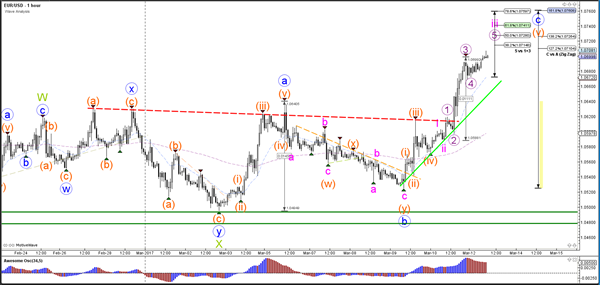
Euro (1.0757) is in a corrective mode now after a strong rejection from our resistance of 1.0820. While the trend remains up above 1.0690, the labored rise in the last few sessions increases the risk at the higher levels in the band of 1.0820-50.
Dollar-Yen (112.66) is stuck in the range of 112-114 for the last 4 sessions and the next directional move depends on the breakout direction from this range. Bidirectional possibilities exist at this point despite the downtrend. Wait and watch.
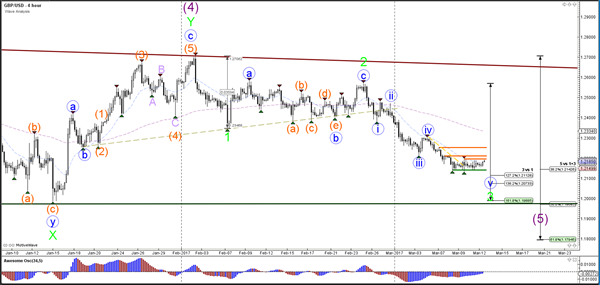
Pound (1.2520) crashed from 1.27 levels despite the BOE raising the growth forecast dramatically as the governor warned about the Brexit impact on the economy. We have to see if it recovers above 1.26 soon as a failure may damage the near term uptrend.
Aussie (0.7644) is taking a breather after its sharp rally to 0.77 and may test the target/resistance of 0.7750 in the next 2-3 sessions.
Dollar-Rupee (67.37) has closed below the support of 67.40 and the chances of testing 67.25 and the major support of 67.00-66.90 are much higher now. Some short covering may be expected near 67.00-66.90.
INTEREST RATES
Less than expected bond purchase by the BOJ has driven the Japanese yields sharply higher. The Japan 10Yr (0.137%) has gained almost 0.03% in a single session, shaking up the market confidence in the central bank commitment to hold down bond yields. Now the 10Yr is testing a major 7-year resistance line at 0.15% which may hold if BOJ is willing to control the yields.
While the German-US 2yr yield differentials (-1.96%) remained the same, the German-US 10Yr (-2.06%) saw a sharp decline, pulling down Euro (1.0757) along with.
Similar sharp rejection was seen for the UK-US 10Yr (-1.00%) as it came down from the medium term resistance around -0.92%. The chances of further decline to -1.08% can’t be ruled out which would weaken Pound (1.2520) too.
Foreign Exchange Market Commentary
EUR/USD
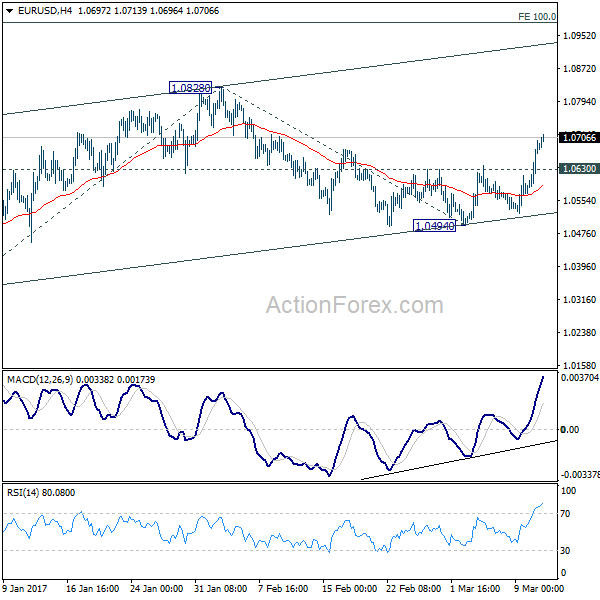
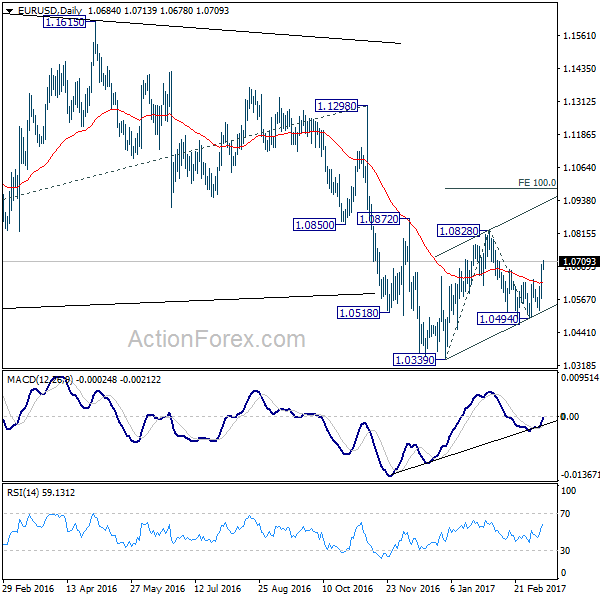
The EUR/USD pair closed the day marginally higher, a couple of pips below the 1.0800 threshold, but managed to extend its gains up to a fresh 2017 high of 1.0828 intraday. The American dollar traded softly against all of its major rivals, undermined by FOMC's monetary policy statement that failed to provide any signal on upcoming rate hikes, but European currencies were unable to take as much advantage as commodity-related ones. The common currency found support in local data, as in the EU, producer price inflation surged in December by 0.7% when compared to November, and up to 1.6% YoY from previous 0.1%, the fastest pace in nearly four years, driven by soaring energy costs, according to Eurostat.
In the US, weekly unemployment claims fell down to 246K for the week ending January 27, whilst Nonfarm Productivity rose in the last quarter of 2016 to 1.3%, above market's forecast but below a previous upwardly revised 3.5%. Finally, the US unit labor cost, also for the last quarter of 2016, rose by less than expected, up to 1.7% from a previously revised 0.2%. If it weren't because of Trump-related uncertainty, such data, ahead of the NFP release, would have been enough to support the case of a faster rate hike pace coming from the FED, and therefore a stronger greenback. The Nonfarm Payroll report, to be released this Friday, will probably have a similar effect over the greenback, with any positive figure overshadowed by uncertainty about Trump's policies.
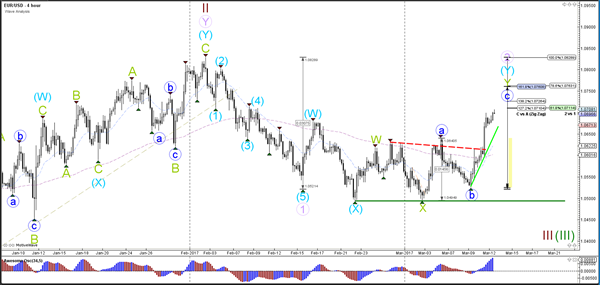
Technically, the EUR/USD pulled back from a major resistance area, as the 1.0800/40 region has probed strong back in 2015 and 2016, when it acted as a major static support. The area is a tough bone to break, but once cleared, the pair may extend its rally up to the 1.1000 region. Technically, the 4 hours chart shows that the price remains above a bullish 20 SMA, now providing support around 1.0770, whilst technical indicators retreat within positive territory alongside with price, not enough to support further slides ahead. Much of the upcoming direction will depend on the result of the NFP report, with a positive figure probably helping the pair to correct down to 1.0710.
Support levels: 1.0770 1.0710 1.0650
Resistance levels: 1.0840 1.0885 1.0930

USD/JPY
The Japanese Yen advanced against its American counterpart this Thursday, helped by the weak tone of worldwide equities and falling US Treasury yields. The 10-year benchmark stands at 2.46%, pulling back from pre-FOMC highs of 2.51%. There were no relevant releases coming from Japan, and for this Friday, the country will release the Minutes of the BOJ latest meeting, hardly a market mover. Attention then, will likely turn towards the US Nonfarm Payroll report to be released ahead of Wall Street's opening. The US economy is expected to have added 175K new jobs during December, while the unemployment rate is expected to have remained unchanged at 4.7%. Wages are seen rising at a softer pace than during November, when they jumped well beyond 2016 average. The Japanese yen is quite sensitive to dollar's news, and as larger the deviation between expectations and the outcome, the larger the pair's move in either direction. The technical stance for the USD/JPY pair is bearish given that it settled below the 113.00 level, and in the 4 hours chart, the price remains well below a bearish 100 SMA. Technical indicators in the mentioned chart are recovering within bearish territory, but below previous highs, indicating that it's still at risk of breaking lower. The pair has bounced twice already from the 112.00 region, but renewed selling interest around the level will likely result in a bearish breakout, with scope then to test the 111.20 region, where the pair has its 100 SMA.
Support levels: 112.00 111.60 111.20
Resistance levels: 113.00 113.45 113.90

GBP/USD
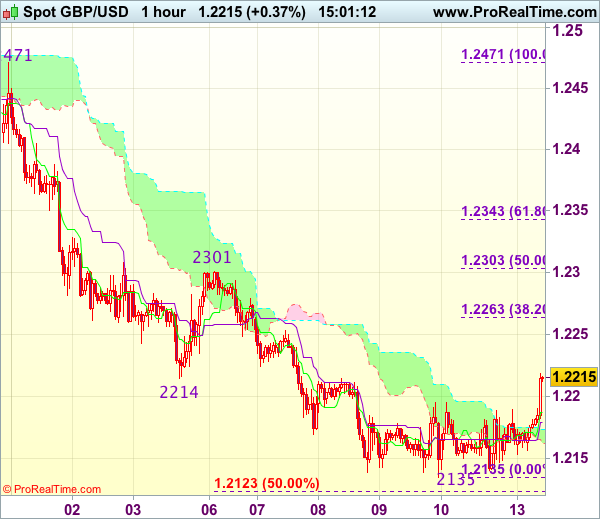
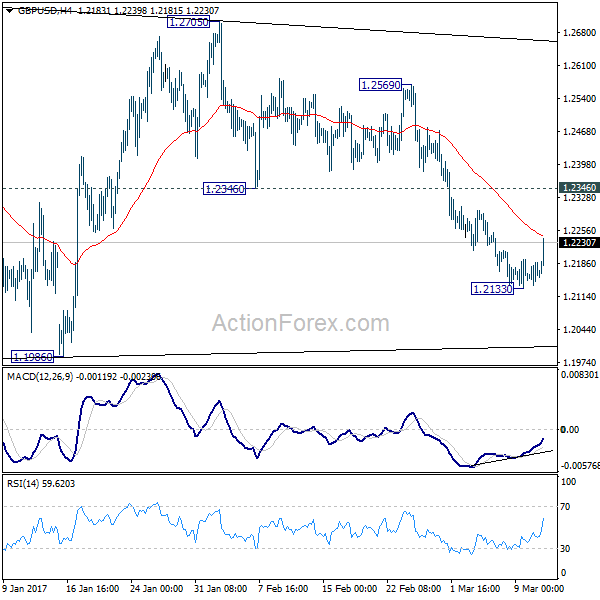
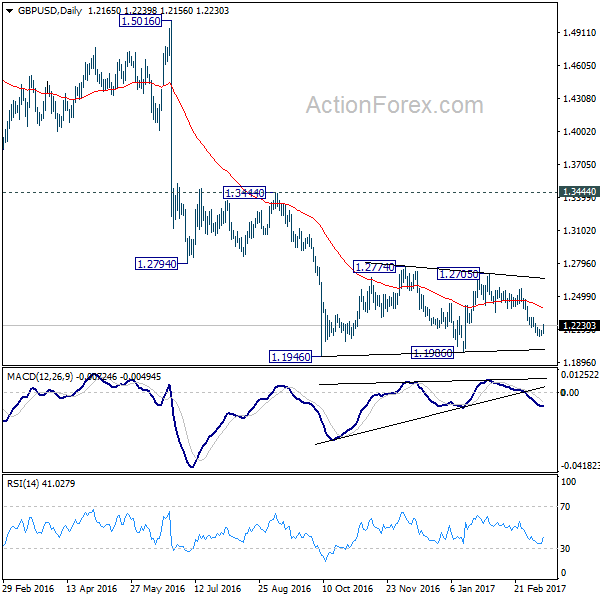
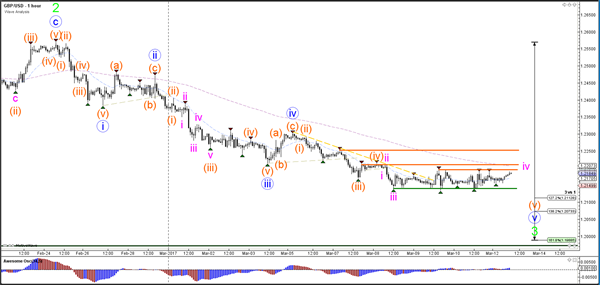
BOE's Super Thursday was a major disappointment for Pound's bulls, as the Central Bank seemed little concerned about rising inflation, attributing it to external factors and a weaker GBP. As widely expected, the Bank of England left rates and the APP unchanged by an unanimous decision, whilst Governor Carney reiterated that “monetary policy can respond, in either direction, to changes to the economic outlook as they unfold”. The Central Bank reviewed its growth forecast from 1.4% to 2% for this 2017, but maintained its inflation perspectives unchanged. Carney also repeated that “there are limits to the extent that above target inflation can be tolerated,” but policy makers are in no rush to raise rates to deal with higher inflation. The GBP/USD pair plunged to 1.2525 in the US afternoon, from where the pair bounced modestly after shedding roughly 200 pips from its daily high. From a technical point of view, however, the decline seems corrective, and further slides unlikely, given that the pair bounced from the 23.6% retracement of the 1.1986/1.2705 rally at 1.2530. In the 4 hours chart, the pair is standing a few pips below a directionless 20 SMA, whilst the Momentum indicator bounced from near its mid-line, and the RSI pared losses and turned higher, now around 46. A recovery above 1.2600 is now required to confirm additional gains for this Friday.
Support levels: 1.2520 1.2470 1.2430
Resistance levels: 1.2600 1.2645 1.2690

GOLD
Gold rallied on the back of persistent dollar's weakness, but trimmed half of its daily gains ahead of the close, with spot settling around $1,215.85 a troy ounce. The commodity traded as high as 1225.23 this Thursday, underpinned by the negative tone of worldwide stocks, following a clueless FOMC meeting. Adding to the safe-haven upward momentum these days, are US President Trump contentious´ relationships with countries such as Mexico, Japan and now, Australia. From a technical point of view, spot has advanced above its 100 DMA for the first time since past September, while the 20 DMA is nearing the 100 DMA with a sharp bullish slope, supporting some further gains ahead. In the same chart, the RSI indicator resumed its advance, now around 62, a fresh weekly high. In the 4 hours chart, technical indicators have retreated from overbought readings, maintaining bearish slopes, but within positive territory, whilst the price is above a bullish 20 SMA, indicating that the commodity may correct lower before resuming its advance.
Support levels: 1,211.56 1,204.50 1,196.10
Resistance levels: 1,225.23 1,231.10 1,241.35

WTI CRUDE
West Texas Intermediate crude oil prices surged to a daily high of $54.32 a barrel, but trimmed all of its daily gains ahead of the close and settled at 53.47. The early advance was triggered by mounting tensions between the US and Iran, as the White House put Iran "on notice" after the country conducted a ballistic missile-test launch, but at the end of the day, US rising production weighed more on traders' sentiment. From a technical point of view, US oil maintains the neutral stance seen on previous updates according to the daily chart, as technical indicators remain flat around their mid-lines, while the price is a few cents above an also directionless 20 SMA. In the shorter term, and according to the 4 hours chart, the price is standing above its moving averages that anyway remain all together in a tight range, and with no certain directional strength, whist technical indicators have pulled back from oversold territory, and are currently standing within neutral territory.
Support levels: 53.20 52.65 52.00
Resistance levels: 53.90 54.30 55.10

DJIA
US major indexes closed pretty much flat, with the DJIA down 6 points at 19,884.91, and the S&P also down by 6 points at 5,636.20. The S&P gained 1 point or 0.06% to settle at 2,280.85. Earnings reports released right after the close were disappointing, with GoPro missing on sales, down 11% after hours, and Amazon plunging also due to missing sales and despite Q4 earnings per share beat estimates. Ongoing uncertainty and upcoming US Nonfarm Payroll report kept investors side-lined this Thursday, ahead of clearer clues about the US economic future. The DJIA daily chart shows that the index is in a consolidative phase, despite off its record highs around 20,150, still hovering around a horizontal 20 DMA, but far above a bullish 100 SMA, and with technical indicators within neutral territory. In the 4 hours chart, the index is a few points above a bearish 20 SMA but hovering around flat 100 and 200 SMAs, both together around 19,890, while the Momentum indicator heads north within positive territory and the RSI hovers around 48, this last limiting changes of a steeper recovery.
Support levels: 19,844 19,806 19,745
Resistance levels: 19,929 19,975 20,036

FTSE 100
The FTSE 100 gained 33 points to close the day at 7,140.75, underpinned by an advance in the mining sector and a weaker Pound, which plummeted after the BOE disappointed speculative interest waiting for an upcoming rate hike on soaring inflation. Hikma Pharmaceuticals top gainer's list, up by 3.82, followed by consumer health and hygiene products firm Reckitt Benckiser Group which added 4.48%, benefiting from a cheaper Sterling. Capita on the other hand was the worst performer, down by 2.72%. The daily chart for the index shows that it holds below the 20 DMA, whilst technical indicators have lost their bearish strength, but remain within negative territory, indicating that the daily recovery is not enough to revert the soft tone seen since early January. In the 4 hours chart, a modestly bullish tone surged ahead of the close, as the benchmark is above a horizontal 20 SMA, whilst technical indicators head higher within positive territory.
Support levels: 7,104 7,057 7,011
Resistance levels: 7,183 7,241 7,297

DAX
The German DAX lost 31 points and closed the day at 11,627.95, with European indexes closing mixed but not far from their daily openings. In the region, financial firms and automakers led the way lower, as investors continued unwinding the so-called "Trump trade." In Germany, Deutsche bank was the worst performer, down by 3.87%, followed by Daimler that shed 294% and Volkswagen which closed 1.29% lower. Infineon Technologies on the other hand was the best performer, up 2.13%. Daily basis, the technical picture remains neutral, with indicators unable to find direction, still stuck around their mid-lines, and the benchmark stuck around a horizontal 20 SMA. Shorter term and according to the 4 hours chart, the index remains below a bearish 20 SMA, whilst technical indicators have turned flat right below their mid-lines, indicating that the risk is towards the downside for the upcoming session.
Support levels: 11,609 11,550 11,000
Resistance levels: 11,711 11,770 11,804

GOLD – Remains Bullish In The Short Term
GOLD - The commodity rallied on Thursday following its recent bullish short term uptrend. On the downside, support comes in at the 1,210.00 level where a break will turn attention to the 1,200.00 level. Further down, a cut through here will open the door for a move lower towards the 1,190.00 level. Below here if seen could trigger further downside pressure targeting the 1,180.00 level. Conversely, resistance resides at the 1,230.00 level where a break will aim at the 1,240.00 level. A turn above there will expose the 1,250.00 level. Further out, resistance stands at the 1,260.00 level. Its daily RSI is bullish and pointing higher suggesting further strength. All in all, GOLD looks to strengthen further in the days ahead.

Pre NFP Squaring
Pre NFP squaring
Much of the price action revolved around pre-NFP position squaring. The one exception was the Pound that tanked after the latest BOE inflation forecasts.
All eyes are on the greenback today. In the wake of this week’s’ robust ADP print, expectations are running high for an equally boisterous NFP print, but are the remaining dollar bulls setting themselves up for disappointment? Needless to say, a combination of higher earnings and lower employment rates will see the dollar bounce. However, I’m convinced that we have not seen the last of the current USD “correction”, even more so in the absence of any concrete news on the fiscal front.
The USD is finding itself perched in a precarious position, all but waiting for someone to push it off the ledge. The ardent dollar bull in me says, “Buy the Buck and Duck”. But I hate putting so much emphasis on one economic print. Rest assured that a strong NFP will shift the Fed’s March rate hike expectations hard but remember, there’s a lot of data between now and March 15, so tread lightly.
Australian Dollar
Tempering one’s expectations in the wake of “home run” trade numbers is tough, but it’s imperative to take note of the increasingly complex landscape ahead of us. Needless to say, volatility has ratcheted higher ahead of tonight’s NFP and the US trade negotiations are just warming up.
The stars are aligning with a record positive AUD trade balance and a less hawkish Fed, but the Feds may still pull the trigger on a March hike or begin the long awaited balance sheet taper. I still take the view that whatever side of the coin you’re on in this uncertain trading environment, the best course of action is a nimble one.
Japanese Yen
Not lots of action overnight, but one thing that is certain is, the spot Yen play versus your typical correlation remains broken-down.But don’t t be fooled by the sense of calm in the market as pockets of interest are sitting with trigger fingers ready to hammer the dollar. While tonight’s NFP is a critical inflexion point on the macro side, the larger stage is still President Trump’s.
In early trade the USDJPY is having s choppy open as the market remains glued to the goings on in the JGB markets BoJ increased 5-10y JGB purchase to 450 billion from 410 billion as expected. USDJPY ticked up to 113.15, but as has been the case in so many dollar upticks lately the USD bears were quick to hammer the buck back to reality
Yuan
China will be back after the long holiday and given recent market moves; I would expect the USDCNH short to cover ahead of tonight’s NFP. I still believe the CNH is ostensibly overvalued at current levels, but while the PBoC continues to bully the market, investor interest continues to wane. In the meantime, look for the CNH current high G-10 correlation to hold intact.
USDCNY is fixing after a long break, and the fixing has come at 6.8556 which is lower than market expectation of around 6.8645. With President Trump and NFP hogging the headlines, I’m not putting much emphasis on todays’ fix
SPI200 Range-Bound
Throughout the month of January, the Australian SPI200 has been trapped in an hourly range. Inside this range, price has more recently been coiling into a triangle almost at the dead centre.
SPI200 Hourly:

Something has to give. Is it going to be the the bulls or the bears that take control here?
(BoE) Statement on Monetary Policy
Bank Rate held at 0.25%, government bond purchases at £435bn and corporate bond purchases at up to £10bn
The Bank of England's Monetary Policy Committee (MPC) sets monetary policy to meet the 2% inflation target, and in a way that helps to sustain growth and employment. At its meeting ending on 1 February 2017, the Committee voted unanimously to maintain Bank Rate at 0.25%. The Committee voted unanimously to continue with the programme of sterling non-financial investment-grade corporate bond purchases, financed by the issuance of central bank reserves, totalling up to £10 billion. The Committee also voted unanimously to maintain the stock of UK government bond purchases, financed by the issuance of central bank reserves, at £435 billion.
As the MPC had observed at the time of the UK's referendum on membership of the EU, the appropriate path for monetary policy depends on the evolution of demand, potential supply, the exchange rate, and therefore inflation. The Committee's latest economic projections are contained in the February Inflation Report. The MPC has increased its central expectation for growth in 2017 to 2.0% and expects growth of 1.6% in 2018 and 1.7% in 2019. The upgraded outlook over the forecast period reflects the fiscal stimulus announced in the Chancellor's Autumn Statement, firmer momentum in global activity, higher global equity prices and more supportive credit conditions, particularly for households. Domestic demand has been stronger than expected over the past few months, and there have been relatively few signs of the slowdown in consumer spending that the Committee had anticipated following the referendum. Nevertheless, continued moderation in pay growth and higher import prices following sterling's depreciation are likely to mean materially weaker household real income growth over the coming few years. As a consequence, real consumer spending is likely to slow.
In preparing the February Report, the MPC undertook its scheduled regular assessment of aggregate supply-side conditions. Pay growth, although edging up, has remained persistently subdued by historical standards – strikingly so in light of the decline in the rate of unemployment to below 5%. This is likely to have reflected somewhat stronger labour supply than previously assumed and, therefore, the presence of a greater margin of slack in the labour market, restraining wage increases. This updated assessment means that the stronger path for demand in the February projection is roughly matched by higher supply capacity. Combined with the 3% appreciation of sterling and a somewhat higher yield curve over the past three months, that results in a projected path of inflation that is similar to the one expected in November, despite the stronger growth outlook.
The value of sterling remains 18% below its peak in November 2015, reflecting investors' perceptions that a lower real exchange rate will be required following the UK's withdrawal from the EU. Over the next few years, a consequence of weaker sterling is that the higher imported costs resulting from it will boost consumer prices and cause inflation to overshoot the 2% target. This effect is already becoming evident in the data. CPI inflation rose to 1.6% in December and further substantial increases are very likely over the coming months. In the central projection, conditioned on market yields that are somewhat higher than in November, inflation is expected to increase to 2.8% in the first half of 2018, before falling back gradually to 2.4% in three years' time. Inflation is judged likely to return to close to the target over the subsequent year. Measures of inflation compensation derived from financial markets have stabilised at around average historical levels, having increased during late 2016 as concerns about a period of unusually low inflation faded.
Monetary policy cannot prevent either the real adjustment that is necessary as the UK moves towards its new international trading arrangements or the weaker real income growth that is likely to accompany it over the next few years. Attempting to offset fully the effect of weaker sterling on inflation would be achievable only at the cost of higher unemployment and, in all likelihood, even weaker income growth. For this reason, the MPC's remit specifies that in such exceptional circumstances the Committee must balance the trade-off between the speed with which it intends to return inflation to the target and the support that monetary policy provides to jobs and activity. At its February meeting, the MPC continued to judge that it remained appropriate to seek to return inflation to the target over a somewhat longer period than usual, and that the current stance of monetary policy remained appropriate to balance the demands of the Committee's remit.
As the Committee has previously noted, however, there are limits to the extent that above-target inflation can be tolerated. The continuing suitability of the current policy stance depends on the trade-off between above-target inflation and slack in the economy. The projections described in the Inflation Report depend in good part on three main judgements: that the lower level of sterling continues to boost consumer prices broadly as expected, and without adverse consequences for expectations of inflation further ahead; that regular pay growth does indeed remain modest, consistent with the Committee's updated assessment of the remaining degree of slack in the labour market; and that the hitherto resilient rates of household spending growth slow as real income gains weaken. In judging the appropriate policy stance, the Committee will be monitoring closely the incoming evidence regarding these and other factors. For instance, if spending growth slows more abruptly than expected, there is scope for monetary policy to be loosened. If, on the other hand, pay growth picks up by more than anticipated, monetary policy may need to be tightened to a greater degree than the gently rising path implied by market yields. Monetary policy can respond, in either direction, to changes to the economic outlook as they unfold to ensure a sustainable return of inflation to the 2% target.