Sample Category Title
Yen Falls on Political Turmoil as Dollar Strengthens Ahead of Key Economic Data
Yen suffered broad-based selloff during an otherwise quiet Asian session, following the weekend's indecisive snap election that left Japan without a clear governing party. In contrast, Dollar emerged as the main beneficiary despite its own political uncertain, building on its recent upward momentum and gained across the board.. Canadian Dollar and Euro also showed firmness. Conversely, Swiss Franc clearly lagged behind, while Australian and New Zealand Dollars displayed relative weakness.
With the economic calendar empty today, major shifts in market trends are unlikely. However, the upcoming US presidential elections remain a source of volatility, as any unexpected developments could sway investor sentiment. Traders are also gearing up for a week filled with high-impact economic releases, including US GDP, PCE, ISM and NFP, inflation data from Eurozone, Australia and Swiss.
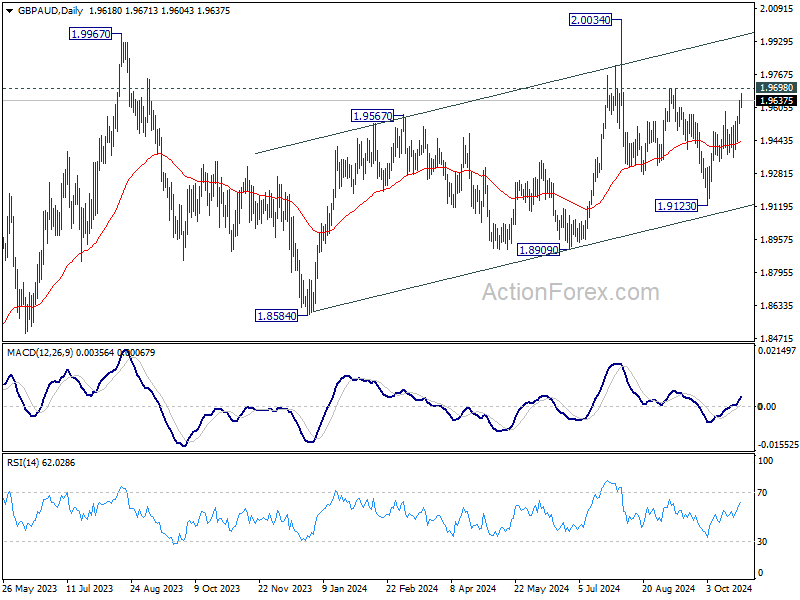
Technically, GBP/AUD's extended rebound suggests that correction from 2.0034 has completed with three waves down to 1.9123. Firm break of 1.9698 resistance will argue that larger up trend is ready to resume through 2.0034. The next move could hinge of Australia quarterly CPI featured this week.
In Asia, Nikkei rose 1.85%. Hong Kong HSI is up 0.07%. China Shanghai SSE is up 0.24%. Singapore Strait Times is down -0.01%. Japan 10-year JGB yield rose 0.0187 to 0.971.
Yen depreciates sharply following inconclusive Japanese election
Yen fell significantly after this weekend's snap election resulted in a fragmented parliament, leaving no single party with a clear mandate to govern. This political uncertainty introduces the prospect of days or even weeks of negotiations as parties attempt to form a coalition, raising concerns among traders about potential change in leadership and policy direction. Despite the political instability, Nikkei rebounded notably, primarily driven by the weaker yen rather than optimism about the electoral outcome.
Election results showed that Prime Minister Ishiba's Liberal Democratic Party and its coalition partner Komeito secured only 215 seats in the lower house of parliament, a substantial decline from their previous 279 seats. The opposition Constitutional Democratic Party of Japan increased its seats to 148 from 98 but still fell short of the 233 required for a majority. Under Japan's constitution, political parties now have 30 days to negotiate and form a governing coalition. The lack of a decisive outcome casts doubt on Ishiba's tenure as premier, especially considering he assumed office less than a month ago.
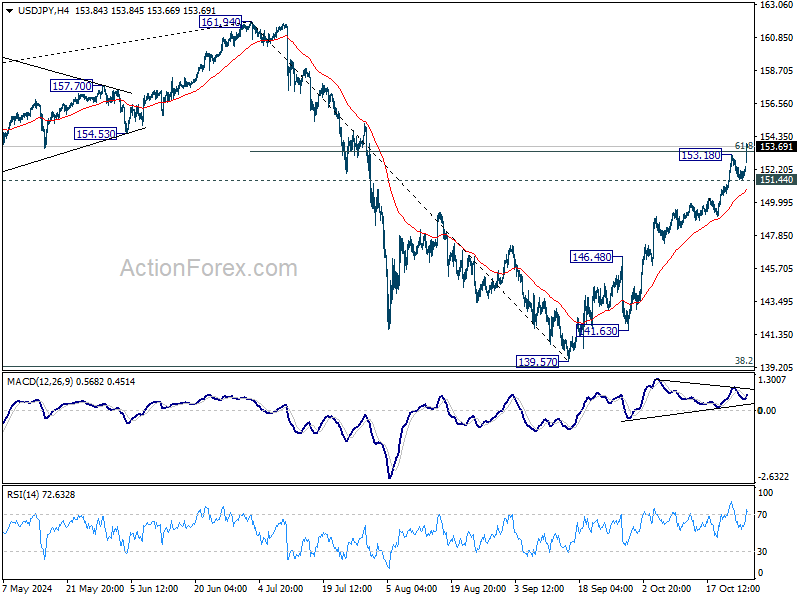
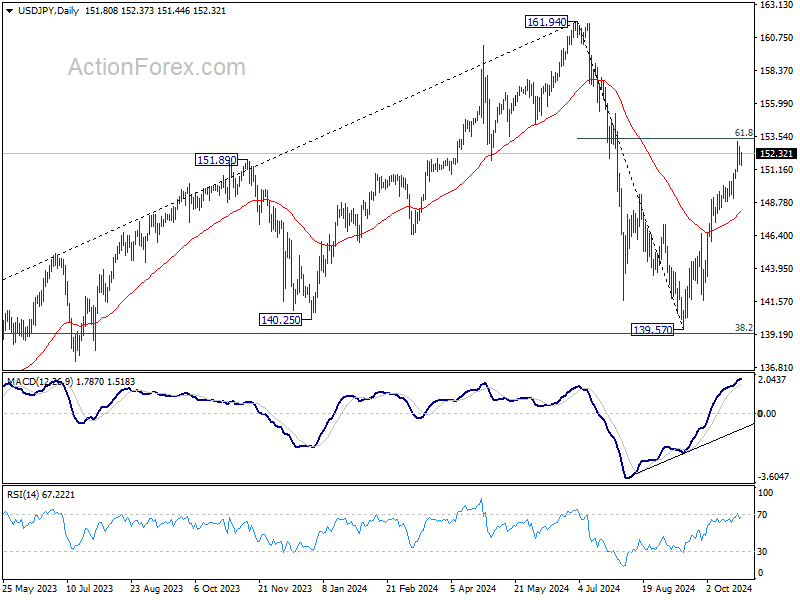
USD/JPY's rise from 139.57 resumed after brief consolidations by breaking through 153.18 temporary low. Further rally is expected as long as 151.44 support holds. The question is whether USD/JPY could sustain above 61.8% retracement of 161.94 to 139.57 at 153.39. If it can, the next target wil be a retest on 161.94 high.
ECB’s Knot cautions against overly enthusiastic rate cut expectations
Speaking on Saturday, Dutch ECB Governing Council member Klass Knot acknowledged the market’s heightened expectations for ECB rate cuts, noting that this shift occurred after disappointing PMIs and consumption data.
Knot described these expectations as having increased “quite dramatically” but cautioned that the market may have been “a little bit over-enthusiastic.” He highlighted that "We will only know once we do our own calculations again in December."
Knot outlined two contrasting scenarios regarding the ECB's rate path. On one hand, if incoming data reveal a rapid pace of disinflation or signal a notable shortfall in economic recovery, ECB could accelerate policy easing. On the other, if inflation risks shift upwards or data show resilience in growth and inflation, a more gradual reduction of restrictive measures might be warranted.
Knot underscored the importance of retaining “full optionality,” a strategy designed to act as a hedge against unpredictable shifts in the economic outlook. He stressed that ECB’s meeting-by-meeting and data-dependent approach has been effective.
Top-tier global economic data take center stage
The global financial markets are bracing for an array of critical economic data this week, from the world’s major economies. The upcoming US presidential election on November 5 adds a layer of complexity. Any unexpected news related to the election could introduce significant volatility, making it imperative to stay informed.
In the US, attention centers on Q3 GDP growth, PCE inflation, ISM Manufacturing Index, and the highly anticipated non-farm payrolls report. Fed has been increasingly focusing on the employment component of its dual mandate, making the October NFP report particularly significant. Currently, market expectations are for Fed to cut interest rates by 25bps at both the November and December meetings. However, these expectations may be recalibrated based on this week's economic data.
Eurozone is set to release its flash estimate for Q3 GDP and October CPI. While some dovish members of ECB have advocated for discussion of a 50bps rate cut at the December meeting, others have opposed such aggressive easing. The base case remains for a 25bps cut for now. Nevertheless, ECB's decision will hinge on the depth of economic deterioration reflected in the GDP figures and whether inflation is rebounding as policymakers anticipate.
In Japan, BoJ is expected to maintain its current monetary policy stance during its upcoming meeting. The new economic projections will be crucial in gauging the central bank's confidence in achieving its 2% inflation target sustainably. This outlook is critical for timing the next rate hike.
For Australia, Q3 CPI release is expected to be pivotal for RBA's approach to future rate cuts, possibly as early as next year. The inflation data will reveal whether RBA can have the room to relax its vigilant stance against inflation and possibly adjust its guidance in the upcoming meeting. A softer CPI reading could pave the way for a rate cut in early 2025. Additionally, Australia's economic prospects are closely tied to China's performance; thus, China's PMI data will be significant in assessing the impact of government stimulus measures announced since September.
Other noteworthy data releases include Switzerland's CPI and Canada's monthly GDP.
Here are some highlights for the week:
- Tuesday: Japan unemployment rate; German Gfk consumer climate; UK M4 money supply, mortgage approvals; US goods trade balance; house price index; consumer confidence.
- Wednesday: Australia CPI; Japan consumer confidence; Germany CPI flash, unemployment GDP; French GDP flash; Swiss KOF economic barometer, UBS economic expectations; Eurozone GDP flash; US ADP employment, GDP advance, pending home sales.
- Thursday: Japan industrial production, retail sales, BOJ rate decision; New Zealand ANZ business confidence; Australia retail sales building approvals, import prices; China PMIs; Germany import price, retail sales; Eurozone CPI flash; Canada GDP; US jobless claims personal income and spending, PCE Inflation, Chicago PMI.
- Friday: Australia PPI; Japan PMI manufacturing final; China Caixin PMI manufacturing; Swiss CPI, retail sales, PMI manufacturing; UK PMI manufacturing final; US non-farm payrolls, ISM manufacturing.
EUR/JPY Daily Outlook
Daily Pivots: (S1) 163.98; (P) 164.39; (R1) 164.83; More....
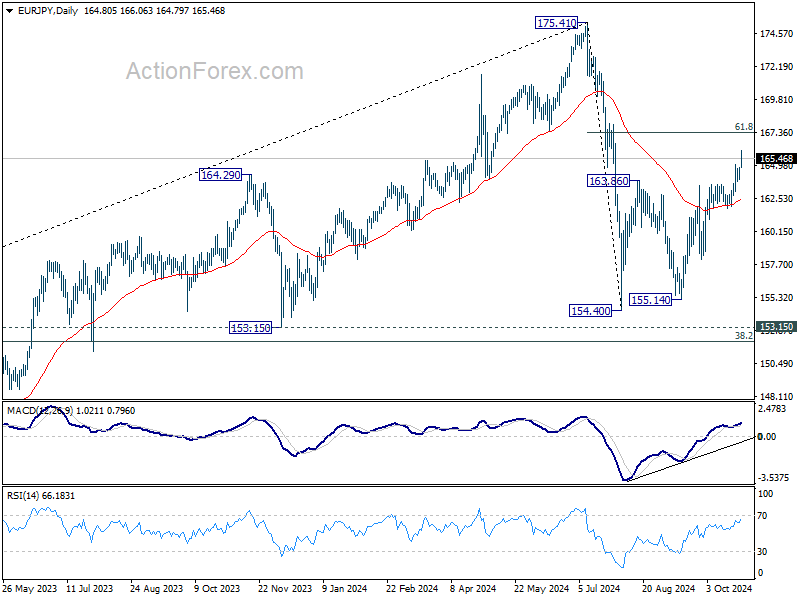
EUR/JPY's rally resumed after brief consolidations and intraday bias is back on the upside. Current rally from 154.40 should target 61.8% retracement of 175.41 to 154.40 at 167.38. Sustained break there will pave the way to retest 175.41 high. On the downside, below 163.79 minor support will turn intraday bias neutral again first.
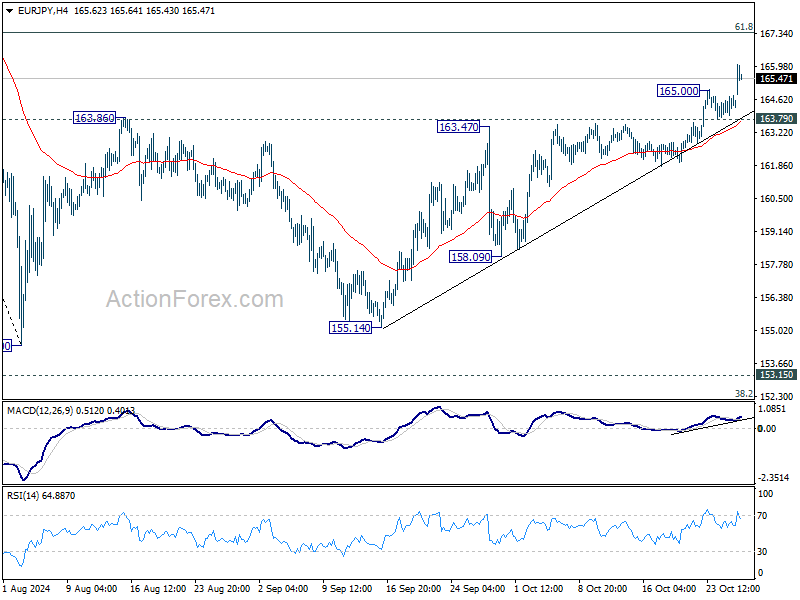
In the bigger picture, price actions from 175.41 are seen as correction to rally from 114.42 (2020 low). The range of consolidation should have been set between 38.2% retracement of 114.42 to 175.41 at 152.11 and 175.41 high. However, decisive break of 152.11 would argue that deeper correction is underway.
EUR/USD Still At Risk of More Downsides Below 1.0750
Key Highlights
- EUR/USD declined further below the 1.0820 support.
- It attempted a recovery wave above a connecting bearish trend line with resistance at 1.0810 on the 4-hour chart.
- Gold prices could soon gain pace to climb above the $2,760 resistance.
- Bitcoin eyes upsides above the $68,500 resistance zone.
EUR/USD Technical Analysis
The Euro remained in a bearish zone below 1.0950 against the US Dollar. EUR/USD traded below the 1.0850 and 1.0820 support levels.
Looking at the 4-hour chart, the pair settled below the 1.0850 level, the 100 simple moving average (red, 4-hour), and the 200 simple moving average (green, 4-hour). Finally, the pair tested the 1.0760 zone.
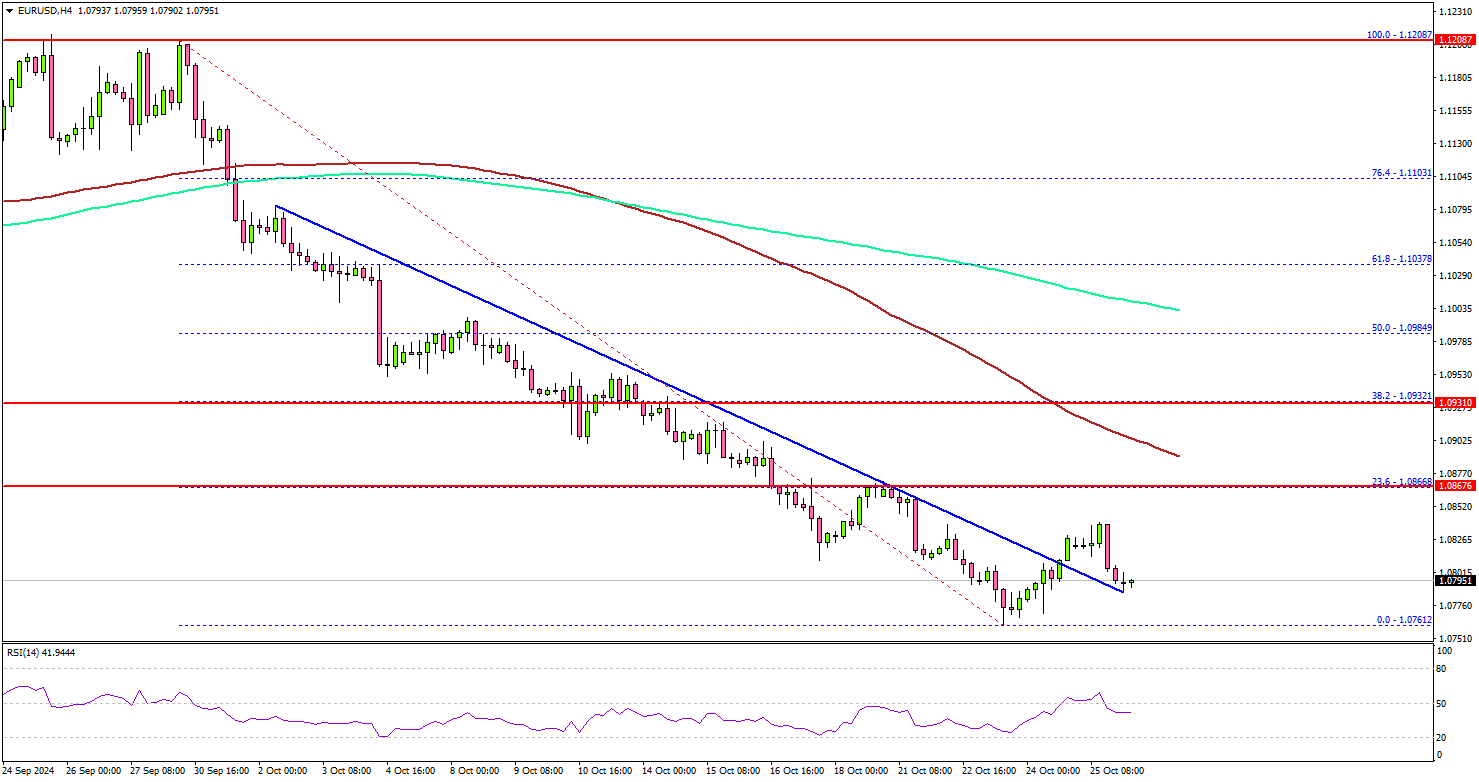
A low was formed at 1.0761 and the pair recently attempted to recover. It cleared a connecting bearish trend line with resistance at 1.0810 on the same chart. However, the bears seem to be active below the 1.0850 level.
On the downside, immediate support sits near the 1.0760 level. The next key support sits near the 1.0735 level. Any more losses could send the pair toward the 1.0700 level.
On the upside, the pair could face resistance near the 1.0850 level. The first key resistance is near the 1.0865 level and the 23.6% Fib retracement level of the downward move from the 1.1208 swing high to the 1.0761 low.
A close above the 1.0865 level could set the tone for another increase. The next major resistance could be 1.0925, above which the price could accelerate higher toward the 50% Fib retracement level of the downward move from the 1.1208 swing high to the 1.0761 low at 1.0985.
Looking at Gold, the bulls remain in action, and they seem to be eyeing a fresh rally to a new all-time high above the $2,760 level.
Upcoming Economic Events:
- Dallas Fed Manufacturing Business Index for Oct 2024 – Forecast -9.0, versus -9.0 previous.
Yen depreciates sharply following inconclusive Japanese election
Yen fell significantly after this weekend's snap election resulted in a fragmented parliament, leaving no single party with a clear mandate to govern. This political uncertainty introduces the prospect of days or even weeks of negotiations as parties attempt to form a coalition, raising concerns among traders about potential change in leadership and policy direction. Despite the political instability, Nikkei rebounded notably, primarily driven by the weaker yen rather than optimism about the electoral outcome.
Election results showed that Prime Minister Ishiba's Liberal Democratic Party and its coalition partner Komeito secured only 215 seats in the lower house of parliament, a substantial decline from their previous 279 seats. The opposition Constitutional Democratic Party of Japan increased its seats to 148 from 98 but still fell short of the 233 required for a majority. Under Japan's constitution, political parties now have 30 days to negotiate and form a governing coalition. The lack of a decisive outcome casts doubt on Ishiba's tenure as premier, especially considering he assumed office less than a month ago.
USD/JPY's rise from 139.57 resumed after brief consolidations by breaking through 153.18 temporary low. Further rally is expected as long as 151.44 support holds. The question is whether USD/JPY could sustain above 61.8% retracement of 161.94 to 139.57 at 153.39. If it can, the next target wil be a retest on 161.94 high.
ECB’s Knot cautions against overly enthusiastic rate cut expectations
Speaking on Saturday, Dutch ECB Governing Council member Klass Knot acknowledged the market’s heightened expectations for ECB rate cuts, noting that this shift occurred after disappointing PMIs and consumption data.
Knot described these expectations as having increased “quite dramatically” but cautioned that the market may have been “a little bit over-enthusiastic.” He highlighted that "We will only know once we do our own calculations again in December."
Knot outlined two contrasting scenarios regarding the ECB's rate path. On one hand, if incoming data reveal a rapid pace of disinflation or signal a notable shortfall in economic recovery, ECB could accelerate policy easing. On the other, if inflation risks shift upwards or data show resilience in growth and inflation, a more gradual reduction of restrictive measures might be warranted.
Knot underscored the importance of retaining “full optionality,” a strategy designed to act as a hedge against unpredictable shifts in the economic outlook. He stressed that ECB’s meeting-by-meeting and data-dependent approach has been effective.
Morning Report
Today's economic developments and market movements.
Key themes: Higher yields and a firmer US dollar resumed on Friday ahead of a slew of key economic data this week and as the US election heads into its final full week of campaigning.
Inflation, labour market and GDP data in the US and Europe will take centre stage, while September quarter domestic inflation data on Wednesday will be crucial for local markets.
Key for most markets will be whether US data can sustain recent strength and reinforce the soft/no landing narrative.
Japan faces some near-term political instability after the ruling Liberal Democratic Party coalition failing to win a majority in parliament for the first time since 2009.
Share markets: The S&P 500 was flat on Friday but finished the week down 1.0%, ending a string of six consecutive weeks in the green. The NASDAQ was firmer, rising 0.6% on Friday to be up 0.2% on the week and extending its string of weekly gains to seven.
The Euro Stoxx 50 eked out a 0.2% gain but was 0.9% lower over the week. In the UK, the FTSE closed down 0.3% on Friday and was 1.3% lower over the week.
The ASX 200 was up 0.1% on Friday but this was not enough to offset earlier losses, leaving the local bourse 0.9% lower over the week.
Interest rates: US yields were modestly higher on Friday. The 2-and-10-year yields were both up 3 basis points to 4.10% and 4.24%, respectively and remain around the top their recent 3-month range.
The implied odds of a November Fed rate cut have pushed out to around 97%, while the chances of a follow-up cut in December have also firmed a little to around 63%.
Aussie bond futures also sold off a touch. The 3-year futures yield is 4 basis points higher at 3.93%, while the 10-year is 5 basis poitns higher at 4.47%. Market’s have futher discounter the chance of an RBA rate cut this year, with the implied odds ritting at 21%. The first cut is fully priced for May 2025, with an earlier April move around 97% priced in.
Foreign exchange: The US dollar continued to consolidate above 104, trading a range of 103.94 to 104.34 before closing at 104.26. Key US GDP, labour market and inflation data this week will be crucial to sustaining the current US dollar upside and keeping the soft/no landing narrative in tact.
The Aussie dollar looks to be forming a tentative base around 0.6600-0.6615. However, key US and domestic data this week has plenty of potential to break key levels both on the upside and downside. Locally, inflation data is likely to show some welcomed progress, which could present a hurdle fo the Aussie subject to developments offshore.
The Euro traded a 1.0839-1.0793 range on Friday but has opened slightly lower in early trade this morning. Local activity, inflation and labour market data this will be important for the Euro, however, absent any upside strength, the US dollar leg will likely be the bigger determinant of price action this week.
The sell-off in the Yen resumed on Friday and has gained some traction at the open this morning following reports Japan’s Liberal Democratic Party and its coalition partner are set to lose their majority following Sunday’s general election. Near-term political uncertainty is likely to weigh on the Yen, leaving it vulnerable to move lower and reigniting caution around potential intervention risks.
Commodities: Crude advanced Friday as traders focussed on the risks of escalation in the Middle East. West Texas Intermediate (WTI) futures closed up 2.3% Friday at US$71.78
Over the weekend, Israel attacked military targets in Iran though Iranian media downplayed the impact of strikes and signalled a measured response.
The US and Israel confirmed they would hold talks in Doha over the weekend. Egypt proposed a two-day cease-fire allowing for the exchange of prisoners and hostages. Bloomberg reported that Russian fuel exports are on course to hit the lowest in at least 8 years amid a sharp drop-in refining activity amid seasonal maintenance and low refining profits.
Metals were mixed despite the strong US dollar and high US yields. Copper closed up 1.0% at US$9,509 while aluminium rose 0.8% to US$2,670. Zinc fell a hefty 2.4% to US$3,099 after the sharp spike earlier in the week took it to a fresh 20 month high.
Iron ore rose modestly Friday, helped by hopes of more fiscal stimulus in China. Futures rose 1.8% to US$103.40. China Iron Ore Steel Association (CISA) called for supply restraint after the recent rally noting ‘there hasn’t been any notable change in orders for steel products’. CISA reported that steel inventory rose 5% into mid-October from the beginning of the month to be 2% above average levels for this time of year.
Australia: There were no major economic data releases on Friday.
Eurozone: Germany’s IFO business climate index edged higher in October to 86.5 as firms current assessment and expectations both improved.
European Central Bank (ECB) measures of inflation expectations drifted lower in September, providing policymakers with further confidence inflation is on a sustainable path lower. 1-year ahead expectations dropped to 2.4% from 2.7% in August, the lowest level since September 2021. 3-year ahead expectations fell to 2.1% from 2.3%, reaching their lowest level since February 2022.
Japan: Japan faces some near-term political instability after the decision by Prime Minister Shigeru Ishiba to call a snap election backfired with the ruling Liberal Democratic Party coalition failing to win a majority in parliament for the first time since 2009.
New Zealand: Consumer confidence slipped 4.1% in October to 91.2. This ended a string of three consecutive months of improving sentiment.
United Kingdom: The GfK consumer confidence index was little changed at -21 in October, a touch above the 5-year average of -25.
United States: US durable goods orders fell 0.8% in September, largely as expected. August was revised down to -0.8% from a flat reading. Core orders (non-defence ex air) showed some resilience, gaining 0.5% in September after a 0.3% rise in August.
University of Michigan consumer sentiment was revised up in the final release for October, from 68.9 to 70.5, leaving the index a touch above September’s 70.1.
1-year inflation expectations eased from 2.9% to 2.7% while the 5-10-year measure remained unchanged at 3.0%. Both inflation expectations measures are historically consistent with inflation at target.
Key Events for the Week Ahead
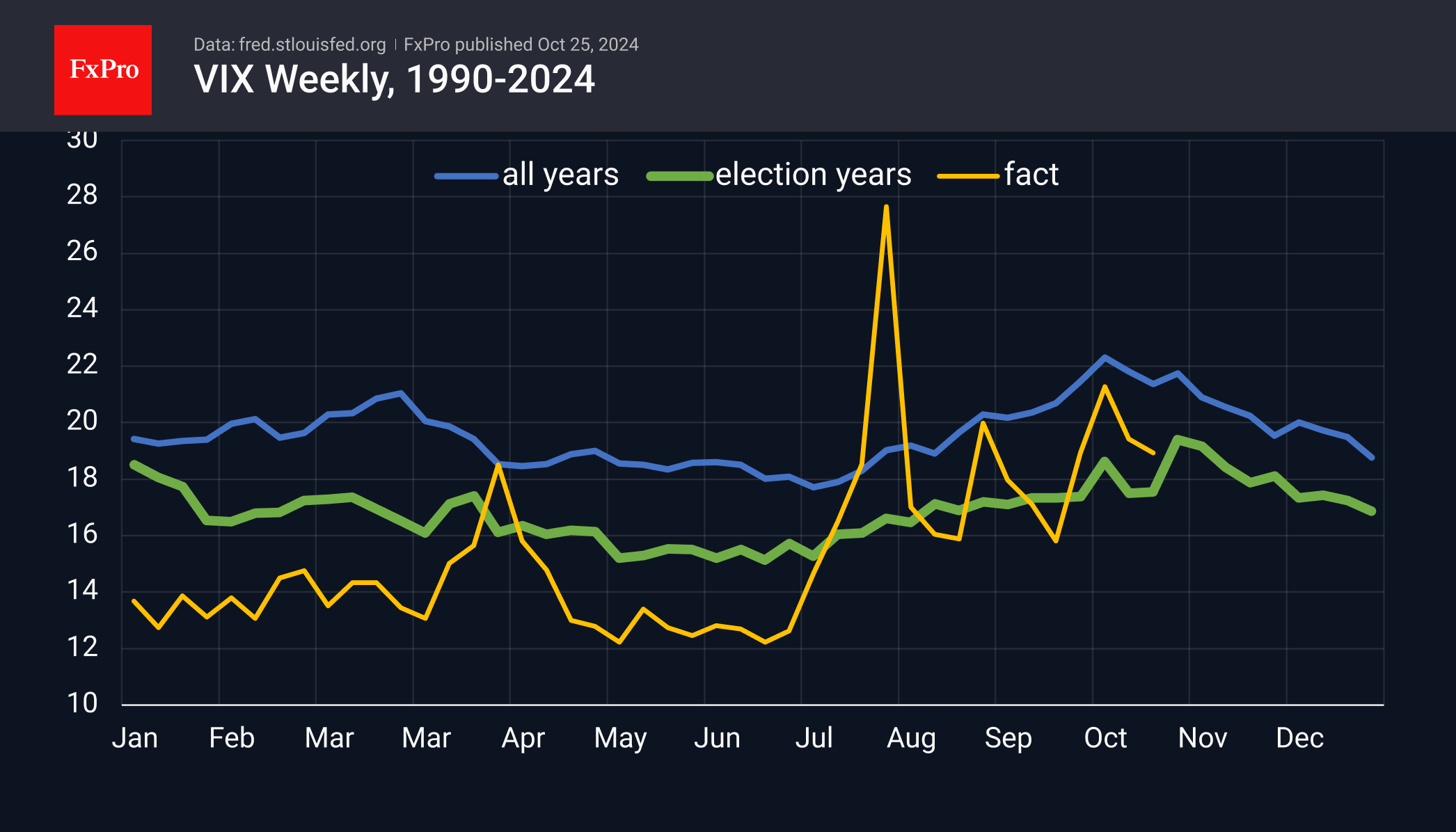
Seasonal patterns in the VIX, often referred to as the market’s fear gauge, indicate that volatility during this election year is likely to peak in the coming weeks, so be prepared for moves against established trends.
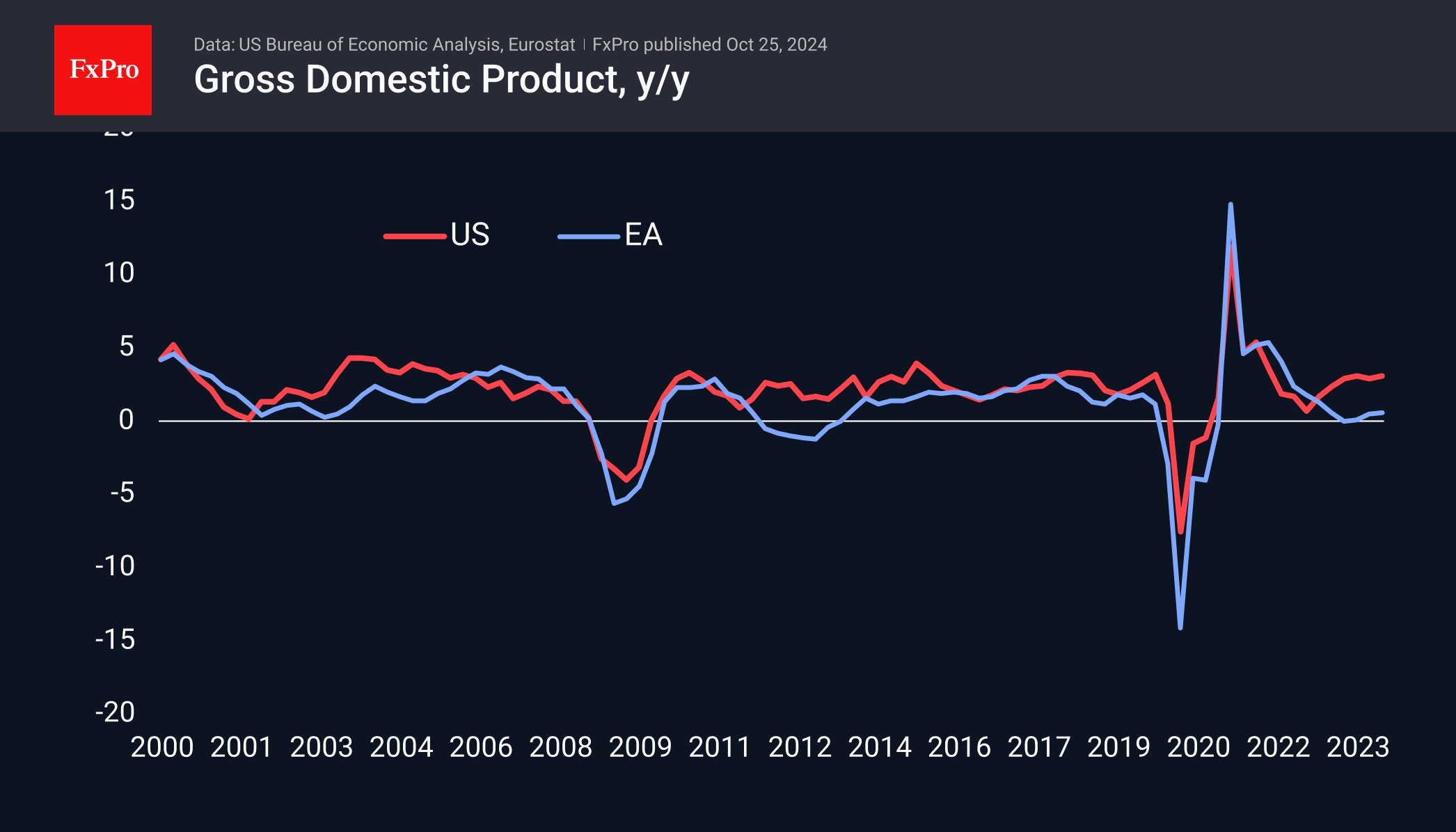
Looking ahead, consumer inflation data from Australia and Germany will be released on Wednesday. Initial estimates of third-quarter GDP for the eurozone and the US are also significant, as they could greatly influence the central bank’s views on interest rates.
The Bank of Japan will decide on interest rates on Thursday. Expectations have shifted towards ‘no change’ in recent days, putting pressure on the yen. However, the promise of further rate hikes could revive interest in the Japanese currency.

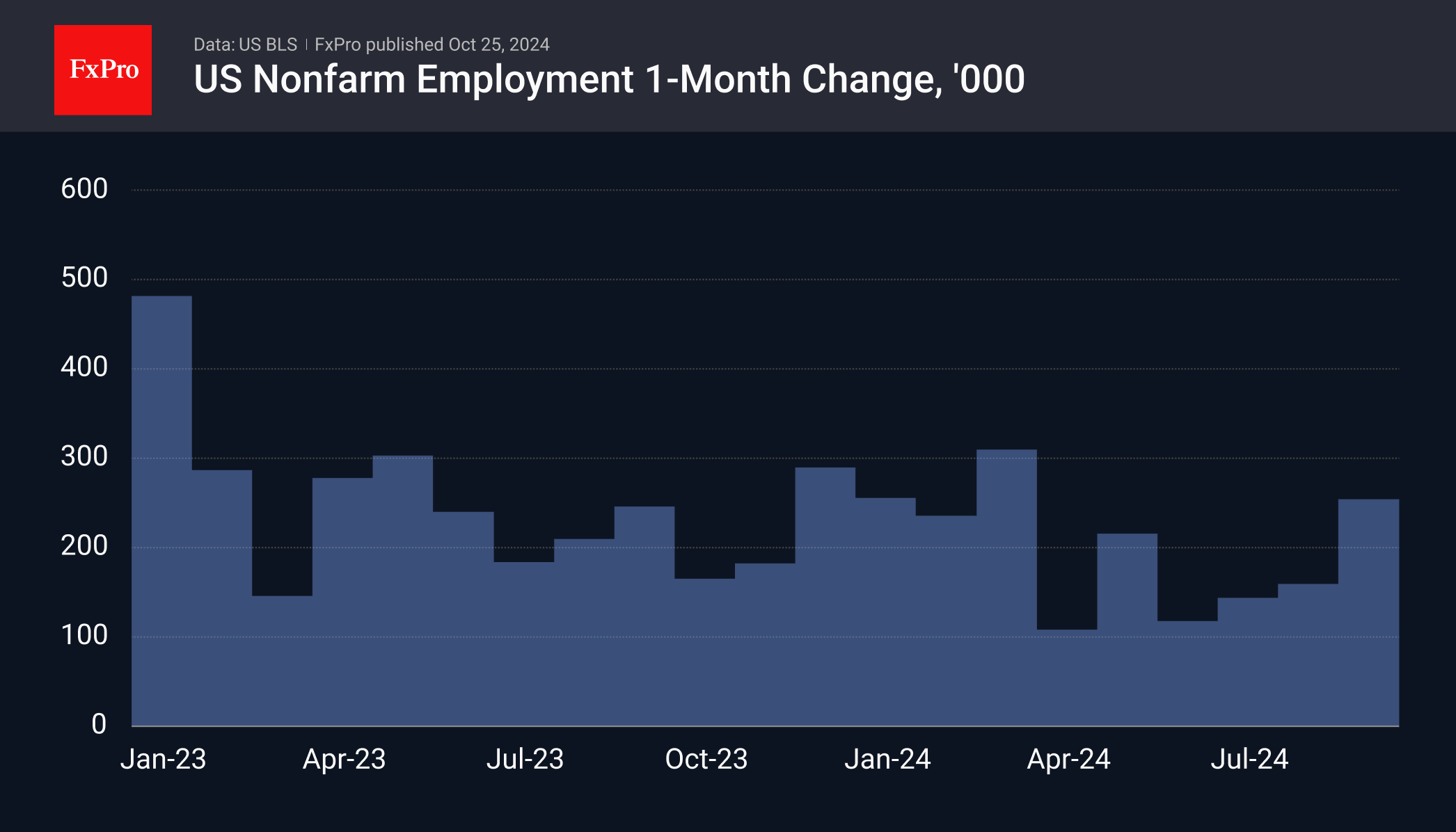
Friday will be the highlight of the week for the US markets, thanks to the October employment report. Throughout the week, the markets and we will be monitoring indirect indicators to assess the situation early.
Not a Stronger Dollar, But Weaker Others
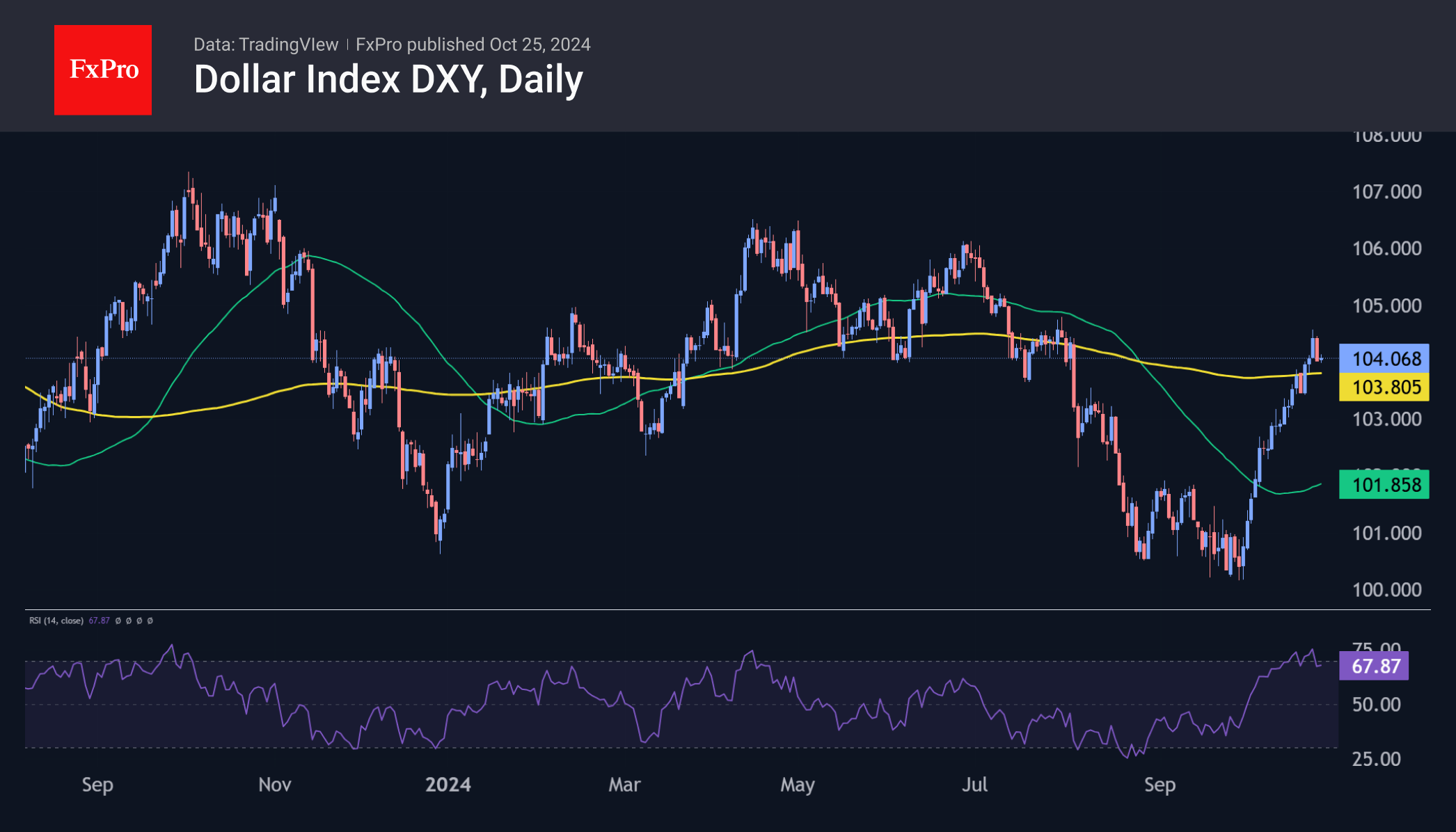
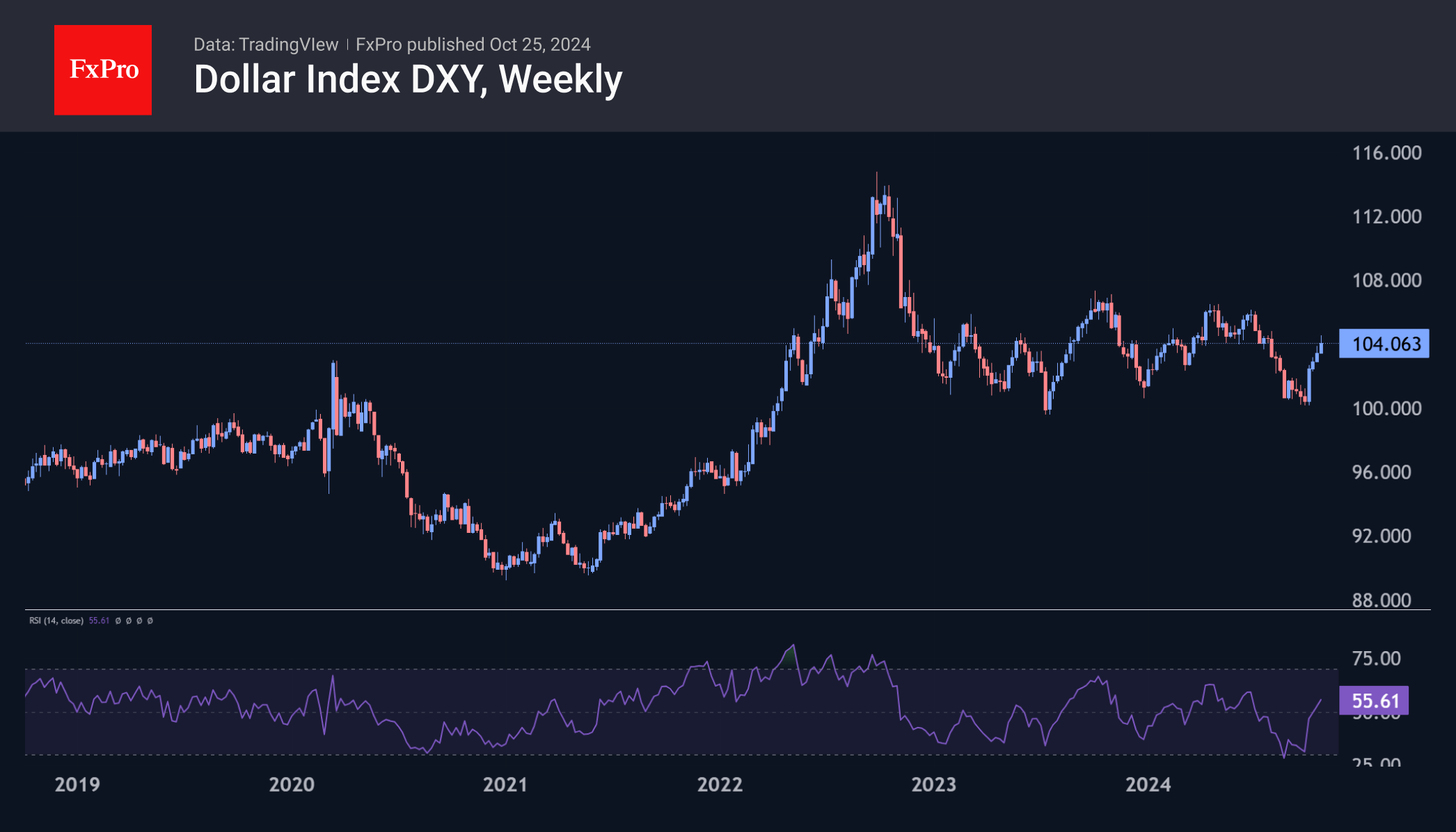
The Dollar Index has climbed 4.5% over the past four weeks, a movement that’s not unusual compared to longer and sharper rallies in recent years.
However, what stands out is that equities and gold are also on the rise alongside it. It’s probably more accurate to talk about a decline in competitors rather than a strengthening of the dollar.
The drop in U.S. bond prices (reflected in rising yields) supports the hypothesis and rejects the idea of a craving for defensive assets.
By the end of the week, this craving had abated somewhat, leading to a fall in risky assets and a correction in the dollar. Traders are de-risking and consolidating ahead of a series of important market events in early November.
There are three potential technical targets for the USD pullback from the current level of 104. The first is the 200-day moving average at 103.8. The second is the intermediate Fibonacci retracement level of 76.8% of the advance at 103.33. The third is the classic 61.8% retracement to 102.7.
Dominant Dollar Breaks Key Resistance Alongside 10-Year Yield
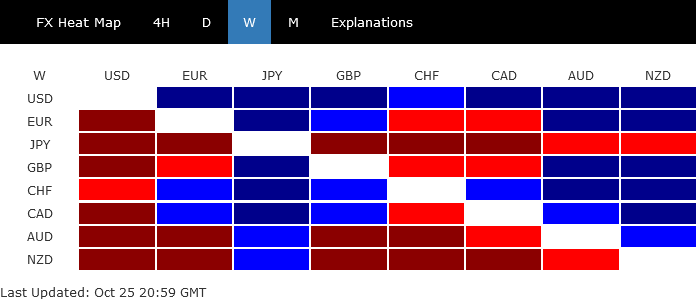
Dollar emerged as the unequivocal winner in the currency markets last week. Both Dollar Index and 10-year US Treasury Yield surged through their respect technically significant 55 W EMA resistance. It remains to be seen whether traders are positioning ahead of the US presidential election results, which are less than two weeks away. However, the pullback in stock markets indicates that investors are exercising caution instead. In any case, the upcoming fortnight will be pivotal for markets in determining medium-term trends.
Conversely, Japanese Yen suffered an extended selloff, ending the week as the worst-performing major currency. Verbal interventions by Japanese officials had limited effect, likely hindered by ongoing political uncertainty surrounding the snap election. This uncertainty also weighed heavily on Nikkei, which saw significant declines. Additionally, subdued performance in Hong Kong and Chinese stocks contributed to the regional weakness. Yen's weakness was mirrored by New Zealand Dollar and Australian Dollar, both of which closed near the bottom of the performance chart.
Meanwhile, European occupied middle ground. Euro displayed resilience despite intensified discussions within ECB about accelerating monetary easing measures. Canadian Dollar was among the firmer currencies last week, alongside Swiss Franc. However, their strength was modest, and neither currency matched the dominance exhibited by the greenback.
Investor Caution Grows Ahead of US Payrolls and Presidential Election
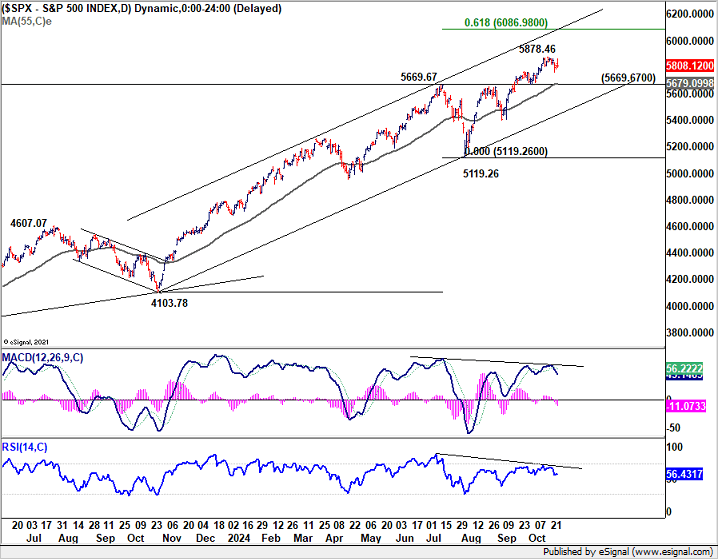
Investors are turning increasingly cautious as the global markets prepare for a high-stakes two weeks ahead, marked by the upcoming US non-farm payroll report and a tightly contested US presidential election. Last week, both DOW and S&P 500 ended their recent winning streaks, closing with significant declines. Although NASDAQ managed a record intraday high on Friday, the gains didn’t hold through to the close, reflecting an underlying cautious tone. Meanwhile, 10-year Treasury yield to stood firm above 4.23% after strong rally, supporting Dollar, which closed as the best performing currency among majors.
The non-farm payroll report next week is expected to be pivotal for shaping the Fed’s anticipated easing cycle. Futures markets currently imply a 95.1% probability of a 25bps rate cut in November and a 74.6% chance of another 25bps reduction in December. However, these odds are likely to shift depending on the strength or weakness of the payroll report.
In addition, the US presidential election looms just under two weeks away, adding another layer of uncertainty to markets. The election remains tight, with Democratic candidate Kamala Harris and Republican candidate Donald Trump running neck-and-neck. The election’s outcome could bring significant shifts to fiscal policy, bond issuance, and even broader trade and foreign relations.
Given these unknowns, market responses are likely to be unpredictable. Rather than speculating on the election results or market reactions, it may be beneficial to focus on the technical picture.
S&P 500 should have formed a short term top at 5878.46 and some consolidations could be seen in the near term. Deeper retreat might be seen to 55 D EMA (now at 5679.09). But outlook will stay bullish as long as 5669.67 resistance turned support holds. The long term up trend would still be in favor to 6000 handle, or further to 61.8% projection of 4103.78 to 5669.67 from 5119.26 at 6086.98, at a later stage.
However, considering bearish divergence condition in both D MACD and RSI, firm break of 5669.67 will confirm medium term topping, and set up deeper correction back to channel support (now at 5445) or even further to 5119.26 structural support.
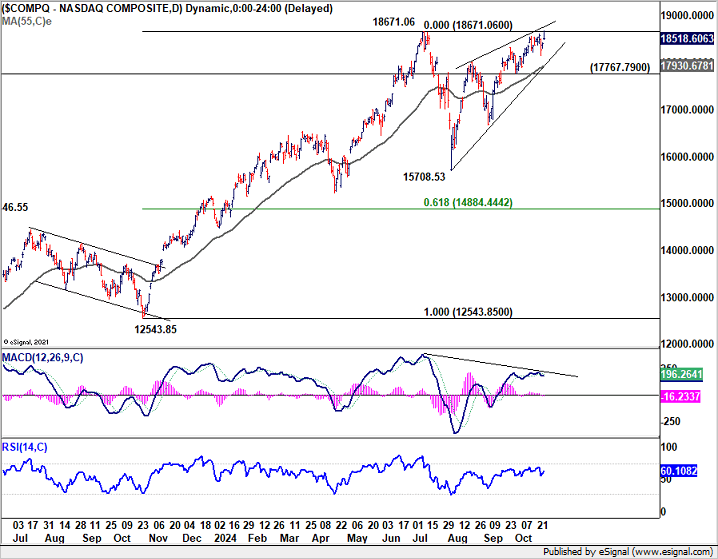
NASDAQ's rise from 15708.53 is still seen as the second leg of the corrective pattern from 18671.06 high. Firm break of 17767.79 support should confirm rejection by 18671.06, and the start of the third leg back towards 15708.53 support.
Both 10-Year Yield and Dollar Index Surge Past 55 W EMA, More Bullish Momentum on the Horizon?
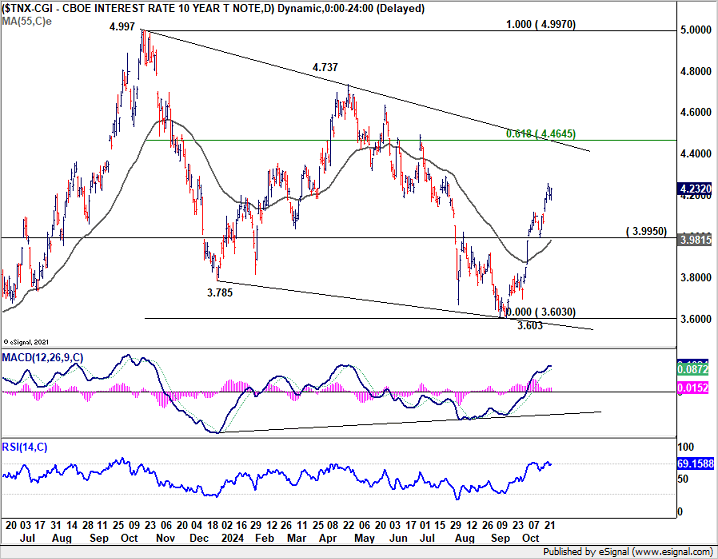
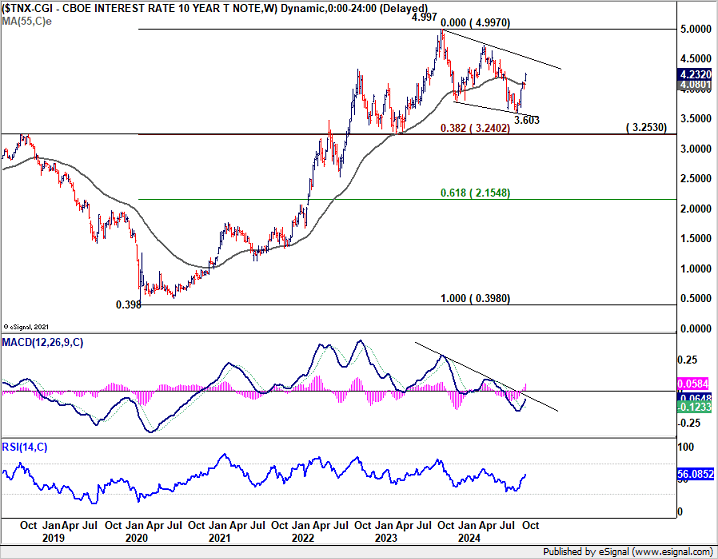
US 10-year yield surged sharply last through 55 W EMA last week to close at 4.232. The development further affirmed the bullish case that whole correction from 4.997 has completed with three waves down to 3.603. Near term outlook will remain bullish as long as 3.995 support holds. Next near term target is 61.8% retracement of 4.997 to 3.603 at 4.464.
From a pure technical point of view, it's plausible that the up trend from 0.398 is ready to resume through 4.997 high. However, it's premature to make definitive judgments without considering the still uncertain fundamental picture. The eventual path of yield depends on whether the next US administration would flood the markets with bond issuance for its expansive fiscal policies.
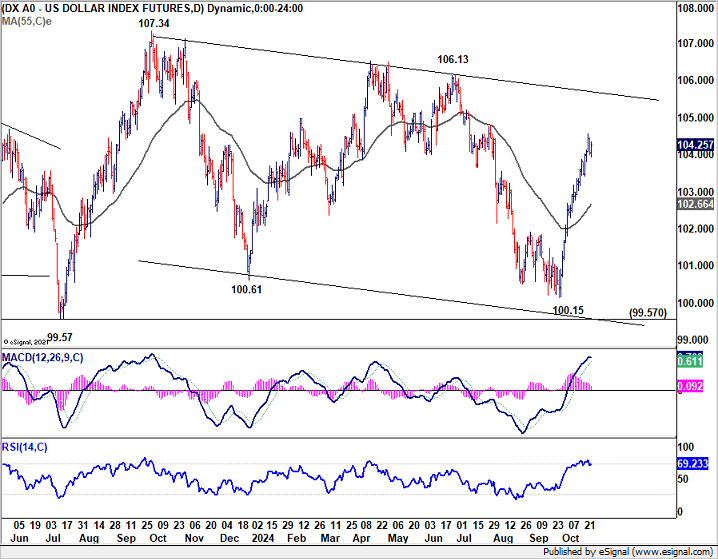
Dollar Index also broke through 55 W EMA decisively last week. Further rally is now expected as long as 55 D EMA (now at 102.66) holds. Next target is 106.13 resistance.
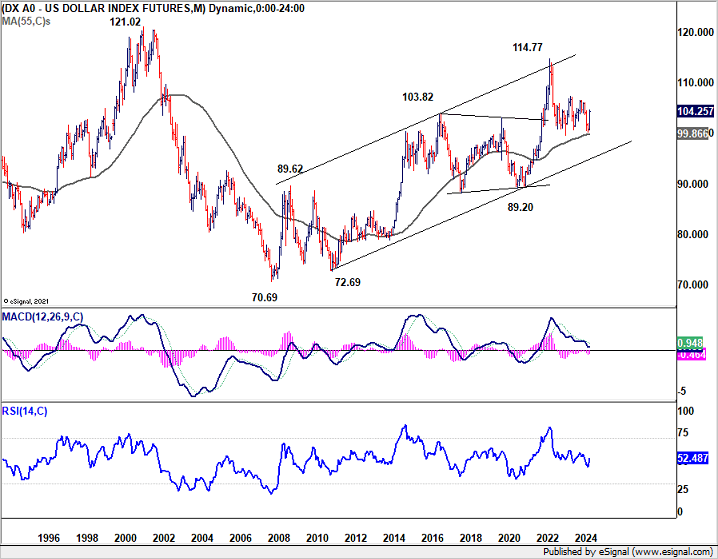
Meanwhile, it should be emphasized again that Dollar Index has just drawn strong support from rising 55 M EMA (now at 99.86). Current development is raising the chance that whole correction from 114.77 has already completed, at 99.57 or 100.15. Further break of 106.13/107.34 resistance will solidify this bullish case, and target 114.77 again in the medium term.
While the upcoming NFP would have huge impact on Dollar the in the near term, the medium term path would hinge on the election result, and the impact on risk sentiment as well as treasury yields.
Yen Decouples from Nikkei Amid Japan's Political Uncertainty
Yen has unexpectedly decoupled from the Nikkei index over the past week. Despite Yen weakening beyond the significant 150 level against Dollar, Nikkei 225 has suffered notable declines, unable to capitalize on the traditionally positive effect a weaker Yen has on export-oriented stocks. The primary driver behind this divergence is the heightened political uncertainty stemming from the snap election in Japan. Meanwhile, attempts by Japanese authorities to arrest Yen's decline through weak verbal interventions have been largely ineffective.
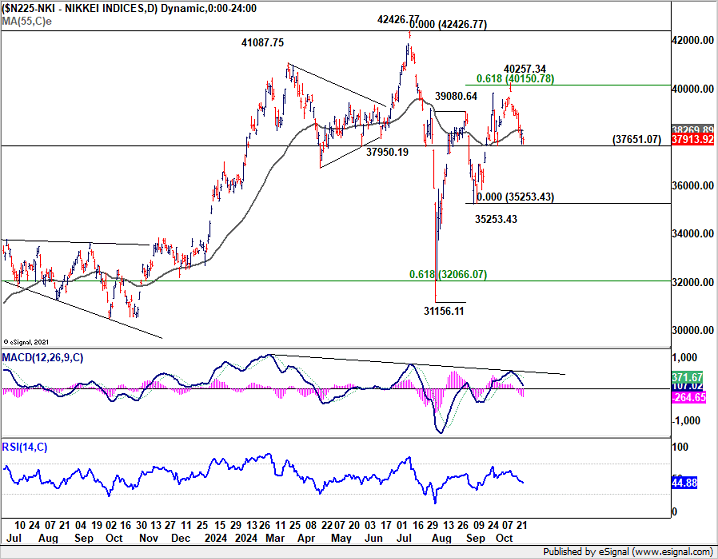
Technically, Nikkei is approaching a critical support level at 37651.07 following the two-week decline. Firm break there should confirm that entire rebound from 31156.11 has completed with three waves up to 40257.34. In this, deeper fall should be seen back to 35253.34 first, as the third leg of the corrective pattern from 42426.77 commences.
The key question is whether USD/JPY will recouple with Nikkei's movement if the index continues to slide. For now, further rise in USD/JPY would remain in favor as long as 55 D EMA (now at 148.16) holds. Decisive break of 61.8% retracement of 161.94 to 139.57 at 153.39 will extend the rally from 139.57, as the second leg of the corrective pattern from 161.94, to retest 161.94 high.
Euro Finds Support from PMI After Intense ECB Debates
It was an active week of commentary from ECB policymakers, with discussions centered on three key issues: whether to implement a 25 bps or 50 bps rate cut in December, the risk of inflation undershooting, and the need of lowering interest rates below neutral level. While dovish members pushing for more aggressive cuts are vocal, they currently remain a minority within the Governing Council.
While the debates put come pressure on Euro, the currency managed to stabilize, aided by the latest PMI data from Eurozone. The PMIs presented at worst a mixed but not wholly negative picture. While France showed signs of economic deterioration, Germany's data indicated improvement. An uptick in manufacturing activity helped offset a downtick in the services sector. Crucially, persistent inflation and wage growth are likely to keep ECB's hawkish members cautious about rapid easing, suggesting that a significant rate cut may not be imminent.
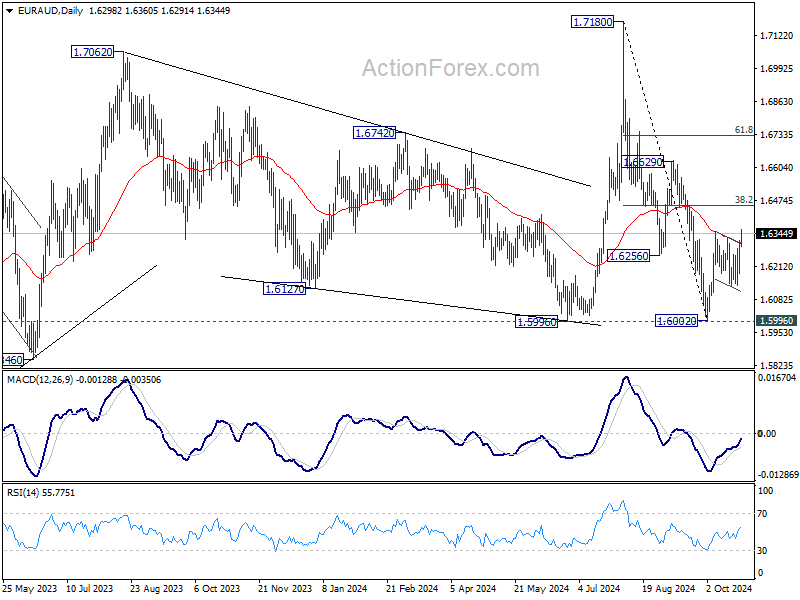
In the currency markets, Euro weakened against Dollar, influenced by Dollar's strength and expectations of divergent monetary policies. However, the selloff against British Pound has slowed, and Euro remains range-bound against Swiss Franc. Notably, EUR/AUD is showing signs of strength as the rebound from 1.6002 gains momentum.
Technically, EUR/AUD's fall from 1.7180 could have completed with three waves down to 1.6002, after defending 1.5996 key support. Further rise is now in favor to 38.2% of 1.7180 to 1.6002 at 1.6452. Sustained break there should confirm near term bullish reversal, and target 61.8% retracement at 1.6730 and above.
USD/CAD Weekly Outlook
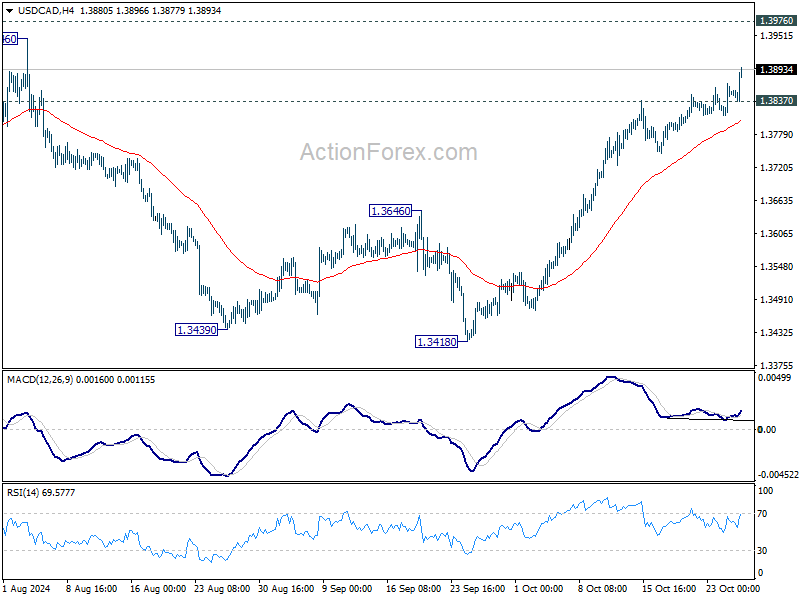
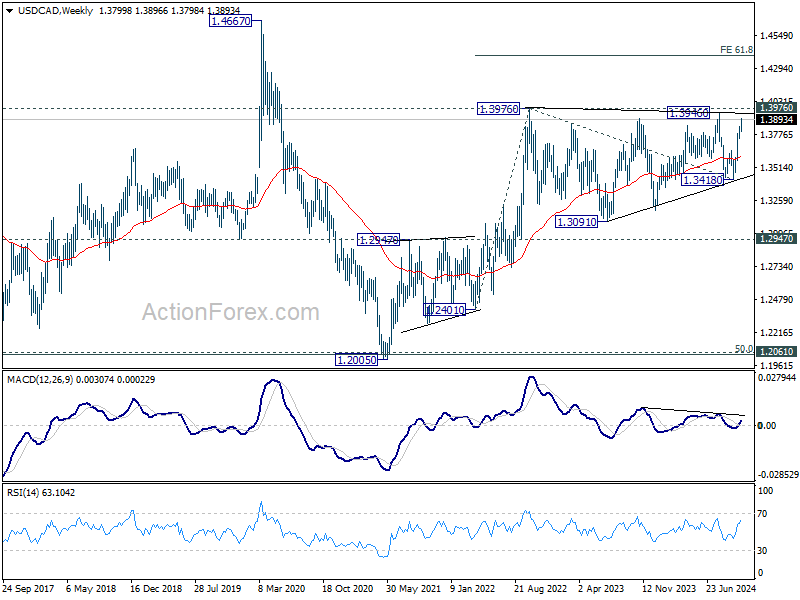
USD/CAD's rally from 1.3418 continued last week and there is no clear sign of topping yet. Initial bias stays on the upside this week for 1.3946/76 resistance zone. On the downside, below 1.3837 minor support will turn intraday bias and bring consolidations first.
In the bigger picture, sideway consolidation pattern from 1.3976 (2022 high) might still extend further. While another decline cannot be ruled out, strong support should emerge above 1.2947 resistance turned support to bring rebound. Rise from 1.2005 (2021 low) is still in favor to resume at a later stage. Decisive break of 1.3976 will target 61.8% projection of 1.2401 to 1.3976 from 1.3418 at 1.4391.
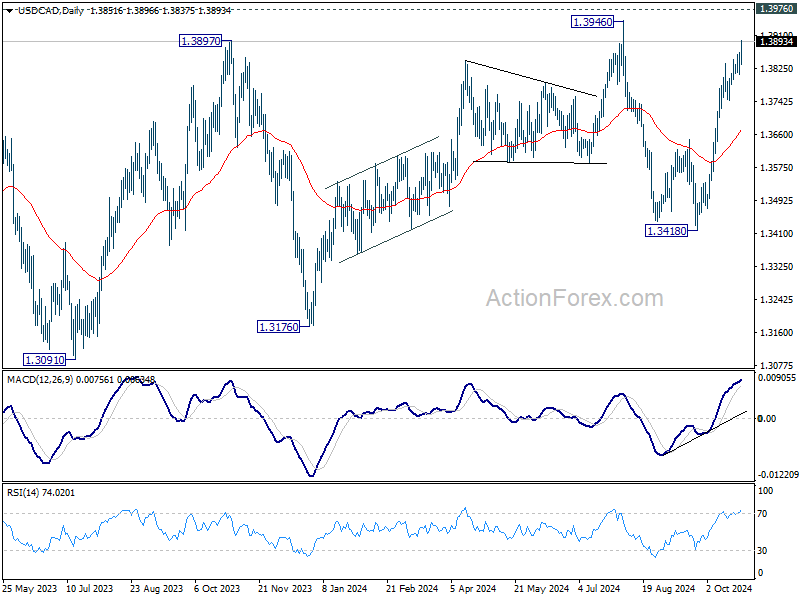
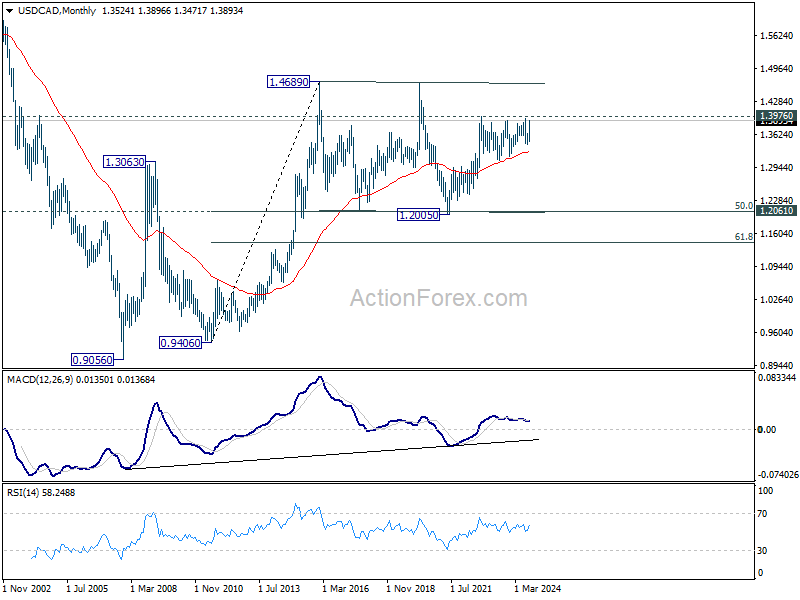
In the longer term picture, price actions from 1.4689 (2016 high) are seen as a consolidation pattern, which might have completed at 1.2005. That is, up trend from 0.9506 (2007 low) is expected to resume at a later stage. This will remain the favored case as long as 1.2947 resistance turned support holds.
EUR/USD Weekly Outlook
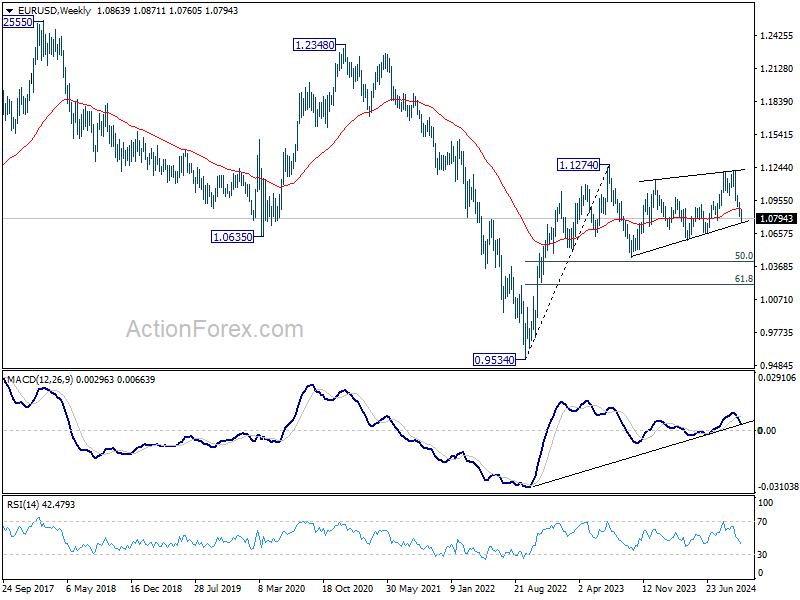
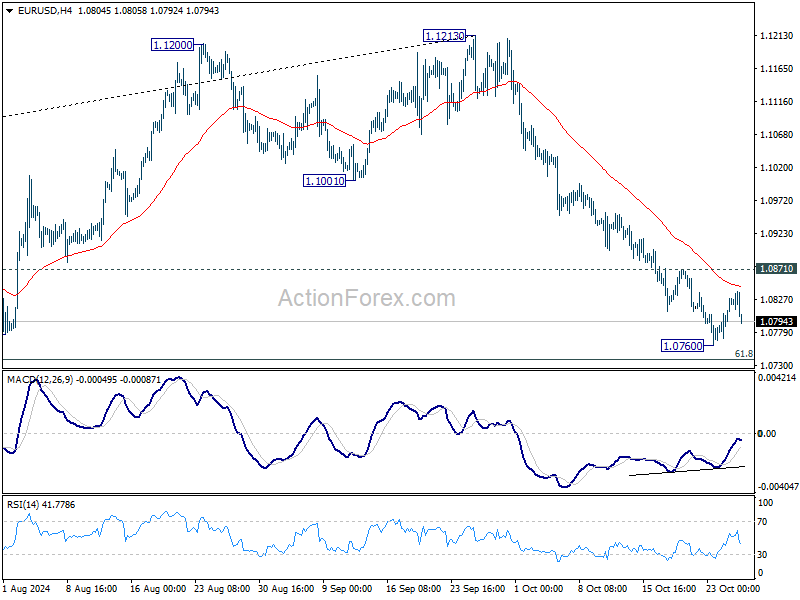
EUR/USD's fall from 1.1213 extended to as low as 1.0760 last week before forming a temporary bottom there and recovered. Initial bias remains neutral this week for consolidations. Further decline is expected as long as 1.0871 resistance holds. Below 1.0760 will target 61.8% retracement of 1.0447 to 1.1213 at 1.0740. Firm break there will target 1.0601 support next. However, considering bullish convergence condition in 4H MACD, break of 1.0871 will indicate short term bottoming, and turn bias back to the upside for 55 D EMA (now at 1.0962).
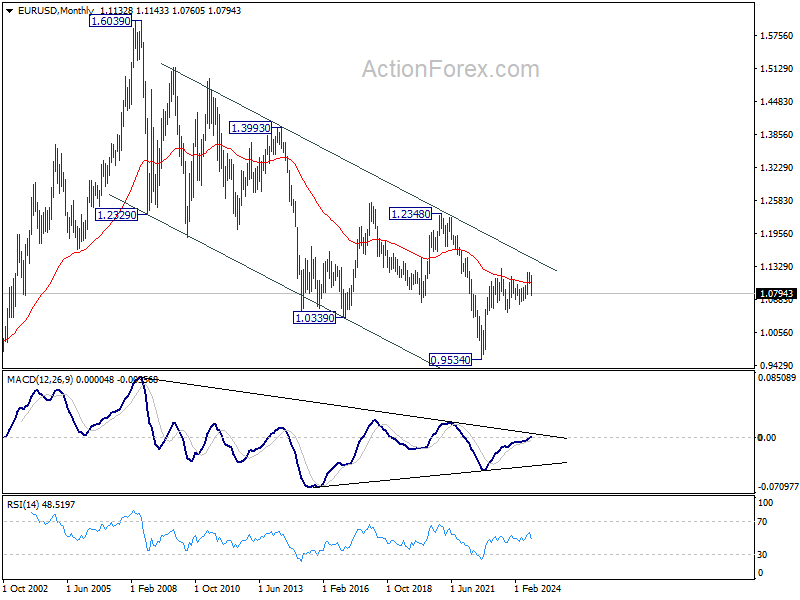
In the bigger picture, price actions from 1.1274 (2023 high) are seen as a consolidation pattern to up trend from 0.9534 (2022 low), with fall from 1.1213 as the third leg. Downside should be contained by 50% retracement of 0.9534 (2022 low) to 1.1274 at 1.0404, to bring up trend resumption at a later stage.
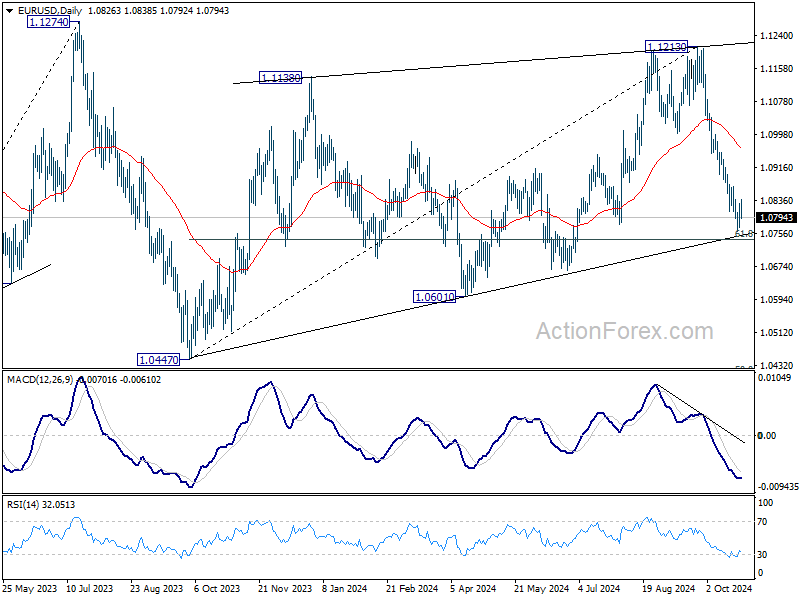
In the long term picture, a long term bottom is in place at 0.9534 (2022 low). But for now, EUR/USD is struggling to sustain above 55 M EMA (now at 1.1011). Outlook is neutral at best at this point.