Thu, Apr 09, 2026 14:20 GMT
More

    Sample Category Title

    US Private Payrolls to Signal March Hiring Trends Ahead of Friday’s NFP

    Danske Bank

    In focus rest of the week

    In the US, the ADP private sector employment report and ISM manufacturing data for March are set to be released. February's ADP report showed a gain of 63k private sector jobs. Weekly data highlighted a recovery, with employers adding an average of 10k jobs per week through early March. However, this momentum weakened towards the end of the period, indicating a potential slowdown in job growth. Meanwhile, February's ISM manufacturing report revealed a sharp rise in the prices index to 70.5, the highest since June 2022, driven by increased imports amid stagnant domestic production. For March, it will be interesting to see if the ISM data reflects any effects of the Iran conflict, particularly regarding rising input costs.

    We again have speeches from ECB (Cipollone) and Federal Reserve (Barr and Musakem)

    Today's Swedish PMI for March will be the first indicator to reflect the impact of the US-Israel-Iran war, as the NIER-indicator was collected too early. Last month's strong PMI at 56.1 highlighted robust production and employment. For March, focus will be on the price component, following increases seen in preliminary euro area, UK, and US data.
    On Friday, key US labour market data will be released. We project non-farm payroll growth at +30k, below consensus, with the unemployment rate rising to 4.5% and average hourly earnings increasing by +0.3% m/m SA. Recent indicators, including declines in daily job postings and weekly private sector employment growth, point to a softer labour market.

    Economic and market news

    What happened overnight

    US-Iran tensions remain high despite signs of possible de-escalation. President Trump signalled a possible end to the US-Iran war within weeks, stating the US could leave without a formal deal, while Secretary of State Rubio hinted at potential talks with Tehran. Iran's president expressed readiness to halt fighting if assured of no further attacks, though its foreign minister warned of prolonged conflict. Asian markets rallied on hopes of de-escalation as questions remain over Washington's strategy. Wednesday night, Trump will address the nation regarding Iran.

    Japan's Q1 Tankan survey revealed a rise in large manufacturers' sentiment to its highest level since Q4 2021, reflecting resilience in the sector despite challenges like rising energy costs and a weaker yen. Sentiment among large non-manufacturers held steady signalling stability in services. However, record corporate inflation expectations and surging fuel costs from the Iran war raise risks. Markets may focus on whether these factors push the Bank of Japan towards a rate hike at its upcoming meeting.

    In China, RatingDog PMI fell to 50.8 in March from February's 52.1, missing forecasts of 51.6. While growth continued for a fourth month, expansion slowed, with export orders decelerating. Input costs rose at their fastest rate since March 2022, and output prices surged, driven by Middle East tensions, highlighting mounting inflationary pressures despite steady production and new orders.

    What happened yesterday

    In the euro area, March HICP inflation rose to 2.5% y/y, slightly below the expected 2.6% but up from 1.9% in February. Core inflation aligned with expectations at 2.3% y/y. The increase was driven entirely by energy inflation, which surged 6.8% m/m, the second-largest rise since March 2022. No war-related effects were visible in other components. While the report is less concerning than feared, giving the ECB some more time to "wait and see", energy prices continue to rise. The ECB is likely to focus on April's inflation data and forward-looking indicators before deciding on policy changes.

    Meanwhile, the EU Energy Commissioner has urged member states to prepare for prolonged disruptions in jet fuel and diesel supplies, calling for coordinated actions to stabilise energy prices and address inflationary risks.

    In the ECB space, officials Muller, Panetta and Rehn highlighted inflationary risks and the potential for monetary policy adjustments in response to the Iran conflict and elevated energy prices. Muller indicated that interest rates are likely to rise in the coming quarters, questioning the ECB's 2026 inflation forecast of 2.6% as overly optimistic. Panetta stressed the need to prevent a wage-price spiral and ensure monetary policy remains proportionate. Rehn, however, struck a cautious tone, stating that a rate hike is not guaranteed and that decisions will be made on a meeting-by-meeting basis, with a focus on the medium-term inflation outlook. All emphasised vigilance against second-round effects, as euro-area inflation reached 2.5% in March.

    In the US, JOLTS job openings dropped to 6.882m in February, below the consensus of 6.918m, while January was revised upwards to 7.24m. The job openings-to-unemployment ratio fell to 0.9, signalling weaker wage growth in the next six months as workers' bargaining power diminishes. Hiring slowed, while involuntary layoffs edged higher, offering overall dovish signals for the Fed. Meanwhile, the Conference Board's March consumer sentiment unexpectedly improved, driven by a stronger assessment of the current situation. However, future expectations weakened as average inflation expectations rose to 6.2% from 5.5%, reflecting recent fluctuations in petrol prices.

    In the Fed space, Kansas City's Schmid warned that rising energy prices could have a lasting impact on inflation, already near 3% before the Iran war. He stressed the need for policy measures to anchor expectations, highlighting risks to both headline and core inflation. While growth impacts may be modest, Schmid's focus on inflation aligns with speculation about potential rate hikes, contrasting with other officials' cautious approach.

    In Sweden, Riksbank's Per Jansson reaffirmed his comments from the Minutes, noting that low inflationary pressures provide room to tolerate modest increases without risking excessive inflation. He emphasised the importance of avoiding premature actions or falling behind the curve. His neutral stance contrasts with Thedeen and Seim's hawkish bias, underscoring the flexibility of the mildly expansionary policy rate for potential adjustments.

    Equities: Global equities were significantly higher yesterday rising 2.3%, led by the US indices with 83% of the names in the S&P500 up. S&P500 rose 2.9%, Nasdaq +3.8%, Russell2000 +3.4% and Stoxx600 +0.4%, with the latter seen in context of outperformance on Monday. Mag7 outperformed the 493, rising 4.5% and 2.2% respectively. Only the Energy and Utilities sectors declined yesterday. The positive sentiment carried into the Asian session and the futures.

    FI and FX: While quarter-end flows set the tone during yesterday's European session the renewed optimism wrt. a possible end to the Iran war has been the dominant driver in both FI and FX markets in the last 12 hours. Yields are lower across the board in both the long- and short-end of curves while CEEs, ZAR and SEK have been the outperformers in FX. Energy prices have moved considerably lower and EUR/USD is now back above the 1.15-level.

    Please note that due to the Easter holidays the next edition of the Danske Morning Mail will be distributed on Tuesday, 7 April.

    AUD/USD Daily Report

    Daily Pivots: (S1) 0.6854; (P) 0.0.6879; (R1) 0.6926; More...

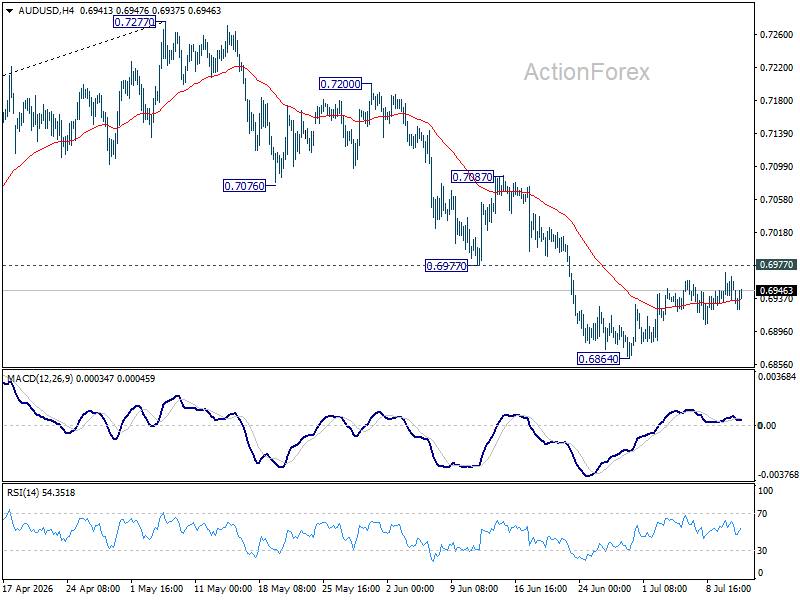
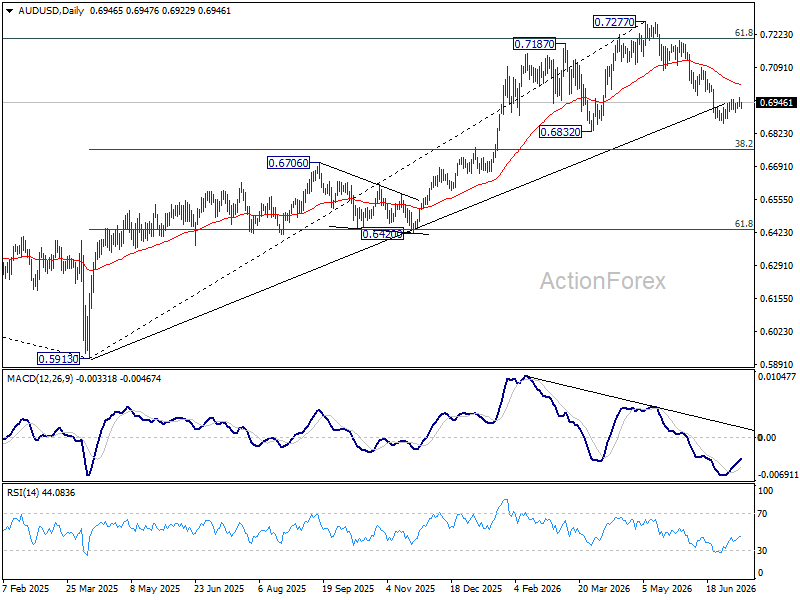
    A temporary low should be in place at 0.6832 in AUD/USD with current recovery. Intraday bias is turned neutral first. Further decline is expected as long as 0.6978 support turned resistance. Below 0.6832 will extend the decline from 0.7187 to 38.2% retracement of 0.5913 to 0.7187 at 0.6700. However, firm break of 0.6978 will argue that the correction has completed, and bring retest of 0.7817 high.

    In the bigger picture, as long as 0.6706 cluster support holds, rise from 0.5913 (2024 low) should still be in progress. Decisive break of 61.8% retracement of 0.8006 to 0.5913 at 0.7206 will solidify the case that it's already reversing the down trend from 0.8006 (2021 high). However, firm break of 0.6706 will dampen this bullish case, and bring deeper fall back to 0.6420 support, and possibly below.

    Dollar Falls, Stocks Jump as Iran War ‘Finish Line’ Comes Into View

    Markets opened Q2 with a powerful relief rally, as a clear shift in the Iran war narrative—from attrition to conclusion—triggered a sharp repricing across assets. The change in tone from prolonged conflict toward a potential endgame has sparked "finish line" optimism, driving equities higher, pulling the Dollar lower, and easing pressure across risk assets.

    The catalyst lies in a coordinated shift in messaging from Washington. US President Donald Trump signaled a near-term withdrawal, saying “We’ll be leaving very soon,” possibly within “two or three weeks,” while adding that “Iran doesn’t have to make a deal.” The remarks point to a unilateral exit strategy from “Operation Epic Fury,” removing the need for a negotiated settlement and accelerating expectations of de-escalation.

    Reinforcing this shift, Secretary of State Marco Rubio described the situation as approaching a “finish line,” confirming that indirect messages are being exchanged and that a direct meeting is now plausible. He added that if "new people" (implying a change in leadership or a shift in the influence of the IRGC) emerge with a more cooperative stance, that would constitute the political finish line.

    Additionally, Iran’s stance introduces a clear condition to the emerging de-escalation narrative. President Masoud Pezeshkian told EU that Tehran has the “necessary will” to end the conflict, but only if credible guarantees are in place to prevent future aggression. This signals openness to a conclusion, but not a unilateral one, with Iran seeking assurances on long-term security.

    Together, the messages mark a decisive pivot in the narrative—from a war of attrition toward a conclusion phase.

    The immediate impact has been a broad unwind of defensive positioning. US equities surged, with DOW closed up 1,100+ points overnight. S&P 500 rose 2.9% and NASDAQ jumped 3.8%, marking the best single-session performance since March 2025. Also, Asian markets followed with sharp rebounds. Gold has pushed above 4,600 too. The rally reflects not just improved sentiment, but also a positioning reset at the start of Q2, after weeks of risk-off flows tied to escalation fears.

    In energy markets, the shift has capped upside risks. Brent crude, while still elevated around 107, has moved back below 110, suggesting that the worst-case supply disruption scenario is no longer being priced. Nevertheless, war premium is being unwound, but not fully erased, as uncertainty around the Strait of Hormuz and Iran’s strategic posture remains unresolved.

    Currency markets have reacted decisively. Dollar has fallen sharply, losing its war-premium support as safe-haven demand rotates out. Yen has emerged as the strongest performer, benefiting from lower US yields and a broader unwinding of USD longs, while Euro and Aussie have also gained on improving risk appetite.

    However, this is a relief rally driven by expectations, not confirmation. While markets are increasingly pricing a path toward de-escalation, key uncertainties remain. The timeline for withdrawal, the structure of any post-conflict arrangement, and the risk of renewed disruptions in energy flows all remain open questions. Any delay or reversal in these expectations could quickly reintroduce volatility.

    Until rhetoric translates into concrete outcomes, conviction will remain fragile, and the current rally will continue to hinge on whether the anticipated “finish line” becomes reality.

    In Asia, at the time of writing, Nikkei is up 4.87%. Hong Kong HSI is up 2.07%. China Shanghai SSE is up 1.24%. Singapore Strait Times is up 1.91%. Japan 10-year JGB yield is down -0.054 at 2.305. Overnight, DOW rose 2.49%. S&P 500 rose 2.91%. NASDAQ rose 3.83%. 10-year yield fell -0.031 to 4.311.

    Gold Breaks 4,600: Reversal or Bull Trap? Q2 Becomes Battleground

    Gold’s rally above 4,600 looks strong, but the move is driven by relief from easing war tensions, not resolution. Inflation risks continue to build in the background, making Gold's outlook uncertain. Q2 will be the key battleground to determine whether this is a true reversal or a bull trap. Read more.

    Japan's Strong Tankan Signals Support BoJ Normalization Despite External Risks

    Japan’s Tankan survey surprised to the upside, with stronger business sentiment and capex plans signaling resilient corporate activity. More importantly, inflation expectations climbed to record levels, reinforcing the case for further BoJ normalization. However, rising energy costs tied to Middle East tensions continue to cloud the outlook. Read more.

    Japan PMI Manufacturing Finalized at 51.6, War-Driven Cost Pressures Build

    Japan’s manufacturing PMI eased to 51.6 in March, signaling slower growth after February’s 45-month peak. However, the bigger shift came from surging input costs, with firms facing the sharpest price increases in over 18 months due to Middle East tensions. As companies pass on higher costs and turn more cautious, inflation risks are building even as momentum softens. Read more

    AUD/USD Daily Report

    Daily Pivots: (S1) 0.6854; (P) 0.0.6879; (R1) 0.6926; More...

    A temporary low should be in place at 0.6832 in AUD/USD with current recovery. Intraday bias is turned neutral first. Further decline is expected as long as 0.6978 support turned resistance. Below 0.6832 will extend the decline from 0.7187 to 38.2% retracement of 0.5913 to 0.7187 at 0.6700. However, firm break of 0.6978 will argue that the correction has completed, and bring retest of 0.7817 high.

    In the bigger picture, as long as 0.6706 cluster support holds, rise from 0.5913 (2024 low) should still be in progress. Decisive break of 61.8% retracement of 0.8006 to 0.5913 at 0.7206 will solidify the case that it's already reversing the down trend from 0.8006 (2021 high). However, firm break of 0.6706 will dampen this bullish case, and bring deeper fall back to 0.6420 support, and possibly below.


    Economic Indicators Update

    GMT CCY EVENTS Act Cons Prev Rev
    23:50 JPY Tankan Large Manufacturing Index Q1 17 16 15 16
    23:50 JPY Tankan Non - Manufacturing Index Q1 36 33 34 36
    23:50 JPY Tankan Large All Industry Capex Q1 3.30% 3.00% 12.60%
    00:30 AUD Building Permits M/M Feb 29.70% 6.20% -7.20%
    00:30 JPY Manufacturing PMI Mar F 51.6 51.4 51.4
    01:45 CNY RatingDog Manufacturing PMI Mar 50.8 51.8 52.1
    06:30 CHF Real Retail Sales Y/Y Feb 0.90% -1.10%
    07:30 CHF Manufacturing PMI Mar 47.1 47.4
    07:50 EUR France Manufacturing PMI Mar F 50.2 50.2
    07:55 EUR Germany Manufacturing PMI Mar F 51.7 51.7
    08:00 EUR Eurozone Manufacturing PMI Mar F 51.4 51.4
    08:30 GBP Manufacturing PMI Mar F 51.4 51.4
    09:00 EUR Eurozone Unemployment Rate Feb 6.10% 6.10%
    12:15 USD ADP Employment Change Mar 42K 63K
    12:30 USD Retail Sales M/M Feb 0.40% -0.20%
    12:30 USD Retail Sales ex Autos M/M Feb 0.30% 0.00%
    13:30 CAD Manufacturing PMI Mar 51
    13:45 USD Manufacturing PMI Mar F 52.4 52.4
    14:00 USD ISM Manufacturing PMI Mar 52.3 52.4
    14:00 USD ISM Manufacturing Prices Paid Mar 72.5 70.5
    14:00 USD ISM Manufacturing Employment Index Mar 48.8
    14:00 USD Business Inventories Jan 0.20% 0.10%
    14:30 USD Crude Oil Inventories (Mar 27) 2.0M 6.9M


    Gold Price Breaks 4,600: Reversal or Bull Trap? Q2 Becomes Battleground

    Gold Price's break above the 4,600 level this week has reignited bullish momentum, but the move raises a deeper question — is this a genuine reversal or a temporary bounce? After a sharp Q1 correction, Q2 is now shaping up as the decisive battleground that will determine whether Gold is reversing higher or merely recovering within a broader bearish structure.

    The immediate drivers are clear. The pullback in Dollar and US yields has provided a tailwind, while easing geopolitical tensions. US President Donald Trump’s remarks that the US could be “leaving very soon" from the Iran War, possibly within “two or three weeks,” alongside his comment that “Iran doesn’t have to make a deal,” suggest a willingness to exit “Operation Epic Fury” without a formal agreement. This shift has lowered the war premium embedded in Dollar, indirectly supporting gold.

    Still, this is a rebound driven by relief, not resolution. While de-escalation pressures the Dollar and lifts gold, the broader macro backdrop remains conflicted. If Iran maintains its "toll booth" strategy in the Strait of Hormuz, oil is likely to stay above $100, keeping inflation risks elevated. That, in turn, would anchor higher interest rate expectations and limit Gold’s upside.

    Technically, the break above the 38.2% retracement of 5,419.02 to 4,098.45 at 4,602.90 suggests that price action is doing more than just bouncing — it is challenging the prior bearish structure. However, 4,600 is a trigger, not a confirmation. The next key test lies at the 55 D EMA (now at 4789.98), which now serves as the real battleground for bulls and bears.

    Sustained break above 55 D EMA would strengthen the case that the correction from 5,419.02 peak has completed in three waves down to 4,098.45, after drawing support from the key 4,000 cluster support. That will open the path back toward 5,419.02–5,598.38 resistance zone, with prospect of resuming the long term up trend towards the end of the year.

    On the flip side, rejection at 55 D EMA followed by a break below 4,482.53 minor support would argue that the rebound has run its course. That scenario would likely see Gold retest the 4000 psychological level before forming a more durable bottom.

    With the Iran War outcomes and elevated oil price still unresolved, Q2 will separate signal from noise, determining whether Gold’s latest surge marks the start of a new leg higher or just another bull trap.


    Bitcoin Edges Higher, Recovery Signals Early Strength

    Key Highlights

    • Bitcoin started a recovery wave above $66,500 and $67,000.
    • A bearish trend line is forming with resistance at $68,500 on the 4-hour chart of BTC/USD.
    • Ethereum also climbed over 4% and surpassed $2,050.
    • Gold is grinding higher toward the $4,760 resistance.

    Bitcoin Price Technical Analysis

    Bitcoin price remained supported above $65,000 against the US Dollar. BTC formed a base and started a recovery wave above $66,500.

    Looking at the 4-hour chart, the price surpassed the 23.6% Fib retracement level of the downward move from the $72,001 swing high to the $64,915 low. However, the bears seem to be active near the $68,500 resistance.

    There is also a bearish trend line forming with resistance at $68,500. The price is now well below the 100 simple moving average (red, 4-hour) and the 200 simple moving average (green, 4-hour).

    Immediate support sits at $67,000. The first key support could be $66,500. The main breakdown support could be near $65,500. A downside break below $65,500 might start another decline. The next major support is $64,200, below which BTC could decline toward $63,500.

    On the upside, the price now faces resistance near $68,500 and the trend line. The first key hurdle is $69,200, the 200 simple moving average (green, 4-hour), and the 50% Fib retracement level of the downward move from the $72,001 swing high to the $64,915 low.

    A close above $69,200 could send the price toward $71,500. Any more gains might call for a test of $74,000.

    Looking at Ethereum, the price also gained bullish momentum above $2,000, and the bulls could now aim for a move toward $2,200.

    Today’s Key Economic Releases

    • US Retail Sales for Feb 2026 (MoM) – Forecast +0.5%, versus -0.2% previous.
    • US ADP Employment Change for March 2026 - Forecast 40K, versus 63K previous.

    Japan PMI Manufacturing Finalized at 51.6, War-Driven Cost Pressures Build

    Japan’s PMI Manufacturing was finalized at 51.6 in March, down from February’s 45-month high of 53.0, signaling moderation in growth momentum. Even so, the reading still marked the second-strongest performance since July 2022, with Q1 overall delivering the best quarterly showing since Q2 2022.

    S&P Global Market Intelligence's Annabel Fiddes noted that the slowdown coincided with escalation of the Middle East conflict, which survey respondents linked directly to rising cost pressures. Input prices increased at the fastest pace in over a year-and-a-half, driven largely by higher energy costs. Firms responded by raising output prices "at a quicker pace as they sought to protect their margins".

    “While the immediate impact of the war is already feeding through directly to price indicators, it will be important to monitor the PMI data in the coming months to see whether cost and supply chain pressures continue to intensify, and to assess how resilient global demand conditions are," Fiddles added.

    Full Japan PMI Manufacturing final release here.

    Japan’s Strong Tankan Signals Support BoJ Normalization Despite External Risks

    Japan’s Q1 Tankan survey showed business sentiment holding firm, with the Large Manufacturing Index rising from 16 to 17, beating expectations of 16. The Non-Manufacturing Index held steady at 36, also above forecasts of 33. The data points to stable domestic conditions even as external uncertainties persist, and strengthens the case for further normalization by the BoJ.

    Capital expenditure plans added to the constructive tone, with large firms expecting to increase spending by 3.3% in fiscal 2026, slightly above the 3.0% market forecast.

    The survey highlighted strong demand linked to artificial intelligence and semiconductors, reinforcing the view that Japan’s corporate sector continues to benefit from structural tech investment trends. However, the Middle East conflict weighed on petroleum, coal, and chemical sectors.

    More importantly for the BoJ, inflation expectations rose notably. Firms now see inflation at 2.6% one year ahead, up from 2.4%. Projections for three and five years both climbed to 2.5%, the highest on record. This sustained rise reinforces the narrative of a gradual shift in Japan’s inflation dynamics, supporting expectations that the BoJ will continue its path toward policy normalization.

    Full Japan Tankan release here.

    Brent-WTI Falls to 2026 Lows! Oil Corrects as War Resolution Nears – WTI Outlook

    • Oil tumbles as traders are getting more convinced that the conflict is heading towards its end
    • The Brent-WTI spread erases its entire War premium, hinting at softer conditions in a stressed Market
    • Exploring an in-depth Technical Analysis of the commodity

    Traders are now slowly preparing for an end to the US-Iran conflict after 5-weeks of ceaseless, methodical attacks from the US-Israel coalition on IRGC military targets.

    The conflict has caused significant damage and volatility in global Markets, dampening equities and overall risk assets and even hurting traditional safe havens like Metals and bonds amid a rise in inflation expectations.

    Precious Metals like Gold actually began to trade as if they were typical risk assets during the war, as flagged in a HSBC piece – We are indeed in a new age for Markets!

    As always in the Middle East, Crude Oil is right in the center stage, having bounced about 50% since February 27, the Friday that preceded the commencement of the conflict.

    As the war began, the Brent-WTI spread, a historical indicator of energy commodity Market stress, had spiked to $18.65, levels unseen since February 2019 (excluding the extreme COVID spikes).

    This spread is now rushing back towards its yearly and pre-war lows.

    Brent-WTI Spread – Source: TradingView. March 31, 2026

    This indicates a large easing in narrative, at least, which also could compromise Trump's threat to let European and Gulf nations take care of the Strait of Hormuz passage after the military operation.

    In any case, the spread easing in such a manner could further ease tensions in the Energy Market, as the two enemy-counterparties confirm they are engaged in more serious talks.

    China and Pakistan have formulated their own 5-point Peace Plan for a smoother, peaceful process ahead. That same plan wasn’t even criticized by President Trump in his daily address – given how verbal the President typically is, this was a first- and Markets took this as a sign of significant progress, boosting Equity Indexes by 2.50% each in the afternoon session.

    Odds for a US-Iran Ceasefire by April 15 – Source: Polymarket. March 31, 2026

    For now, Polymarket odds for a ceasefire by April 15 are still only around 25%. Still, a lack of a ceasefire doesn't prevent a truce – how volatile that truce will be and under what conditions will dictate whether more consistent upside is warranted in risk assets.

    Upcoming headlines and developments will have to be contrasted heavily by Participants, particularly as expectations from here will be elevated, and today's session moves might be exaggerated by the Month-End flows.

    As the situation becomes clearer as the week continues, let's dive into a multi-timeframe analysis of WTI (US) Oil to identify levels of interest and put the odds in the trader's favor to capitalize on the situation.

    US Oil Multi-Timeframe Analysis

    WTI Daily Chart

    WTI Oil Daily Chart – March 31, 2026. Source: TradingView

    WTI's steep rise in previous sessions has seen a significant stop with the turn in narrative.

    Testing $107.80 in the overnight trading, the key resistance was then rejected, but the price action isn't so clear yet.

    Tumbling to $100 and reverting higher, traders will want to see a clear rejection to the downside to assume a clearer path ahead.

    The past two daily candlesticks have formed a Tweezer top, which coincides with a turn in RSI plus a bearish RSI pattern, all pointing to some downside.

    But timing will be important to avoid getting tricked by a sudden change in atmosphere – Waiting for a clear break below today's lows could be a better way to avoid getting stuck short.

    WTI 4H Chart and Technical Levels

    WTI Oil 4H Chart – March 31, 2026. Source: TradingView

    As seen in the intraday charts, recent candles are more pointing towards a very hesitant price action that a decidedly bearish reversal – In such setups, waiting for breakouts with Stop orders could prove a more efficient strategy.

    • For bears, watch for a clean break below $100, with extra confirmation below $96.64 (4H 50 MA) and $92.70 for an final conflict support break.
    • Bulls will want to see an extension and close above $108 to head back towards $116.

    WTI Technical Levels:

    Resistance Levels

    • $106 to $108 June 2022 Resistance (morning highs)
    • $110 psychological level
    • 2022 and Monday highs $116 to $120
    • Ukraine War Spike $120 to $124

    Support Levels

    • $98 to $100 Momentum Pivot
    • $96.64 4H 50-MA
    • Pivotal Support $93.00 to $95
    • $87 to $90 mini-Support
    • $82.80 to $84 Key Support
    • War flows Pivot $65.00 to $66.00

    1H Chart and action levels

    WTI Oil 1H Chart – March 31, 2026. Source: TradingView

    The short-timeframe is more prone to fakeouts, particularly as headlines can quickly change the narrative, but for the most eager and impatient traders, a 1H Head and Shoulders pattern in arising, pointing towards $96.66 (200-Hour MA).

    A rally back above $106 would void the technical pattern.

    Safe Trades and keep your eyes on the news!

    Gold (XAU/USD) Rallies 3%, Eyes Acceptance Above $4600/oz Handle for Bullish Momentum to Continue

    • Gold (XAU/USD) prices have broken above the key $4,600/oz psychological barrier.
    • Middle East tensions are escalating as diplomacy stalls and the US continues a military buildup, fueling market uncertainty.
    • The rare negative correlation between Crude and Gold appears to be shifting, with rising Oil prices potentially benefiting Gold by compressing real interest rates and bringing back the "inflation hedge" narrative.
    • Gold needs to find acceptance above the $4600/oz handle for bullish momentum to continue.

    Gold prices have risen over the last two days to pierce above a key psychological barrier at the $4600/oz handle. The precious metal is eyeing acceptance above this level which could lead to further upside in the days ahead, if the geopolitical picture remains supportive.

    Middle East Tensions: Diplomacy stalls as military buildup adds to market uncertainty

    Hopes for a swift de-escalation in the Middle East have taken a hit as Iran signals a clear reluctance to engage in direct negotiations with the US. This friction is undermining what was already a fragile diplomatic process, leaving market participants wary of a prolonged standoff.

    Iranian President Pezeshkian summed it up by saying Iran was attacked twice during the talks, proving the US does not believe in diplomacy. However, he followed this up by saying that Iran is ready to end the war, but wants guarantees. This mixed messaging is similar to what we have been seeing from the US administration as well.

    Adding fuel to the fire, the US continues to deploy additional troops and military assets to the region. As uncertainty climbs, the focus remains firmly on how these developments will impact broader market sentiment and the demand for safe-haven assets.

    Oil and Gold correlation shifts

    Since the onset of the conflict in the Middle East, we have witnessed a rare and sustained negative correlation between Crude and Gold. Usually, these two move in tandem as hedges against geopolitical risk.

    However, the recent spike in Oil prices forced a massive repricing of Fed expectations:

    Rising Oil = Inflationary Pressure: As energy costs soared, markets were forced to price out previously anticipated Fed rate cuts.

    Gold’s Sensitivity: With the "pivot" narrative delayed, Gold lost its luster as a non-yielding asset, leading to the sharpest decline in nearly two decades.

    The tide may be turning. Over the last few sessions, we’ve seen Gold and Oil begin to rise at the same time, a signal that the negative correlation is changing.

    With Fed funds futures now effectively ruling out further rate cuts, but the market remaining skeptical of additional hikes, we enter a new phase. If the Fed remains on hold while Oil continues to climb, inflation expectations will naturally rise. This scenario would lead to a compression in real interest rates (nominal rates minus inflation).

    As long as the Fed remains sidelined and refuses to entertain further hikes, rising Oil prices may actually provide a tailwind for Gold by dragging real yields lower.

    For gold bugs, the "inflation hedge" narrative might finally be back on the table.

    Where to next?

    The US dollar is still playing a role and with high impact US data ahead this week we could still see some volatility.

    However, it is Easter this weekend and thus the closer to the weekend we get the greater the probability that we could see a thinning of liquidity and thus some sideways price action.

    Market participants will still be keeping a close watch on the geopolitical developments in the Middle East and any changes to the situation could impact gold prices.

    For all market-moving economic releases and events, see the MarketPulse Economic Calendar. (click to enlarge)

    Technical Outlook - Gold (XAU/USD)

    Gold (XAU/USD) is showing signs of a technical recovery on the H4 chart, successfully reclaiming the $4,600 handle.

    After a period of aggressive selling, price action has established a solid ascending trendline, suggesting that the "buy the dip" mentality is returning to the market.

    Key Levels to Watch:

    • Resistance: The immediate hurdle sits at $4,700. A sustained break above this level could open the door for a retest of the $4,800 area.
    • Support: The recent pivot at $4,500 remains a crucial psychological floor. As long as the ascending trendline holds, the bullish structure remains intact.

    The RSI is currently hovering around 62, indicating that while momentum is positive, there is still room to run before hitting overbought territory. Bulls will be looking for a daily close above $4,600 to confirm this recovery phase.

    Gold (XAU/USD) Four-Hour Chart, March 31, 2026

    Source: TradingView (click to enlarge)

    Nikkei 225 Wave Analysis

    Nikkei 225: ⬆️ Buy

    • Nikkei 225 reversed from support zone
    • Likely to rise to resistance level 54000.00

    Nikkei 225 recently reversed from the support zone between the pivotal support level 51235.00 (which has been reversing the price from January), lower daily Bollinger Band and the 61.8% Fibonacci correction of the upward impulse from October.

    The upward reversal from this support zone is currently forming the daily Japanese candlesticks reversal pattern Morning Star – strong buy signal for Nikkei 225.

    Given the long-term daily uptrend, Nikkei 225 can be expected to rise to the next resistance level 54000.00 (which has been reversing the price from the middle of March).