

Sample Category Title
EURUSD Gets Set to Go
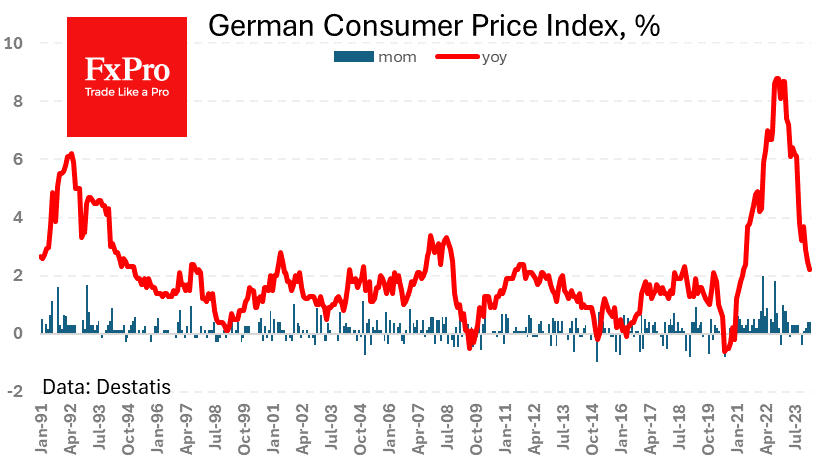
The slowdown in German inflation is fuelling hopes that the ECB will ease policy in the coming months. German CPI rose 0.4% m/m, weaker than the 0.5% expected. Annual inflation slowed from 2.5% in February to 2.2% in March, the lowest since May 2021.
Germany’s reading is a useful guide to what to expect in the eurozone on Wednesday, which is likely to come in weaker than average market expectations for headline inflation to slow from 2.6% to 2.5% and core inflation to slow from 3.1% to 3.0%. At the same time, it would take a significant deviation from the forecasts to have a material impact on prices.
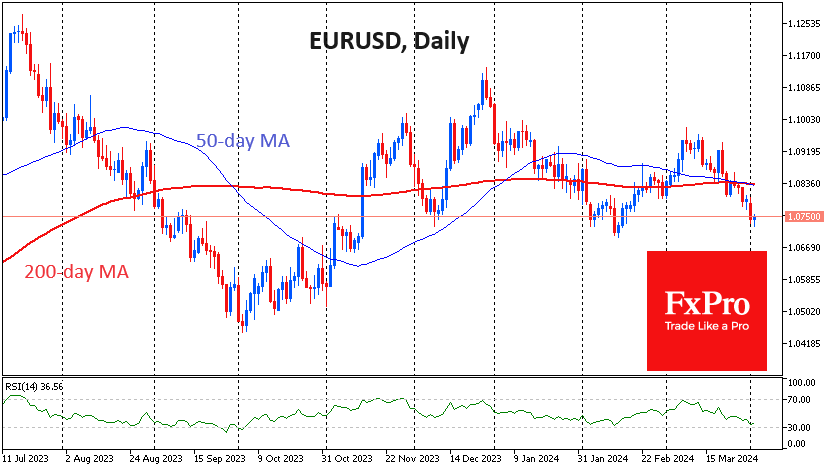
EURUSD slipped to 1.075, the lower boundary of the range since November. This is a good starting position for new momentum on a breakout or bounce. US data released on Monday was supportive of a strong dollar, while German inflation data was in favour of a weaker euro. If the balance of power remains the same, EURUSD may decide to move towards 1.05.
Sunset Market Commentary
Markets
Core bonds dropped with a continued rise in oil prices ($88.5/b) serving as a common factor. German Bunds underperform US Treasuries. That’s partially a catch-up move as European markets missed out on US action yesterday (Easter Monday). German yields add between 1 (2-y) to 14.3 bps (30-y). The curve steepening (less inverse) happens against the background of the ECB survey showing consumer inflation expectations decreasing to 3.1% for the 1-year ahead gauge (but stabilizing at 2.5% longer term (3-y)) as well as German actual inflation figures coming in slightly below consensus. Prices rose 0.6% m/m in March. That’s a lot but given the high bar last year (1.1% m/m), it still caused the yearly figure to ease from 2.7% to 2.3%. After last week’s Spanish and French outcome, the risks for tomorrow’s euro zone reading (0.9% m/m, 2.5% y/y) are marginally tilted to the downside. They are likely to cement expectations for a less restrictive monetary policy stance in the near term at a time when the economy is already bottoming on its own. Money markets in the region fully price in the inaugural June ECB cut. With another (close to) three in the pipeline, we think that’s more than enough for 2024. US rates continue down Monday’s path, adding between 1.7 (2-y) to 8.2 bps (10-y) in a similar curve shift. All maturities but the 2-y are either heavily testing (3-7 year bucket) or pushing through (10 year and longer) to new year-to-date highs, regardless of the fact that there’s still some important data to be published today (JOLTS) and later this week (services ISM, payrolls). US money markets push back the timing for a first Fed rate cut, with not even July fully discounted.
Bund underperformance helps the euro to hold ground against the dollar, but only barely so. EUR/USD tested the upper bound of the 1.0724 (December correction low)/1.0695 support area. The pair is currently changing hands in the mid 1.07/1.08 area, nothing more than a few ticks higher than yesterday’s close. DXY (trade-weighted dollar index) returned south of 105 in technically insignificant trading. USD/JPY is still eager for a topside break above 152, regardless of the verbal warnings from BoJ/Japanese government officials. USD/CNY meanwhile crept higher to the highest level since mid-November (7.236) in a sign Chinese authorities do allow a further CNY depreciation, provided the process goes gradually.
News & Views
The ECB today published its monthly consumer expectations survey from February. The median rate of perceived inflation over the previous 12 months decreased from 6.0% in January to 5.5%. Median expectations for inflation over the next 12 months also eased from to 3.1% from 3.3%, the lowest level since the start of the start of the war in Ukraine in February 2022. Expectations for inflation 3-years ahead were unchanged at 2.5%. With respect to demand and activity, European consumers saw nominal income growth rising from 1.2% to 1.4%. Perceived nominal spending growth over the previous 12 months eased from 6.6% to 6.4%. Consumers expected spending to grow 3.7% over the next 12 months (unchanged) but still see an contraction of economic activity of -1.1% in the coming year. They also expect unemployment remains unchanged at 10.9% versus 10.5% currently perceived. As a reference, the official EMU unemployment rate (Eurostat figures) was 6.4% in January. Consumers expect the price of their homes to increase by 2.4% in the coming year (2.2% previously). Mortgage rates are seen unchanged at 5.1%.
The Swedish Riksbank today made a submission to the Riksdag with a proposal to restore its equity to the statutory base stipulated in the Sveriges Riksbank Act. The proposal involves a capital injection of SEK 43.7 bln in 2024. The RB is obliged to make such a submission if the reported equity falls below one third of the target level. After the allocation of 2023 profit, equity is expected at SEK -2 bln compared to a statutory base level of SEK 41.7 bln. The Riksbank reported a loss in 2022 caused by a sharp rise in interest rates both in Sweden and abroad due to a rapid increase in inflation. The higher interest rates decimated the market value of the RB’s bonds in Swedish krona and foreign currency. This unrealised loss caused the Riksbank's equity to become negative. RB governor Thedéen assesses that a negative equity does not affect the RB’s ability to conduct monetary policy short-term. However it is necessary that the RB is financially independent to maintain confidence in an independent policy longer term.
EUR/USD Mid-Day Outlook
Daily Pivots: (S1) 1.0716; (P) 1.0758; (R1) 1.0784; More...
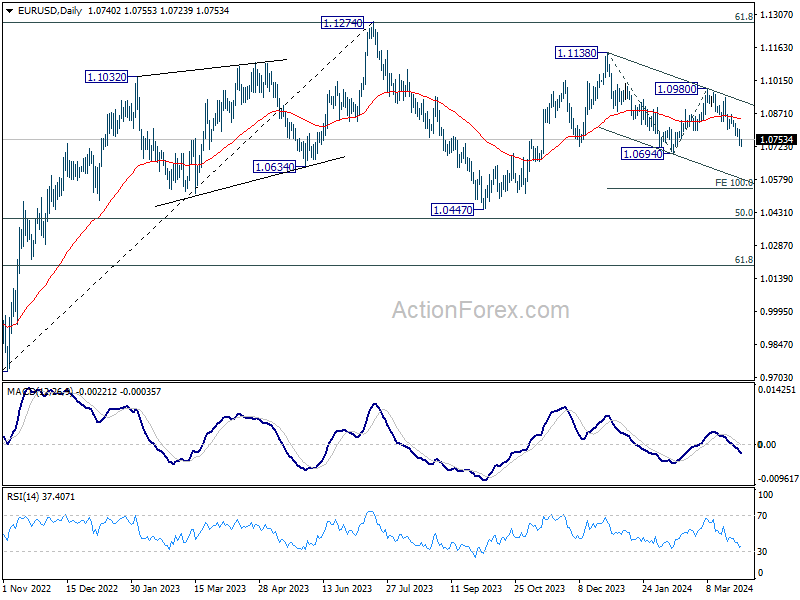
EUR/USD's decline is still in progress and intraday bias stays on the downside for 1.0694 support. Decisive break there will resume the whole decline from 1.1138 and target 100% projection of 1.1138 to 1.0694 from 1.0980 at 1.0536. On the upside, above 1.0767 minor resistance will turn intraday bias neutral first. But risk will stay on the downside as long as 1.0834 support turned resistance holds, in case of recovery.
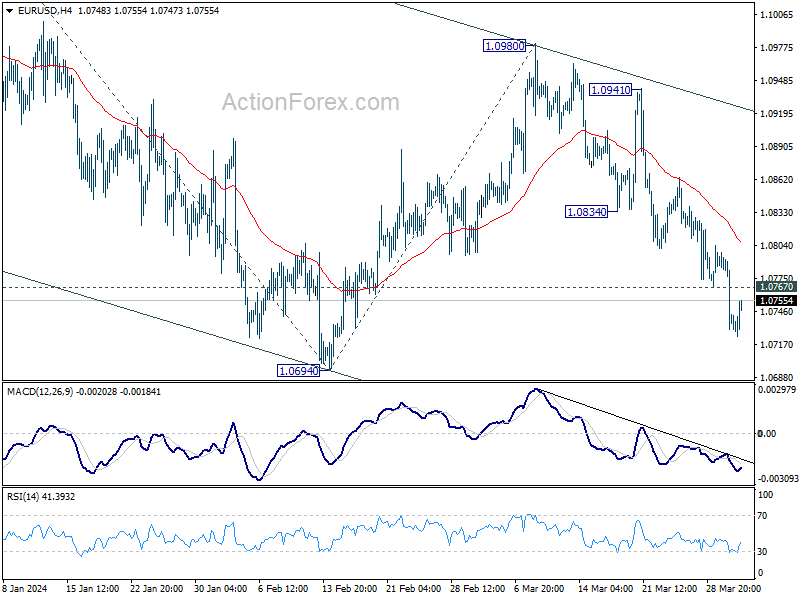
In the bigger picture, price actions from 1.1274 are viewed as a corrective pattern to rise from 0.9534 (2022 low). Rise from 1.0447 is seen as the second leg. While further rally could cannot be ruled out, upside should be limited by 1.1274 to bring the third leg of the pattern. Meanwhile, sustained break of 1.0694 support will argue that the third leg has already started for 1.0447 and possibly below.
GBP/USD Mid-Day Outlook
Daily Pivots: (S1) 1.2513; (P) 1.2578; (R1) 1.2617; More...
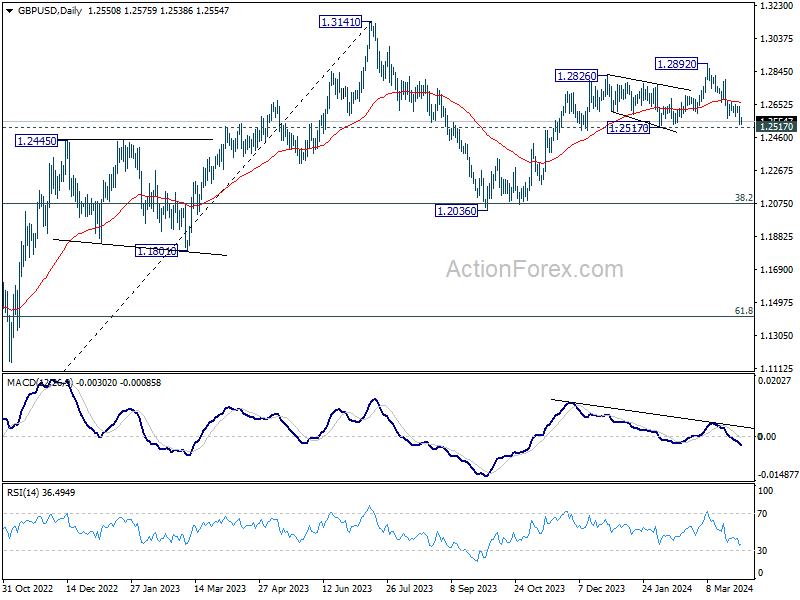
GBP/USD's decline is still in progress and intraday bias stays on the downside for 1.2517 structural support. Decisive break there will suggest that rise from 1.2036 has completed at 1.2892 already, and turn near term outlook bearish. For now, risk will stay on the downside as long as 1.2667 resistance holds, in case of recovery.
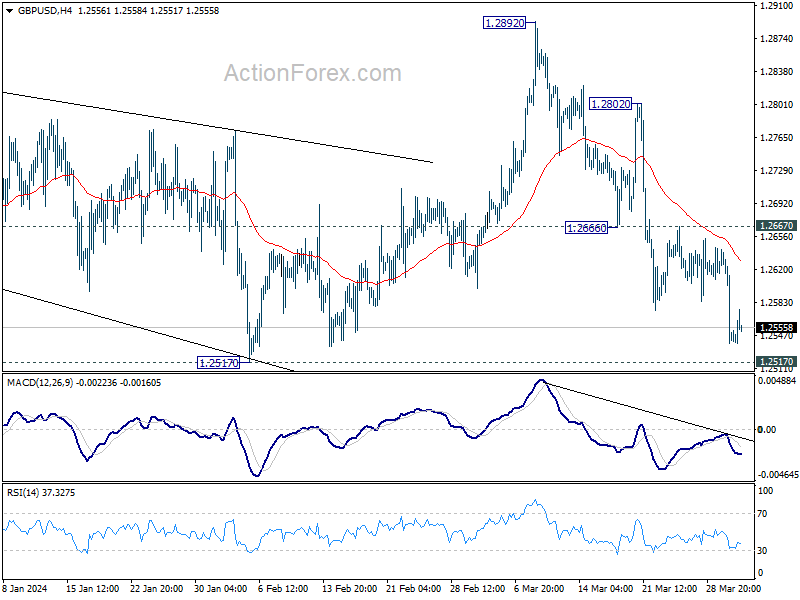
In the bigger picture, price actions from 1.3141 medium term top are seen as a corrective pattern to up trend from 1.0351 (2022 low). Rise from 1.2036 is seen as the second leg, which might still be in progress. But upside should be limited by 1.3141 to bring the third leg of the pattern. Meanwhile, break of 1.2517 support will argue that the third leg has already started for 38.2% retracement of 1.0351 (2022 low) to 1.3141 at 1.2075 again.
USD/JPY Mid-Day Outlook
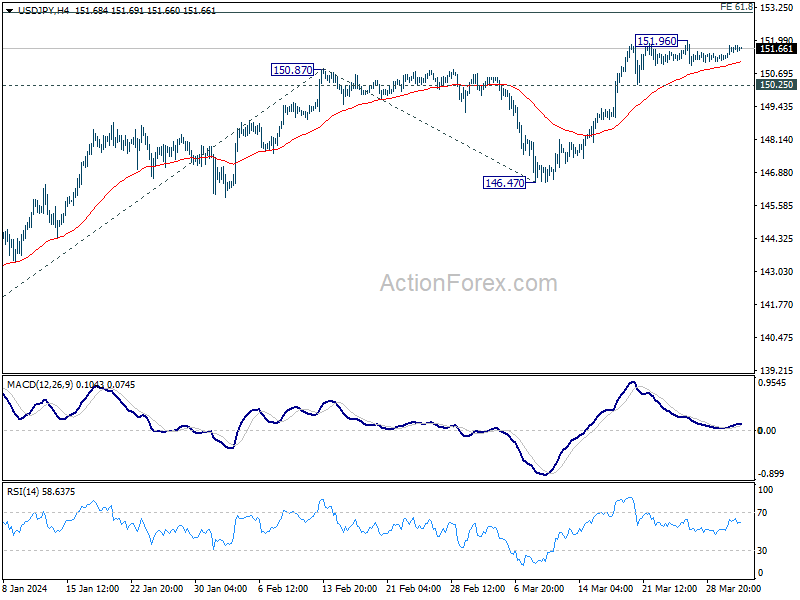
Daily Pivots: (S1) 151.33; (P) 151.55; (R1) 151.88; More...
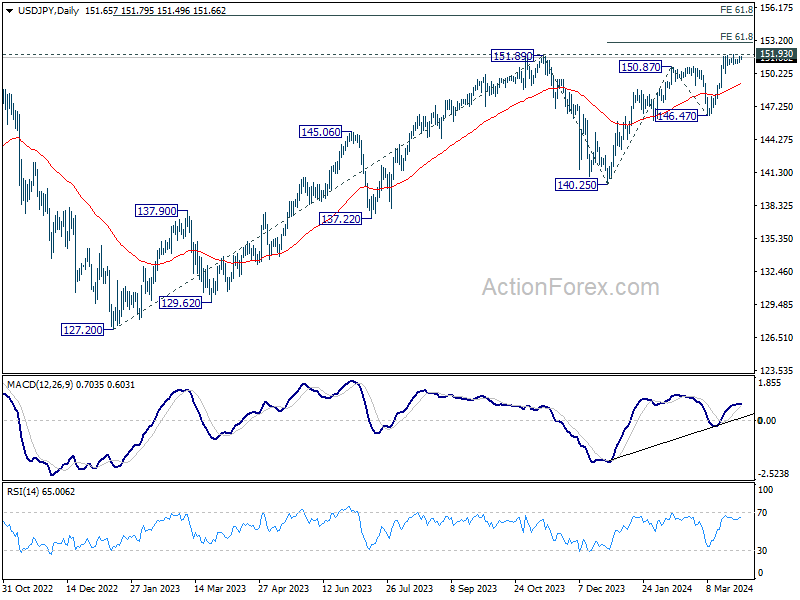
Range trading continues in USD/JPY and intraday bias remains neutral. On the downside, break of 150.25 support should confirm short term topping, and turn bias back to the downside for 55 D EMA (now at 149.35). Nevertheless, sustained break of 151.93 key resistance will confirm long term up trend resumption. Next near term target will be 61.8% projection of 140.25 to 150.87 from 146.47 at 153.03.
In the bigger picture, correction from 151.87 (2023) high could have completed at 140.25 already. Rise from 127.20 (2023 low), as part of the long term up trend, is probably ready to resume. Decisive break of 151.93 resistance (2022 high) will confirm this bullish case. Next medium term target will be 61.8% projection of 127.20 to 151.89 from 140.25 at 155.20. This will remain the favored case as long as 146.47 support holds, in case of another pullback.
USD/CHF Mid-Day Outlook
Daily Pivots: (S1) 0.9014; (P) 0.9036; (R1) 0.9066; More....
USD/CHF's rally resumed by breaking through 0.9070 temporary top and intraday bias is back on the upside. Current rally is in progress for 0.9243 key resistance next. On the downside, break of 0.9005 support is needed to indicate short term topping. Otherwise, outlook will stay bullish in case of retreat.
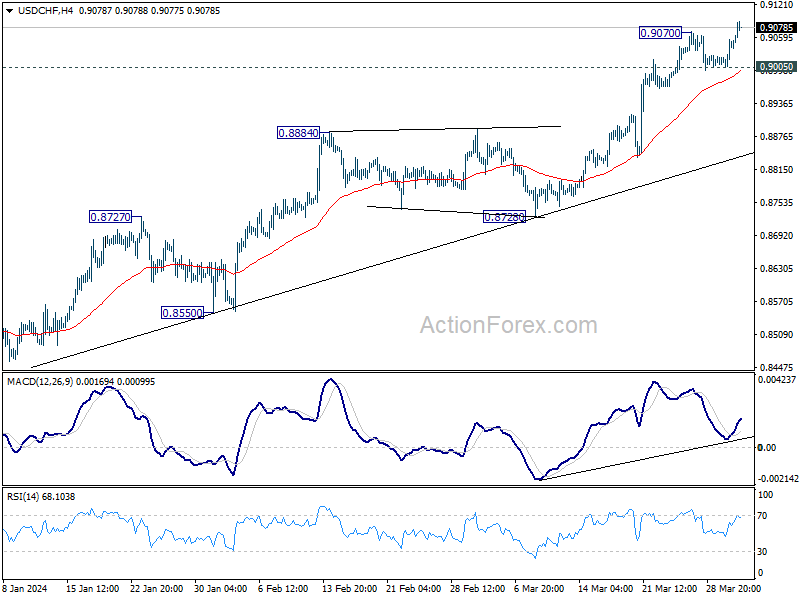
In the bigger picture, price actions from 0.8332 medium term bottom as tentatively seen as developing into a corrective pattern to the down trend from 1.0146 (2022 high). Further rise would be seen as long as 0.8728 support holds. But upside should be limited by 0.9243 resistance, at least on first attempt.
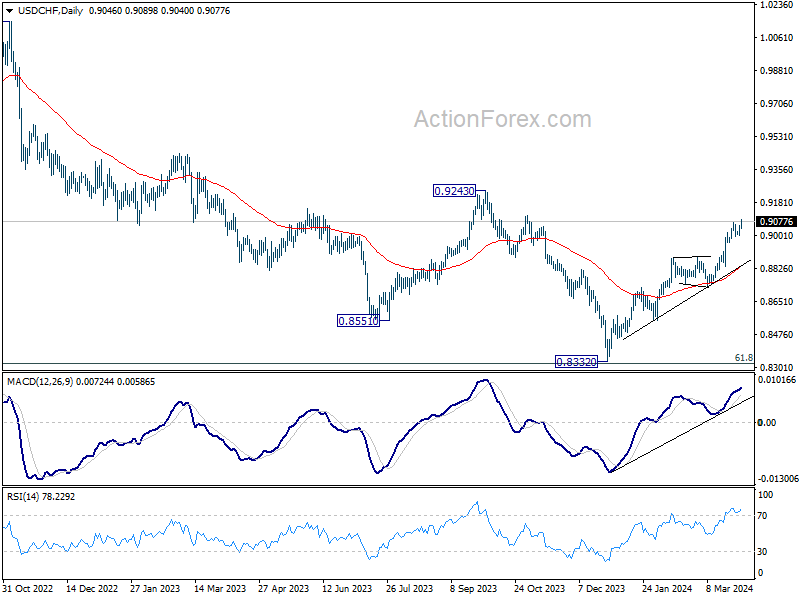
Swiss Franc Falls Amid Surging Treasury Yields and Manufacturing Optimism
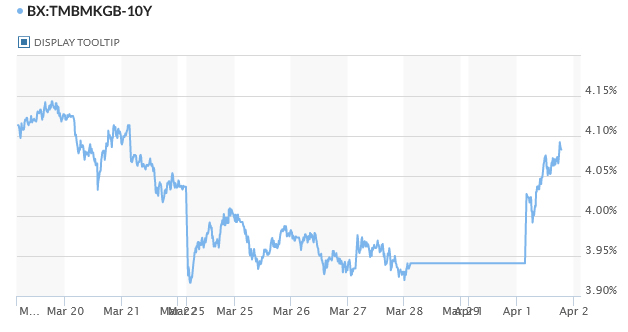
Currency markets shifted their attention towards the sell-off in Swiss Franc today, a reaction to the substantial rally observed in European and US treasury yields. With the 10-year yields in Germany and UK climbing back above 2.4% and towards 4.1% respectively, and US 10-year yield setting sights on 4.4%.
The surge in yields comes on the heels of unexpectedly strong manufacturing data from UK today and US yesterday, suggesting a resurgence in the sector globally. This development may provide some relief for global central banks, easing the imperative for continued rate cuts and offering a more nuanced approach to monetary policy adjustments.
Overall in the forex markets, Yen and Dollar are also under mild scrutiny, shedding gains against European majors and ranking as the next weakest currencies after Swiss Franc so far. In contrast, Australian Dollar is trading as the strongest currency of the day, with Sterling and New Zealand Dollar trailing behind. Euro and Canadian Dollar find themselves positioned in the middle of the pack.
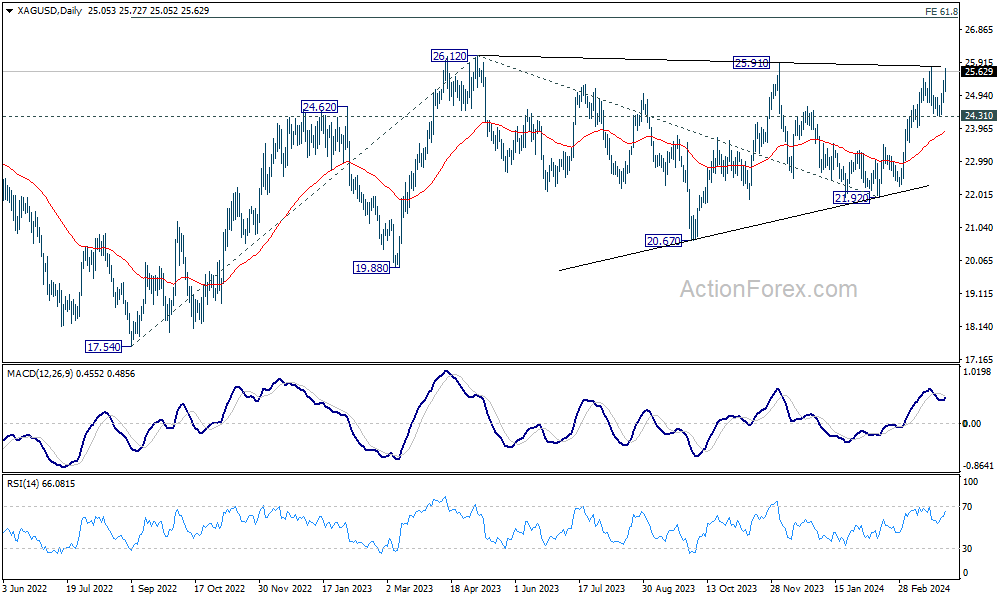
Technically, Silver's near term pull back could have completed at 24.31 already with this week's strong rally. Immediate focus is now on 25.91/26.12 resistance zone. Decisive break there will confirm resumption of whole medium term rebound from 17.54. Next target will be 61.8% projection of 17.54 to 26.12 from 21.92 at 27.22.
In Europe, at the time of writing, FTSE is up 0.30%. DAX is down -0.12%. CAC is down -0.10%. UK 10-eyar yield is up 0.1541 at 4.095. Germany 10-year yield is up 0.121 at 2.425. Earlier in Asia, Nikkei rose 0.09%. Hong Kong HSI rose 2.36%. China Shanghai SSE fell -0.08%. Singapore Strait Times rose 0.40%. Japan 10-year JGB yield rose 0.0104 to 0.752.
ECB consumer survey reveals 1-yr inflation expectations drop to 3.1%, a two-year low
ECB's Consumer Expectations Survey for February indicated continuing decline in consumers' median inflation perceptions over the past 12 months, marking a fifth consecutive month of decrease, settling at 5.5% down from 6.0% in January.
Furthermore, median expectations for inflation over the next 12 months have dipped to 3.1% from 3.3%. This level is the lowest recorded since the onset of Russia's conflict with Ukraine in February 2022.
Expectations for inflation three years ahead remained stable at 2.5%.
Eurozone PMI manufacturing finalized at 46.1, two largest cylinders out of action
Eurozone PMI Manufacturing was finalized at 46.1 in March, down from February's 46.5. Disparities across member countries continued, with Greece achieving a 25-month high at 56.9, Italy at 12-month high at 50.4, and Spain dipped slightly to 5.1.4. Meanwhile, Germany recorded a 5-month low at 41.9, and France fell to 46.2.
Cyrus de la Rubia, Chief Economist at Hamburg Commercial Bank, provided a grim outlook based on the latest PMI figures, suggesting that the recession in Eurozone's manufacturing sector is likely to persist.
De la Rubia noted that Eurozone's manufacturing industry, heavily reliant on the collective output of Germany, France, Italy, and Spain—known as the Euro-4 countries—faces significant challenges as Germany and France experience notable downturns. While Italy and Spain showed signs of recovery in March and February, respectively, their improvements have yet to offset the overall sector's decline.
While that the pace of decrease in incoming orders has slowed in the first quarter, yet the industry still records a net loss in orders compared to the previous months. This trend raises concerns that the sector may soon exceed the longest contraction spell for incoming new orders recorded during the euro crisis from 2011 to 2013. Such a scenario underscores the difficulties facing a swift reversal in manufacturing activity across Eurozone.
UK PMI manufacturing finalized at 50.3, signaling first growth since July 2022
UK PMI Manufacturing was finalized at 50.3 in March, climbing from February's 47.5 to mark a 20-month high. This development represents the sector's first move above the critical 50.0 threshold since July 2022, indicating a tentative resurgence in manufacturing activity.
Rob Dobson, Director at S&P Global Market Intelligence, highlighted, "The end of the first quarter saw UK manufacturing recover from its recent doldrums." This recovery is attributed primarily to revival in production and new orders, spurred by strengthening domestic demand. Despite the growth being characterized as hesitant, following year-long downturns, the shift towards expansion signals a turning point for the sector.
The resurgence in demand has also buoyed manufacturers' confidence, with positive sentiment reaching an 11-month peak. Remarkably, 58% of companies surveyed anticipate increase in their output over the coming year.
However, challenges persist, including "weak export performance and supply chain stresses," which continue to hinder the sector's full recovery potential. The EU market, in particular, has been identified as the "main drag" on overseas demand, compounded by ongoing issues in the Red Sea impacting supply chains.
RBA minutes: No rate hike discussed, focus on preserving labor market gains
RBA's minutes from March 18-19 meeting revealed no explicit discussion on rate hikes, marking a departure from previous communications that outlined the board's considered options.
The board assessed that it would require more time to gain "sufficient confidence" in inflation's return to target range within a foreseeable timeframe. At the same time, it emphasized on the priority to "preserve as many of the gains in the labor market as possible."
These considerations led to the characterization of the policy outlook as ambiguous, with the board finding it "difficult to either rule in or out future changes" in the cash rate target.
Inflation remains elevated, albeit on a gradual decline towards the target, while labor market is approaching conditions synonymous with full employment. In light of these observations, maintaining the cash rate target unchanged was deemed the most suitable course of action.
The board also recognized that risks had become little more even", noting that recent data did not suggest "materialisation of upside risks to inflation" and confirmed an anticipated slowdown in economic output.
RBNZ's Orr asserts laser-focused commitment to inflation control
RBNZ Governor Adrian Orr articulated a firm stance today and emphasized that the committee is "laser-focused" on steering inflation back to its target range.
Orr's acknowledged the progress and RBNZ is "on track" getting inflation back to targets. Yet he also tempers expectations by noting that the journey is far from complete with the admission that they are "not there yet."
A critical element highlighted by Orr concerns inflation expectations, which he identifies as a significant challenge in the battle against rising He pointed out the cyclical nature of inflation expectations, stating, "the more people think inflation will rise next year, the more inflation will rise next year."
USD/CHF Mid-Day Outlook
Daily Pivots: (S1) 0.9014; (P) 0.9036; (R1) 0.9066; More....
USD/CHF's rally resumed by breaking through 0.9070 temporary top and intraday bias is back on the upside. Current rally is in progress for 0.9243 key resistance next. On the downside, break of 0.9005 support is needed to indicate short term topping. Otherwise, outlook will stay bullish in case of retreat.
In the bigger picture, price actions from 0.8332 medium term bottom as tentatively seen as developing into a corrective pattern to the down trend from 1.0146 (2022 high). Further rise would be seen as long as 0.8728 support holds. But upside should be limited by 0.9243 resistance, at least on first attempt.
Economic Indicators Update
| GMT | Ccy | Events | Actual | Forecast | Previous | Revised |
|---|---|---|---|---|---|---|
| 23:01 | GBP | BRC Shop Price Index Y/Y Feb | 1.30% | 2.20% | 2.50% | |
| 23:50 | JPY | Monetary Base Y/Y Mar | 1.60% | 2.50% | 2.40% | |
| 00:00 | AUD | TD Securities Inflation M/M Mar | 0.10% | -0.10% | ||
| 00:30 | AUD | RBA Meeting Minutes | ||||
| 06:30 | CHF | Real Retail Sales Y/Y Feb | -0.20% | 0.40% | 0.30% | |
| 07:30 | CHF | Manufacturing PMI Mar | 45.2 | 44.9 | 44 | |
| 07:45 | EUR | Italy Manufacturing PMI Mar | 50.4 | 48.8 | 48.7 | |
| 07:50 | EUR | France Manufacturing PMI Mar F | 46.2 | 45.8 | 45.8 | |
| 07:55 | EUR | Germany Manufacturing PMI Mar F | 41.9 | 41.6 | 41.6 | |
| 08:00 | EUR | Eurozone Manufacturing PMI Mar F | 46.1 | 45.7 | 45.7 | |
| 08:30 | GBP | Manufacturing PMI Mar F | 50.3 | 49.9 | 49.9 | |
| 08:30 | GBP | Mortgage Approvals Feb | 60K | 57K | 55K | |
| 08:30 | GBP | M4 Money Supply M/M Feb | 0.50% | 0.20% | -0.10% | |
| 12:00 | EUR | Germany CPI M/M Mar P | 0.40% | 0.40% | 0.40% | |
| 12:00 | EUR | Germany CPI Y/Y Mar P | 2.20% | 2.40% | 2.70% | |
| 14:00 | USD | Factory Orders M/M Feb | 1.00% | -3.60% |
Dollar Strengthens Following Positive Manufacturing Data
The EUR/USD pair has dipped to its lowest since 15 February this year following the release of encouraging data regarding the US manufacturing sector's activity on Monday. This improvement, the first since September 2022, has bolstered the US dollar's position.
The Institute for Supply Management (ISM) reported that the manufacturing business activity index climbed to 50.3 points in March from 47.8 in the preceding month. This rise above the crucial 50.0-point threshold, which distinguishes contraction from expansion, signals a positive development for the sector.
Key insights from the report highlight an increase in new orders, although manufacturing employment figures remained subdued. The surge in raw material prices also influenced the overall index, which might have otherwise recorded a higher reading. Importantly, this data signifies the end of the manufacturing sector's most prolonged downturn in 16 months, a sector that constitutes approximately 10.4% of the US economy.
Further economic data revealed that the US Core Personal Consumption Expenditure (PCE) rose by 0.3% in February, slightly below the anticipated 0.4% increase. This Core PCE index, closely monitored by the Federal Reserve, suggests that the Fed may have room to adjust interest rates downwards in June 2024, given the subdued inflationary pressures.
Market expectations for the Federal Reserve's decision in June have seen slight adjustments. CME FedWatch Tool data indicate a 66% likelihood of policy easing, a slight decrease from the prior 68% and significantly up from 57% the previous week.
Technical analysis of EUR/USD
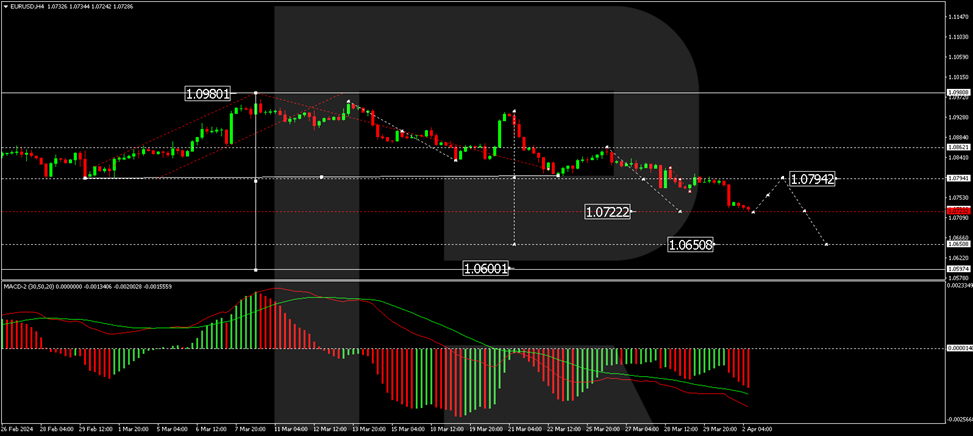
H4 Chart Analysis: the EUR/USD pair is currently in a consolidation phase around the 1.0794 level. A downward breakout from this range could lead to a continued decline towards 1.0650. A corrective move back to 1.0794, testing from below, may follow, with potential further descent to 1.0600. This scenario is supported by the MACD indicator, which shows the signal line below zero, indicating a continued downward trend.
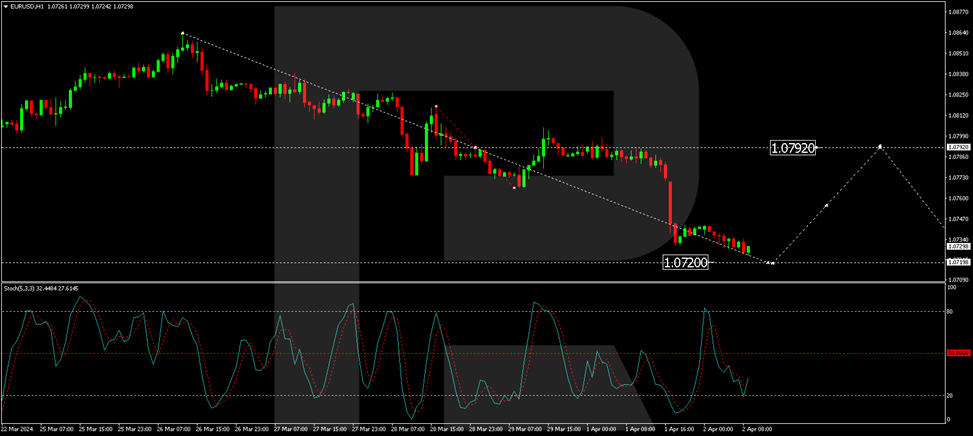
H1 Chart Analysis: a corrective structure has been completed at the 1.0804 level on the H1 chart. Following the news release, the market breached the 1.0777 level downwards, continuing the downward trajectory towards 1.0720. Upon completion, a potential uptick to 1.0790 (testing from below) could occur before another drop to the 1.0650 mark. The Stochastic oscillator, currently below 50, anticipates a further decline to the 20 mark, supporting the bearish outlook.
Oil Clears Way for Growth Above $90
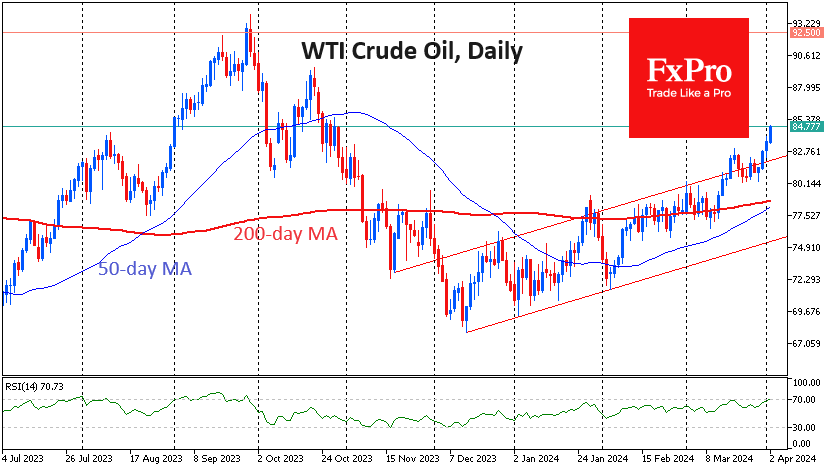
Oil prices have been hitting five-month highs, and every trading session has been rising since 27 March. The price of a barrel of WTI reached $84.6 at the start of the day on Tuesday before retreating slightly by midday in Europe.
To some extent, oil is managing to copy gold, which has also seen a steady increase in buying since the beginning of last week. The latest rally can also be attributed to signs of acceleration in China and continued strong manufacturing data from the US, which promises energy demand.
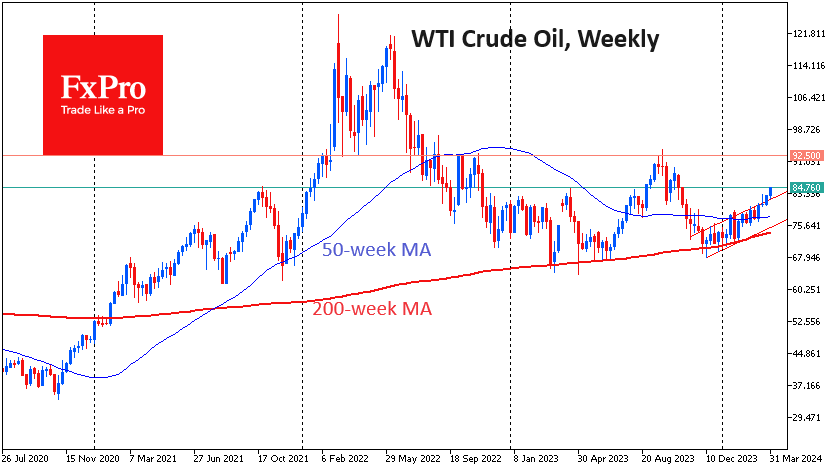
Contrary to common logic, oil prices are rising simultaneously with the dollar despite historically having a negative correlation. But America has commonly been the largest energy importer, consuming a quarter of all Crude in the early 2000s. In recent years, however, the US has become a net Crude exporter. Last year, it reclaimed the title of largest oil producer. Recently, it became the largest exporter of LNG, a formidable competitor to the OPEC+ countries.
Meanwhile, the states have maintained production at 13.1 million bpd since October last year. Drilling activity has also stagnated for all these months, barring any supply spikes in the coming quarters.
All of this argues for further price growth and methodical, albeit small, additions to the strategic reserve.
The price chart clearly shows the acceleration in growth since the second half of March, when the previous upper boundary of the rising channel turned into support last week. We are also watching for the formation of a “golden cross”, which could attract additional speculative buying in the coming days.
From a technical point of view, the only barrier for oil is the area of previous highs at $92.5. Approaching this area may require significant profit-taking and prolonged consolidation before the next breakout, but success is by no means guaranteed.
ECB consumer survey reveals 1-yr inflation expectations drop to 3.1%, a two-year low
ECB's Consumer Expectations Survey for February indicated continuing decline in consumers' median inflation perceptions over the past 12 months, marking a fifth consecutive month of decrease, settling at 5.5% down from 6.0% in January.
Furthermore, median expectations for inflation over the next 12 months have dipped to 3.1% from 3.3%. This level is the lowest recorded since the onset of Russia's conflict with Ukraine in February 2022.
Expectations for inflation three years ahead remained stable at 2.5%.