

Sample Category Title
Dollar Slips as CPI Fails to Rattle Fed’s Transitory View, Islamabad Talks Awaited
Dollar is back under mild pressure as US trading gets underway, with markets reacting to a softer-than-feared inflation report from the US. While headline CPI surged in March, the print missed expectations, easing fears of a more aggressive inflation shock. The key relief came from the core reading. Despite the sharp rise in headline inflation driven by energy, underlying price pressures remained contained. This has reassured markets that the inflation spike is not yet broadening into the wider economy.
As a result, the Fed is unlikely to shift its stance. Policymakers have long emphasized their willingness to look through energy-driven inflation shocks, and the latest data does little to challenge that framework. There is no immediate pressure for the Fed to pivot back toward tightening. Market pricing reflects this view. Futures are assigning around a 35% probability of a rate cut before year-end, slightly higher than earlier in the week, suggesting expectations for policy easing remain delayed but not abandoned.
However, the inflation outlook remains tightly linked to geopolitics. The Strait of Hormuz remains shut, and tensions persist despite the two-week ceasefire, with both the US and Iran accusing each other of violations. These developments underscore the fragility of the current truce. Ongoing exchanges involving Israel and Hezbollah, alongside continued disruptions to oil flows, highlight that the situation remains far from resolved. Attention now turns to the upcoming US-Iran talks in Islamabad, which represent a critical inflection point. Markets are waiting to see whether the ceasefire can evolve into a more durable agreement or unravel further.
Beyond the US, the energy shock is once again feeding into global rates markets. Yields in Germany and the UK have surged following reports of potential jet fuel shortages within three weeks, based on the intrinsically linked "energy-inflation-interest rate" cycle. The development has taken EUR/JPY and GBP/JPY notably higher.
Overall for the week so far, Dollar is still the worst performer, followed by Yen, and then Loonie. Kiwi is the best, followed by Aussie and then Sterling. Euro and Swiss Franc are positioning in the middle.
In Europe, at the time of writing, FTSE is up 0.40%. DAX is up 0.80%. CAC is up 0.64%. UK 10-year yield is up 0.099 at 4.777. Germany 10-year yield is up 0.056 at 3.045. Earlier in Asia, Nikkei rose 1.84%. Hong Kong HSI rose 0.55%. China Shanghai SSE rose 0.51%. Singapore Strait Times rose 0.25%. Japan 10-year JGB yield rose 0.045 to 2.442.
US CPI at 3.3% Misses Expectations, Second-Round Effects Still Limited
US inflation surged in March, driven by a sharp jump in energy prices, particularly gasoline. But beneath the headline spike, core inflation remained subdued, showing little sign of broader price pressures. The lack of second-round effects suggests the shock may stay contained—for now. Read More.
Canada Employment Rebound 14.1k in March, Wage Growth Picks Up
Canada’s labor market showed signs of stabilization in March, with employment beating expectations after two months of sharp losses. At the same time, wage growth accelerated to its strongest pace since late 2024, adding another layer to the outlook as policymakers weigh growth risks against inflation pressures. Read More.
BoJ’s Himino Sees No Stagflation Yet, Warns of Oil-Driven Policy Dilemma
BoJ Deputy Governor Ryozo Himino said Japan is not facing stagflation for now, with inflation near target and growth still holding up. But he warned that a prolonged Middle East conflict could change that dynamic—pushing inflation higher while dragging on growth and creating a difficult policy trade-off. Read More.
Japan PPI Accelerates to 2.6% in March as Import Costs Surge 7.9%
Japan’s producer prices picked up more than expected in March, driven by a sharp rise in import costs and higher energy and industrial input prices. The surge in import prices points to renewed upstream inflation pressure, raising the risk that cost increases could feed through more broadly into the economy. Read More.
China PPI Turns Positive for First Time Since 2022 as CPI Softens
China’s factory prices returned to growth for the first time since 2022, driven by rising energy and commodity costs. But consumer inflation is losing momentum, with CPI and core prices slowing sharply—highlighting a growing gap between upstream cost pressures and weak domestic demand. Read More.
NZ BNZ Manufacturing Falls to 53.2, Slower Expansion as War Concerns Weigh on Sentiment
New Zealand’s manufacturing sector is still expanding, but momentum is clearly slowing. PMI eased in March as production and new orders softened, while inventories rose—hinting at cooling demand. Read More.
EUR/USD Mid-Day Outlook
Daily Pivots: (S1) 1.1658; (P) 1.1692; (R1) 1.1733; More….
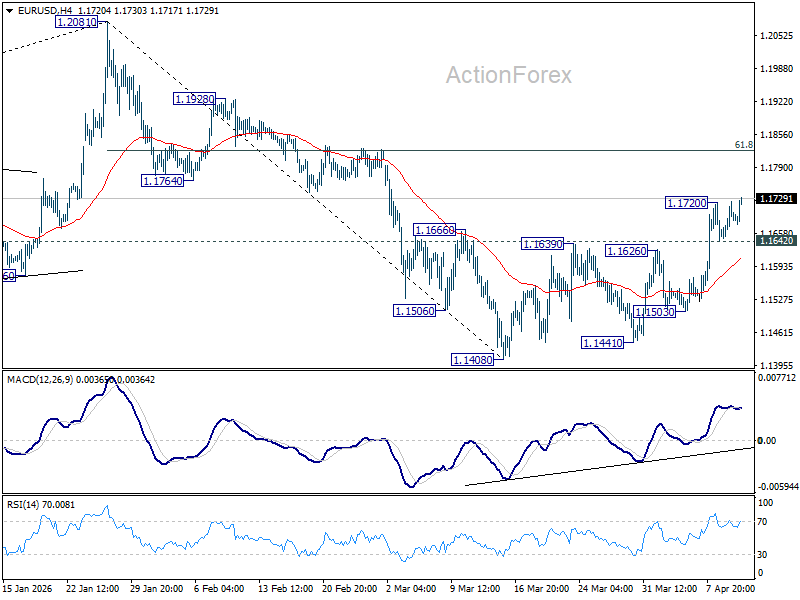
Intraday bias in EUR/USD is back on the upside with break of 1.1720 temporary top. Rise from 1.1408 is resuming and should target 61.8% retracement of 1.2081 to 1.1408 at 1.1824. Decisive break there will pave the way to retest 1.2081 high. On the downside, below 1.1642 minor support will turn intraday bias neutral again first.
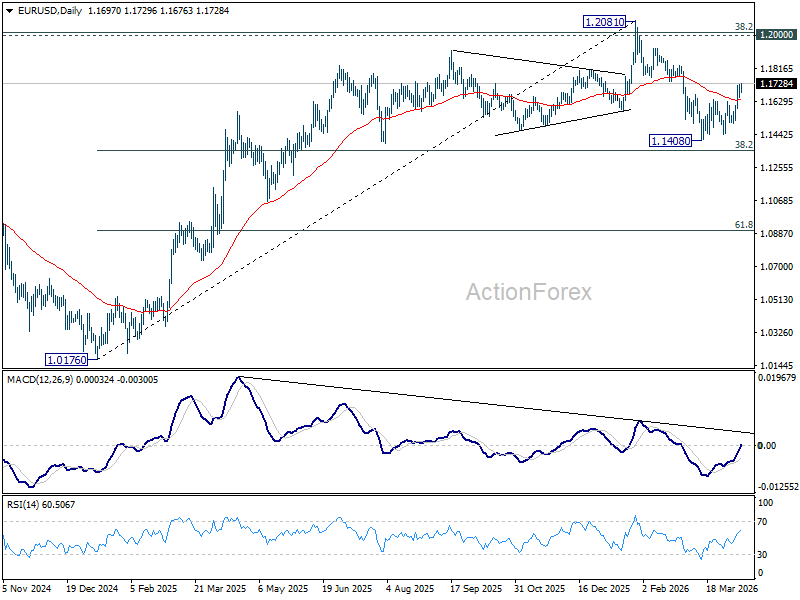
In the bigger picture, the strong support from 38.2% retracement of 1.0176 to 1.2081 at 1.1353 suggests that the pullback from 1.2081 is more likely a corrective move. Strong support was also found in 55 W EMA (now at 1.1505). Focus is back on 1.2 key cluster resistance level. Decisive break there will carry long term bullish implications. Nevertheless, break of 1.1408 support will revive the case of medium term bearish trend reversal.
Canada Employment Rebound 14.1k in March, Wage Growth Picks Up
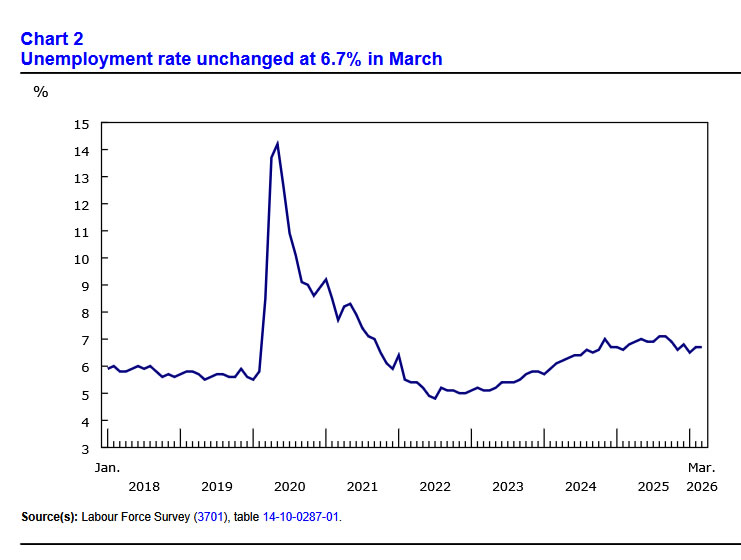
Canada’s employment rose by 14.1k in March, slightly above expectations of 12.6k, offering a modest rebound after a cumulative decline of -109k over the first two months of the year. Despite the headline gain, both full-time and part-time employment showed little variation, suggesting underlying momentum remains limited.
Labor market conditions were broadly stable. The unemployment rate held at 6.7%, below expectations of 6.8%. Employment rate remained unchanged at 60.6%. Participation was also steady at 64.9%, indicating that the stability in unemployment partly reflects a lack of re-entry into the labor force rather than a strong pickup in hiring.
Wage growth, however, accelerated notably. Average hourly earnings rose 4.7% yoy, up from 3.9% in February and marking the fastest pace since October 2024. Adjusted for composition effects, wage growth was more moderate at 3.6% yoy. The combination of modest job gains and firmer wages presents a mixed picture, offering some relief after earlier weakness but not enough to signal a clear turnaround in Canada’s labor market.
US CPI at 3.3% Misses Expectations, Second-Round Effects Still Limited
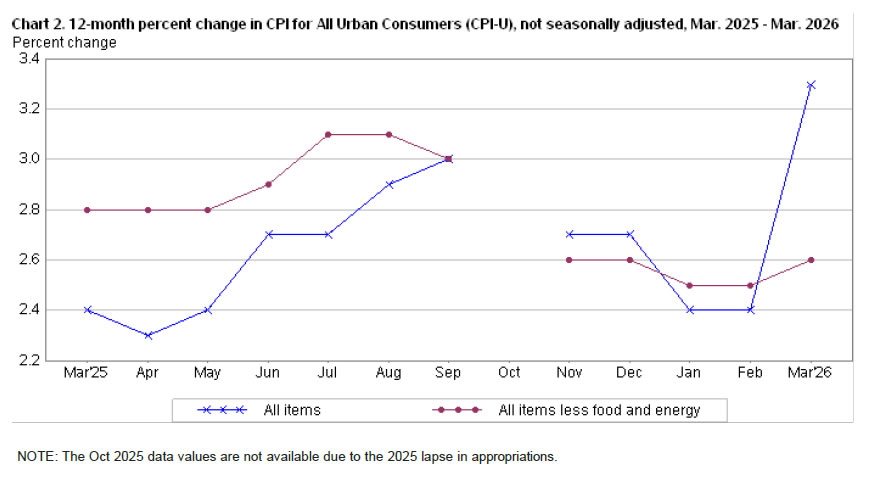
US inflation surged in March, with CPI rising 0.9% mom and lifting the annual rate from 2.4% yoy to 3.3% yoy. While the jump was significant, both figures came in slightly below expectations of 1.0% mom and 3.4% yoy respectively, suggesting the energy-driven spike was largely anticipated.
The surge was overwhelmingly driven by energy costs. Energy prices jumped 10.9% mom, led by a 21.2% spike in gasoline, which accounted for nearly three quarters of the monthly increase in headline CPI.
In contrast, underlying inflation pressures remained more contained, with core CPI rising 0.2% mom and edging up from 2.5% yoy to 2.6% yoy, both below expectations of 0.3% mom and 2.7% yoy.
Other components painted a more stable picture. Shelter rose 0.3% mom, continuing its gradual climb, while food prices were unchanged on the month. Overall, the data reinforces the view that the inflation spike is largely energy-driven, with limited evidence so far of broad-based second-round effects.
EUR/USD: Bulls Face Headwinds on Approach to the Base of Falling and Thickening Daily Cloud
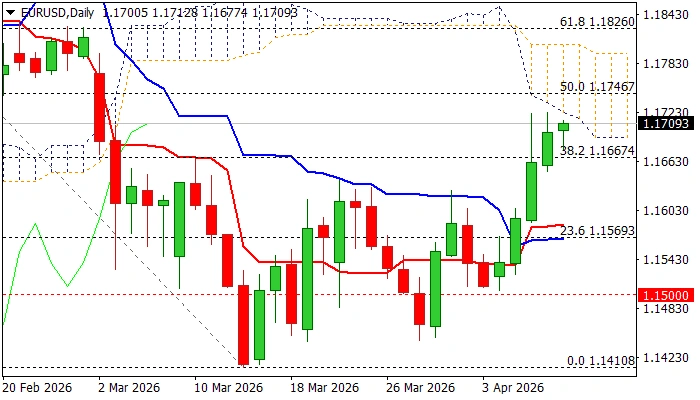
The Euro slowed on Friday, signaling that strong rally of past four days might be showing initial signs of fatigue on approach to next very significant barrier at 1.1722 (base of falling and thickening daily Ichimoku cloud).
Bulls managed to crack strong resistance zone at 1.1667/97, consisting of Fibo 38.2% of 1.2082/1.1410 descend and converged 200/100/55DMAs, at the second attempt (after Wednesday’s attack was rejected and left bullish candle with long upper shadow).
Fading bullish momentum and overbought stochastic contribute to developing negative signals, though more action to the downside (return and close below MAs and broken Fibo 38.2%) will be needed to boost signal.
Meanwhile, near term action would keep bullish bias while holding above MAs (or at least not to drop below 1.1667 – Fibo / 200DMA) but increased headwinds from falling daily cloud should be anticipated.
We will closely watch reaction at this zone, with penetration of cloud and violation of 1.1746 (50% retracement) to sideline immediate downside risk and keep near term focus at the upside (initial signal of bullish continuation).
Traders will also focus on the developments on the peace talks between the US and Iran, as well as release of US March CPI data, as economists expect inflation to start rising, in reaction to crisis from the war in the Middle East.
Res: 1.1722; 1.1746; 1.1800; 1.1826.
Sup: 1.1688; 1.1667; 1.1640; 1.1585.
Dollar Seeking a Foothold
- Inflation data could boost the US dollar.
- Gold is rising as risk appetite recovers.
The US dollar is attempting to stabilise after its slump on 8 April, as oil prices find their footing following their worst rout since 2020. The truce between the US and Iran is fragile, having led only to a reduction in the ‘war premium’, but not its complete elimination. Donald Trump has called on Israel and Lebanon to engage in talks and stated that Tehran is struggling to manage the opening of the Strait of Hormuz. Indeed, according to Marine Traffic, only 8 tankers have passed through it in the last 24 hours, compared to 135 before the March conflict.
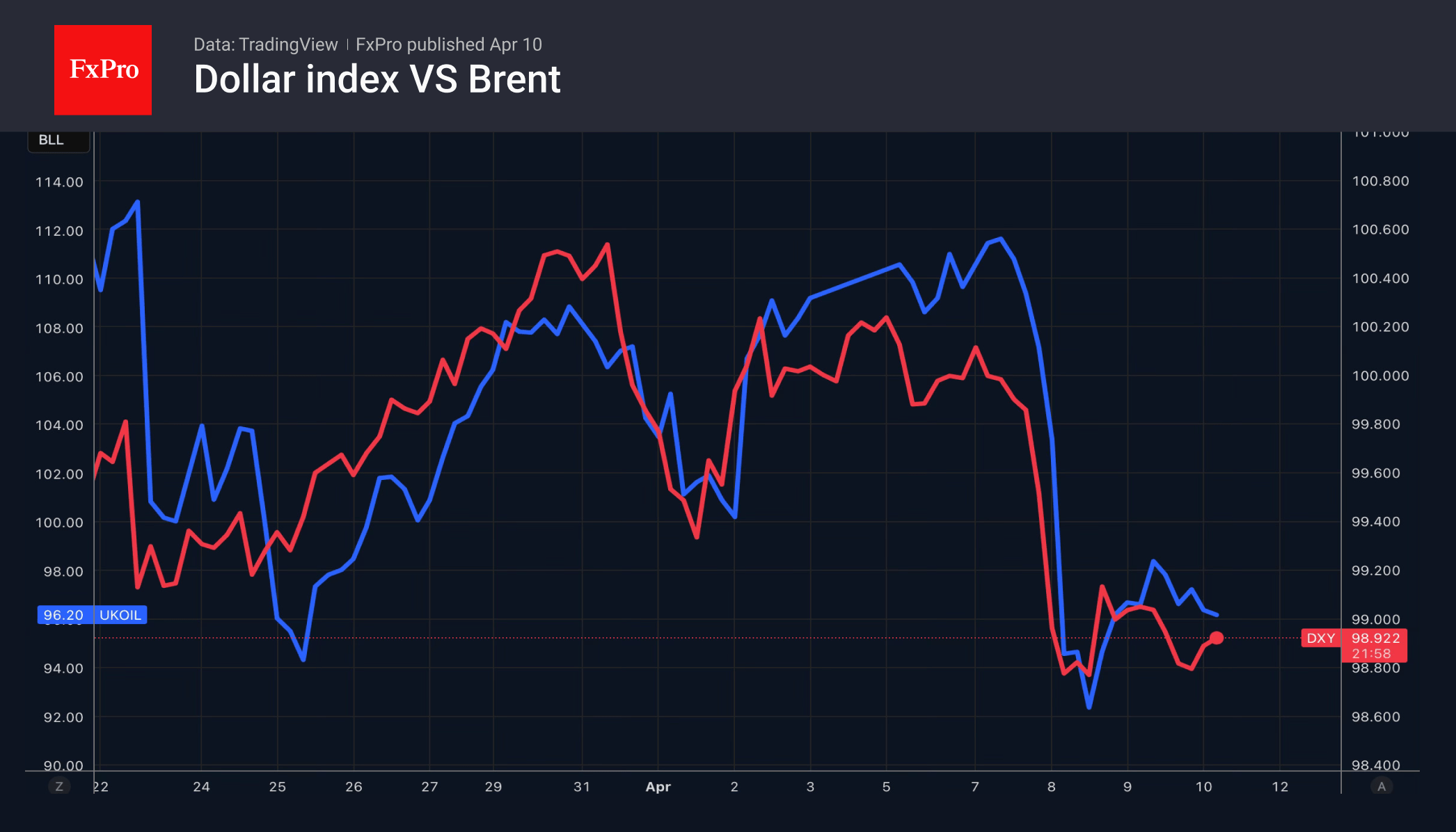
The IMF warns that it will soon lower its growth forecast for this year from 3.3%, as estimated in January. Even if the US and Iran agree on a lasting peace, the economic scars will remain, says Fund chief Georgieva. The OECD believes the impact on global GDP will depend on the damage to energy infrastructure. The worse the situation for the world, the worse it will be for the eurozone, which imports raw materials and energy, and its currency, the euro. In this context, a recovery in EURUSD appears premature. Traders bought into the rumours of negotiations, but the time will soon come to sell on the facts.
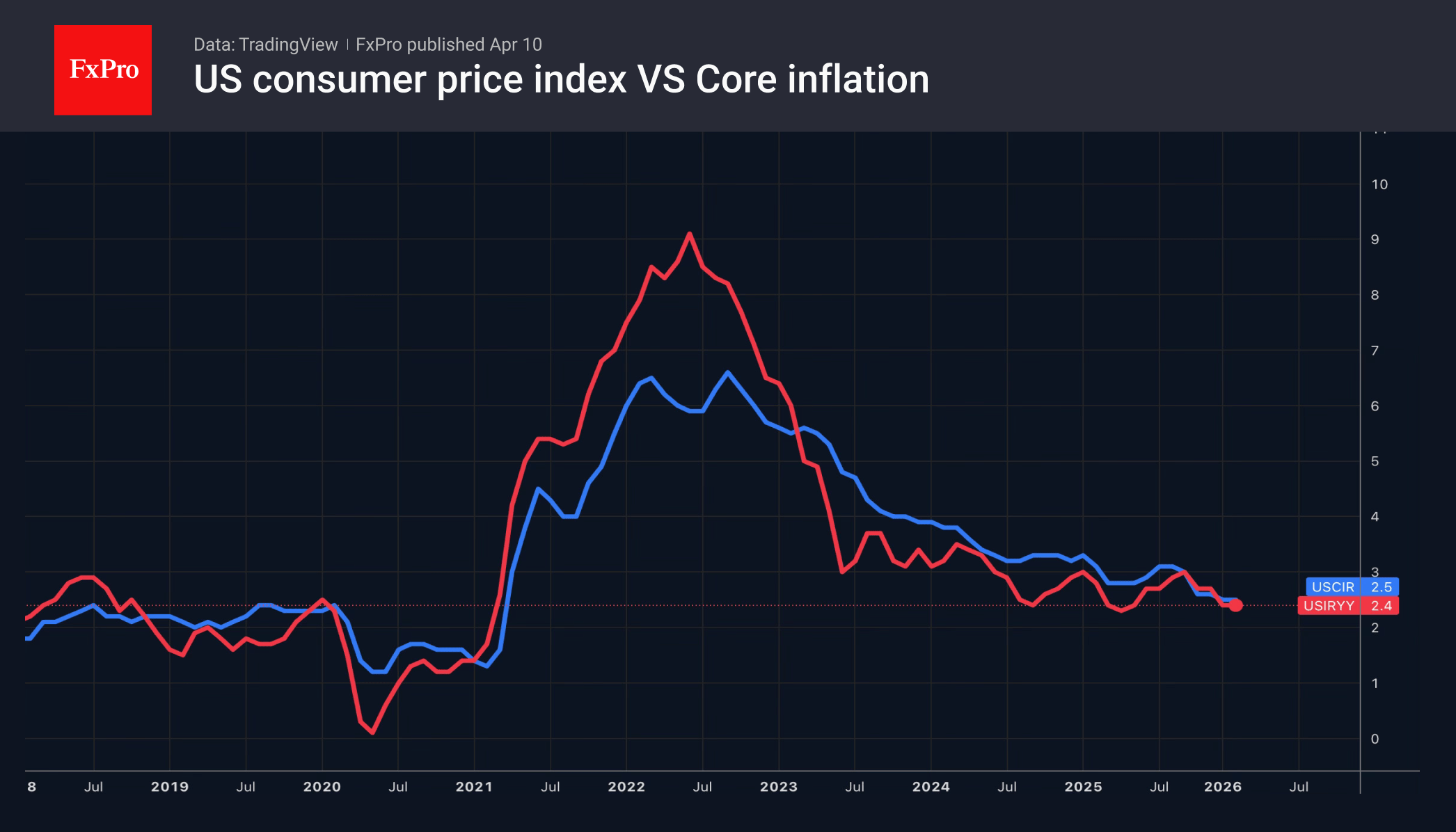
US inflation data for March could act as a short-term trigger for a decline in EURUSD. Consumer prices are forecast to rise by 0.9% month-on-month and 3.3% year-on-year. Such dynamics, along with the risks of core inflation accelerating from second-order effects, will force the Fed to keep rates high. Moreover, the resilience of the US economy may lead the futures market to anticipate a rise in borrowing costs. This will play into the dollar’s hands.
Meanwhile, USDJPY bulls are recovering after the sell-off triggered by news of the Washington-Tehran talks. The consolidation of oil prices at high levels makes Japan’s energy-import-dependent economy and the yen extremely vulnerable. At some point, the government’s verbal interventions will cease to work, and it will revert to currency interventions. Increased volatility in the pair is guaranteed.
Gold is gaining favour thanks to a resurgence in risk appetite and the long-term erosion of confidence in the US dollar as a reserve currency. In its time, the British pound lost this function due to the First World War, the abandonment of the gold standard, Bretton Woods and the Suez Crisis. Now, due to White House policy, the greenback may follow suit. For the first time in history, the value of assets denominated in it within the central bank’s reserves has fallen below the value of its precious metal reserves.
Bitcoin Steadily Reaching New Local Highs
Market Overview
The crypto market capitalisation has risen by 1.19% over the past 24 hours to $2.45 trillion. The crypto market has weathered a short-term consolidation phase following a growth surge quite successfully, consolidating above its 50-day MA, which is one of the first signs of a reversal in the medium-term trend towards a bullish tone. Today’s top performers include Dash (+17.4%), Zcash (+16.6%) and Theta Network (+11%). The underperformers were VeChain (−1.2%), Hedera (−1%) and OFFICIAL TRUMP (−0.9%).
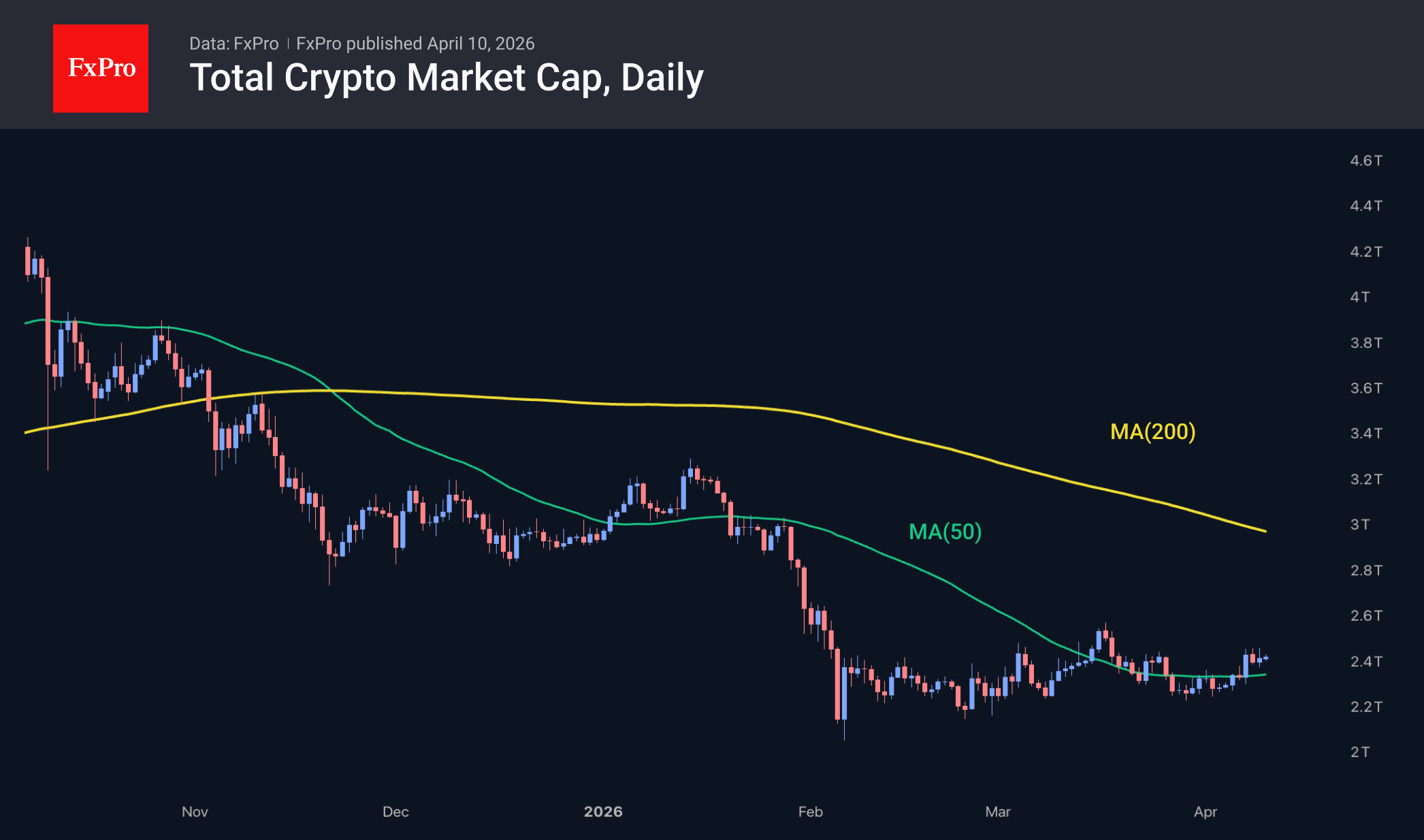
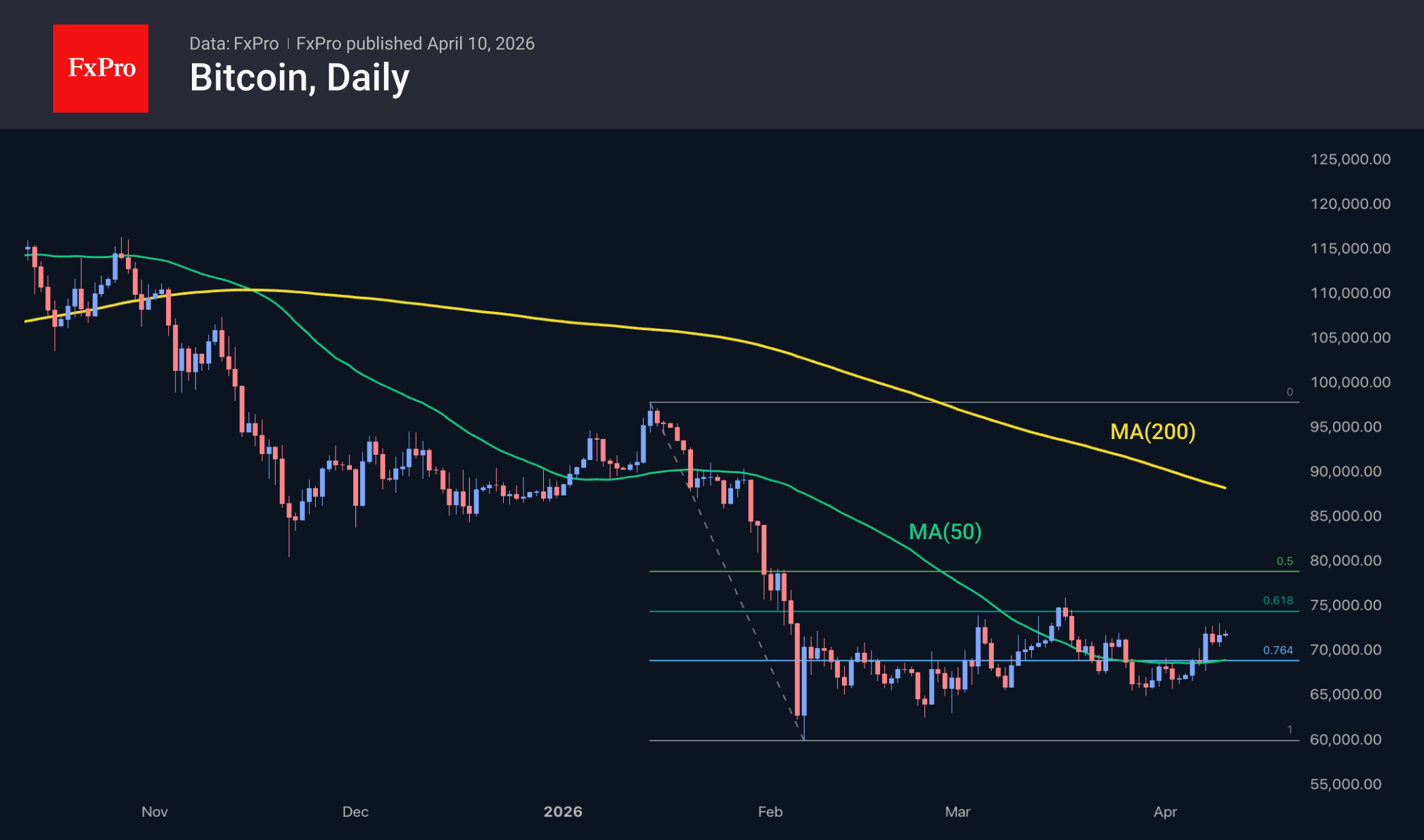
Bitcoin is cautiously testing new local highs, briefly rising above $73K on Thursday, although it is currently trading just below $72K. These fluctuations around local highs and the cautious renewal of them appear to mark a new phase following a prolonged period of hovering near the bottom and a cautious upward trend since late March. However, the market still needs to pass an important test by breaking out of the 61.8% retracement of the decline seen at the start of the year. It cannot be ruled out that the bears are simply giving the market more room to move below their key levels near $75K.
News Background
Standard Chartered forecasts that Bitcoin could fall to $50K in the near term, then recover to $100K by the end of the year. In the long term, the bank’s target price is $500K by 2030.
According to Lookonchain, Bhutan is preparing to sell $22.7 million worth of Bitcoin. The country’s government has transferred 319.7 BTC to two different wallets. Publicly listed mining company Cango sold 2,000 Bitcoin for $143 million in March to repay debts.
US bank Morgan Stanley has launched its own spot Bitcoin ETF with reduced fees. Demand for digital gold from high-net-worth clients remains high, the bank notes.
According to CryptoQuant, trading volume on centralised crypto exchanges fell by 48% from its October 2025 peak to $4.3 trillion in March, reaching its lowest level in the last five months.
On 9 April, the Catchain 2.0 update was successfully activated on the TON network, increasing throughput tenfold. According to Pavel Durov, the blockchain now creates blocks six times faster, and transactions “take place instantly, in less than a second”.
USD/JPY: Yen Fared Better, but Energy Rally Not Over
USD/JPY traded at 159.16 on Friday. The yen is retreating slightly but appears less weak than previously, amid a two-week truce between the US and Iran. The decline in oil prices following the announcement of the truce has partially reduced stagflationary risks and provided some support to the Japanese currency.
Investor focus is on the upcoming talks in Islamabad, where Vice President JD Vance will lead the US delegation. Meetings with the Iranian side are expected to clarify the prospects for further de-escalation.
However, sentiment remains subdued. Continued strikes in the region and ongoing disruptions in the Strait of Hormuz continue to put the fragile truce at risk, driving ** market uncertainty.
The yen has remained under pressure since the conflict began, losing approximately 2%. Investors are factoring in rising energy prices, which add to inflationary pressures while dampening Japan's growth outlook.
The market is now awaiting signals from Bank of Japan Governor Kazuo Ueda ahead of the 28 April meeting, which could set the future direction of monetary policy.
Technical Analysis
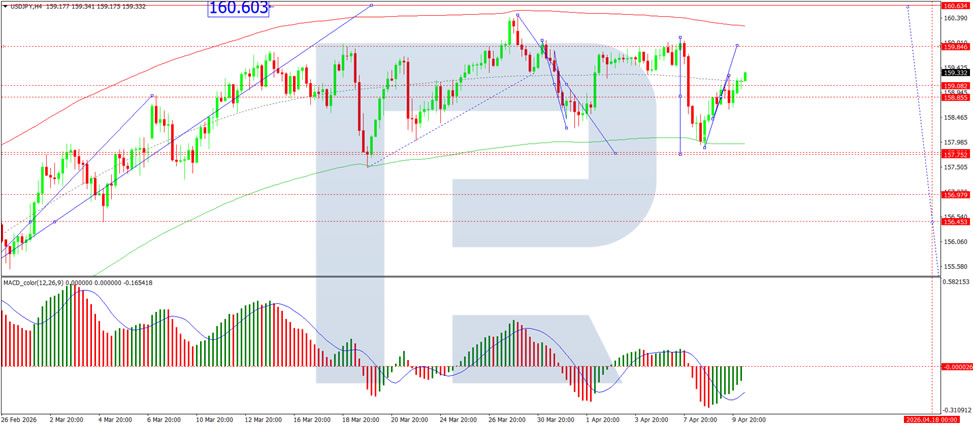
On the H4 USD/JPY chart, the market is forming a consolidation range around the 158.85 level, currently extending up to 159.30. A move higher towards 159.85 (testing from below) is expected today. Subsequently, a potential decline towards the 157.72 level will be considered. Technically, this scenario is confirmed by the MACD indicator, whose signal line is below zero and pointing upwards from low levels.
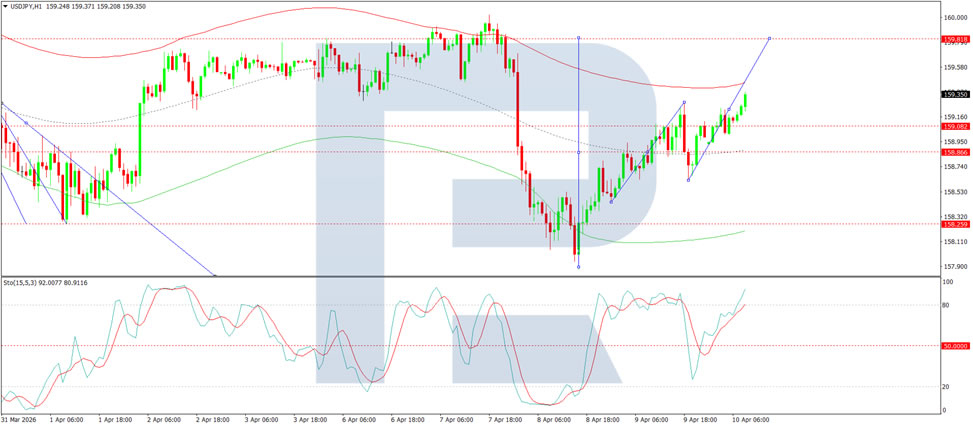
On the H1 chart, the market is forming a wave of growth towards the 159.82 level. A wave extension to the 160.00 level is possible. Thereafter, a downward wave to at least 158.85 is expected. Technically, this scenario is confirmed by the Stochastic oscillator, with its signal line below the 80 level and pointing strictly downwards.
Conclusion
USD/JPY has stabilised as the yen shows tentative signs of recovery, benefiting from the temporary truce between the US and Iran and the resulting pullback in oil prices. However, the fragility of the ceasefire – underscored by continued strikes and disruptions in the Strait of Hormuz – means that energy-driven risks remain very much alive. The yen has lost approximately 2% since the conflict began, and market attention now turns to upcoming diplomatic talks in Islamabad and BOJ Governor Ueda's signals ahead of the 28 April policy meeting. Technically, a short-term bounce in USD/JPY appears likely, but the broader trajectory will depend on whether de-escalation holds or tensions reignite.
AUD/CAD Uptrend Resumes, Path to Parity Hinges on Canada Jobs Data
AUD/CAD is back on the front foot this week, with its uptrend reasserting itself as markets price in a widening gap between a hawkish RBA and a defensive BoC. The spotlight now shifts squarely to Canada’s employment report today, which carries outsized importance after a string of weak labor data. A soft print could accelerate AUD/CAD's move toward parity, while a strong rebound in jobs may trigger a near-term pullback in the cross without altering the broader bullish trend.
The medium term up trend in AUD/CAD is underpinned by clear monetary policy divergence. With the RBA rate at 4.10% and the BoC at 2.25%, the yield gap is already substantial. But more importantly, markets are increasingly positioning for further divergence rather than convergence. The RBA has already delivered two rate hikes this year to combat domestic demand-driven inflation, even before the latest oil shock.
With higher energy prices feeding into inflation expectations, economists are now anticipating two to three additional hikes, potentially expanding the rate differential with BoC to a massive 260 basis points. This widening spread provides a strong structural foundation for AUD/CAD strength.
Meanwhile, Canada’s economic backdrop has deteriorated noticeably. Over 100,000 jobs were lost in the first two months of the year. BoC Governor Tiff Macklem has framed the slowdown as part of a broader structural adjustment tied to weaker deteriorating trade relationship with the U.S.
Notably, the sharp rise in oil prices during March failed to provide sustained support to the Loonie. Instead of reversing the trend, it only led to a temporary consolidation in AUD/CAD. The latest leg higher in AUD/CAD has also been aided by the US-Iran ceasefire, which improved global risk sentiment while easing oil prices. This combination has favored the Aussie and further weighed on the Loonie.
Focus now turns to Canada's March employment data today. After consecutive months of job losses, markets are hoping for a modest rebound. However, the risks around the release remain skewed to the downside.
If the job data misses significantly (e.g., another net loss of jobs), or unemployment rate jumps sharply higher than 6.8%, this would force the BoC to prioritize growth over the inflation "overshoot" caused by oil, potentially putting a June cut back on the table. That would likely hammer Lonnie further, and send AUD/CAD higher.
On the other hand, a strong "beat" in jobs today, would likely end any talk of further BoC easing for the first half of 2026. The market is already starting to price in the possibility of a prolong hold (or even a defensive hike) if oil sustained at triple digits starts leaking into core CPI. That might trigger a dip in AUD/CAD, but still it won't be enough to alter the trend.
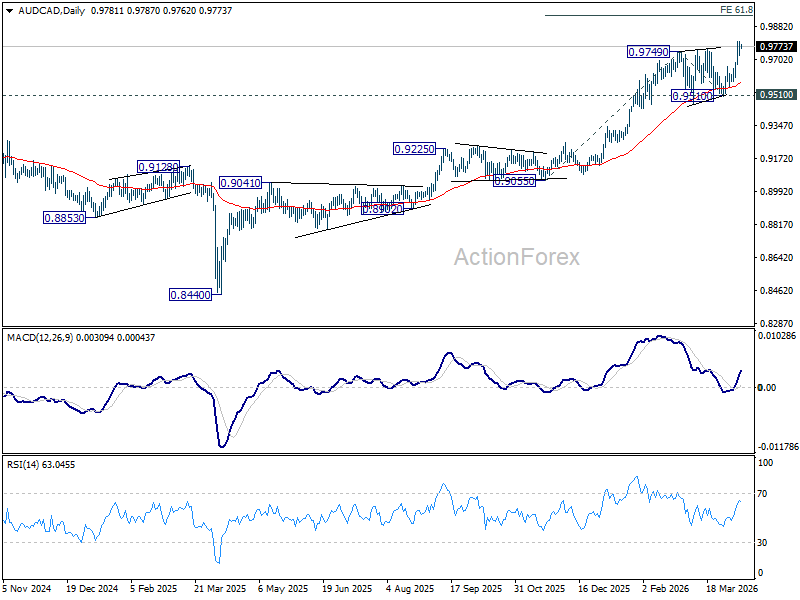
Technically, outlook in AUD/CAD will stay bullish as long as 0.9510 support holds, even in case of retreat. Next near term target is 61.8% projection of 0.9055 to 0.9749 from 0.9510 at 0.9939, or even further through parity.
Nasdaq Futures (NQ) Target New Record High After Ending Double Three Elliott Wave Structure
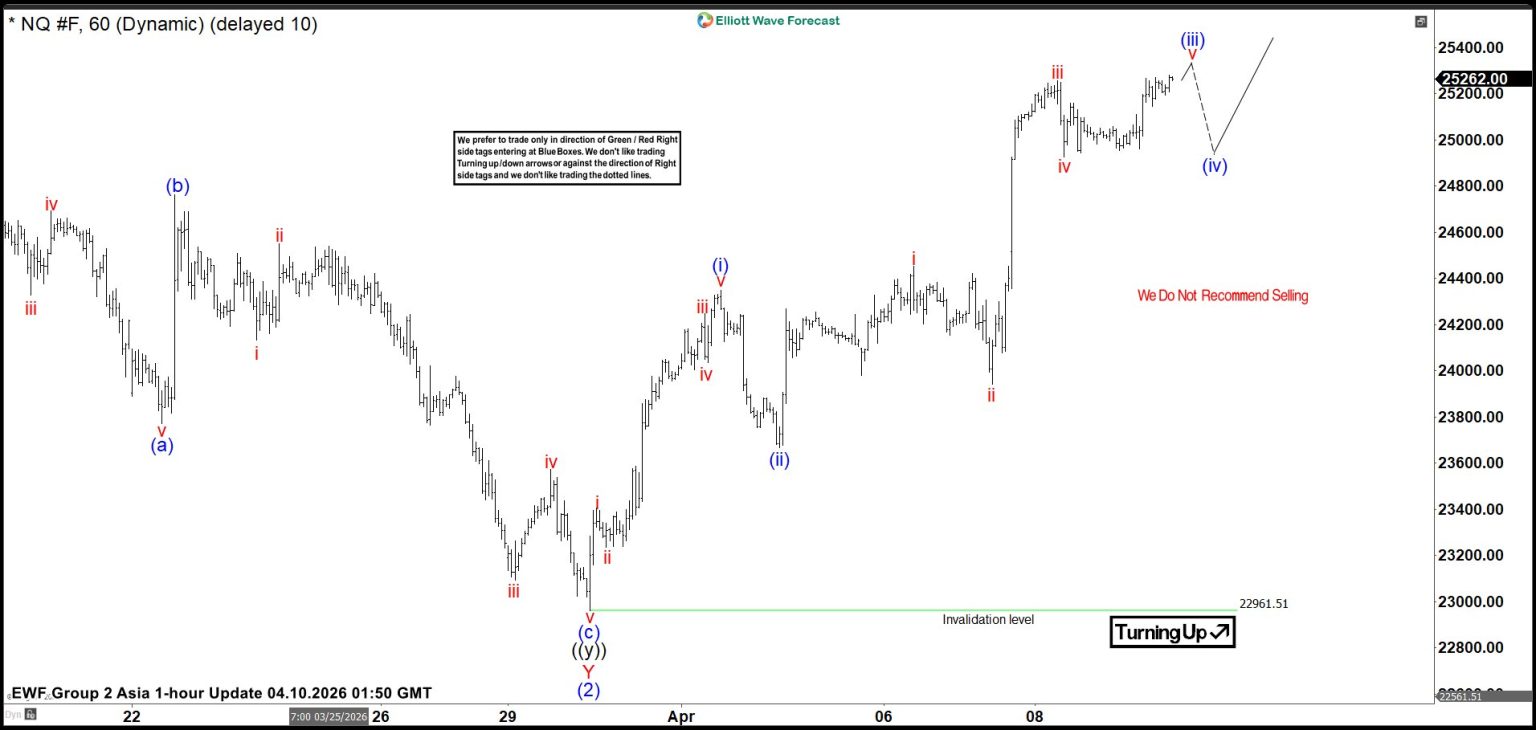
Nasdaq Futures (NQ) reached an all‑time high on October 30, 2025 at 26,399, which we identify as the completion of wave (1). The market then entered a corrective phase in wave (2), unfolding as a double‑three Elliott Wave structure. From the wave (1) peak, wave W declined to 23,904.5. A recovery in wave X followed and reached 26,349. The final leg lower in wave Y ended at 22,961.5, completing wave (2) in a higher degree.
With the correction finished, the Index has turned higher in wave (3). It still needs to break above the wave (1) high at 26,399 to fully rule out a double correction. From the wave (2) low, wave (i) advanced to 24,348.25. A pullback in wave (ii) then found support at 23,666. The Index is now progressing within wave (iii), which is expected to complete soon. A pullback in wave (iv) should follow before another advance in wave (v) to finish wave ((i)).
Once wave ((i)) ends, the Index should correct the cycle from the March 31 low in wave ((ii)). This would set the stage for another bullish phase. In the near term, the pivot at 22,961.5 remains a key level. As long as this level holds, any pullback should attract buyers in a three‑ or seven‑swing sequence, supporting the broader upside outlook.
Nasdaq Futures (NQ) 60-Minute Elliott Wave Chart
NQ Elliott Wave Video:
https://www.youtube.com/watch?v=yz60Fg5LKJo
Market Repricing of Risk as Gold Loses Safe-Haven Demand
Geopolitical tensions in the Middle East had remained the primary macro driver for the gold market over recent weeks; however, on 8 April the situation shifted sharply as the United States and Iran agreed to a temporary two-week ceasefire, including the reopening of the Strait of Hormuz and a pause in military strikes. The easing of acute tensions triggered a sharp decline in oil prices and a return of risk appetite across global markets, weighing on demand for safe-haven assets. As a result, gold retreated from intraday highs near 4,850.
That said, the durability of the agreement remains uncertain. Reports of localised strikes in the region continue to keep market participants on edge, preventing a full dismissal of Iranian-related risks. Additional influence comes from macroeconomic data—particularly US inflation—whose interpretation in the context of Federal Reserve rate expectations continues to shape dollar dynamics. Structural support from central banks persists, with China continuing to increase its gold reserves, while Malaysia and South Korea have resumed purchases after an extended pause.
Technical Outlook
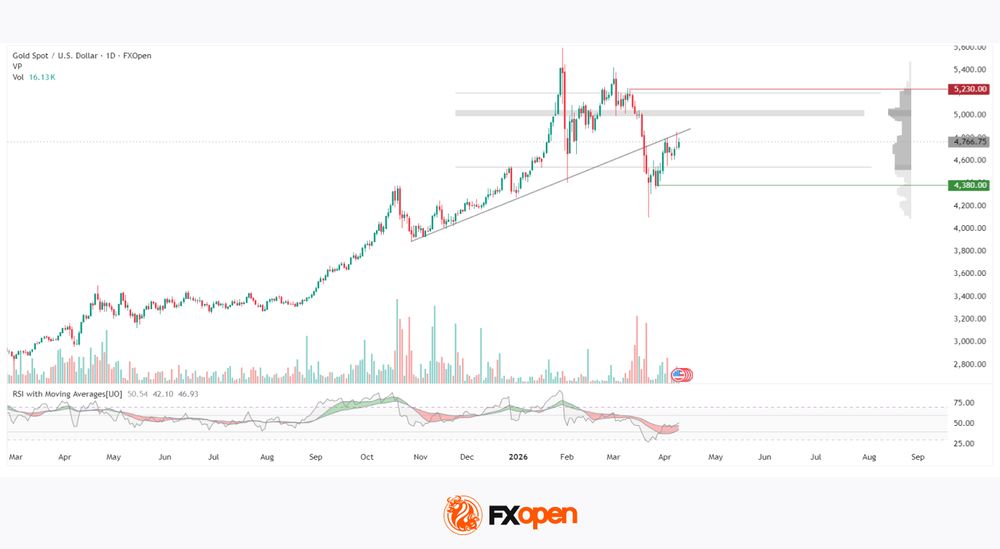
On the daily chart of XAU/USD, a clear two-phase structure is evident. An uptrend that began in March 2024 drove prices to a record high in the 5,595–5,600 range by late January 2026, followed by a sharp and impulsive decline. Notably, the peak in vertical volume occurred not at the price high, but during the subsequent sell-off in March 2026, indicating a climactic phase of selling rather than buying.
The low of that move was recorded near 4,100, from which price rebounded to current levels around 4,766. The horizontal volume profile reveals a dense cluster in the 4,990–5,050 zone, marking the point of control (POC) where trading activity has been most concentrated. This area acts as a natural resistance to further upside. The next significant level above lies at 5,230.
The ascending trend line originating from autumn 2025 was broken to the downside in March 2026 and no longer serves as support for buyers. It may now act as an additional resistance near the 5,000 level.
The lower boundary of the current range is located around 4,380. The RSI and moving averages stand at 50.54 / 42.10 / 46.93, with the RSI hovering near the neutral 50 level and remaining below both upward-sloping moving averages, signalling a lack of confirmed directional momentum.
Summary
Following the completion of an active corrective phase, gold has stabilised below the POC zone, while the RSI remains near neutral levels without a clear directional bias. The current trading range—4,380 on the downside and 5,230 on the upside—continues to define the market structure, as geopolitical developments and Federal Reserve rhetoric shape short-term price dynamics.
Start trading commodity CFDs with tight spreads (additional fees may apply). Open your trading account now or learn more about trading commodity CFDs with FXOpen.
This article represents the opinion of the Companies operating under the FXOpen brand only. It is not to be construed as an offer, solicitation, or recommendation with respect to products and services provided by the Companies operating under the FXOpen brand, nor is it to be considered financial advice.