Sample Category Title
Slowing Economy Keeps Bank of Canada On Hold in December
The Bank of Canada maintained the overnight rate at 5.0%, while stating that it will continue with Quantitative Tightening (QT).
The Bank highlighted the slowing in economic momentum stating, "economic growth stalled through the middle quarters of 2023 (and that) higher interest rates are clearly restraining spending". The Bank also noted that the labour market has cooled, as "job creation has been slower than labour force growth, job vacancies have declined further, and the unemployment rate has risen modestly."
On the improvement in inflation, it stated that "the slowdown in the economy is reducing inflationary pressures in a broadening range of goods and services prices". It did hedge this by stating that "shelter price inflation has picked up, reflecting faster growth in rent and other housing costs along with the continued contribution from elevated mortgage interest costs."
On the future path of policy, the Bank "is still concerned about risks to the outlook for inflation" and maintained the statement that it "remains prepared to raise the policy rate further if needed".
Key Implications
A hold today was the only option for the BoC. Given the economic backdrop, the BoC has likely gained greater confidence that its policy stance is sufficiently restrictive. There has been obvious weakness emanating from the housing market for a while now, but more recently, consumer spending has slowed alongside a further cooling in the labour market. But with inflation still above 3%, we get why the BoC isn't ready to declare victory. Instead, the BoC seems like it is preparing to sit on the sidelines for the next couple of months while maintaining its cautious rhetoric.
Markets don't think the BoC will be able to get too comfortable. The next move is clearly a cut, with odds pointing to the first move in April. We agree. The next few months are going to be challenging given our expectation that the unemployment rate will continue to rise, which will hit consumer spending and bring inflation down along with it. No wonder the Canada 2- and 10-year yields have fallen approximately 90 basis points over the last two months.
US Private Sector Slowed Hiring, ADP Says
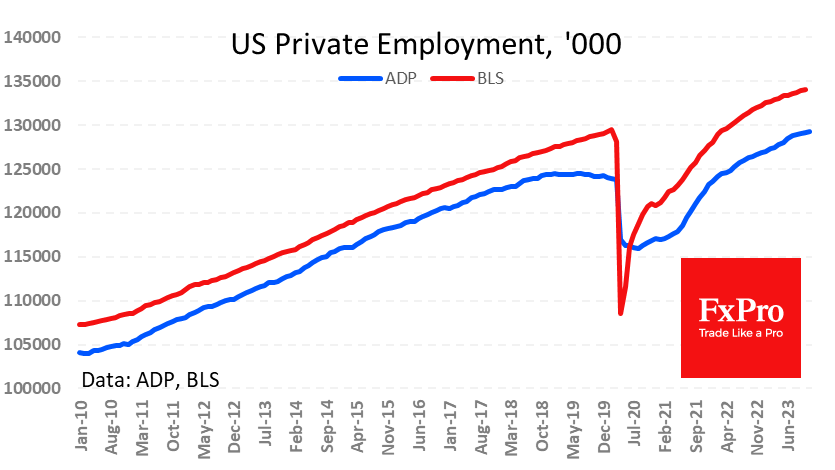
ADP reported a 103k increase in new private sector jobs in the US, against expectations of 130k and 106k (revised from 113k) a month earlier.
This indicator was designed as the last insight on the jobs market before the official data. In the last three months, according to ADP, the private sector has been creating an average of 100k new jobs per month. We saw a similar slowdown at the end of 2018, followed by a year of stagnation and a reversal to decline before the pandemic hit.
The slowdown in the labour market comes as interest rates come under pressure and the potential for a quick recovery from the pandemic is exhausted.
The importance of the ADP reports to the markets is diminishing as they increasingly diverge from official data. The difference began to accumulate in 2018 when the official data continued the trend of employment growth with stagnant or declining numbers from an independent source.
Dow Jones is Close to a Peak
The Dow Jones index has switched into consolidation mode, joining the S&P500 and Nasdaq100, which did so almost two and three weeks ago, respectively. This could be consolidation before a spurt to new highs, but it’s more likely that we’re seeing a depletion of growth.
The Dow Jones index is trading just 0.8% away from its record close in December 2021 and 2% away from its all-time high, having added nearly 12% during the rally over the past five weeks. The rally has been so rapid that the RSI on the daily charts has exceeded 80, an extremely overbought zone. Sometimes, a move into this territory kicks off an even wilder rally, indicating extreme investor greed.
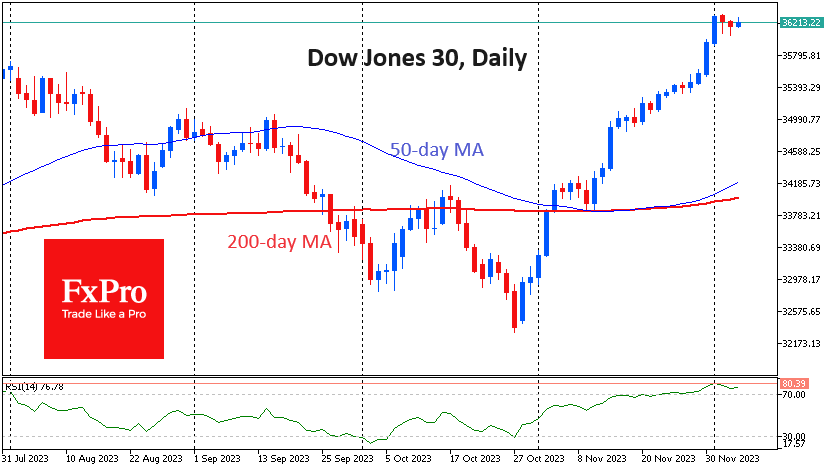
But a different pattern of behaviour seems to have been chosen this time. The Dow Jones index slowly slid on Monday and Tuesday. The S&P500 and Nasdaq100, the broader equity indices, did not connect to the upside and continued to consolidate at recent tops.
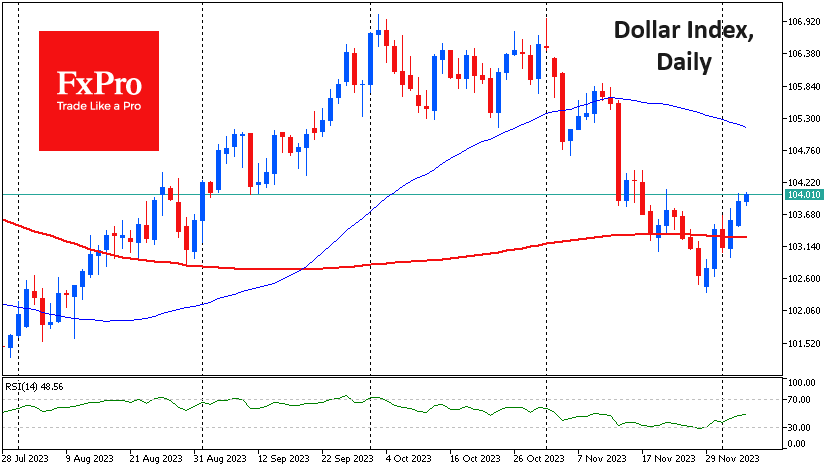
Equally important is the behaviour of the currency market, where the dollar has been adding since late November, which is usually a bearish factor for the market. And this is clearly visible in the dynamics of other indices. Dow Jones, contrary to simple logic, has accelerated its ascent these days.
Such character of movement reminds one of active liquidation of short positions. We saw ruthless equivalents of such liquidations in gold, with the capitulation peak on the 1st and at the beginning of trading on the 4th of December. We saw the opposite situation in April 2020, with negative prices in some oil futures.
That is, technically, from current levels, it is now more comfortable to be bearish in the Dow Jones, assuming that the index is more likely to fall by 5% than rise by another similar amount. Fundamentally, it’s also not easy to buy stocks whose prices include expectations that the Fed will cut rates by 150 points over the next year, with final demand and corporate profits remaining as strong.
BoC stands pat as economic slowdown eases inflationary pressures
BoC keeps overnight rate target unchanged at 5.00%, aligning with market expectations. In its policy statement, the central bank emphasized its ongoing concern about inflationary risks, stating it "remains prepared to raise the policy rate further if needed."
Nevertheless, BoC also noted recent data suggesting that the Canadian economy is "no longer in excess demand". This shift is seen as contributing to a reduction in inflationary pressures across a broad range of goods and services prices. This observation suggests a subtle yet significant change in the economic environment, potentially signaling a pivot in the central bank's future policy decisions.
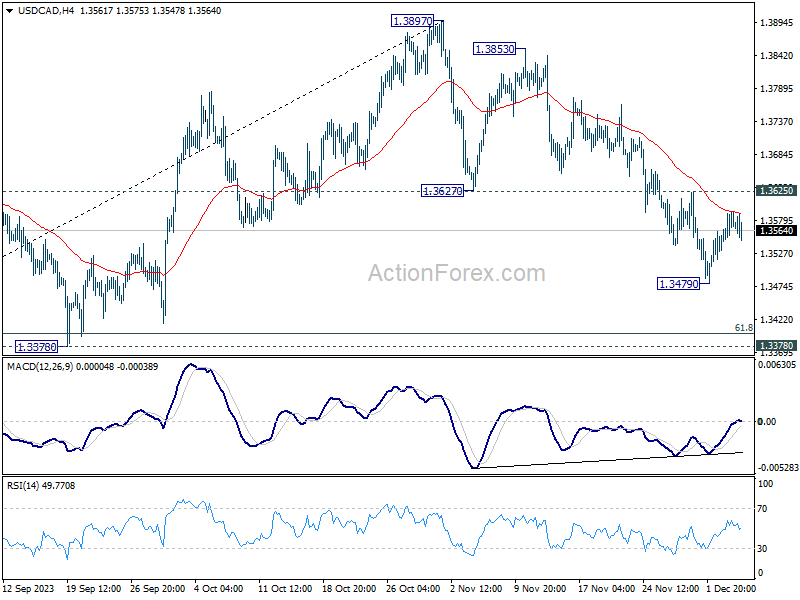
USD/CAD is steady after the policy announcement. The focus for the rest of the week will be on whether rebound from 1.3479 could extend through 1.3625 resistance decisively to confirm that whole correction from 1.3897 has completed.
(BOC) Bank of Canada maintains policy rate, continues quantitative tightening
The Bank of Canada today held its target for the overnight rate at 5%, with the Bank Rate at 5¼% and the deposit rate at 5%. The Bank is continuing its policy of quantitative tightening.
The global economy continues to slow and inflation has eased further. In the United States, growth has been stronger than expected, led by robust consumer spending, but is likely to weaken in the months ahead as past policy rate increases work their way through the economy. Growth in the euro area has weakened and, combined with lower energy prices, this has reduced inflationary pressures. Oil prices are about $10-per-barrel lower than was assumed in the October Monetary Policy Report (MPR). Financial conditions have also eased, with long-term interest rates unwinding some of the sharp increases seen earlier in the autumn. The US dollar has weakened against most currencies, including Canada's.
In Canada, economic growth stalled through the middle quarters of 2023. Real GDP contracted at a rate of 1.1% in the third quarter, following growth of 1.4% in the second quarter. Higher interest rates are clearly restraining spending: consumption growth in the last two quarters was close to zero, and business investment has been volatile but essentially flat over the past year. Exports and inventory adjustment subtracted from GDP growth in the third quarter, while government spending and new home construction provided a boost. The labour market continues to ease: job creation has been slower than labour force growth, job vacancies have declined further, and the unemployment rate has risen modestly. Even so, wages are still rising by 4-5%. Overall, these data and indicators for the fourth quarter suggest the economy is no longer in excess demand.
The slowdown in the economy is reducing inflationary pressures in a broadening range of goods and services prices. Combined with the drop in gasoline prices, this contributed to the easing of CPI inflation to 3.1% in October. However, shelter price inflation has picked up, reflecting faster growth in rent and other housing costs along with the continued contribution from elevated mortgage interest costs. In recent months, the Bank's preferred measures of core inflation have been around 3½-4%, with the October data coming in towards the lower end of this range.
With further signs that monetary policy is moderating spending and relieving price pressures, Governing Council decided to hold the policy rate at 5% and to continue to normalize the Bank's balance sheet. Governing Council is still concerned about risks to the outlook for inflation and remains prepared to raise the policy rate further if needed. Governing Council wants to see further and sustained easing in core inflation, and continues to focus on the balance between demand and supply in the economy, inflation expectations, wage growth, and corporate pricing behaviour. The Bank remains resolute in its commitment to restoring price stability for Canadians.
Information note
The next scheduled date for announcing the overnight rate target is January 24, 2023. The Bank will publish its next full outlook for the economy and inflation, including risks to the projection, in the MPR at the same time.
Sunset Market Commentary
Markets
Today’s US ADP job report served as the next test for markets eager to frontrun a sharp Fed pivot. November employment grew by 103k, less than the 130k expected and a further deceleration from an already downwardly revised 106k. The biggest contributors were trade, transportation and utilities (+55k) & education and health services (+44k). But a negative print in the leisure sector (-7k) points to weakness in the services sector along with goods sector (construction -4k, manufacturing -15k), ADP said. The numbers came on the back of (admittedly outdated) Q3 unit labor costs that have been adjust to the downside as well (-1.2%). Bond markets’ first reaction was tepid and almost suggested the correction lower in yields was nearing its end. But with the joining of American investors, things shifted in higher gear again. US yields at the front end returned back to the intraday opening lows. Longer maturities at some point turned 3 bps lower with intraday moves amounting to 7 bps. Technical charts came to the rescue for the likes of the 10-y yield. Support at 4.13% (50% retracement on the 2023 rally) in the meantime narrowed losses to around 2 bps. Either way, these are not the strong moves down we’ve seen in recent weeks but note that the ADP job report doesn’t rank too high on the market influence list. Friday’s payrolls on the other hand are another story and are the litmus test for bond markets this week. German yields trailed their US peers, easing between 1.7-3.1 bps across the curve with the belly outperforming. UK gilts did best today, with yields shedding 3.1-8.1 bps. The Bank of England successfully kept markets betting on premature rate cuts on a leash but the global force is strong. The timing of a first, fully priced in rate cut moved from August to June in the last two days.
The fall-out on sterling from the latter remains limited though. EUR/GBP erased earlier losses to trade virtually unchanged around 0.857 but this is just as much technically inspired (rejected test of support at 0.8557) as it is genuine sterling weakness. EUR/USD is going nowhere with the pair unable to retake 1.08. Poland’s zloty awaits guidance from the National Bank of Poland after it kept policy rates steady (as expected) at 5.75%. Stock markets in Europe add another 0.7%. The EuroStoxx50 is nearing the YtD (intraday) high at 4491.51. Wall Street opens with gains between 0.25 and 0.4%.
News & Views
Italian foreign Minister Antonio Tajani today said that the country formally informed China that the country will end its participation in China’s Belt and Road initiative. Tajani said that the initiative hasn’t produced the desired effects and was no longer a priority for the country. Italy was the only G7 country that had subscribed to the Chinese initiative as it joined the pact in 2019. The 5-year term of the pact was due to expire in March 2022 and Italy had to decide on a prolongation before the end of the year. Italy participating in the project was a politically sensitive topic as the US and other Western countries took more balanced approach on their relationship with China amongst others due to issues on human rights, China’s positioning vis-à-vis Russia with respect to the war in Ukraine and as Western economies reevaluate their dependence on China supply in key economic sectors.
October retail and production data published by the Hungarian Statistical office today indicated that activity in the country remains sluggish. The volume of retail trade in October was 6.5% lower than in the same period last year. Sales volumes declined by 1.9% in food shops, 5.1% in non-food retailing and by 21.1% in automotive fuel sales. Sales also declined 0.3% compared to the September. Volume of industrial production in October also dropped 0.6% M/M and 3.2% Y/Y. Production dropped in the majority of manufacturing subsections, including computer, electronic and optical products as well as that of food products, beverages and tobacco products. However, as a glimmer of hope, the Statistical office mentioned that the two subsectors with the biggest weight, manufacturing of transport equipment and electrical equipment, posted an increase in production. After brining the emergency overnight rate again in line with the conventional base rate, the National Bank of Hungary (MNB) started cutting rates at a pace of 75 bps (currently 11.50%). MNB members indicated that they want to proceed at that pace at the Dec 19 meeting. Hungarian November CPI data will be published on Friday. The forint today hovered near EUR/HUF 380.
WTI Oil: Bears Hold Grip on Demand Concerns, OPEC+ Decisions
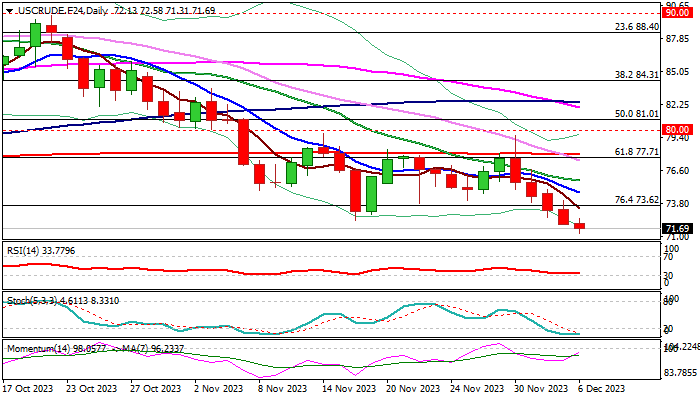
WTI oil price fell below $72 on Wednesday and trading at the lowest levels in five months.
Bear-leg from $79.57 (Nov 30 peak) extends into fifth straight day, as decision of OPEC+ to extend production cuts and further reduce output from January did not satisfy market expectations, with growing concerns over fuel demand on clouded outlook for China’s economic health, additionally souring the sentiment.
Daily technical studies are weak as 14-d momentum stays in the negative territory and moving averages are in bearish configuration (multiple death-crosses contributing to negative near-term outlook.
Tuesday’s close below former low at $72.36 (Nov 16) generated fresh signal of bearish continuation, after larger bears were paused for $72.36/$79.57 consolidation, opening way for attack at $70.31 (200WMA) and psychological $70 support.
Meanwhile, bears may take a breather on oversold conditions, with upticks to provide selling opportunities while the price stays below falling 10DMA ($74.77).
Res: 72.36; 74.10; 74.77; 75.76.
Sup: 71.31; 71.00; 70.31; 70.00.
Canada’s Trade Accounts Register a $3.0 Billion Surplus in October
Canada's merchandise trade account recorded a trade surplus of $3 billion in October, the third consecutive month in black ink. This comes after September's surplus was revised slightly upward to $1.1 billion.
Exports advanced slightly by 0.1% month-on-month (m/m) in October, though 6 of 11 sectors posted decreases in export values. The large increase in aircraft and other transportation equipment (+15% m/m) did just enough to offset export declines in energy products (-1.2% m/m), industrial chemical, plastic, and rubber products (-3.5% m/m), and industrial machinery and equipment (-2.4% m/m).
Meanwhile, total imports slipped by 2.8% m/m in October, with 8 of 11 sectors declining on the month. Imports of motor vehicles and parts (-5.8% m/m) posted its first decline in seven months, while the highly volatile imports of unwrought gold, silver and platinum contributed most to the decline (-41.2% m/m). Energy products (-8.0% m/m) and farm, fishing and food products (-4.1% m/m) also meaningfully declined.
In volume terms, overall imports decreased by 3.2% m/m in October while exports edged down slightly by 0.1% m/m.
Canada's trade surplus with the United States widened for a fourth consecutive month to $12.1 billion in October.
Key Implications
October trade data provides a first look for how net trade will feed into GDP growth in the fourth quarter. Recall that growth revisions over the past two quarters hit net trade more than any other GDP component, with net exports acting as one of the largest drags to Q3 growth. With export volumes tracking higher than imports in October, trade may shape up to be a small tailwind for Q4 growth.
The trade effects induced by shocks over the past quarter appear to have been reversed over the past few months, potentially leading to cleaner readings going forward. That said, the details in the trade data suggest some slowing momentum in international demand with key trading partners. This will be an important factor to watch over the coming months.
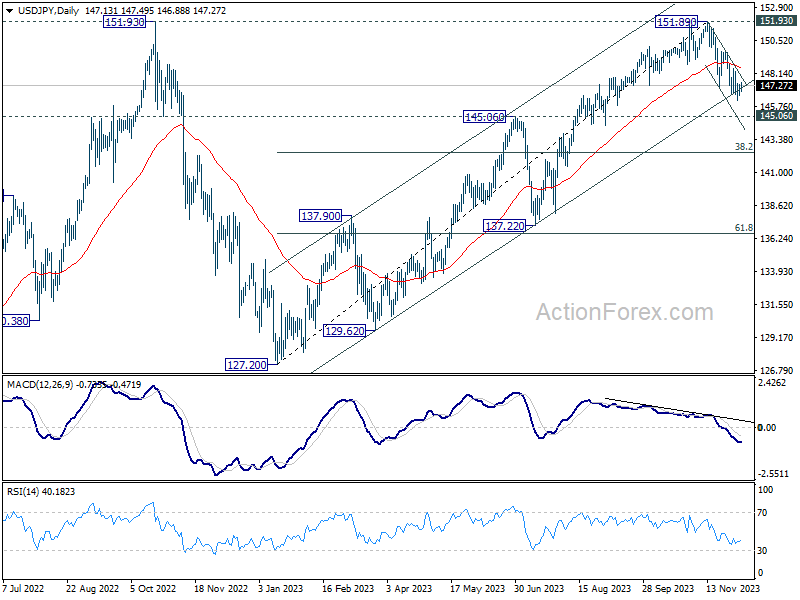
USD/JPY Mid-Day Outlook
Daily Pivots: (S1) 146.68; (P) 147.03; (R1) 147.51; More...
Intraday bias in USD/JPY remains neutral as consolidation from 146.22 is extending. Further decline is expected as long as 148.50 resistance holds, even in case of stronger recovery. On the downside, firm break of 146.22 will resume the fall from 151.89 to 145.06 key support level.
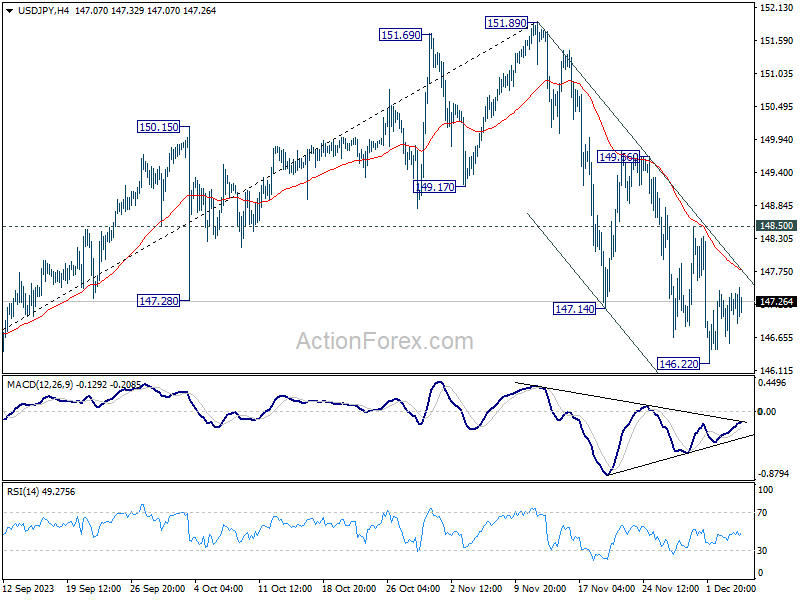
In the bigger picture, rise from 127.20 (2023 low) is seen as the second leg of the pattern from 151.93 (2022 high). Decisive break of 145.06 resistance turned support will confirm that this second leg has completed, after rejection by 151.93. Deeper fall would be seen through 38.2% retracement of 127.20 to 151.89 at 142.45 to 61.8% retracement at 136.63. Nevertheless strong bounce from 145.06 will retain medium term bullishness for another test on 151.93 at a later stage.