

Sample Category Title
Gold Price Could Soon Surpass $2K, US GDP Next
Key Highlights
- Gold prices could extend gains above the $2,000 resistance.
- A connecting bullish trend line is forming with support near $1,968 on the 4-hour chart.
- Crude oil prices trimmed gains and traded below $85.00.
- The US GDP could grow 4.2% in Q3 2023 (Preliminary).
Gold Price Technical Analysis
Gold prices remained in strong demand due to the Israeli–Hamas war. The price rallied above the $1,920 and $1,950 resistance levels.
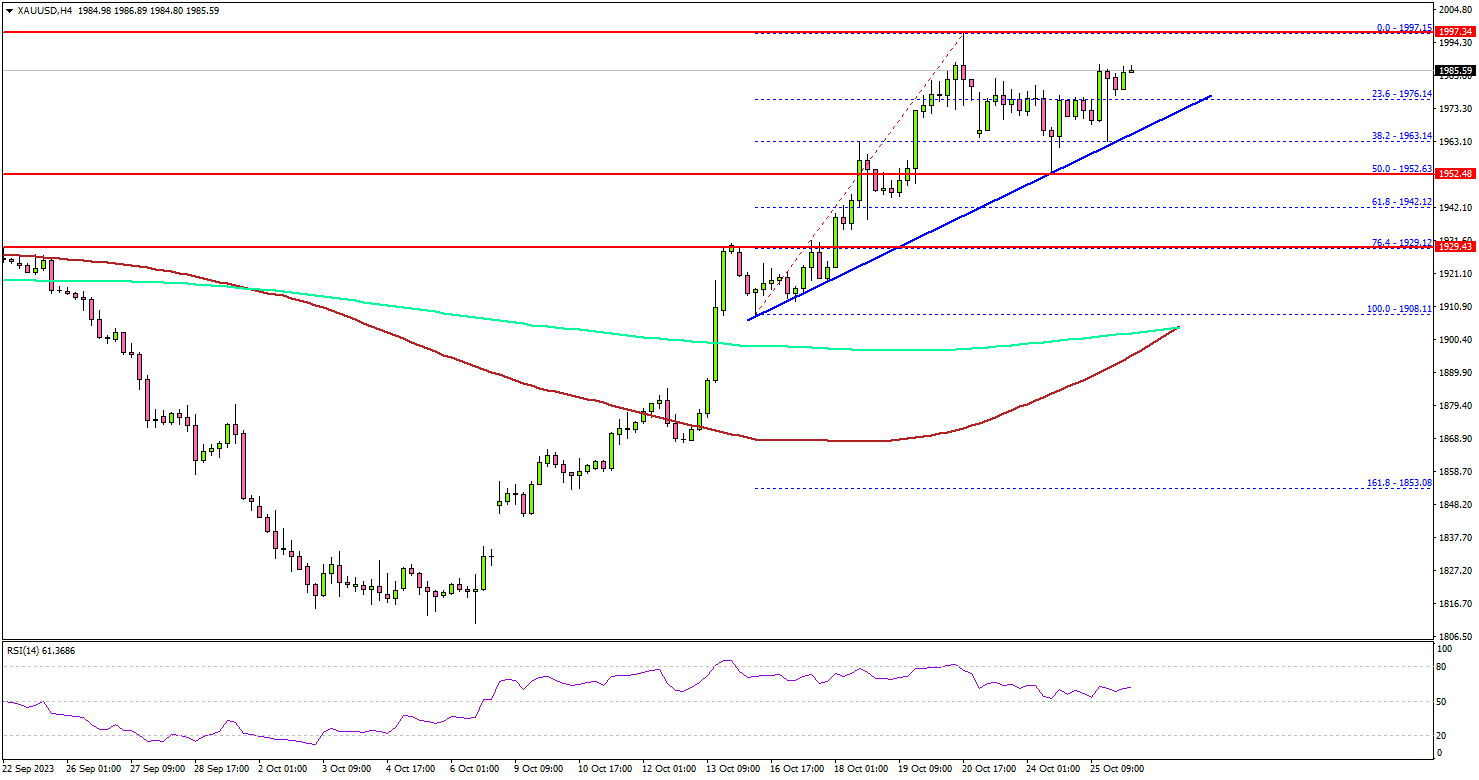
The 4-hour chart of XAU/USD indicates that the price settled above the $1,965 resistance, the 100 Simple Moving Average (red, 4 hours), and the 200 Simple Moving Average (green, 4 hours).
It even spiked toward the $2,000 level before the price started a minor downside correction. The price dipped below the $1,965 level. It tested the 50% Fib retracement level of the upward move from the $1,908 swing low to the $1,997 high.
There is also a connecting bullish trend line forming with support near $1,968 on the same chart. The current price action suggests there are high chances of more upsides above $1,980.
Immediate resistance is near the $1,995 level. The first major resistance is $2,000. An upside break above the $2,000 level could send the price soaring toward the $2,050 resistance. The next major resistance is near the $2,080 level, above which Gold could revisit the key $2,120 resistance zone.
On the downside, the price might find support near the $1,968 level. The next key support is near the gap area at $1,950. If the bulls fail to protect the $1,950 support, there is a risk of a major decline. In the stated case, the price could decline toward the $1,930 level.
Looking at crude oil prices, there was a downside correction and the bears were able to push the price below the $85 level.
Economic Releases to Watch Today
- US Initial Jobless Claims - Forecast 208K, versus 198K previous.
- US Gross Domestic Product for Q3 2023 (Preliminary) – Forecast 4.2% versus previous 2.1%.
ECB to finally pause, EUR/USD looking soft
Today, ECB is broadly anticipated to maintain its main refinancing rate at 4.50% and the deposit rate at 4.00%. Having increased rates consistently during its previous ten meetings to tackle surging inflation, ECB hinted at a pause last month, reflective of the policy's apparent efficacy, as evidenced by deceleration in the Eurozone economy.
President Christine Lagarde, along with other top officials, has been keen to redirect discussions toward the duration for which the interest rates might need to remain at these current restrictive thresholds.
Amid this backdrop, there's also been speculation regarding ECB's potential move for an early reduction in bond holdings within its colossal EUR 1.7T euro Pandemic Emergency Purchase Programme. However, given the prevailing climate of heightened macroeconomic, geopolitical, and financial ambiguities, it's probable that the ECB will resist any hasty decisions to expedite quantitative tightening.
Some previews on ECB:
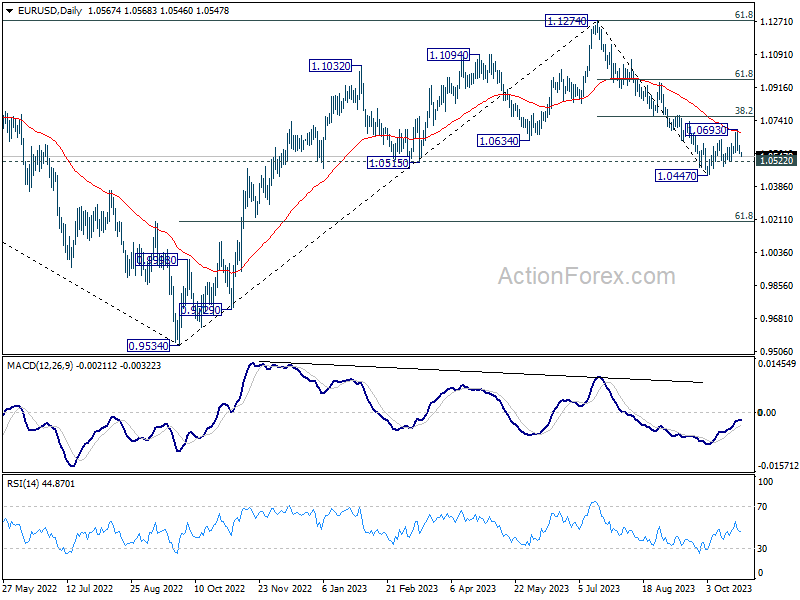
Technically, it's possible that EUR/USD's recovery from 1.0447 has completed at 1.0693, after rejection by 55 D EMA. Immediate focus for today is 1.0522 minor support. Firm break there should strengthen this bearish case. Further break of 1.0447 will resume whole fall from 1.1274, and target 61.8% retracement of 0.9534 to 1.1274 at 1.0199 next.
As USD/JPY breaks 150, Japan faces intervention and YCC decision
In a significant move, USD/JPY surpasses the key psychological level of 150 today, marking its highest point in a year. This uptick has reignited concerns among investors regarding market interventions by Japan, given that the 150 mark is widely regarded as a trigger point for such actions.
Japanese finance minister Shunichi Suzuki addressed the market developments, reiterating, "I'm watching market moves with a sense of urgency, as before." Notably, despite the heightened speculation, he refrained from commenting on any immediate intervention measures. This silence has led to further ambiguity, especially considering the suspected actions by Japan on October 3 to buy Yen, actions that have yet to be officially confirmed.
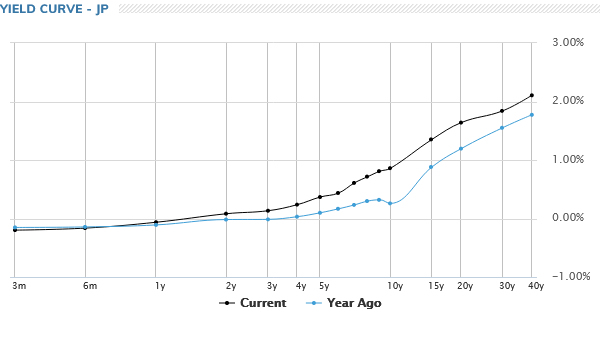
A primary reason for the sustained pressure on Yen can be attributed to increasing yield gap between Japan and other major economies. This disparity intensifies the debate on the necessity for BoJ to revise its yield curve control, especially in light of rising global interest rates. There are rumblings about a possible adjustment to the 10-year yield cap, even though it was adjusted only three months prior, especially with a policy meeting on the horizon.
Nevertheless, BoJ has consistently asserted that previous adjustments to the yield curve control were primarily to rectify any irregularities in the bond market's operations. The current yield curve appears more natural, especially when contrasted against the noticeable dip in 10-year yield in the curve from a year ago. It remains uncertain whether BoJ feels the immediacy to modify its YCC in the near term.
RBA’s Bullock undecided on rate hike following CPI surprise
In the Senate Economics Committee session today, RBA Governor Michele Bullock indicated that the bank was not entirely caught off guard by the stronger than expected CPI data released yesterday. She refrained from offering a definitive direction for the bank's next steps
The Q3 and September CPI data, which Bullock admitted "came out a little higher" than the projections in the August Statement on Monetary Policy, still aligned with the bank's expectations. She clarified, "The numbers were pretty much where we thought it would come out".
When queried on the prospect of another rate hike in the forthcoming meeting, Bullock responded, "We're still analyzing the numbers at the moment. I wouldn't like to say more or less likely, we're still looking at it."
Bullock reiterated the bank's position, stating, "We've always said we have a low tolerance" on inflation surprises. She added, "We are wary and we don't know if the job has been done yet."
Looking forward, Bullock hinted at imminent changes to their economic projections, announcing, "We will be releasing a new set of forecasts after the board meeting." Moreover, she alluded to the significance of these revisions by stating, "There is going to be a change to our forecasts. We have to look at whether or not it's material enough to change our views on monetary policy."
We Have Seen Enough for RBA’s Next Move to be an Increase
Last week we noted that the RBA would leave rates unchanged so long as they saw inflation coming down as they had expected. But if the data flow showed inflation declining slower than that, they would raise rates. This message was reinforced in the Governor's first speech, on Tuesday, where she said "The Board will not hesitate to raise the cash rate further if there is a material upward revision to the outlook for inflation." The September quarter CPI release was always going to be crucial.
Has the RBA seen enough to move? At 1.2% in the quarter, both headline and trimmed mean inflation was a little higher than the Westpac team expected (see Westpac Senior Economist Justin Smirk's note). We assessed that it would take a significant upside surprise to induce the RBA Board to raise rates at the November meeting. A 0.1% difference might not seem like a lot, but the underlying detail was sobering.
So yes, I've seen enough to make my first-ever rate call to be a prediction of a hike.
In August, the RBA expected that the trimmed mean rate of inflation would reach 3.9% over 2023. That seems a long way out of reach now: the December quarterly result would have to print at 0.5% for this to happen. The higher result also cannot be attributed solely to volatile components that will reverse out soon. Fuel inflation was stronger in the quarter, but so were vehicle price inflation, homebuilding cost inflation and inflation in a range of services components such as meals out and takeaway, dental fees and transport fares. Recreational services more broadly were also strong. And a significant fraction of the index saw quarterly changes moderating by less than expected.
Looking at some of the risks we called out last week, it is noteworthy that some traded goods prices are still holding up, even as similar prices decline in other economies; see the graph in Justin Smirk's inflation note for more detail. The cumulative difference in price movements is too large to explain as an exchange rate effect. A sequence of above average inflation outcomes is also evident in the related services series, which includes things like streaming services. Along with strong services inflation more broadly, these outcomes suggest that domestic demand pressures are still driving domestic inflation, even though consumer spending growth more broadly is very weak. Strong population growth is a factor here, and recent arrivals data suggest it will remain so.
Another risk that will remain front of the Board's mind is that housing prices continue to rise. Related to this, the material in the Financial Stability Review and the Governor's speech this week highlighted that the household sector has been resilient to the tightening in monetary policy so far. So although the household sector is currently facing a squeeze on real incomes, and household spending is weak, the Board could conclude that the risk that domestic demand remains stronger than expected has increased. The recent resurgence in US retail sales is a salutary example of what can happen, though it should be emphasised that the US consumer sector is in a very different position to Australia's.
That said, we do not think that a decision to increase rates at the November meeting is entirely clear cut. There is an argument that bygones are bygones, and the upside surprise on the September quarter data will not carry through to subsequent quarters. If the RBA did not want to raise rates this month, it could upgrade its 2023 forecast for inflation but not the forecast for 2024 and beyond. It could then argue that there had been no material upward revision to the outlook for inflation, only to the history.
As an aside, we do not take any signal from the Governor's parliamentary testimony this morning on the interpretation of the CPI data. Having spelled out so clearly that a material surprise to the outlook would warrant a rate increase, she simply had to be equivocal to avoid front-running the Board's decision, which is still more than a week away.
The Board could point to the reduced risk of a price-wage spiral and the turning in the labour market as evidence in support of a decision to keep rates on hold. The Board might also want to reference the current uncertainty generated by the conflict in the Middle East and the tightening in global financial conditions. Some of the near-term strength in services inflation could be a passing through of award wage increases that probably won't be repeated, as well as non-standard timing of increases in health insurance. Business services have been showing cost pressures easing, and growth in the real economy is relatively weak.
But this seems like a hard case to make. It is going to be a finely balanced decision and a decision to hold still can't be ruled out entirely. An increase this month won't be the outcome the RBA had hoped for. But given the strength of their rhetoric around upside surprises, I don't think they will try to craft a rates-on-hold story. Nor will they wait until the following month. There is not enough in the way of new data between the November and December meetings, and waiting would be inconsistent with the clear language from the Governor's speech this week about not hesitating if the outlook changes.
GBPUSD Wave Analysis
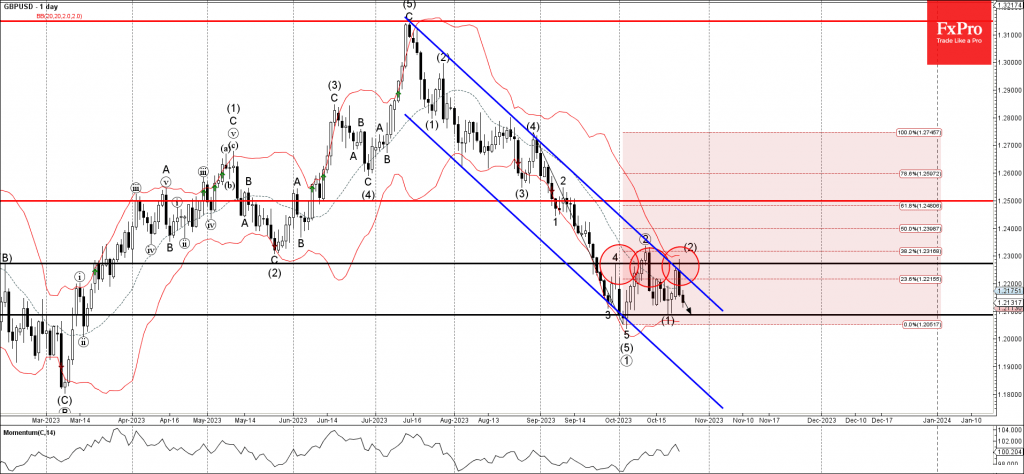
- GBPUSD reversed from resistance level 1.2270
- Likely to fall to support level 1.2085
GBPUSD earlier reversed down with the Piercing Line candlesticks pattern from the key resistance level 1.2270 (which also stopped the previous waves 4 and 2).
The resistance level 1.2270 was strengthened by the upper daily Bollinger Band, 38.2% Fibonacci correction of the previous downward impulse from August and the resistance trendline of the daily down channel from July.
Given the moderate USD bullishness, GBPUSD can be expected to fall further toward the next support level 1.2085 (low of the previous waves (5) and (1)).
EURUSD Wave Analysis
- EURUSD reversed from resistance level 1.0665
- Likely to fall to support level 1.0515
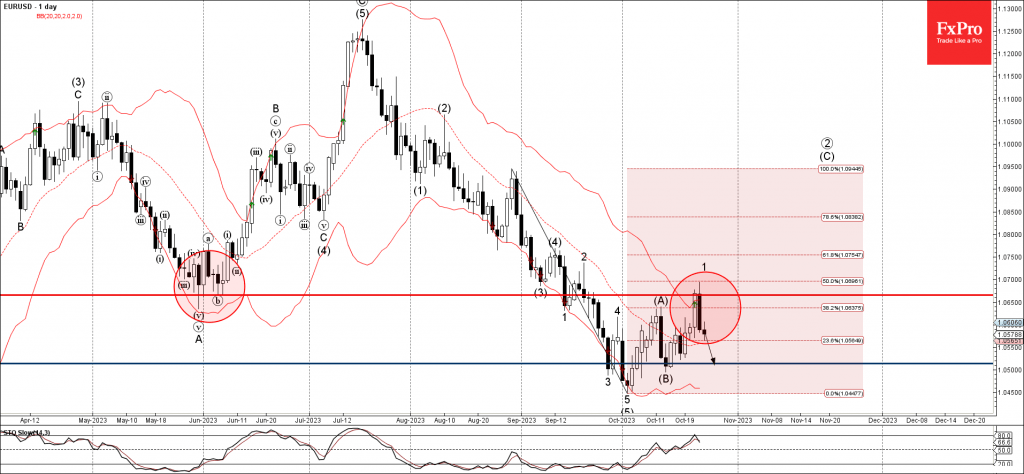
EURUSD currency pair recently reversed down with the Bearish Engulfing from the key resistance level 1.0665 (former strong support from May and June) intersecting with the upper daily Bollinger Band.
The resistance level 1.0665 was strengthened by the 50% Fibonacci correction of the previous downward impulse from August.
Given the clear daily downtrend, EURUSD can be expected to fall further toward the next support level 1.0515 (low of the previous wave (B)).
Canada: Sluggish Growth, Slowing Inflation, Softer Currency
Summary
- Incoming data continues to point to increasing challenges and slower growth for the Canadian economy ahead. Past monetary tightening has led to a significant rise in the household debt servicing burden, while forward-looking surveys point to a softening business outlook. Amid this backdrop, we have lowered our Canadian GDP growth forecasts for 1.1% for 2023 and 0.7% for 2024.
- Although Canada's September CPI surprised to the downside, inflation remains elevated for now and continues to move only gradually in a more favorable direction.
- The Bank of Canada (BoC) held its policy rate at 5.00% at its October announcement, and maintained a moderate tightening bias. However, we believe the BoC's interest rate pause will be an interest rate peak. Given we forecast slower growth and inflation than the central bank, we expect policy rate to hold steady for an extended period, before rate cuts begin in Q2-2024.
- As Canadian growth remains subdued and in the absence of further BoC tightening, we also see potential for further Canadian dollar weakness over the next several months.
Canadian Growth Challenges Accumulating
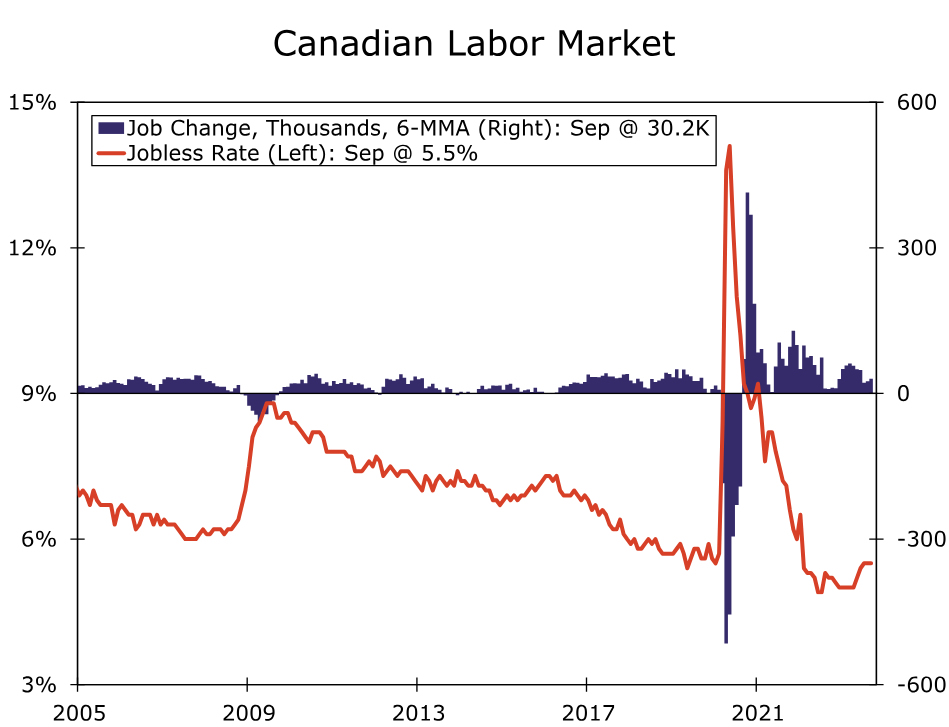
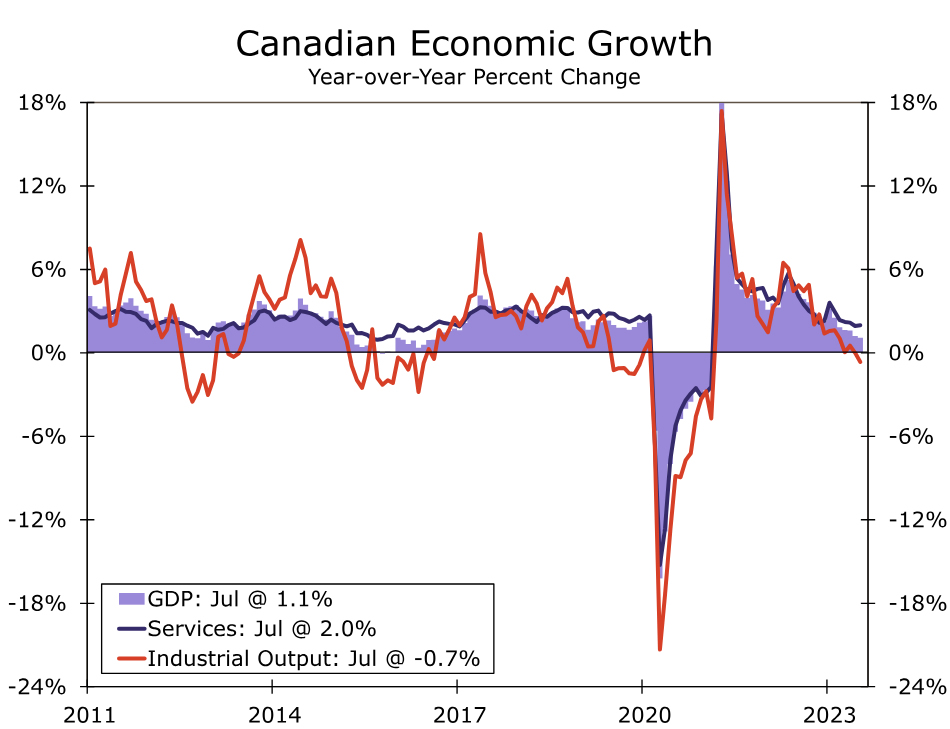
While Canada's economy has shown pockets of strength in recent months, incoming data continues to point to increasing challenges and slower growth for the Canadian economy ahead. The main bright spot for Canada has been the labor market, which added a combined 103,700 jobs in July and August, while hourly wage growth for permanent employees remains elevated at 5.3% year-over-year. Even so, the employment gains are perhaps not as strong as they might appear at first glance. A 48,000 gain in full-time jobs accounted for less than half of the increase, whereas for the outstanding level of employment, full-time jobs make up 82% of total employment. Moreover, the July-August period saw a decline in private sector employees, with the jobs increase instead driven by a rise in public sector employees and self-employment. Other areas of the economy are noticeably less robust. Despite the employment gains, higher interest rates and cost-of-living issues appear to be contributing to consumer caution, with real retail sales having declined for three months in a row through August. More broadly, Canada's Q2 GDP growth contracted at a 0.2% quarter-over-quarter annualized rate and, based on available data for July and preliminary data for August, is at best on track for only very modest positive growth in Q3.
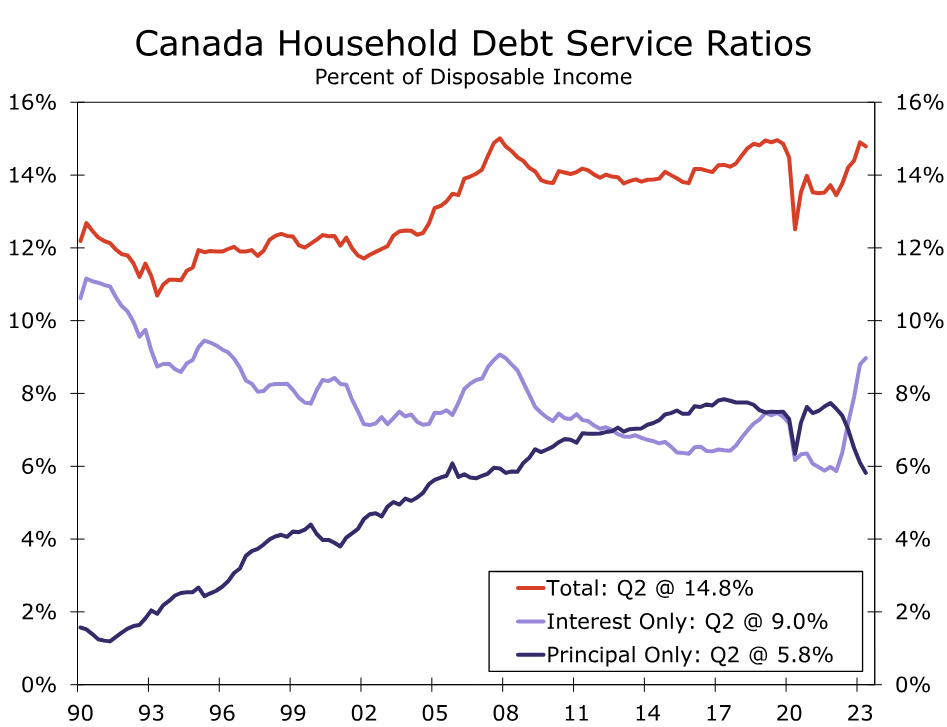
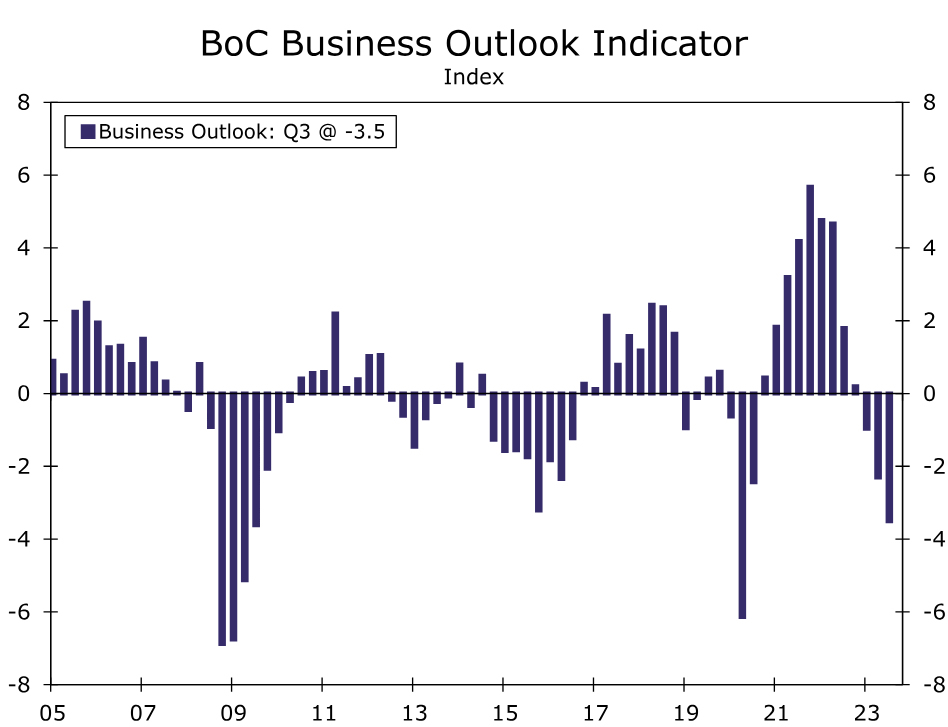
Moreover, economic fundamentals and forward-looking indicators do not point to an improvement in Canada's growth prospects any time soon. From a consumer perspective, the outlook is mixed. Growth in real household disposable income has returned to positive territory and the household saving rate of 5.1% remains slightly above pre-pandemic levels. However, the Bank of Canada's monetary tightening has led to a rising interest and debt servicing burden for Canadian households. In Q2, interest costs were 9.0% of disposable income, while total debt servicing costs (that is, principal and interest) were 14.8% of disposable income. Those metrics are elevated by historical standards, and suggest continued consumer restraint going forward. The outlook for businesses is similarly subdued. Declining corporate profit growth has led to a drop in business fixed investment through mid-2023, and the central bank's Q3 Business Outlook Survey suggests the outlook may have worsened further since. The Bank of Canada's (BoC) Business Outlook Indicator fell further to -3.5, the weakest reading since the depths of the pandemic. In addition, the Indicators of Future Sales balance, which takes into account factors such as order books, advance bookings, sales inquiries and so on, fell to zero in Q3, also the weakest reading since Q3-2020. Finally, more than half of firms surveyed by the BoC believe that the effects of past monetary tightening on their businesses are far from over. To the extent that more cautious businesses scale back hiring plans, that could add to headwinds for Canadian households and consumers. Against this backdrop we have pared our growth forecast for Canada, and now anticipate GDP growth of 1.1% in 2023 (previously 1.2%) and 0.7% in 2024 (previously 1.0%).
Canadian Inflation: High, But Heading In The Right Direction
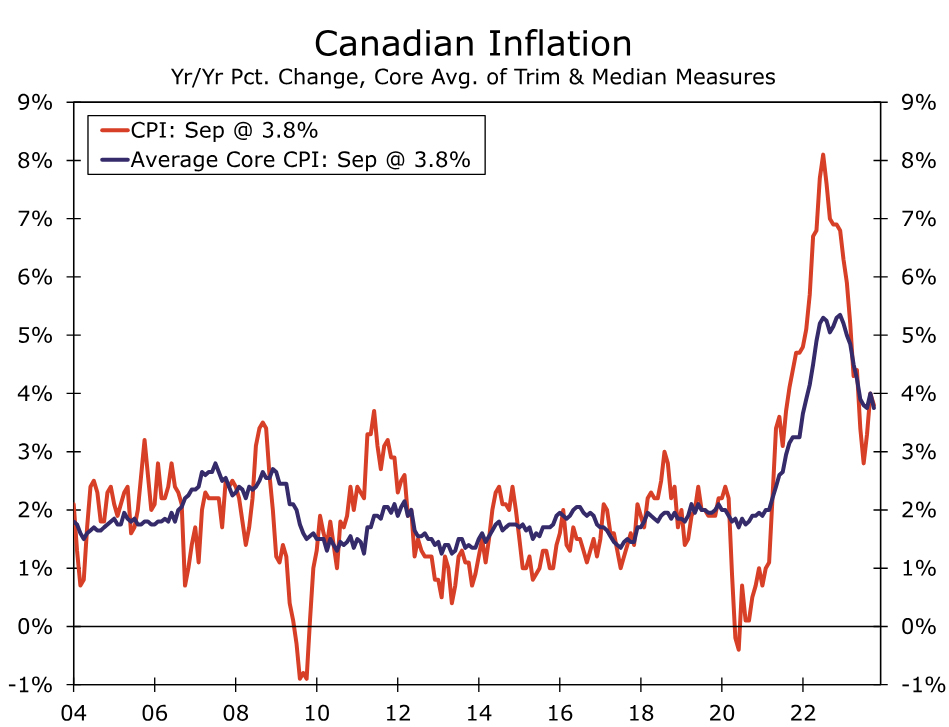
While recent news on Canadian growth has been disappointing, news on the inflation front has been slightly more hopeful. The message from actual inflation data as well as forward-looking indicators are the same—inflation remains too high for now, but is gradually heading in the right direction. With respect to the September CPI, both headline and core inflation surprised to the downside. The headline CPI slowed to 3.8% year-over-year, while the average core CPI similarly eased to 3.8% year-over-year. Importantly, the average core CPI rose at a 3.67% three-month annualized pace through September. That is less than the increase seen in August, even if the recent trend of underlying inflation remains above the central bank's 2% target and the underlying pace of disinflation remains frustratingly slow.
Survey data also point to elevated inflation trends that are nonetheless moving in a more favorable direction. The BoC's Business Outlook Survey showed more firms expecting slower input and output price inflation over the next 12 months. For example, the net balance for input price inflation fell to -63 in Q3 from -53 in Q2 (that is, more respondents seeing slower input price inflation), while the net balance for output price inflation fell to -43 in Q3 from -33 in Q2 (more seeing slower output price inflation). In terms of firms' CPI inflation expectations over the next two years, 53% saw inflation above 3% during that period, still high but less than the 64% in Q2 and 79% in Q1. Finally, in a separate survey of consumers during Q3, one-year ahead and two-year ahead inflation expectations were still elevated at 5.03% and 4.04% respectively. Nonetheless, that same survey said consumers who expect more adverse effects from rate hikes are less likely to plan major purchases such as cars or appliances, and more likely to spend on discretionary items like vacations and concerts—a hint perhaps that higher interest rates are having some impact on consumer expectations.
Bank of Canada's Interest Rate Pause Will Be An Interest Rate Peak
Against this backdrop of slowing growth and gradually slowing inflation, the Bank of Canada once again held its policy interest rate steady at 5.00% at its October monetary policy announcement. In its accompanying statement, the BoC acknowledged softer economic activity, saying:
- There is growing evidence that past interest rate increases are dampening economic activity and relieving price pressures.
- Consumption has been subdued, and weaker demand and higher borrowing costs are weighing on business investment.
- A range of indicators suggest that supply and demand in the economy are now approaching balance.
- Economic growth is expected to be weak for the next year before increasing in late 2024 and through 2025.
The softer outlook is also reflected in the central bank's updated projections, which forecast GDP growth of 1.2% in 2023 (compared to 1.8% in July) and 0.9% in 2024 (compared to 1.2% in July).
At the same time, the BOC kept the option of further tightening on the table, saying it is “prepared to raise the policy rate further if needed.” The central bank clearly remains somewhat wary about the inflation outlook, saying it “is concerned that progress towards price stability is slow and inflationary risks have increased.” Those inflation concerns are also reflected in the BoC's updated inflation forecasts, which see CPI inflation at 3.0% for 2024 (previously 2.5%) and 2.2% for 2025 (previously 2.1%).
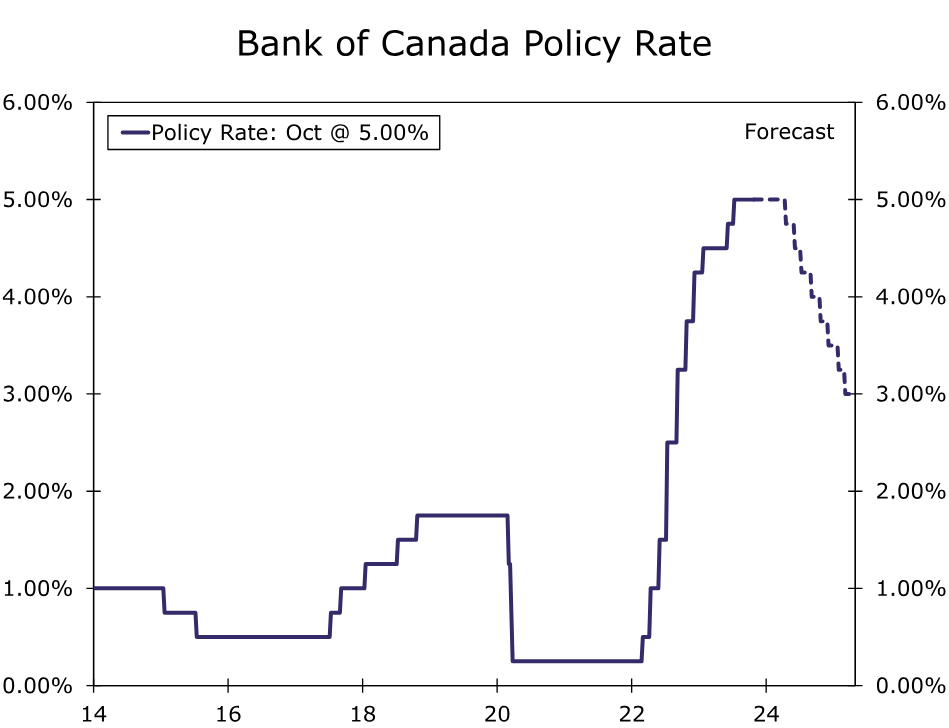
Although BoC maintained a moderate rate hike bias, we continue to believe that further tightening remains a possibility rather than a probability. We expect Canadian economic growth to slow more quickly than the central bank's forecast, and as a result, we see slightly slower CPI inflation next year than does the central bank. We believe the Bank of Canada will hold its policy rate steady at 5.00% for an extended period. That said, as growth remains subdued and underlying inflation measures move a bit closer to the central bank's 2% target, we still forecast Bank of Canada rate cuts beginning in Q2-2024, and a cumulative 150 bps of easing to 3.50% by the end of next year. As Canadian growth remains subdued and in the absence of further BoC tightening, we also see potential for further Canadian dollar weakness. The USD/CAD exchange rate has already reached our medium-term target of CAD1.3700, but a further move closer to CAD1.4000 over the next several months cannot be ruled out. We will provide a full assessment and updated currency forecasts in our International Economic Outlook, due for publication later this week.
Dollar’s Shallow Correction May Be Over
After starting the week in retreat, the US dollar reversed sharply higher in the European session on Tuesday and is on the offensive on Wednesday. Dollar bulls have returned to active buying after a long but shallow correction from earlier this month’s peak.
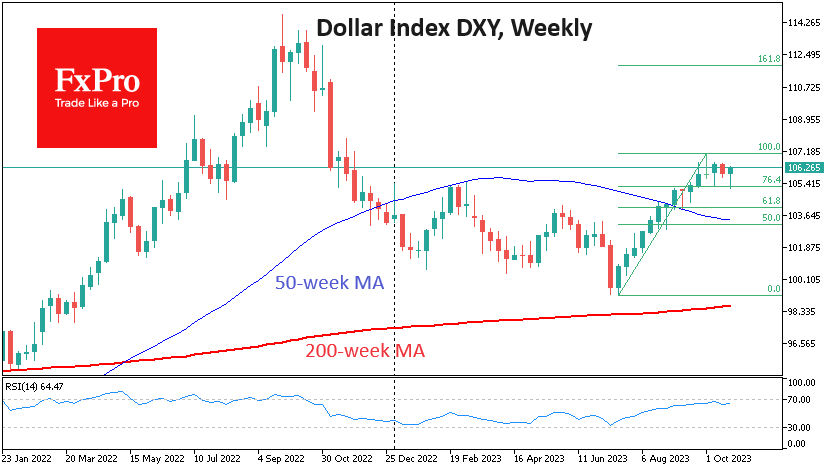
The Dollar Index peaked at 107 in early October after twelve weeks of gains. The market was then dominated by profit-taking. However, the pullback from the 107.1 peak was relatively shallow, and the DXY corrected 76.4% of the total upside amplitude, finding support at 105.2. Deeper corrections are seen as the norm, but there are truncated corrections in solid markets when there is sufficient reason to complete them.
On the news side, the reason for the resumption of buying in the US was the failure of the Eurozone PMIs. This starkly contrasted to the better-than-expected indices coming out of the US. These indices underlined that America is doing well with high interest rates, while Europe is losing traction, and its countries are likely to slip into recession one by one.
The technical reason for the sell-off was that the EURUSD touched its 50-day moving average as it approached 1.07. The dollar bulls did not let this vital trend indicator be taken away, proving once again that we are in a strengthening dollar environment.
The DXY index also approached its 50-day average but failed to touch it and was just minutes below its 76.4% retracement.
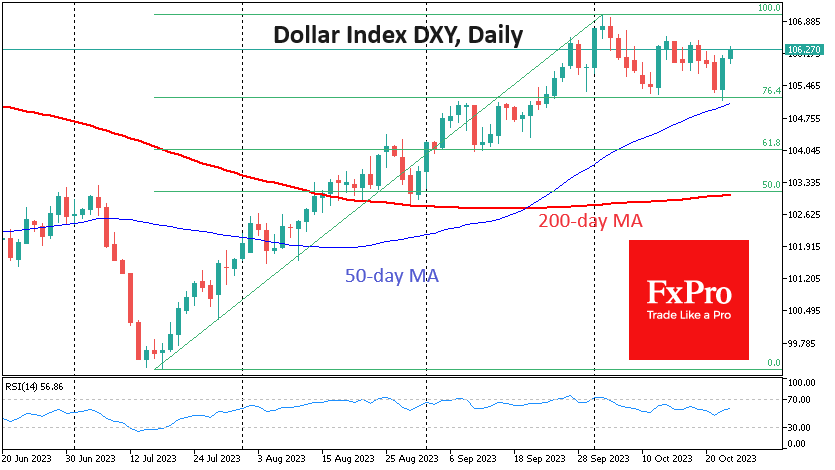
In general, it is too early to talk about a continuation of the dollar rally, and it is better to wait for confirmation in the form of an update of the previous local highs at 107.1.
However, the bulls have two critical factors on their side. First, the Carry trade – playing the interest rate differential – is now entirely on the side of US assets, not to mention the attractive liquidity and reliability of the US market.
Secondly, we note the strong dollar buying impulses on Tuesday and 12 October, suggesting impressive demand on the downside.
Thus, barring any surprises from macro data and next week’s FOMC meeting, it is only a matter of time before the Dollar Index reaches new highs.