Sample Category Title
USD/JPY Mid-Day Outlook
Daily Pivots: (S1) 149.51; (P) 149.72; (R1) 150.12; More...
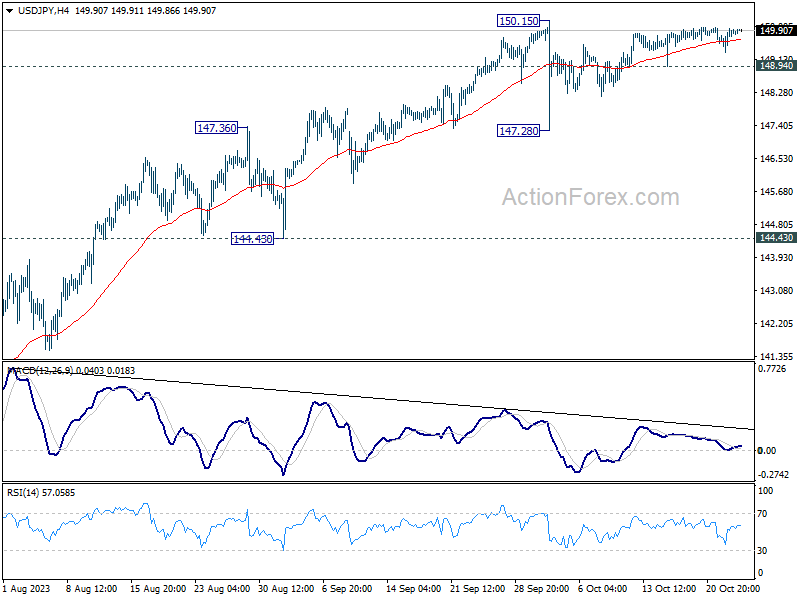
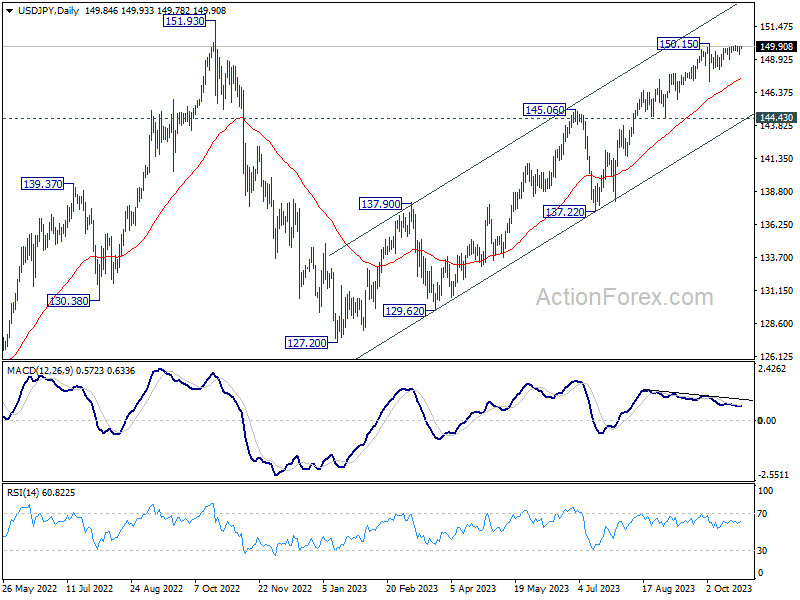
USD/JPY is still extending the consolidation from 150.15 and intraday bias stays neutral. On the downside, below 148.94 minor support will turn bias to the downside for another down leg towards 147.28. On the upside, firm break of 150.15 will resume larger up trend to test 151.93 high.
In the bigger picture, while rise from 127.20 is strong, it could still be seen as the second leg of the corrective pattern from 151.93 (2022 high). Rejection by 151.93, followed by sustained break of 145.06 resistance turned support will be the first sign that the third leg of the pattern has started. However, sustained break of 151.93 will confirm resumption of long term up trend.
Inflation Surprise Doesn’t Help the Aussie
Australian inflation surprised on the upside, reigniting expectations of another rate hike as early as November. However, the Aussie could not enjoy the buying momentum for long as the US dollar strengthened.
In the third quarter, CPI rose 1.2%, accelerating from 0.8% three months earlier due to fuel and energy cost dynamics. Annual inflation slowed to 5.4% from 6.0%, above expectations of 5.3%.

Monthly data showed that inflation accelerated to 5.6% y/y in September from 5.2% in August and 4.9% in July. This looks like a dangerous and sustained uptrend, although it is yet to be seen in the quarterly numbers, which are the central bank’s primary focus.
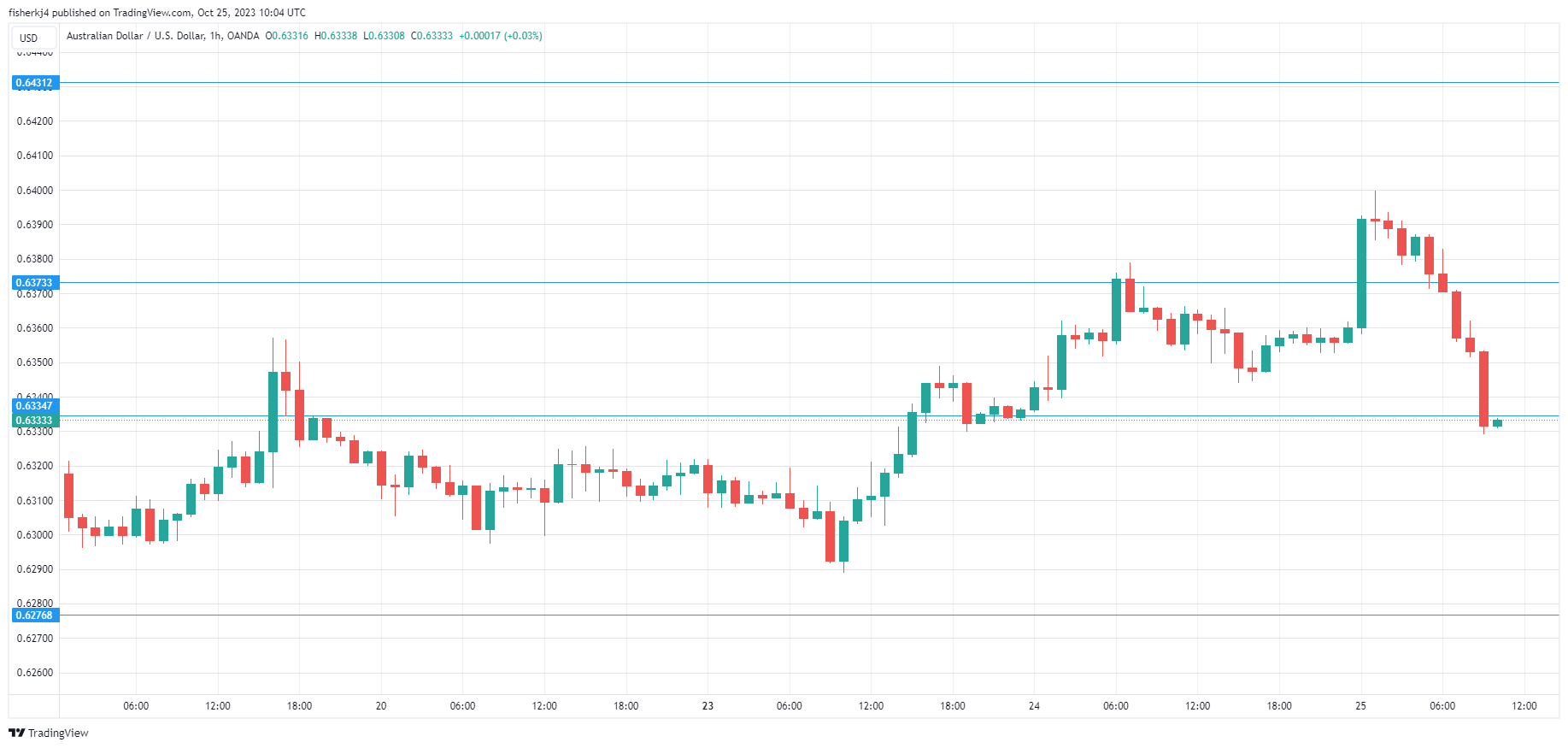
AUDUSD came close to 0.6400, adding two-thirds of a cent shortly after the news. However, the round level and touching of the 50-day moving average also triggered heavier selling in the pair, repeating what we saw in EURUSD a day earlier.
At the time of writing, the Aussie has pulled back to 0.6330, erasing the gains made early Tuesday. Technically, the Aussie remains in the hands of the bears as it makes a series of lower local highs and stumbles off the 50-day moving average. There is significant support at 0.63, from which the pair has been bought on the downtrend since the beginning of the month. A break below this level would open the door for a quick fall back below 0.62.
The risk of the AUD falling into a downward spiral should raise the RBA’s alert level. But will it happen?

USD/CAD Eyes Bank of Canada Decision
- Bank of Canada expected to hold rates at 5.0%
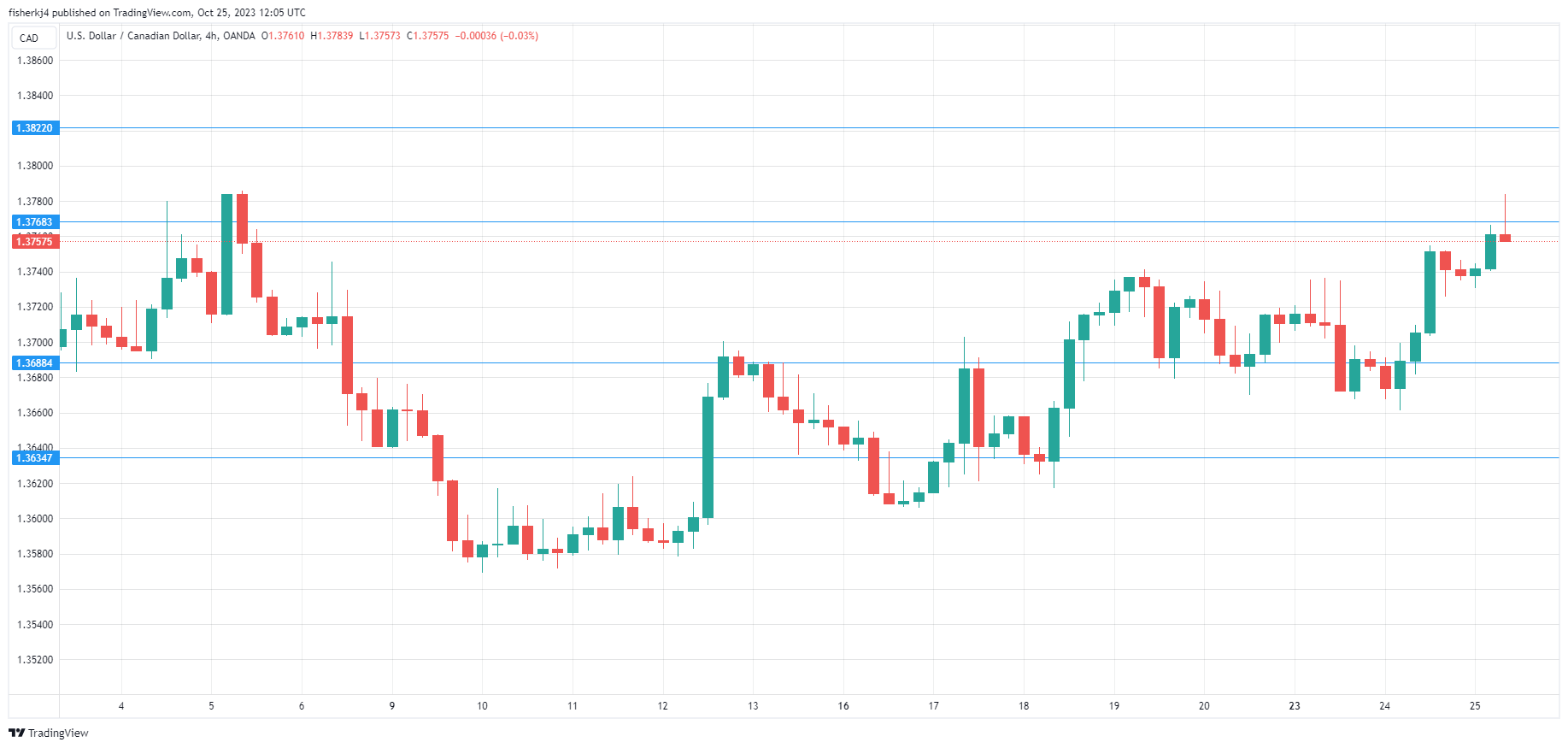
The Canadian dollar is steady on Wednesday. In the European session, USD/CAD is trading at 1.3758, up 0.12%.
Bank of Canada expected to hold rates
The Bank of Canada meets later today and the markets are widely expecting the Bank to hold the benchmark cash rate at 5.0%. The BoC has aggressively raised rates to levels not seen since 2001 in order to curb inflation. The economy has cooled as elevated rates continue to filter through the economy and inflation eased to 3.8% in September. Still, this remains close to double the BoC’s inflation target of 2%, and central banks have come to realize that the final ‘sprint’ to getting inflation back down to target may be the most difficult phase in the battle to curb inflation.
The BoC is doing its utmost to hold rates and not inflation further pain on households. I don’t anticipate the BoC cutting rates before inflation is back at the 2% target, which won’t occur before sometime next year at the earliest.
US GDP expected to jump to 4.5%
Over in the US, the economy remains strong, raising hopes that the Fed will be able to guide the economy to a soft landing. The US releases third-quarter GDP on Thursday and the consensus estimate stands at a massive annual rate of 4.5%, compared to 2.1% in the second quarter. This would mark the highest level since Q4 2021, when the economy was in recovery mode from the Covid pandemic.
As the major economies grapple with weak growth, US exceptionalism has been marked by a strong labour market which is driving consumer spending. The Fed is clearly worried, with Jerome Powell stating last week that continuing strong growth could complicate the efforts to rein in inflation and force the Fed to raise rates. As far as the Fed is concerned, a strong GDP release could be “too much of a good thing” and would add pressure to raise rates.
USD/CAD Technical
- USD/CAD tested resistance at 1.3768 earlier. Above, there is resistance at 1.3822
- There is support at 1.3688 and 1.3634
Australian Dollar Falls Despite CPI Rise
- Australia’s CPI accelerates
- US PMIs show slight improvement
The Australian dollar rose about 40 basis points on Wednesday after Australia’s CPI surprised to the upside, but has reversed directions and is in negative territory. In the European session, AUD/USD is trading at 0.6335, down 0.32%.
Australia’s CPI accelerates
Australian inflation was hotter than expected in the third quarter and that could translate into the Reserve Bank of Australia hiking rates after four consecutive pauses.
Australian CPI rose 1.2% q/q in the third quarter, up from 0.8% in Q2 and higher than the consensus estimate of 0.8%. For September, CPI jumped 5.6% y/y, up from 5.2% in August. The trimmed mean, a key core CPI indicator, rose to 1.2% q/q, up from a revised 1.0% in September and higher than the consensus estimate of 1.1%. The fact that headline CPI and the trimmed mean both decelerated on an annual basis was cold comfort to the markets, which have raised the odds of a rate hike next month to 66%, compared to 35% a day ago.
The RBA remains hawkish over inflation, and Governor Bullock said on Tuesday that the RBA would increase rates if there was “a material upward revision to the outlook for inflation”. I’ll leave it to the number-crunchers at the central bank to determine if today’s inflation report meets that definition, but it’s clear that the upswing in inflation will put pressure on the RBA to raise rates at the November 2nd meeting. Two major Australian banks, the Commonwealth Bank of Australia and ANZ switched their rate stance in the aftermath of the inflation report and are now projecting a quarter-point hike next month.
It wasn’t a spectacular upswing but US manufacturing and services PMI gained ground in September. Manufacturing PMI rose from 49.8 to 50.0 is September, above the market consensus of 49.5 and hitting a six-month high. The Services PMI rose to 50.9, up from 50.1 in September, above the market consensus of 49.8 and the highest level in three months. The PMI releases are the latest sign that the US economy has been able to weather the Federal Reserve’s tightening cycle.
AUD/USD Technical
- AUD/USD has support at 0.6240 and 0.6184
- 0.6343 and 0.6399 are the next resistance lines
Tokyo Inflation Report to Set the Scene for Next Week’s BoJ Meeting
- Tokyo inflation details will be released on Thursday 23.30 GMT
- Market prepares for the next BoJ gathering as geopolitics affect sentiment
- A strong set of data could offer some short-term respite to the yen
Market prepares for the next BoJ meeting
With only a few days left until the next Bank of Japan meeting, the market is trying to evaluate the impact of geopolitical developments. An escalation in the Middle East would most likely unsettle global markets and cause another rally in oil and gas prices, similar to the 2022 episode that fueled the elevated inflation rates.
To be fair, the BoJ might not strongly complain about another inflation surge, provided it does not hamper Japan’s growth outlook. This looks quite difficult to achieve considering the amount of oil imported annually and the associated cost. However, an inflation jump would most likely result in stronger wage increases going forward, like the ones agreed during the 2023 negotiation round; this is key for most BoJ members in order to finally support the gradual reduction of the current accommodation provided by the BoJ.
Rumours for another YCC tweak
There have been rumours lately that the BoJ is considering another tweak in its yield curve control (YCC) programme. The Japanese 10-year yield is trading around 0.85%, the highest level since the distant 2013, mostly due to the upside pressure from surging US yields. While there does not appear to be strong support for such a YCC change, a tweak announcement could be used as a signal that the BoJ is aiming for a tighter monetary policy stance.
Wages are critical but the Tokyo inflation release is coming up next
Until the 2024 wages discussion gets underway, the BoJ members will have to be content with the inflation reports and earnings prints. The latest figures for the latter, in the form of the labour cash earnings, have not been exciting so the burden falls on inflation data for some positive news for the BoJ. In this context, the Tokyo print for October will be pushed on Thursday evening (23.30 GMT).
Tokyo’s headline CPI has dipped below the 3% threshold over the past two months with the national headline figure mimicking this move. More importantly, the core CPI indicator – excluding food and energy – remains elevated, pleasing certain BoJ members. Looking ahead to Thursday’s release, a small pickup in inflation rates, on the back of higher oil prices feeding through the system over the past month, would make sense.
Yen at multi-year highs across the board
It has been a brutal year for yen bulls as the underperformance against the key global currencies has reached double digits. However, there have been some muted signs of life from the yen lately, for example the pound-yen pair. This is mostly the result of intervention threats, but the divergent rhetoric of the two respective central banks has probably been a factor as well.
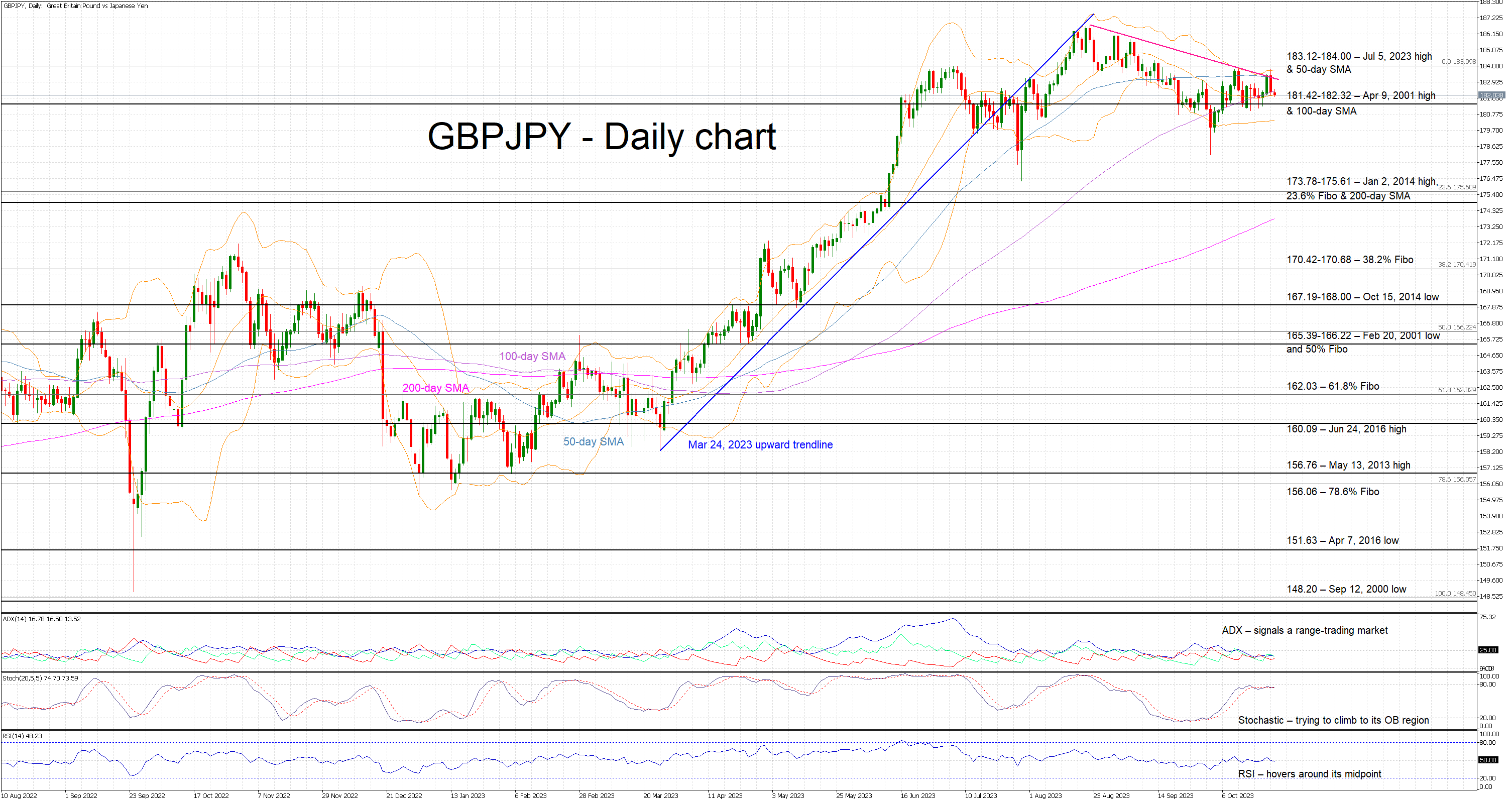
Having said that, an upside surprise in Thursday’s data could result in a small downleg below the 181.42-182.32 area, but this move would most likely prove to be short-lived. On the flip side, a weak inflation report would cause a smaller market reaction higher as the intervention threat remains at large.
USDCAD Has Another Round of Fighting Ahead
- USDCAD jumps above 1.3700 ahead of BoC rate decision
- Will the pair breach the neutral triangle pattern too?
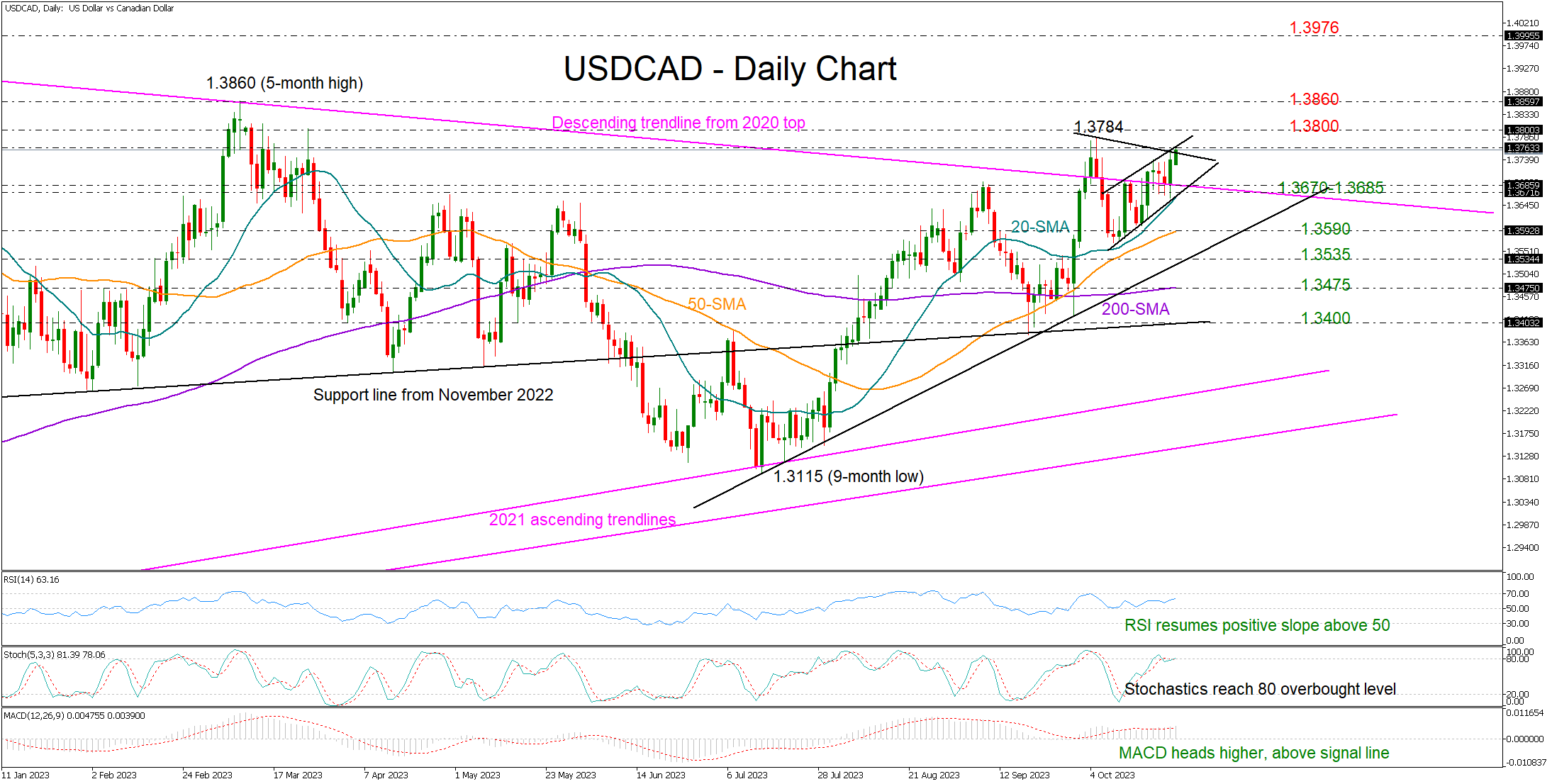
USDCAD held its footing above the resistance-turned-support trendline drawn from the 2020 peak and bounced back into the 1.3700 area on Tuesday.
The latest bullish action shifted the attention back to the 1.3800-1.3860 region ahead of the Bank of Canada’s policy meeting, with the technical indicators promoting further progress in the market. The RSI has resumed its positive slope above 50 and the MACD is heading higher above its red signal line.
Conversely, the stochastic oscillator is staying close to its 80 overbought level, implying that the bulls are lacking the strength to push upwards. Also, the price itself has yet to close above the resistance line of a symmetrical triangle at 1.3750, making a pullback likely.
Should the pair accelerate above 1.3860, the next destination could be the 2022 top of 1.3976.
On the downside, the 1.3670-1.3685 zone, which encapsulates the 2020 constraining line and the 20-day simple moving average (SMA) could come first into view. A close below this range could confirm more losses towards the 50-day SMA, while a sharper decline could challenge the short-term ascending trendline from July at 1.3535 and the 200-day SMA.
In summary, USDCAD has the potential for more upside, but unless it successfully violates the neutral triangle structure, the bulls could face some more delays.
German Ifo business climate rose to 86.9, seeing a silver lining
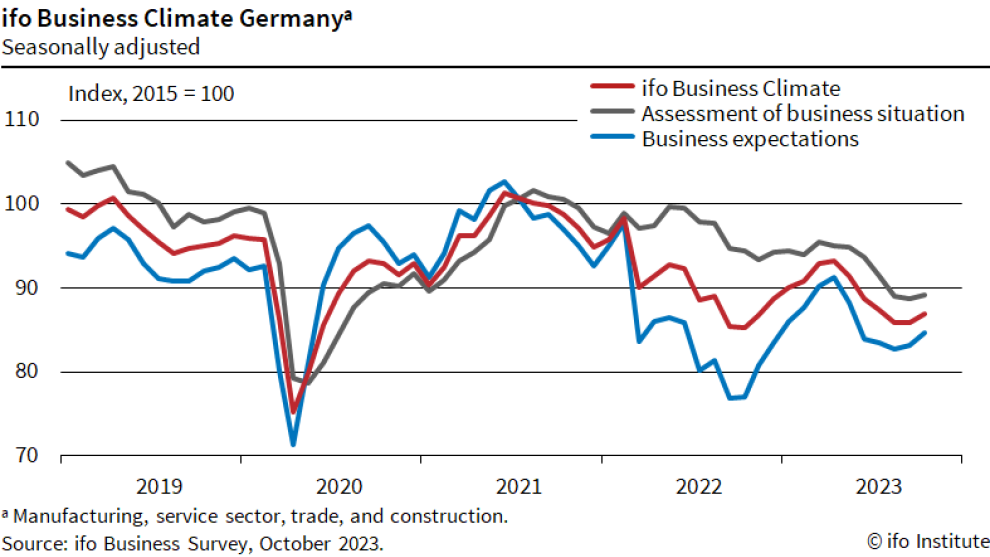
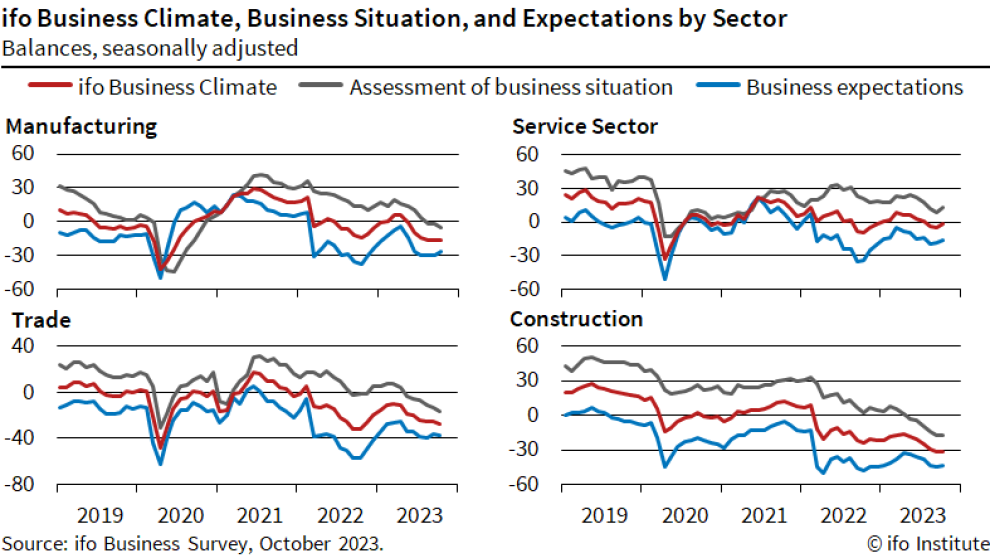
German Ifo Business Climate rose from 85.8 to 86.9 in October. Current Assessment Index rose from 88.7 to 89.2. Expectations Index rose from 83.1 to 84.7.
By sector, manufacturing rose from -16.2 to -15.9. Services rose from -4.9 to -1.5. Trade dropped from -25.0 to 27.2. Construction ticked up from -31.2 to -31.1.
Ifo said: "Managers were less pessimistic in their view of the coming months. Germany's economy can see a silver lining ahead."
EUR/AUD Daily Outlook
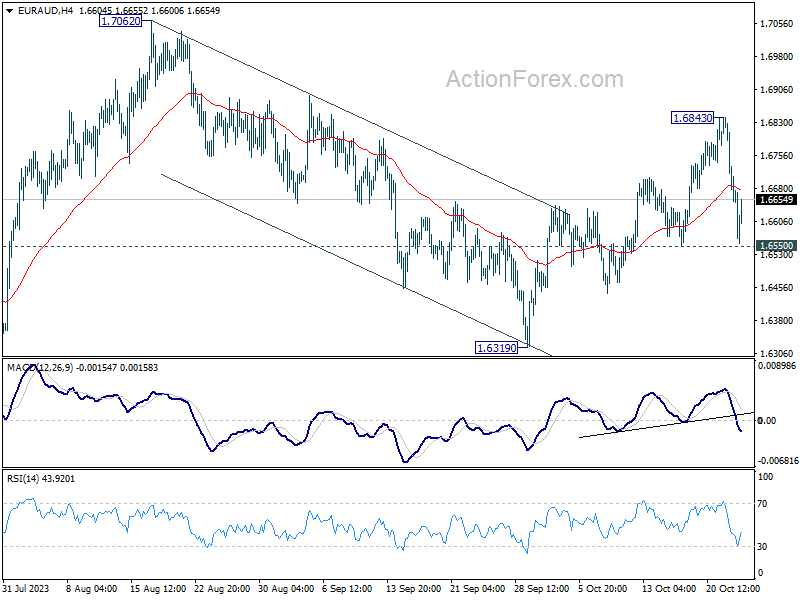
Daily Pivots: (S1) 1.6595; (P) 1.6721; (R1) 1.6791; More...
Near term outlook is mixed up by the steep pull back from 1.6843. Intraday bias is turned neutral first. On the upside, above 1.6843 will resume the rebound from 1.6319. Firm break there will resume larger up trend. However, break of 1.6550 support will bring deeper fall back to 1.6319 support instead.
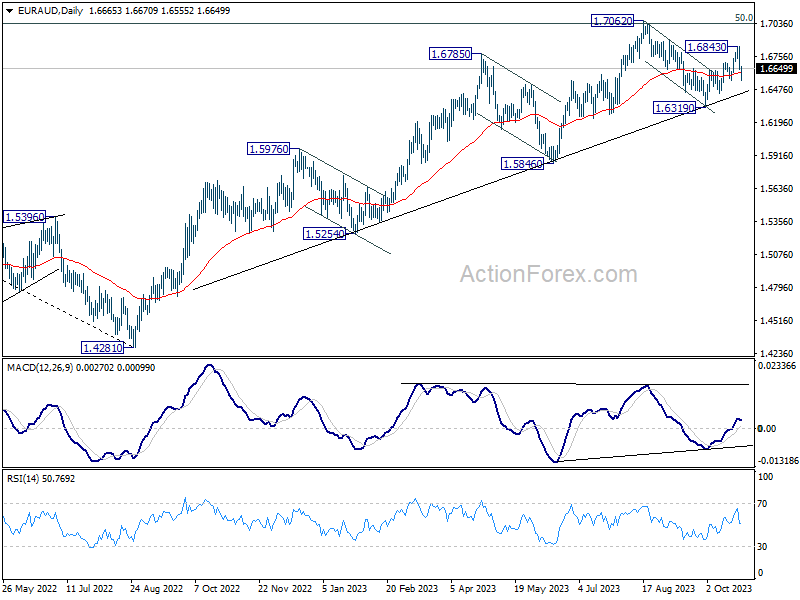
In the bigger picture, the strong support from medium term rising trend line indicates that rise from 1.4281 (2022 low) is still in progress. Sustained break of 1.7062 will pave the way to 61.8% retracement of 1.9799 (2020 high) to 1.4281 at 1.7691. In any case, outlook will stay bullish as long as 1.6319 support holds.
EUR/GBP Daily Outlook
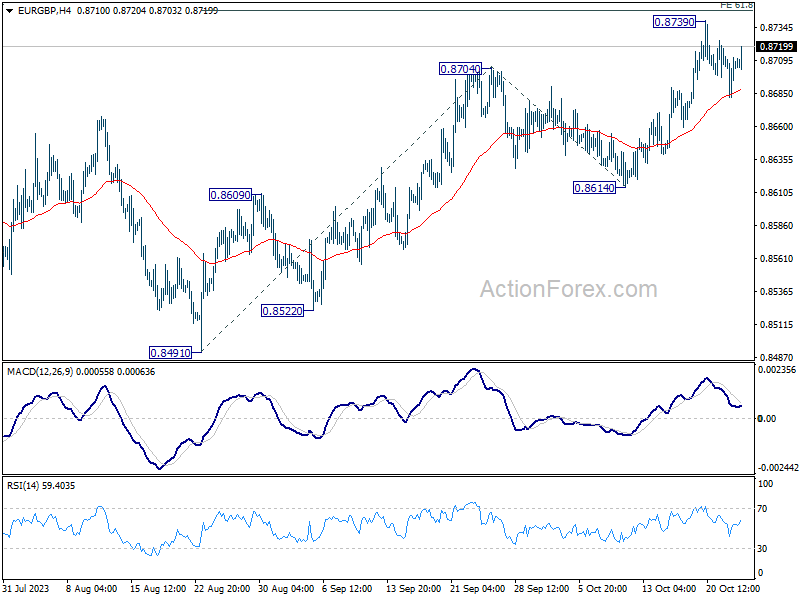
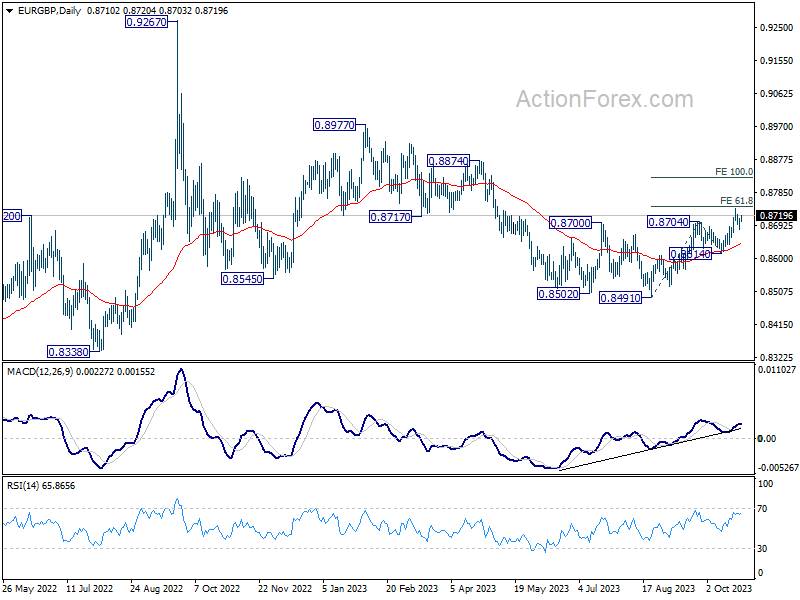
Daily Pivots: (S1) 0.8688; (P) 0.8704; (R1) 0.8726; More....
Intraday bias in EUR/GBP remains neutral as consolidation from 0.8739 is still extending. Downside of retreat should be contained well above 0.8614 support to bring another rally. Firm break of 0.8746 will target 100% projection of 0.8491 to 0.8704 from 0.8614 at 0.8827 next.
In the bigger picture, current development suggests that whole down trend from 0.9267 (2022 high) has completed with three down to to 0.8491. Rise from 0.8491 is seen as another leg inside that pattern from 0.9499 (2020 high). Further rally should be seen to 0.8977 resistance and above. This will now remain the favored case as long as 0.8614 support holds.
EUR/JPY Daily Outlook
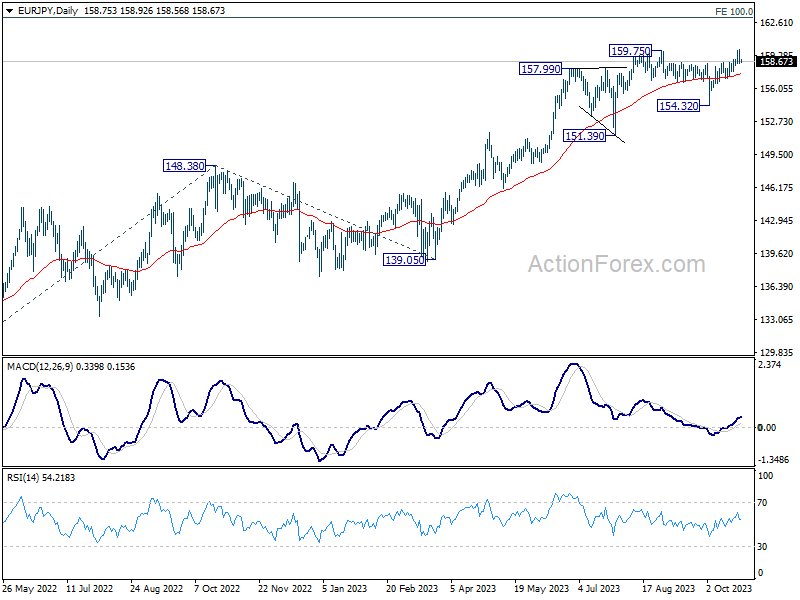
Daily Pivots: (S1) 158.23; (P) 159.08; (R1) 159.61; More....
Intraday bias in EUR/JPY is turned neutral again as it retreated quickly after hitting 159.90. For now, further rise is in favor as long as 157.67 support holds. Above 159.90 will resume larger up trend to 163.06 projection level. However, firm break of 157.67 will turn bias back to the downside 154.32 support instead.
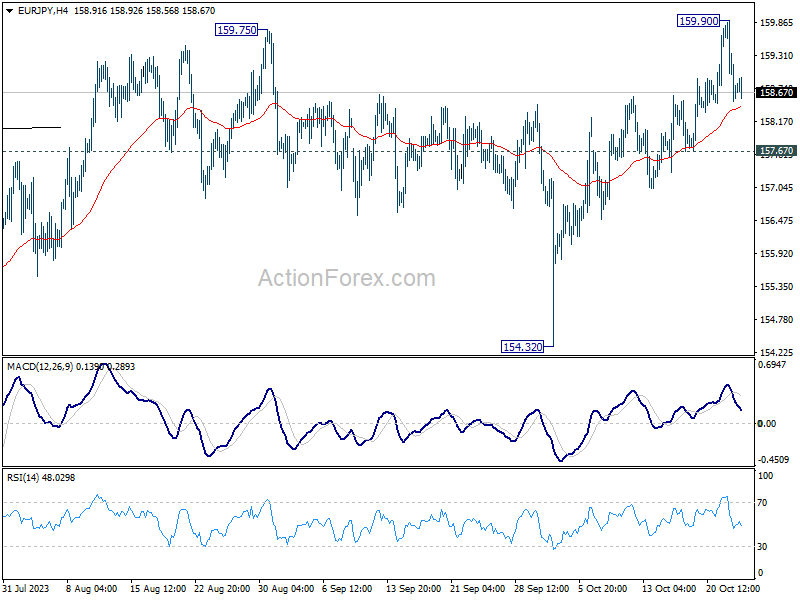
In the bigger picture, rise from 114.42 (2020 low) is in progress. next target is 100% projection of 124.37 to 148.38 from 139.05 at 163.06. On the downside, break of 154.32 support is needed to be the first sign of medium term topping. Otherwise, outlook will remain bullish even in case of deep pullback.