Sample Category Title
Saudi’s Commitment is Not Written into a Law
Markets are on an emotional rollercoaster ride this week. The slightest data is capable of moving oceans. Yesterday, the significantly softer-than-expected ADP report, and the announcement that 75’000 healthcare workers at Kaiser went on strike sparked a positive reaction from the market in a typical ‘bad news is good news’ day. The US economy added only 89K new private jobs in September, much less than 153K penciled in by analysts. It was also the slowest job additions since January 2021. The rest of the data was mixed. US factory orders were better than expected in August, but the services PMI came close to slipping into the contraction zone, and the ISM’s non-manufacturing component also hinted at slowing activity. Mortgage activity in the US fell to the lowest levels since 1995, as the 30-year mortgage rates spiked higher toward 8%. Housing and services are among the biggest contributors to high inflation besides energy prices, therefore, seeing these sectors cool down has a meaningful impact on inflation expectations, hence on Federal Reserve (Fed) expectations. As such, yesterday’s soft-looking data tempered the Fed hawks, after the stronger-than-expected JOLTs data triggered panic the day before. The US 2-year yield took a dive toward the 5% mark, the 10-year yield bounced lower after flirting with the 4.90% level, while the 30-year hit 5% for the very first time since 2007 before bouncing lower on relieving news of soft job additions. Hallelujah.
The US dollar index retreated across the board, and equities rebounded. The S&P500 jumped from the lowest levels since the beginning of June. The score is now one to one. One good news for the US jobs market, and one bad news. Everyone is now holding his or her breath into Friday’s jobs data, which will determine whether we will end this week with a sweet or a sour taste in our mouth. Sweet would be loosening jobs data, sour would be a still-strong jobs data which would fuel the hawkish Fed expectations and further boost US yields while the US yields are at a critical moment.
For the first time since 2002, the US 10-year yield comes at a spitting distance from the S&P500 earnings. The index is just about 60 points above its critical 200-DMA. Looking at the seasonality chart, the S&P500 could dip at about now. In this context, there is a chance that soft jobs data from the US marks a dip in the S&P500 selloff. But one thing is sure: the yields and the US dollar must come down to keep the S&P500 on a rising path. Profits at the S&P500 companies are inversely correlated with the US dollar as their international profits account for about a third of the total. If the yields and the US dollar continue to rise, the S&P500 will face severe headwinds into the year end.
Oil fell nearly 6%
Rising suspicions that the global economy is headed straight into a wall didn’t spare oil bulls yesterday. The barrel of American crude dived almost 6%, slipped below the 50-DMA ($85pb), and below the positive trend base building since the end of June. The 6.5-mio-barrel build in gasoline stockpiles last week helped bring the bears back to the market even though the data also showed a more than 2-mio-barrel draw in crude inventories over the same week.
Yesterday’s move shows that what matters the most for intraday moves is the rhetoric. This summer, the market focus was on the tightening global oil supply and how the US will ‘soft land’ despite the aggressive Fed tightening. Now we start talking about slowing economies and recession worries.
OPEC decided to maintain its oil production strategy unchanged at yesterday’s decision. Saudi and Russia repeated that they will keep their production restricted to maintain the positive pressure on oil. But if global demand cools down and volumes fall, both Saudi and Russia will be tempted to increase profits by selling more oil at a cheaper price. Saudi Arabia shouldering all the production cuts for OPEC is not written into a law, it could become uncertain if market conditions turn sour.
Bond Market Sell-Off Takes a Break
Market movers today
A string of central bank speakers on today's calendar. The interpretation of recent tightening of financial conditions will be closely watched.
The weekly jobless claims data in the US have been among those indicators pointing to a still-strong labour market, so this data will be interesting to follow today.
From Japan, we get August cash earnings at 1:30 CET Friday. It has disappointed over the summer, and a pick-up here is key for the BoJ to start normalising its policies.
The 60 second overview
US Macro: US data came in weaker than expected yesterday, providing some support to market sentiment. ADP private employment rose by only 89,000 new jobs in September, which was well below expectations of 150,000. The ADP figures have often deviated quite substantially from the official payrolls data, but markets took notice of the weakness as a sign of some renewed softening in the US labour market. The headline ISM Services index fell in line with expectations from 54.5 to 53.6 in September, but what stood out was a significant decline in the forward-looking new orders component from 57.5 to 51.8. In our view, this points towards some weakening of consumer demand ahead.
Oil: The oil price rally has clearly lost steam, and yesterday the Brent price plunged 6% to 86.4 USD/barrel yesterday, despite Russia and Saudi Arabia confirming their commitment to maintain the OPEC+ production curbs of 1 million barrels/day until the end of the year. Tighter financial conditions might be beginning to bite in the commodity markets, and furthermore, the weekly EIA report out yesterday showed further weakness in US gasoline demand, now being at the lowest level for the season in 25 years.
Equities: Equities finished a notch higher yesterday. The trigger for the turnaround was not hard to find: A pullback in yields. S&P 500 immediately rebounded 0.8% while Stoxx 600 only recovered to -0.1%. Large caps outperformed small caps, growth beat value and cyclicals rebounded. Huge sector rotation dispersion again, with best performing sector consumer discretionary up 2% and underperforming energy down -3%, as oil prices plunged. The yields fear is easing in Asia as well this morning, with BB APAC up 2%. US futures are unchanged.
FI: The bond market sell-off stalled yesterday as weaker US macro data supported the sentiment. 10Y Bund yields declined by 5bp to 2.91% throughout the day, while the 10Y UST yield ended the day 7bp lower at 4.73%. The 5y5y EUR inflation swap rate was close to unchanged implying that a decline in real yields was behind yesterday's move.
FX: Yesterday's session saw the latest USD rally take a breather amid rates rallying and equities rebounding. This contributed to lifting EUR/USD above 1.05. Notably, despite the slight relief in risk-sensitive assets neither NOK nor SEK saw any strength with both EUR/NOK and EUR/SEK continuing to move higher. USD/JPY still trades around the 149 level after Tuesday's knee-jerk reaction lower while EUR/GBP trades around the 0.865-mark.
Credit: Credit markets were in a wait-and-see mode yesterday as markets digested important macroeconomic numbers out of the US. The primary credit market was also muted with low new issuing activity. Main was 1bp wider while X-over was 4bp wider.
USD/JPY Daily Outlook
Daily Pivots: (S1) 148.81; (P) 149.06; (R1) 149.39; More...
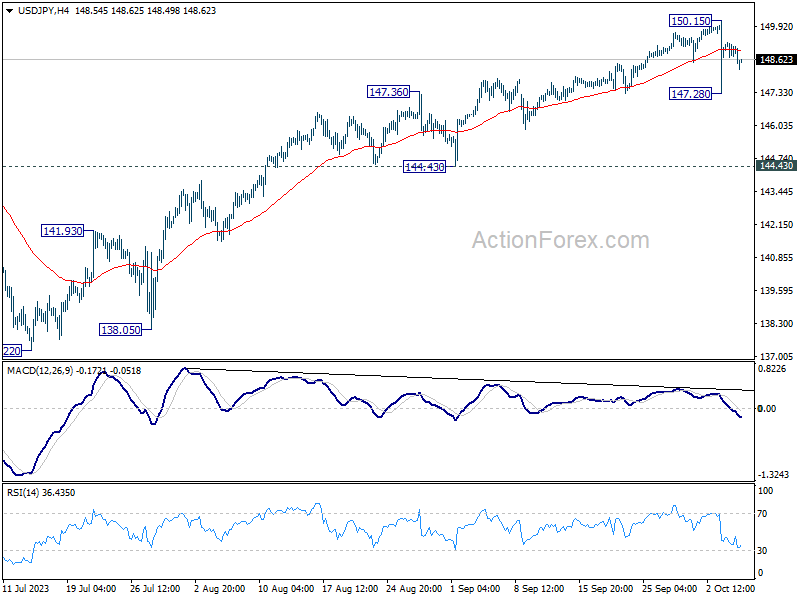
Intraday bias in USD/JPY remains neutral for the moment and more sideway trading could be seen. On the downside, below 147.28 will turn bias to the downside for deeper pull back. But there is no confirmation of bearish trend reversal before firm break of 144.43 support. Another rally remains mildly in favor through 150.15 to retest 151.93 high.
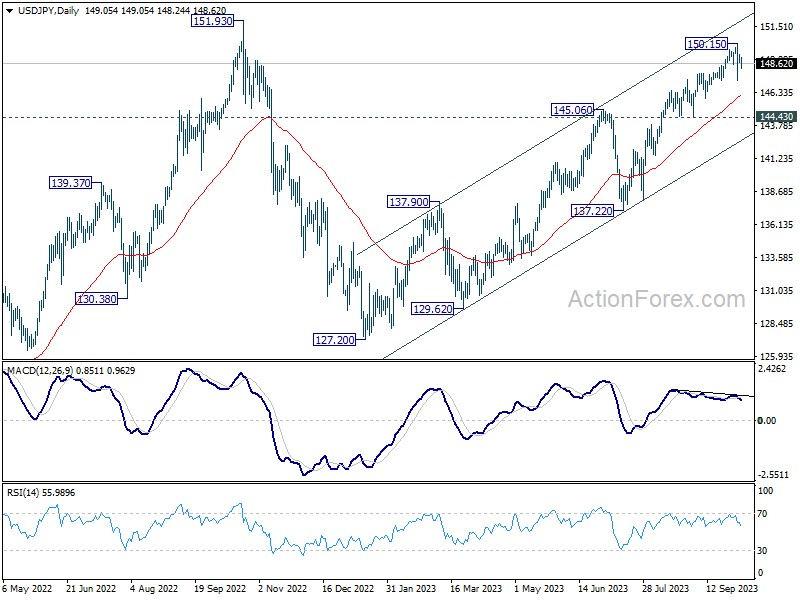
In the bigger picture, while rise from 127.20 is strong, it could still be seen as the second leg of the corrective pattern from 151.93 (2022 high). Rejection by 151.93, followed by sustained break of 145.06 resistance turned support will be the first sign that the third leg of the pattern has started. However, sustained break of 151.93 will confirm resumption of long term up trend.
EUR/USD Daily Outlook
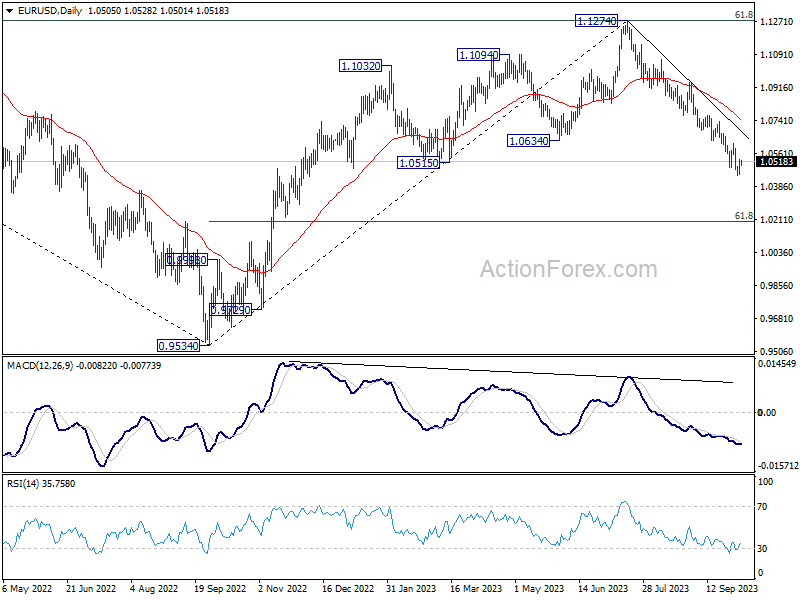
Daily Pivots: (S1) 1.0460; (P) 1.0496; (R1) 1.0540; More...
Intraday bias in EUR/USD Remains neutral for consolidation above 1.0447. Outlook will remain bearish as long as 1.0616 resistance holds. Break of 1.0477 will resume the fall from 1.1274 to 1.0199 fibonacci level next. Nevertheless, firm break of 1.06161 will confirm short term bottoming, and turn bias back to the upside for stronger rebound.
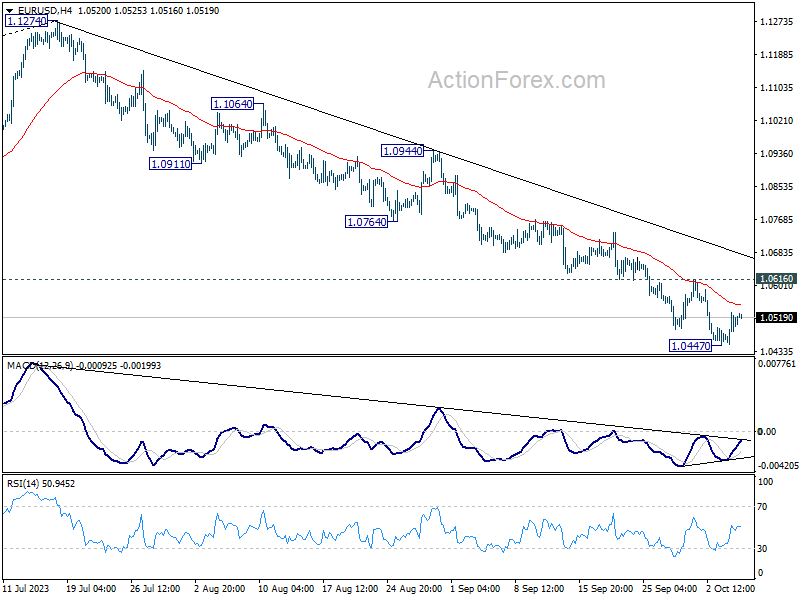
In the bigger picture, fall from 1.1274 medium term top could still be a correction to rise from 0.9534 (2022 low). But chance of a complete trend reversal is rising. In either case, current fall should target 61.8% retracement of 0.9534 to 1.1274 at 1.0199 next. For now, risk will stay on the downside as long as 55 D EMA (now at 1.0759) holds, in case of rebound.
GBP/USD Daily Outlook
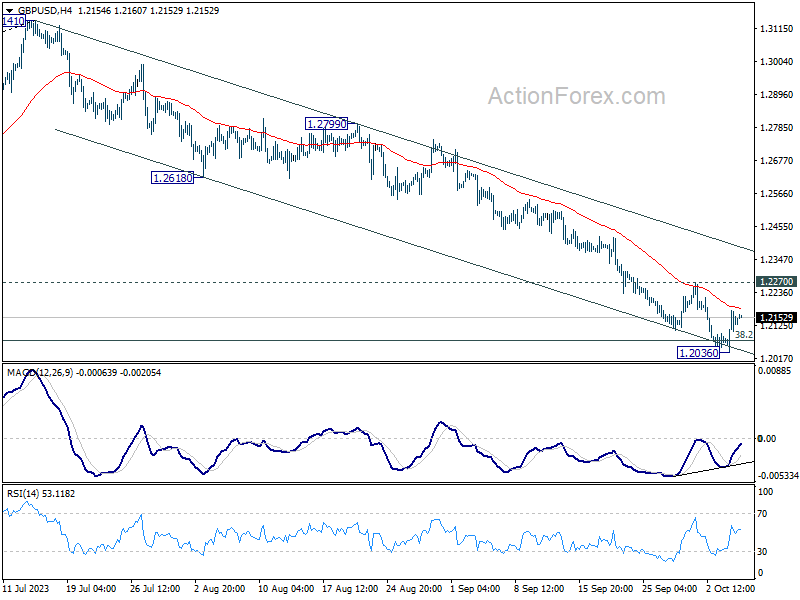
Daily Pivots: (S1) 1.2056; (P) 1.2116; (R1) 1.2196; More...
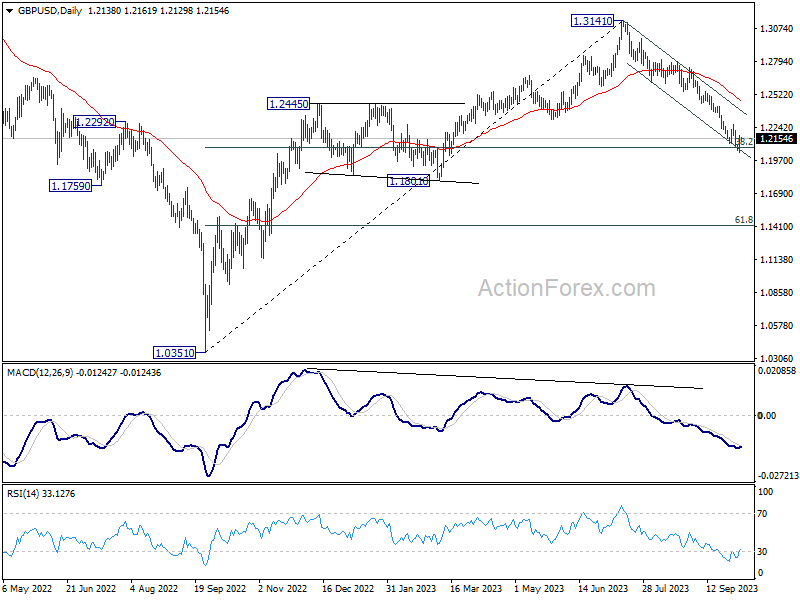
Intraday bias in GBP/USD remains neutral for consolidation above 1.2036. Outlook will stay bearish as long as 1.2270 resistance holds. Break of 1.2026 will resume the fall from 1.3141. Sustained trading below 1.2075 fibonacci level would carry larger bearish implication, and target 1.1801 support next. On the upside, firm break of 1.2270 resistance will indicate short term bottoming, and turn bias back to the upside.
In the bigger picture, fall from 1.3141 medium term top could still be a correction to up trend from 1.0351 (2022 low) only. But risk of complete trend reversal is rising. Sustained break of 38.2% retracement of 1.0351 to 1.3141 at 1.2075 will pave the way to 61.8% retracement at 1.1417. For now, risk will stay on the downside as long as 55 D EMA (now at 1.2486) holds, in case of rebound.
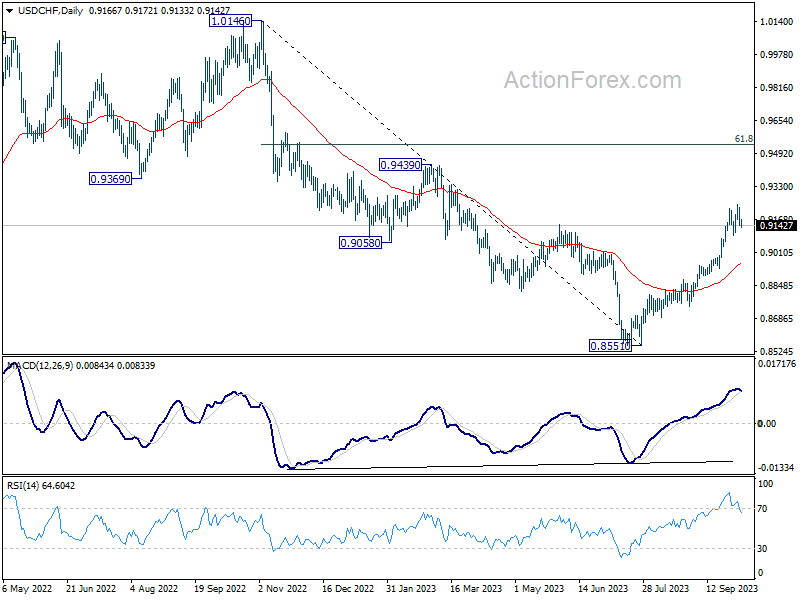
USD/CHF Daily Outlook
Daily Pivots: (S1) 0.9134; (P) 0.9183; (R1) 0.9223; More....
Intraday bias in USD/CHF remains neutral for consolidation below 0.9243. Near term outlook will stay bullish as long as 0.9089 support holds. On the upside, break of 0.9243 will resume the rally from 0.8551 and target 0.9439 resistance next. However, firm break of 0.9089 will confirm short term topping, and turn bias back to the downside for deeper pull back.
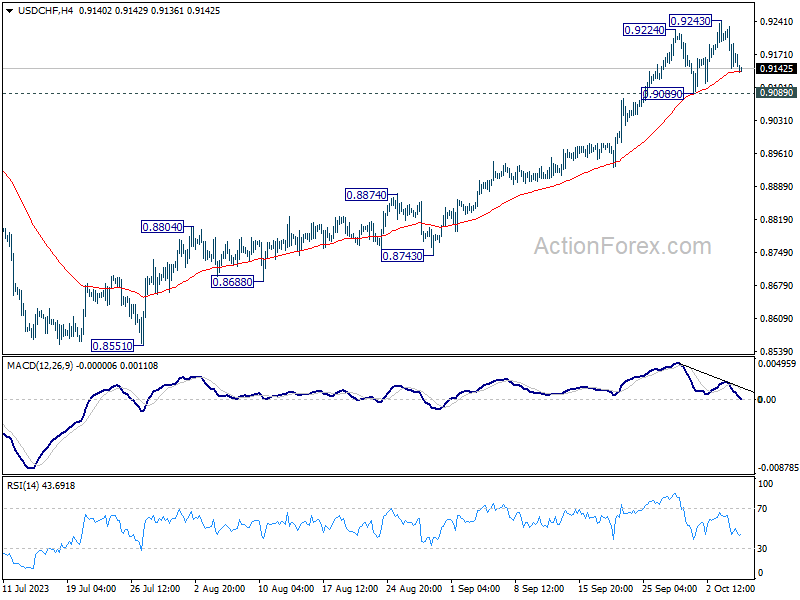
In the bigger picture, current development indicates that rise from 0.8551 is reversing whole down trend from 1.0146. Further rally would then be seen to 61.8% retracement at 0.9537 and above. For now, this will be the favored case as long as 55 D EMA (now at 0.8942) holds, even in case of deep pullback.
AUD/USD Daily Report
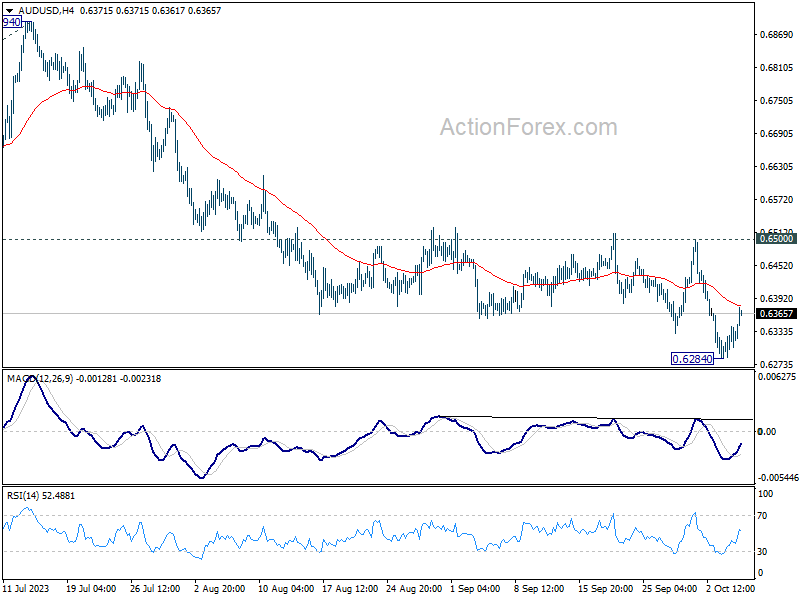
Daily Pivots: (S1) 0.6294; (P) 0.6318; (R1) 0.6350; More...
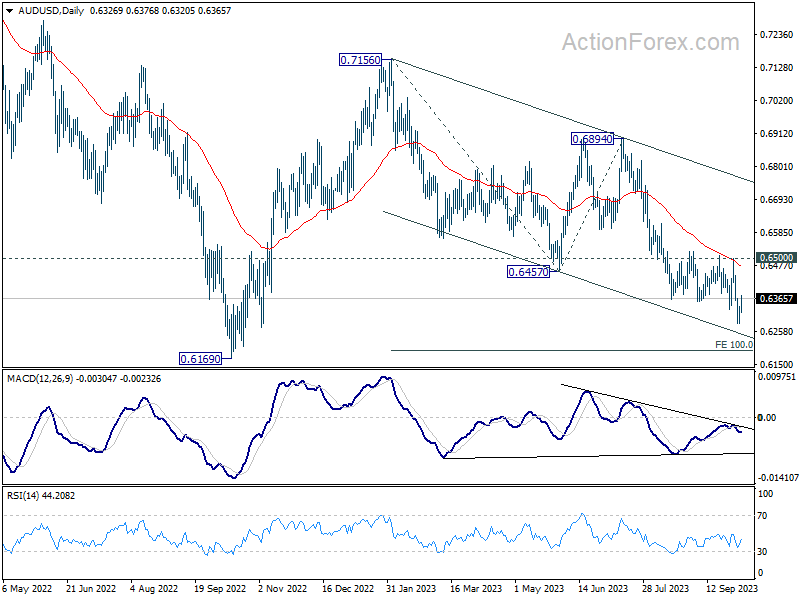
Intraday bias in AUD/USD is turned neutral with current recovery. Some consolidations could be seen first. But outlook will stay bearish as long as 0.6500 resistance holds. Below 0.6284 will resume the fall from 0.7156. Next target is 100% projection of 0.7156 to 0.6457 from 0.6894 at 0.6195.
In the bigger picture, down trend from 0.8006 (2021 high) is possibly still in progress. Decisive break of 0.6169 will target 61.8% projection of 0.8006 to 0.6169 to 0.7156 at 0.6021. This will now remain the favored case as long as 0.6894, in case of strong rebound.
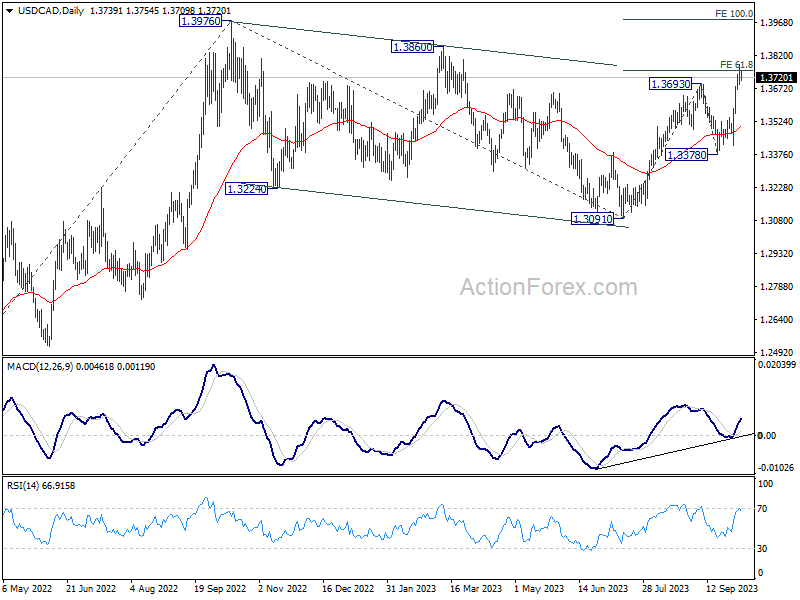
USD/CAD Daily Outlook
Daily Pivots: (S1) 1.3697; (P) 1.3739; (R1) 1.3786; More....
Intraday bias in USD/CAD is turned neutral with current retreat, and some consolidations could be seen first. But outlook will stay bullish as long as 1.3378 support holds. Above 1.3778 will resume the rally from 1.3091 and target 100% projection of 1.3091 to 1.3693 from 1.3378 at 1.3980.
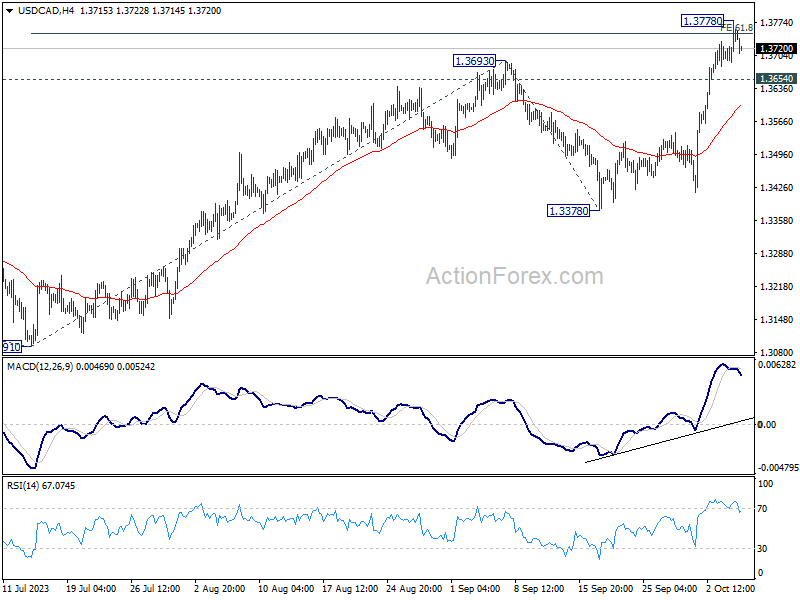
In the bigger picture, current development revives the case that corrective pattern from 1.3976 (2022 high) has completed with three waves down to 1.3091. Decisive break of 1.3976 high will confirm resumption of up trend from 1.2005 (2021 low). Next target will be 61.8% projection of 1.2401 to 1.3976 from 1.3091 at 1.4064. This will now remain the favored case as long as 1.3378 support holds.
EUR/GBP Daily Outlook
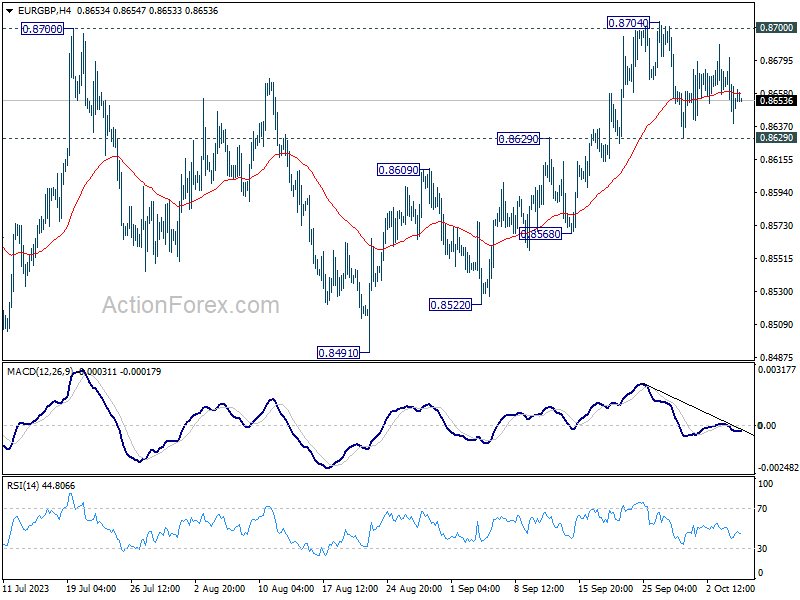
Daily Pivots: (S1) 0.8637; (P) 0.8659; (R1) 0.8679; More....
Intraday bias in EUR/GBP remains neutral as sideway trading continues. On the upside, decisive break of 0.8700 resistance will carry larger bullish implication and bring stronger rally to 0.8874 resistance next. Nevertheless, rejection by this resistance will maintain bearish outlook that larger down trend is not over. Firm break of 0.8629 resistance turned support will turn bias back to the downside for 0.8568 support first.
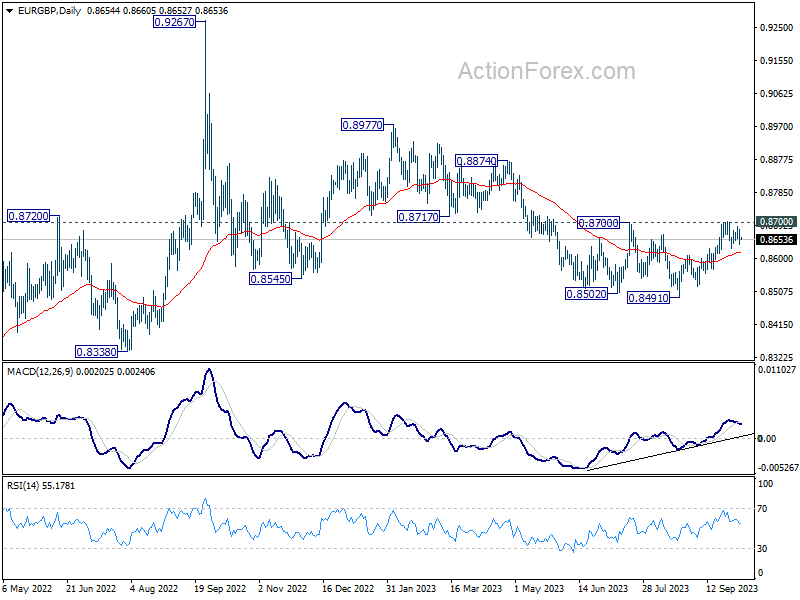
In the bigger picture, the down trend from 0.9267 (2022 high) is seen as part of the long term range pattern from 0.9499 (2020 high). Decisive break of 0.8700 resistance will argue that this decline has completed with three waves down to 0.8491. Rise from 0.8491 could then be another leg inside the pattern and targets 0.8977 and above. However, rejection by 0.8700 will keep the down trend alive for another fall through 0.8491 at a later stage.
EUR/AUD Daily Outlook
Daily Pivots: (S1) 1.6558; (P) 1.6600; (R1) 1.6649; More...
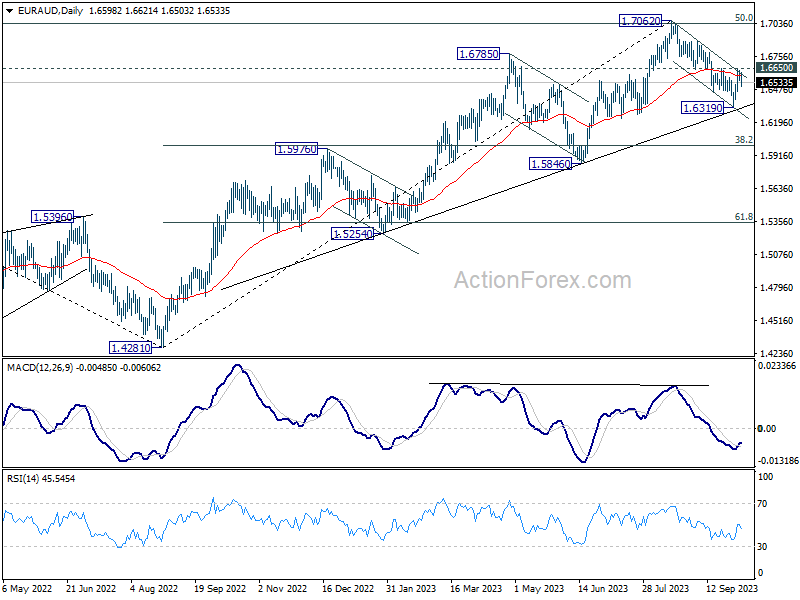
Intraday bias in EUR/AUD remains neutral for the moment. With 1.6650 resistance intact, fall from 1.7062 is still expected to continue. Below 1.6446 minor support will bring retest of 1.6319 first. Break there will resume the decline to 1.6000 fibonacci level. On the upside, firm break of 1.6650 resistance will argue that pull back from 1.7062 has completed, after drawing support from medium term rising trend line. Further rally would be seen back to retest 1.7062.
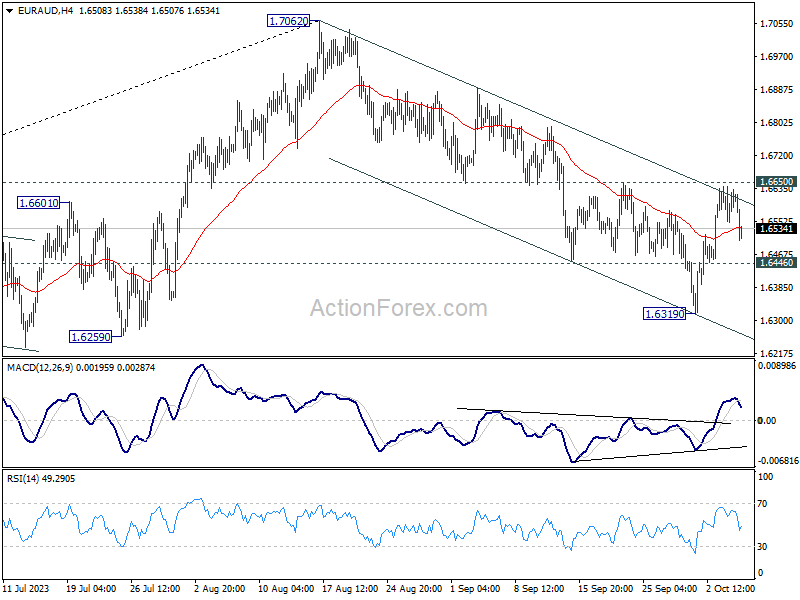
In the bigger picture, fall from 1.7062 is probably correcting whole up trend from 1.4281 (2022 low). Deeper decline would be seen to 38.2% retracement of 1.4281 to 1.7062 at 1.6000. Strong support could be seen there to bring rebound, at least on first attempt. This will remain the favored case as long as 1.6650 resistance holds.