Sample Category Title
GBP/USD Mid-Day Outlook
Daily Pivots: (S1) 1.2056; (P) 1.2116; (R1) 1.2196; More...
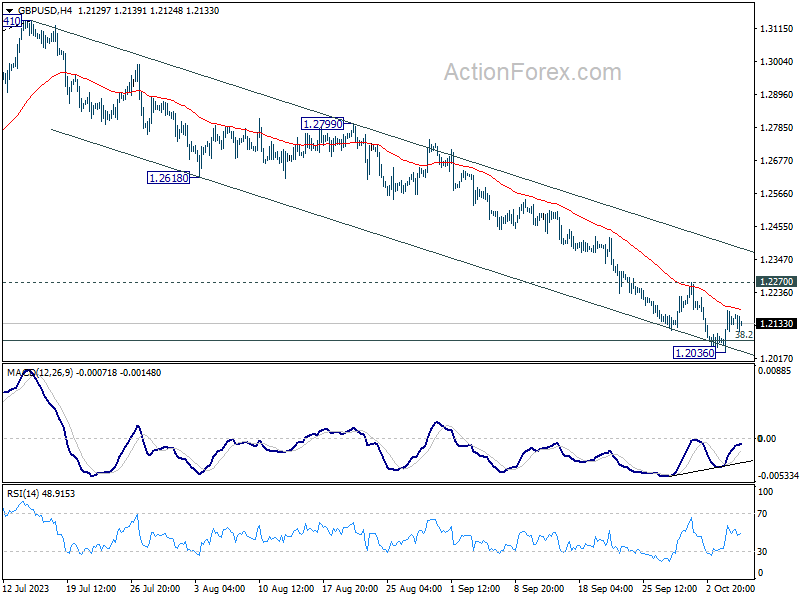
GBP/USD is staying in consolidation above 1.2036 and intraday bias remains neutral for the moment. Outlook will stay bearish as long as 1.2270 resistance holds. Break of 1.2026 will resume the fall from 1.3141. Sustained trading below 1.2075 fibonacci level would carry larger bearish implication, and target 1.1801 support next. On the upside, firm break of 1.2270 resistance will indicate short term bottoming, and turn bias back to the upside.
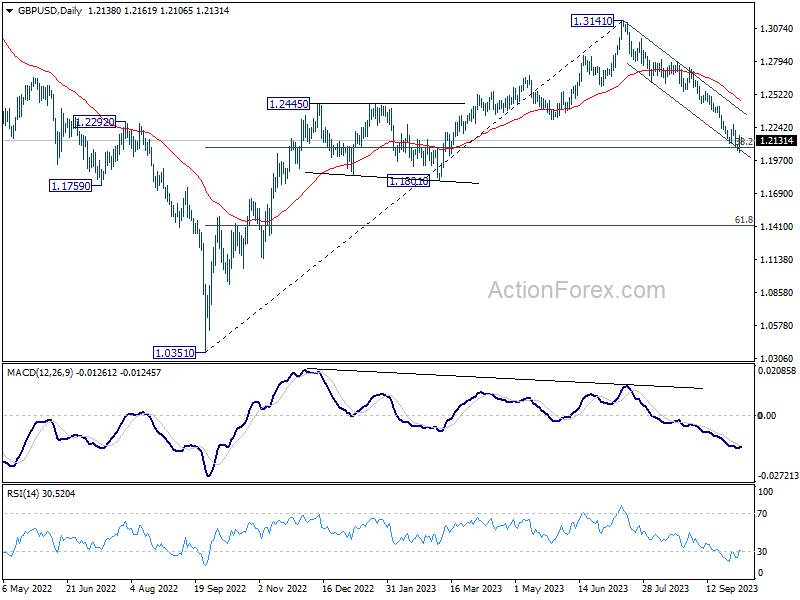
In the bigger picture, fall from 1.3141 medium term top could still be a correction to up trend from 1.0351 (2022 low) only. But risk of complete trend reversal is rising. Sustained break of 38.2% retracement of 1.0351 to 1.3141 at 1.2075 will pave the way to 61.8% retracement at 1.1417. For now, risk will stay on the downside as long as 55 D EMA (now at 1.2486) holds, in case of rebound.
Sterling Underwhelms amid Market Consolidation; Gold Heading Lower Again
British Pound emerged as the weakest link, facing headwinds following subpar construction data. Not far behind in performance was the Canadian Dollar, which felt the pressure from the ongoing plunge in oil prices. Dollar, while still in a commanding position, appears to be taking a pause, digesting its recent upticks. Contrastingly, Australian and New Zealand Dollars found some respite as the market's risk aversion sentiment momentarily eased. Meanwhile, Euro, Swiss Franc, and Yen are all moving within a mixed range, with no clear directional bias discernible.
However, it's crucial to underscore that today's performance is likely transient, serving as brief consolidations rather than indicative of any established trends. Yen, though challenged to prolong its intervention-boosted rally, remains the top-performer. Dollar holds its ground as second, albeit with an air of caution as market participants await Non-Farm Payrolls release tomorrow. Aussie and Kiwi Dollars, despite today's modest bounce-back, continue to languish at the bottom. Among European currencies, Sterling's underperformance stands out.
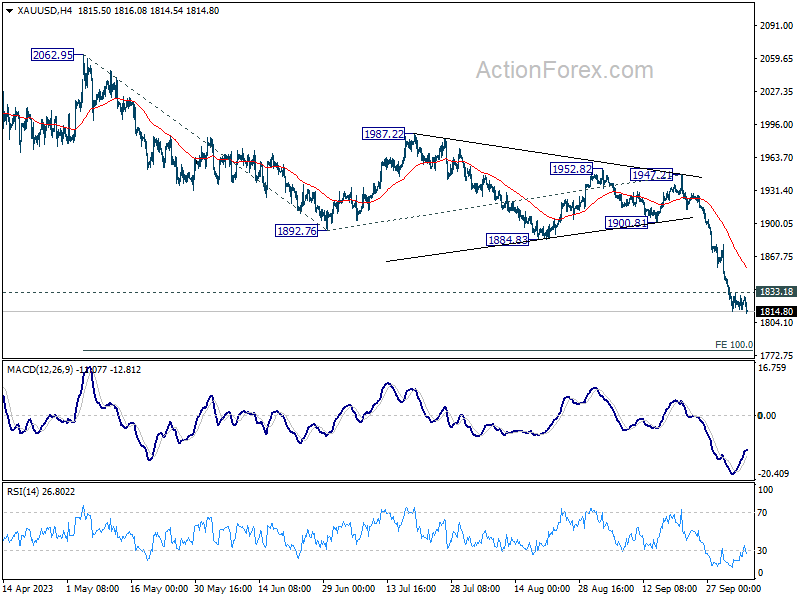
Technically, Gold is trying to resume recent decline in early US session. For now, further fall is expected as long as 1833.18 resistance holds. Next target is 100% projection of 2062.95 to 1892.76 from 1947.21 at 1777.02. However, break of 1833.18 resistance will bring a stronger corrective rebound first, before staging another decline.
In Europe, at the time of writing, FTSE is up 0.54%. DAX is flat. CAC is up 0.08%. Germany 10-year yield is up 0.001 at 2.924. Earlier in Asia, Nikkei rose 1.80%. Hong Kong HSI rose 0.10%. Singapore Strait Times rose 0.24%. Japan 10-year JGB yield dropped -0.003 to 0.805.
US initial jobless claims rose to 207k, below expectations
US initial jobless claims rose 2k to 207k in the week ending September 30, below expectation of 211k. Four-week moving average of initial claims dropped 2.5k to 209k.
Continuing claims dropped -1k to 1664k in the week ending September 23. Four-week moving average of continuing claims fell -5k to 1668k.
Canada records unexpected trade surplus in Aug as exports surge
Canada reported merchandise trade surplus of CAD 718m in August, marking its first monthly trade surplus since April. This comes after a deficit of CAD 437m in July and defies market expectations of a CAD -1.4B deficit.
Driving this positive turnaround, exports in August jumped by 5.7% mom, marking the most robust growth since October 2021. This surge was widespread, with gains registered in 7 of the 11 product sections.
Meanwhile, imports also witnessed a 3.8% mom uptick, with increments seen in 9 of the 11 product sections.
BoE survey shows business inflation expectations cool
BoE's Decision Maker Panel survey for September indicating an anticipated ease in output price inflation, slowly easing CPI inflation expectation, and subtle nuances in wage growth predictions
A notable takeaway from the survey is the anticipated decline in output price inflation over the next year. Businesses foresee their year-ahead own-price inflation at 4.8%, a slight moderation from the 5.0% noted in the preceding three months to August. This decline hints at an expectation of easing price pressures, offering a counter-narrative to prevalent inflation concerns.
On the consumer front, one-year ahead CPI inflation expectations inched higher to 4.9% in September from 4.8% in August. However, a broader perspective reveals a decline, with the three-month moving average dipping by 0.3 percentage points to 5%. Looking further ahead, three-year CPI inflation expectations held steady at 3.2% in September, unaltered from August.
In the realm of wages, the anticipated year-ahead wage growth was static at 5.1% on a three-month moving average basis. September's single-month reading did register a slight uptick to 5.2%, a 0.2 percentage point increment from August. However, these expectations are notably subdued compared to realised wage growth.
UK PMI construction dives to 45, sharp decline and worst since 2020
UK's construction sector is experiencing a significant setback, as evidenced by the sharp fall in PMI Construction index to 45.0 in September, a level not seen since May 2020 and far below the anticipated 49.9.
The report shows a distinct contraction in the industry, with residential work plunging to an index of 38.1, indicating the steepest decline amongst all sectors. Civil engineering activity isn't faring much better, posting a 45.7 index, while commercial building has shown some resilience, albeit still in the contraction zone at 47.7.
Tim Moore, Economics Director at S&P Global Market Intelligence, paints a grim picture of the current state of the sector. "Output levels declined across the UK construction sector for the first time in three months during September, and the latest downturn marked the worst overall performance since the early stages of the pandemic," he stated.
The future outlook for the construction sector does not instill confidence. Moore points out that the survey's forward-looking measures have remained somewhat pessimistic. "Order books decreased at an accelerated pace and business activity expectations eased to the lowest so far this year," Moore explained. The decrease in project starts has led to an increase in sub-contractor availability, reaching levels not seen since the summer of 2009.
ECB's Kazimir strongly believe that latest hike was last
ECB Governing Council member Peter Kazimir said today, "I strongly believe that our rate hike at the last meeting was the last one" The focus, he outlined, now shifts to the upcoming December and March forecasts, as "only real data can persuade us that we're at the peak."
Kazimir addressed inflation concerns, observing that, "We see the overall inflation and also core inflation on a downward trend, though this is lasting a bit longer than we'd wanted." He further highlighted the ripple effects of past rate hikes, pointing out that they "have an increasingly significant impact on the real economy."
Shedding light on the broader economic repercussions, he mentioned that "Financing conditions are tightening and are weakening demand for investments, in production and affecting overall economic growth." With this context, Kazimir emphasized the urgency to manage inflation effectively and swiftly.
On the topic of ECB's PPEP reinvestments, Kazimir treaded cautiously, suggesting the bank was "ready for debate" but reiterated the importance of maintaining balance. The topic of altering the balance sheet's reduction pace will be broached only when the Council is confident further rate hikes won't be necessary.
GBP/USD Mid-Day Outlook
Daily Pivots: (S1) 1.2056; (P) 1.2116; (R1) 1.2196; More...
GBP/USD is staying in consolidation above 1.2036 and intraday bias remains neutral for the moment. Outlook will stay bearish as long as 1.2270 resistance holds. Break of 1.2026 will resume the fall from 1.3141. Sustained trading below 1.2075 fibonacci level would carry larger bearish implication, and target 1.1801 support next. On the upside, firm break of 1.2270 resistance will indicate short term bottoming, and turn bias back to the upside.
In the bigger picture, fall from 1.3141 medium term top could still be a correction to up trend from 1.0351 (2022 low) only. But risk of complete trend reversal is rising. Sustained break of 38.2% retracement of 1.0351 to 1.3141 at 1.2075 will pave the way to 61.8% retracement at 1.1417. For now, risk will stay on the downside as long as 55 D EMA (now at 1.2486) holds, in case of rebound.
Economic Indicators Update
| GMT | Ccy | Events | Actual | Forecast | Previous | Revised |
|---|---|---|---|---|---|---|
| 00:30 | AUD | Trade Balance (AUD) Aug | 9.64B | 8.61B | 8.04B | 7.32B |
| 06:00 | EUR | Germany Trade Balance (EUR) Aug | 16.6B | 14.3B | 15.9B | 16.0B |
| 06:45 | EUR | France Industrial Output M/M Aug | -0.30% | -0.40% | 0.80% | 0.50% |
| 08:30 | GBP | Construction PMI Sep | 45 | 49.9 | 50.8 | |
| 11:30 | USD | Challenger Job Cuts Y/Y Sep | 58.20% | 266.90% | ||
| 12:30 | USD | Initial Jobless Claims (Sep 29) | 207K | 211K | 204K | |
| 12:30 | USD | Trade Balance (USD) Aug | -58.3B | -65.1B | -65.0B | -64.7B |
| 12:30 | CAD | Trade Balance (CAD) Aug | 0.7B | -1.4B | -1.0B | -0.4B |
| 14:00 | CAD | Ivey PMI Sep | 50.8 | 53.5 | ||
| 14:30 | USD | Natural Gas Storage | 97B | 90B |
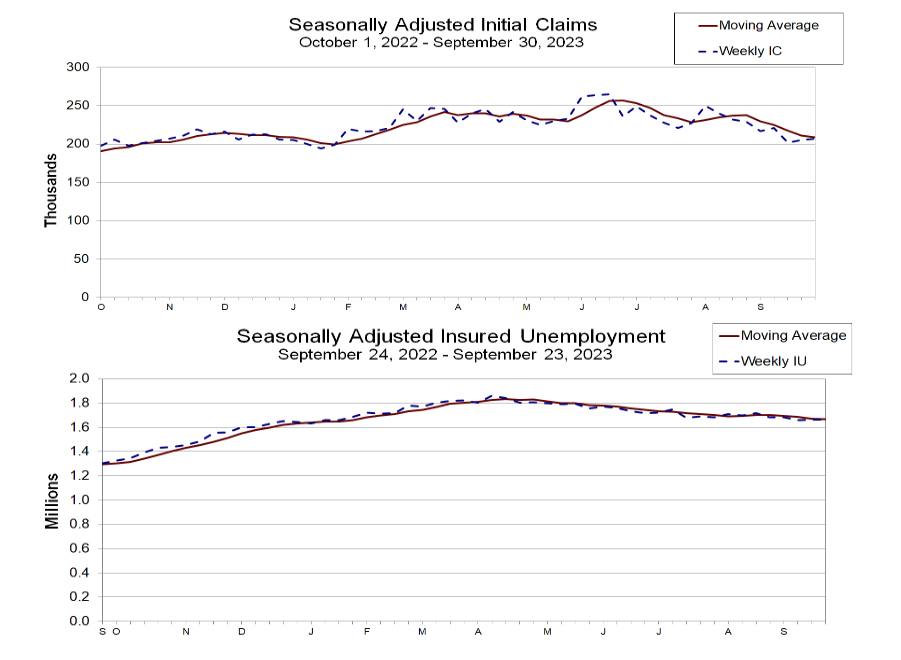
US initial jobless claims rose to 207k, below expectations
US initial jobless claims rose 2k to 207k in the week ending September 30, below expectation of 211k. Four-week moving average of initial claims dropped 2.5k to 209k.
Continuing claims dropped -1k to 1664k in the week ending September 23. Four-week moving average of continuing claims fell -5k to 1668k.
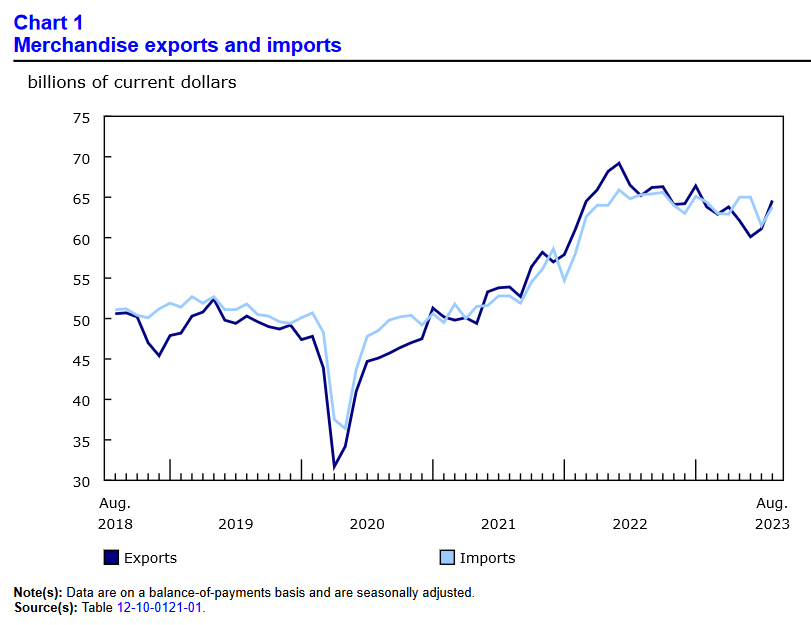
Canada records unexpected trade surplus in Aug as exports surge
Canada reported merchandise trade surplus of CAD 718m in August, marking its first monthly trade surplus since April. This comes after a deficit of CAD 437m in July and defies market expectations of a CAD -1.4B deficit.
Driving this positive turnaround, exports in August jumped by 5.7% mom, marking the most robust growth since October 2021. This surge was widespread, with gains registered in 7 of the 11 product sections.
Meanwhile, imports also witnessed a 3.8% mom uptick, with increments seen in 9 of the 11 product sections.
Full Canada trade release here.
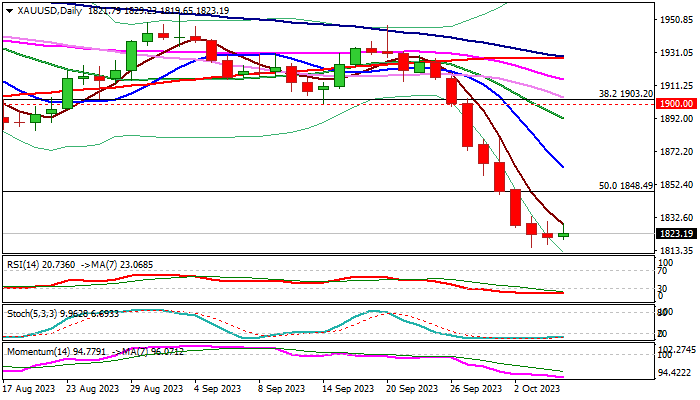
Gold: Bears Pausing ahead of US NFP Report
Gold price turned sideways and holding within a narrow range for the second straight day, consolidating after seven-day steep fall.
Larger bears slowed pace ahead of key release of this week – US non-farm payroll report for September- which is expected to generate fresh direction signal.
Gold was deflated by strong dollar on expectations that the Fed would keep high interest rates for longer period, but the latest economic data raised a question mark above signals that the economy is resilient despite strong negative impact from high borrowing cost.
Reports from US labor sector were so far mixed as job openings rose above forecast but hiring in private sector slowed well below expectations.
Focus turns towards the more comprehensive non-farm payrolls report, which will provide more details about conditions in labor sector and generate clearer direction signals.
Firmly bearish daily studies are also deeply oversold and point to a pause in recent steep downtrend, which found temporary footstep at 200WMA ($1814).
Consolidation was so far narrow, with initial direction signals expected on break of $1862 (falling10DMA) at the upside, or dip below $1814/04 (200WMA / Feb 28 trough) on the downside.
Res: 1830; 1848; 1862; 1885.
Sup: 1814; 1804; 1793; 1765.
BoE survey shows business inflation expectations cool
BoE's Decision Maker Panel survey for September indicating an anticipated ease in output price inflation, slowly easing CPI inflation expectation, and subtle nuances in wage growth predictions
A notable takeaway from the survey is the anticipated decline in output price inflation over the next year. Businesses foresee their year-ahead own-price inflation at 4.8%, a slight moderation from the 5.0% noted in the preceding three months to August. This decline hints at an expectation of easing price pressures, offering a counter-narrative to prevalent inflation concerns.
On the consumer front, one-year ahead CPI inflation expectations inched higher to 4.9% in September from 4.8% in August. However, a broader perspective reveals a decline, with the three-month moving average dipping by 0.3 percentage points to 5%. Looking further ahead, three-year CPI inflation expectations held steady at 3.2% in September, unaltered from August.
In the realm of wages, the anticipated year-ahead wage growth was static at 5.1% on a three-month moving average basis. September's single-month reading did register a slight uptick to 5.2%, a 0.2 percentage point increment from August. However, these expectations are notably subdued compared to realised wage growth.
ECB’s Kazimir strongly believe that latest hike was last
ECB Governing Council member Peter Kazimir said today, "I strongly believe that our rate hike at the last meeting was the last one" The focus, he outlined, now shifts to the upcoming December and March forecasts, as “only real data can persuade us that we're at the peak.”
Kazimir addressed inflation concerns, observing that, "We see the overall inflation and also core inflation on a downward trend, though this is lasting a bit longer than we'd wanted." He further highlighted the ripple effects of past rate hikes, pointing out that they "have an increasingly significant impact on the real economy."
Shedding light on the broader economic repercussions, he mentioned that "Financing conditions are tightening and are weakening demand for investments, in production and affecting overall economic growth." With this context, Kazimir emphasized the urgency to manage inflation effectively and swiftly.
On the topic of ECB's PPEP reinvestments, Kazimir treaded cautiously, suggesting the bank was "ready for debate" but reiterated the importance of maintaining balance. The topic of altering the balance sheet's reduction pace will be broached only when the Council is confident further rate hikes won’t be necessary.
Crypto Hits a Glass Ceiling
Market Picture
The crypto market is struggling to break above the $1.09 trillion cap, having turned south from that level on Thursday morning, bringing the total market valuation down to $1.084 trillion.
Bitcoin continues to tend to sell on growth, failing to make a fresh attack on the 200-day. Bitcoin has recently outperformed the stock market but is now retreating against the buying in the indices. In the short term, bitcoin seems more at risk of falling than rising.
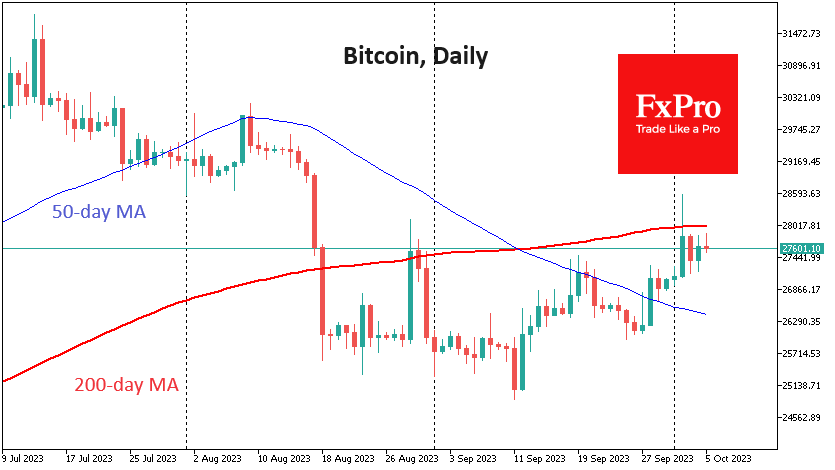
Ethereum also seems to be on the bears’ side, losing for the fifth consecutive session, tied to the downward-sloping 50-day moving average.
XRP has been trading at arm’s length from its 200-day moving average since the second half of August, most of the time acting as resistance.
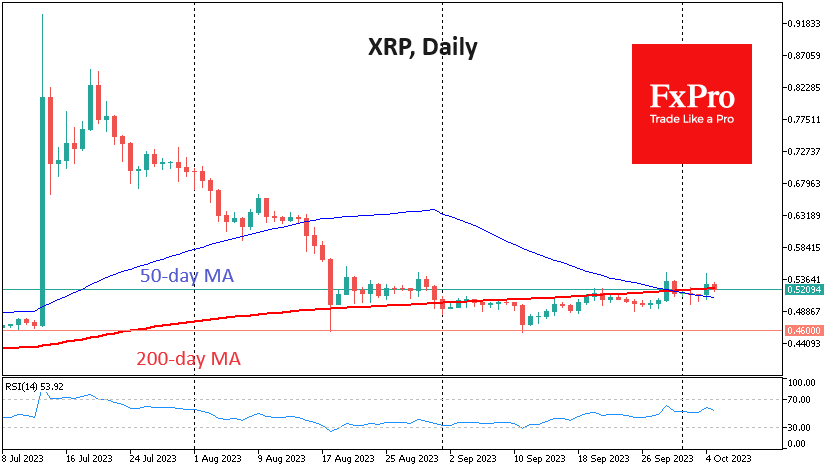
The entire cryptocurrency market seems to be waiting for a substantial pullback in the top coins to buy in for the long term.
News background
The court rejected the SEC’s appeal in the Ripple case, noting that the regulator did not provide enough evidence and that the request would not “materially advance the ultimate dismissal of the case.”
The Bank for International Settlements (BIS) has developed a prototype system for monitoring Bitcoin transfers to give authorities a clearer picture of how, when and where the cryptocurrency is being used. The new monitoring system could form the basis for regulating the cryptocurrency sphere.
Indian authorities have begun developing a global cryptocurrency transaction tracking system that will allow government authorities to monitor transactions in digital assets across all cryptocurrency exchanges worldwide.
El Salvador launched the first local Bitcoin mining pool. The Volcano Energy project started mining the first cryptocurrency on Lava Pool in partnership with Luxor Technology.
GBP/USD: Falling 10DMA Continues to Cap Recovery Attempts
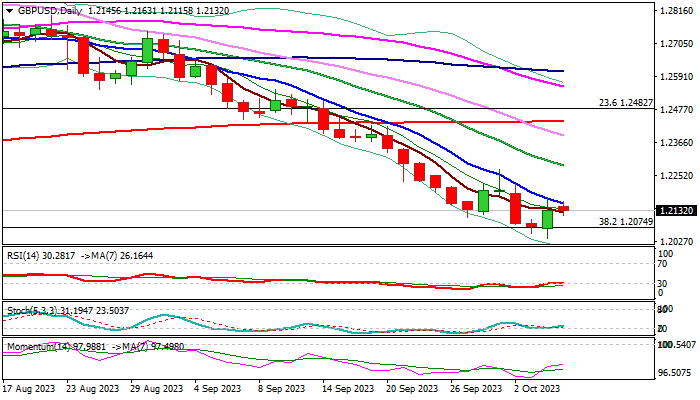
Cable started to lose traction in early European trading on Thursday, after Wednesday’s recovery, supported by better than expected UK services PMI and US ADP miss, stalled under initial resistance – falling 10DMA (1.2173), which continued to cap the action.
UK construction PMI (released this morning) dipped well below expectations in September and slid below 50 threshold for the first time since March 2020, adding to fresh negative signals.
Technical picture on daily chart remains firmly bearish with strong downside risk while 10DMA continues to limit recovery attempts.
Larger bears faced a double rejection at pivotal Fibo support (38.2% of 1.0348/1.3141) at 1.2074, but mild correction (capped by 10DMA) keeps the downside vulnerable, with eventual break here to expose psychological 1.20 support and daily cloud top at 1.1988.
Meanwhile, the pair may hold in extended consolidation within 1.2074/1.2173 range before bears resume.
Conversely, sustained break above 10DMA would ease downside pressure, but stronger reversal signals expected on lift above falling 20DMA (1.2286).
Res: 1.2173; 1.2217; 1.2286; 1.2328.
Sup: 1.2115; 1.2074; 1.2037; 1.2000.
Japanese Yen Steadies as Intervention Speculation Subsides
- USD/JPY drifting for a second straight day
- BoJ likely did not intervene in currency markets
The Japanese yen has posted slight gains on Wednesday. In the European session, USD/JPY is trading at 148.97, down 0.10%.
Yen spike was likely not due to intervention
The yen has stabilized after a massive spike on Tuesday. The yen spiked upwards close to 2% in a matter of seconds on Tuesday after the yen breached the 150 line for the first time since October 2022. This raised a flurry of speculation that the Bank of Japan intervened in the currency markets in order to prop up the yen. It remained unclear if the spike was driven by an intervention or a technical movement, and the fact that Japanese officials refused to comment only added to the mystery.
It now appears that the BoJ did not intervene, based on an analysis of the Bank of Japan’s current account figures. The Ministry of Finance publishes intervention records monthly, which means investors will have to wait until October 31st to answer the intervention question with certainty. If there was no intervention, the yen’s spike at 150 demonstrates nervousness in the markets which is hanging in the air.
The BoJ may not have intervened on the currency markets, but the central bank did intervene in the bond markets on Wednesday and made an emergency bond purchase. The move failed to stop yields from rising on 10-year yields of Japanese government bonds, which have risen to 0.816% today, the highest level since 2013. The BoJ has insisted that it will not phase out its ultra-loose policy, but speculation continues that tightening is only a matter of time.
USD/JPY Technical
- USD/JPY tested support at 148.50 earlier. Below, there is support at 147.84
- 149.10 is a weak resistance line, followed by resistance at 149.97