

Sample Category Title
EUR/JPY Daily Outlook
Daily Pivots: (S1) 156.26; (P) 156.52; (R1) 156.96; More....
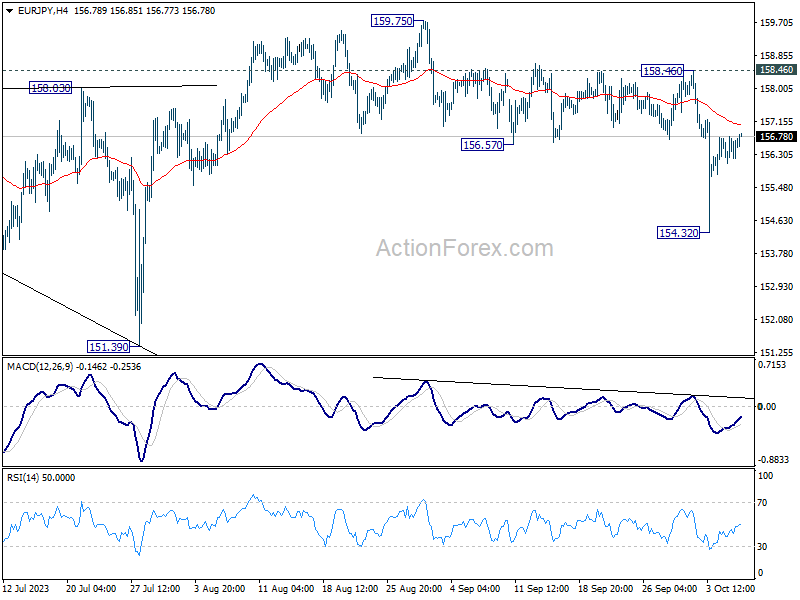
Intraday bias in EUR/JPY remains neutral for the moment. Near term outlook stays bearish as long as 158.46 resistance holds. Break of 154.32 will resume the whole fall from 159.75 to 151.39 support. Nevertheless, break of 158.464 will argue that the pull back has completed, and turn bias back to the upside.
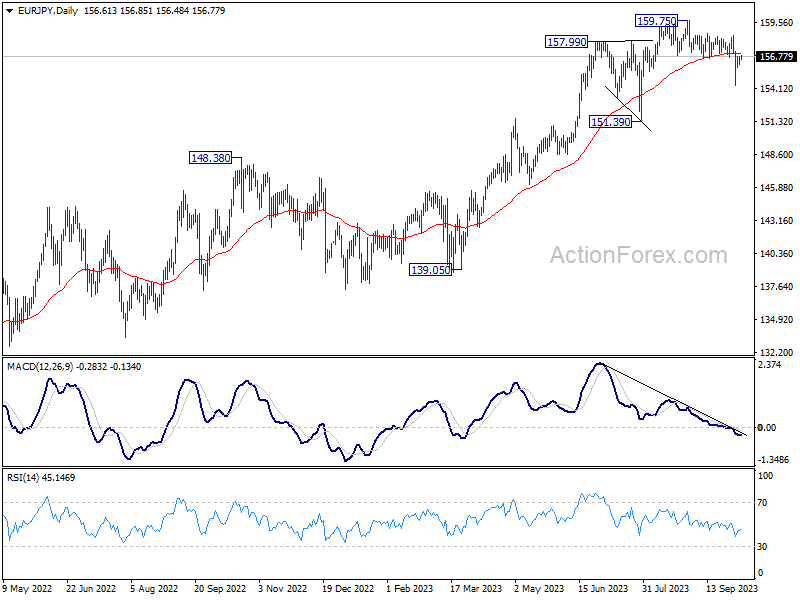
In the bigger picture, price actions from 159.75 are views as a corrective pattern for now. As long as 151.39 support holds, rise from 114.42 (2020 low) is still expected to continue through 159.75 at a later stage. Nevertheless, firm break of 176.29 will confirm medium term topping, and bring lengthier and deeper correction.
EUR/GBP Daily Outlook
Daily Pivots: (S1) 0.8637; (P) 0.8656; (R1) 0.8672; More....
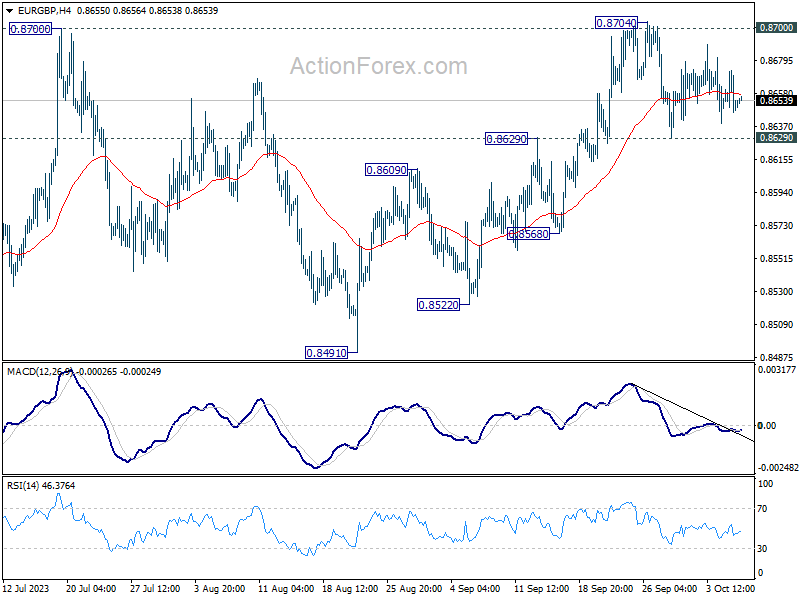
EUR/GBP is still bounded in range trading and intraday bias stays neutral. On the upside, decisive break of 0.8700 resistance will carry larger bullish implication and bring stronger rally to 0.8874 resistance next. Nevertheless, rejection by this resistance will maintain bearish outlook that larger down trend is not over. Firm break of 0.8629 resistance turned support will turn bias back to the downside for 0.8568 support first.
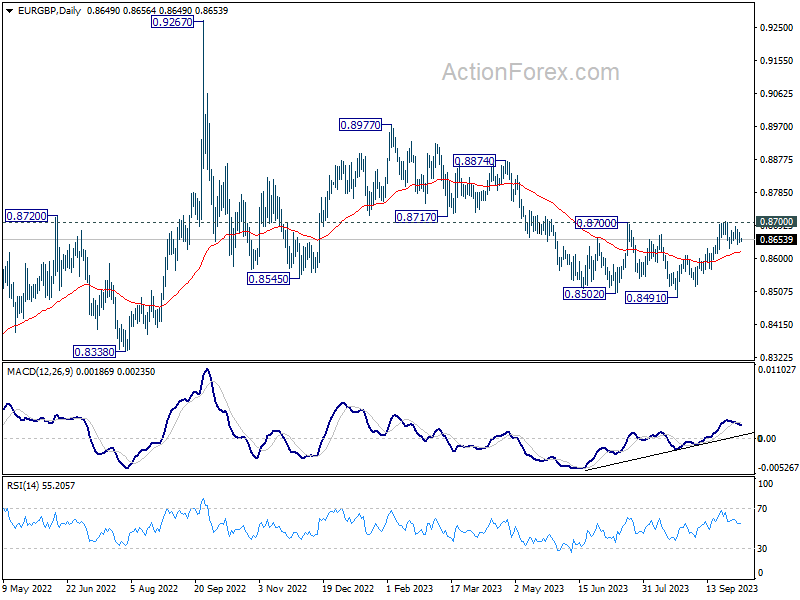
In the bigger picture, the down trend from 0.9267 (2022 high) is seen as part of the long term range pattern from 0.9499 (2020 high). Decisive break of 0.8700 resistance will argue that this decline has completed with three waves down to 0.8491. Rise from 0.8491 could then be another leg inside the pattern and targets 0.8977 and above. However, rejection by 0.8700 will keep the down trend alive for another fall through 0.8491 at a later stage.
EUR/AUD Daily Outlook
Daily Pivots: (S1) 1.6502; (P) 1.6565; (R1) 1.6625; More...
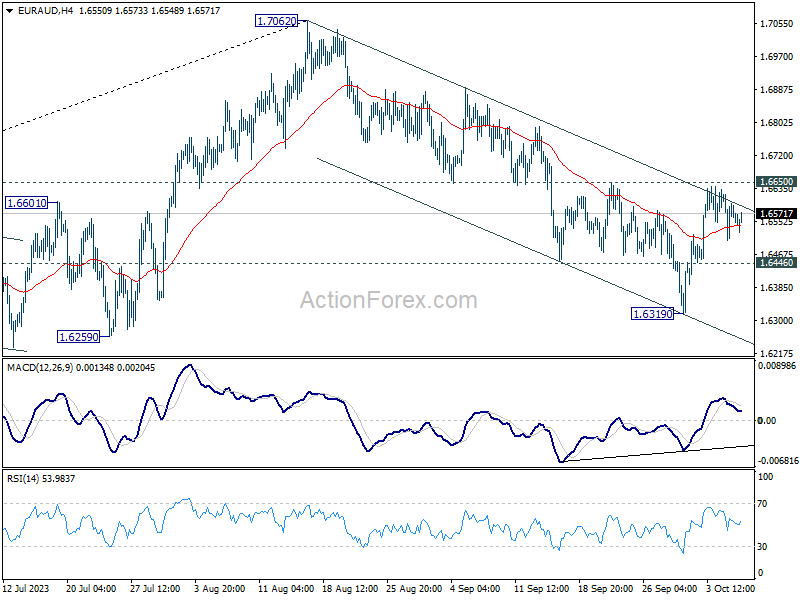
Range trading continues in EUR/AUD and intraday bias remains neutral. With 1.6650 resistance intact, fall from 1.7062 is still expected to continue. Below 1.6446 minor support will bring retest of 1.6319 first. Break there will resume the decline to 1.6000 fibonacci level. On the upside, firm break of 1.6650 resistance will argue that pull back from 1.7062 has completed, after drawing support from medium term rising trend line. Further rally would be seen back to retest 1.7062.
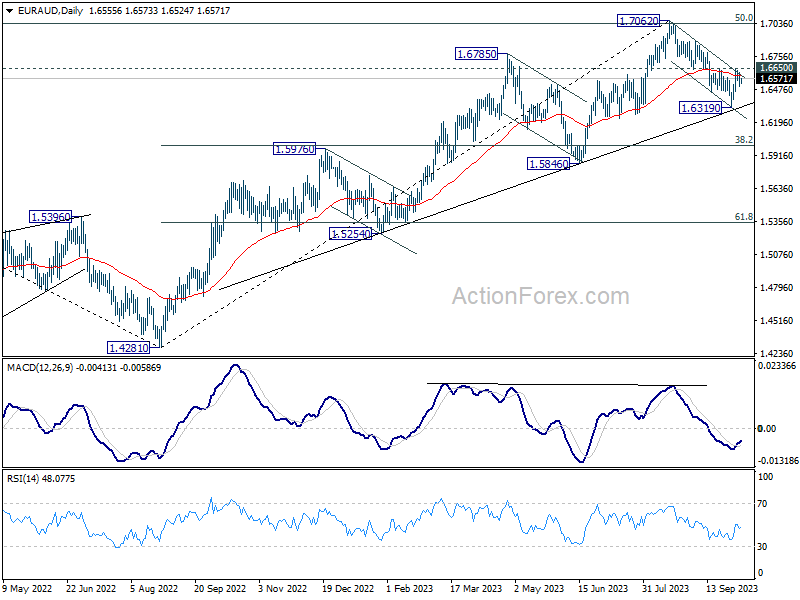
In the bigger picture, fall from 1.7062 is probably correcting whole up trend from 1.4281 (2022 low). Deeper decline would be seen to 38.2% retracement of 1.4281 to 1.7062 at 1.6000. Strong support could be seen there to bring rebound, at least on first attempt. This will remain the favored case as long as 1.6650 resistance holds.
EUR/CHF Daily Outlook
Daily Pivots: (S1) 0.9610; (P) 0.9629; (R1) 0.9645; More...
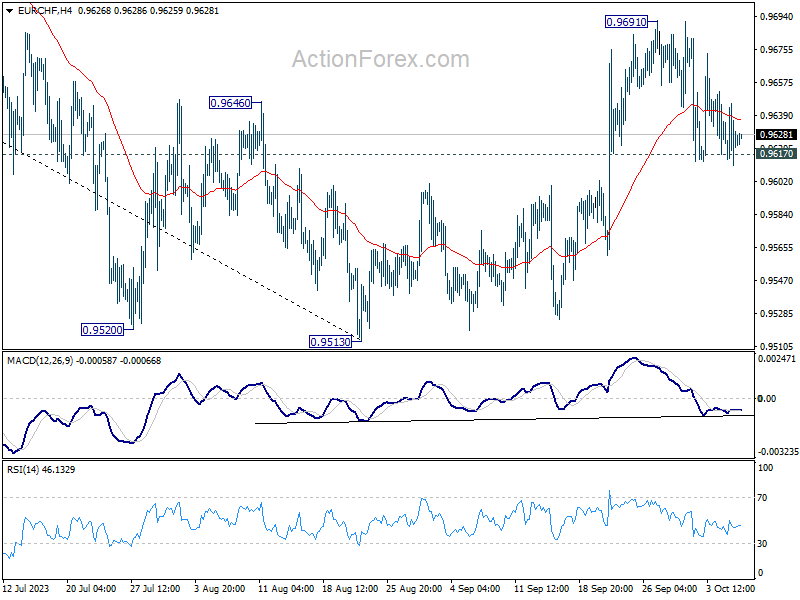
Intraday bias in EUR/CHF stays neutral and outlook is unchanged. Another rally is still mildly in favor as long as 0.9617 support holds. Above 0.9691 will resume the rebound from 0.9513 to 38.2% retracement of 1.0095 to 0.9513 at 0.9735. However, firm break of 0.9617 will turn bias back to the downside for retesting 0.9513 low.
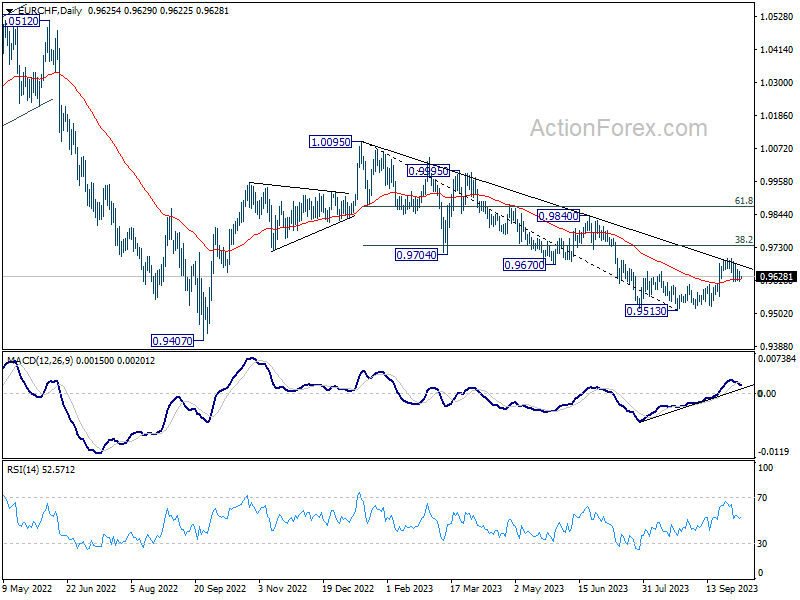
In the bigger picture, medium term outlook will stay bearish as long as the cross is capped well below falling 55 W EMA (now at 0.9804). That is, down trend from 1.2004 (2018 high) could still resume through 0.9407 (2022 low). However, sustained trading above the 55 W EMA will raise the chance that 0.9470 is already a long term bottom. Further rise would then be seen to 1.0095 resistance to indicate bullish trend reversal.
EUR/USD Daily Outlook
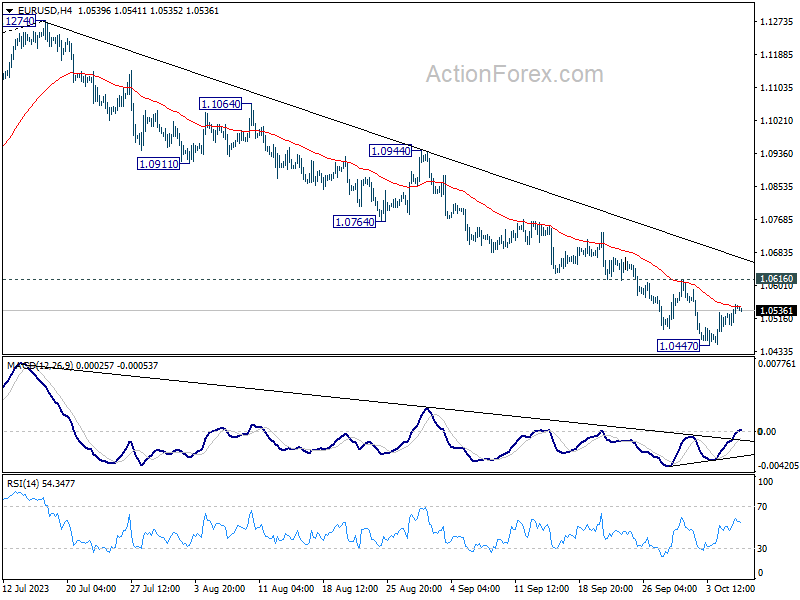
Daily Pivots: (S1) 1.0517; (P) 1.0534; (R1) 1.0569; More...
EUR/USD is staying in consolidation from 1.0447 and intraday bias remains neutral. Outlook will stay bearish as long as 1.0616 resistance holds. Break of 1.0477 will resume the fall from 1.1274 to 1.0199 fibonacci level next. Nevertheless, firm break of 1.0616 will confirm short term bottoming, and turn bias back to the upside for stronger rebound.
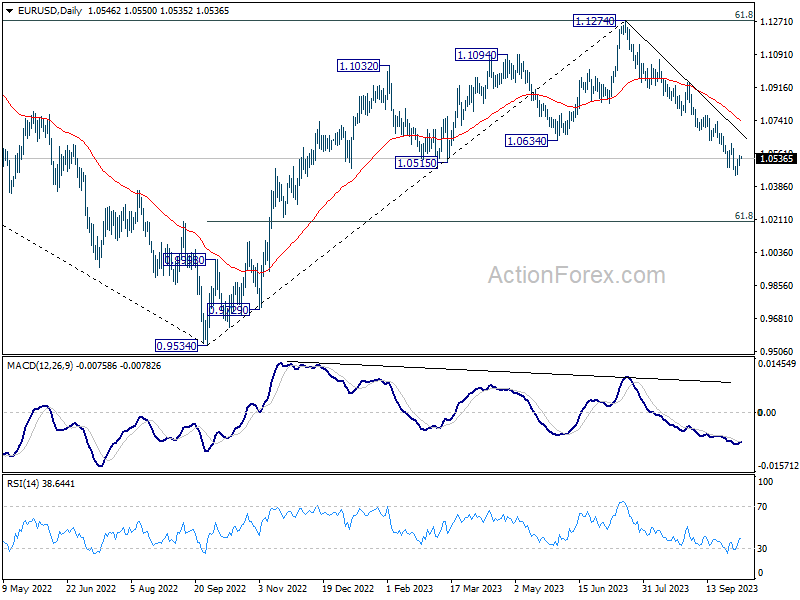
In the bigger picture, fall from 1.1274 medium term top could still be a correction to rise from 0.9534 (2022 low). But chance of a complete trend reversal is rising. In either case, current fall should target 61.8% retracement of 0.9534 to 1.1274 at 1.0199 next. For now, risk will stay on the downside as long as 55 D EMA (now at 1.0759) holds, in case of rebound.
GBP/USD Daily Outlook
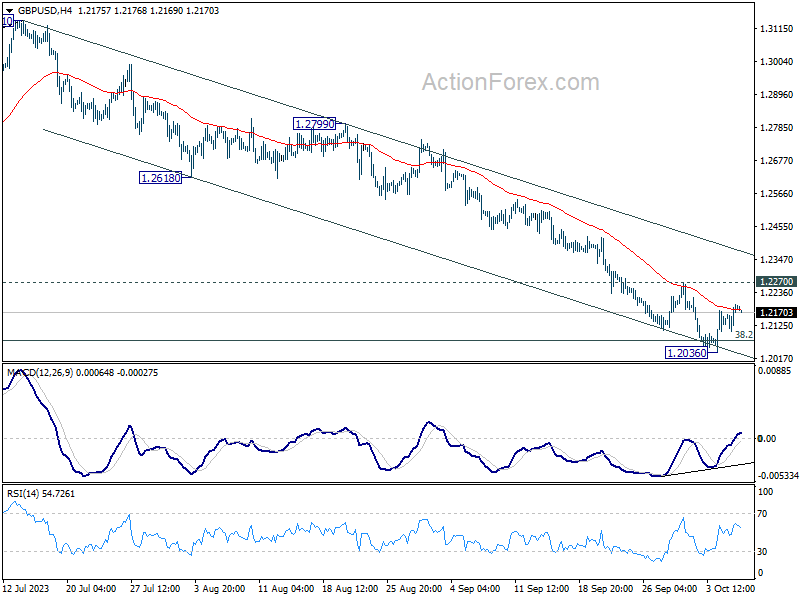
Daily Pivots: (S1) 1.2135; (P) 1.2166; (R1) 1.2223; More...
GBP/USD's consolidation from 1.2036 is still in progress and intraday bias remains neutral. Outlook will stay bearish as long as 1.2270 resistance holds. Break of 1.2026 will resume the fall from 1.3141. Sustained trading below 1.2075 fibonacci level would carry larger bearish implication, and target 1.1801 support next. On the upside, firm break of 1.2270 resistance will indicate short term bottoming, and turn bias back to the upside.
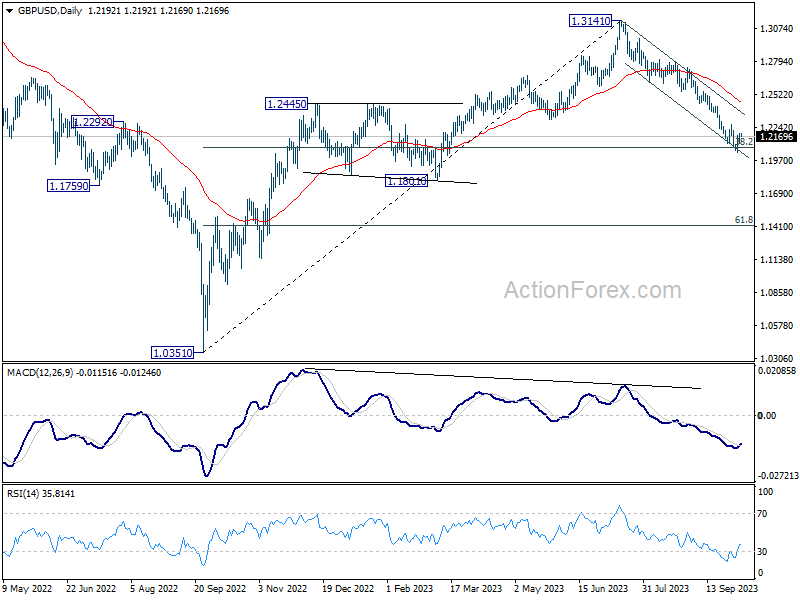
In the bigger picture, fall from 1.3141 medium term top could still be a correction to up trend from 1.0351 (2022 low) only. But risk of complete trend reversal is rising. Sustained break of 38.2% retracement of 1.0351 to 1.3141 at 1.2075 will pave the way to 61.8% retracement at 1.1417. For now, risk will stay on the downside as long as 55 D EMA (now at 1.2486) holds, in case of rebound.
USD/CHF Daily Outlook
Daily Pivots: (S1) 0.9103; (P) 0.9142; (R1) 0.9164; More....
USD/CHF is extending the consolidation from 0.9243 and intraday bias remains neutral. Near term outlook will stay bullish as long as 0.9089 support holds. On the upside, break of 0.9243 will resume the rally from 0.8551 and target 0.9439 resistance next. However, firm break of 0.9089 will confirm short term topping, and turn bias back to the downside for deeper pull back.
In the bigger picture, current development indicates that rise from 0.8551 is reversing whole down trend from 1.0146. Further rally would then be seen to 61.8% retracement at 0.9537 and above. For now, this will be the favored case as long as 55 D EMA (now at 0.8963) holds, even in case of deep pullback.
USD/JPY Daily Outlook
Daily Pivots: (S1) 148.14; (P) 148.63; (R1) 149.01; More...
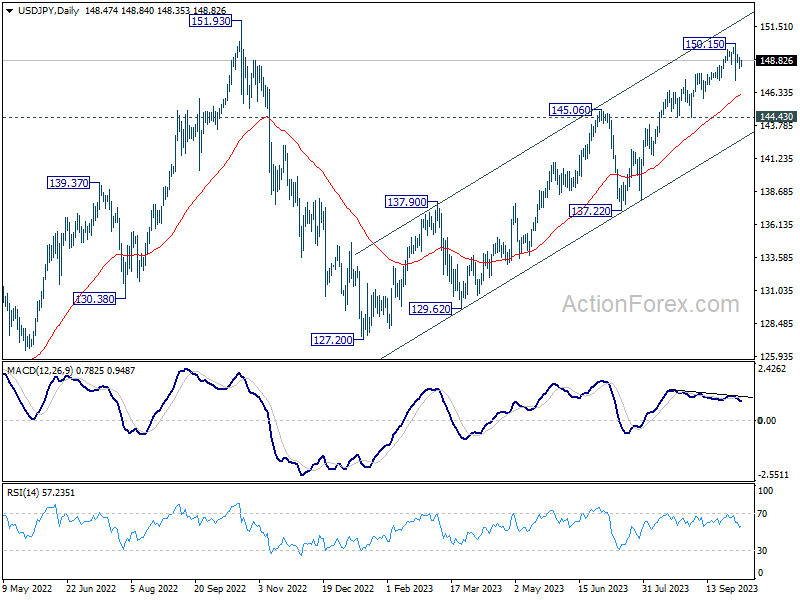
USD/JPY is extending the consolidation from 150.15 and intraday bias remains neutral. On the downside, below 147.28 will turn bias to the downside for deeper pull back. But there is no confirmation of bearish trend reversal before firm break of 144.43 support. Another rally remains mildly in favor through 150.15 to retest 151.93 high.
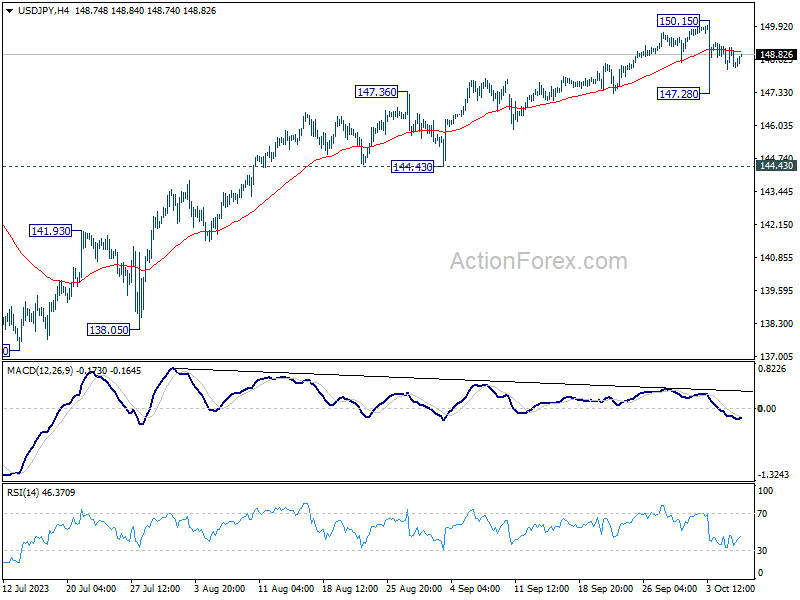
In the bigger picture, while rise from 127.20 is strong, it could still be seen as the second leg of the corrective pattern from 151.93 (2022 high). Rejection by 151.93, followed by sustained break of 145.06 resistance turned support will be the first sign that the third leg of the pattern has started. However, sustained break of 151.93 will confirm resumption of long term up trend.
AUD/USD Daily Report
Daily Pivots: (S1) 0.6294; (P) 0.6318; (R1) 0.6350; More...
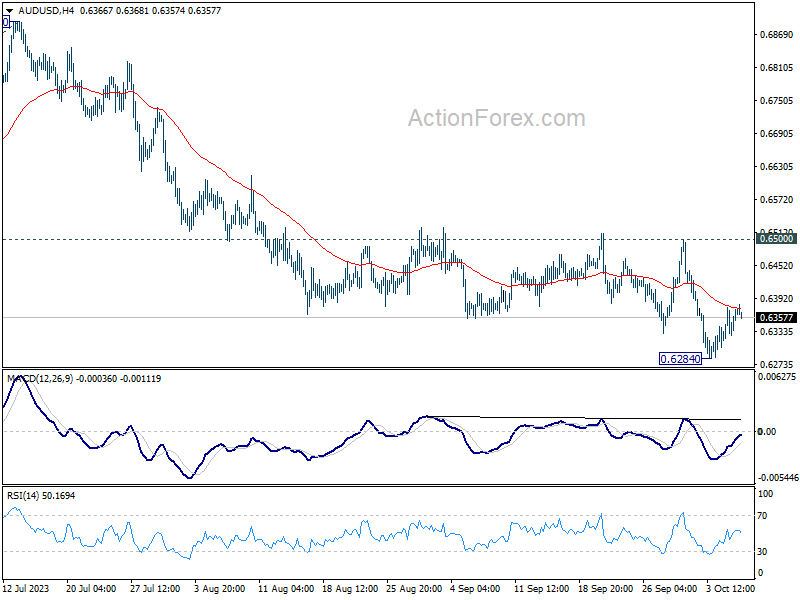
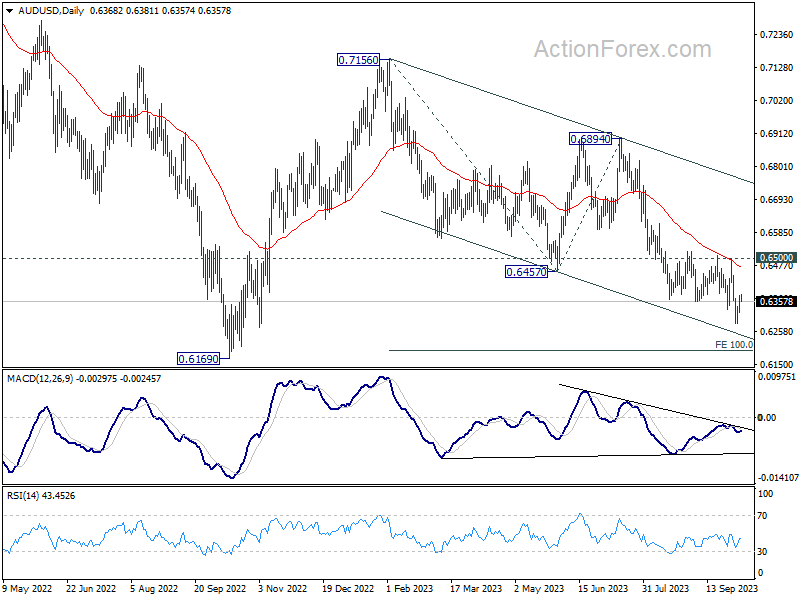
Intraday bias in AUD/USD stays neutral at this point, and consolidation from 0.6284 could extend further. Outlook will stay bearish as long as 0.6500 resistance holds. Below 0.6284 will resume the fall from 0.7156. Next target is 100% projection of 0.7156 to 0.6457 from 0.6894 at 0.6195.
In the bigger picture, down trend from 0.8006 (2021 high) is possibly still in progress. Decisive break of 0.6169 will target 61.8% projection of 0.8006 to 0.6169 to 0.7156 at 0.6021. This will now remain the favored case as long as 0.6894, in case of strong rebound.
Cliff Notes: Considering Near-Term Risks
Key insights from the week that was.
This week, the RBA decided to leave policy unchanged for a fourth consecutive month. Given that it was Governor Bullocks’s first meeting at the helm, market participants were eager to dissect the decision statement for any changes in rhetoric or perceived risks. In the event, the decision statement was little-changed from August, apart from refreshed observations on the Monthly CPI Indicator, including “fuel prices have risen notably of late”. The RBA is certainly justified in highlighting near-term momentum in inflation. Indeed, we have upgraded our own inflation forecasts for Q3 and Q4 in light of the stickier services detail in the Monthly CPI Indicator, recent strength in crude oil prices and the languishing Australian dollar. These developments will be incorporated into the RBA’s staff forecasts next month following the more comprehensive Q3 CPI report of late-October. We expect their revisions to also be contained to the near-term, leaving intact inflation’s path back into the target band in 2025.
As such, we remain of the view that the RBA will keep the cash rate unchanged in coming months. Looking to 2024, as economic growth remains weak, labour market slack will build. With inflation maintaining its downtrend towards target, the RBA will have sufficient evidence to begin easing from September quarter 2024, delivering 25bps of cuts per quarter through to mid-2025.
For more detail on our views on the outlook for the RBA and global central banks, our latest edition of Market Outlook is now available. The RBA also released their latest Financial Stability Review today, highlighting the resilience of Australia’s economy and financial system amid considerable uncertainty.
Turning then to the housing data, the CoreLogic home value index posted another broad-based gain in September (0.9%) with solid increases reported in most of the major capital cities. Despite clear evidence of robust momentum in house prices, housing finance approvals point to low transaction volumes, with the total value of new loans still 27% below 2022’s peak. A sizeable pipeline of work is currently holding up the level of housing construction, abstracting for high-rise volatility; but, as highlighted by dwelling approvals, the pulse of new activity is soft. Elevated construction costs and widespread capacity issues will continue to weigh on housing construction activity over the coming year, providing support to both house prices and rents.
Before moving offshore, a quick note on trade. Australia’s trade surplus bounced notably in August, rising from $7.3bn to $9.6bn. This was largely a consequence of strength in gold exports which nearly doubled in the month as imports essentially halved, leading to a remarkable $2.4bn improvement in the gold balance. Excluding gold, the detail was broadly as expected, exports rising 0.3% as imports gained 0.7%. The latter in part reflects the impact of a weaker Australian dollar and higher global oil prices.
Turning to New Zealand, the RBNZ kept rates steady at 5.50% at their October meeting and their statement did not carry as hawkish a tone as Westpac and others forecasters had expected. Inflation continues to show persistence in New Zealand, while the impact of current policy settings has been blunted by strong migration and expansionary fiscal policy. As such, we maintain our call for an additional rate hike in November and now expect the cash rate to remain on hold at 5.75% until early 2025. A slow decline in the cash rate to 4% in 2026 and 3.5% from 2027 onwards is then anticipated.
Further afield, the ISM manufacturing PMI rose for a third consecutive month, albeit only to a still-contractionary 49. The lift was broadly supported by new orders, production, and employment. Despite the stronger pulse of activity, prices paid fell, leaving the sub-index 12pts below its 5-year pre-COVID average. Both from a demand and supply perspective, manufacturing sector inflation pressures seem benign.
The September non-manufacturing PMI report was mixed. The headline index fell in the month, but at 53.6 is still expansionary. Looking ahead, the decline in new orders and employment point to a belief amongst service providers that discretionary spending is losing steam across the economy.
Focusing in on the labour market, the manufacturing and non-manufacturing ISM employment components together with the JOLTS survey’s hiring and quit rates, which are now back at pre-pandemic levels, suggest labour demand and supply are near balance. If GDP growth settles below trend in coming quarters as we expect, then a further deceleration in job creation is likely.
Several FOMC members also spoke this week. Of most significance were the comments of San Fransisco Fed President Mary Daly. President Daly described holding nominal rates steady as an “active policy action” because declining inflation expectations will see the real stance of policy “grow increasingly restrictive”. With real term interest rates already at deeply contractionary levels, and given our expectation that GDP growth and the labour market will disappoint the FOMC, we continue to believe rate cuts will be appropriate from March 2024 and that 100bps of cuts will be required over the year versus the Committee’s current median estimate of just 50bps (from a higher peak).
Over in the UK, the Bank of England released its Decision Maker Panel (DMP) survey results for September. Of note, 3-year ahead inflation expectations rose to 3.2%. Realised wages increased to 7.1% and expected wages to 5.2% after two months at 5%. In the most recent meeting, the BoE indicated that wage growth was “stable” according to broader measures of wage growth, setting aside the rapid gain in headline average weekly earnings. The DMP is one of the broader measures that the BoE is referring to. An uptick in expected wages (albeit a modest one) increases the risk of another rate hike for the BoE. It is worth noting that the survey closed a day after the most recent meeting, potentially supporting the survey’s outcomes.