

Sample Category Title
As US Yields Surge, How High Can They Go?
- Skyrocketing bond yields put markets in a spin
- Fed’s higher for longer calls grow louder
- US 10-year yield approaches 4.8% at 16-year high
- Can they reach 5.0% and how soon before something breaks?
Yields heeding the higher for longer message
Yields on government bonds are flying again as central banks are all singing from the same hymn sheet lately, flagging that interest rates will stay high for a longer period of time. This isn’t exactly a new revelation for investors but more recently, the message has started to sink in deeper as the combination of persistent price pressures and resilient economies has taken everyone by surprise.
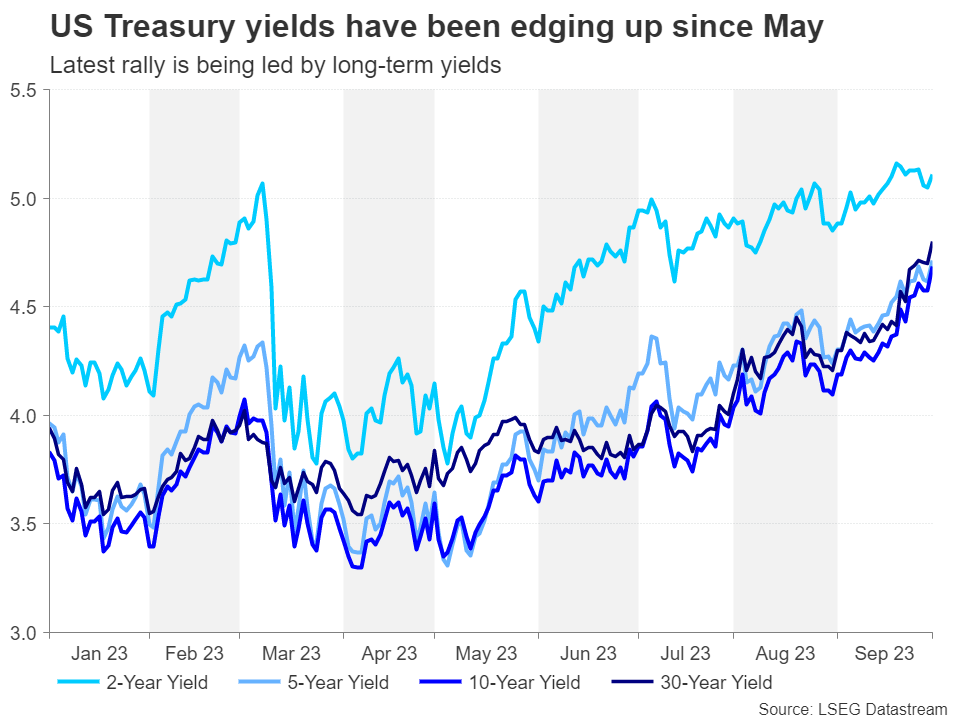
With rates potentially yet to peak in the United States and elsewhere, government bond yields have been rallying since May when the US banking turmoil began to dissipate. However, this latest leg of the rally isn’t so much driven by expectations of where interest rates will peak but more about how long they will stay at elevated levels.
There may be more tightening to come
The Federal Reserve and even the European Central Bank may yet have to tighten further, but it’s unlikely this would involve anything more than a 25-basis-point hike. What’s gotten markets so jittery is the prospect of rates staying near current levels for an extended duration. That is why long-dated government bonds have borne the brunt of the latest selloff, pushing 10-year yields to more-than-decade highs.
The last time the 10-year Treasury yield was above 4.8% was at the onset of the global financial crisis in the summer of 2007. Not long after that, rock-bottom rates became the norm. This highlights just how markedly the inflation picture has altered since the pandemic, with the supply and energy shocks irreversibly lifting prices.
Job not done yet on inflation
However, falling inflation has been the big story of 2023 – so why are the Fed and other central banks still thinking about hiking further? The problem is that despite good progress, inflation in most places has some distance to cover before reaching the 2% target. In the US, the core PCE measure of inflation stood at 3.9% in August – almost double the Fed’s objective.
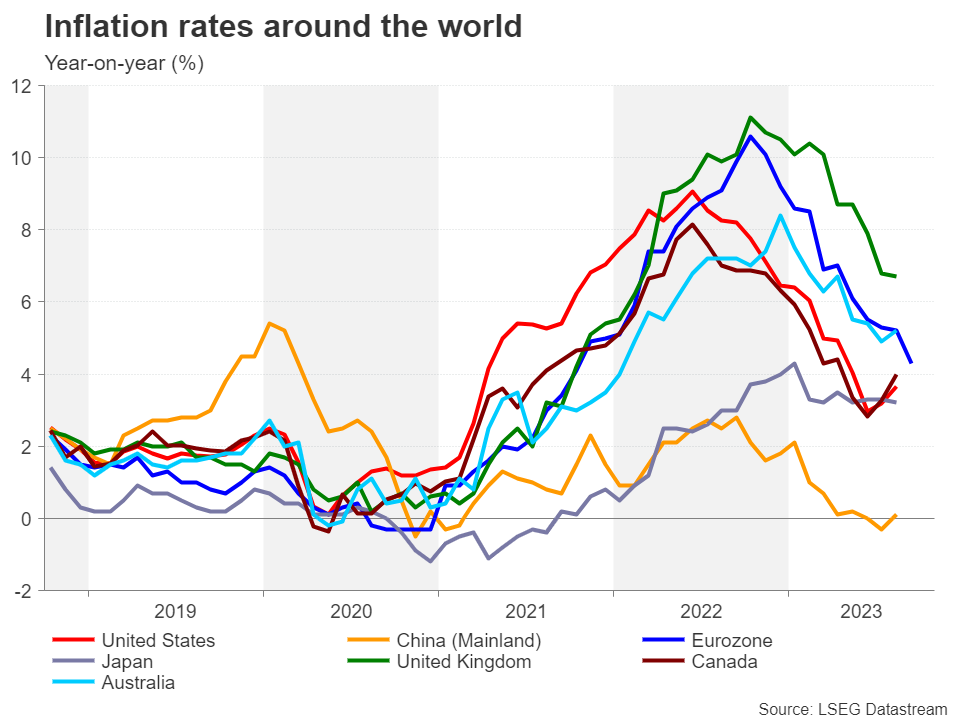
Inflation may have come down sharply over the past year as the energy crisis subsided, but the next phase may take a lot longer. There are several factors that could prevent inflation from dropping all the way down to 2% in a quick manner and they vary in each country. In America, it is the tight labour market and robust consumer spending.
The elusive soft landing
The Fed is in a tricky spot at the moment when it comes to correctly gauging how restrictive policy has become. It risks tightening more than it has to should it act solely on the actual data, or doing too little should its caution on the basis that there are transmission lags in monetary policy prove to be a miscalculation. With various measures of inflation expectations converging slightly above 2% and hiring slowing down lately, the Fed seems to be taking its chances with the latter option.
But this is not the entire explanation. The Fed is desperate to engineer a soft landing for the economy, which comes at a price as it would necessitate taking a more patient approach to hitting the 2% target in a sustainable manner. Policymakers are thus effectively making a conscious decision to let inflation run above target for longer so as not to choke off economic growth.
What this means for monetary policy, however, is that whilst rates would peak somewhat lower, they’re less likely to be cut sooner. For the US where the economy continues to display remarkable resilience, this is even more significant as any cut would risk fuelling renewed inflationary pressures.
Is the only way up for yields?
The recent gains in Treasury yields may be a reflection of this realisation by investors. The question now is, can yields rise further, and if so, at what point will higher yields inflict some serious damage on the economy?
For the moment, neither consumption nor the labour market are showing any major signs of cracks. Should this still be the case by December, the Fed may well end the year with another rate increase. Not only that, but the Fed might also lift its projected rate path again, spurring another rally in long-term yields.
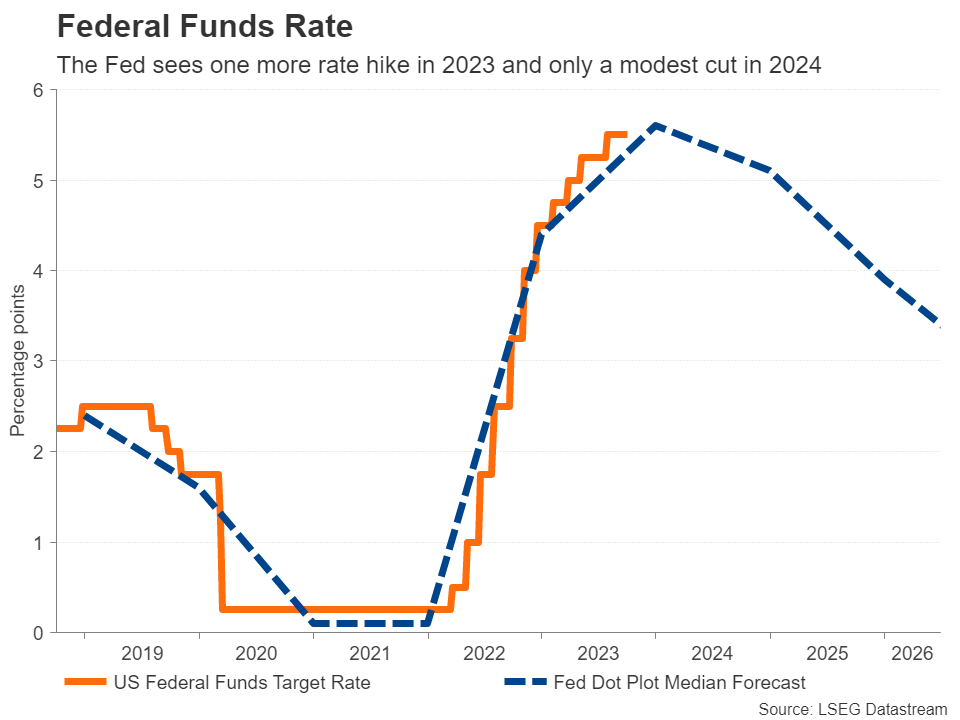
Assuming that the outlook in Europe and elsewhere doesn’t improve, the US dollar would be in a position to appreciate further, while there could be more pain in store for US equities. So far though, the upside surprises in the economic data, the artificial intelligence (AI) mania as well as the defensive nature of many tech stocks have all contributed to driving Wall Street indices higher even as financial conditions have tightened.
Small cracks are appearing in the economy
But it’s hard to see this picture lasting once the 10-year yield nears the 5.0% level. Looking under the hood, there are several signs of trouble brewing. The manufacturing sector is contracting, and banks are lending less, hitting struggling businesses and new investment. Households have almost drawn down on their excess savings and this coincides with an increase in the number of households unable to pay their credit card debts. In addition, Americans will soon have to start repaying their student loans as the pandemic support expires.
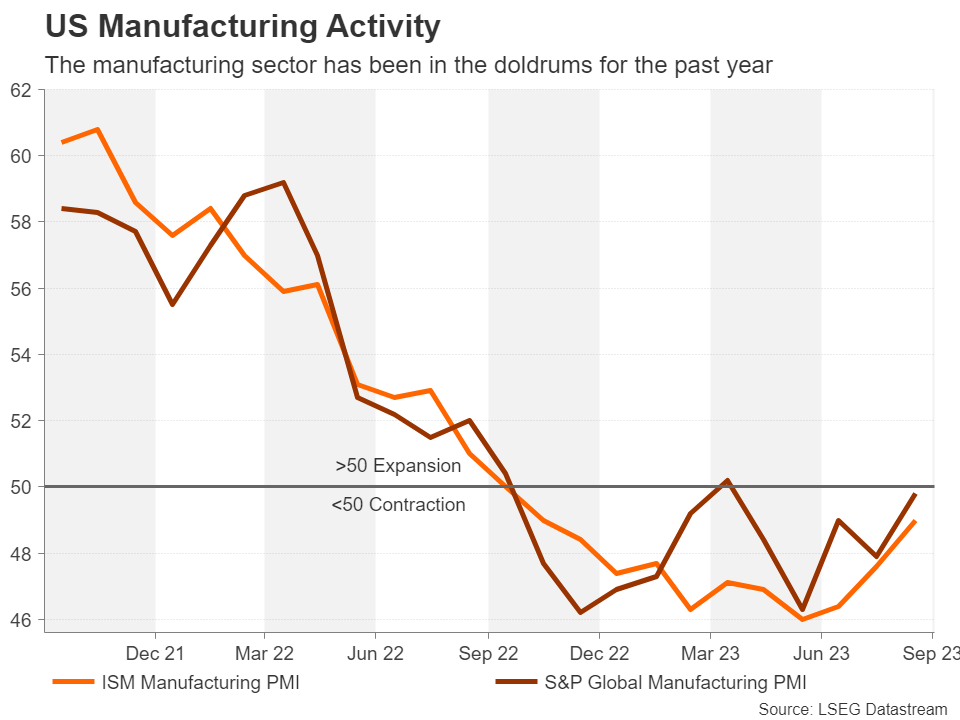
Resurgent oil prices are another worry as they threaten to push up costs again just as the pain was easing. Not to forget the slowdown in Europe and China that’s bound to affect the earnings for US multinationals, all this could yet kill any momentum in the economy, if not tip it into recession.
Is a recession only delayed, not cancelled?
For now, the expectation of a soft landing is maintaining the upward pressure on yields, while the deluge of new debt issuance by the Treasury Department is worsening the rout in the bond market. Unless there’s a sharp deterioration in the outlook, it is difficult to envisage bond yields retreating substantially in the near future.
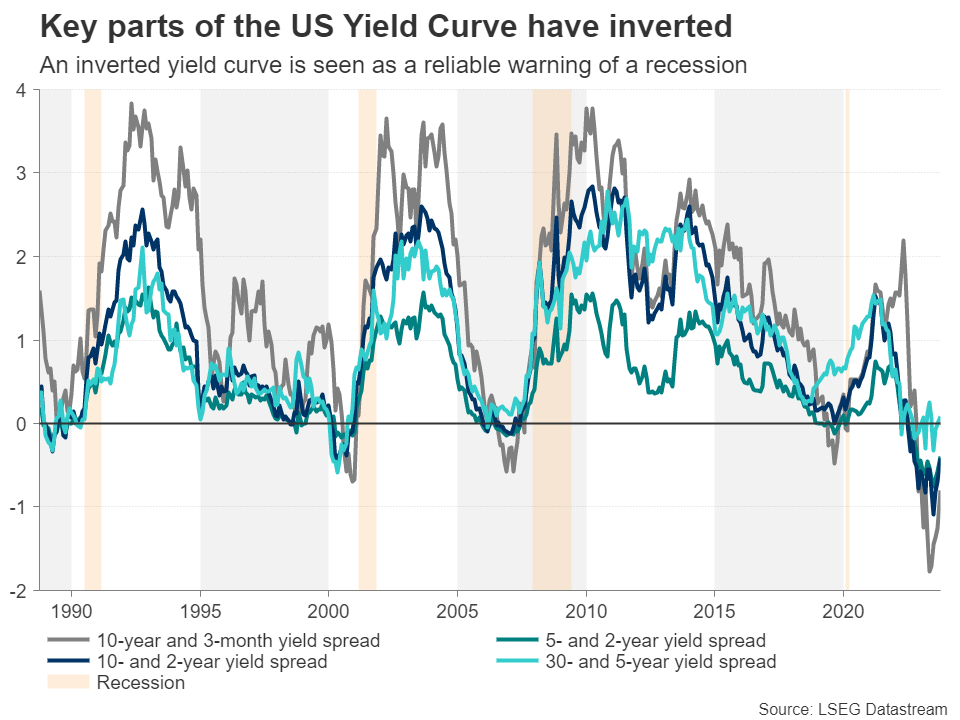
The danger is that the risk of a recession may not be as low as policymakers and investors would like to believe. The inverted yield curve continues to flash red even though the gap between long- and short-term yields has narrowed over the last few months. The other cause of concern is that in the past, calls for a soft landing have often tended to precede recessions and what may be happening now is simply the timing of one being pushed further and further back.
Yields vs stocks
Adding to the confusion is the broken negative relationship between Treasury yields and the stock market. When yields reach a cycle peak, stocks traditionally enter a bear market. However, during the post-pandemic recovery, the S&P 500 and the 10-year yield rallied in tandem.
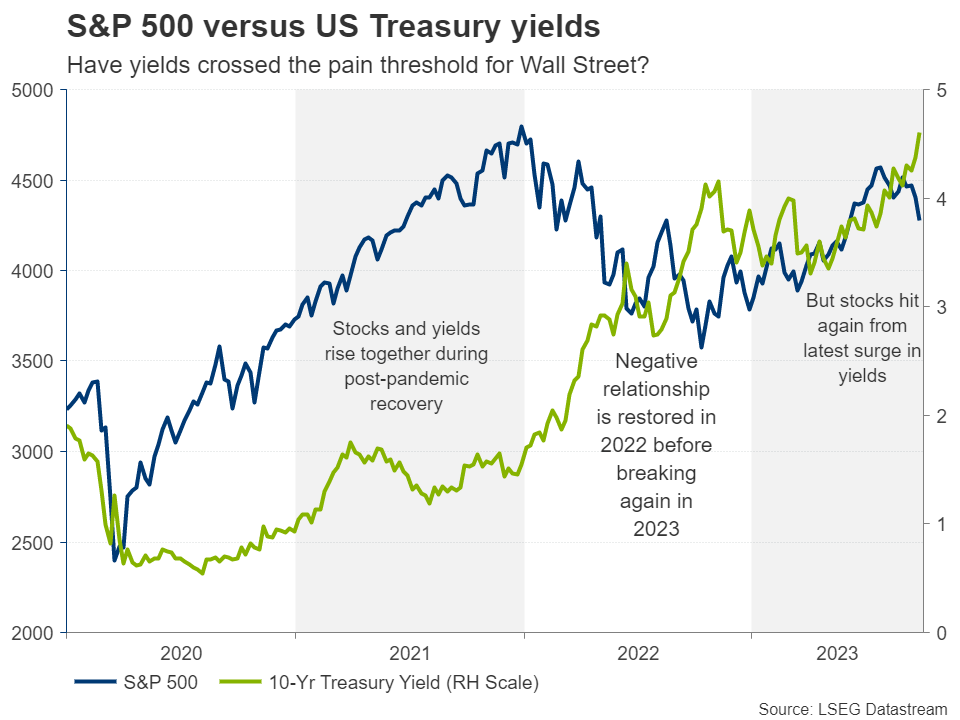
The negative relationship corrected itself last year when Wall Street declined and yields kept rising, but it broke again in the first half of 2023. Since September, however, yields and stocks have gone their opposite ways once more, in a possible sign that yields may have already reached the pain threshold for Wall Street. Does this hold true for the economy as well?
Could USDJPY Change Course after the Rumoured Intervention?
- USDJPY is edging higher today after yesterday’s tumultuous session
- It continues to hover inside a wide ascending trend channel
- Stochastic oscillator could be close to giving a bearish signal
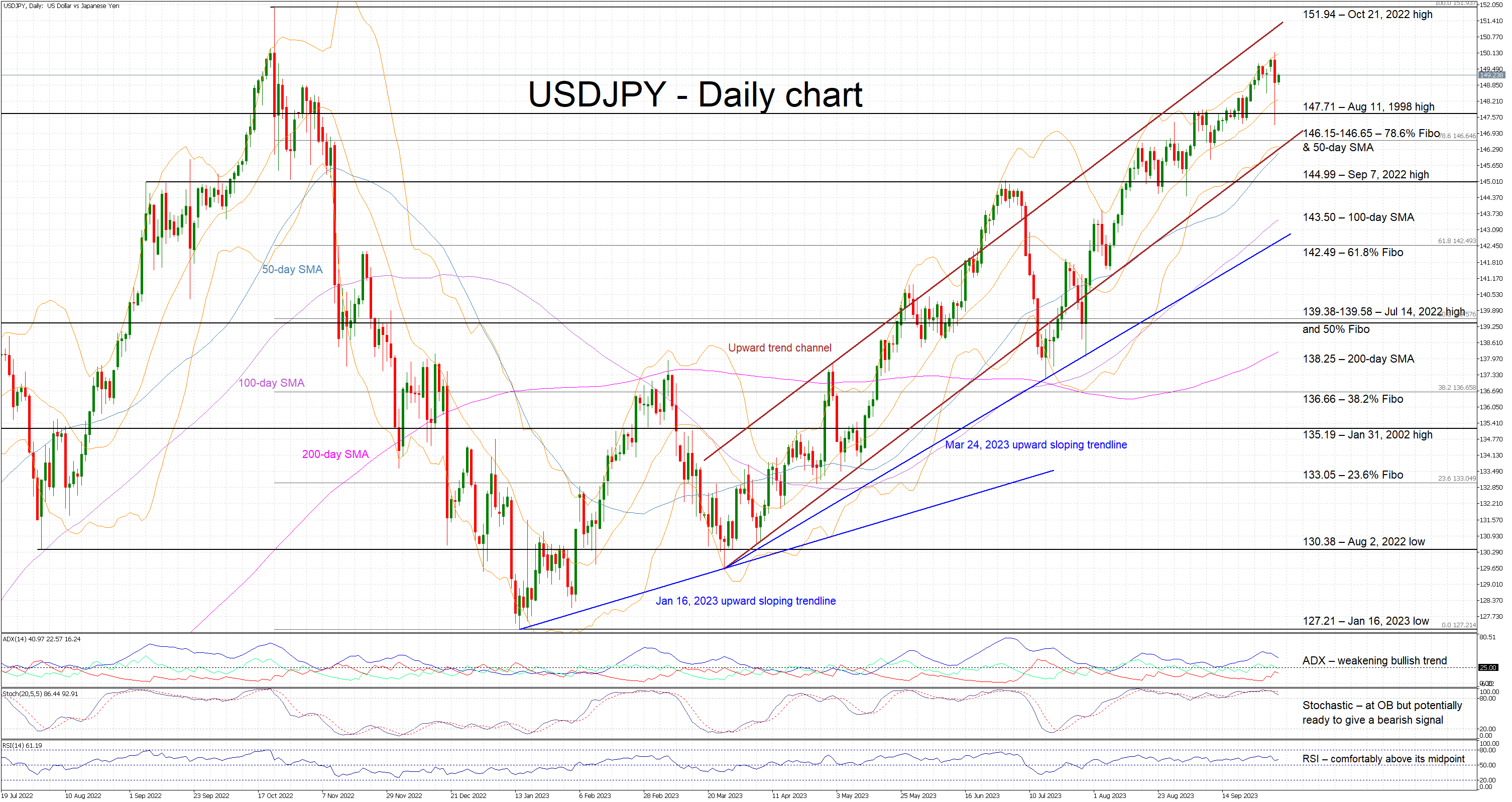
USDJPY is in the green today as market participants are trying to find their foot following yesterday’s alleged intervention from the Japanese authorities. The pair continues to trade at extremely elevated levels and remains comfortably inside an upward trend channel.
However, the picture portrayed by the momentum indicators is not so clear cut. The Average Directional Movement Index (ADX) is edging lower but continues to show a weakening bullish trend. Similarly, the RSI remains comfortably above its 50-midpoint, spending 2.5 months in bullish territory. However, the stochastic oscillator is currently at a precarious position. It has broken below its moving average and looks ready to edge below its overbought region. Should this take place, it would be seen as a strong bearish signal.
Should the bears feel energized to stage a pullback, they would try to push USDJPY below the August 11, 1998 high at 147.71. Lower, the busy 146.15-146.65 area, defined by the 78.6% Fibonacci retracement of October 21, 2023 - January 16, 2023 downtrend at 146.65, the 50-day simple moving average (SMA) and the lower boundary of the upward trend channel, could prove a very strong support area.
On the flip side, the bulls are trying to digest the alleged intervention. Should they remain committed to recording new highs, they could try to overcome yesterday's high at 150.15 and then potentially set a course for the October 21, 2022 high at 151.94.
To sum up, USDJPY bulls are still in control of the market, but they could be walking on thin ice as a JPY intervention threat remains at large.
Japanese Officials Won’t be Able to Fight Strong USD Without Backing by BoJ U-Turn
Markets
The US manufacturing ISM on Monday and US JOLTS job openings (9.61mn from 8.8mn vs stabilization expected) yesterday. Eco data provided the bearish bond trend with some additional ammo, delaying in time any US recession bets and keeping the Fed’s preferred soft landing scenario alive. US money markets for the first time attach a 50/50 probability that the US central bank will effectively deliver on its “promised” (via dot plot) final rate hike this year. The sell-off nevertheless centered again at the longer end of the curve. US yields added 4.7 bps (2-yr) to 13.5 bps (30-yr) in a daily perspective. Since the Fed delivered the 5%+ message until end 2024 at the September 20 policy meeting, the US 10-yr yield and 30-yr yield increased by 44 bps and 50 bps respectively driven by higher real rates. Both are obviously at cycle and multiyear highs respectively at 4.85% and 4.97%. The US 10-yr real rate (2.43%) overtook inflation expectations (2.40%) for the first time since 2009. Other (global) core bonds followed US Treasuries south with the Fed’s course serving as a template for the rest. German yield changes varied between -1.7 bps (2-yr) and +7.6 bps (30-yr). The German 10-yr yield closed at a cycle high 2.97% and is about to pass beyond 3% for the first time since June 2011. The German 30-yr yield closed at 3.21%. The trade-weighted dollar closed off the intraday highs yesterday following a suspicious move in USD/JPY. The pair was fighting the psychologic 150 threshold which is seen as line in the sand for Japanese officials. As the pair tried to make its way beyond 150 following JOLTS data, it was countered by strong JPY inflows, pulling the FX rate temporary to USD/JPY 147.50. Currently, we’re back around 149.25, adding strength to our case that Japanese officials won’t be able to fight a strong USD without backing by a BoJ policy U-turn. Stock markets were wacked again with key European indices losing over 1% and Wall Street losses ranging between -1.3% (Dow) and -1.9% (Nasdaq). Technical pictures become more and more dire, with the trading pattern shifting to sell-on-upticks. We don’t fight ruling trends today even though the eco calendar might cause some additional 2-way volatility with ADP employment change and the services ISM scheduled in the US. The key European focus is on ECB President Lagarde’s speech at a monetary policy conference in Frankfurt with often overlooked Q2 Italian deficit data serving as a wildcard. As the Italian spread over Germany (10y) is on the verge of passing 200 bps for the first time since end of last year.
News & Views
The Reserve Bank of New Zealand this morning kept its policy rate unchanged at 5.50%. The Monetary Policy Committee assessed that interest rates are constraining economic activity and reducing inflationary pressure as required. Even as GDP growth in the June quarter was stronger than expected (0.9% Q/Q 1.8% Y/Y), the RBNZ expects demand in the economy to continue to slow. Weakening global demand is putting downward pressure on New Zealand export volumes and prices. Global import prices (ex oil) are seen easing. While the imbalance between supply and demand is moderating, the RBNZ indicates that a prolonged period of subdued activity remains required to reduce inflation, supporting the case to keep policy restrictive. At the same time, the RBNZ in the press release didn’t given a clear hint on further tightening. The central bank sees a near-term risk that activity and inflation do not slow as much as needed. Over the medium term, a greater slowdown in global demand, particularly in China, could weigh more on commodity prices and New Zealand exports. Markets expected a more hawkish tone. The 2-y government bond yields eased 3 bps after the decision (5.79%). The kiwi dollar dropped to NZD/USD 0.59.
Kevin McCarthy, the Republican Speaker of the US House of Representatives, was removed from his function as the House in a 216-210 vote approved a ‘motion to vacate’. Eight Republicans joined the 208 democrats in the vote. The vote came after opposition within the Republican party led by Matt Geatz, after McCarthy last week needed the support from democratic representatives to approve a bill avoiding a partial government shutdown. The House now needs to look for a new speaker, but there remains a high degree of dissent within the Republican party. The current situation de facto brings legislative action to a halt. A new agreement to fund the US government is needed by mid-November to again prevent a government shut-down. Also other key topics including US aid to Ukraine might be blocked in the process.
USD/CAD Daily Outlook
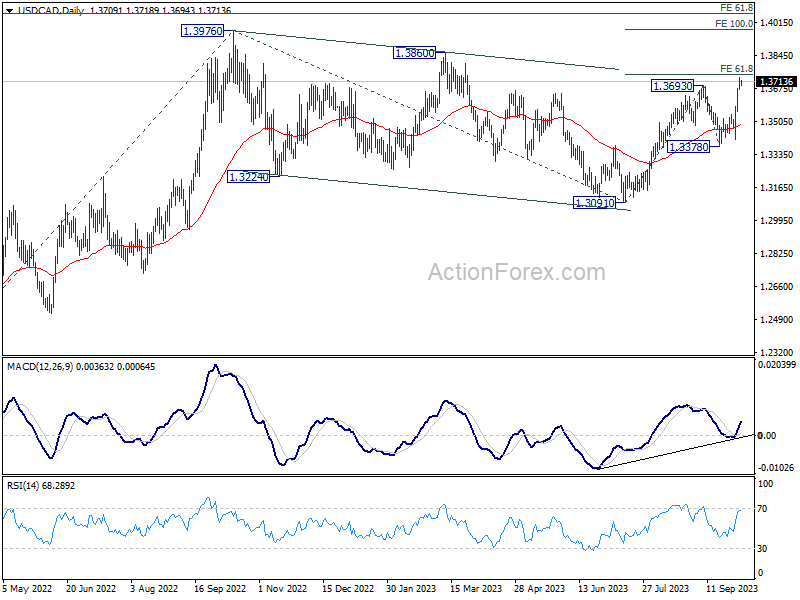
Daily Pivots: (S1) 1.3668; (P) 1.3702; (R1) 1.3743; More....
Intraday bias in USD/CAD remains on the upside at this point. Current rise from 1.3091 should target 61.8% projection of 1.3091 to 1.3693 from 1.3378 at 1.3750. Firm break there will target 100% projection at 1.3980. On the downside, below 1.3654 minor support will turn intraday bias neutral first.
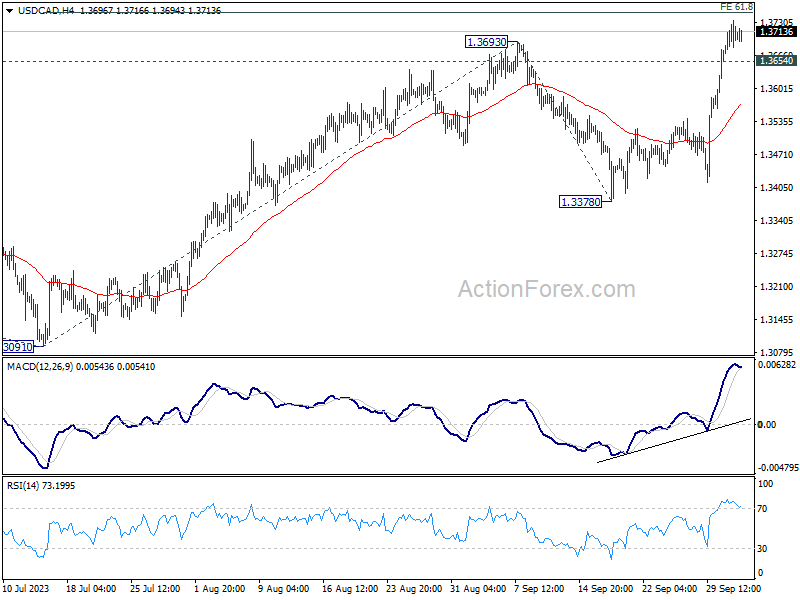
In the bigger picture, current development revives the case that corrective pattern from 1.3976 (2022 high) has completed with three waves down to 1.3091. Decisive break of 1.3976 high will confirm resumption of up trend from 1.2005 (2021 low). Next target will be 61.8% projection of 1.2401 to 1.3976 from 1.3091 at 1.4064. This will now remain the favored case as long as 1.3378 support holds.
AUD/USD Daily Report
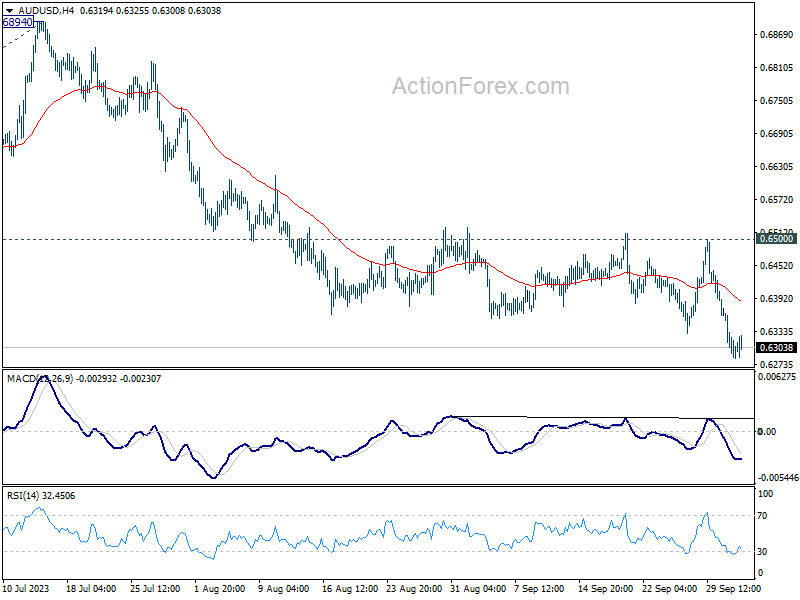
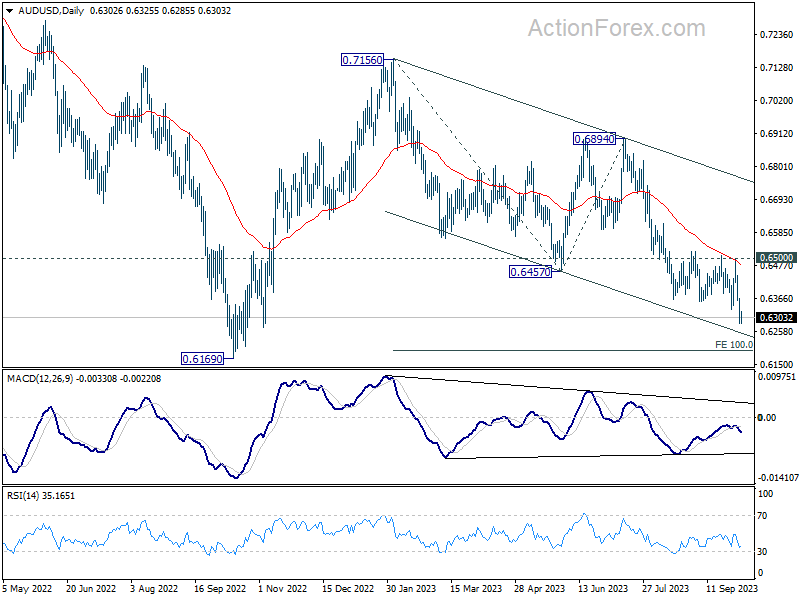
Daily Pivots: (S1) 0.6268; (P) 0.6320; (R1) 0.6353; More...
Intraday bias in AUD/USD remains on the downside for the moment. Current fall from 0.7156 is in progress and should target 100% projection of 0.7156 to 0.6457 from 0.6894 at 0.6195. On the upside, break of 0.6500 resistance is needed to indicate short term bottoming. Otherwise, outlook will stay bearish in case of recovery.
In the bigger picture, down trend from 0.8006 (2021 high) is possibly still in progress. Decisive break of 0.6169 will target 61.8% projection of 0.8006 to 0.6169 to 0.7156 at 0.6021. This will now remain the favored case as long as 0.6894, in case of strong rebound.
EUR/USD Daily Outlook
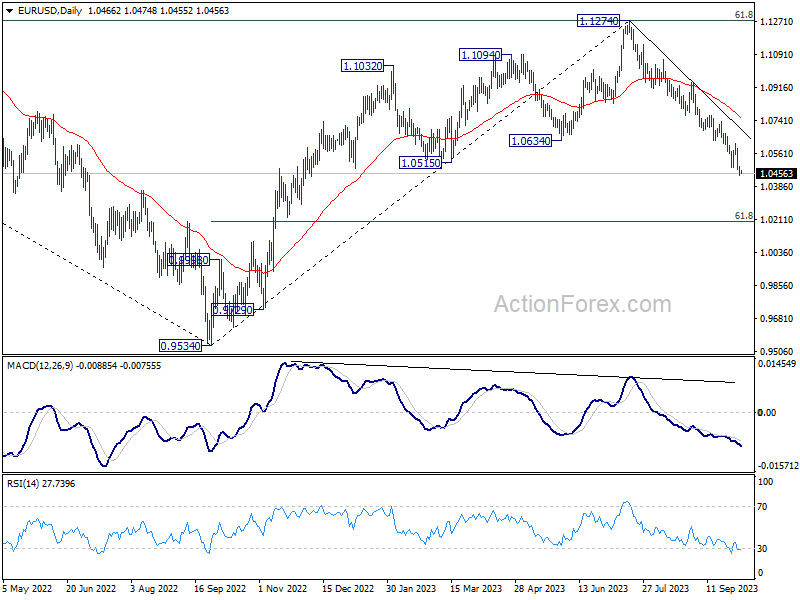
Daily Pivots: (S1) 1.0445; (P) 1.0469; (R1) 1.0491; More...
Intraday bias in EUR/USD stays on the downside for the moment. Fall from 1.1274 is in progress and should target 1.0199 fibonacci level next. On the upside, break of 1.0616 resistance is needed to indicate short term bottoming. Otherwise, outlook will stay bearish in case of recovery.
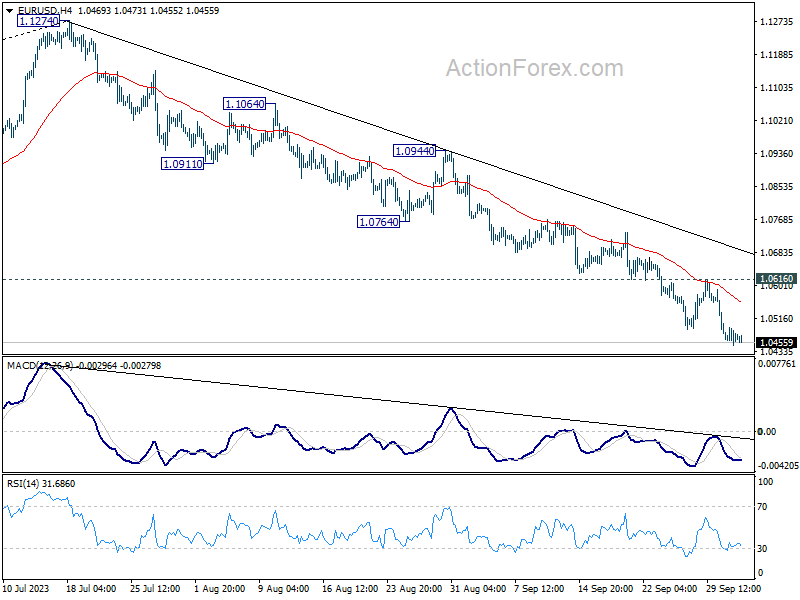
In the bigger picture, fall from 1.1274 medium term top could still be a correction to rise from 0.9534 (2022 low). But chance of a complete trend reversal is rising. In either case, current fall should target 61.8% retracement of 0.9534 to 1.1274 at 1.0199 next. For now, risk will stay on the downside as long as 55 D EMA (now at 1.0759) holds, in case of rebound.
GBP/USD Daily Outlook
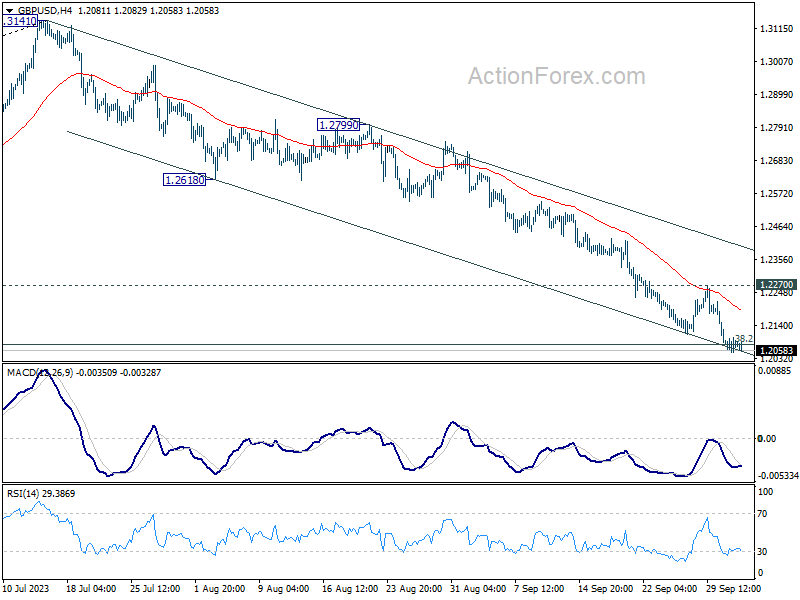
Daily Pivots: (S1) 1.2052; (P) 1.2077; (R1) 1.2102; More...
Outlook in GBP/USD is unchanged and intraday bias stays on the downside. Sustained trading below 1.2075 fibonacci level would carry larger bearish implication. Fall from 1.3141 should then target 1.1801 support next. On the upside, break of 1.2270 resistance is needed to indicate short term bottoming. Otherwise, outlook will stay bearish in case of recovery.
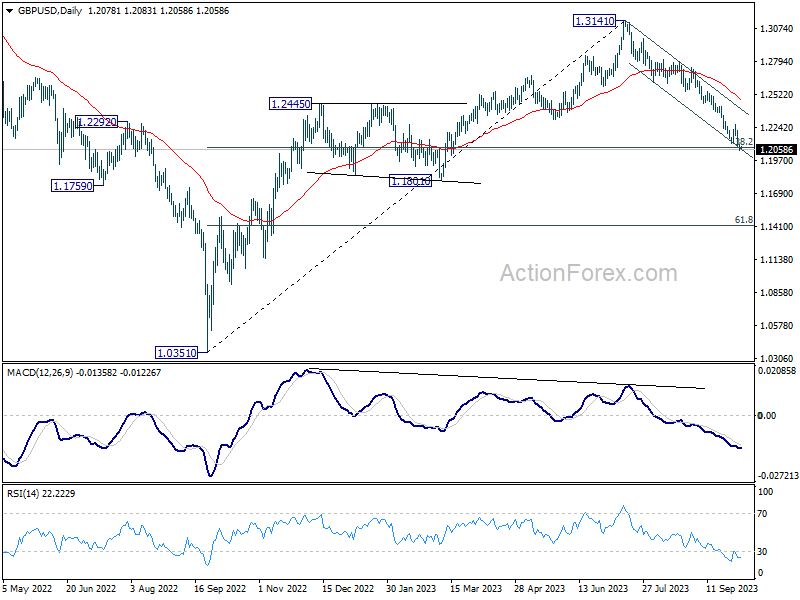
In the bigger picture, fall from 1.3141 medium term top could still be a correction to up trend from 1.0351 (2022 low) only. But risk of complete trend reversal is rising. Sustained break of 38.2% retracement of 1.0351 to 1.3141 at 1.2075 will pave the way to 61.8% retracement at 1.1417. For now, risk will stay on the downside as long as 55 D EMA (now at 1.2486) holds, in case of rebound.
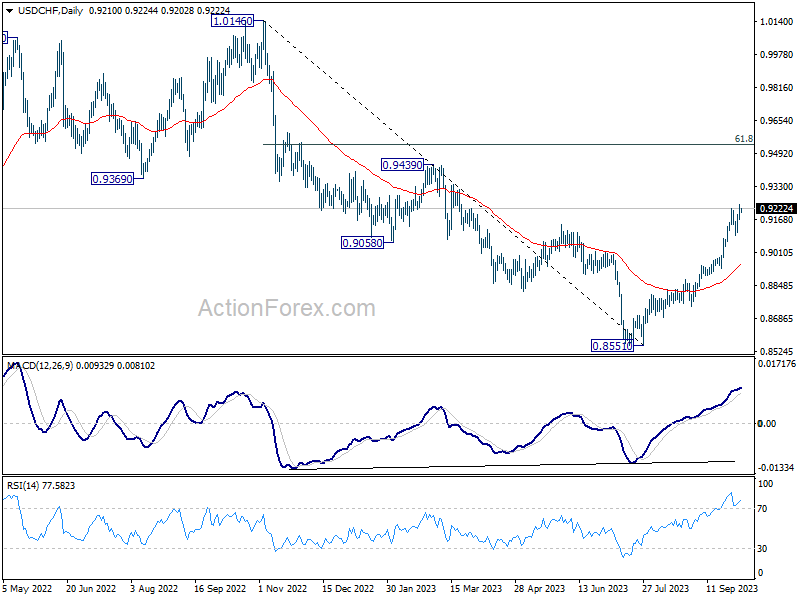
USD/CHF Daily Outlook
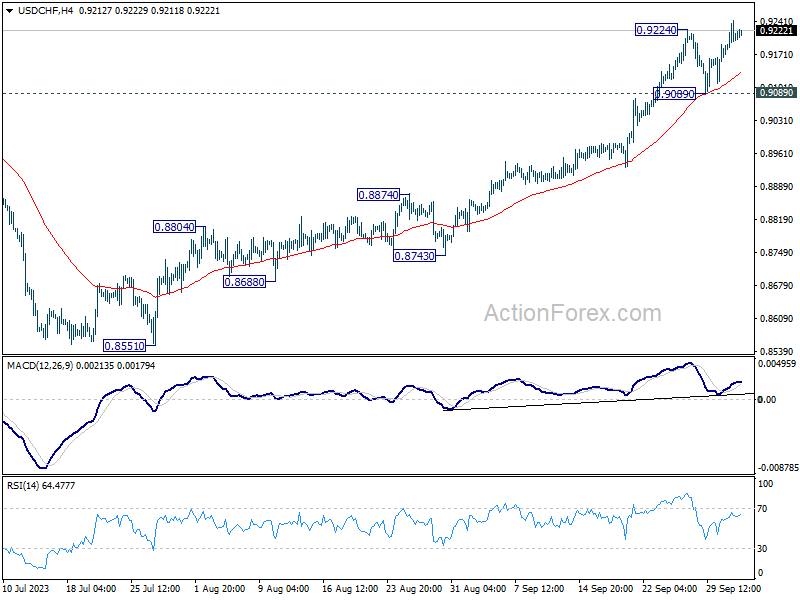
Daily Pivots: (S1) 0.9175; (P) 0.9209; (R1) 0.9246; More....
Intraday bias in USD/CHF remains on the upside for the moment. Current rise from 0.8551 should 0.9439 resistance next. On the downside, break of 0.9089 support is needed to indicate short term topping. Otherwise, outlook will stay bullish in case of retreat.
In the bigger picture, current development indicates that rise from 0.8551 is reversing whole down trend from 1.0146. Further rally would then be seen to 61.8% retracement at 0.9537 and above. For now, this will be the favored case as long as 55 D EMA (now at 0.8942) holds, even in case of deep pullback.
The Fear of Strong Jobs
Even a hint of an improving US jobs market sends shivers down investors' spines.
This is why the stronger than expected job openings data from the US spurred panic across the global financial markets yesterday. Although hirings and firings remained stable, the financial world was unhappy to see so many job opportunities offered to Americans as the data hinted that the US jobs market could be going back toward tightening, and not toward loosening. And that means that Americans will keep their jobs, find new ones, asked better pays, and keep spending. That spending will keep US growth above average and continue pushing inflation higher, and the Federal Reserve (Fed) will not only keep interest rates higher for longer but eventually be obliged to hike them more. Alas, a catastrophic scenario for the global financial markets where the rising US yields threaten to destroy value everywhere. PS. JOLTS data is volatile, and one data point is insufficient to point at changing trend. We still believe that the US jobs market will continue to loosen.
But the market reaction to yesterday’s JOLTS data was sharp and clear. The US 2-year yield spiked above 5.15% after the stronger than expected JOLTS data, the 10-year yield went through the roof and hit the 4.85% mark. News that the US House Speaker McCarthy lost his position after last week’s deal to keep the US government open certainly didn’t help attract investors into the US sovereign space. The US blue-chip bond yields on the other hand have advanced to the highest levels since 2009, and the spike in real yields hardly justify buying stocks if earnings expectations remain weak. The S&P500 is now headed towards its 200-DMA, which stands near the 4200 level. The more rate sensitive Nasdaq still has ways to go before reaching its own 200-DMA and critical Fibonacci levels, but the selloff could become harder in technology stocks if things got uglier.
In the FX, the US dollar extended gains across the board. The Reserve Bank of New Zealand (RBNZ) kept the interest rate steady at 5.5% as expected. Due today, the ADP report is expected to show a significant slowdown in US private job additions last month; the expectation is a meagre 153’000 new private job additions in September. Any weakness would be extremely welcome for the rest of the world, while a strong looking data, an - God forbid – a figure above 200K could boost the Federal Reserve (Fed) hawks and bring the discussion of a potential rate hike in November seriously on the table.
The EURUSD consolidates below the 1.05 level, the USDJPY spiked shortly above the 150 mark, and suddenly fell 2% in a matter of minutes, in a move that was thought to be an unconfirmed FX intervention. Gold extended losses to $1815 per ounce as the rising US yields increase the opportunity cost of holding the non-interest-bearing gold.
The barrel of American crude remains under pressure below the $90pb level. US shale producers say that they will keep drilling under wraps even if oil prices surge to $100pb, pointing at Joe Biden’s war against fossil fuel. A tighter oil supply is the main market driver for now, but recession fears will likely keep the upside limited, and September high could be a peak.
Strong JOLTS Data Supports Even Higher Yields
Market movers today
ECB president Christine Lagarde delivers pre-recorded welcome address to a monetary policy conference, and ECB board member Luis de Guindos is among the speakers at a conference organised by the Central Bank of Cyprus.
We receive euro area PPI figures for august. Producer prices have dropped like a stick this year after the sharp increases last year. In July, the index fell -7.6% and will likely drop even more in August as the price increases peaked in August last year at 43.4% y/y. The decline in producer prices will continue to weigh on goods prices, which have declined over the last months. This is welcoming news for the ECB but also as expected after the sharp rise in producer prices last year. However, the price pressure in the service sector continues due to a tight labour market and rising wages. Service PMI output prices are still at 55.
We also get data for the August retail sales in the euro area. Retail sales in real terms has been weak this year but surprised marginally on the upside in both June and July. Rising consumer confidence and real wages should support the figure going forward, but for now, consumers still seem chary with spending.
ISM non-manufacturing and the final version of the S&P service PMI are released in the US. The flash service PMI surprised to the upside both on activity and prices paid.
The ADP employment report is released in the US, but note that it is not always a good predictor for the official jobs report due Friday.
Fed governor Michelle Bowman speaks on banking reform.
The 60 second overview
US Data & Fed: The US August JOLTs report added support for the rates higher for longer narrative, as job openings unexpectedly rose to 9.61 million (July revised higher to 8.92 million; from 8.83). The ratio of job openings to unemployed still declined to 1.51 (from 1.53) reflecting the sharp recovery in labour force participation, but in any case labour market conditions remain tight. Hiring showed no signs of cooling, involuntary layoffs remained stable below pre-pandemic levels and the uptick in voluntary quits suggests that workers' confidence in finding new job opportunities has remained high. UST yields continued to edge higher following the release, and while both the Fed's Mester and Bostic acknowledged that the recent tightening in financial conditions would likely weigh on growth, neither appeared overly concerned, with Bostic noting that businesses would not be affected 'beyond what would happen in a normal tightening cycle'.
US politics: Last night republican Kevin McCarthy was ousted from his position as Speaker of the House. The motion-to-vacate came after the last weekends' continuing resolution (CR) funding bill required House democrats' support to pass. Vast majority of House republicans supported McCarthy in a tight vote, but as all of the House democrats joined only eight hardliner republicans in voting against the speaker, McCarthy lost the vote 216-210. As the CR bill covers government funding until mid-November, the result will not have immediate effect on the economy or the markets. But even so, as this was the first time in history when House speaker has been ousted by a vote, and as McCarthy's successor remains unclear, the path towards agreeing on the remaining funding bills by mid-November likely turned even more uncertain.
RBNZ: The Reserve Bank of New Zealand maintained the Official Cash Rate unchanged at 5.50% this morning as widely anticipated by both markets and analyst consensus. While risks to the growth outlook were seen as balanced, the overall tone in the press release was to the dovish side. RBNZ maintained its forward guidance unchanged, signalling that rate hikes are most likely already over, but that rates would remain at restrictive levels for 'a more sustained period of time'. Markets have speculated with a modest chance of RBNZ returning to hiking going forward, and hence the guidance was a slight dovish surprise, causing NZD/USD to decline following the meeting. We maintain a modestly downward-sloping forecast profile, with 12m forecast at 0.57.
Japan: Service PMI declined to 53.8 (revised up from 53.3) in September from 54.3 in August. It marks the lowest level since January and thus the service sector continues to decelerate. Even so, it remains strong not least supported by a booming tourism sector, which makes up for less impressive domestic demand. In the longer run, wage data will be key for more demand and a normalisation of monetary policies. We will know more on Friday.
Equities: Equities were sharply lower as yields broke a new record. The sell-off intensified in the US session amid the hot job print. Unlike last week, this resulted in a more classic value and defensive rotation. FANMAG, tech and yield sensitive real estate underperformed while defensives and value sectors (industrials, staples, materials) held up better. However, one sector stuck out: Banks. Banks underperformed yesterday which would normally not be the case in a rising yield environment. Fear of renewed bond losses in regional banks is probably one explanation behind this quite unusual mix. However, Nordic banks sold off massively too, and even underperformed the debt sensitive real estate sector. We have a hard time understanding the logic behind this and recommend buying banks on weakness.
Small caps underperform quite remarkably in this environment. This continued yesterday with Russell 2000 -1.7% (vs S&P 500 -1.1%) and OMX Nordic small cap -2% (vs Stoxx 600 -1.1%). This makes sense to us given the higher financing risk in small caps on top of weak liquidity. There will be a strong buy case in small caps later on, but probably not until after the recession, which is also when we expect QT to be done and liquidity to improve.
FI: Global bonds continue to rise despite inflation expectations such as 5y5y EUR and US inflation expectations either decline or have stabilised as spot inflation continues to decline. However, long-dated real rates and nominal rates have risen significantly during September and are slowly approaching 5% in 10Y Treasuries and 3% in 10Y Bunds. Furthermore, the bearish steepening of the curves continues. Yesterday's US labour market data from JOLT's report supported the higher for longer theme.
FX: The primary event in FX markets yesterday was the JPY volatility that followed USD/JPY hitting the 150 mark, which triggered a knee-jerk reaction drop in the cross. While not confirmed it has left markets speculating in the Japanese authorities intervening in the FX market. While the USD also had a strong session the Scandies came under heavy selling pressure with both EUR/NOK and EUR/SEK extending the rebounds following the last weeks' decline.
Credit: Muted activity in credit markets continued Tuesday with main 1bp wider and X-Over 4bp tighter. In Scandi space Carlsberg announced the termination of all licence agreements in Russia which means that the Russian Baltica business will be prevented from producing, marketing and selling Carlsberg group products. Furthermore, Carlsberg will take full impairment on the related assets. Overall this was not a surprise and we see no spread impact from the news.