

Sample Category Title
EUR/AUD Daily Outlook
Daily Pivots: (S1) 1.6453; (P) 1.6545; (R1) 1.6622; More...
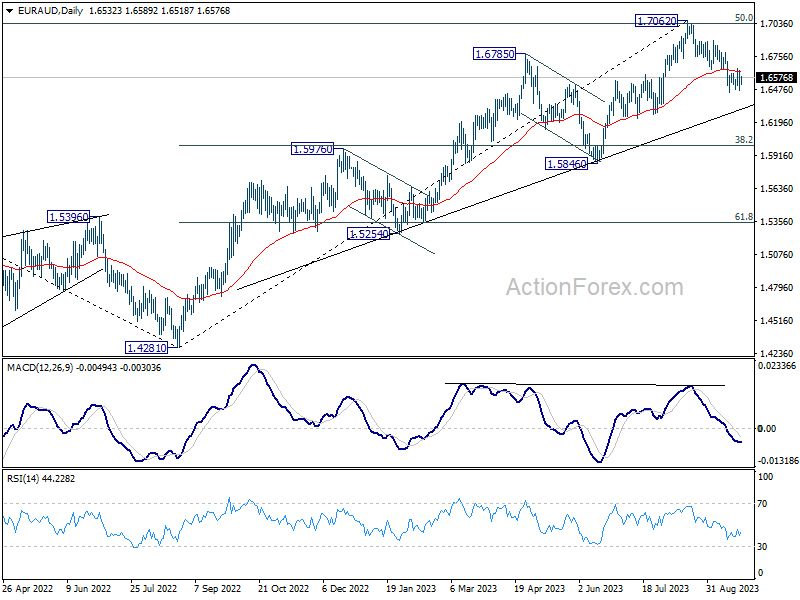
Intraday bias in EUR/AUD remains neutral as sideway trading continues. On the downside, break of 1.6452 will resume the fall from 1.7062, as a larger scale correction, to 1.6000 fibonacci level. Nevertheless, firm break of 1.6793 will dampen this view and bring retest of 1.7062 instead.
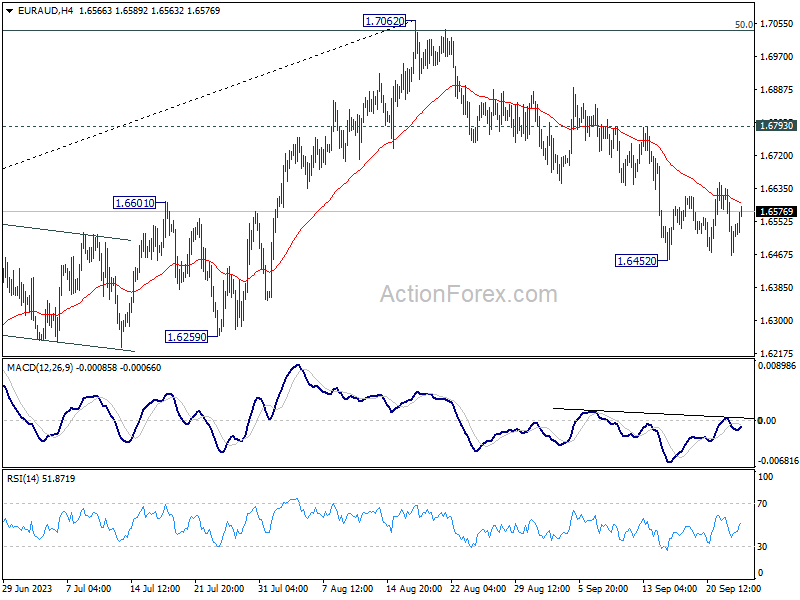
In the bigger picture, fall from 1.7062 is probably correcting whole up trend from 1.4281 (2022 low). Deeper decline would be seen to 38.2% retracement of 1.4281 to 1.7062 at 1.6000. Strong support should be seen there to bring rebound, at least on first attempt.
EUR/CHF Daily Outlook
Daily Pivots: (S1) 0.9631; (P) 0.9649; (R1) 0.9673; More...
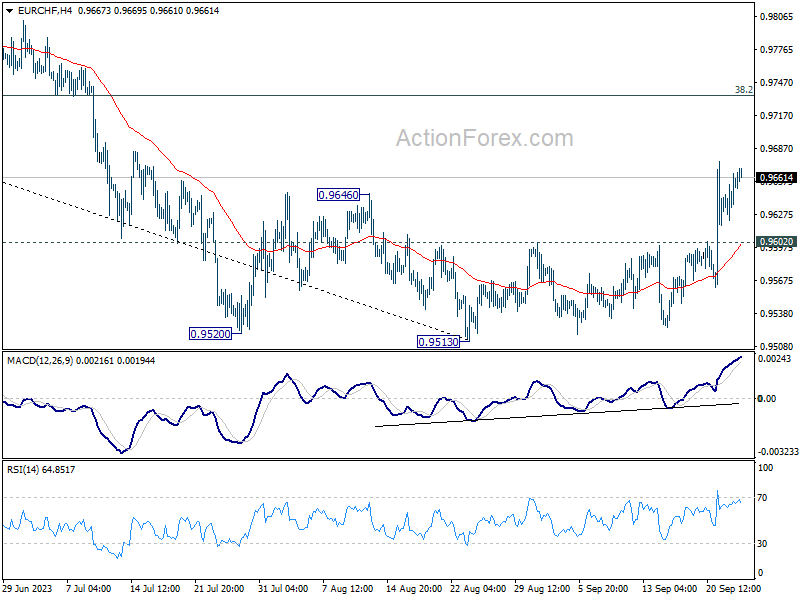
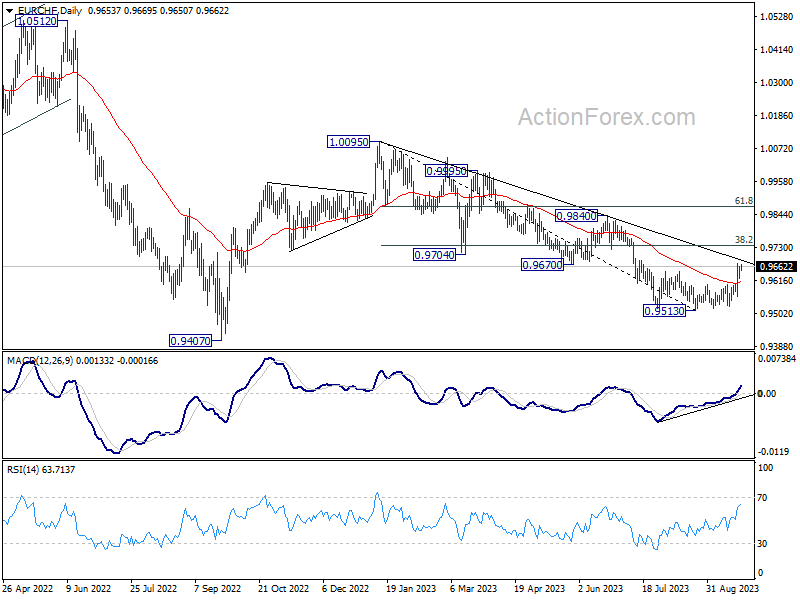
Intraday bias in EUR/CHF stays on the upside at this point. Rise from 0.9513 should continue to rally to 38.2% retracement of 1.0095 to 0.9513 at 0.9735. Sustained break there will target 61.8% retracement at 0.9873. On the downside, however, below 0.9602 minor support will dampen the bullish case and turn intraday bias neutral first.
In the bigger picture, medium term outlook will stay bearish as long as the cross is capped well below falling 55 W EMA (now at 0.9799). That is, down trend from 1.2004 (2018 high) could still resume through 0.9407 (2022 low). However, sustained trading above the 55 W EMA will raise the chance that 0.9470 is already a long term bottom. Further rise would then be seen to 1.0095 resistance to indicate bullish trend reversal.
EUR/USD Daily Outlook
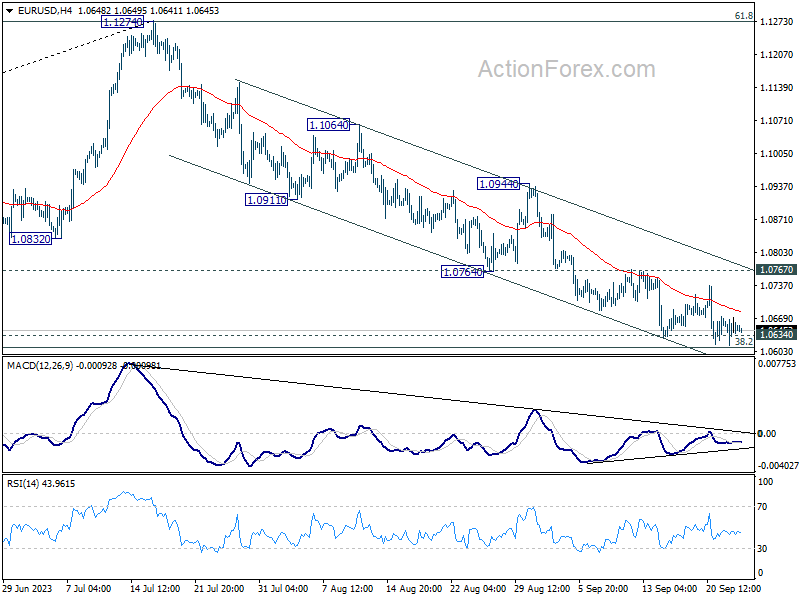
Daily Pivots: (S1) 1.0616; (P) 1.0644; (R1) 1.0673; More...
Intraday bias in EUR/USD remains neutral for the moment. On the downside, sustained break of 1.0609/34 cluster support will carry larger bearish implication. Fall from 1.1274 should then target 1.0515 support next. Nevertheless, strong rebound from current level, followed by break of 1.0767 resistance, should confirm short term bottoming. Intraday bias will be back on the upside for 1.0944 resistance.
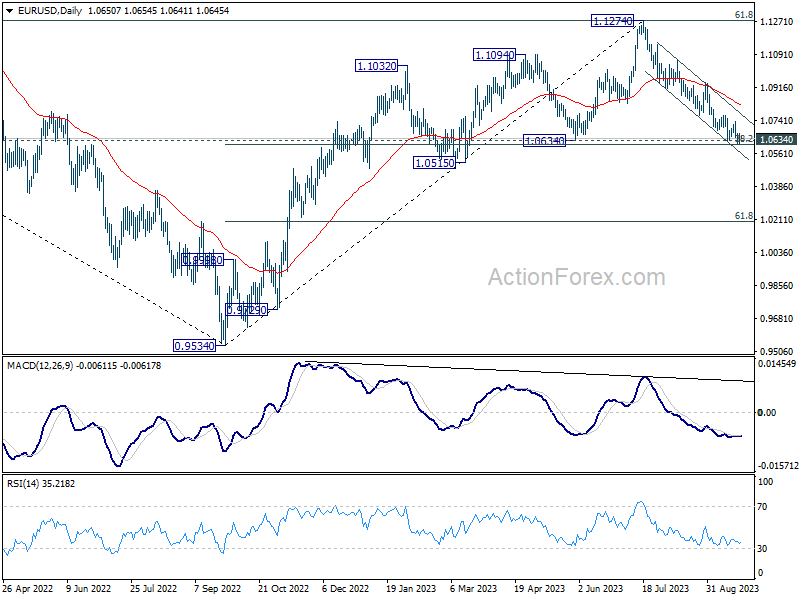
In the bigger picture, fall from 1.1274 medium term top is seen as a correction to up trend from 0.9534 (2022 low). Strong support could be seen from 1.0634 cluster support (38.2% retracement of 0.9534 to 1.1274 at 1.0609) to bring rebound, at least on first attempt. However, sustained break of 1.0609/0634 will raise the chance of bearish trend reversal, and target 61.8% retracement at 1.0199.
GBP/USD Daily Outlook
Daily Pivots: (S1) 1.2213; (P) 1.2257; (R1) 1.2284; More...
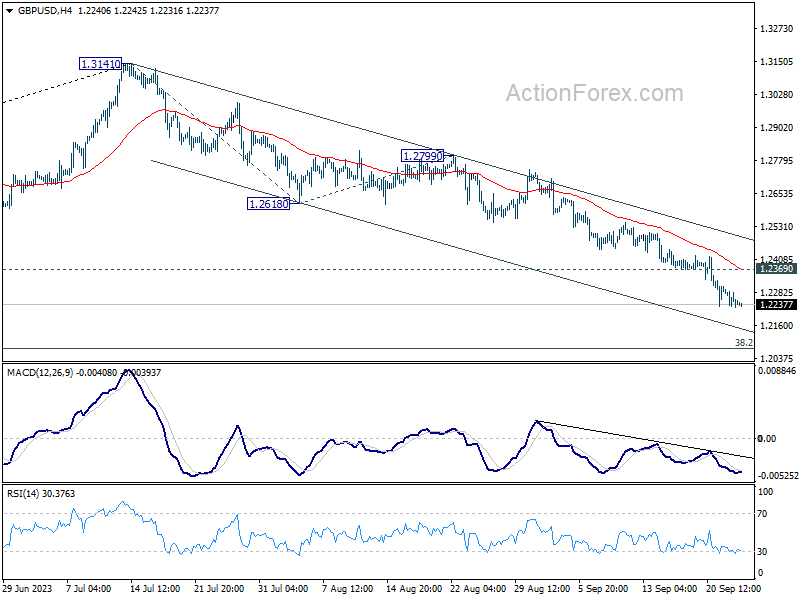
Intraday bias in GBP/USD remains on the downside for the moment. Current fall from 1.3141 is in progress for 1.2075 fibonacci level. On the upside, above 1.2369 minor resistance will turn intraday bias neutral and bring consolidations. But near term outlook will stay bearish as long as 1.2618 support turned resistance holds, in case of strong recovery.
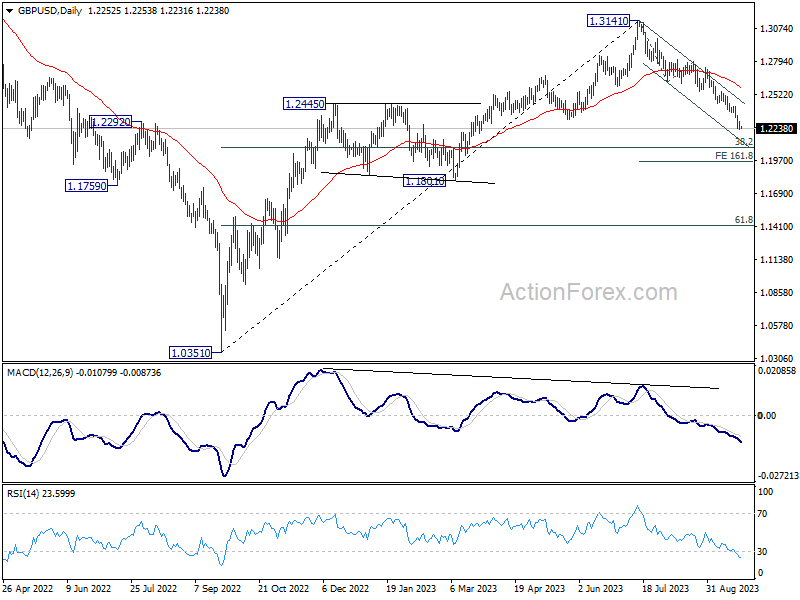
In the bigger picture, fall from 1.3141 medium term top is seen as a correction to up trend from 1.0351 (2022 low). Deeper decline would be seen to 38.2% retracement of 1.0351 to 1.3141 at 1.2075. Strong support would be seen there to bring rebound on first attempt. However, sustained break of 1.2075 will raise the chance of bearish trend reversal and target 1.1801 structural support next.
USD/JPY Daily Outlook
Daily Pivots: (S1) 147.77; (P) 148.10; (R1) 148.70; More...
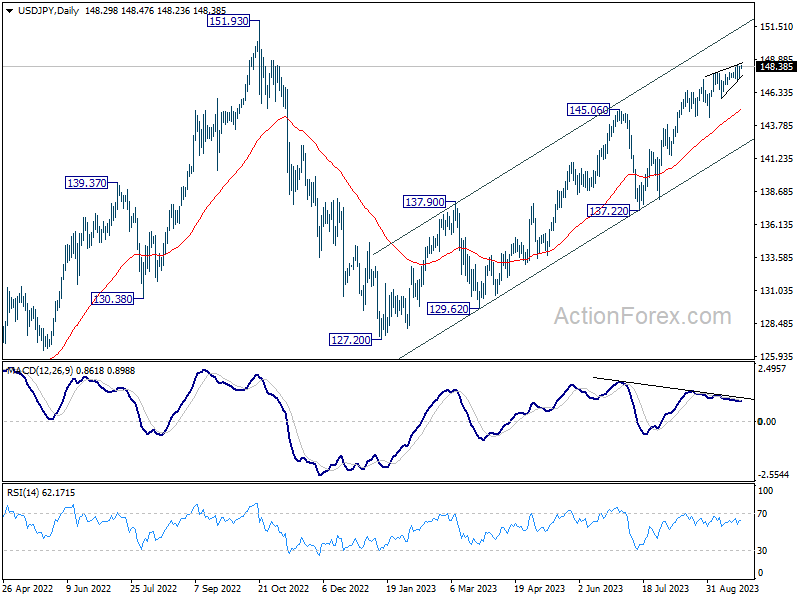
Intraday bias in USD/JPY is back on the upside a recent rally is trying to resume. Rise from 127.20 should target 151.93 high. However, firm break of 147.31 support will should confirm short term topping, and turn bias to the downside for 145.88 support and below.
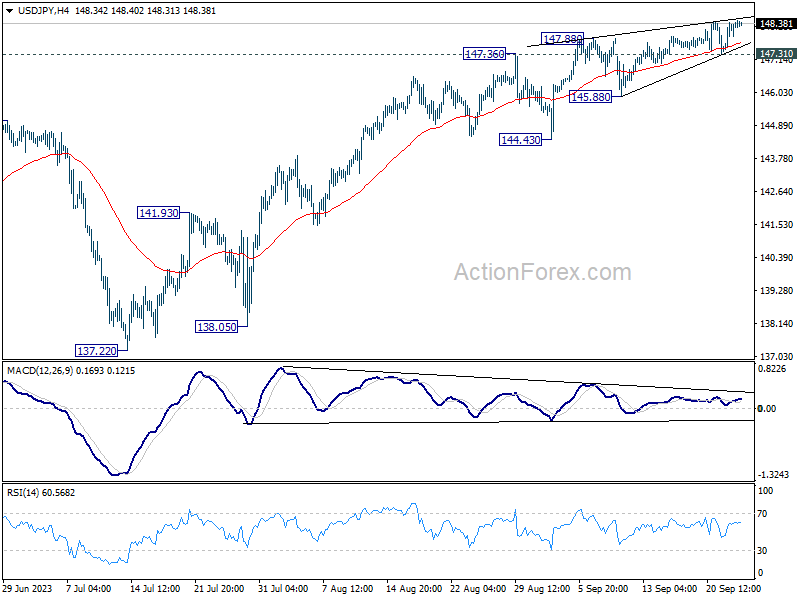
In the bigger picture, while rise from 127.20 is strong, it could still be seen as the second leg of the corrective pattern from 151.93 (2022 high). Rejection by 151.93, followed by break of 137.22 support will indicate that the third leg of the pattern has started. However, sustained break of 151.93 will confirm resumption of long term up trend.
USD/CHF Daily Outlook
Daily Pivots: (S1) 0.9044; (P) 0.9060; (R1) 0.9086; More....
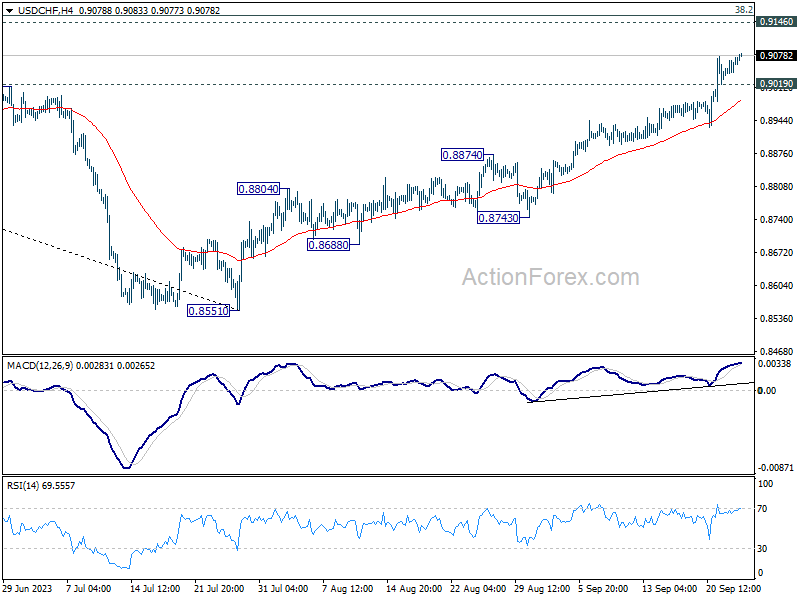
Intraday bias in USD/CHF remains on the upside for the moment. Current rise from 0.8551 is in progress for 0.9146/60 cluster resistance. On the downside, break of 0.9019 minor support will turn intraday bias neutral first. But further rally will remain in favor as long as 0.8874 resistance turned support holds, in case of retreat.
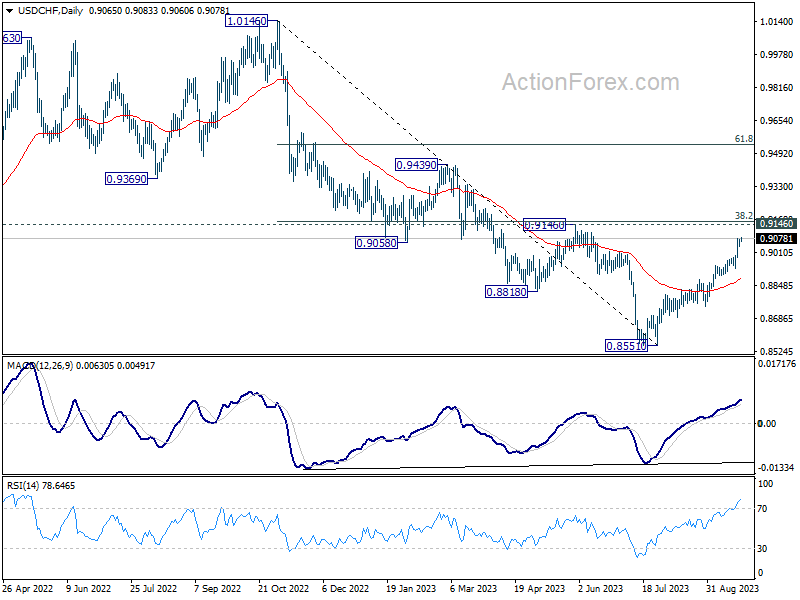
In the bigger picture, rebound from 0.8551 medium term bottom is currently seen as a correction to the downtrend from 1.0146 (2022 high). Further rally would be seen to 0.9146 cluster resistance (38.2% retracement of 1.0146 to 0.8551 at 0.9160). Strong resistance could be seen there to limit upside, at least on first attempt. However, decisive break of 0.9146/60 will indicate trend reversal, and target 61.8% retracement at 0.9537.
USD/CAD Daily Outlook
Daily Pivots: (S1) 1.3441; (P) 1.3466; (R1) 1.3509; More....
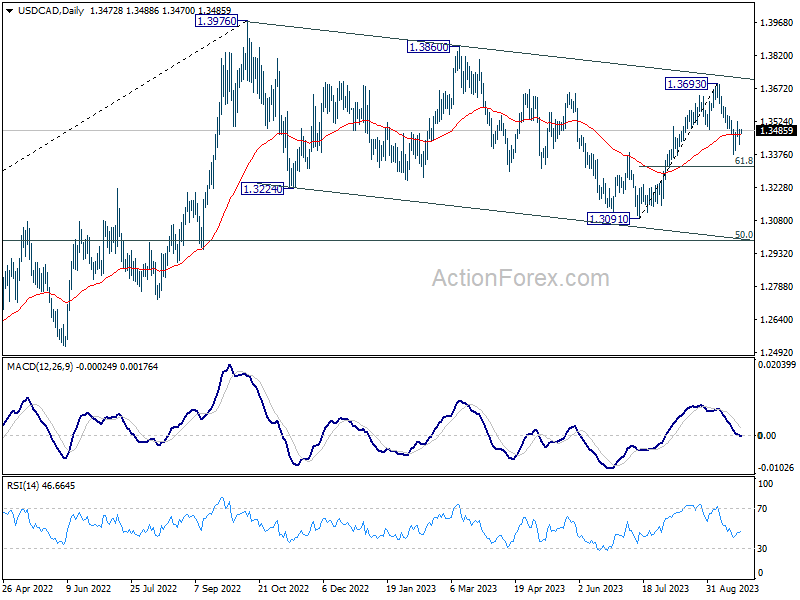
Intraday bias in USD/CAD remains neutral as consolidation from 1.3378 is extending. Risk will stay on the downside as long as 1.3548 resistance holds. Break of 1.3378 will resume the fall from 1.3693, as another leg in the corrective pattern from 1.3976 high, to 61.8% retracement of 1.3091 to 1.3693 at 1.3321.
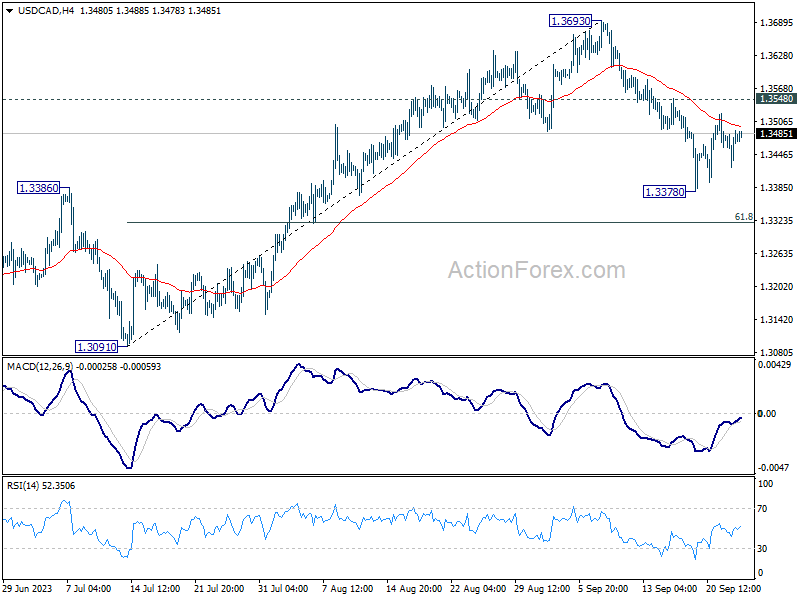
In the bigger picture, price actions from 1.3976 are viewed as a corrective pattern to the up trend from 1.2005 (2021 low). Deeper decline could be seen as the pattern is now extending. But downside should be contained by 50% retracement of 1.2005 to 1.3796 at 1.2991. Rise from 1.2005 is still expected to resume after the correction completes.
BoJ Ueda highlights shifting dynamics in Japan’s inflation drivers
BoJ Governor Kazuo Ueda, in a speech today, delineated the two forces in play regarding Japan's inflationary pressures: "The first force, led by import prices, has seen its year-on-year rate of increase decelerate," and he anticipates this force will "gradually wane."
As for the second force, Ueda suggested it is tied to changes in firms' wage and price-setting behaviors, with the potential to strengthen as "wage growth accelerates owing to economic improvement, leading to moderate inflation."
However, he cautioned that the spread and permanence of these behaviors are uncertain, adding, "Changes have started to be seen in some aspects of firms' wage- and price-setting behavior, but there are extremely high uncertainties as to whether these changes will become widespread."
Addressing Japan's broader economic outlook, Ueda described the nation as being in a "critical phase" concerning the interplay between wages and prices. Stressing the importance of fostering nascent economic shifts, he emphasized the need "to carefully nurture the buds of change in the economy."
Ueda reiterated BoJ's stance on monetary policy, stating the need "to patiently continue with monetary easing under the framework of yield curve control."
Euro-Dollar at Important Support
The week started on a cautious note as stocks in Asia mostly sold off following a rough week in the US, where the Federal Reserve’s (Fed) hawkish pause triggered a fresh wave of worries that the rates would stay higher for longer. The US 2-year yield bounced lower after hitting 5.20%, yet the US 10-year continues its journey higher and hit 4.50% on Friday. The S&P500 slipped below its ascending base since last October, fell below its 100-DMA, and closed the week at the lowest levels since June, having recorded the worst performance over the week since the banking crisis in March. BoFA said that equity investors are dumping stocks at the fastest level since last December, and Morgan Stanley warned that stocks are now ‘fragile’. Indeed! More fragile than the S&P500 are the rate sensitive technology stocks, and the small cap stocks. The growing divergence between the S&P500 and Russell 2000 index is also flashing ‘recession’, on top of the heavily inverted US yield curve.
Elsewhere, the UAW strikes will broaden to all GM and Stellantis parts plants in the US, which means that 5600 more workers will join the movement (Ford will likely be spared, for now, as some good progress is made on negotiations with the UAW) and the US will shut down by the end of the week if politicians fail to pass a dozen of bills. The latest US GDP update will fall in this chaotic environment, but the expectation is a positive revision from 2.1% to 2.3%.
In the currency markets, the US dollar extends gains. The dollar index entered the bullish consolidation zone after the Fed kept the possibility of another rate hike before the year ends on the table when it met last week, and said that the rates will likely stay higher for longer next year.
The EURUSD tested an important Fibonacci support last week, the major 38.2% retracement level which should distinguish between the positive trend building since last year, and a slide into the bearish consolidation zone. There is a stronger case for further euro weakness than the contrary. Released last Friday, the preliminary September PMI figures were mixed; the Eurozone manufacturing further slowed but German numbers hinted at some improvement. This week, we will see how the recent slowdown impacted the inflation dynamics in September. Headline inflation in the euro area is expected to have slowed from 5.2% to 4.5% this month, a slowdown that would defy the rising energy prices and the euro depreciation. Core inflation is seen softening from 5.3% to 4.8%. Any softness in inflation figures should give further support to the euro bears, while higher than expected numbers, which I believe could be the surprise of this week could revive the European Central Bank (ECB) hawks, but will hardly prevent the euro from seeking into a deeper depression, as further ECB action would also mean a bigger hit on economies. That’s a fear that will likely keep euro bulls away from the market for now.
On the corporate calendar, Micron Technology and Nike will be releasing their latest quarterly results, and TotalEnergies Investor Day Event will gather happy industry players as US crude consolidates gains above $91pb with no big sign of a significant downside correction.
Modest Movements in Global Market Monday Morning
Market movers today
This week starts off with thin calendar in terms of data releases. In Germany, we receive the Ifo indicator for September. The assessment of the current climate has declined continuously since March and it will likely tick lower again. Expectations have stabilised in recent months, and it will be interesting to see if they actually increase a bit, which is what consensus is looking for.
The 60 second overview
We have seen modest moves in the global bond and equity markets this morning. US Treasury yields rose very modestly from the long end of the curve. There have also been modest declines in the Asian equity markets this morning where the Chinese equity market is under pressure given the uncertainty surrounding the Chinese property market.
The main event today is the release of the German IFO indicator for September. We also get PPI from Finland and Spain and there are several ECB speeches from Villeroy, Schabel and Lagarde.
The main event this week will be the inflation data from US and Euroland released on Friday. A downside surprise will be supportive for the bond market as the market will again speculate in faster rate cuts than is currently priced in after last week's central bank meetings where especially the Federal Reserve indicated "higher for longer" and the market priced out rate cuts and Treasury yields rose. However, with 2Y yields higher than 5%, short-dated bonds look attractive from the outright perspective.
Equities: Global equities were lower on Friday and hence failed to recover the lost ground from Thursday. Hence last week equities were lower 5 out of 5 days and the higher for longer narrative was dominating. This picture was confirmed by the style rotation with value and Min Vol doing good and VIX creeping higher. Higher-for-longer was driven by central banks and not least the updated summary of economic projections from Fed members. Inflation numbers were benign last week and oil prices were lower. Higher-for-longer is not just a drag on the economy but is also leading to new discussions on the level of discounting factor and leading to long duration small caps underperforming. On Friday in the US, Dow -0.3%, S&P 500 -0.2%, Nasdaq -0.1% and Russell 2000 -0.3%. Asian markets are mixed this morning with Japan outperforming once again. European futures are lower while US futures are higher.
FI: Last week was busy with several central bank meetings. One common theme was "higher for longer" as rate cuts are not coming in as fast as previously expected especially in the US, and 10Y US Treasury yields have risen some 19bp during the week before declining 6bp on Friday. If the inflation data published on Friday surprises on the downside it should lead to a decline in yields and rates.
FX: After a hectic central bank week, EUR/USD consolidates around 1.0650 following the Fed-induced one-figure drop. GBP/USD continues its downward trajectory following the dovish surprise from BoE. The JPY remains under pressure after BoJ left ultra-easy monetary policy unchanged. Both SEK and NOK are modestly stronger vs EUR after the Riksbank's marginally dovish rate path was effectively balanced by the decision to start hedging the FX reserves and Norges Bank left a hawkish surprise in its rate trajectory. This week has a lot to offer as well including US and EA inflation numbers and interesting central bank speeches.
Credit: The credit markets ended the week on a marginally stronger footing with iTraxx main tightening 0.2bp to 77.3bp and Xover tightening 2.4bp to 416.7bp. We expect a revival of the primary markets in the coming weeks with the central bank rate decisions now out of the way and ahead of the black-out periods.
Nordic macro
This week, August data in the form of PPI, trade balance, household lending and retail sales will be released and the implications for Q3 GDP assessed. Selling price expectations will be in focus what concerns the September confidence survey. Riksbank's Jansson and Flodén will be talking about current monetary policy.