

Sample Category Title
EUR/USD Mid-Day Outlook
Daily Pivots: (S1) 1.0600; (P) 1.0676; (R1) 1.0720; More...
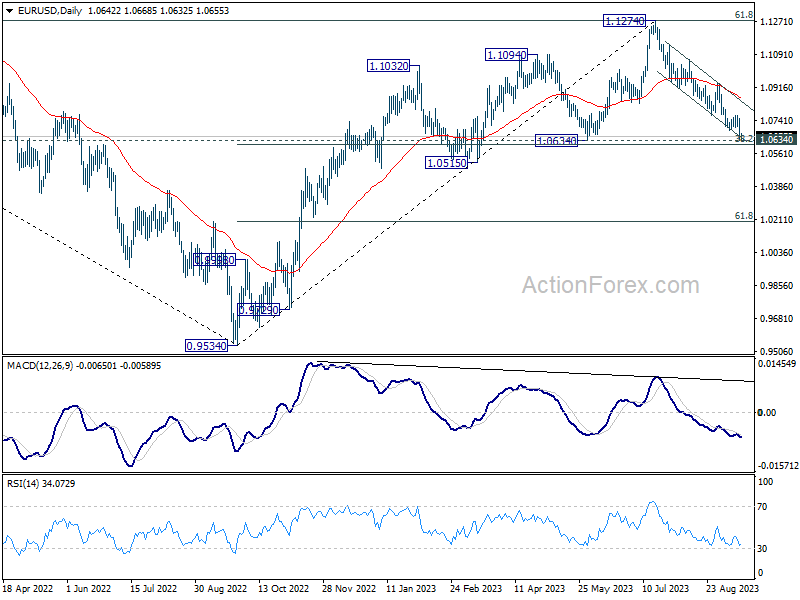
Intraday bias in EUR/USD is staying on the downside for the moment. Strong rebound from current level, followed by break of 1.0767 resistance, should confirm short term bottoming. Intraday bias will be back on the upside for 1.0944 resistance. However, sustained break of 1.0609/34 support zone will carry larger bearish implication, and target 1.0515 support next.
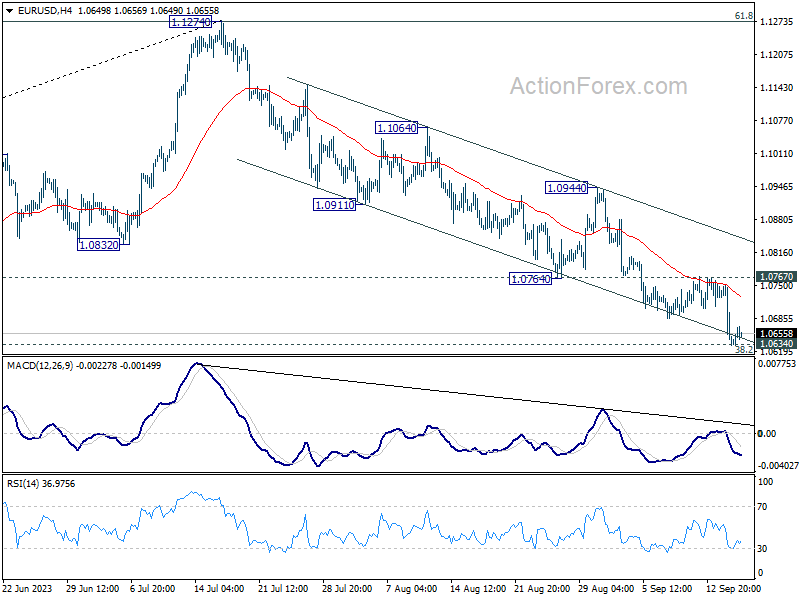
In the bigger picture, fall from 1.1274 medium term top is seen as a correction to up trend from 0.9534 (2022 low). Strong support could be seen from 1.0634 cluster support (38.2% retracement of 0.9534 to 1.1274 at 1.0609) to bring rebound, at least on first attempt. Break of 1.0944 will indicate the start of the second leg, and target retest of 1.1274. However, sustained break of 1.0609/0634 will raise the chance of bearish trend reversal, and target 61.8% retracement at 1.0199.
GBP/USD Mid-Day Outlook
Daily Pivots: (S1) 1.2369; (P) 1.2438; (R1) 1.2478; More...
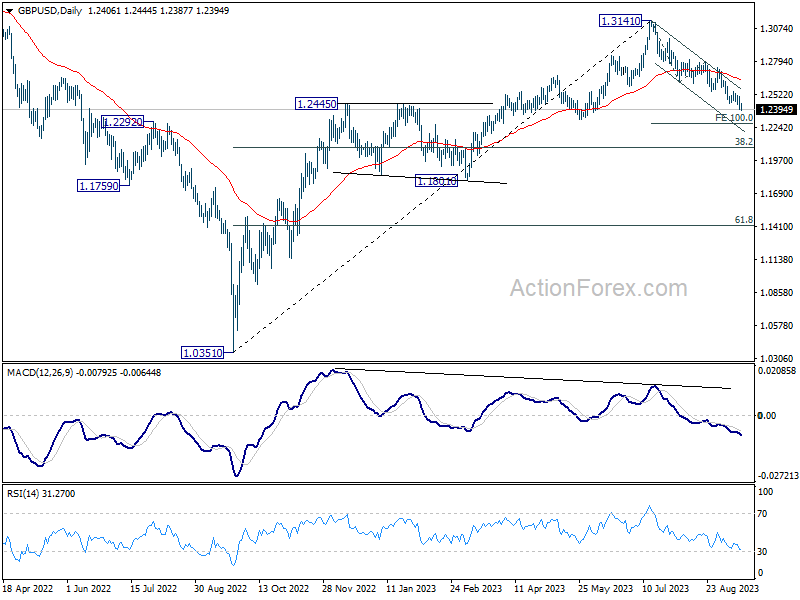
GBP/USD's decline continues today and intraday bias stays on the downside. Current fall from 1.3141 should target 100% projection of 1.3141 to 1.2618 from 1.2799 at 1.2276. On the upside, however, firm break of 1.2547 resistance will now indicate short term bottoming, and bring stronger rebound.
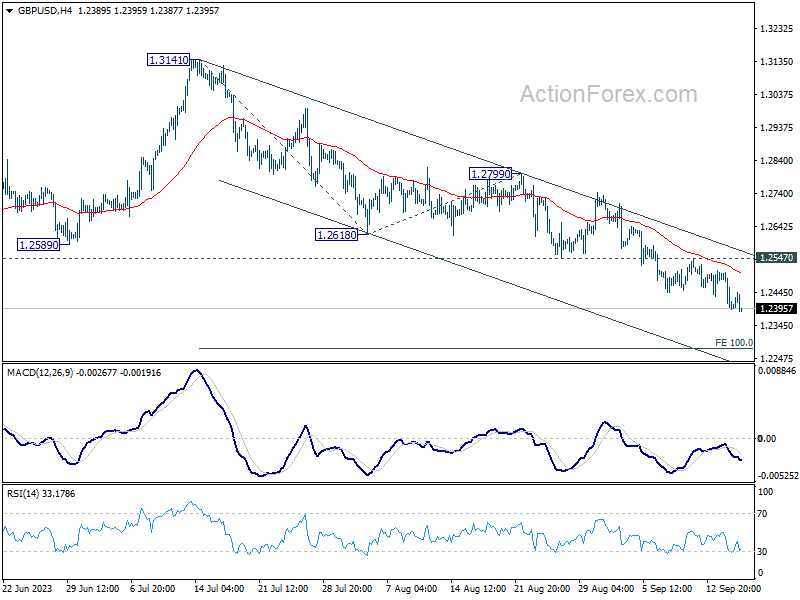
In the bigger picture, fall from 1.3141 medium term top is seen as a correction to up trend from 1.0351 (2022 low). Deeper decline would be seen to 38.2% retracement of 1.0351 to 1.3141 at 1.2075. Strong support would be seen there to bring rebound on first attempt. But outlook will be neutral at best as long as 1.3141 resistance holds, and consolidation from there is set to extend, until further development.
USD/CHF Mid-Day Outlook
Daily Pivots: (S1) 0.8924; (P) 0.8948; (R1) 0.8980; More....
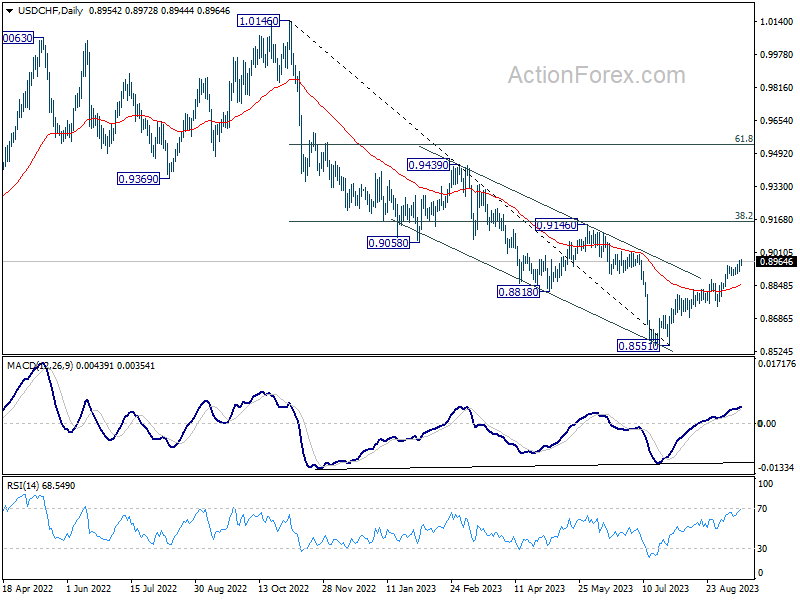
USD/CHF's rally from 0.8551 continues today and intraday bias stays on the upside. Further rise should be seen to 0.9146 cluster resistance. On the downside, though, break of 0.8893 support will indicate short term topping, and turn bias to the downside for deeper pullback.
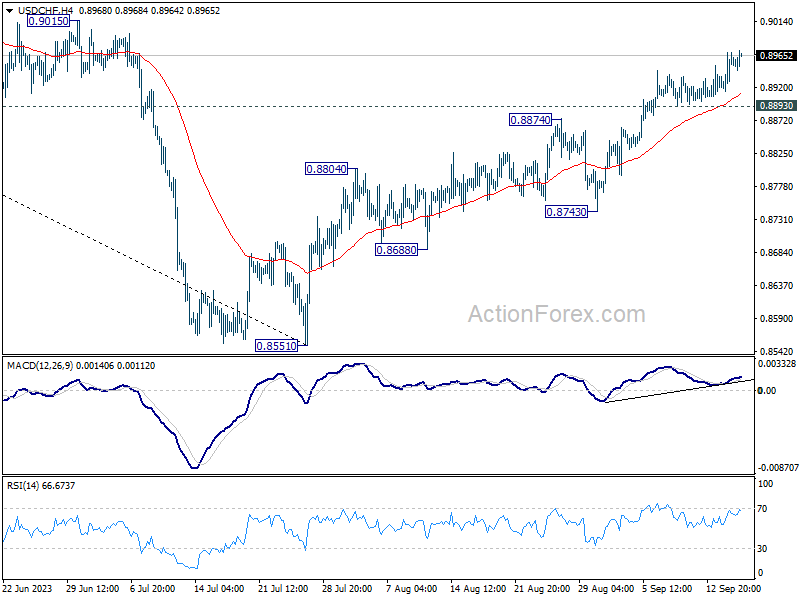
In the bigger picture, rebound from 0.8551 medium term bottom is currently seen as a correction to the downtrend from 1.0146 (2022 high). Further rally would be seen to 0.9146 cluster resistance (38.2% retracement of 1.0146 to 0.8551 at 0.9160). Strong resistance could be seen there to limit upside, at least on first attempt.
USD/JPY Mid-Day Outlook
Daily Pivots: (S1) 147.14; (P) 147.35; (R1) 147.69; More...
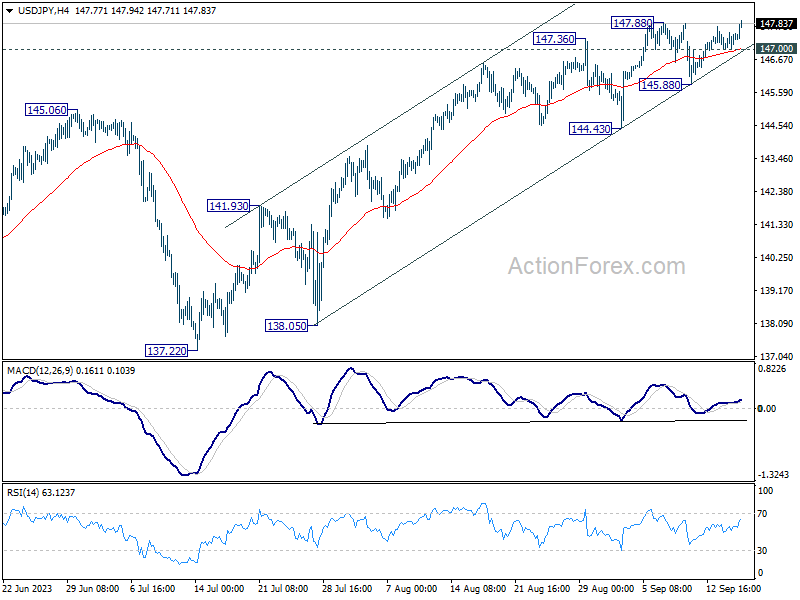
USD/JPY's breach of 147.88 resistance argues that rise from 127.20 is resuming. Intraday bias is back on the upside. Sustained trading above 147.88 will pave the way to retest 151.93 high. On the downside, below 147.00 minor support will turn intraday bias neutral again first. But outlook will remain bullish as long as 145.88 support holds.
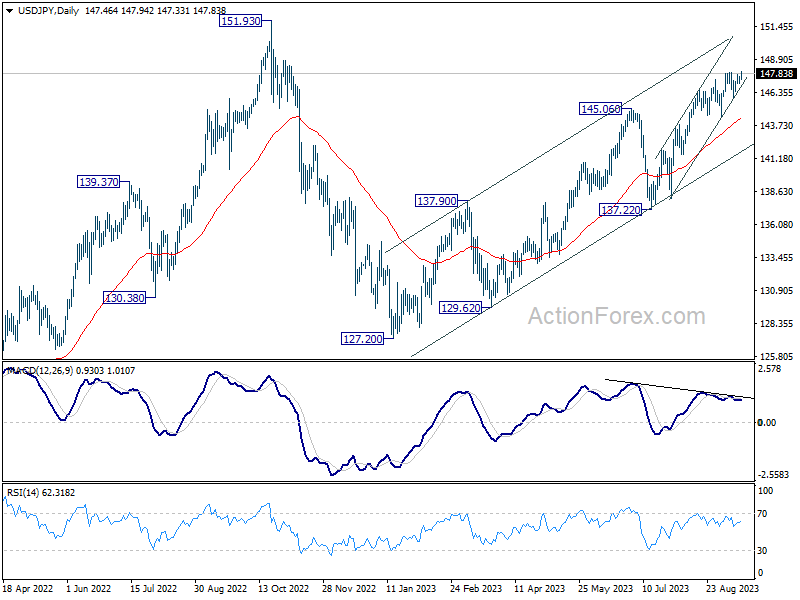
In the bigger picture, while rise from 127.20 is strong, it could still be seen as the second leg of the corrective pattern from 151.93 (2022 high). Rejection by 151.93, followed by break of 137.22 support will indicate that the third leg of the pattern has started. However, sustained break of 151.93 will confirm resumption of long term up trend.
Yen Hits Year Low on Yields, Euro Shows Signs of Stabilization
Japanese Yen registered notable slump today, recording a new low for the year against Dollar, a move driven largely by ascending benchmark yields in the US and European markets. Meanwhile, sentiment in risk markets appears to be on the upswing, partly propelled by encouraging economic data emerging from China, fostering an environment where commodity currencies are experiencing a lift, with Australian Dollar taking the forefront.
Euro, on the other hand, managed to slow its descent, buoyed by remarks from ECB officials who sought to downplay the prospects of rate cuts in the coming year. The comments stimulated a recovery in Euro, particularly against Sterling and Swiss franc. While Dollar is making efforts to strengthen up, traders remain cautious, seemingly unwilling to stake large bets ahead of Fed's rate decisions slated for next week.
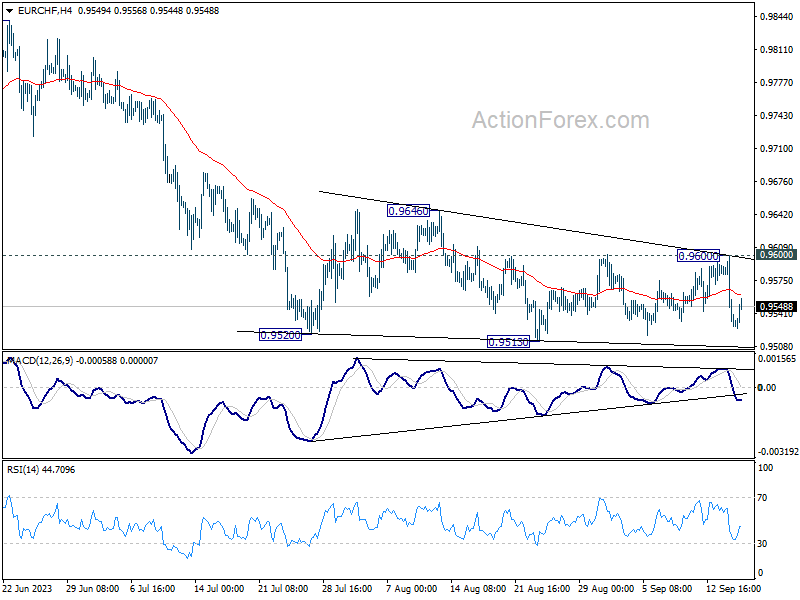
Technically, EUR/CHF recovered well ahead of 0.9513 low, and the developments argues that post-ECB selling might have past its climax. Nevertheless, outlook will stay bearish as long as 0.9600 resistance holds. Break of 0.9513 is in favor sooner or later to resume larger decline from 1.0095.
In Europe, at the time of writing, FTSE is up 0.68%. DAX is up 0.91%. CAC is up 1.43%. Germany 10-year yield is up 0.0649 at 2.661. Earlier in Asia, Nikkei rose 1.10%. Hong Kong HSI rose 0.75%. China Shanghai SSE dropped -0.28%. Singapore Strait Times rose 0.96%. Japan 10-year JGB yield rose 0.0013 to 0.710.
ECB officials dismiss predictions of early rate cuts
In a chorus of comments, ECB officias pushed back on market expectations on a rate cut next year.
During a press conference today, ECB President Christine Lagarde emphasized, "We have not decided, discussed or even pronounced cuts." She underlined that the institution's strategy will pivot according to incoming economic data and highlighted that the levels and duration of the existing high rates are designed to foster a return to the inflation target of 2%. The focus is on evolving economic indicators, reviewed in a meeting-by-meeting approach, hinting at the bank's readiness to adapt in the face of changing economic contexts.
Supporting Lagarde's stance, ECB Vice President Luis de Guindos conveyed skepticism regarding market pricing that forecast a rate cut in June 2024. Speaking to Spanish radio station Cadena Cope, de Guindos mentioned that the markets often rely on speculative "hypotheses that sometimes do not come true." He viewed such forecasts as gambles, affirming that they might not materialize. "It is a bet, it may be right and it may not be right," De Guindos added, underlining the uncertain nature of market forecasts.
Martins Kazaks, a member of ECB's Governing Council, expressed comfort with the current rate levels, showing optimism regarding achieving the 2% inflation goal by the second half of 2025. He maintained that the bank remains open to the possibility of another rate increase if substantiated by forthcoming data.
Kazaks was assertive in dismissing speculations about a rate cut in April, stating such conjectures are "inconsistent with our macro scenario." He reiterated the bank's firm stance to "stay in restrictive territory for as long as necessary to get inflation to 2%."
UK public anticipates elevated inflation and ascending interest rates, BoE Survey Reveals
Bank of England/Ipsos Inflation Attitudes Survey for August has shed light on how the public perceives inflation trends and the likely moves by the central bank.
Interestingly, public's perception of current inflation rate seems to have moderated, with a median estimate of 8.6%. This is a full percentage point decline from 9.6% recorded in May. This suggests that the public may feel the worst of inflationary surge has passed.
However, expectations for inflation over the short to medium term are slightly more elevated. The median expectation for inflation over the next year stood at 3.6%, a modest uptick from 3.5% three months ago. Looking a bit further out, the 12-month period after next, expectations rose to 2.8% from 2.6% in the prior survey.
Regarding BoE's policy path, a significant 63% anticipate interest rate hike over the next year, marking an increase from 57% in May. Meanwhile, those expecting rates to remain stable accounted for 19%, a slight decrease from prior reading of 20%.
Eurozone goods expects down -2.7 yoy, imports fell -18.2% yoy
Eurozone exports of goods to the rest of the world dropped -2.7% yoy to EUR 227.8B in Jul. Imports fell -18.2% yoy to EUR 221.3B. Eurozone recorded EUR 6.5B trade surplus. Intra-Eurozone trade fell -7.9% yoy to EUR 211.8B.
In seasonally adjusted term, exports fell -1.7% mom to EUR 232.6B. Imports rose 0.7% mom to EUR 229.7B. Trade surplus narrowed from EUR 8.6B to EUR 2.9B, smaller than expectation of EUR 13.5B. Intra-Eurozone trade fell slightly from EUR 219.3B to EUR 218.7B.
NZ BNZ PMI falls to 46.1, manufacturing activity slumps to multi-year low
New Zealand's manufacturing sector experienced a further slowdown in August, with BusinessNZ Performance of Manufacturing Index falling slightly from 46.6 in July to 46.1. This marks the lowest rate of activity for a non-pandemic affected month since June 2009. Furthermore, the latest PMI data sits significantly below its long-term average of 52.9.
A closer look at the August data reveals: Production observed a modest increase, moving from 43.1 to 43.9. Employment metrics improved, rising from 44.8 to 47.7. New orders experienced a minor uptick, growing from 45.5 to 46.6. Finished stock levels retreated slightly from 52.7 to 52.1. Deliveries, however, showed more promise, escalating from 42.9 to 47.7.
Despite the grim headline figure, it is noteworthy that there was a slight decrease in the proportion of negative comments, standing at 66.7%, a marginal relief compared to July's 72%. However, the level of pessimism mirrored that of May, maintaining the same rate of 66.7%. The pervasive market uncertainty stemming both from domestic and offshore influences, coupled with rising costs and weather-impacted demand, continued to be highlighted as primary drivers for the negative sentiment pervading the industry.
BNZ Senior Economist Craig Ebert expressed concern over the PMI's latest results, noting that while the headline figure had seen much lower points during previous recessions, the composition of August figures brought little consolation. Ebert pinpointed new orders and production as substantial drags on the performance, trailing behind the standard levels by 8.0 and 9.5 points respectively.
China's Economic Data Surpasses Forecasts, but Challenges Persist
China's economic indicators for August showcased a mixed picture but, on the whole, exceeded analyst expectations in key areas. Industrial production exhibited growth of 4.5% yoy, edging out forecast of 4.0% yoy. Retail sales also outperformed predictions, registering 4.6% yoy increase compared to anticipated 3.0% yoy. However, fixed asset investment lagged slightly, presenting a 3.2% rise year-to-date year-on-year, just shy of the 3.3% expected.
The official communique from the NBS acknowledged the data as revealing a "marginal improvement." Emphasizing the resilience and progress of the national economy, the statement underscored that "high-quality development" was on track and the accumulation of positive factors was evident. However, it also stressed caution. While the recovery is in motion, the bureau pointed out that there are still several "unstable and uncertain factors in the external environment" that China has to contend with.
USD/JPY Mid-Day Outlook
Daily Pivots: (S1) 147.14; (P) 147.35; (R1) 147.69; More...
USD/JPY's breach of 147.88 resistance argues that rise from 127.20 is resuming. Intraday bias is back on the upside. Sustained trading above 147.88 will pave the way to retest 151.93 high. On the downside, below 147.00 minor support will turn intraday bias neutral again first. But outlook will remain bullish as long as 145.88 support holds.
In the bigger picture, while rise from 127.20 is strong, it could still be seen as the second leg of the corrective pattern from 151.93 (2022 high). Rejection by 151.93, followed by break of 137.22 support will indicate that the third leg of the pattern has started. However, sustained break of 151.93 will confirm resumption of long term up trend.
Economic Indicators Update
| GMT | Ccy | Events | Actual | Forecast | Previous | Revised |
|---|---|---|---|---|---|---|
| 22:30 | NZD | Business NZ PMI Aug | 46.1 | 46.3 | 46.6 | |
| 02:00 | CNY | Industrial Production Y/Y Aug | 4.50% | 4.00% | 3.70% | |
| 02:00 | CNY | Fixed Asset Investment YTD Y/Y Aug | 3.20% | 3.30% | 3.40% | |
| 02:00 | CNY | Retail Sales Y/Y Aug | 4.60% | 3.00% | 2.50% | |
| 04:30 | JPY | Tertiary Industry Index M/M Jul | 0.90% | 0.20% | -0.40% | -0.70% |
| 08:30 | GBP | Consumer Inflation Expectations | 3.60% | 3.50% | ||
| 09:00 | EUR | Eurozone Trade Balance (EUR) Jul | 2.9B | 13.5B | 12.5B | 8.6B |
| 12:30 | CAD | Manufacturing Sales M/M Jul | 1.60% | 0.70% | -1.70% | |
| 12:30 | USD | Empire State Manufacturing Sep | 1.9 | -10 | -19 | |
| 12:30 | USD | Import Price Index M/M Aug | 0.50% | 0.30% | 0.40% | |
| 13:15 | USD | Industrial Production M/M Aug | 0.20% | 1.00% | ||
| 13:15 | USD | Capacity Utilization Aug | 79.30% | 79.30% | ||
| 14:00 | USD | Michigan Consumer Sentiment Index Sep P | 69.5 | 69.5 |
ECB officials dismiss predictions of early rate cuts
In a chorus of comments, ECB officias pushed back on market expectations on a rate cut next year.
During a press conference today, ECB President Christine Lagarde emphasized, "We have not decided, discussed or even pronounced cuts." She underlined that the institution's strategy will pivot according to incoming economic data and highlighted that the levels and duration of the existing high rates are designed to foster a return to the inflation target of 2%. The focus is on evolving economic indicators, reviewed in a meeting-by-meeting approach, hinting at the bank's readiness to adapt in the face of changing economic contexts.
Supporting Lagarde's stance, ECB Vice President Luis de Guindos conveyed skepticism regarding market pricing that forecast a rate cut in June 2024. Speaking to Spanish radio station Cadena Cope, de Guindos mentioned that the markets often rely on speculative "hypotheses that sometimes do not come true." He viewed such forecasts as gambles, affirming that they might not materialize. "It is a bet, it may be right and it may not be right," De Guindos added, underlining the uncertain nature of market forecasts.
Martins Kazaks, a member of ECB's Governing Council, expressed comfort with the current rate levels, showing optimism regarding achieving the 2% inflation goal by the second half of 2025. He maintained that the bank remains open to the possibility of another rate increase if substantiated by forthcoming data.
Kazaks was assertive in dismissing speculations about a rate cut in April, stating such conjectures are "inconsistent with our macro scenario." He reiterated the bank's firm stance to "stay in restrictive territory for as long as necessary to get inflation to 2%."
USD/JPY: Bulls Look for Retest of 2023 Peak
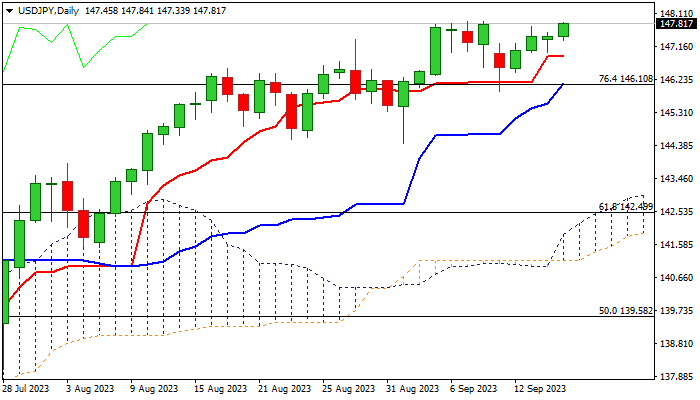
Bulls regained control and are on track to fully retrace a pullback sparked by comments of BoJ Governor Ueda about possible change in monetary policy.
Positive impact on yen was short-lived as dollar remains well supported despite threats of Japan’s intervention.
Firmly bullish daily techs underpin the action which looks for the fourth consecutive weekly close above broken Fibo level at 146.10 (76.4% of 151.94/127.22), now acting as solid support and keeping the downside protected.
Break of last Friday’s high at 147.87 (2023 peak) to reinforce bullish structure for possible attack at psychological 150 barrier.
First support at 146.88 (daily Tenkan-sen should ideally contain and guard key 146.10 level (reinforced by daily Kijun-sen), loss of which put larger bulls on hold.
Res: 148.00; 148.59; 148.84; 149.70.
Sup: 147.34; 146.88; 146.43; 146.10.
AUD/USD Extends Gains on Strong Chinese Data
- Chinese industrial production, retail sales accelerate
- AUD/USD posts slight gains
- US to release manufacturing, consumer confidence data on Friday
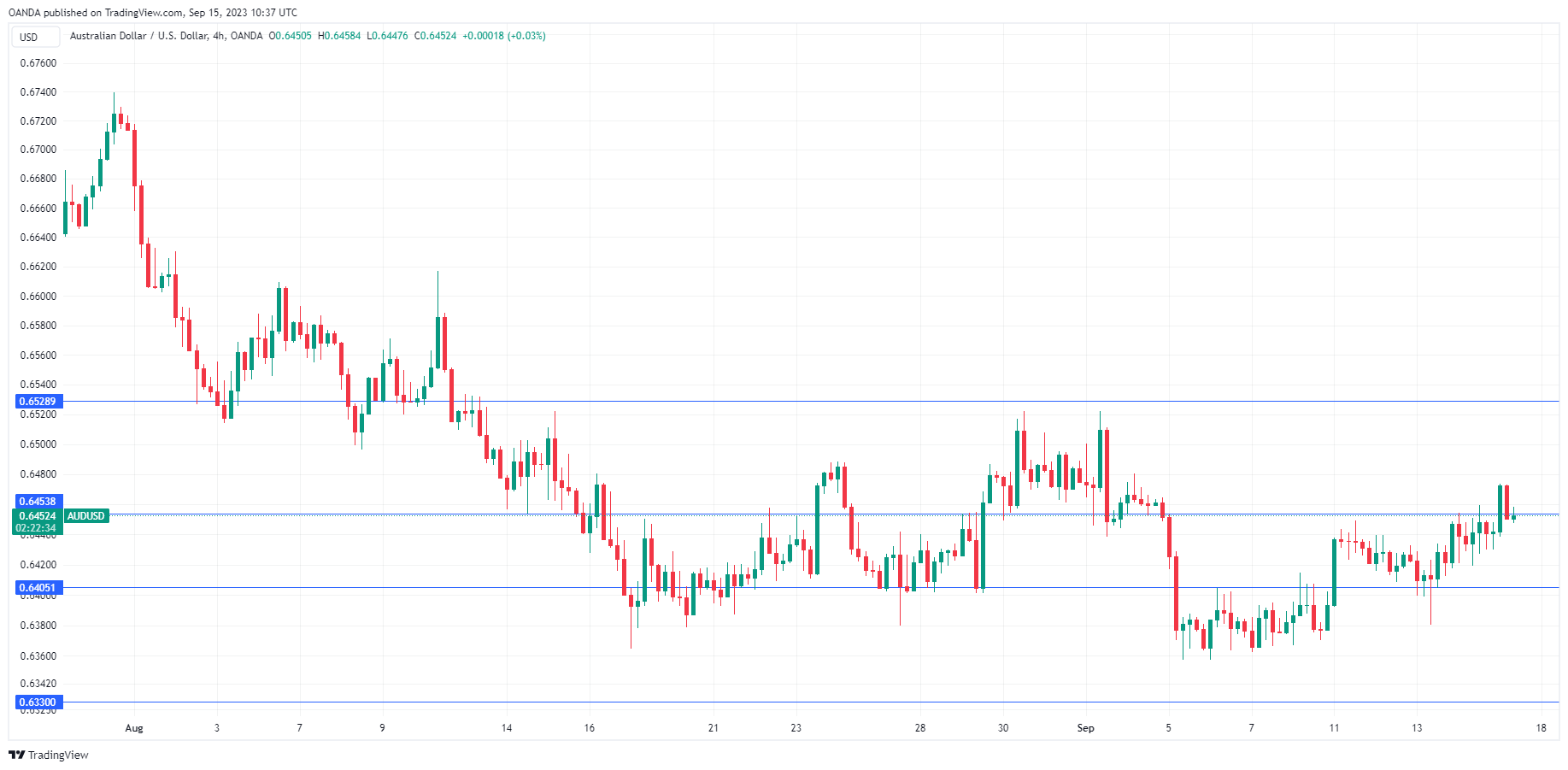
The Australian dollar has edged higher on Friday. In the European session, AUD/USD is trading at 0.6452, up 0.18%. Earlier, AUD/USD touched a high of 0.6473, its highest level since September 4th.
Chinese data beats expectations
China posted better-than-expected numbers on Thursday, raising hopes that the world’s number two economy might be finding its footing. Industrial production climbed 4.5% y/y in August, up from 3.7% in July and beating the consensus estimate of 3.9%. This was the strongest growth since April. There was more positive news as retail sales rose 4.6% y/y in August, up sharply from 2.5% in July and above the market consensus of 3.0%.
The solid data follows recent stimulus measures from the government after a host of economic data pointed to a sharp deterioration in economic growth. The central bank has cut benchmark rates such as the one-year loan prime rate and has reduced the reserve requirement ratio for all banks, which means that banks can keep less cash on hand.
These stimulus measures, while welcome, are unlikely to resolve the property sector crisis. Moody’s lowered its outlook for the property sector from stable to negative, in response to the brewing crisis which has engulfed two of the country’s largest private property developers. The Evergrande Group recently defaulted and Country Garden Holdings is trying to avoid a default.
Economic developments in China tend to have a significant impact on the Australian economy and the Australian dollar, as China is Australia’s largest trading partner. China’s slowdown has weighed heavily on the Aussie’s poor performance, as AUD/USD plunged 3.48% in August. If China’s downturn continues, we can expect the Australian dollar to lose ground.
In the US, there are two key events on the data calendar, which could trigger some volatility from the US dollar in the North American session. The Empire State Manufacturing Index, which plunged to -19 in August, is expected to improve to -10 points. UoM Consumer Sentiment is expected to dip to 69.1, down from 69.5 and inflation expectations are projected to remain unchanged at 3.5%.
AUD/USD Technical
- AUD/USD continues to test resistance at 0.6453. The next resistance line is 0.6528
- 0.6405 and 0.6330 are providing support
Can the Chinese Economy Recover?
Amid concerns of a Chinese economic slowdown, reports of declining investment often overlook China's efficient investment strategy in emerging sectors for long-term growth. China has taken measures to stabilize foreign and private sector investments, like reducing the reserve requirement ratio to boost investor confidence. While China's fixed-asset and private-sector investments have shown some decline, there is robust investment activity in key areas. Foreign investments increasingly focus on high-tech sectors, aligning with China's emphasis on emerging industries. China's investment strategy prioritizes quality and reasonable growth over quantity expansion, with policies supporting this approach.
USDCNH - D1 Timeframe
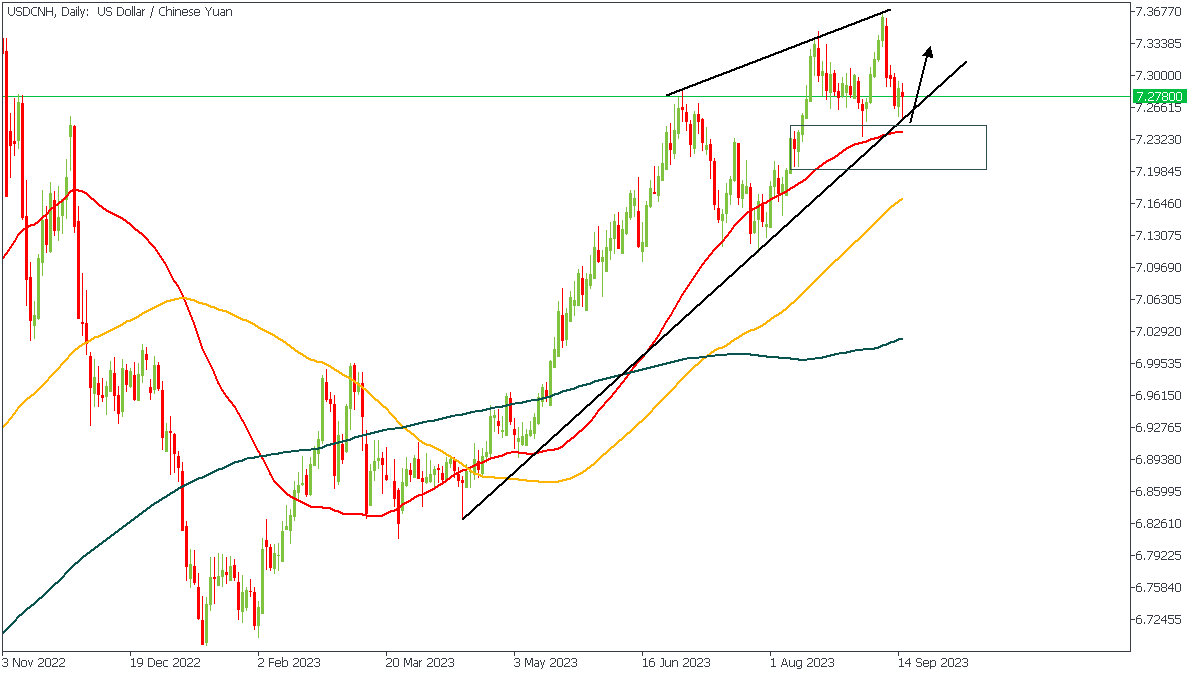
The Daily timeframe of USDCNH, as seen in the chart, shows that the price has reacted initially from the support trendline of the wedge pattern and may very well be continuing its bullish rally from here. Considering the presence of the 50-day moving average as an additional support, the rally-base-rally demand zone, and the bullish array of the moving averages, I am quite optimistic about a bullish sentiment.
Analyst’s Expectations:
- Direction: Bullish
- Target: 7.33086
- Invalidation: 7.21807
HK50 - D1 Timeframe
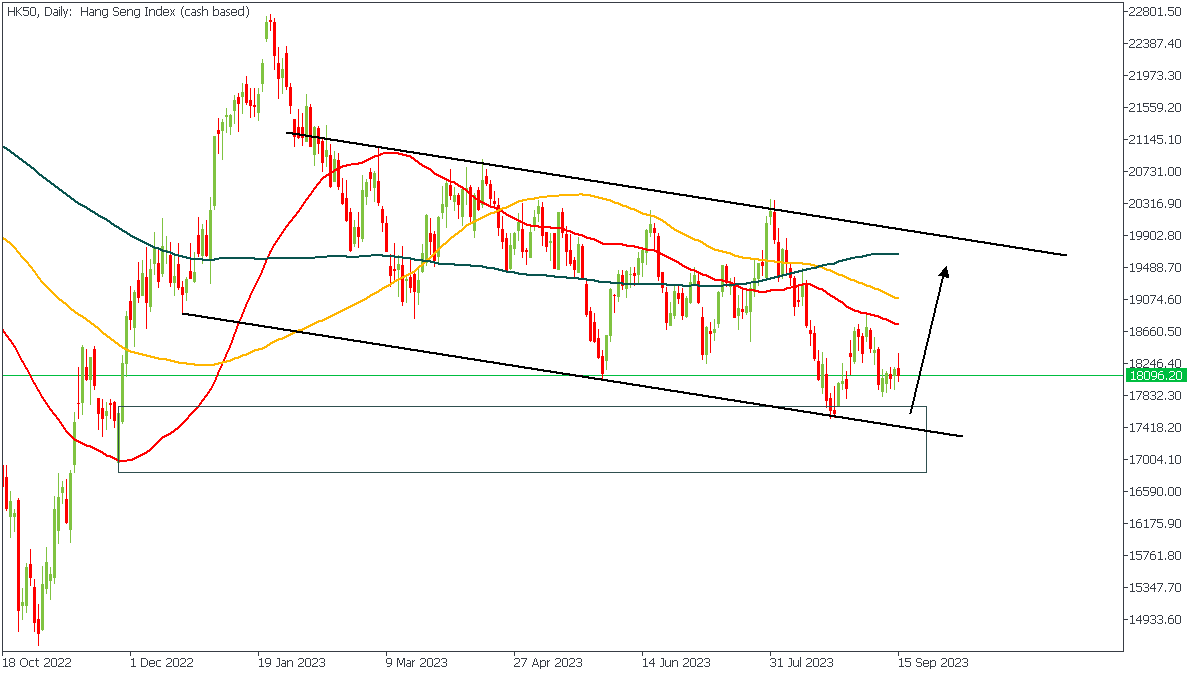
HK50 as seen in the chart image seems to be trading inside a descending channel, with the most recent move being a touch of the trendline support. The trendline also overlaps with a drop-base-rally demand zone, which serves as a further confluence for bullish sentiment.
Analyst’s Expectations:
- Direction: Bullish
- Target: 18595.26
- Invalidation: 17494.04
CONCLUSION
The trading of CFDs comes at a risk. Thus, to succeed, you have to manage risks properly. To avoid costly mistakes while you look to trade these opportunities, be sure to do your due diligence and manage your risk appropriately.
Yuan Retreats from Multi-year Highs on Strong Economic Data
The US dollar index hit its highest level since early March this week, but the yuan is one of the few currencies to rise against the USD over the period.
This was facilitated, among other things, by strong economic data published today:
→ Industrial production growth in August amounted to +4.5% in annual terms (expected +3.9). This is the strongest progress in 1 month since autumn 2022.
→ Retail sales in August increased by 4.6% year on year (expected +3.0%).
The chart shows that after a multi-year high (B) of about USD 7.36 per yuan set on September 8, the rate has retreated sharply. That is, sales of dollars (B→C) for yuan increased. And the sharp increase in A→B is completely leveled out. This is a bearish sign, indicating that the bulls have completely retreated.
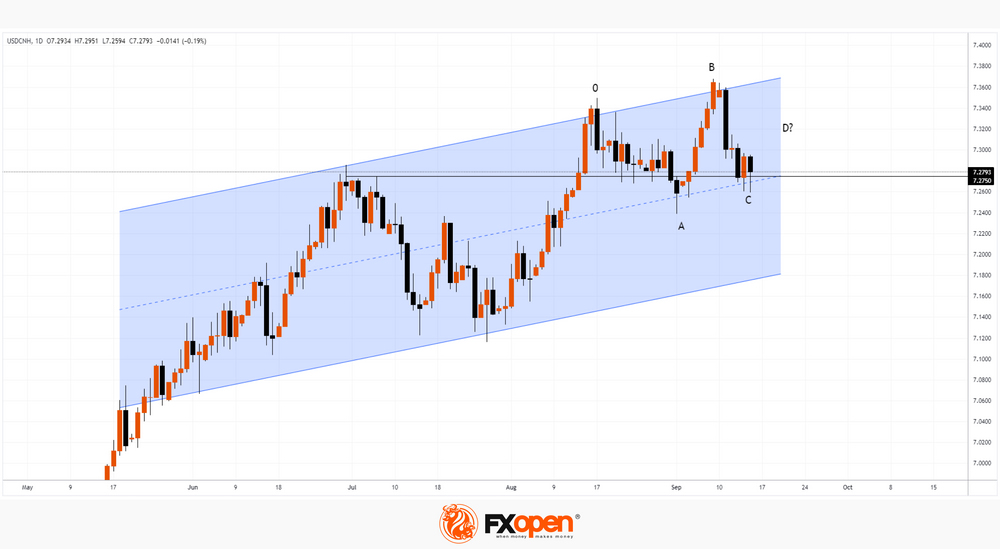
Now the price is near the median line of the channel. Here one can expect support, which is also strengthened by the level of 7.275, which previously served as resistance.
Let’s say that if a rebound C→D occurs (its probability is indicated by the long lower shadows on the candles on September 14-15), then by its dynamics it will be possible to judge the sustainability of the initiative that the bears have taken. If the rebound is 50% of the momentum (B→C), this will confirm the change in sentiment to bearish, and then we can expect that sellers will be able to put pressure on the rate so that it will decline to the lower border of the channel.
And then the picture will be even more bearish, because a head-and-shoulders pattern will form on the chart along the 0-B-D vertices. Provided the positive news background regarding the Chinese economy continues, we will be able to witness the formation of a stable bearish trend in favor of the yuan.