

Sample Category Title
ECB Review: Confirmed – A Final Rate Hike, But Restrictive Policies Not Over
- Today, the ECB delivered a 25bp rate hike and indicated that it is now on pause, which is fully in line with our expectation.
- ECB still expects inflation will 'remain too high for too long', but it now wants to work with the 'patience' argument more than the 'level' argument for additional hikes, i.e. see the lagged effect of the monetary policy tightening already implemented impact the inflation outlook.
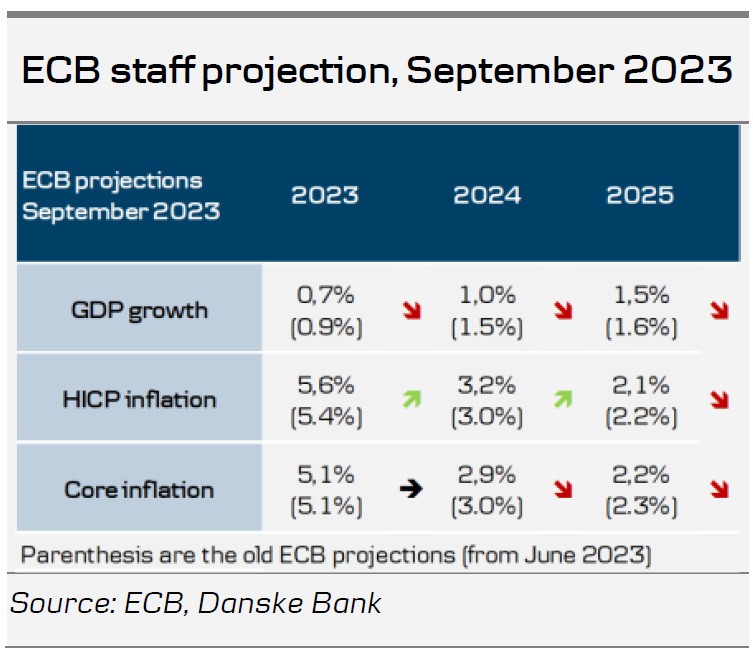
- The ECB's staff inflation projection was revised higher for 2023 and 2024 but lower for 2025. For core inflation, the projection is now slightly lower across the board.
- We recommend to pay the December 2023 ECB meeting.
No additional ECB hikes
Today, the ECB announced that all three policy rates will be hiked by 25bp (effective from 20 September) and guided that it will not make any more hikes for now. In our view, the monetary policy statement can best be described as a balancing act in a stagflationary-ish environment. The ECB's clear message to markets is that inflation is still too strong, but economic activity and the outlook are weaker. As a result, today's decision should be seen as a compromise in the governing council. During the Q&A session, president Lagarde also said that today's hike was taken on the back of a 'solid majority' as 'some' members favoured a pause to see how the monetary policy decisions already taken so far are working through the economy.
It was somewhat surprising to us that the ECB didn't include much optionality for additional rate hikes, should the incoming data warrant it. The guidance provided was clear the ECB is on pause for now as it weighs the weakening economic outlook and its impact on inflation. As usual, Lagarde also highlighted that the three key elements still prevail in their reaction function: monetary policy transmission, inflation outlook and the economic and financial data. As such, given the current information, the ECB is done with further hikes, but should economic acitivity hold up better than anticipated or inflation see another rise near term, the ECB is ready to adjust its policy rate. Overall, we see the ECB's monetary policy-setting approach focusing on the 'patience' argument and not the 'level' one.
During the Q&A session, Lagarde also said that the transmission channel is working faster in the current hiking cycle than in previous hiking cycles.
The ECB didn't discuss advancing PEPP reinvestments or potential APP sales today. The Italian-German bond spread tightened marginally on the ECB not having discussed further balance sheet normalisation.
Cooling economy lowers staff projection of growth and core inflation
Lagarde characterised the current economic environment as a period with sluggish growth. The service sector now looks weak too, but real incomes will underpin consumer spending. The labour market is still strong amid signals that employment demand is fading. Lagarde stressed that the ECB expects inflation to decline significantly in the coming months due to base effects from energy prices last year. However, inflation is expected to remain too high for too long.
The new staff projections revised the inflation forecast higher for 2023 and 2024 but lower for 2025. Headline inflation is now expected at 5.6% in 2024 (vs 5.4% in June), 3.2% in 2024 (vs 3.0% in June) and 2.1% in 2025 (vs 2.2% in June). The upward revisions mainly reflect a higher path for energy prices since the forecast in June. The ECB revised down projections for core inflation by 0.1pp for both 2023 and 2024, while 2025 was left unchanged. The ECB acknowledged that underlying inflationary pressure remains high, even though most indicators have started to ease. The lower estimate for core inflation reflects that the previous policy tightening is working its way through financial conditions into the real economy. Hence, the wage forecast for 2024 was revised down to 4.3% from 4.5% in June. The ECB lowered the forecast for growth to 0.7% in 2023 (vs 0.9% in June), 1.0% in 2024 (vs. 1.5% in June) and 1.5% in 2025 (vs. 1.6% in June). Most of the downward revision for 2024 is due to carry over from sluggish growth in second-half 2023.
Risks to the economic outlook are tilted to the downside due to stronger monetary policy transmission and weak external demand. These two factors pose downward risks to the inflation outlook while upside risks to inflation include higher than expected energy prices, wage increases and profits.
ECB has finished hiking, but paying the Dec ECB meeting is attractive from a risk-reward perspective
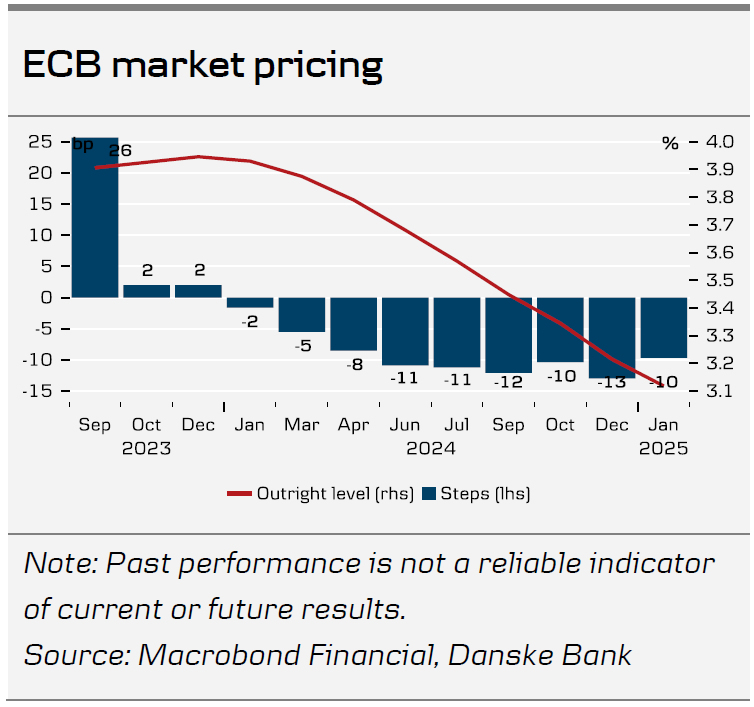
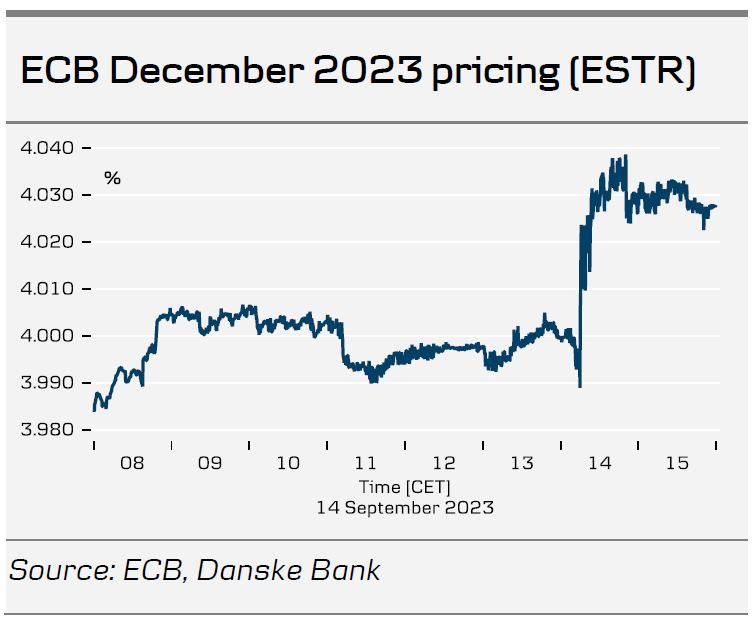
With the ECB guiding that its policy rate has 'reached levels that have been maintained for a sufficiently long duration', we observe that markets are pricing 4bp of additional hikes this year. And while our baseline is for the ECB not to make further rate hikes, we still recommend to pay the Dec23 ECB meeting with an entry level of 4bp and a target of 12bp, which we perceive as an attractive risk-reward. With the ECB's hike today, we book a 19.5bp profit on our paid September ECB meeting, which we initiated on 1 September. Markets are pricing 73bp of rate cuts in 2024, which is 7bp more than before the meeting.
EUR weakness and USD strength
EUR/USD first declined towards 1.07 on the dovish 25bp rate hike from the ECB, and shortly after further declined well below the 1.07 mark on stronger-than-expected US retail sales. The USD broadly strengthened in the G10 space, while the EUR fell to its weakest level since May this year. Altogether, the dovish hike from the ECB and ongoing US outperformance are weighing on the cross. The next big event for the cross should be the Fed meeting on 20 September. We expect a relatively muted market reaction on that meeting, as it is highly expected that the Fed will be on hold.
Overall, we make no changes to our EUR/USD forecast, and hence we maintain our strategic case for a lower EUR/USD based on relative terms of trade, real rates and relative unit labour costs. As we deem that peak rates have now been reached – we do not expect further rate hikes from the Fed or the ECB – we expect the relative strength of the US economy to continue weighing on the EUR/USD in the coming months as growth differentials take the driver's seat, and we continue to forecast the cross at 1.06/1.03 in 6/12M. As it is hard to imagine a sudden change of the current USD momentum, and with commodity prices currently rising, we may reach our 6M forecast for the cross earlier than expected.
ECB Delivers Dovish Final Rate Hike of the Tightening Cycle
The ECB raised interest rates again today, probably for the last time in the tightening cycle although it did leave itself some flexibility on that front.
This certainly falls into the dovish hike category, with the ECB acknowledging inflation remains too high but also that growth is suffering. What's more, it clearly indicated that it believes the current stance should be tight enough to return inflation to target, given time.
It would appear the decision wasn't unanimous though, with only a solid majority backing the decision. Again, we shouldn't be surprised at this stage of the cycle that, considering the uncertain outlook, not everyone is in agreement on their assessment of the situation.
The euro slipped after the decision and following comments from President Christine Lagarde, as did euro area yields. Further progress on inflation over the coming months, as the ECB anticipates, should enable pauses over the coming meetings, at which point the focus will gradually shift to the timing of the first rate cut.
Sunset Market Commentary
Markets
The ECB today hiked rates by 25 bps in a decision supported by a “solid majority”. The deposit rate now stands at a record 4%. As per bond portfolios, Lagarde explained there was no discussion about a potential quicker rundown of APP (through active sales) or PEPP (through a sooner than currently communicated ending of reinvestments). Frankfurt’s statement opens with “Inflation continues to decline but is still expected to remain too high for too long.” Indeed, projections were lifted upwards for this year and the next by 0.2 ppts to 5.6% and 3.2% respectively, mainly on the account of higher energy prices. The 2025 forecast was lowered marginally to 2.1% (-0.1 ppt). Core inflation is seen at 5.1% this year, 2.9% in 2024 and 2.2% in 2025 with minor downward revisions for the latter two. In any case, all gauges remain above the 2% target over the policy horizon, warranting another hike “to reinforce progress towards its target”. Related to this, ECB president Lagarde said that some indicators of inflation expectations must be monitored carefully. We assume the 5y5y forward inflation swap (rising to 2.6%) is one of those. GDP forecasts were cut (sharply) in every year through 2025 amid further tightening of financing conditions and weakening domestic & external demand. Growth is expected at 0.7% this year (-0.2 ppts vs June), 1% in 2024 (-0.5 ppts) and 1.5% in 2025 (-0.1 ppt). Risks remain tilted to the downside. The ECB retains policy rate optionality through its data-dependent approach and Lagarde later refused to say rates indeed hit their peak. However, the statement this time also added that “Based on its current assessment, the Governing Council considers that the key ECB interest rates have reached levels that, maintained for a sufficiently long duration, will make a substantial contribution to the timely return of inflation to the target.” It’s a dovish twist that does suggest the tightening cycle has ended. Despite that it clearly states rates are needed at a high enough level for a long enough period, it immediately sparked market speculation about the timing of a first rate cut. German Bunds strengthen following today’s decision as a result, even as it wasn’t fully priced in. Yields lose between 1.6-6.7 bps with the belly of the curve outperforming. The euro slips. EUR/USD specifically was additionally hit by a dollar-supporting triple whammy of strong US retail sales, higher than expected PPI numbers and another consensus-beating reading of US jobless claims. The pair trades at the lowest level since early June around 1.067.
News & Views
Inflation in Sweden for the second consecutive month declined faster than expected. August headline inflation printed at 0.1% M/M and 7.5% Y/Y (0.0% M/M and 9.3% in July). The Riksbank’s reference, CPIF inflation (using a fixed interest rate), eased -0.1% M/M to 4.7% Y/Y (was -0.2% M/M and 6.4% Y/Y in July). Core CPIF (ex. energy), was reported at -0.3 M/M and 7.2% Y/Y (from 8.0%). Despite the easing, 0.5%+ M/M rises were still registered for several sub-categories, suggesting still broad-based underlying inflationary tendencies. The August inflation data probably won’t change the scenario for the Riksbank to raise its policy rate by 25 bpn to 4.0% next week. In the June policy statement, the RB indicated it intended to raise the policy rate at least one more time this year. However, this ‘commitment’ didn’t help the Swedish currency, with the krone setting a new all-time low against the euro in august and holding near that level. Weakness of the currency became an important topic for RB policy. Giving higher rates outside Sweden, further interest rate support beyond next week is probably needed to change SEK fortunes. EUR/SEK hovered near 11.94 post the inflation data, with the all-time top (low for the krone) at EUR/SEK 11.963.
A quarterly survey of the Norges bank questioning regional contacts in the country shows participants expect output growth at 0.3% in Q3 2023 Q3 followed by a slowdown to 0.1% in Q4. Reduced construction activity and weaker household demand are dampening activity growth, while investment related to energy production, and commercial services continues to rise. A number of contacts also point out that the krone depreciation over the past year has helped improve Norwegian firms’ competitiveness. Contacts expect annual wage growth of 5.4% in 2023 and 4.6% in 2024. At the same time, contacts report reduced profitability in Q3 compared with the same time in 2022. The Norges Bank holds a policy meeting Thursday next week where it is expected to raise the policy rate by 25 bps to 4.25%, potentially marking the end of the rate hike cycle. The krone (EUR/NOK 11.5) currently hovers in a short-term consolidation pattern between EUR/NOK 11.40/60.
EUR/AUD Mid-Day Outlook
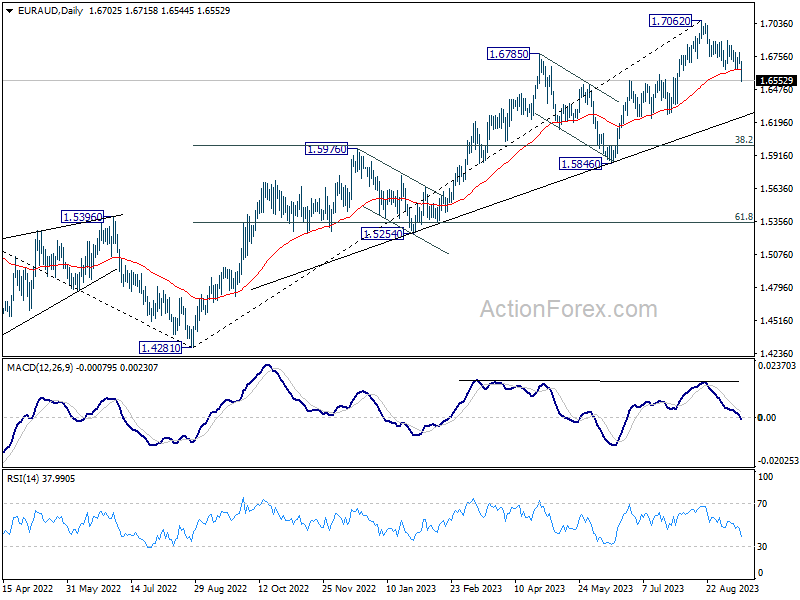
Daily Pivots: (S1) 1.6675; (P) 1.6735; (R1) 1.6770; More...
EUR/AUD's decline from 1.7062 resumes by breaking through 1.6647 support. Intraday bias is back on the downside for 1.6601 support next. On the downside, break of 1.6793 resistance is needed to indicate short term bottoming. Otherwise, outlook will stay mildly bearish in case of recovery.
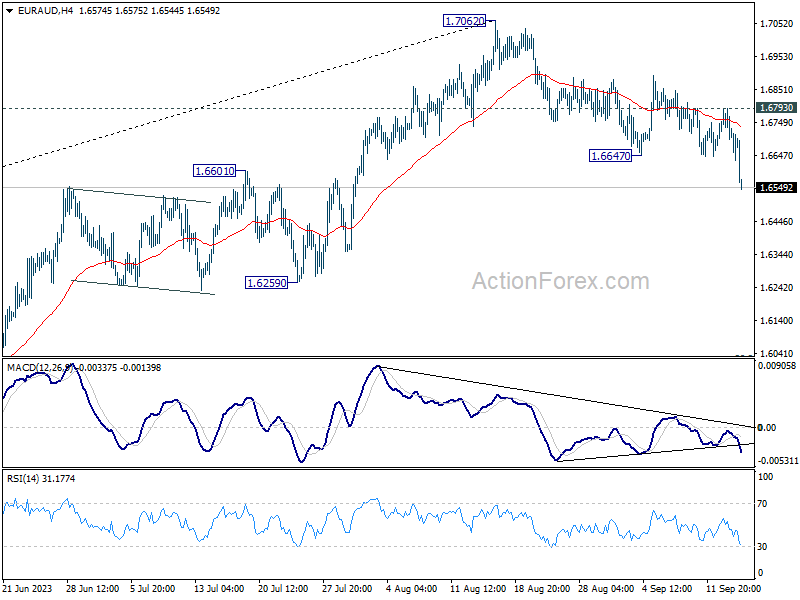
In the bigger picture, Fall from 1.7062 could be seen as correction to whole up trend from 1.4281 (2022 low). Sustained trading below 55 EMA (now at 1.6644) would affirm this case and target 38.2 retracement of 1.4281 to 1.7062 at 1.6000. Strong support should be seen there to bring rebound, at least on first attempt.
USD/JPY Mid-Day Outlook
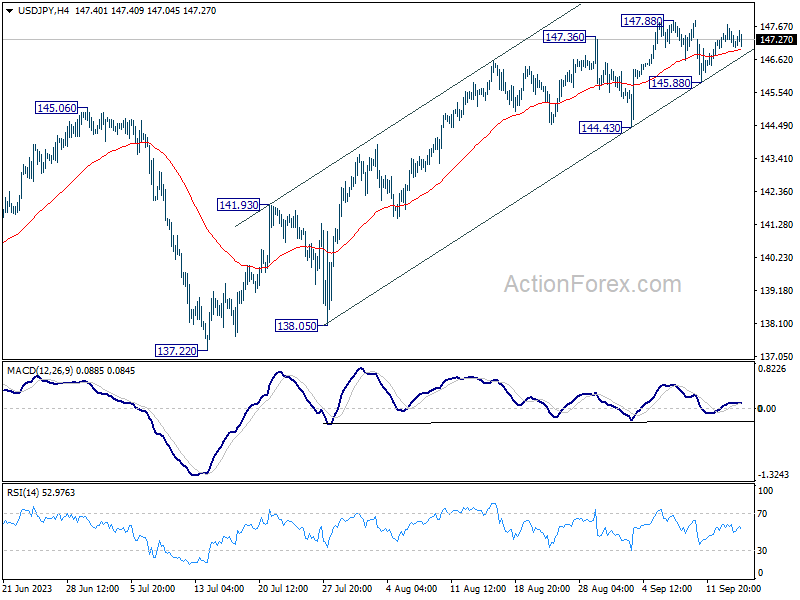
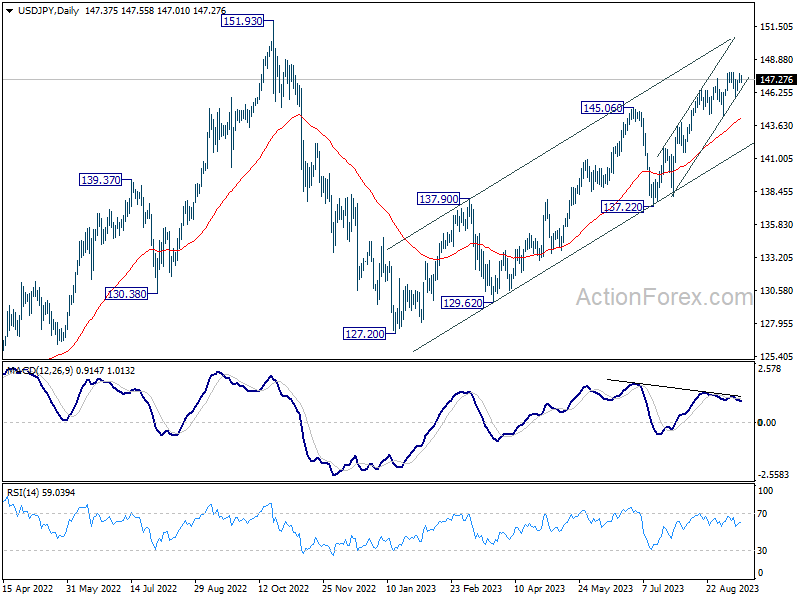
Daily Pivots: (S1) 147.08; (P) 147.41; (R1) 147.80; More...
USD/JPY is still bounded in consolidation from 147.88 and intraday bias stays neutral. In case of another pull back, near term outlook will remain bullish as long as 144.43 support holds. On the upside, firm break of 147.88 will resume larger rise from 127.20, to retest 151.93 high.
In the bigger picture, while rise from 127.20 is strong, it could still be seen as the second leg of the corrective pattern from 151.93 (2022 high). Rejection by 151.93, followed by break of 137.22 support will indicate that the third leg of the pattern has started. However, sustained break of 151.93 will confirm resumption of long term up trend.
USD/CHF Mid-Day Outlook
Daily Pivots: (S1) 0.8908; (P) 0.8930; (R1) 0.8959; More....
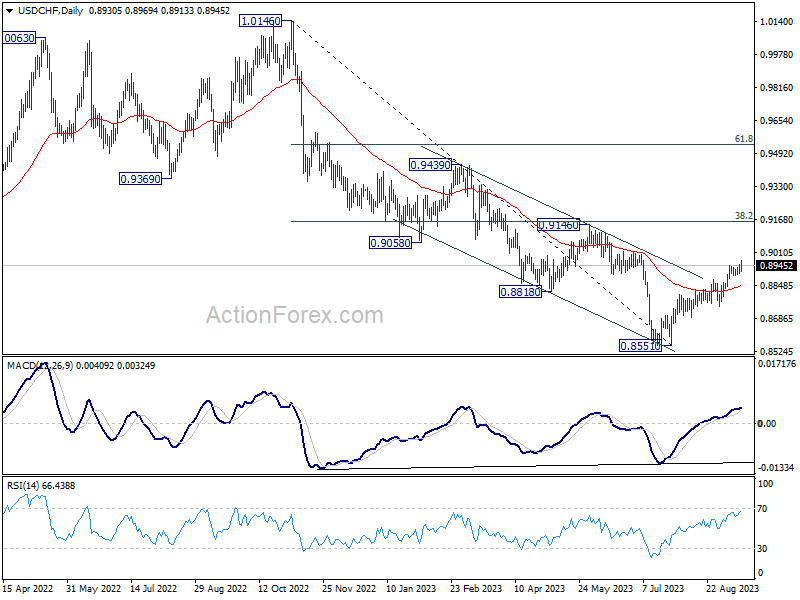
Intraday bias in USD/CHF is back on the upside with break of 0.8915 resistance. Rise from 0.8551 is resuming for 0.9146 cluster resistance. On the downside, though, break of 0.8893 support will indicate short term topping, and turn bias to the downside for deeper pullback.
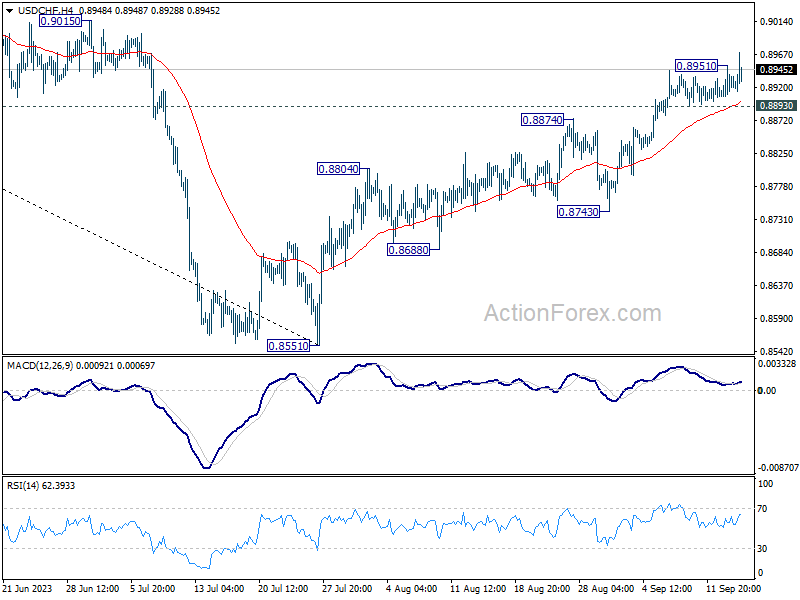
In the bigger picture, rebound from 0.8551 medium term bottom is currently seen as a correction to the downtrend from 1.0146 (2022 high). Further rally would be seen to 0.9146 cluster resistance (38.2% retracement of 1.0146 to 0.8551 at 0.9160). Strong resistance could be seen there to limit upside, at least on first attempt.
GBP/USD Mid-Day Outlook
Daily Pivots: (S1) 1.2446; (P) 1.2479; (R1) 1.2523; More...
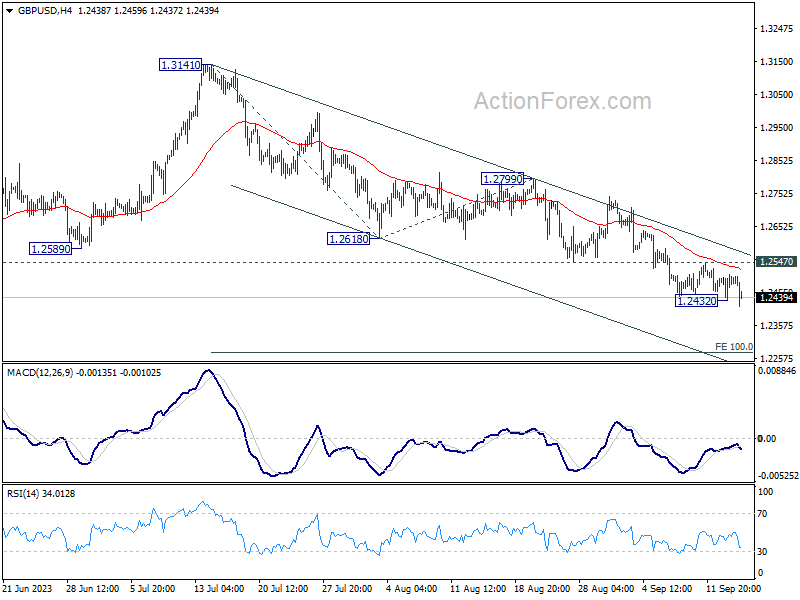
Intraday bias in GBP/USD is back on the downside with breach of 1.2432. Fall from 1.3141 is trying to resume, and further fall would be seen to 100% projection of 1.3141 to 1.2618 from 1.2799 at 1.2276. On the upside, however, firm break of 1.2547 resistance will now indicate short term bottoming, and bring stronger rebound.
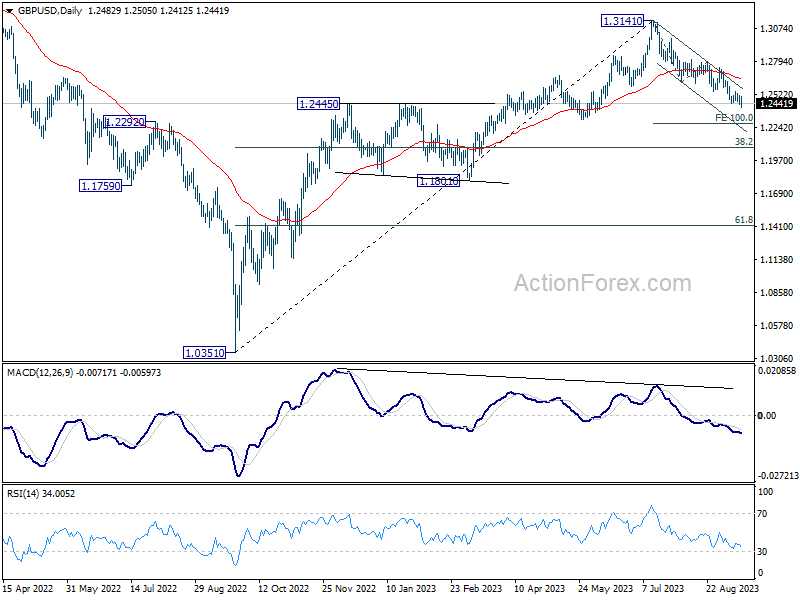
In the bigger picture, fall from 1.3141 medium term top is seen as a correction to up trend from 1.0351 (2022 low). Deeper decline would be seen to 38.2% retracement of 1.0351 to 1.3141 at 1.2075. Strong support would be seen there to bring rebound on first attempt. But outlook will be neutral at best as long as 1.3141 resistance holds, and consolidation from there is set to extend, until further development.
U.S. Retail Sales Rise in August, Beating Expectations
Retail sales rose by 0.6% month-on-month (m/m) in August, up from the downwardly revised 0.5% (previously 0.7%) reading in July. This was notably above the median consensus forecast calling for a more muted gain of 0.1%.
Trade in the auto sector strengthened on the month rising by 0.3% m/m, relative to a -0.4% m/m decline in July. This largely reflected sales at motor vehicle dealers, which rose 0.4% (erasing a similar decline last month). Meanwhile, sales at automotive parts and accessory stores declined by -0.9% m/m – its first decline since March of this year.
The large gain in headline retail sales was driven by sales at gasoline stations, which soared by 5.2% m/m (the largest increase since March 2022). The rebound at gas stations largely reflects recent upward movements in gas prices. The building materials and equipment category rose by 0.1% m/m, but is down by 4.9% versus a year ago.
Sales in the retail sales "control group", which excludes the above volatile components (autos, building materials and gas) and is used to estimate personal consumption expenditures (PCE) came in at 0.1% m/m – this was above consensus forecast which called for a -0.1% decline. However, July's figure was revised lower to show an increase of 0.7% instead of the previously reported 1.0%.
- Among the control group, the largest contribution came from sales at clothing and accessory stores (+0.9% m/m), health and personal care (+0.5% m/m), food and beverage stores (+0.4% m/m) and general merchandise store (+0.3% m/m).
- The main categories posting declines were sporting goods stores (-1.6% m/m) and miscellaneous stores retailers (-1.3% m/m).
Food services & drinking places – the only services category in the retail sales report – was up 0.3% m/m, the smallest increase since March.
Key Implications
Retail sales continued to pull ahead in August, although downward revisions to July's numbers tempered pervious gains. With two months of data in for the third quarter, sales are currently tracking 4.4% annualized for 2023 Q3, notably above the revised 0.4% annualized gain recorded in Q2 (previously 0.6%). This should give a decent boost to consumer spending which continues to defy expectations for a major slowdown.
Even as retail spending continues to post gains, the headwinds facing U.S. consumers continue to gain traction. Notably, the labor market is gradually cooling, taking some of the steam out of consumers' sails, credit markets remain tight and student loan payments are coming due. Additionally, while overall price gains are moderating, the recent uptick in gasoline prices evident in today's numbers is causing consumers pain at the pump. Given these confluence of factors, we still expect to see a deceleration in spending towards the end of the year as consumers' resilience gets tested even more.
EUR/USD: ECB Hikes and Euro Falls as Stagflation Risks Grow; Dollar Strength Extends after US Retail Sales Data
- Euro falls to the lowest levels in May after ECB hikes rates and delivers an abysmal growth forecasts, while upgrading 2023 and 2024 inflation outlooks
- Post ECB decision – October 26th ECB rate hike odds hover around 35.4%
- US retail sales remained strong on back-to-school spending and despite the extra energy costs at the pump
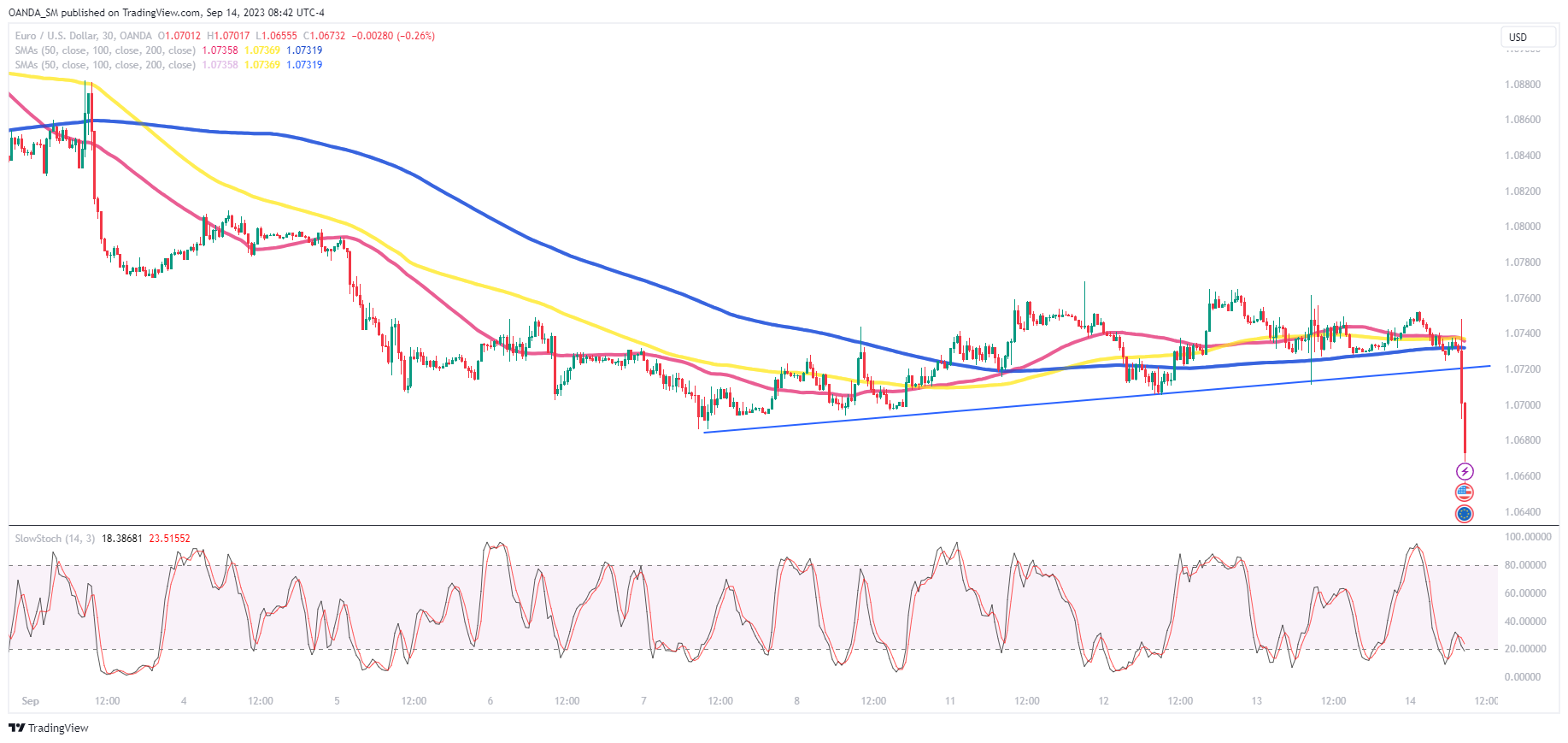
The euro initially spiked after the ECB raised rates, but quickly tumbled after traders digested the ECB forecasts that suggest stagflation might be here. Shortly after, the US posted robust retail sales and jobless claims data, which basically drove home the message that the US economy will easily outperform the eurozone economy throughout the rest of the year. Investors were thinking that the US might be poised to deliver more rate cuts than the eurozone, but that seems like that won’t be happening anytime soon.
EUR/USD – 30 minute chart
ECB
The summer break is over for the ECB and they have a tough job ahead. Inflation remains too high and that is forcing the ECB to signal that they ” will ensure that the key ECB interest rates will be set at sufficiently restrictive levels for as long as necessary.” The market was split on whether they would raise rates, but when processed the forecasts, they realized stagflation risks are here.
ECB Forecasts:
- 2023 GDP forecast cut from 0.9% to 0.7%
- 2024 GDP forecast cut from 1.5% to 1.0%
- 2023 GDP forecast cut from 1.6% to 1.5%
- 2023 Inflation forecast raised from 5.4% to 5.6% (core steady at 5.1%)
- 2024 Inflation forecast raised from 3.0% to 3.2%(a tick lower to 2.9%
ECB’S Lagarde Press Conference
When asked if she was done with rate hikes, Lagarde noted that some members preferred to pause, but that still a solid majority of members agreed with the decision. One of the key takeaways from Lagarde is that they won’t be cutting rates anytime soon as inflation is still far from target. Lagarde repeated this quote a few times, “based on current assessment…. the key ECB interest rates have reached levels that, maintained for a sufficiently long duration, will make a substantial contribution to the timely return of inflation to the target.”
EUR/USD – Daily Chart
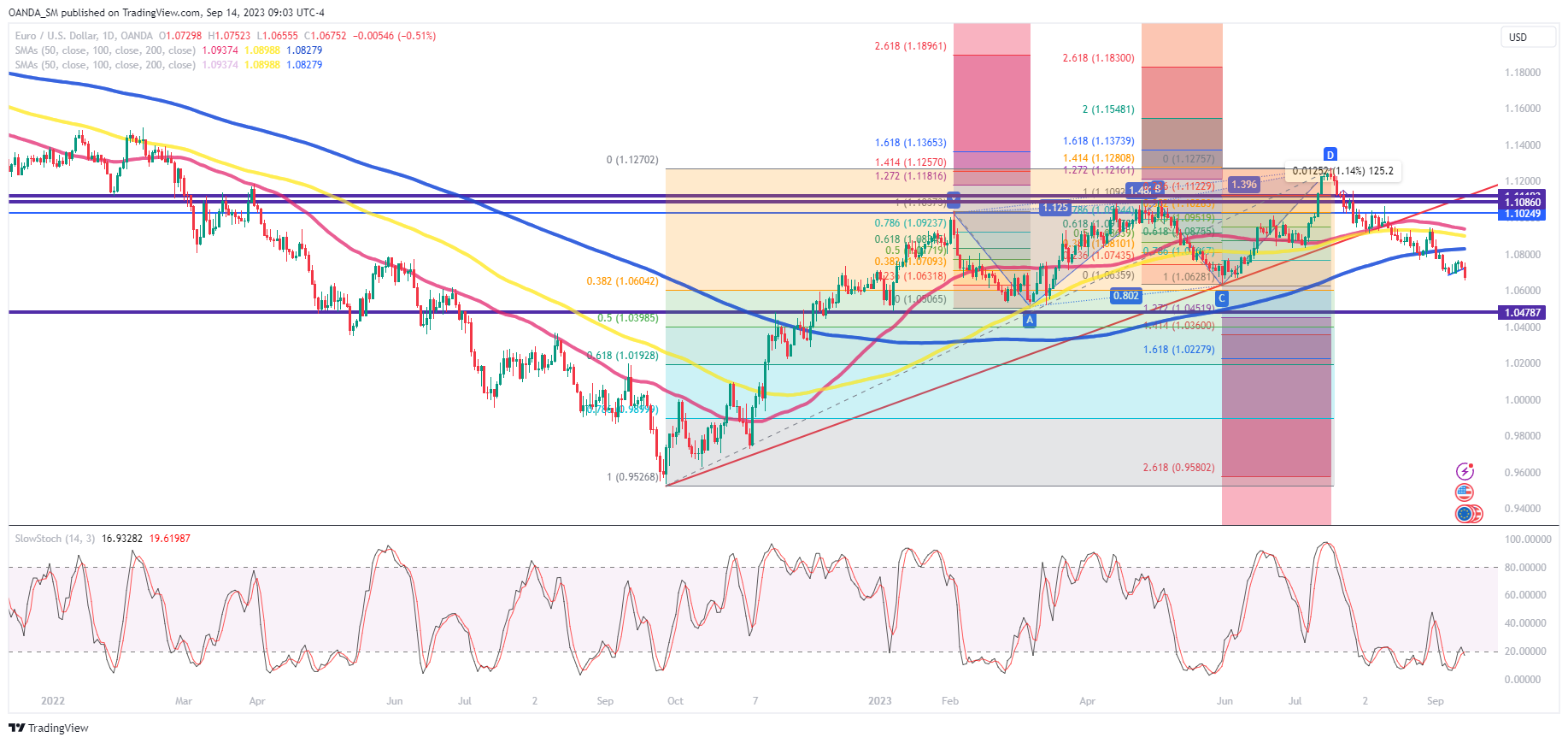
The euro might not be ready to punch a one-way ticket to the 1.05 level, but it sure seems like it is heading there. Price action on the EUR/USD daily highlights the bearish trend has firmly been in place since mid-July. As the risks for growth continue to deteriorate even further, the euro could see short-term weakness before a bottom is put in place. Major long-term support could be provided by the 1.04 level, which is the 50% Fibonacci retracement of the September low to July high move.
On the other side of the Atlantic, another round of US data supported USD strength after it reminded investors how strong the US economy remains; retail sales ex-auto had a fifth straight increase, producer prices came in hotter-than-expected, and jobless claims remained low.